March 4, 2004

O.A.S. Seeks Peaceful Solution to Tense Venezuelan Impasse

by Juan Forero, reprinted from The New York Times (registration required.)

CARACAS, Venezuela, March 3 — The Organization of American States met Wednesday with electoral officials and opposition leaders in a last-ditch effort to find a peaceful solution to Venezuela's political turmoil, while opponents of President Hugo Chávez called for a major protest march on Thursday.

The situation here has remained tense since the National Electoral Council announced on Tuesday the disqualification of hundreds of thousands of signatures needed to allow a recall referendum on Mr. Chávez.

The president's foes charged that the leftist government pressured electoral authorities to disqualify the signatures in order to derail a referendum, since a successful recall would end Mr. Chávez's tumultuous five-year rule. The opposition leaders contended they had collected more than enough signatures to permit a recall on Mr. Chávez, whom they have fought to oust over the last two years through legal maneuvers, a failed coup, strikes and protests.

But though Western diplomats monitoring the recall effort agreed that the opposition had the required valid signatures, the Electoral Council ruled Tuesday that the effort had fallen 600,000 short of the 2.4 million needed.

Electoral officials have proposed a two-day "repair period" in which about 1.1 million voters could confirm the validity of signatures sidelined by the council. The opposition argues that the two-day time limit is intended expressly to sink the referendum.

"Under these fraudulent conditions, it is impossible to go to the repair period," Timothy Zambrano, an opposition leader, said in an interview.

The Electoral Council announced Tuesday that 876,017 signatures displayed signs of similar handwriting, and that an additional 233,000 were disqualified for other reasons. Independent observers said that, in many cases, volunteer workers had filled out petition forms but that citizens had signed them.

The Organization of American States and the Atlanta-based Carter Center, observers at the December signature gathering, called the signature collection fair and urged that "excessive technicalities" not get in the way of the will of the people.

Still, diplomats monitoring the work of electoral authorities said that unless the opposition went along with the repair period, Venezuela could be plunged into a period of violence. "There is still a path leading to a recall," one diplomat said.

American officials, despite voicing "real concerns" about the Electoral Council's decision, have recommended that the opposition negotiate a workable, logistically sound agreement that will permit signatures to be quickly confirmed.

Fernando Jaramillo, chief of mission for the O.A.S., said his organization was not pressing the opposition to accept the council's conditions. But he said that if the verification of signatures takes place, the organization will try to ensure that 100 international observers are in place.

The opposition has proposed that the Electoral Council simply publish the names of all signers and allow those whose names may have been falsely included to scratch themselves from the list. The council, though, is unlikely to go along.

The opposition has threatened to pick up the pace of protests, but faces a formidable opponent in a president who has consolidated his power. Polls show that more than 40 percent of Venezuelans support Mr. Chávez, and his government is enjoying an economic rebound after two disastrous years.

March 3, 2004

OAS-Carter Center Statement

JOINT OAS-CARTER CENTER PRESS RELEASE ON THE PRELIMINARY REPORT ON THE SIGNATURE VERIFICATION IN VENEZUELA

March 2, 2004
Caracas-Today, the National Electoral Council (CNE) made public the preliminary official results of the process of verification of signatures for the petition to recall the president of the Bolivarian Republic of Venezuela.

The presence of the Organization of American States (OAS) and The Carter Center throughout all stages has been continuous, thorough and comprehensive. During the petition drive some 50 international observers covered more than 50 percent of the signature collection centers in 20 States throughout the country, witnessing first hand the democratic and civic spirit demonstrated by all Venezuelans. In the ongoing process of verification of the signatures, the OAS has accompanied the CNE in each technical stage, working three shifts 24 hours per day, observing these activities in detail. The Carter Center carried out an analysis of the process based on a statistically representative sample to determine whether the verification criteria used by the CNE were applied correctly. We would like to extend our appreciation to the European Union and to the countries of the hemisphere which have supported our efforts with resources and public recognition of our work.

As international observers, our objectives are to assure that the process is transparent, complying with the laws and regulations of the country; that it respects the will of the citizens; and that the citizens and the actors have confidence in the process and the results. We have expressed privately and publicly the international criteria for general principles that guide this type of process. These principles include transparency and controls to prevent fraud, as well as the promotion of the participation of the citizens.

In this process, in particular, we find sufficient controls , including security paper for the petitions, full identification of the citizen with signature and thumbprint, summary forms (actas) listing the petition (planillas) serial numbers during the collection process, party witnesses, personnel trained and designated by the CNE, verification of each petition form and cross-check with the summary forms , cross-check of the names with the voters list, and a mechanism for appeal and correction.

We have had some discrepancies with the CNE over the verification criteria. In the case of the petition forms in which the basic data of several signers, but not the signatures themselves appear to have been filled in by one person, we do not share the criterion of the CNE to separate these signatures, sending them to the appeals process in order to be rectified by the citizens. These occur such large numbers that they could have an impact on the outcome of the process.

We recognize that in any such process there can be attempts to manipulate the will of the citizens, but it is necessary to evaluate the magnitude of the impact that these attempts could have on the total universe. We understand the concerns of the CNE, but the evaluation should start from the presumption of the good faith of the citizen as a universal principle. During the signature collection process, we observed that some collection agent assisted signers in good faith by filling in their basic data.

Those citizens who are erroneously or fraudulently included on the list (planillas) should be given the opportunity to remove their names during the appeals and correction period. In addition, the signatures themselves that appear to have a similar handwriting, which have also been found, should be carefully reviewed in order to reject those that are not genuine.

More...

Revolutionary lexicography

Some have written to ask about the meaning of "come-flor" - part of the lexicon of Venezuela in revolutionary times.

The Venezuelan opposition is broadly divided in two bands, the talibanes (opposition hard-men) who think Chavez is Castro and can only be defeated on the streets, and the come-flores - flower eaters - who believe in peace, love and understanding and think some kind of accomodation with state institutions within the framework of the law is possible.

Many in the Venezuelan opposition - including, admittedly, yours truly - waver between the two positions.

As to the term itself, the image comes from the old children's story: Ferdinand, the bull who refused to fight.

The image is particularly apropos given my last name...

Judicial purges: Venezuela's latest human rights outrage

Translated and reprinted from eud.com

Judges who freed opposition protesters defrocked
Two Caracas area judges have been defrocked, after freeing a number of protesters from various political organizations belonging to the opposition.

The decisions were taken by the head of the Supreme Tribunal, Ivan Rincon, who sent them a statement notifying them that their appointments had been left without effect, "due to observations made to them."

The letter was sent as head of the Judicial Commission of the Supreme Tribunal, charged with designating and removing provisory judges. (Note: 85% of judges are officially "provisory.")

The first judge to lose her job was the 41st Criminal Control judge, Maria Trastoy, who had freed six Primero Justicia activists stopped during the protests that took place on Friday, against closing the door on the recall referendum.

The second judge was 3rd Control Judge, Petra Jimenez, who was a substitute judge and liberated Lorenzo Carrieri, a protester.

Better luck went to 32nd Criminal Control Judge, Maria Perez de Motaban, who is is said kept her job because she kept three other activists in jail.

The comeflor line...

Resist and repair

by Luis Salamanca

We must repair and resist. If our resistance pushes them to correct the "planas" matter, perfect. If it doesn't, we must repair, and turn the reparo process into a reparazo, a big social and political movement. Not doing it would be to abandon the spaces of power, which chavismo will be delighted to take over. Even if they cheat, we must repair so that the material and political evidence may be established. We must exhaust the democratic and legal route, what little is left of it, that is our way of acting. At the same time, if we managed 3.4 million signatures in four days, we can reaffirm our signatures because there are fewer.

The CD should discuss this, because the decision not to go to repairs, as a strategy of handing off all institutions entirely to chavismo, would be a great mistake. We have to put them in the situation of having to announce to the world that the repairs are also invalid. I want to see the faces of Carrasquero, Rodriguez and Battaglini telling people they've flunked. From that moment on, the situation will be entirely clear: a government that can only stay in power through electoral fraud and force, the two Fs.

March 2, 2004

Speaking for the opposition coalition...

Julio Borges said the opposition will not accept a "repair process" under the terms CNE announced earlier. Borges urged the Carter Center/OAS mission to help broker a compromise with CNE that restores the principle of the presumption of good faith on the part of signatories. The presumption of good faith - a cornerstone of administrative law - is now the center of the opposition's argument, and Carter Center/OAS have made it clear they agree with the opposition on this key point.

The opposition calculates the bar is set too high. If CNE accepts only 1,832,493 million signatures as prima facie valid valid, the opposition would need to mobilize 603,590 supporters - many old or illiterate - to the reparo centers over two days in order to reach the 2,436,083 signatures needed to call a referendum.

The opposition's central point is that it should be up to the people wrongly included in the petition to come forward to ask to have their names struck off the list. Under the current rules, government supporters who believe their names were included in the petition fraudulently would not have to do anything at all to have their signatures disqualified. Legitimate signatories, on the other hand, would need to turn out again to confirm what they've already signed.

The opposition and the Carter Center/OAS mission agree that, by imposing additional requirements on signatories, CNE inverts the burden of proof. They take the signatures to be fraudulent as the "default setting" and place the burden of disproving that presumption on citizens who have already fulfilled all the requirements set out in the law to request a Recall Referendum. This procedure is illegal, unconstitutional, divorced from common sense, and wrong.

The Wisdom of Jaramillo and McCoy

The Carter Center/OAS observation mission made its long awaited report tonight, and with characteristic good sense. In a carefully worded statement, Jaramillo said the opposition was unambiguously right in its argumentation against the "reparo" mechanisms proposed by CNE. For about five minutes, Jaramillo sounded like an escualido activist, vindicating one by one each of the points the opposition has been making.

But then, and again showing good sense, they called on the opposition to return to the process despite these misgivings, as the only possible peaceful road out of the impasse.

I think this is a sensible position.

As usual...

...CNE public relations are a shambles. Chairman Carrasquero, after tubeating himself earlier in the day, announced finally, final (we mean it this time), official CNE numbers on the petition for a recall vote on Chavez. The breakdown:

1,832,493 signatures are valid
876,017 signatures will need to be "confirmed" (through reparos) because they come from forms with the same handwriting in all the data fields.
688,000 (estimate, no precise number given) signatures disqualified for various reasons (signed twice, signed in forms not recognized in the actas, signed without being registered to vote, etc.

2,700 "repairs centers" would be set up and but there would be no "itinerant repairs" to visit the sick and elderly and confirm their signatures. The process would last 48 hours.

That all seems clear enough, but minutes after the official CNE broadcast, Jorge Rodriguez took questions from reporters where he said there would be more signatures going to "reparo" than that. "Around a million," is as specific as he would be.

The CNE decision is final. Will the opposition play ball? Should they? What will Carter Center/OAS say? Keep reading...

Compare and contrast

In 1999, President Chavez called a referendum to determine if the Venezuelan people wanted a constituent assembly to draft a new constitution. President Chavez did not have the constitutional or legal authority to call a referendum under the 1961 constitution, which was in force at the time. However, he argued that the sovereignty resides in the people, and therefore the act of voting at the referendum retroactively legitimates the legality of calling a referendum, even if no such legal authority technically exists at the time the referendum is actually called. It is on the basis of this radical pro-referendum, people-power centered vision of political life that the chavista political process was initially launched.

Fast forward five years. A constituent assembly has been called and a new constitution has been approved by referendum. A new article in that new constitution expressly allows recall referenda against all elected officials, provided sufficient signatures are gathered. The opposition, under a set of highly restrictive rules and elaborate security procedures imposed by the elections' authorities gather their signatures. 90% of election observers who witness say the process functioned well, 10% say reasonably well. The opposition then turn in these signatures, with hundreds of thousands to spare. What does CNE do? On the basis of rules that had not been made clear during the process, it decides to disqualify or question over a million of the signatures, further delaying a referendum that ought to take place no later than May 16th, and most likely stopping it altogether.

What happened to all that sovereignty-belongs-to-the-people rhetoric, all the beautiful people-power promises Chavez made that got him elected? How can the elections' authority now deny, on a burlesque of technicalities, the right of the holders of sovereignty to make their voices heard in accordance to the constitution? What kind of sick game is this?

It pains me to write it, but today is the day Francisco Toro ceased being a comeflor.

In an unexpected BBC interview...

National Electoral Council head Francisco Carrasquero has announced the figures CNE will officialize later today as the results of the signature gathering process to request a recall referendum against president Hugo Chavez.

Carrasquero said that only between 1.7 and 1.8 million opposition-collected signatures are valid, well short of the 2.4 million required for a recall referendum. Far worse, he suggested some 700,000 signatures would need to go to "repairs" - meaning the opposition would have to mobilize virtually ALL of those people to CNE "repair" centers to confirm that they did what they said they did. Worse again was the announcement that CNE plans to invalidate outright a shocking one-million signatures.

If these turn out to be the numbers CNE announces, this effectively closes the referendum as a real possibility. It would be virtually impossible to track down near all of the assisted signers, many of whom are illeterate or old and would be particularly hard to reach under any circumstances. Carrasquero knows this, this announcement constitutes only the latest in the chavista campaign of escalation, a campaign willfully designed to push the country into open conflict.

Carrasquero's announcement pushes the country in the direction of unpredictable, open-ended conflict. In a moment of deep national crisis, it will only add fuel to the fire. He has badly undermined the position of the already beleaguered moderate anti-chavistas who might have considered the reparo road viable.

This is the end of the line, folks. From here on out, it's the twilight zone.

La Muerte de José Vilas

José Vilas used to work for PDVSA. Last night he went out to protest in San Antonio de los Altos, a Caracas suburb. Two pictures of him were taken. In the first, you see him retreating from military police troops. In the second, he's been shot dead. The bullet that killed him entered through the back.


Eyewitness report: Santa Rosa de Lima Uprising

The detail you don't get from a newspaper, you get from a blog. The following eye-witness report is gripping in its detailed description of the incongruous atmosphere gripping Caracas these days these crazy days.

A new word has crept into the daily vocabulary: "guarimba" - the rampart or barricade blocking off a street and sidewalks in practically all middle class neighborhoods. What would have seemed incredible a few weeks ago has now become  the norm in Caracas.

Sta Rosa de Lima is a conservative, middle class community in Caracas: it has its own small supermarket, shopping center and the famous Sta Rosa de Lima girl's academy lies at its entrance. Many of the residents are the ageing - mid 60's to 70's - original purchasers of the apartments 40 years ago that raised their families there; now many of the children there are the grandchildren of the original neighbors. These are not the sort of people that you would describe as "revolutionaries" in ordinary times, yet that is what they have become.

Yesterday, (Monday March 1, 2004) over 80 of these neighbors took over main entrance road into the neighborhood, just in front of the Colegio Sta Rosa de Lima. Mothers brought down their bags of garbage; sons and fathers dragged tree stumps, scrap metal and anything else with weight into the street. By 4PM a major roadblock had been  created through the communal efforts of these people; a Chrysler Town and Country van, complete with child seat in the back and soccer mom as driver served as a dump truck hauling newspapers, an old bathtub, metal scraps and other useable refuse to reinforce the barricade. Everyone lends an arm to carry something useful in blocking the street. 

A housewife requests funds to buy "supplies", everyone around her chips in; in 5 minutes she has over USD 15 from over a dozen people and more are placing bills in her hand. Soon she comes back from the supermarket with sugar and soap. In front of the girl's school, over a dozen housewives and grandmothers, as well as assorted children, husbands and this author, receive instructions in how to mix soap, oil, gasoline and sugar into a Molotov cocktail. "You have to be sure to tie the knot of the wick tight,"  says the bomb making instructor as he carefully shows the technique, "or else the wick will come loose when you throw it at the armored vehicles. They enthusiastically cheer the two or three people that are busy filling three beer and soda crates with these ingredients and soon over two dozen home made bombs protect the guarimba from a possible invasion.

A DISIP (state security police) helicopter flies overhead and hovers over the group. The reflection of the lens of a long distance camera is clearly visible in the passenger compartment behind the pilot. As one, everyone raises their arms to give the helicopter the traditional one fingered gesture of salute. A grey haired lady next to me ambidextrously flashes this salute accompanying it all the while with the friendly greeting "Hijo'e'puta". Soon the helicopter is gone and a general cheer of victory erupts from the crowd, which has now gathered to over 100. A bellows of white smoke erupts around 500 yds down the Prados del Este freeway, visible from our vantage point. A neighbor, owner of a butcher shop in Catia to which he only went briefly today, clicks his Motorola walkie talkie, barks out a question and from the other end comes the answer that the other guarimba had merely lit a few bags of dry leaves. I ask him whether he can talk to the other roadblock in the other direction and he replies, "Yes, we talk all the time, they'll let us know when the National Guard comes." Not NATO quality, maybe, but organization just the same.

Soon it is dark, someone walks around the group forming shifts, "Who has been here all day? Go home please...you need to rest. The others, please stay... we need four hour shifts...how come there are so many older people here? Where are the young ones?"  A father replies, "The younger people went to Caurimare" (where an active firefight was going on against an Army tanqueta), "... they found this too boring."

Report from the scene

A Caracas high school teacher writes in: I have several students living in Terrazas del Avila (far northeast Caracas.) According to them, the ones shooting into buildings last night were National Guardsmen in motorbikes (i.e. government controlled soldiers.) In fact, I have a 16 year old student who took three plastic buckshot pellets: on his upper arm, left side of his back, and on the left of his neck as well. The National Guard entered the neighborhood firing tear gas canisters, which were quickly put out by neighbors by pouring water over them with buckets. This angered the Guardsmen, who started shooting hand guns (9 mm. pistols) towards the buildings where neighbors were putting out the tear gas canisters with water.

Later that night, Circulo Bolivariano (i.e. Chavez civilian supporter groups) bikers came to the access point to the neighborhood, but they didn't go in. There are rumors I can't confirm that neighbors were shooting at the Circulo bikers.

In Caurimare (also in the middle-class-heavy east side) the National Guard showed up to remove the barricades the neighbors had thrown up, using tear gas indiscriminately, such that one of them wafted into room 108 of the Policlinica Metropolitana, forcing the evacuation of all patients on the first floor. The same thing happened Sunday at the La Floresta clinic, when a group of bikers dressed as civilians tossed four tear gas canisters into the inside of the building. They had to move 30 patients from their floor, including intensive care patients. (This last bit comes from El Nacional, who cites Dr. Wartan Kekilikian.)

Please keep sending short, factual statements to this email...I will edit and post. If you're not fully comfortable writing in English, mándamelo en español que yo lo traduzco.

Venezuelans use people power to attack Chavez

By Phil Gunson in Caracas, from The Independent (London)

Burning barricades erected by opposition protesters blocked streets and motorways in many parts of the Venezuelan capital yesterday, as chances of a peaceful, electoral solution to the country's two-year-old crisis appeared to recede.

Three months after the opposition umbrella group, the Democratic Co-ordinator (CD), gathered more than three million signatures for a referendum against the leftist President Hugo Chavez, Venezuela's electoral authority was poised to reject the petition.

The only way to revive the referendum, guaranteed under Mr Chavez's 1999 constitution, would be for hundreds of thousands of signatories to reaffirm their intentions - an option that seemed certain to be rejected by the CD as impractical.

More...


Eyewitness statements from yesterday evening
Statement:
In Altamira the stakes are somewhat high: oil, broken glass and debris litter the streets on the Luis Roche avenue south of the Fco de Miranda down to Torre Britanica. A slide and fall will get you hurt with several small pieces of wreckage (broken shards mainly).

The GN pushed north a couple of times from 5 pm to 6:30 pm. Only one attempt was made in earnest, the others were bluffs. But that push was intense in tear gas. I heard but cannot confirm that a person was wounded from a FAL shot earlier in the day when the GNs pusdhed north from Torre Britanica from Luis Roche avenue and San Juan Bosco avenue.

Most of the people are young (from teens to 30s). As the previous eyewitness reports, you could see people from different social strata in the mix. However, unlike that eyewitness, the only people I can disqualify are those that acted like hoodlums (the walls of the Cine Altamira building are being / were broken broken into pieces) - but certainly I cannot disqualify the "sifrinos" or the "giggling teens".

One of the myths that the Government is trying to perpetuate is that the opposition is monolithic. On the contrary, it is anything but. This means that the moment you call a rally anywhere, you'll get hoodlums (and maybe a couple of "infiltrados" for the conspiracy theorists), you'll get old ladies (I saw some north of Fco de Miranda), you'll get bourgeois, you'll get non-bourgeois, men, women, young, adults, that is to say, a huge mix. Given that none of them have clear orders (unlike the well-funded guys on the other side of the 'contienda'), it is almost impossible to predict or control the outcome (e.g. tumbling walls of Cine Altamira). Basically, you have to know that some crap is bound to happen when a rally is called...

That said, Altamira is not the end-all be-all of the situation. Prados del Este was blocked in toto at the Santa Fe distributor, Caurimare saw some troubles too (even affecting the Policlinico - a private hospital). Macaracuay. In other cities, I talked this morning with a client of mine in Estado Carabobo: many districts were also closed.

This is a reaction against the continued hooptedoodle the country's ruler and his cronies are trying pull. People are fed up - the sentiment is "No more BS!"

Statement: Coming home in Colinas de Bello Monte, I saw a group of maybe 40 people (all ages, all genres and, as I'm not a fashion victim, I didn't see how they were dressed; they were dressed, though: nudity is out of the question when there is fire around) lighting up a barricade. Would have liked to stay longer that the five minutes I stayed, but I'm over a hundred kilos and can't run. The people there were with the typical "merry-go-lucky" (if that is the expresion) attitude with which Venezuelan get into everything. But there was also a "come-and-get-me" attitude. Maybe they just want to be in the news. At least in that way they would be heard, which is all they want.

You know how Venezuelans act when they feel someone is trying to bully them: arrecho, arrecho y medio. That was exactly the stance these people had. I think they are making a mistake, they are playing into Chávez's hands (giving him the justification to declare the Estado de Excepción), but then I understand their feeling of powerlessness.

Keep those eye-witness statements coming. Make them snappy and factual, tell me what you saw.

March 1, 2004

118 political detainees at least and counting...

Speaking for the Coordinadora Democratica, Luis Manuel Esculpi said there are 70 political detainees in Caracas and at least 30 more in Anzoategui State. El Universal reports 18 additional detainees including Alfredo Ramos, a member of the National Assembly formally protected by parliamentary immunity. Many reports coincide that these civilians are being taken into military custody and some say they are being threatened with trials at military tribunals, in open violation of established human rights standards. Other reports suggest some detainees are being released hours after arrest.

Does Mr. Wilpert intend to maintain a complicit silence on this outrage? How about Mr. Tarek William Saab, the chavista human rights' activist whose ass was bailed out of jail by Teodoro Petkoff on April 12th? Mr. Mundarain, People's Ombudsman? No? How about MariPili Hernandez? Anyone? Anyone at all?


Next day update Alfredo Ramos, at least, is not in jail: he's in the globovision studios! Now word is that left-wing anti-Chavez activist (and inveterate rabble-rouser) Carlos Melo has "disappeared." Where is he?

Just to give a taste to foreign readers...

As to the degree of the craziness gripping Venezuela, chew on this for a bit. There are now repeated reports of DISIP (i.e. Chavez controlled State security police) officers in motorbikes going around a middle-class neighborhood (Terrazas del Avila) shooting randomly into buildings. (Just rumors?)

There are also multiple stories of army (government controlled) soldiers being suited up in (opposition controlled) Metropolitan Police uniforms and setting out with assault rifles. No way to discern truth from exageration or fiction at this point, but the stories don't strike as far-fetched, given the calculating authoritarian nature of the government.

A ton of confusion and conflicting rumors, but the barricades keep going up all over the country.

What we're experiencing now is the famous ruptura historica Alberto Garrido has been predicting for years. Garrido is certain this moment has been a part of the plan all along, and has shown evidence to back his claim. Today, it is not difficult to see him as a cassandra.

Chavez tried to force the ruptura historica (through Plan Avila) on April 11th, 2002 but he was stopped. Now, who will stop him?

Call for eye-witness statements

If you've been out in the streets of Caracas today and want to share what you saw, I encourage you to write an eye-witness statement and email it to me. I will post selections here, with or without your name.

I'm looking for short (200-500 words), factual statements with specific observations, and what you made of them.

Eyewitness report...

Author's name withheld to protect the cadid
was just in altamira. man is that a ridiculous scene. it's basically a mixed
crowd of popular class teenage hoodlums along with sifrinos and neighbors
from the area who are either watching and giggling as people burn tires and
set up crappy barricades, or have tried themselves to jump into the action,
clumsily trying to light molotov cocktails and throw rocks.

it really never ceases to amaze me how people who've spent their entire
lives in priviledged isolation have suddenly discovered how much fun it is
to break shit and burn things and block streets -- something just about
everyone else has known for years.

i just walked back to my house from plaza altamira and there are these guys
standing at the bottom of the avenida principal de santa eduviges in their
dockers and penny loafers with cardigan sweaters trying to figure out how to
pop up sewer grates so they could block the street. just outside my building
a group of lawyers and doctors smiling charmingly next to piles of burning
trash that are blocking the street i live on.

i need to go back out there, just to ask one of these guys something like
"i'm sure you're wearing that ski mask to protect yourself from the tear
gas, but why exactly are you breaking in the roof of an abandoned building?
is this part of the peaceful demonstration against the cne for blocking the
referendum?"

Amnesty International: Respect for human rights must be guaranteed in Venezuela

Amnesty International Press Release - March 1, 2004: The authorities must ensure protection of human rights of all citizens in the increasingly violent political climate surrounding the decision of the National Electoral Commission expected today, Amnesty International said today.

At least three people were killed and up to 50 injured, including two journalists, over the weekend in the context of clashes between National Guard and Anti and Pro government demonstrators. There have been allegations of excessive use of force, in particular by the National Guard, while policing these demonstrations, some of which were reportedly violent. Heavily armed military and civilian intelligence units also reportedly participated in policing operations. There have also reportedly been a number of detentions of opposition supporters during opposition demonstrations in different parts of the country.

More...

Political Prisoners

On April 12th, in the midsts of a right-wing coup, the best of the Venezuelan opposition made itself known by sticking up for universal human values in extremely adverse conditions. People like Teodoro Petkoff and Ruth Capriles, strong critics of the Chavez government, spent the day of the coup interceding for the release of chavista political prisoners taken by the brief de facto government. That day, we found out who was true to their principles and who was an opportunist.

Today, Caracas is awash with stories of opposition activists who have been taken prisoner illegally and taken into military facilities in Fuerte Tiuna. In open violation of basic human rights' laws, they are being threatened with trial at military courts, despite being civilians. Today, we will see who within chavismo raises a voice against these violations of the most basic of all human rights: habeas corpus.

The taking of at least a dozen opposition activists into military custody yesterday marks another, large step in the government's advance into open dictatorship.

Crazy country!

24 minutes after CNE chairman Francisco Carrasquero said the Carter Center is withdrawing from the process, Carter Center mision head Jennifer McCoy denies it on live TV, saying she personally is leaving on a pre-planned trip, but the mission remains.

What is Carrasquero thinking?!

But Francisco Diez backs Carrasquero's statement that Solbella Mejias refused to attend the morning's negotiation session. Mejias' impetuous statement to the press scuttled the plan meeting.

What is Mejias thinking?!

The die is cast...

The Carter Center and the OAS are out. Carrasquero speaks for the Carter Center saying it's Solbella Mejias' fault.

Que dios nos agarre confesados.

Venezuela's democracy teeters on the brink

While US newspapers focus their attention entirely on Haiti, prospects for a peaceful resolution to the two-year old political crisis in Venezuela deteriorate by the day. The weekend saw riots in most large cities in the country, and an atmosphere of palpable tension grips the air. Having, for all intents and purposes, successfully aborted a recall vote on his term in office, President Chavez seems to be preparing for a future of outright dictatorship.

In the last 72 hours, Venezuelans have seen thousands of soldiers round up on a large peaceful protest firing hundreds of tear gas canisters, plastic pellets and, on occasion, live ammo - and leaving 2 dead and 30 injured. They've seen tank and troop movements through many cities, for ill-understood reasons. They've seen President Chavez praise Zimbabwe's President Robert Mugabe as a freedom fighter and immediately turn around and implement some of his tactics. For the first time, Chavez blamed all of the country's problems on the US bogeyman. And they've seen three solid days of rioting in most of the major cities in the country, as protesters armed with nothing but flags and placards have been heavy-handedly repressed by soldiers again and again. (See article below, from the local press.)

Venezuelans are discovering, to their great dismay, that democracy does not necessarily die with a bang. In Caracas today, democracy is dying in the whimper of a tangled web of seemingly hum-drum bureaucratic decisions. Little by little, over five years, these have squeezed out the rights of ordinary citizens and left the government with control over almost every institution in the country and entirely unchecked power. Over five years, the government has pealed away at the citizens' democratic freedoms like an onion, layer by layer, until there is nothing left.

Taking a page out of the Castro/Mugabe playbook, last night Chavez called President Bush a "moron" in a speech to hundreds of thousands of supporters, and threatened to cut off oil supplies to the US. Chavez knows that international observers from the Carter Center and the Organization of American States will not stand by the blatant theft of a recall referendum against him before it has even been held, and moved to pre-empt their criticisms of the process even before they could be issued.

The critical technicality concerned the procedure for calling a recall vote against president Chavez. The recall process - already months behind schedule - is being run by an electoral commission appointed semi-legally by an openly pro-Chavez Supreme Tribunal. Due to a string of delays and contrary decisions, the board has completely lost the trust of the opposition, who now openly believe the elections authorities are in cahoots with the government. Certainly, a series of new rules published yesterday setting out new procedures that to verify some 700,000 signatures requesting a referendum have been seen as the last straw by most of the opposition. They now seems ready to walk out of the process altogether, and so do the international observers.

This is about much more than administrative niceties. For over two years now, the government of Venezuela has accused its large, rambunctious, and fractious opposition movement of being little more than a fascist conspiracy, a coup-plotters' private club, even as polls showed majority support for regime change. Again and again, Chavez charged that the opposition was undemocratic because it refused to follow the rules for a legal recall vote on the president as allowed by article 72 of the constitution, pushing instead for extra-constitutional "fast tracks" like coups and insurrectional general strikes, both of which failed to oust Chavez in 2002.

Now, the government shows why the opposition was right not to trust them all along. Having followed the legal requirements, having collected the signatures under the strict safety regulations imposed by the elections authorities, in front of witnesses from both sides, on numbered forms printed on bank security paper, having jumped through a million and one hoops to satisfy the requirements, they find their signatures once again brought into question and yet another bureaucratic obstacle in front of them. Most see the latest delay as an unsubtle attempt to scupper the referendum altogether.

After five years of highly divisive rhetoric, President Chavez has managed to fracture the country into two highly emotional sides, and has gone out of his way to teach his supporters to hate his opponents. Today, his explosive strategy of class resentment, calculated division and endlessly escalating provocation has left Venezuela on the edge of a civil war.

If a recall vote is aborted over and above the protestations of international observers, Chavez will have clearly violated the Venezuelan constitution he himself drafted, and he will clearly have stepped outside the bounds of even the most bare-bones definition of democracy. He appears, as of today, very close to joining his hero Fidel Castro as the hemisphere's second out-and-out dictator.
----
Lexicography in revolutionary times: What do you think is the best way to translate "pendejo." Reuter's has "asshole", but doesn't "moron" seem closer to the mark?

February 27, 2004

Venezuela: Opposition march repressed with tear gas and buckshot

by Ramon Navarro and Laura Weffer
Translated by Francisco Toro, reprinted from El Nacional. Photos from Devil's Poop.

CARACAS-"The order is to resist, resist," said one lady close to 70 years of age to a group of friends who replied: "Today or never, Magdalena, you are right, we have to resist." Around eight women were next to the security cordon placed by the CANTV headquarters on Libertador Avenue in Caracas, while the thick of the opposition march walked euphorically towards Plaza Morelos.

Suddenly, the National Guard responded to the citizen action with tear gas, for no other reason than the arrival of the march on territory that had been permitted by the competent authorities, but was banned turf to the military.

The ladies left at a jog, escaping the effects of the tear gas canisters, that scratched their faces generating an intolerable chaos as people retreated. And yet, they didn't manage altogether to clean up the area, because the people would return to offer resistence, would return with anti-government slogans, would again inflame the patience of the so-called "guards at the service of the regime."

The march, called by the opposition and whose ultimate goal was to reach Plaza Morelos, did not meet its main goal: to get noticed by the foreign ministers and some heads of state from the Group of 15, who were meeting in the Teresa Carreno Theater.


Burning
At 8:30 am, people started to arrive at Parque del Este, on the main Francisco de Miranda avenue, starting point for the protest. Copei and MAS representatives were the first to prepare their flags, while Primero Justicia joined in Altamira, Proyecto Venezuela in Chacaito and AD in La Florida.

The spirit of the march was to break through the security barrier and reach the space adjacent to the theater. On that subject organizer Oscar Perez spoke clearly about the legitimate right to reach the space accorded: "We have authorization from the Greater Caracas mayor, and I don't see why they want to stop this peaceful march."

Opposition leaders like Lilieana Hernandez, Henry Ramos Allup, Miranda state governor Enrique Mendoza, Gerardo Blyde, Jesus Mendez Quijada, Carlos Ocariz, among others, went through the rigors of inhaling large doses of tear gas, surprised also by the military show of force, though the soldiers (the "soldiers" are National Guard troops -ft) were also attacked with bottles, sticks, and stones.

Some of the tear gas canisters ended up against the walls of the Lara and Zulia residential buildings, on Libertador Avenue, and others were directed to the parking lot in front of the El Globo newspaper, and others never even came close to the protesters. This shows not just the spotty marksmanship but the real sense of dissuasion of the guarantors of public order.

However, there were also dozens of canisters shot into the heart of the march, whose protagonists started throwing stones at the MVR party building, while one person, unidentified, set fire to the roof of a neighboring car garage.

"If you want to topple Chavez then shit, ignore him! They almost burned my house. People live here, that crap is not on. They burned the roof of my house and they almost burned my truck. In this garage there are flamable materials," said an angry Juan Carlos Calderon, co-owner of the shop, who came out half-naked to yell for help.

In fact, the same people who tried to burn down the place later bashfully helped to put out the fire.

Also in Plaza Venezuela, a man of 60 or so was shot in the leg, "they hit me! they hit me!" and while he asked for help from the metropolitan fire department, a crowd of people in AD flags charged a wooden structure and threw everything out onto the street, including bottles.

Just before that, a rattle of gunfire forced over 300 people in Plaza Venezuela to fall to the ground.


All out
The wall of tear gas didn't allow one to see through to the other side. The green uniforms could be seen tenuously behind the choking white mass. Suddenly, as though in a fiction film, groups of women and men with flags in their hands would expose themselves to the irrepressible effects of the gas.

Regardless of age or gender, people would face down the charges of the guards. At the compressed cry of "pa'lante!" ("onward!") the protesters would push forward, gaining meter by meter terrain from the military men.

But victory was short. In a well rehearsed syncronicity, the uniformed men would fire off canisters and rubber buckshot to anyone they saw defending the tricolor flag. The opposition members would resist a few seconds, minutes at most, but then had to retreat because the gas did not allow them to breathe.

"If you're going to kill us, then kill us" screamed one of the marchers, with bloodshot eyes and sweating buckets. From the loudspeakers, eventually, a voice tried to convince the marchers to walk back, but the will of the people was not seduced by the call.

Beneath the Mariperez overpass, those in the vanguard made a deafening noise. With anything they could get their hands on they would strike the metal bases of the bridge, building a strong echo. An amazing noise.

Aura Morales, 74 years old, refused to walk backwards. She remembered the way she had faced down the national security (the dictatorship era security force in the 50s), in the times of the Perez Jimenez dictatorship "and in that time they had machine guns."

With a discrete cap and a flag in her hand, she refused to answer the call of those calling on her to retreat. "For god's sake! Always go backward!" and with nostalgia she would look on the few meters they had conquered and that again the military were recovering. A bit further on, a small man, some 70 years old, was screaming at the top of his lungs, and with a stone in his hand said he was foreign, but he was going to defend Venezuela because he considered it his fatherland.

At 1:35 pm, the Guardia had already lost all inhibitions and was firing bursts of buckshot, and some of the marchers would fire back with roman candles. With the National anthem in the background, people refused to back down. One of the women who had to be evacuated, passed out, returned later with her flag and walked back into the tear gas.


Shots
The dry sound of a hand gun broke with the buckshot chorus, which had already become an auditive routine. From the street in front of the Patria Para Todos headquarters, behind the Main Street in Mariperez, a group of youths was shooting upward, exactly in the direction of the bridge, on Libertador avenue.

The protesters responded with stones, most dropped to the ground in a split-second reaction. Some covered their heads, others stayed totally still. Nobody screamed. In the distance, the figure of a young man could be seen at the door of his house, doing what he could to try to stop the exchange.

A few minutes later, people returned to their struggle. To the skirmishes with the military. Chanting slogans and breathing tear gas. In the mean time, the Disip secret police helicopter flew over the area. The response of those below was to raise their middle finger in the "usual gesture."

By 2:35 pm the uniformed men went back on the offensive. Protected by untold tear gas canisters, they advanced and advanced until they dissolved the last of the rally. Thus, they took the neighboring areas and some spots that had served as opposition regrouping areas. Some ran for the side streets. On Lima Sur street, the protesters took shelter for a while in the student bar, Cordon Bleu. By 3:20 pm what had been a battle field turned into a desolate field for firing tear gas canisters.

Below, on Plaza Venezuela, the Guards had cordoned off the area. Already resting from their attack, they were replenishing themselves eating hot dogs from the "Taliban" stand, and drinking kolitas. They traded stories about the day, laughing, as though it had been just one more victory.

27-F


Mugabe lessons well-learned

An afternoon of violence in Caracas today. Massive riots all along the main East-West road - Avenida Libertador - all afternoon. Meanwhile, Chavez and the G15 representatives sit in an air conditioned hall a mile away heartily applauding Robert Mugabe's speech. Sickening.

Pascal Fletcher's report for Reuter's sets the scene well.

I have never seen the National Guard use that much tear gas at once...clouds and clouds of it on Avenida Libertador all afternoon. Nasty.

The climate now is of total destabilization. The opposition is incredibly angry and not very rational at the moment. People want trouble. It's April 9th all over again.

At 5:00 pm there are reports of gunshots on Avenida Libertador. No cassualty count yet.

Today marks a dangerous turning point in the crisis. The opposition has decided to meet the governments provocation strategy with a full-on provocation of its own. People on the opposition side have simply lost all faith in CNE - the reparo process now seems distant. Things will not be the same from tomorrow.

Mugabe makes Chavez look like an amateur

I didn't know that I could despise any political message more than I despise Chavez's, but today, I was proven wrong. Robert Mugabe's speech to the G15 summit was a document of such far reaching criminal cynicism it made JVR look like a grammar school kid, and Chavez himself like an amateur.

To rapturous applause, Mugabe lavished praise on Chavez, and made clear that ALL problems in Venezuela and Zimbabwe are exclusively the fault of the US and the UK, respectively. He hit an emotional high talking in heart-rending terms about how transnational capitalism robs the children of Zimbabwe of their food.

No, Mr. Mugabe, if Human Rights Watch is to be believed, you are the one who makes sure your children go to bed hungry at night, and quite literally.

The Human Rights Watch report is worth quoting in full:

Zimbabwe: Food Used as Political Weapon
Government, Donors Must Halt Discrimination

(New York, October 24, 2003) - Zimbabwean authorities discriminate against perceived political opponents by denying them access to food programs, Human Rights Watch said in a report released today. Some international relief agencies in Zimbabwe fail to ensure that access to food is based on need alone and is not biased by domestic or international political concerns.

The 51-page report, "Not Eligible: The Politicization of Food in Zimbabwe," documents how food is denied to suspected supporters of Zimbabwe's main opposition party and to residents of former commercial farms resettled under the country's "fast-track" land reform program. The report examines the widespread politicization of the government's subsidized grain program, managed by the Grain Marketing Board, as well as the far less extensive manipulation of international food aid."

According to the report, government authorities and party officials of the ruling Zimbabwe African National Union-Patriotic Front (ZANU-PF) manipulate the supply and distribution of government-subsidized grain and the registration of recipients for international food aid. Though international aid agencies, including the World Food Programme, have gone to great lengths to prevent interference, this kind of manipulation remains a problem. International aid agencies must devote greater resources and attention to preventing the manipulation of recipient lists. The report also examines international community's tacit complicity in preventing food from reaching former commercial farm areas resettled under land reform.

"Select groups of people are being denied access to food," said Peter Takirambudde, executive director of the Africa division of Human Rights Watch. "This is a human rights violation as serious as arbitrary imprisonment or torture."

Today one-half of Zimbabwe's population of nearly 14 million is considered "food-insecure," living in households that are unable to obtain enough food to meet basic needs. The international community has spent hundreds of millions of dollars pouring food aid into Zimbabwe, yet thousands continue to go hungry.

Any perceived political adversaries of ZANU-PF or the government encounter difficulty gaining access to food. Known members of the main opposition party, the Movement for Democratic Change (MDC), are top-most among perceived enemies. This category also encompasses teachers, former commercial farm workers and urban residents-groups generally considered to favor the MDC. In effect, without a ZANU-PF party card, a Zimbabwean cannot register for or receive government-subsidized grain.

Often international relief agencies need to rely on local authorities in some cases to determine beneficiary status, which leads to a certain degree of political manipulation. However, some international aid programs are also politicized. According to insiders of the international aid regime, some international donors are opposed to funding aid for those resettled on the former commercial farms that were redistributed under the "fast-track" land reform program. The international aid agencies universally deny that donors' political opposition to land reform is a factor, explaining that they cannot distribute any relief food in these areas until a comprehensive needs assessment has been completed by the government.

"Politically, it is disadvantageous for the Zimbabwe government to investigate need on the resettled farms," said Takirambudde. "If the farms are not productive and people are hungry, the government's land reform program will look like a failure. It seems that the government is manipulating relief efforts, and that the international community is playing along even though people on the resettled farms need food desperately."

Human Rights Watch asserted that the Zimbabwe government has an obligation under international and domestic law to supply food without reference to race, religion, ethnicity or regional origin, or to residence, sex or political affiliation. The government should instruct authorities in charge of beneficiary lists to abide by the principle of nondiscrimination.

The government should impress upon the leadership of all political parties that it is prohibited under domestic and international law for politicians and party supporters to use food to influence or reward constituents or voters. Punitive action should be taken against those who flout this prohibition.

Human Rights Watch recommended that the international community continue to fight the politicization of relief food through its efforts to maintain tight controls on food distribution and to implement all aspects of relief efforts directly or through local non-governmental organizations.

Human Rights Watch also emphasized that international aid should not be based on any factor other than need. In particular, farmers who were resettled under the "fast-track" land reform program should be eligible to receive food aid from all international sources. Donors that have withdrawn support for humanitarian programs in Zimbabwe should reconsider their duty, under international law, to assist those in need.

...

What do you think this freedom warrior will do with that replica of Bolivar's sword?

Of course...

Lula and Kirchner are in Caracas as well. And they have eyes.

Chavez, Mugabe, and the Credibility Gap


Hermanazo!

Chavistas constantly acuse the press of treating their guy unfairly. They're not always wrong. But last night's little sound-bite, when Chavez lavished praise on the stomach-churningly violent dictator of Zimbabwe, confirms what we've known all along: the most damaging of the media "hits" on Chavez are always self-inflicted.

For a quick introduction to the character of the "Freedom Warrior" Robert Mugabe, have a look at:

I could add 20 more links if I spent 20 more minutes on it...Mugabe's Google trail as a mass-scale human rights abuser is long and deep, so I just picked out stories from the last few of months or so.

Reminds you of these:


Charming

Though at least Chavez had the good sense not to praise Saddam personally.

For Mugabe, though? The AP write up is worth citing:

CARACAS (AP)--Venezuelan President Hugo Chavez praised Zimbabwe's embattled President Robert Mugabe as a "freedom fighter," bestowing the visiting African leader with a replica of South American independence hero Simon Bolivar's sword.

"I give you a replica of liberator Simon Bolivar's sword," Chavez said Thursday after the two leaders signed an energy cooperation agreement.

"For you, who like Bolivar, took up arms to liberate your people. For you, who like Bolivar, are and will always be a true freedom fighter," Chavez said. "He continues, alongside his people, to confront the pretensions of new imperialists."

Notes from my other identity...

As most of you probably know, I moonlight as an economics researcher at the United Nations University's Institute for New Technologies in Maastricht, the Netherlands. On the theory that it will help me concentrate on my schoolwork to blog about my research, I've started a second blog - Maastricht Chronicles - just to write about Innovation Economics topics.

The first essay has just gone up: it's kind of a crash introduction into the branch of economics I'm studying (Schumpeterian heterodoxy.) I have no idea how many of you find that sort of thing at all interesting. But I'd really appreciate feedback from any real economists out there.

Maastricht Chronicles is here.

February 26, 2004

Joint Statement on Venezuela Signature Verification Process: OAS, The Carter Center

Published February 24th on the Carter Center website.

CARACAS, VENEZUELA. The Organization of the American States and The Carter Center have been observing the process of collection, verification, and validation of signatures developed by the National Electoral Council to determine whether current requests for recall referenda will be adequate. This work has been at the invitation of the government of the Bolivarian Republic of Venezuela and the electoral authority and in the framework of the agreement of May 23, 2003, as a result of the Table of Negotiation and Agreements.

The OAS and The Carter Center express once again their gratitude for the confidence shown by the executive power, the electoral authority, and the representatives of the opposition, and we reiterate our commitment and willingness to continue our efforts so that Venezuelans find a constitutional, democratic, peaceful, and electoral solution to their differences, as stated in Resolution 833 of the Permanent Council of the OAS, dated Dec. 16, 2002.

There is at present a concern regarding the validity of the signatures on the so-called "planillas planas," signature forms where the handwriting of the basic data of the persons is similar. The OAS and The Carter Center consider the concern legitimate in that it is necessary to determine whether one person signed for another, clearly violating the rules approved by the CNE and the very personal nature of a person expressing his or her will.

Various methodsexist to determine whether signatures are genuine. Due to the extreme complexity of comparing the fingerprints or the signatures with the data stored in the Department of Identification and Naturalization, the OAS and The Carter Center have presented to the CNE, as an alternative, a technically viable proposal, previously used in several countries and supported by international experts. The proposal consists of drawing a statistically representative random sample from the universe of signatures, and then comparing, one by one, the fingerprints and signatures that appear in the signed petition forms with those newly provided by these signers. The results of this sample would establish whether, in the case of the planillas planas, the signers represent distinct persons that have freely expressed their will, or whether on the contrary, there are unacceptable irregularities. By thus determining the scope of the problem, the CNE could decide the methods for the appeals process -- either to assume the signatures are legitimate unless citizens disavow them, or that there are sufficient doubts to require all the signers to reaffirm their signatures.

The OAS and The Carter Center respect the autonomy of the CNE decisions. We respectfully make this suggestion so that the CNE can fulfill its constitutional functions while starting from the presumption that the citizens acted in good faith as they signed.

Both organizations continue to be concerned about the pressure and the harassment that directors and workers of the CNE face, and we ask once again that all Venezuelans, including the media, the political parties and the actors involved, to permit the CNE to perform its tasks free of such pressure. The OAS and The Carter Center urge the CNE to provide a mechanism of appeal (reparo) that is transparent, agile and simple, with the rules agreed to beforehand, and which presumes the good faith of the signers.

Finally, the OAS and The Carter Center repeat our commitment to continue to assist in this process until its conclusion, including the appeals period.

The measure of my ignorance...

I don't know what is happening inside CNE. I think very few people know. The presumption of bad faith runs so strongly in both directions, it's almost impossible to peel away the truth from the rumors from the wishes from the spin from the slurs. I can't pretend to understand why CNE acts the way it does, not from a distance.

I do know that the climate of opinion that is gripping the country at this moment is obviously conducive to violence, and that all sides need to do what it takes to help defuse the tension as soon as possible.

The opposition has a clear interest in protecting the signatures of those who really did sign and CNE has said it intends to implement a procedure to do just that. The opposition should welcome the chance to prove that its signatures are valid. If they are not, and a million of them really are invalid, CNE needs to demonstrate that publicly in a way no one can argue with.

So long as international observers remain part of the process, it would be best for everyone to avoid maximalist positions and seek workable compromises. The road is long, but it is the road. Cynicism is the enemy, common sense needs to prevail.

(God, I sound like a politico.)

Reconciliation Redux

This is what I was writing in October 2002. Fifteen months have gone by, but nothing has changed.


"...it's critical that Chávez is replaced through an election. Aside from all the valid idealistic reasons for demanding democratic decision-making, the fact is that he does retain the support of a third of the population. Much more relevantly, he maintains the fervent support of about 20% of the electorate, the so-called chavistas duros (hard-core chavistas) who see him more as a mystical figure than a politician. If Chávez is pushed out of office unconstitutionally, by force, these people will never accept the outcome. At best, they'd be a constant thorn on the side of the next government, at worst they could start a civil war. It worries me that the most radicalized opposition figures out there don't seem to realize how much of a problem this is, and continue to push for extra-constitutional means of getting rid of the guy. Making sure that 20% feels included - or at least doesn't feel openly violated - by the transition to the post-chavista era will probably be the most important task of the next government. Let's hope they don't screw it up."


Thanks to Mike for noticing the eerie similarities.

February 25, 2004

Beating Plan Colina III

Today, my inbox is replete with furious/ranting/despondent emails about CNE's decision to put almost 150,000 forms "in the fridge" because they contain "planas".


This Bloomberg article explains why the opposition is so mad, but the reporting is somewhat careless: it blurs the all-important distinction between outright invalidation and what the council actually did. CNE has not invalidated anything, it's important to understand that. All that it has done is open a process to re-confirm the validity of the signatures it has. It's a delaying tactic, not a final decision.


Whatever the details, the opposition as a whole is livid. The decision is widely seen as a naked stab at violating the constitutional rights of those who signed. Even Teodoro is furious, which is always a bad sign.


But I'm going to do the heretical and suggest that there might be some positive aspects to this nasty situation.


As always happens, each side in the confrontation tends to forget the other. Both sides lose sight of the requirements for real, long term reconciliation. It's worth reminding ourselves that the recall is only useful if both sides accept the results.


Think Moises Naim here. Chavez cannot be thrown out by one half of the country, or even by 60% of the country - if the remainder are not convinced of the legitimacy of the procedures. The country needs to vomit Chavez out of its system, the entire country. The only good reason to have a referendum in the first place is to reach a solution both sides can accept as legitimate.


Millions of Venezuelans honestly think the signatures are fake. It's hard for the opposition to accept that, but that's what they genuinely think. With much of the country honestly convinced that there are millions of fake signatures backing the recall petition, proceding with a referendum would not unite the country. In fact, proceeding under those circumstances would risk destabilizing the country further.


Now you and I both know that the only reason millions of people believe the signatures are fake are that the president has pursued an obscene and wide-reanging disinformation campaign. Still, blatantly ill-intentioned though it has been, Chavez has millions of supporters who believe it. We should welcome a process that gives us a chance to prove to them beyond any doubt that the signatures are there.


And hell, who knows, maybe Maria Corina Machado really is some kind of Lara Croftesque CIA operative secretly cranking out millions of fake signatures from bank records, as the government would have us believe. It seems wildly unlikely to me, but still, if it's true, with the reparo process we'll find out.


The situation is incredibly infuriating, because Chavez's game is so blatant, so false, so fantastically irresponsible and dangerous. We still remember how he yelled "megafraude" on the Sunday while the firmazo was still going on - we know this line was agreed well ahead of time, long before they'd had even a look at the signatures or had any conceivable evidential basis for screaming fraud. We know it's a sham. But like it or not, it's a sham millions of people believe. That's the country Venezuela has become, and our job now is to try to stop that country's slide into open conflict.


It's not the opposition who needs convincing the signatures are there, it's the two in five Venezuelans who believe in Chavez and believe Chavez. It's keeping the faith of those people in the process that's important for reconciliation, especially if Chavez eventually loses a recall vote, as I believe he will.


In ten years, nobody will care that it took four or five weeks longer than it would have otherwise to get to the recall, they'll care that the war was averted.


I realize that for many in the opposition this is just the last straw, and it's probably hard to listen to any arguments anymore. Chavez nos tiene locos, sin vaina. But the stakes are too high to give up now.


(But, answer this: what alternative do we have?)


You better think (Think! Think!)
I know that from any reasonable point of view the CNE's decision is wrong, and yes, I realize it's alarming that they are still making up rules as they go along, and yes I've read and re-read articles 22 and 29 of the instructivo again and again and I'm sure it doesn't say what Jorge Rodriguez says it says. I could rant at length about how wrong the decision is, how silly, how contrary to plain old common sense. But I won't. Because fanning the anger everyone is feeling would play right into the government's hands. It's time to stop, breathe deeply and think.


We need to realize that by intensifying the "megafraude" rhetoric and forcing CNE to acknowledge it, Chavez is just doing what he's always done. He's doing what he did in February 1992, and in April 2002 and in December 2002: he's provoking a crisis. He thinks sooner or later one of these crises will finally lead to an actual, old-style social revolution of the kind Venezuela really hasn't had so far. Like all good marxists, he's convinced that the worse things get, the better things get. "Heightening the contradictions," used to be the jargon. In other words, forcing a conflict. That's his only strategy.


We've seen him do this before. We saw it twelve years ago, we saw it twice in 2002 - both during the coup and the strike. Now, we're seeing Plan Colina III. He's running the same old play book all over again. You can tell this is the government's plan by just how often JVR has been acusing US of trying to replay April 2002 (rule one of JVResque psy-war: whatever you're doing, acuse your opponent of doing it.)


Chavez needs push us into despair, he's only hope is to goad us into doing something stupid. His only chance to stay in power is if we over-react, if we do something that will, again, allow him to take over even more institutional and political space.


The opposition's job, now, is to make sure that Plan Colina III blows up in his face. And the way to do it is by doing precisely the opposite of what we did in 2002 - by ignoring the extremists on our side, by processing our (justified) anger intelligently, and by refusing to give him the supreme pleasure of falling into his trap for a third time. A la tercera va la vencida, carajo!


The recall is still our best and - in fact - only strategy. The opposition should seize the offensive and welcome the reparo, despite our justified misgivings, as a chance to strip naked the charade of the mega-fraude charge. It might revolut us, it might make our blood boil, but we have to play ball. The path to the revocatorio is long and hard, but it's the path.


Encouragingly, Enrique Mendoza seems to get it. He quickly pledge to win by remaining within the legal system, which is a positive step. The opposition cannot succomb to the lure of emotional maximalism again.


The chilling fact is that there are only two alternatives to a legitimate, broadly credible recall: open dictatorship and civil war. If 40% of the country believes the referendum was called on bogus signatures, a referendum could well trigger a civil war. The chances of getting out of this mess without violence are - obviously - not great, but the alternatives remain too horrific to consider.


If we fall into his provocation again, we're Haiti.


It's time for cool heads to prevail, folks.

February 24, 2004

One time only!

Can't let a Golden Opportunity like this go by: for once I get to earnestly and unambiguously praise something the government does.

Chavez has dropped the silly, longstanding Venezuelan obstructionism to Guyanese development on the "disputed region" West of the Essequibo river - a region "disputed" on paper only, recognized by everyone and their cousin as Guyanese, and with no chance of ever being returned to Venezuela.

The dispute does nothing for Venezuela and genuinely hurts Guyana. Dropping the objections to development projects in the region is a forward-looking, corageous decision that Venezuela has resisted for too long for non-sensical, knee-jerk nationalist reasons.

February 21, 2004

South Korea, HaloScan, and Flames

Well, I've spent most of the last few days reading about the East Asian economic miracles - particularly South Korea's - fascinating stuff, suggestive and encouraging. I'll post something detailed about the lessons of the East Asian tigers sooner or later, but will try to wet your appetite with this tidbit:

45 years ago, Korea's per capita income was $200/year, the illiteracy rate was 75% and the country had virtually no middle class. Today - per capita income is over $15,000/year, illiteracy basically doesn't exist, and the country has virtually no poor people.

If they can do it, we can do it.

In other news, parts of the Comments feature started to get slightly out of hand with a series of really unacceptable flames and insults which, personally, I refuse to have on my site. So I upgraded my HaloScan account and I want to be very clear about this: flames, insults, and incitement will be erased. Please don't post them in the first place.

Venezuelans need to learn to respect one another even when (especially when) we really, really, really disagree. So please voice your disagreements as strongly as you like, but don't flame.

February 19, 2004

We interrupt this study break...

To report that I've succombed to total despair about Venezuela. The email I'm getting from Caracas is truly terrible: the government's extremism is worse than ever; the opposition's haplessness has reached new heights.

The space between the Scylla of civil war and the Charybdis of open dictatorship is closing fast. The space was always narrow, but today it seems vanishingly small, hopelessly tiny, way too little to fit a whole country through.

Somebody please post something to cheer me up!

February 16, 2004

Away...

In a last ditch effort to keep from getting kicked out of my doctoral program, I've decided to cloister myself for the next two weeks to study far from the distractions of the net.

Before signing off, I'll post the rather irate email of one reader who think I mischaracterized Amesty International Canada's reasons for yanking The revolution will not be televised from their film festival. I had said that the yanking was related to the film's questionable content, as early reports had it. Irate reader replies, citing a Guardian story, that instead it was due to the fascist campaign of intimidation by the opposition. Irate reader writes:

"Since the Guardian is liberal, and could be biased on this one, I called Amnesty International Canada, and I spoke to their spokesperson John Tackaberry. He told me that the selection committee had received a petition not to show the film and that their staff in Venezuela had said "there was a real threat to their safety" if AI was associated with the film in any way. AI did not want to be perceived as partisan in any way but, he said, the withdrawing of the film in "no way" reflected on the quality of the film."

Knowing, as I do, some of the AI staffers in Caracas, this story always seemed a bit outlandish to me. Is some opposition radical really going to attack Fernando M. Fernandez over TRWNBT?! Just doesn't seem likely. However, as I couldn't get Dr. Fernandez himself to comment on it, I'll have to give irate reader the benefit of the doubt.

I should add, for the record, that I've never been among those who oppose the showing of TRWNBT. It makes me mad that documentary film-makers make such trash and get rich off of it, but I can't in good conscience oppose the showing of any movie, no matter how awful. I do think theaters should've shown or handed out some kind of disclaimer, some kind of warning to their audience that they were about to get an aggressively ideologically slanted version of events many Venezuelans would not recognize at all. And thanks to the energy of some opposition organizers and leafleters abroad, a good number of TRWNBT's audience did indeed receive such leaflets on the way in or out of the film, which is all to the good.

On a related note, believe it or not I'm still working on a long post about April 11-14th. It's long and complex, though, and it's not coming together quickly. I promise it will be out before April 11th, 2004.

February 15, 2004

The Discovery of Warm Water

One fun thing about enabling comments on the site is that I've found out all kinds of unsuspected things about my readers. Somewhat to my surprise, I have more than a couple of Bushies reading CC. Maybe I'm just hopelessly naive, but I'm genuintely surprised by the resistance to my earlier Bush/Chavez post.


For one thing, if you don't realize that a substantial portion of Americans now detest Bush with a passion that rivals that of Venezuelan opposition members, you must interact with very few democrats.


The similarity between Bush and Chavez is one of kind, not of degree. Obviously, the US has many more still-functioning institutions than Venezuela does, and this makes all the difference. But the thrust of both of their styles is to gradually erase the formal separations between leader, office, party, country and flag. The seed of autocratic thinking that runs between the two seems obviously similar to me.


Bushies who resist the obvious comparison would do well to look at this New Republic Notebook entry. TNR can be acussed of many things, but mindless Bushwhacking is not one of them.


A festival of Weil...

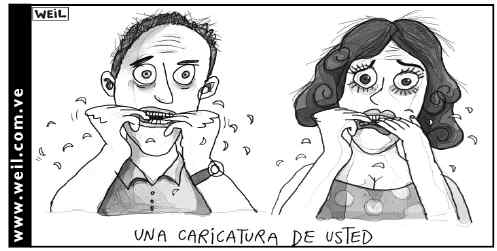
If you've seen his cartoons in Tal Cual, you have some sense of how talented Roberto Weil is. Following in a Venezuelan tradition where serious artists moonlight as editorial cartoonists, Weil makes some wonderful, surprising, sporadically twisted art.


Well, I'll just let the pictures tell the story.


"Carnavales"


"Gaita"


"Fireworks"


"Barbie Gynecologist."


There are many more drawings at: Weil.com.ve

Apologies to subscribers

My email subscription service - bloglet.com - had some technical glitch and did not mail out new entries for the last few days. The system is running again now. (By the way, subscribe!)

February 14, 2004

Megafraude Chronicles...

My friend Juana emails me with this pearl...


For my part, my signature and my mom's will be eliminated because my mom asked me to fill out her information to make sure she didn't make any mistakes, and she put down her signature and her fingerprint. Well, it turns out that for the "impartial" CNE that's a "plana" - meaning someone falsified both the signatures, since both sets of information have my handwriting.


Que tal?


Juana

Chavez is an open book...

I don't often link to Gustavo Coronel, mostly because we have very different ideologies. But I will link to this sensational essay on Chavez's "accountability speech" to the National Assembly, which Gustavo apparently soldiered through taking notes. Great stuff...


What's interesting about the essay is that it demolishes the standard government response to any opposition argument - which for over a year has been to scream back: "coupsters! you sabotaged the oil industry and destroyed the economy with the paro!"


It's been a brutally effective, if antidemocratic, rhetorical tool. The only problem is that president Chavez used the Public Accountability speech - the equivalent of the State of the Nation address - to admit openly that the line is, at best, a very, very partial truth - and more likely an outright sham.


Gustavo's headline, of course, says it all: Chavez publicly admits he consciously sought out both of the 2002 PDVSA crises. He openly and earnestly owns up that he didn't understand the first thing about the oil industry and didn't trust anyone who seemed to know more than he did. He boasts that he therefore decided to get rid of anyone who would tell him anything he couldn't understand, or anyone who wouldn't take a direct order from him. And that's precisely what he achieved.


You can download the (stultifyingly long) full transcript of the speech, in Spanish, as a PDF file here. Strictly for masochists. To cite the most incriminating bits (admittedly out of context, the full context is on Gustavo's site) from Chavez's speech:


"Crisis in Chinese means danger and opportunity. Sometimes the crisis has to be generated, and kept measured, of course. What we did in PDVSA was necessary...and we generated the crisis. When I blew the referee's whistle in 'Alo Presidente' and started to fire people, I was provoking the crisis. When I named Gaston Parra President of PDVSA and the new board, we were provoking the crisis. They responded and the conflict appeared. And this is where we are today."


With heart-rending earnestness, Chavez admits he put together a plan (Plan Colina), along with a task force, (Grupo Colina) to instigate the crisis and provoke the opposition into drastic action. Both in the run-up of April 11th (the Gaston Parra crisis) and in December, Chavez openly admits what opposition pundits have always suspected - that he took us for suckers, and we fell for it.


The beauty of it is that chavistas everywhere are hereby banned from ever again using the coup-attempt or the strike as an argument against the opposition!


The entire rationale worked out in the government's propaganda - "you can't trust them, they don't care about you or democracy, they launch coups and insurrectional strikes" - is unmasked as a sham.


All those vitriolic attacks against the heartless oligarchs who took away Christmas and people's livelihoods? Crocodile tears! All the talk about how the opposition really doesn't care about the people, but Chavez really does? Just bullshit. All the ethical high ground carefully carved out in ten million 30-second spots on state TV and The Revolution Will Not Be Televised and VEA and every single Chavista rant you've heard about how it's all the opposition's fault because they launched a coup and they started the strike? Pure, unadulterated cynicism.


All of that is out the window now. We have the gold-standard of counterarguments: a public admission by the other side. It's a "check-mate" kind of moment.


Surely the opposition made mistakes in falling for the provocations, but this open admission clearly shifts a substantial portion of responsibility for the paro squarely onto Chavez's shoulders. Chavez, once again, unwittingly demonstrates the abysmal ethical bankruptcy at the heart of his government to an audience of adoring fans. Priceless.


The worrying thing, of course, is that he shows every sign of doing it again over the referendum. Each time JVR warns that the opposition is planning a new strike, he telegraphs the government's intentions. My guess is that the first world lefties reading this have never seriously entertained what it might be like to be led by a president who openly admits to being a provocateur, of fostering extreme, destructive confrontations for political benefit.


Bush's handlers, for instance, are far too smart for that.


But for Venezuelans, it's our bread and butter - both literally and figuratively. The resulting climate of permanent destabilization and "cold civil war" is deeply traumatizing to the population as a whole. It is a climate of constant potential danger, of open intimidation by the powerful and, at times, of openly courting civil war. Let me assure you, you would not want to have close family members having to live through it day to day, as all the Venezuelans who read this blog do.


Yesterday's Weil from TalCual - "a caricature of you."

Ultimately, Chavez is an open book.


The funny thing is that for all his faults, he has the hardest time lying. He basically tells you what's on his mind: he tries to be secretive, but he's sloppy, he talks too much, things slip out when you gab for 4 hours in front of a camera every week. And just by looking at what he's actually said, you can largely substantiate much of the opposition's charge of autocratic tendencies and vicious intolerance, along with an insatiable apetite for mischief making.


Venezuelans have heard too much from Chavez himself to let their minds be made up by the media, or anyone else. They know the man, they've listened to him for hundreds of hourse, he has no surprises left in store for them. They know his rule means perpetual instability and the risk of war - those who prefer that policy support him, those of us who don't, don't. But we've all understood full well that the country will never be stable under Chavez, because he's not vicious enough to truly crack down, but he's not sane enough to work out compromises. The only alternative is the open-ended social mobilization against perceived enemies so many Chavistas seem to be so keen on.


As a revolutionary fantasy, it's not so bad, but as a government plan it stinks.


My feeling is that the foreigners who read this site really need to sit down and think through what the people of Venezuela are actually experiencing before passing judgment - this climate of agitation and barely-contained aggression is just as destructive to chavistas as it is to the other side.

February 13, 2004

Authoritanianism of the Left = Authoritarianism of the Right

I usually resist the urge to draw the obvious and often striking parallels between Hugo Chavez and George W. Bush, but just this once I'll give in. This is a repost of a Paul Krugman op-ed about Bush from the New York Times. Many Venezuelan readers will spot the similarities on the first read. [Gringos may need brackets.] Sure, Bush's handlers are sneakier and more sophisticated, but the underlying tactics (the abuse of state institutions for political purposes and the whole agree-with-me-or-get-called-an-enemy-of-the-people shtick) are the same.

The Real Man
By PAUL KRUGMAN
To understand why questions about George Bush's time in the National Guard are legitimate, all you have to do is look at the federal budget published last week. No, not the lies, damned lies and statistics - the pictures.

By my count, this year's budget contains 27 glossy photos of Mr. Bush. We see the president in front of a giant American flag, in front of the Washington Monument, comforting an elderly woman in a wheelchair, helping a small child with his reading assignment, building a trail through the wilderness and, of course, eating turkey with the troops in Iraq. Somehow the art director neglected to include a photo of the president swimming across the Yangtze River.

[Venezuelans can only wish this sort of shenanigans were limited to technocratic documents nobody reads: our cult of personality is played out on Venezuela's publicly financed broadcaster every day of the year.]

It was not ever thus. Bill Clinton's budgets were illustrated with tables and charts, not with worshipful photos of the president being presidential.

[We used to have tables and charts - hell, we've got some here!]

The issue here goes beyond using the Government Printing Office to publish campaign brochures. In this budget, as in almost everything it does, the Bush administration tries to blur the line between reverence for the office of president and reverence for the person who currently holds that office.

[the language reads stunningly like an El Nacional article circa 1999 - when our cult of personality was starting.]

Operation Flight Suit was only slightly more over the top than other Bush photo-ops, like the carefully staged picture that placed Mr. Bush's head in line with the stone faces on Mount Rushmore. The goal is to suggest that it's unpatriotic to criticize the president, and to use his heroic image to block any substantive discussion of his policies.

[To Venezuelans, "insinuations of unpatriotism" seem rather mild - we're more used to ranting denunciations, ironically, of being Bush puppets...]

In fact, those 27 photos grace one of the four most dishonest budgets in the nation's history - the other three are the budgets released in 2001, 2002 and 2003. Just to give you a taste: remember how last year's budget contained no money for postwar Iraq - and how administration officials waited until after the tax cut had been passed to mention the small matter of $87 billion in extra costs? Well, they've done it again: earlier this week the Army's chief of staff testified that the Iraq funds in the budget would cover expenses only through September.

[Krugman would weep reading a Venezuelan budget.]

But when administration officials are challenged about the blatant deceptions in their budgets - or, for that matter, about the use of prewar intelligence - their response, almost always, is to fall back on the president's character. How dare you question Mr. Bush's honesty, they ask, when he is a man of such unimpeachable integrity? And that leaves critics with no choice: they must point out that the man inside the flight suit bears little resemblance to the official image.

[How dare you impede the leader of the revolution? is our version, but again, the chilling effect on public discourse is the same.]

There is, as far as I can tell, no positive evidence that Mr. Bush is a man of exceptional uprightness. When has he even accepted responsibility for something that went wrong? On the other hand, there is plenty of evidence that he is willing to cut corners when it's to his personal advantage. His business career was full of questionable deals, and whatever the full truth about his National Guard service, it was certainly not glorious.

[Our guy was just a coup-plotter for 7 years - but again, their military pasts hunt both Chavez and Bush]

Old history, you may say, and irrelevant to the present. And perhaps that would be true if Mr. Bush was prepared to come clean about his past. Instead, he remains evasive. On "Meet the Press" he promised to release all his records - and promptly broke that promise.

[In this we are different: Venezuelans can only wish for "evasiveness" from our guy. Instead of evading his military past, our guy basks in his, holding huge military parades to celebrate his exploits in trying to violently overthrow an elected government. But then, our guy is far nuttier (and probably smarter) than yours.]

I don't know what he's hiding. But I do think he has forfeited any right to cite his character to turn away charges that his administration is lying about its policies. And that is the point: Mr. Bush may not be a particularly bad man, but he isn't the paragon his handlers portray.

Some of his critics hope that the AWOL issue will demolish the Bush myth, all at once. They're probably too optimistic - if it were that easy, the tale of Harken Energy would have already done the trick.

The sad truth is that people who have been taken in by a cult of personality - a group that in this case includes a good fraction of the American people, and a considerably higher fraction of the punditocracy - are very reluctant to give up their illusions. If nothing else, that would mean admitting that they had been played for fools.

[That paragraph, I will suspect, will have elicited the most nods from Venezuelans.]

Still, we may be on our way to an election in which Mr. Bush is judged on his record, not his legend. And that, of course, is what the White House fears.

[so, so resonant.]

In Carter Center I trust...

Let's get real here: the level of (arguably justified) mutual mistrust between government and opposition is so great that the ONLY way a CNE decision will have any credibility is if it's vouched for by the Carter Center. We are fortunate to have observers of the caliber, experience, expertise and impartiality of the Carter Center mission - these people are unspinable. Ask Fujimori if they can be spun.

That's really all there is to say about this topic. CNE will either give the same results as the Carter Center verifiers, in which case we'll ALL have to accept its decision, or CNE will give a different set of results, in which case all bets are off.

February 12, 2004

Madness to the method

Y'know, my obsessive interest in Venezuelanalysis.com stems only partially driven by the fact that I'm jealous of their slick web design. Most of it is just befuddlement at the strange mix of truly incicive writing and just intolerable dribble they publish.

This last piece really made me laugh - some poll by some no-name polling firm cited by Venpres showing Chavez at 51% in the polls. OK, fair enough, just because the firm is new doesn't necessarily mean that it's lousy.

But then look at the question they asked:

"If the recall referendum were to take place tomorrow, would you confirm President Chavez in office? Yes or No"

Now, unless you've recently emerged from a persistent vegetative state, you know that for months the opposition has been waving little "Si!" signs, urging people to vote "Yes" to recalling Chavez. What the geniuses at Indaga have done is switched the question around so that "Yes" favors Chavez - and surprise surprise, yes gets 51%!

Now, yes, Greg, I know you're not the main person in charge over there, but you're the interlocutor I have. Try to think yourself back into that academic mindset, into the way of thinking you had to embrace to get that Fullbright. Now, think about it: would you have been able to get research design this dumb past any kind of peer review? You, Wilpert, who for years criticized polls that favored the opposition on methodological grounds...e tu, Greg?

But maybe I shouldn't even pick you up on this point...you think you have 51%? Great! Lets vote!

February 11, 2004

NED, Sumate and the silly season

Yeah, ok, so you could argue that the US shouldn't fund civil society groups abroad at all - and there's something to that argument, for sure. The National Endowment for Democracy has a long and strange history of snafus and a well-documented knack for shooting itself on the foot.

Still, it's very silly to pass off news that NED funded several Venezuelan NGOs as some kind of smoking gun for US involvement in the April, 2002 coup. First of all, THIS IS NOT NEWS. You didn't need to put in some fancy Freedom of Information Act request to find out: you just needed to pick up a phone, call Sumate, and ask them. It's been a matter of public record for years.

And christ! If you could topple Chavez with $53,400, Gustavo Cisneros would have toppled him several times over already!

February 9, 2004

Enough technocratic gobbledygook for a while...

...today, my curiosity is blowing in a different direction.

Venezuelanalysis.com is an editorially independent website produced by individuals who are dedicated to disseminating news and analysis about Venezuela. It is financially dependent upon donations and advertising.

Hmmm. I wonder what that means exactly. Who are these donors? Who are these advertisers? are there any advertisers? How much does a Google sponsored link cost anyway? Who pays?

And how come an "editorially independent website" has a links section with seven pro-Chavez links and not a single voice on the other side?

Here, I even made a button for y'all: