It's the very worst thing that could've happened. CNE head Francisco Carrasquero, by himself, announces a set of partial results that give the government a huge advantage. The opposition CNE members immediately say the announcement was made without following proper procedures. The opposition cries foul, and announces mirror-image results. The Carter Center/OAS mission is missing in action, at least at first.
A national disaster, in short. The referendum was meant to bring closure to the governance crisis in Venezuela. With results that fly in the face of exit-poll results announced on the basis of a fishy procedure, the referendum takes Venezuela further away from closure, not closer.
These are dangerous days for Venezuela, dangerous hours. The potential for violence is high. The opposition cannot, will not accept these results. And chavismo, surely enough, will not accept their reversal.
In other words, God only knows how the referendum will go down in history, but it will not go down as the peaceful, constitutional, electoral and democratic solution to the crisis that was the one chance the country had of avoiding both dictatorship and civil war.
There could, I suppose, still be a 13th hour surprise. But Jimmy Carter and Cesar Gaviria are diplomats, not miracle workers.
Pray for Venezuela, folks...it's going to get ugly.

August 16, 2004
12:45 a.m.: The Carter Shuttle Swings Into Action
Past midnight, and the mood in the opposition is exhultant. The real question now is how the government will deal with the staggering defeat they're being dealt. Will they grin and bear it, or are there more tricks to come?
UnionRadio reports that President Carter has just left Opposition headquarters at the Tamanaco Hotel headed towards the National Electoral Council. This is crunch time, la hora de la chucurrucuticas. The next few hours are critical.
I've said it before and I'll say it again, when all is said and done, we'll have to choose a major Caracas street to rename Avenida Presidente Carter...
UnionRadio reports that President Carter has just left Opposition headquarters at the Tamanaco Hotel headed towards the National Electoral Council. This is crunch time, la hora de la chucurrucuticas. The next few hours are critical.
I've said it before and I'll say it again, when all is said and done, we'll have to choose a major Caracas street to rename Avenida Presidente Carter...


August 15, 2004
Carter: Everyone Will Get To Vote
President Carter announces that CNE says it is willing to keep voting centers open for as long as it takes so everyone gets to vote. Lines remain very long throughout Venezuela, turnout appears to be extraordinarily high.
Presidents Carter and Gaviria once again urged everyone not to announce results before CNE makes an official statement...but, lets get real: this is Venezuela, information leaks, exit polls leak, sewer systems leak, everything leaks...and, dear readers, Hugo Chavez is in big big trouble...
Presidents Carter and Gaviria once again urged everyone not to announce results before CNE makes an official statement...but, lets get real: this is Venezuela, information leaks, exit polls leak, sewer systems leak, everything leaks...and, dear readers, Hugo Chavez is in big big trouble...
Eyewitness Report #1
I woke up before 5:00 am and got to my voting center by 5:10. Everything went smoothly and even that way, I got to vote by 8:30 am. Guess what was causing the delays?
You got it...the fingerprint machines. The funny thing is that the voting centers that have fingerprint machines (very few,) already gave up on transmiting the data to make comparisons. They only get your fingerprint and that's it. This is the situation nation-wide.
Before getting home I took a little ride around the city and huge lines are the common scene.
Many voting centers haven't been opened yet but people seem to be waiting patiently.
That's it for now.
Cristina in Caracas
Have a short, sharp snippet of observation to add to this blog? Send it to caracaschronicles@fastmail.fm
You got it...the fingerprint machines. The funny thing is that the voting centers that have fingerprint machines (very few,) already gave up on transmiting the data to make comparisons. They only get your fingerprint and that's it. This is the situation nation-wide.
Before getting home I took a little ride around the city and huge lines are the common scene.
Many voting centers haven't been opened yet but people seem to be waiting patiently.
That's it for now.
Cristina in Caracas
Have a short, sharp snippet of observation to add to this blog? Send it to caracaschronicles@fastmail.fm
August 14, 2004
One for luck, please read it carefully
(The following is the Homeric Hymn to Ares, Greek god of war. The ancients had a form of ritual, called "apothropaic", in which you called by good names gods and godesses that were to fear. Ares is one case. It comes from circa 485 A. D., and the translation is Charles Boer´s, considered by many as the best in English. Please read it carefully, specially the final lines. Let the gods and godesses and every possible force bless us!)
Ares, superior force,
Ares, chariot rider,
Ares, wears gold helmet,
Ares has mighty heart,
Ares, shield-bearer,
Ares, guardian of city,
Ares has armor of bronze,
Ares has powerful arms,
Ares never gets tired,
Ares, hard with spear,
Ares, rampart of Olympus,
Ares, father of Victory
who herself delights in war,
Ares, helper of Justice,
Ares overcomes other side,
Ares leader of most just men,
Ares carries staff of manhood,
Ares turns his fiery bright cycle
among the seven-signed tracks
of the aether, where flaming chargers
bear him forever
over the third orbit!
Hear me,
helper of mankind,
dispenser of youth's sweet courage,
beam down from up there
your gentle light
on our lives,
and your martial power,
so that I can shake off
cruel cowardice
from my head,
and diminish that deceptive rush
of my spirit, and restrain
that shrill voice in my heart
that provokes me
to enter the chilling din of battle.
You, happy god,
give me courage,
let me linger
in the safe laws of peace,
and thus escape
from battles with enemies
and the fate of a violent death.
Ares, superior force,
Ares, chariot rider,
Ares, wears gold helmet,
Ares has mighty heart,
Ares, shield-bearer,
Ares, guardian of city,
Ares has armor of bronze,
Ares has powerful arms,
Ares never gets tired,
Ares, hard with spear,
Ares, rampart of Olympus,
Ares, father of Victory
who herself delights in war,
Ares, helper of Justice,
Ares overcomes other side,
Ares leader of most just men,
Ares carries staff of manhood,
Ares turns his fiery bright cycle
among the seven-signed tracks
of the aether, where flaming chargers
bear him forever
over the third orbit!
Hear me,
helper of mankind,
dispenser of youth's sweet courage,
beam down from up there
your gentle light
on our lives,
and your martial power,
so that I can shake off
cruel cowardice
from my head,
and diminish that deceptive rush
of my spirit, and restrain
that shrill voice in my heart
that provokes me
to enter the chilling din of battle.
You, happy god,
give me courage,
let me linger
in the safe laws of peace,
and thus escape
from battles with enemies
and the fate of a violent death.
Nothing left to write...
Today, there's nothing left to write. If political speculation was an export commodity, Venezuela would be Kuwait. Every possible spin has been put on every possible snippet of information. Writing is useless today. Waiting is all we can do.
How can you shake off the explosive cocktail of anxiety and trepidation you're feeling today?
1-Get cooking. Lines tomorrow will be long. Very long. People may hold out for a few hours, then poop out as they start to get hungry. Bring some food for yourself. Bring some food for your line-mates. Arroz con pollo is a good option, as is a big pasta salad. Or just make a thermos full of coffee and bring some plastic cups. Make a personal connection with the other "si" voters in line so they feel bad about going home even if the line lasts 10 hours.
2-Get calling. Phone a Ni-Ni Today. Give it one last try. Call anyone you know who is minded to vote "si" but is apathetic and may stay home. Offer them a ride.
3-Get calm. Get ready mentally to be civil to the "no" voters you meet in line tomorrow. Even friendly.
4-Get grateful. Read the international page of the newspaper. Realize how much worse off people in Nayaf are compared even to our worst case scenario. Feel fortunate.
5-Get stoned. Camomille tea. Flores de Bach. Valeriana. Paciflorum. Nerv-o-calm. Lexotanil. Whatever it takes...
How can you shake off the explosive cocktail of anxiety and trepidation you're feeling today?
1-Get cooking. Lines tomorrow will be long. Very long. People may hold out for a few hours, then poop out as they start to get hungry. Bring some food for yourself. Bring some food for your line-mates. Arroz con pollo is a good option, as is a big pasta salad. Or just make a thermos full of coffee and bring some plastic cups. Make a personal connection with the other "si" voters in line so they feel bad about going home even if the line lasts 10 hours.
2-Get calling. Phone a Ni-Ni Today. Give it one last try. Call anyone you know who is minded to vote "si" but is apathetic and may stay home. Offer them a ride.
3-Get calm. Get ready mentally to be civil to the "no" voters you meet in line tomorrow. Even friendly.
4-Get grateful. Read the international page of the newspaper. Realize how much worse off people in Nayaf are compared even to our worst case scenario. Feel fortunate.
5-Get stoned. Camomille tea. Flores de Bach. Valeriana. Paciflorum. Nerv-o-calm. Lexotanil. Whatever it takes...
August 13, 2004
Supositorio de Triquitraqui
Yesterday's closing "Si" march seems to have breathed some badly needed hope and dynamism into the opposition's campaign. At the last possible moment, the opposition remembered how to march. There is no better tonic for opposition morale than holding a big, big march, and yesterday's rally seems to have done wonders to dispel the gloom that had been visibly falling over the "Si" camp. Supositorio de triquitraqui, que lo llaman...
CD spokesman Chuo Torrealba - far and away the brightest star in the CD's upper realms - has a little riff that goes something like: "Look, the dirty little secret here is that we are not the leaders of the opposition movement, we are merely the conductors. The leadership of the opposition movement is out on the streets, in the energy of the millions of people who simply will not accept the imposition an authoritarian system of government in Venezuela. We, as conductors, can try to channel that energy. But we did not put that energy there, nor do we control it. At most, we try to steer it."
This reality came into focus clearly on the Autopista yesterday.
When chavistas talk about "the opposition", they're referring to the 50 or 60 people who lead the Coordinadora Democratica. And many of them are, no doubt, lamentable figures - batequebraos de toda la vida. It's not surprising that the army full of caciques and shorn of indios called the CD put on an awful, unfocused, discombobulated campaign. There was never much hope of getting pears from that particular elm tree.
But if the "Si" camp is going to win, it was never going to be thanks to the efforts of the Batequebrao Squad. The one hope the "Si" has is that the movement's leaders would once again come to the rescue of its conductors. However misconceived the opposition campaign has been, there are millions of Venezuelans passionately committed to ending the Chavez experiment. They deserve much more competent conducting that they've been getting, but they won't stop playing simply because the conductor is not up to the task.
[Incidentally, the millions of earnest, idealistic Chavez supporters out there certainly also deserve far more competent leadership than they've been getting, but that's a subject for another post...]
Today, I have serious doubts that the Batequebrao Squad is really up to running the country. But looking at the image's of yesterday's march, I can see that the country has changed, decisively, over the last 6 years. If the "Si" wins and the regime changes, the conductors will not be able to break free of the leaders, because the leaders will be only too aware that it is them (i.e. US!) who put them in power. The era of closed-doors elite decisionmaking is over - the leaders have realized that the conductors work for them, not the other way around.
For all of the government's fixation with the opposition's alledged "secret heads" - from George W. Bush to Carlos Andres Perez - it's always been the grassroots who've called the shots. It's the grassroots that signed, marched, and will vote. On Sunday, we'll find out if this grassroots movement actually outnumbers the one on the government's side.
If it doesn't, que nos agarre confesados...
CD spokesman Chuo Torrealba - far and away the brightest star in the CD's upper realms - has a little riff that goes something like: "Look, the dirty little secret here is that we are not the leaders of the opposition movement, we are merely the conductors. The leadership of the opposition movement is out on the streets, in the energy of the millions of people who simply will not accept the imposition an authoritarian system of government in Venezuela. We, as conductors, can try to channel that energy. But we did not put that energy there, nor do we control it. At most, we try to steer it."
This reality came into focus clearly on the Autopista yesterday.
When chavistas talk about "the opposition", they're referring to the 50 or 60 people who lead the Coordinadora Democratica. And many of them are, no doubt, lamentable figures - batequebraos de toda la vida. It's not surprising that the army full of caciques and shorn of indios called the CD put on an awful, unfocused, discombobulated campaign. There was never much hope of getting pears from that particular elm tree.
But if the "Si" camp is going to win, it was never going to be thanks to the efforts of the Batequebrao Squad. The one hope the "Si" has is that the movement's leaders would once again come to the rescue of its conductors. However misconceived the opposition campaign has been, there are millions of Venezuelans passionately committed to ending the Chavez experiment. They deserve much more competent conducting that they've been getting, but they won't stop playing simply because the conductor is not up to the task.
[Incidentally, the millions of earnest, idealistic Chavez supporters out there certainly also deserve far more competent leadership than they've been getting, but that's a subject for another post...]
Today, I have serious doubts that the Batequebrao Squad is really up to running the country. But looking at the image's of yesterday's march, I can see that the country has changed, decisively, over the last 6 years. If the "Si" wins and the regime changes, the conductors will not be able to break free of the leaders, because the leaders will be only too aware that it is them (i.e. US!) who put them in power. The era of closed-doors elite decisionmaking is over - the leaders have realized that the conductors work for them, not the other way around.
For all of the government's fixation with the opposition's alledged "secret heads" - from George W. Bush to Carlos Andres Perez - it's always been the grassroots who've called the shots. It's the grassroots that signed, marched, and will vote. On Sunday, we'll find out if this grassroots movement actually outnumbers the one on the government's side.
If it doesn't, que nos agarre confesados...
August 11, 2004
Three questions to start a juicy comments thread...
1-Who do you think will win next Sunday and by how much?
2-Why do you think so?
3-What will happen on August 16th? 17th?
Please try to answer briefly - no Cont.'s. Do NOT flame.
This thread will be interesting to look back on after the fact.
Thanks to Dan Burnett for the idea
2-Why do you think so?
3-What will happen on August 16th? 17th?
Please try to answer briefly - no Cont.'s. Do NOT flame.
This thread will be interesting to look back on after the fact.
Thanks to Dan Burnett for the idea
August 10, 2004
Why should the minority accept the veredict of the majority?
What gives the many the right to impose decisions on the few? How can the few be constrained by the many, and yet remain free? These are deep philosophical questions that have to be answered if democracy is to mean freedom for all rather than freedom for the majority only. As far as I know nobody's answered it better than Rousseau. When we vote, it is the will of the nation, as a single organic unit, that we try to ascertain. That's what Rousseau calls the general will. From this point of view, if the "no" side wins on Sunday, the opposition will have to accept that we were wrong, that what we believed to be the general will is not, in fact, the general will. And we will have to accept the majority's decision as something that is not imposed on us, but rather as something that was, in the end, our will. Needless to say, this applies in the other direction as well.
From Rousseau's Social Contract, Book IV, Chapter 2:
The vote of the majority always binds all the rest. This follows from the social contract itself. But it is asked how a man can be both free and forced to conform to wills that are not his own. How are the opponents at once free and subject to decisions they have not agreed to?
I retort that the question is wrongly put. The citizen gives his consent to all the decisions of the body politic, including those laws which are made in spite of his opposition, and even those which punish him when he dares to break them. The constant will of all the members of the State is the general will; by virtue of it they are citizens and free. When in the popular assembly a law is proposed, what the people is asked is not exactly whether it approves or rejects the proposal, but whether it is in conformity with the general will, which is their will. Each man, in giving his vote, states his opinion on that point; and the general will is found by counting votes.
When, therefore, the opinion that is contrary to my own prevails, this proves neither more nor less than that I was mistaken, and that what I thought to be the general will was not so. If my particular opinion had carried the day I should have achieved the opposite of what was my will; and it is in that case that I should not have been free.
This presupposes, indeed, that all the qualities of the general will still reside in the majority: when they cease to do so, whatever side a man may take, liberty is no longer possible.
From Rousseau's Social Contract, Book IV, Chapter 2:
The vote of the majority always binds all the rest. This follows from the social contract itself. But it is asked how a man can be both free and forced to conform to wills that are not his own. How are the opponents at once free and subject to decisions they have not agreed to?
I retort that the question is wrongly put. The citizen gives his consent to all the decisions of the body politic, including those laws which are made in spite of his opposition, and even those which punish him when he dares to break them. The constant will of all the members of the State is the general will; by virtue of it they are citizens and free. When in the popular assembly a law is proposed, what the people is asked is not exactly whether it approves or rejects the proposal, but whether it is in conformity with the general will, which is their will. Each man, in giving his vote, states his opinion on that point; and the general will is found by counting votes.
When, therefore, the opinion that is contrary to my own prevails, this proves neither more nor less than that I was mistaken, and that what I thought to be the general will was not so. If my particular opinion had carried the day I should have achieved the opposite of what was my will; and it is in that case that I should not have been free.
This presupposes, indeed, that all the qualities of the general will still reside in the majority: when they cease to do so, whatever side a man may take, liberty is no longer possible.
The die is cast.
Alea jacta est.
Caius Julius Caesar
La suerte está echada. The die is cast.
However you may wish to interpret it, the fact is there's very little time left to change the course of fate. Only an event of miraculous or catastrophic nature could modify the idea that millions of Venezuelans (of any political sign) have made themselves about this government during almost 6 years. Yes, indeed it's been almost 6 years. On August 15th, 2004, President Chávez will have spent exactly 5.53 years in power. 5.53, you ask.
Yes, 5.53 years. That is the product of dividing the amount of days Hugo has been in power between the amount of days in a year: 2021 days/365 days pr. year = 5.53 years. It is curious that on that day, a president who keeps telling us he will be in power until 2021, arrives at exactly 2021 DAYS in power. Coincidence? Fate?
It will be 5.53 years, which began auspiciously because the lot of us bought into Chávez's intentions and promises of taking the country ahead in peace.
That there's violence in both sides, that both parts have degraded political discourse, that the opposition does not condemn it's own violent radicals, that we don't assume the reponsability of the actions of both Carmona and Ortega, that we are an embodiment of the past; are all ideas frequently presented as arguments by "ni-ni's" and philochavistas to present the idea that the Venezuelan President should be left alone.
Well, I want to express the following:
- Violence from any source is despicable and must be abhorred
- Both parts have commited grave mistakes in their handling of the last three years.
- Again, Violence is depicable. If the opposition is responsible for it, it is even more so, because the way to go should be democratic.
- I admit that I felt a strong sympathy for the paro and its promoters at its beginning, although I understand they did not force anybody to do anything. IT must be noted though that the Venezuelan approached the Paro as if it did not exist: it was "virtual", "inexistent", "mediático". Now the Paro is to blame for even the simplest things.
- I was exactly 18 years old at the 4F 1992. I voted for the first time in 1993. And I did so perfectly conscious of the responsability of the act of voting. I took the time, even as party-minded 18 year old to find out about the candidates and their agendas. In 1998 Chaves proposed change, in peace. And lied. I never belonged to any political party, and adecos and copeyanos I feel no sympathy for. But antipathy for adecos, will not drive me to support Hugo and his hate agenda
Having said all that, I decided to post this, because if it serves to convince a single "ni-ni" who believes Chavez should be left to finish his period, or a chavista who has enough doubts about the intentions of their leader, that this government is nothing but a vile lie, smoke and mirrors with everybody's money, I've accomplished my task.
Again: Alea jacta est. But my undecided friend, there's always time to reconsider: Venezuela, not its government, requires your loyalty. The future is also in your hands.

Los "civilistas" protegen a los escuálidos de si mismos

August 7, 2004
Just a specimen of Venezuelan humour...
(Sure that I ´m going to be censored and earn a "color de hormiga" card, I can´t resist the temptation to post this joke here).
Conjugacion del verbo REVOCAR:
YO revoco
TU revocas
ÉL SE VA
NOSOTROS celebramos
VOSOTROS celebráis
ELLOS huyen
In English:
I revoke
You revoke
HE GOES AWAY
We celebrate
You celebrate
THEY FLEE
Conjugacion del verbo REVOCAR:
YO revoco
TU revocas
ÉL SE VA
NOSOTROS celebramos
VOSOTROS celebráis
ELLOS huyen
In English:
I revoke
You revoke
HE GOES AWAY
We celebrate
You celebrate
THEY FLEE
August 6, 2004
An attempt to enlight the situation.
The last couple of days have been quite agitated both in Venezuela and CC.
Andres has always tried to make things lighter by posting some Poetry from Venezuelan Laurates.
Some have mentioned the need to let go and release the tension.
So, I'll leave you with a piece of music(at least its lyrics), in order to ease our moods in this last stretch of the road till the 15th.
Sobre mis párpados vela
el gallo de la madrugada,
sobre el péndulo que la vigilia mueve.
Tus rotundas palabras,
tu cortante gesto son el gélido viento que silba
por las rendijas de mi pensamiento.
Y es tan grande la tristeza que hoy siento...
Aléjate espejismo del amor eterno,
sólo eres literaria veleidad.
Ni al peregrino das posada
ni al sediento agua
ni al que ansía saber muestras la verdad.
Detesto el tiempo, la ansiedad lamento.
Descansar sólo quiero, junto al calor del fuego,
Me amarro al momento, y lo único que poseo,
con los hombres azules
irme al azul desierto.
Es lo que hoy deseo,
y a ti te deseo que de cascabeles,
pífanos y timbales se alegre tu camino.
Que nunca te sea adverso el destino.
Que encuentres en tu vida
amigos diáfanos y entretenidos.
Sobre mis párpados velas,
frágil ave de la madrugada.
Eres péndulo que en la vigilia hiere.
Tus cortantes palabras,
tu rotundo gesto
son el gélido viento que silba
por las rendijas de mi pensamiento.
Y es tan honda la nostalgia que hoy siento...
Aléjate espejismo del amor eterno,
sólo eres literaria veleidad.
Ni al peregrino das posada
ni al sediento agua
ni al que ansía saber muestras la verdad.
Somete el tiempo apagará el lamento
bajo un límpido cielo al calor del fuego.
Me acojo el momento y lo único que deseo
es con los hombres azules
irme al azul desierto.
Es lo que hoy deseo.
Y a ti te deseo
que encuentres tu camino.
Es lo que hoy te deseo y lo que hoy te escribo.
Manolo Garcia(Musico Español, Los Hombres Azules,2001)
Andres has always tried to make things lighter by posting some Poetry from Venezuelan Laurates.
Some have mentioned the need to let go and release the tension.
So, I'll leave you with a piece of music(at least its lyrics), in order to ease our moods in this last stretch of the road till the 15th.
Sobre mis párpados vela
el gallo de la madrugada,
sobre el péndulo que la vigilia mueve.
Tus rotundas palabras,
tu cortante gesto son el gélido viento que silba
por las rendijas de mi pensamiento.
Y es tan grande la tristeza que hoy siento...
Aléjate espejismo del amor eterno,
sólo eres literaria veleidad.
Ni al peregrino das posada
ni al sediento agua
ni al que ansía saber muestras la verdad.
Detesto el tiempo, la ansiedad lamento.
Descansar sólo quiero, junto al calor del fuego,
Me amarro al momento, y lo único que poseo,
con los hombres azules
irme al azul desierto.
Es lo que hoy deseo,
y a ti te deseo que de cascabeles,
pífanos y timbales se alegre tu camino.
Que nunca te sea adverso el destino.
Que encuentres en tu vida
amigos diáfanos y entretenidos.
Sobre mis párpados velas,
frágil ave de la madrugada.
Eres péndulo que en la vigilia hiere.
Tus cortantes palabras,
tu rotundo gesto
son el gélido viento que silba
por las rendijas de mi pensamiento.
Y es tan honda la nostalgia que hoy siento...
Aléjate espejismo del amor eterno,
sólo eres literaria veleidad.
Ni al peregrino das posada
ni al sediento agua
ni al que ansía saber muestras la verdad.
Somete el tiempo apagará el lamento
bajo un límpido cielo al calor del fuego.
Me acojo el momento y lo único que deseo
es con los hombres azules
irme al azul desierto.
Es lo que hoy deseo.
Y a ti te deseo
que encuentres tu camino.
Es lo que hoy te deseo y lo que hoy te escribo.
Manolo Garcia(Musico Español, Los Hombres Azules,2001)
For all those who expect the best from (AND FOR) Venezuela
SOLO LA TIERRA
Por todos los astros lleva el sueño
pero sólo en la tierra despertamos.
Dormidos flotamos en el éter,
nos arrastran las naves invisibles
hacia mundos remotos,
pero sólo en la tierra abren los párpados.
La tierra amada día tras día,
maravillosa, errante,
que trae el sol al hombro de tan lejos
y lo prodiga en nuestras casas.
Siempre seré fiel a la noche
y al fuego de todas sus estrellas
pero miradas desde aquí,
no podría irme, no sé habitar otro paisaje.
Ni con la muerte dejaría
que mis cenizas salgan de sus campos.
La tierra es el único planeta
que prefiere los hombres a los ángeles.
Más que el silencio de la tumba
temo la hora de resurrección:
demasiado terrible
es despertar mañana en otra parte.
EUGENIO MONTEJO
Terredad
Por todos los astros lleva el sueño
pero sólo en la tierra despertamos.
Dormidos flotamos en el éter,
nos arrastran las naves invisibles
hacia mundos remotos,
pero sólo en la tierra abren los párpados.
La tierra amada día tras día,
maravillosa, errante,
que trae el sol al hombro de tan lejos
y lo prodiga en nuestras casas.
Siempre seré fiel a la noche
y al fuego de todas sus estrellas
pero miradas desde aquí,
no podría irme, no sé habitar otro paisaje.
Ni con la muerte dejaría
que mis cenizas salgan de sus campos.
La tierra es el único planeta
que prefiere los hombres a los ángeles.
Más que el silencio de la tumba
temo la hora de resurrección:
demasiado terrible
es despertar mañana en otra parte.
EUGENIO MONTEJO
Terredad
August 5, 2004
on the subject on the "correct behaviour"
Tips for Effective Online Communication
Online etiquette is often referred to as "netiquette".
Remember: You are communicating with real people, not machines.
- Use the same courtesy as you would extend someone you are having a phone conversation with.
- Don not entice a flame and don?t participate in flamefests. Flaming occurs when you send a message that provokes an angry, and often nasty, response. When others join in, a full-fledged flamefest ensues.
- Use the same rules regarding good grammar, punctuation and word choice as you would for any written communication.
- Don not type your message in all capital letters. the are hard to read. This is known as SHOUTING and may provoke flaming.
-
- Use the subject line to give recipients an idea of the message?s contents.
- Don not use vulgar language or make sexist comments.
August 4, 2004
An anecdote to start a new thread
Yesterday, I was in the mood for hot-dogs, so I went to a street vendor very near my house. There was a girl there, waiting for a "pepito" (that´s a meat sandwich, delicious, for the unfortunate non-Venezuelans that have never tasted it), and, by their dialogue, I figured out two things: 1) she used to work around there, while she lives somewhere else; 2) she and the vendor knew each other and were on friendly terms.
Suddenly, out of nowhere, he started to talk about how he was going to vote for the NO, and about this hot girl that lived near by... "but she is an escuálida, so I´m losing points there" (the speech was a little bit longer, but that was the drift). Neither the girl nor me said a word, but then I turned out to look at her, and she was looking at me. We both smiled, and, without a word, we both knew the other was going to vote YES. No publicity, no outward signs, nothing but a look and a shy, sly, smile. Isn´t it wonderful to live in a country where you can communicate without words with total strangers as if you had known them all your life?
Suddenly, out of nowhere, he started to talk about how he was going to vote for the NO, and about this hot girl that lived near by... "but she is an escuálida, so I´m losing points there" (the speech was a little bit longer, but that was the drift). Neither the girl nor me said a word, but then I turned out to look at her, and she was looking at me. We both smiled, and, without a word, we both knew the other was going to vote YES. No publicity, no outward signs, nothing but a look and a shy, sly, smile. Isn´t it wonderful to live in a country where you can communicate without words with total strangers as if you had known them all your life?
August 3, 2004

July 31, 2004
If Chavez Wins
The comments section has had some not-very-enlightening debate on how the opposition may react in case Chavez wins. With my last post, I wanted to make clear that it's not only an opposition problem, since chavismo contains its own radical fringe that may not accept a defeat. However, the problem is altogether dicier for the opposition, which seems less psychologically prepared for a loss, and less clear on what comes next if we do lose.
So what would we do if Chavez wins, as he may well? What should we do? To answer these questions, it's worth thinking back to September 2002, when the slogan Elecciones Ya! was born. It's taken 23 months of agitation, four signature gathering drives, the paro, the reparos, Plaza Altamira, zopotocientos foros in the Ateneo de Caracas and an astonishing organizational drive by the Coordinadora Democratica and Sumate to turn that slogan into a reality. For years, literally, we've been working towards August 15th. After all that, a defeat would be a bitter, bitter pill indeed.
But why was it, at the end of 2002, that the opposition started to congeal around the idea of the "electoral solution" to the crisis? Because it was clear to us that when people voted for Chavez in 1998, 99 and 2000 they were not told they were voting for a personalist, autocratic system, that they thought they were voting for a democratic government and would not have voted for Chavez had they known that, after 2000, he would veer as sharply to the autocratic left as he did. We were sure that, given a chance, the voters would remedy that mistake.
We also knew, after April 11th, that any attempt to expel Chavez from power that was not peaceful and democratic would further worsen the nation's division. That it would bring a government that a huge chunk of the country would consider illegitimate and would, therefore, only lead to further instability. We understood that the goal was not merely to get rid of Chavez, but to get rid of Chavez well. Or, as I was writing way back in October 2002,
It's critical that Chávez is replaced through an election. Aside from all the valid idealistic reasons for demanding democratic decision-making, the fact is that he does retain the support of a third of the population. Much more relevantly, he maintains the fervent support of about 20% of the electorate, the so-called chavistas duros (hard-core chavistas) who see him more as a mystical figure than a politician. If Chávez is pushed out of office unconstitutionally, by force, these people will never accept the outcome. At best, they'd be a constant thorn on the side of the next government, at worst they could start a civil war. It worries me that the most radicalized opposition figures out there don't seem to realize how much of a problem this is, and continue to push for extra-constitutional means of getting rid of the guy. Making sure that 20% feels included - or at least doesn't feel openly violated - by the transition to the post-chavista era will probably be the most important task of the next government. Let's hope they don't screw it up.
Only an election offers the possibility of a peaceful, democratic, and constitutional outcome to the crisis that is recognized as legitimate by all, because only in an election can the entire body politic participate. In a situation as badly polarized as Venezuela's, only the opinion of the whole can convince the minority of the legitimacy of accepting the majority's decision.
Today, Venezuelans can no longer say Chavez is an unknown quantity. The regime's extremism, sectarianism and authoritarianism are plain for all to see. Two years ago, the opposition gambled that, given this choice, people would rush to throw out the bum. Today, polls put that in doubt. It seems imaginable, now, that a majority of Venezuelans actually wants this kind of fuzzy-autocracy, or is satisfied enough with Chavez not to see it as a problem. If they win, well, I'll be forced to say I don't understand their ideology or values at all. But I have to respect them.
And, of course, if the vote goes smoothly and the observers sign off on a Chavez win, the opposition will not really have any choice but to respect the results either. All its bargaining power, credibility, and ascendancy over the armed forces, the international community, etc. will be up in smoke. A real Waterloo. If the opposition loses and loses decisively, its reaction will, in a sense, be quite beside the point - the Coordinadora will have no choice but to accept the results...if not in words, in deeds.
This is the beauty of the democratic system, folks. Los politicos proponen y la gente dispone. This is how it's supposed to be - and barring a catastrophic technical failure, this is how it will be.
So what would we do if Chavez wins, as he may well? What should we do? To answer these questions, it's worth thinking back to September 2002, when the slogan Elecciones Ya! was born. It's taken 23 months of agitation, four signature gathering drives, the paro, the reparos, Plaza Altamira, zopotocientos foros in the Ateneo de Caracas and an astonishing organizational drive by the Coordinadora Democratica and Sumate to turn that slogan into a reality. For years, literally, we've been working towards August 15th. After all that, a defeat would be a bitter, bitter pill indeed.
But why was it, at the end of 2002, that the opposition started to congeal around the idea of the "electoral solution" to the crisis? Because it was clear to us that when people voted for Chavez in 1998, 99 and 2000 they were not told they were voting for a personalist, autocratic system, that they thought they were voting for a democratic government and would not have voted for Chavez had they known that, after 2000, he would veer as sharply to the autocratic left as he did. We were sure that, given a chance, the voters would remedy that mistake.
We also knew, after April 11th, that any attempt to expel Chavez from power that was not peaceful and democratic would further worsen the nation's division. That it would bring a government that a huge chunk of the country would consider illegitimate and would, therefore, only lead to further instability. We understood that the goal was not merely to get rid of Chavez, but to get rid of Chavez well. Or, as I was writing way back in October 2002,
It's critical that Chávez is replaced through an election. Aside from all the valid idealistic reasons for demanding democratic decision-making, the fact is that he does retain the support of a third of the population. Much more relevantly, he maintains the fervent support of about 20% of the electorate, the so-called chavistas duros (hard-core chavistas) who see him more as a mystical figure than a politician. If Chávez is pushed out of office unconstitutionally, by force, these people will never accept the outcome. At best, they'd be a constant thorn on the side of the next government, at worst they could start a civil war. It worries me that the most radicalized opposition figures out there don't seem to realize how much of a problem this is, and continue to push for extra-constitutional means of getting rid of the guy. Making sure that 20% feels included - or at least doesn't feel openly violated - by the transition to the post-chavista era will probably be the most important task of the next government. Let's hope they don't screw it up.
Only an election offers the possibility of a peaceful, democratic, and constitutional outcome to the crisis that is recognized as legitimate by all, because only in an election can the entire body politic participate. In a situation as badly polarized as Venezuela's, only the opinion of the whole can convince the minority of the legitimacy of accepting the majority's decision.
Today, Venezuelans can no longer say Chavez is an unknown quantity. The regime's extremism, sectarianism and authoritarianism are plain for all to see. Two years ago, the opposition gambled that, given this choice, people would rush to throw out the bum. Today, polls put that in doubt. It seems imaginable, now, that a majority of Venezuelans actually wants this kind of fuzzy-autocracy, or is satisfied enough with Chavez not to see it as a problem. If they win, well, I'll be forced to say I don't understand their ideology or values at all. But I have to respect them.
And, of course, if the vote goes smoothly and the observers sign off on a Chavez win, the opposition will not really have any choice but to respect the results either. All its bargaining power, credibility, and ascendancy over the armed forces, the international community, etc. will be up in smoke. A real Waterloo. If the opposition loses and loses decisively, its reaction will, in a sense, be quite beside the point - the Coordinadora will have no choice but to accept the results...if not in words, in deeds.
This is the beauty of the democratic system, folks. Los politicos proponen y la gente dispone. This is how it's supposed to be - and barring a catastrophic technical failure, this is how it will be.
July 30, 2004
Ramon Machuca threatens to cut off oil supplies to the US if the "yes" side wins
From Union Radio
Leaders from the pro-chavez oil workers' union, Sentraset, threatened to cut off oil supplies to the US and start a national stoppage if "on next aug. 15th a new fraud is committed" and the "yes" side wins the referendum.
More...
Leaders from the pro-chavez oil workers' union, Sentraset, threatened to cut off oil supplies to the US and start a national stoppage if "on next aug. 15th a new fraud is committed" and the "yes" side wins the referendum.
More...
El 28, el 28, el 28...
The real threat to the integrity of the referendum is not the possibility of fraud. It's not ballot stuffing or triple voting or voting from beyond the grave. The real threat is that, like in May 2000, CNE just won't be ready to hold the vote in time.
2.5 weeks to go, and the voter registry has just now been finalized, including huge numbers of questionable address-changes and millions of somewhat mysterious new voters. The SBC people have still not been given the REP information they need to program the voting machines. The thumbprint readers may or may not be able to cope with the pressure put on them. Francisco Carrasquero rejects the possibility of manual voting if the automated systems fail.
Paranoia, as we all know, is free. But this type of strategy of systematic delay has become a bit of a trademark for this CNE. Ever since August 2003, every obstacle imaginable has been trotted out to delay the effective activation of people's rights under the constitution's Article 72. This is the CNE that turned a simple signature drive into a 8-month long telenovela, the same CNE that sat on the electoral registry for a year before suddenly "discovering" thousands of dead people on the rolls and stood by passively as dozens of reparos tables instituted an operacion morrocoy, that has never really tried to hide its disdain for the possibility of a presidential recall.
It escapes no one's attention that, if the election system fails catastrophically on Aug. 15th, Chavez will have to hold out less than a week before his grip on power is extended until 2006. It would be the mother of all political crises. But then, as you see Jorge Rodriguez's determination to deploy a fingerprint-logging system that CNE's own tests show will not work, it's impossible not to wonder about hidden agendas.
2.5 weeks to go, and the voter registry has just now been finalized, including huge numbers of questionable address-changes and millions of somewhat mysterious new voters. The SBC people have still not been given the REP information they need to program the voting machines. The thumbprint readers may or may not be able to cope with the pressure put on them. Francisco Carrasquero rejects the possibility of manual voting if the automated systems fail.
Paranoia, as we all know, is free. But this type of strategy of systematic delay has become a bit of a trademark for this CNE. Ever since August 2003, every obstacle imaginable has been trotted out to delay the effective activation of people's rights under the constitution's Article 72. This is the CNE that turned a simple signature drive into a 8-month long telenovela, the same CNE that sat on the electoral registry for a year before suddenly "discovering" thousands of dead people on the rolls and stood by passively as dozens of reparos tables instituted an operacion morrocoy, that has never really tried to hide its disdain for the possibility of a presidential recall.
It escapes no one's attention that, if the election system fails catastrophically on Aug. 15th, Chavez will have to hold out less than a week before his grip on power is extended until 2006. It would be the mother of all political crises. But then, as you see Jorge Rodriguez's determination to deploy a fingerprint-logging system that CNE's own tests show will not work, it's impossible not to wonder about hidden agendas.
July 27, 2004
About English, Spanish, Rhetorics and Rhythm
(For Quico and Coral, in the middle of my insomnia).
Coral wrote:
"I agree with Quico. In the USA, the finest, most enduring, historical manifestos and speeches have been written in notably simple English. Lincoln's Gettysburg Address was written in language a baby could understand".
An example: "Four score and seven years ago our fathers brought forth on this continent, a new nation, conceived in Liberty, and dedicated to the proposition that all men are created equal". Would a baby uderstand an expression as "Four score and seven years ago"? Wouldn´t "87 years ago" be more to the point? It´s as if we started, in a good Spanish speech about the 23 de enero de 1958, by saying: "ocho lustros y seis años atrás"... Not very clear, but it sounds so much better than "hace 46 años"...
Another example: "When, in the course of human events, it becomes necessary for one people to dissolve the political bonds which have connected them with another, and to assume among the powers of the earth, the separate and equal station to which the laws of nature and of nature's God entitle them, a decent respect to the opinions of mankind requires that they should declare the causes which impel them to the separation". That is a little bit complicated, to say the least.
To translate both statements you would need to go back in time, looking for Rhetorical expressions inside the language you are trying to translate them into. No easy task.
The problem, a basic problem, I think, is of rhythm. As Fiona Shaw pointed out in a brilliant show about Shakespeare for the BBC, Shakespeare took the common language, identified its rhythm, and turned it into poetry. That is what explains why, even if the Gettysburg Address is not exactly simple, it can reach out to everyone who read it in the Lincoln Memorial, without even reading it aloud... and please believe me, I had to go up to the Lincoln Memorial alone, to read it and weep by myself before facing my prosaic family (and that version of the Imperial Roman Campo di Marte which the Mall is, with all its monuments to dead soldiers...).
Now read this. "But, in a larger sense, we can not dedicate -- we can not consecrate -- we can not hallow -- this ground". Feel the rhythm! It´s there! It jumps at you as you read it, grabs you by the throat, and doesn´t let you go until you are choking!
On the other hand, Spanish has always been a "prosaic" language. It´s not easy, to put it bluntly, to achieve what Shakespeare did in "blank verse" without going into rhyme! To reach a shimmer of the rhythm of English, Spanish has to turn to long resounding phrases. The effect is not always fortunate, I´ll give you that. But you work with the language you ara forced to. No way Venezuelans could write an agreement in perfect, rhytmical English, and be understood by common readers. Given that most Venezuelans seldom read good literature is Spanish (for some cultural reasons we favour foreign literatures, and in translation, mind you, over good Spanish prose), it is unfair to ask from them a perfect, moving speech, inspiring, rhythmically conceived and, at the same time, simple and pristine.
But again, that is our language. We inherited from Spain, as Americans from Shakespeare, a specific rhetorical (Quixotical?) rhythm. As a baby can "comprehend", without understanding clearly, Lincoln´s "eight score and seven year ago", a not so bright Venezuelan reader can understand, in a glass darkly, what the CD agreement meant. Spanish is less clear than English, maybe, it requires more words to say the same thing, but it has its own traditions, heights and chasms. To all those shortcomings every Spanish speaker is used. It´s his language, and those shortcomings fit him like a big, mildly uncomfortable coat (just as Shakesperian English fits most American readers).
So, please, dear gals and guys, start by understanding that a language is a way to conceive the world (Borges wrote some line I would find for you as soon as possible, it´s over 5:00 a.m. and I´m simply spent), not just a vehicle to transmit ideas or an arbitrary repertoire of symbols. As a speaker of that language, you are forced into its limits, unless you have the power of a poet like Shakespeare to break or extend them. Granted no one on the CD is a Shakespeare, a Cervantes or even a Cadenas, try to value what they have done. Do as you do with Lincoln and Jefferson: go to meet them half-way. Do your part.
Coral wrote:
"I agree with Quico. In the USA, the finest, most enduring, historical manifestos and speeches have been written in notably simple English. Lincoln's Gettysburg Address was written in language a baby could understand".
An example: "Four score and seven years ago our fathers brought forth on this continent, a new nation, conceived in Liberty, and dedicated to the proposition that all men are created equal". Would a baby uderstand an expression as "Four score and seven years ago"? Wouldn´t "87 years ago" be more to the point? It´s as if we started, in a good Spanish speech about the 23 de enero de 1958, by saying: "ocho lustros y seis años atrás"... Not very clear, but it sounds so much better than "hace 46 años"...
Another example: "When, in the course of human events, it becomes necessary for one people to dissolve the political bonds which have connected them with another, and to assume among the powers of the earth, the separate and equal station to which the laws of nature and of nature's God entitle them, a decent respect to the opinions of mankind requires that they should declare the causes which impel them to the separation". That is a little bit complicated, to say the least.
To translate both statements you would need to go back in time, looking for Rhetorical expressions inside the language you are trying to translate them into. No easy task.
The problem, a basic problem, I think, is of rhythm. As Fiona Shaw pointed out in a brilliant show about Shakespeare for the BBC, Shakespeare took the common language, identified its rhythm, and turned it into poetry. That is what explains why, even if the Gettysburg Address is not exactly simple, it can reach out to everyone who read it in the Lincoln Memorial, without even reading it aloud... and please believe me, I had to go up to the Lincoln Memorial alone, to read it and weep by myself before facing my prosaic family (and that version of the Imperial Roman Campo di Marte which the Mall is, with all its monuments to dead soldiers...).
Now read this. "But, in a larger sense, we can not dedicate -- we can not consecrate -- we can not hallow -- this ground". Feel the rhythm! It´s there! It jumps at you as you read it, grabs you by the throat, and doesn´t let you go until you are choking!
On the other hand, Spanish has always been a "prosaic" language. It´s not easy, to put it bluntly, to achieve what Shakespeare did in "blank verse" without going into rhyme! To reach a shimmer of the rhythm of English, Spanish has to turn to long resounding phrases. The effect is not always fortunate, I´ll give you that. But you work with the language you ara forced to. No way Venezuelans could write an agreement in perfect, rhytmical English, and be understood by common readers. Given that most Venezuelans seldom read good literature is Spanish (for some cultural reasons we favour foreign literatures, and in translation, mind you, over good Spanish prose), it is unfair to ask from them a perfect, moving speech, inspiring, rhythmically conceived and, at the same time, simple and pristine.
But again, that is our language. We inherited from Spain, as Americans from Shakespeare, a specific rhetorical (Quixotical?) rhythm. As a baby can "comprehend", without understanding clearly, Lincoln´s "eight score and seven year ago", a not so bright Venezuelan reader can understand, in a glass darkly, what the CD agreement meant. Spanish is less clear than English, maybe, it requires more words to say the same thing, but it has its own traditions, heights and chasms. To all those shortcomings every Spanish speaker is used. It´s his language, and those shortcomings fit him like a big, mildly uncomfortable coat (just as Shakesperian English fits most American readers).
So, please, dear gals and guys, start by understanding that a language is a way to conceive the world (Borges wrote some line I would find for you as soon as possible, it´s over 5:00 a.m. and I´m simply spent), not just a vehicle to transmit ideas or an arbitrary repertoire of symbols. As a speaker of that language, you are forced into its limits, unless you have the power of a poet like Shakespeare to break or extend them. Granted no one on the CD is a Shakespeare, a Cervantes or even a Cadenas, try to value what they have done. Do as you do with Lincoln and Jefferson: go to meet them half-way. Do your part.
July 26, 2004
The Style is the Message
or, Despair over an opposition that doesn't seem to have learned anything at all...
From the National Accord for Social Justice and Democratic Peace:
La reconciliación es más que un acto político: es la expresión concreta de la unidad nacional en torno a un proyecto de nación. Por ello el centro de la acción del gobierno de unidad nacional que proponemos estará en la atención privilegiada de los sectores cuya integración a la sociedad ha sido obstaculizada por un inaceptable proceso de exclusión. Especial impulso se le dará a la aplicación de una política social que le permita a la gente desarrollar sus capacidades para incorporarse al trabajo productivo. Generación de empleo y seguridad social y ciudadana son indispensables para la paz. Para ello es imperativo la recuperación y expansión del sector productivo del país, tanto público como privado.
"Reconciliation is more than a political act: it is the concrete expression of national unity around a national project. Therefore the center of the action of the government of national unity that we propose shall be in the privileged attention to the sectors whose integration into society has been obstructed by an unacceptable process of exclusion. Special emphasis shall be given to the application of social policies that allow people to develop their capabilities to incorporate themselves into a productive working life. Generating employment and social and citizen security is indispensible to peace. To this end, the recouperation and expansion of the country's productive sector, both public and private, is imperative."
I have two things to say about this paragraph and the Accord in general.
1-I agree deeply with the content.
2-It doesn't matter that the content is right, because these days in Venezuela, the style is the message.
Go back to the original Spanish. Read it for style rather than substance. Notice the profussion of palabras domingueras, the convoluted sentence structure. Try to imagine you live in a barrio and dropped out of school in the fifth grade. Could you understand it? Is this document accessible to you?
The sad thing about the opposition's elitism is how unconscious opposition leaders are of it. Again and again they've tried to write synthetic accords to communicate with the poor, again and again they produce a document that's about the poor but, probably, incomprehensible to most poor people.
I hate to say it, but reading the document I was grasped by this bizarre urge to vote No, by this deep sense of anger at realizing how far out of the pot opposition leaders are pissing, how detached from the popular mind they are, how much they unwittingly confirm the chavista attacks against them. Six years on, the opposition still hasn't grasped even the basics of why Chavez has had such success in communicating with the poor majority. Six years on, the opposition still finds it vaguely embarrassing to put out a document written in Spanish that everyone can understand. Six years on, opposition leaders still haven't realized that you can't convince someone who doesn't understand the language you use, still hasn't realized that the majority of voters did not go to university. Six years on, the opposition still hasn't found a voice most people can understand.
I read this accord and, frankly, it makes me scared. It makes me scared not just because it suggests the opposition could lose - but also because of what might happen if it wins.
The opposition vows to fight social exclusion, but it does so using a language that excludes the socially excluded.
This is the drama at the center of the opposition's Communication Gap - six years on, we still haven't realized that excluded Venezuelans resent their symbolic (/linguistic) exclusion as much as their economic exclusion. They resent having to listen to politicos who use words they can't understand as much as they resent not having enough to eat. And they will continue to vote for Chavez in their millions not because he has mitigated their economic exclusion (which he hasn't), but because he has ended their symbolic exclusion - their exclusion from being able to understand the language of power (/of the powerful).
Because Chavez talks to them, not about them. Because he works hard to speak in a way everyone can understand, in a way that makes everyone feel part of the audience, that makes everyone feel aludido.
Six years on, the leaders on our side still haven't learned the trick. Still they conceive of politics as a kind of game played by the elite and for the elite - or at least a game played using a language and a style accessible only to the elite. A document like this excludes the poor at the most basic level - at the level of making it impossible for them to even understand what the hell the opposition is even talking about, the meaning of the words and sentences we use.
And then, then we're baffled when chavistas say we want to go back to the old way of doing things.
It pains me to write it, folks, but on a symbolic level, they're on to something big.
From the National Accord for Social Justice and Democratic Peace:
La reconciliación es más que un acto político: es la expresión concreta de la unidad nacional en torno a un proyecto de nación. Por ello el centro de la acción del gobierno de unidad nacional que proponemos estará en la atención privilegiada de los sectores cuya integración a la sociedad ha sido obstaculizada por un inaceptable proceso de exclusión. Especial impulso se le dará a la aplicación de una política social que le permita a la gente desarrollar sus capacidades para incorporarse al trabajo productivo. Generación de empleo y seguridad social y ciudadana son indispensables para la paz. Para ello es imperativo la recuperación y expansión del sector productivo del país, tanto público como privado.
"Reconciliation is more than a political act: it is the concrete expression of national unity around a national project. Therefore the center of the action of the government of national unity that we propose shall be in the privileged attention to the sectors whose integration into society has been obstructed by an unacceptable process of exclusion. Special emphasis shall be given to the application of social policies that allow people to develop their capabilities to incorporate themselves into a productive working life. Generating employment and social and citizen security is indispensible to peace. To this end, the recouperation and expansion of the country's productive sector, both public and private, is imperative."
I have two things to say about this paragraph and the Accord in general.
1-I agree deeply with the content.
2-It doesn't matter that the content is right, because these days in Venezuela, the style is the message.
Go back to the original Spanish. Read it for style rather than substance. Notice the profussion of palabras domingueras, the convoluted sentence structure. Try to imagine you live in a barrio and dropped out of school in the fifth grade. Could you understand it? Is this document accessible to you?
The sad thing about the opposition's elitism is how unconscious opposition leaders are of it. Again and again they've tried to write synthetic accords to communicate with the poor, again and again they produce a document that's about the poor but, probably, incomprehensible to most poor people.
I hate to say it, but reading the document I was grasped by this bizarre urge to vote No, by this deep sense of anger at realizing how far out of the pot opposition leaders are pissing, how detached from the popular mind they are, how much they unwittingly confirm the chavista attacks against them. Six years on, the opposition still hasn't grasped even the basics of why Chavez has had such success in communicating with the poor majority. Six years on, the opposition still finds it vaguely embarrassing to put out a document written in Spanish that everyone can understand. Six years on, opposition leaders still haven't realized that you can't convince someone who doesn't understand the language you use, still hasn't realized that the majority of voters did not go to university. Six years on, the opposition still hasn't found a voice most people can understand.
I read this accord and, frankly, it makes me scared. It makes me scared not just because it suggests the opposition could lose - but also because of what might happen if it wins.
The opposition vows to fight social exclusion, but it does so using a language that excludes the socially excluded.
This is the drama at the center of the opposition's Communication Gap - six years on, we still haven't realized that excluded Venezuelans resent their symbolic (/linguistic) exclusion as much as their economic exclusion. They resent having to listen to politicos who use words they can't understand as much as they resent not having enough to eat. And they will continue to vote for Chavez in their millions not because he has mitigated their economic exclusion (which he hasn't), but because he has ended their symbolic exclusion - their exclusion from being able to understand the language of power (/of the powerful).
Because Chavez talks to them, not about them. Because he works hard to speak in a way everyone can understand, in a way that makes everyone feel part of the audience, that makes everyone feel aludido.
Six years on, the leaders on our side still haven't learned the trick. Still they conceive of politics as a kind of game played by the elite and for the elite - or at least a game played using a language and a style accessible only to the elite. A document like this excludes the poor at the most basic level - at the level of making it impossible for them to even understand what the hell the opposition is even talking about, the meaning of the words and sentences we use.
And then, then we're baffled when chavistas say we want to go back to the old way of doing things.
It pains me to write it, folks, but on a symbolic level, they're on to something big.
July 24, 2004
Hoover Digest: Hugo's Last Stand?
The Hoover Digest's Primer on the Venezuelan Crisis for chronically clueless gringos:
by Michael Walker
CARACAS-A national recall referendum scheduled for August 15 will decide the fate of Venezuelan president Hugo Chavez - and that of his country. Assuming the referendum actually takes place - and with Venezuelan politics, one should never assume anything - the opposition will finally have its chance to unseat the mercurial leftist leader.
Showdown
It appeared for a time that the referendum would not take place. The opposition needed 2.4 million signatures to trigger the recall. More than 3 million signatures were gathered and submitted in December; however, amid much controversy, Venezuela's national electoral council disqualified nearly a million of the signatures on technical grounds. During the months of contentious legal battles that ensued, the opposition took to the streets in large marches that occasionally turned violent. In February, at least 14 people were killed in confrontations with the national guard.
Lots more...
[Who are these guys? The Hoover Institution on War, Revolution and Peace, Stanford University, is a public policy research center devoted to advanced study of politics, economics, and political economy - both domestic and foreign?as well as international affairs. With its world-renowned group of scholars and ongoing programs of policy-oriented research, the Hoover Institution puts its accumulated knowledge to work as a prominent contributor to the world marketplace of ideas defining a free society.]
by Michael Walker
CARACAS-A national recall referendum scheduled for August 15 will decide the fate of Venezuelan president Hugo Chavez - and that of his country. Assuming the referendum actually takes place - and with Venezuelan politics, one should never assume anything - the opposition will finally have its chance to unseat the mercurial leftist leader.
Showdown
It appeared for a time that the referendum would not take place. The opposition needed 2.4 million signatures to trigger the recall. More than 3 million signatures were gathered and submitted in December; however, amid much controversy, Venezuela's national electoral council disqualified nearly a million of the signatures on technical grounds. During the months of contentious legal battles that ensued, the opposition took to the streets in large marches that occasionally turned violent. In February, at least 14 people were killed in confrontations with the national guard.
Lots more...
[Who are these guys? The Hoover Institution on War, Revolution and Peace, Stanford University, is a public policy research center devoted to advanced study of politics, economics, and political economy - both domestic and foreign?as well as international affairs. With its world-renowned group of scholars and ongoing programs of policy-oriented research, the Hoover Institution puts its accumulated knowledge to work as a prominent contributor to the world marketplace of ideas defining a free society.]
July 22, 2004
Demonization
It should be too obvious to state, but it bears raining on this particular bit of wetness. The government's referendum campaign is centered on demonizing all who disagree with Chavez. I don't mean that figuratively, I mean it literally.
Just to clarify for foreign readers, the Chavez government has chosen Florentino y el Diablo as its campaign theme. Florentino y el Diablo is a poem by Alberto Arvelo Torrealba about a poetry slam between a golden-tongued plainsman (Florentino) and Beelzebub - it's kind of like The Devil Went Down to Georgia only with poetry rather than fiddles as the artistic weapon of choice.
Chavez, needless to say, is Florentino here, while the opposition is, well, the Lord of the Hades. This is not implied or hinted at. It's not an occasional play on words. It's quite explicit. In fact, it's the center of the 'No' camp's rhetoric and campaign propaganda.
The broader political message here is spookily authoritarian. Accept our leader or you're Satan, is basically what they're saying. Only our point of view is acceptable. Disagreement is diabolical. Dissent fiendish. Is this how you build an open society?
The question, for me, is how millions of human beings can be led to support such a fantastic, cheerful surrender of common sense. I know, it shouldn't, but it still baffles me. How can millions continue to believe in a leader that embraces such extremes of scare-mongering and sectarianism? And how can anyone abroad fail to see the catastrophic social rifts that follow when you treat politics likea morality play with yourself as the embodiment of pure good and all who disagree with you in the role of pure evil?
Radical comeflor at heart, I just don't see how anyone can fail to see the intellectual and ethical bankruptcy of such a mannichean vision.
Just to clarify for foreign readers, the Chavez government has chosen Florentino y el Diablo as its campaign theme. Florentino y el Diablo is a poem by Alberto Arvelo Torrealba about a poetry slam between a golden-tongued plainsman (Florentino) and Beelzebub - it's kind of like The Devil Went Down to Georgia only with poetry rather than fiddles as the artistic weapon of choice.
Chavez, needless to say, is Florentino here, while the opposition is, well, the Lord of the Hades. This is not implied or hinted at. It's not an occasional play on words. It's quite explicit. In fact, it's the center of the 'No' camp's rhetoric and campaign propaganda.
The broader political message here is spookily authoritarian. Accept our leader or you're Satan, is basically what they're saying. Only our point of view is acceptable. Disagreement is diabolical. Dissent fiendish. Is this how you build an open society?
The question, for me, is how millions of human beings can be led to support such a fantastic, cheerful surrender of common sense. I know, it shouldn't, but it still baffles me. How can millions continue to believe in a leader that embraces such extremes of scare-mongering and sectarianism? And how can anyone abroad fail to see the catastrophic social rifts that follow when you treat politics likea morality play with yourself as the embodiment of pure good and all who disagree with you in the role of pure evil?
Radical comeflor at heart, I just don't see how anyone can fail to see the intellectual and ethical bankruptcy of such a mannichean vision.
July 21, 2004
Lying as State Policy: Lies that make us go SI!
I know Quico's list of lies is more methodical, and better documented, but I just thought I'd keep it short and sweet. So here it goes:
Hugo Chávez: If there are any abandoned children left on the streets, I'll change my name.(Just call him Claus, Santa Claus).
Hugo Chávez: I'll turn Miraflores into Latin America's biggest university. (They call it Corruption U., the Alma Mater of graft and blackmail)
Hugo Chávez: Venezuela will become in less than two years a world power in the production of african oil palms.(JA!)
Hugo Chávez: Under my government there will be no currency devaluations.(From 700 to 3000 is not a devaluation, it's a sin)
Hugo Chávez: In my first year in office there will be no more homeless children left. (Again, his name should be Ali Baba)
Pedro Carreño: Montesinos was murdered in a Peruvian military base and I have proof. (Yeah, he also knows where Jimmy Hoffa is buried)
Hugo Chávez: I've already authorized the conversion of La Carlota into a fantastic theme park, with artificial waves. (Sweet water surfing anyone?)
Nicolas Maduro: This video proves that a CIA plane was in Venezuela. (The plane belonged in fact to a diaper company, Nick puso la cagada!).
Hugo Chávez: In my government no soldier will raise his weapons against the people. (Bolivar musbe rolling in his grave)
Hugo Chávez: My government does not need political policemen and the DISIP will disappear as a repressive body. (Jesus H. Christ!)
Hugo Chávez: I will plant with fruit trees and vegetables every green area of the cities: squares, parks, medians, anywhere. (Peaches, apricots, raspberries and all sorts of local varieties too)
Hugo Chávez: the river Guaire will be cleaned in my government and caraqueños will be able to sail it (?! Was he on drugs? Schooner Brownwater up ahead, sir!).
Lucas Rincón: A formal resignation was requested, which he accepted. (Se le solicitó la renuncia, la cual acectó).
José Vicente Rangel: Neither Ballestas, nor Montesinos are in Venezuela, it's all a media lie. (They were planted by the oligarchic fascist media)
Hugo Chávez: I will place a vertical henhouse in every home. (He will also give every child his own donkey for transportation and cows for milk, we will not be the mos modern country in the world, BUT we will be the one who loves animals the most - at least everybody will have to learn tonadas to milk cows in the morning)
Hugo Chávez: I do not need luxury planes. (He's got not only the Airbus, but the Camastrón and a small fleet of Falcons and choppers. His plane was used in the Promotional video that sheiks see when they want to buy one like that from the dealership)
Hugo Chávez: The young men in Fuerte Mara only have light burns, that scandal is a media lie. (No respect for those guys. Some of them are still, let's say, missing)
Hugo Chávez: A space ship launching base will be built in Venezuela. (Again I ask, is he on crack?)
Hugo Chávez: Joao de Gouveia is an innocent gentleman, incriminated by the media. (This is downright crazy!)
Hugo Chávez: There is no doubt the opposition did not gather enough signatures. (Goebbels preached it, Chavez is the master: repeat, rinse, repeat)
Hugo Chávez: In my government there will be no more kidnappings in the border. (He meant the border with Aruba, Curaçao and Bonaire)
Hugo Chávez: In my first year of government i will get rid of unemployment, that's why I created the Bolivar Plan.(Two words: Cruz Weffer)
Hugo Chávez: After my first trip to Europe I can assure you there are lines of foreign investors.(This is a factual statement: they are making lines to WITHDRAW their money from Venezuela)
Hugo Chávez: I have no doubt Alvarenga will be revoked by a crushing majority. (JA!)
Hugo Chávez: I will create a network of dining halls for the homeless. (See the news on the homeless killers to see how much this government cars for those in need)
Hugo Chávez: In my government the harassment and persecution of the media will be over. (This one sets the standard of what a lie is. If you look liar in the dictionary, you'll find a picture of Chávez illustrating it and a quote of this one in bold red lettering)
Hugo Chávez: I will jail any corrupt individual. In my government there will be no impunity. (El chino de Recadi se revuelve en su tumba)
Hugo Chávez: The Bolivarian Circles are pacific organizations and no one will be able to prove otherwise. (This one is kinda of true, for a few notable exceptions. Carapaicas, Tupamaros on the other hand...)
Pedro Carreño: DIRECTV spies its users through their decodifiers, it is a CIA device, I've got proof. (Crystal Meth, Pot, ecstasy???)
Hugo Chávez: CADIVI will enter history as the best run monetary control institution. (Ask Adina)
Hugo Chávez: In the new PDVSA corruption will be a thing of the past. (I think he meant a thing of the PPT)
Hugo Chávez: The "Land Law" will make us self-sufficient in less than a year. (I ran out of witty commentary)
Good enough to post here
from the Comments...
I think in the dynamics of these discussions, there is a factor that needs to be considered. When people that support Chavez intervene, they somehow assume that we are supporters of a particular group of the opposition. My guess is that most of the readers of this blog, have been in the opposition for over twenty years and that even if they supported, however briefly, any of the Governments of the IVth., if this blog had existed then, most of us would have been highly critical of any of those previous Governments.
In my case, I was never happy with the Governments of the IVth. Republic. I thought two of them briefly tried to solve the main problems of the country, but then politics got in the way. But to me Chavez could not be the solution either, although I hoped I was wrong. How can a former military, surrounded by the mediocre people of all sectors perform well? What I never imagined was that he would actually emphasize the vices of the IVth. to such a degree.
Miguel Octavio
---
The main difference with the past, is that a new player has emerged: civil society. In the past politics was only for politicians. The government that will succeed Chavez will have to deal with a more politically active country. People are involved, and they want to have a say.
For example: I am sure there are many politicians in la CD right now that would rather name a candidate the traditional way: by cogollo. They are going to go through primary elections, a regañadientes, because this is what civil society wants.
Gustavo
I think in the dynamics of these discussions, there is a factor that needs to be considered. When people that support Chavez intervene, they somehow assume that we are supporters of a particular group of the opposition. My guess is that most of the readers of this blog, have been in the opposition for over twenty years and that even if they supported, however briefly, any of the Governments of the IVth., if this blog had existed then, most of us would have been highly critical of any of those previous Governments.
In my case, I was never happy with the Governments of the IVth. Republic. I thought two of them briefly tried to solve the main problems of the country, but then politics got in the way. But to me Chavez could not be the solution either, although I hoped I was wrong. How can a former military, surrounded by the mediocre people of all sectors perform well? What I never imagined was that he would actually emphasize the vices of the IVth. to such a degree.
Miguel Octavio
---
The main difference with the past, is that a new player has emerged: civil society. In the past politics was only for politicians. The government that will succeed Chavez will have to deal with a more politically active country. People are involved, and they want to have a say.
For example: I am sure there are many politicians in la CD right now that would rather name a candidate the traditional way: by cogollo. They are going to go through primary elections, a regañadientes, because this is what civil society wants.
Gustavo
July 20, 2004
"The Opposition will apply Diabolical Plan to Interrupt the Referendum"
From Venpres, La Agencia de Noticia de Todos los Venezolanos
Caracas, 19 Jul. Venpres (Xavier de la Rosa).- MVR Assemblymember Willian Lara assured on Monday that the opposition has a diabolical plan to interrupt the recall referendum on August 15th to sabotage the process.
He said that parts of the opposition, conscious that they don't have the popular support to mobilize more than 2.6 million voters, will boicott the referendum in the afternoon.
"We have information that they are training voters and witnesses to walk up to the machines, after 10:00 a.m., and spill water, coffee or soft drinks on them, or bump into them so they'll fall to the ground and break," he warned...
More (if you can stomach it)...
Folks, the hardcore paranoia phase of chavismo is now in full-swing. These guys see trotskyite plots everywhere, and the standard of common sense has long ago ceased to be applied to the accusations they make. Sick, man, they're sick.
Caracas, 19 Jul. Venpres (Xavier de la Rosa).- MVR Assemblymember Willian Lara assured on Monday that the opposition has a diabolical plan to interrupt the recall referendum on August 15th to sabotage the process.
He said that parts of the opposition, conscious that they don't have the popular support to mobilize more than 2.6 million voters, will boicott the referendum in the afternoon.
"We have information that they are training voters and witnesses to walk up to the machines, after 10:00 a.m., and spill water, coffee or soft drinks on them, or bump into them so they'll fall to the ground and break," he warned...
More (if you can stomach it)...
Folks, the hardcore paranoia phase of chavismo is now in full-swing. These guys see trotskyite plots everywhere, and the standard of common sense has long ago ceased to be applied to the accusations they make. Sick, man, they're sick.
July 19, 2004
Frittata Chronicles
Perugia is a cosmopolitan place. Thanks to the charmingly named University for Foreigners - where I first learned Italian in 2001 - the medieval city center is crawling with students from every part of the globe. Small and innately sociable, the city lends itself to amazing interchanges.
A few nights ago, I got invited to dinner at a friend's house. The dinner party was made up of eight people including three Italians, a Moroccan carpet salesman, an Ethiopian-Italian college student, a Cuban exile, a Lebanese poet and myself.
Our host was Farouk, the Moroccan guy, who is 36 but has lived in Italy for 16 years. He's pretty much Italianized by now; it shows in the way he cooks. I sat between him and Alicia, the Cuban exile, who is 30, and managed to leave the island just two years ago, after eight years of trying.
After the fetuccini with cherry tomatoes, ricotta and basil, Farouk brings out the piece de resistance: a frittata (a dry omelette) covered in truffle paste. Truffles are the quintessential Umbrian specialty - the black variety grows in the hills beyond Perugia more plentifully than in any other part of Italy. Everyone around the tables looked at the bits of mushroom in wonderment - but Alicia, well, she just saw the eggs. "A tortilla! Great!"
Farouk looked at her slightly quizzically. The eggs, of course, are just there to carry the flavor of the mushroom as unobtrusively as possible. She caught his glance and blushed, sensing the faux pas. A few glasses of wine later, she explained.
"I'm sorry if I dissed your truffles, Farouk, they really were delicious. But see, well...here in Italy a frittata is just something you take for granted. What could be simpler? It's just eggs! But for me, well, you know, I've only been in Europe for a little over a year...and eggs, man, part of me still sees them as a luxury."
Now it's Farouk's turn to look puzzled.
"See, in Cuba everyone has this, how do you say it? It's like a rationing booklet. You get the food that the government gives you to eat, no more. If you want more, you have to have connections or dollars. And, well, you know how many eggs there are in the ration? Guess."
"No idea."
"Four."
"Per family per day?" Farouk asks.
"What are you talking about? Four per person, per month."
Farouk looks shocked. "Four eggs a month?"
Alicia smiles, and flashes four fingers up in the air.
"If you want a fifth?"
"Erm, well, unless you're friends with a party big wig, you basically have to sleep with a tourist to get the dollars to buy it."
"You're joking?"
"That's how it is, man. In fact, a good chunk of the reason I wanted to get out so badly is that I love omelettes and I refused to sleep with random French truck drivers just to eat them more than once every two weeks."
"And meat?"
"Meat? Man, Farouk, you can make a Cuban cry talking about this. Listen, when I came here it had been three years since I'd seen a chicken in a plate in front of me. Chicken is no longer in the ration books, at all. Hospital patients get some, a chicken thigh once every two weeks. They marvel at it before eating it. If you're healthy, no chicken."
"No meat at all?"
"We do have picadillo, which is this kind of, God, how to describe it? It's about 60% ground up meat, but you know, really the worst parts of the cow, all the crap, the innards and such. The other 40% is industrial soy protein. Comes in little tin cans, tastes like barf. That's the only meat Cubans can eat, unless they get sick or spread their legs."
Long silence.
Farouk turns to Alicia, looking sheepish. "Are you sure you wouldn't like some more frittata?"
------------
Since Alicia's been abroad for over a year, her passport has expired and, because she overstayed her exit visa, she's considered a deserter and cannot renew it. In effect, she is stateless.
It took her 8 years of applying for various study-abroad programs to finally get a chance to leave. When she finally managed to get out in 2002, she left her whole family behind. Her father is a low level communist party official, a fidelista. Alicia can't apply for Political Asylum in Italy because if she did he would be fired and blacklisted, and her entire family would sink even deeper into poverty. At least, through her dad's job, they can get a few extras that they couldn't get otherwise - shoes and such.
"The incredible thing is that my dad still believes in Fidel, he really does. He hasn't seen a chicken breast since the 1980s but he still thinks the revolution is the way forward."
"Capitalism spreads wealth unevenly," I tell her, "whereas communism spreads misery evenly. Winston Churchill."
She laughs. "That's pretty much it. You know, it's funny, whenever I meet people here and they hear where I'm from, the first thing they say, almost all of them is - oh, 'Cuba e bella!' And I don't know what's running through their heads as they say it, if it's Buena Vista Social Club or some idea about Che Guevara, or if they're just trying to be polite, or what. But when I hear that, I just want to shake my head and ask - 'so, do you like frittata?' "
-----------
Talking to Alicia about Venezuela is an education of its own. She can't quite wrap her head around the politics in Caracas, in ways I find telling. She doesn't know whether to be horrified or amused when I tell her the number one criticism of Chavez in the opposition is that he's trying to "cubanize" Venezuela - even though 90% of the media spend 90% of their newscasts criticizing the government.
"So, wait, journalists write whatever they want against the government whenever they want, and nothing happens to them?"
"Well, not nothing. There's a bit of harassment. Sometimes hothead government supporters beat us up on the streets, steal cameras and such. TV journalists, especially, really have to be careful. Oh and threats, a lot of threats."
"But that's not what I mean. I mean do they go to jail? How about execution? Re-education?"
"No, no, none of that. There are a couple of journalists facing jail terms, but they're really the most extremist of antichavistas, and in fairness, I wouldn't doubt the libel charges against them. But yeah, there are dozens of papers and five TV stations, mostly with anti-government coverage morning noon and night."
She's visibly confused.
"But, but, but this is light years from Cuba!"
"I know!"
Silence.
"It's not a dictatorship at all!"
"Well, that's the strange thing about Venezuela, Alicia: it's obviously not a dictatorship in any traditional sense of the word. But it's also not a democracy in any traditional sense of the word. It's...well, it's weird. It's in a strange liminal space between the two."
"How so?"
"Well, if you actually listen to the official rhetoric coming out of Miraflores, well, that's rhetoric you would recognize. According to the official story, there is no problem in Venezuela that is not the US's fault. The opposition is, as far as Chavez is concerned, merely a mouthpiece for the US. There's no such thing as legitimate dissent, because all dissenters become, ipso facto, suspect of collusion with the Americans. Notionally, at least, Chavez recognizes no such thing as legitimate dissent. Calls us escualidos, y'know."
"Yeah, well, we're gusanos."
"Right. Same thing. Exact same rhetoric. This is not coincidental, you know Alicia, every time Chavez needs any kind of advice he calls Fidel. There are multiple reports going around that Chavez only turned himself over on the night of the 2002 coup after a chat with Tio Fidel. We subsidize oil shipments to the island, Chavez praises Fidel to high heaven every chance he gets, never misses a chance for a nice photo-op with him, obviously sees him as a role model. This scares the hell out of people in Caracas - and scaring the hell out of us seems to be the point."
"Creepy. It's hard to quite figure how the two sides fit together. Perro que ladra no muerde, I guess."
"Por ahora no muerde, is the thing. I mean, it's very obvious, you only need to click through the channels on Venezuelan TV for five minutes in the morning to realize the country is, in some ways, riotously, impossibly free, even libertine. I mean, the TV especially really does go way too far in criticizing the guy. But the words that come out of Chavez whenever he speaks are so sectarian, so extreme, so meant to divide and scare and intimidate, that we have to wonder how long before we start parading off to jail. Already my mayor and about 18 other politicians are sitting behind bars on very silly trumped up charges. Will it stop there? Will it grow? We have no way to know."
"You have a long ways to fall before you get to where Cuba is, though," she says.
"No doubt about it. I'm pretty sure most Venezuelans eat more than four eggs a month. But then you barely have any violent crime, we can't go out without fearing for our lives."
"Incredible! Fidel would never put up with that kind of stuff."
"See, we don't even get the benefits of authoritarianism with Chavez. A revolutionary government with the world's second highest murder rate! It's unbelievable!"
"Por dios...but I have to say, from what you're telling me, doesn't sound like there's very much cubanization going on at all in Venezuela."
"It's hard to put your finger on it. In some ways you're obviously right. But the thing is that when you have a leader that doesn't recognize that it is normal and proper for others to disagree with him, who seeks social conflict as an end in itself, who believes the problems of the country are intimately bound up with the fact that the elite participates in politics and sees the elite's expulsion from the political process as the solution, when you live under a leadership that doesn't allow dissenters to participate in intramural softball tournaments at their ministries, when sectarianism is state policy...well, yes Alicia, obviously we're way far away from where Cuba is now. But what direction are we moving in? Where does the logic of their ideas point to?"
Silence.
A few nights ago, I got invited to dinner at a friend's house. The dinner party was made up of eight people including three Italians, a Moroccan carpet salesman, an Ethiopian-Italian college student, a Cuban exile, a Lebanese poet and myself.
Our host was Farouk, the Moroccan guy, who is 36 but has lived in Italy for 16 years. He's pretty much Italianized by now; it shows in the way he cooks. I sat between him and Alicia, the Cuban exile, who is 30, and managed to leave the island just two years ago, after eight years of trying.
After the fetuccini with cherry tomatoes, ricotta and basil, Farouk brings out the piece de resistance: a frittata (a dry omelette) covered in truffle paste. Truffles are the quintessential Umbrian specialty - the black variety grows in the hills beyond Perugia more plentifully than in any other part of Italy. Everyone around the tables looked at the bits of mushroom in wonderment - but Alicia, well, she just saw the eggs. "A tortilla! Great!"
Farouk looked at her slightly quizzically. The eggs, of course, are just there to carry the flavor of the mushroom as unobtrusively as possible. She caught his glance and blushed, sensing the faux pas. A few glasses of wine later, she explained.
"I'm sorry if I dissed your truffles, Farouk, they really were delicious. But see, well...here in Italy a frittata is just something you take for granted. What could be simpler? It's just eggs! But for me, well, you know, I've only been in Europe for a little over a year...and eggs, man, part of me still sees them as a luxury."
Now it's Farouk's turn to look puzzled.
"See, in Cuba everyone has this, how do you say it? It's like a rationing booklet. You get the food that the government gives you to eat, no more. If you want more, you have to have connections or dollars. And, well, you know how many eggs there are in the ration? Guess."
"No idea."
"Four."
"Per family per day?" Farouk asks.
"What are you talking about? Four per person, per month."
Farouk looks shocked. "Four eggs a month?"
Alicia smiles, and flashes four fingers up in the air.
"If you want a fifth?"
"Erm, well, unless you're friends with a party big wig, you basically have to sleep with a tourist to get the dollars to buy it."
"You're joking?"
"That's how it is, man. In fact, a good chunk of the reason I wanted to get out so badly is that I love omelettes and I refused to sleep with random French truck drivers just to eat them more than once every two weeks."
"And meat?"
"Meat? Man, Farouk, you can make a Cuban cry talking about this. Listen, when I came here it had been three years since I'd seen a chicken in a plate in front of me. Chicken is no longer in the ration books, at all. Hospital patients get some, a chicken thigh once every two weeks. They marvel at it before eating it. If you're healthy, no chicken."
"No meat at all?"
"We do have picadillo, which is this kind of, God, how to describe it? It's about 60% ground up meat, but you know, really the worst parts of the cow, all the crap, the innards and such. The other 40% is industrial soy protein. Comes in little tin cans, tastes like barf. That's the only meat Cubans can eat, unless they get sick or spread their legs."
Long silence.
Farouk turns to Alicia, looking sheepish. "Are you sure you wouldn't like some more frittata?"
------------
Since Alicia's been abroad for over a year, her passport has expired and, because she overstayed her exit visa, she's considered a deserter and cannot renew it. In effect, she is stateless.
It took her 8 years of applying for various study-abroad programs to finally get a chance to leave. When she finally managed to get out in 2002, she left her whole family behind. Her father is a low level communist party official, a fidelista. Alicia can't apply for Political Asylum in Italy because if she did he would be fired and blacklisted, and her entire family would sink even deeper into poverty. At least, through her dad's job, they can get a few extras that they couldn't get otherwise - shoes and such.
"The incredible thing is that my dad still believes in Fidel, he really does. He hasn't seen a chicken breast since the 1980s but he still thinks the revolution is the way forward."
"Capitalism spreads wealth unevenly," I tell her, "whereas communism spreads misery evenly. Winston Churchill."
She laughs. "That's pretty much it. You know, it's funny, whenever I meet people here and they hear where I'm from, the first thing they say, almost all of them is - oh, 'Cuba e bella!' And I don't know what's running through their heads as they say it, if it's Buena Vista Social Club or some idea about Che Guevara, or if they're just trying to be polite, or what. But when I hear that, I just want to shake my head and ask - 'so, do you like frittata?' "
-----------
Talking to Alicia about Venezuela is an education of its own. She can't quite wrap her head around the politics in Caracas, in ways I find telling. She doesn't know whether to be horrified or amused when I tell her the number one criticism of Chavez in the opposition is that he's trying to "cubanize" Venezuela - even though 90% of the media spend 90% of their newscasts criticizing the government.
"So, wait, journalists write whatever they want against the government whenever they want, and nothing happens to them?"
"Well, not nothing. There's a bit of harassment. Sometimes hothead government supporters beat us up on the streets, steal cameras and such. TV journalists, especially, really have to be careful. Oh and threats, a lot of threats."
"But that's not what I mean. I mean do they go to jail? How about execution? Re-education?"
"No, no, none of that. There are a couple of journalists facing jail terms, but they're really the most extremist of antichavistas, and in fairness, I wouldn't doubt the libel charges against them. But yeah, there are dozens of papers and five TV stations, mostly with anti-government coverage morning noon and night."
She's visibly confused.
"But, but, but this is light years from Cuba!"
"I know!"
Silence.
"It's not a dictatorship at all!"
"Well, that's the strange thing about Venezuela, Alicia: it's obviously not a dictatorship in any traditional sense of the word. But it's also not a democracy in any traditional sense of the word. It's...well, it's weird. It's in a strange liminal space between the two."
"How so?"
"Well, if you actually listen to the official rhetoric coming out of Miraflores, well, that's rhetoric you would recognize. According to the official story, there is no problem in Venezuela that is not the US's fault. The opposition is, as far as Chavez is concerned, merely a mouthpiece for the US. There's no such thing as legitimate dissent, because all dissenters become, ipso facto, suspect of collusion with the Americans. Notionally, at least, Chavez recognizes no such thing as legitimate dissent. Calls us escualidos, y'know."
"Yeah, well, we're gusanos."
"Right. Same thing. Exact same rhetoric. This is not coincidental, you know Alicia, every time Chavez needs any kind of advice he calls Fidel. There are multiple reports going around that Chavez only turned himself over on the night of the 2002 coup after a chat with Tio Fidel. We subsidize oil shipments to the island, Chavez praises Fidel to high heaven every chance he gets, never misses a chance for a nice photo-op with him, obviously sees him as a role model. This scares the hell out of people in Caracas - and scaring the hell out of us seems to be the point."
"Creepy. It's hard to quite figure how the two sides fit together. Perro que ladra no muerde, I guess."
"Por ahora no muerde, is the thing. I mean, it's very obvious, you only need to click through the channels on Venezuelan TV for five minutes in the morning to realize the country is, in some ways, riotously, impossibly free, even libertine. I mean, the TV especially really does go way too far in criticizing the guy. But the words that come out of Chavez whenever he speaks are so sectarian, so extreme, so meant to divide and scare and intimidate, that we have to wonder how long before we start parading off to jail. Already my mayor and about 18 other politicians are sitting behind bars on very silly trumped up charges. Will it stop there? Will it grow? We have no way to know."
"You have a long ways to fall before you get to where Cuba is, though," she says.
"No doubt about it. I'm pretty sure most Venezuelans eat more than four eggs a month. But then you barely have any violent crime, we can't go out without fearing for our lives."
"Incredible! Fidel would never put up with that kind of stuff."
"See, we don't even get the benefits of authoritarianism with Chavez. A revolutionary government with the world's second highest murder rate! It's unbelievable!"
"Por dios...but I have to say, from what you're telling me, doesn't sound like there's very much cubanization going on at all in Venezuela."
"It's hard to put your finger on it. In some ways you're obviously right. But the thing is that when you have a leader that doesn't recognize that it is normal and proper for others to disagree with him, who seeks social conflict as an end in itself, who believes the problems of the country are intimately bound up with the fact that the elite participates in politics and sees the elite's expulsion from the political process as the solution, when you live under a leadership that doesn't allow dissenters to participate in intramural softball tournaments at their ministries, when sectarianism is state policy...well, yes Alicia, obviously we're way far away from where Cuba is now. But what direction are we moving in? Where does the logic of their ideas point to?"
Silence.
July 18, 2004
Bread and butter issues will decide the referendum
or, Why I still think Chavez will lose
Nobody who spends any time in Venezuela could confuse it with a well-functioning country. Venezuela is increasingly poor, increasingly anarchic, and increasingly violent. According to almost all polls, economic and physical insecurity have long been the central concerns of Venezuelan voters. On both these central issues, the Chavez government has failed calamitously.
Take violent crime. Since 1998, it has reached stratospheric heights. Venezuela and Iraq have roughly the same population. In 2003, there were 13,000 violent deaths in Venezuela, and just under 11,000 civilian deaths in Iraq (according to the anti-war website IraqBodyCount.org.) Venezuela is now the second most murderous country on earth, after Colombia, having left even Serbia, Jamaica and South Africa behind. Statistically, a Venezuelan is far more likely to die violently than an Israeli. The murder rate tripled between 1998 and 2003.
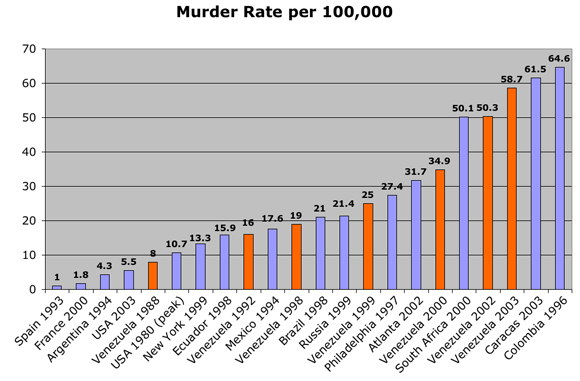
Meanwhile, per capita income has fallen by around 50% over the last 25 years, down to levels not seen since the mid 1950s. Latin American experts speak about the lost decade of the 1980s, but for Venezuela it's been more like the lost half-century.
The twin scourges of steady impoverishment and rising violence and anarchy had been at play in Venezuelan for two decades by the time Hugo Chavez reached power. Popular anger at the inability of the old regime to deal with them largely explains the electorate's decision to give Chavez a shot in 1998. After two decades of broken promises, people were understandably hopping mad. Not surprisingly, they voted en masse for the guy with the angriest anti-establishment discourse.
That was six years ago. A cursory glance at the statistics shows that Chavez has failed to even start to make a dent on these two, central, over-riding concerns of the Venezuelan electorate, the kitchen-table issues persistently ranked most important by people in surveys.
In both cases, the problems have grown because the chavista state has failed catastrophically to deal with them. The newly overhauled penal procedure system has systemically failed to come to grips with violent crime - investigations are rare, convictions rarer, prosecutors' backlogs often involve thousands of cases. The police are undertrained, underequiped, underpaid and easily corruptible, forensic labs barely exist, the state can't find enough lawyers who meet even basic qualifications to be judges.
Violence hurts Chavez's core constituency the hardest. The overwhelming majority of the murders happen in barrios (shantytowns), precisely the areas of greatest social exclusion that are supposed to form the backbone of Chavez's support. Today, the reality is that if you live in a barrio and you kill someone, you can be almost entirely sure you won't go to jail for it. Shooting is an unremarkable thing, an almost nightly occurrence in many barrios. As a result, law abiding barrio-dwellers simply don't go outside at night. They live under an effective curfew.
On the economy, the story of a quarter-century decline accelerating in 1998-2004 is quite similar. The economy had been alternating between stagnation and contraction for 20 years leading up to 1998, (except for a brief period of expansion during the government Chavez tried to overthrow.) Aside from the disastrous financial meltdown of 1994, however, Venezuelans had never seen mass impoverishment on the scale they've seen under Chavez. At least the 1994 crash was followed by a period of stability and then some moderate growth. Certainly, the sustained rate of impoverishment over the last 6 years is unprecedented. It's hit every part of the economy, and even the expected dead-cat bounce this year will do little to make up the lost ground.
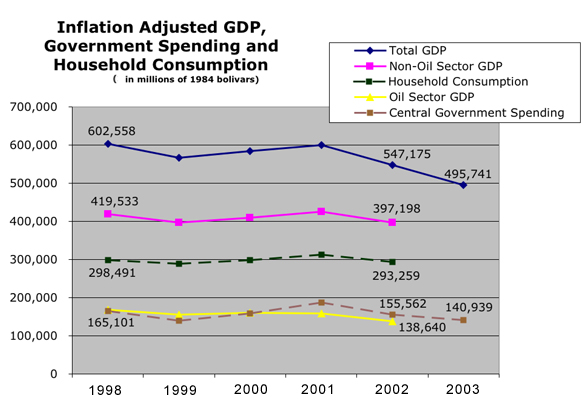
For most Venezuelans, their personal experience of the economy is of having to work harder and harder for less and less money and less and less security. More Venezuelans now work illegally than legally. (The technocratic euphemism is "informally", but it means outside the legal framework.) Illegal workers in Venezuela simply have no welfare protections at all, no severance pay, no vacation leave, nothing.
According to a UCAB study, 90% of illegal workers earn less than the legal minimum wage. To work illegally is to be at the mercy of the unrestrained forces of the market, with no institutions to protect you at all. During the revolutionary people's bolivarian government, for the first time illegal workers have come to outnumber legal ones.
Worse still, out and out unemployment has risen as well. This is particularly alarming in a society where the unemployed typically receive no state aid. Instead, they have to rely on already hard-pressed families to eat, impoverishing their entire households. Given that over half of the nation's manufacturing industries have gone under in the last 6 years, it's hardly surprising unemployment has risen sharply.
So on the Big Two issues, on the issues non-ideological voters care most about, Chavez is faring very badly indeed. Chavistas will argue that the opposition is to blame for this decay. But pragmatic voters are uninterested in the blame game: everywhere and always, the party in power pays the price for underperformance. Venezuela will not be an exception.
Governments that make people less secure, whether in their bodies or their pocketbooks, fare badly at the ballot box. No amount of rhetoric can trump the lived experience of deepening poverty and growing fear of violence. You don't need a statistician to tell you you're poorer than you were 6 years ago, or that your neighborhood is more violent than it's ever been. These are things you live, not things you read about.
The dirty little secret here is that many or most of Chavez's supporters voted for him in 1998 and 2000 because they thought he was going to make their day-to-day lives better. He promised he would, with an energy, a passion and a (seeming) sincerity they'd never seen before in a politician. Today, there are three times as many murders as in 1998. Three times! And less than half as many manufacturing companies! Chavez can call a cadena and talk until the end of time, but those realities are not going away.
The fact - and this is ideologically impossible for the chavistas to understand and accept - is that most 1998 chavistas wanted what most normal people everywhere want. They didn't want the end of American Imperialism, they didn't want to re-engineer capitalism. They didn't want to reorder society from the ground up, or turn PDVSA into a glorious people's cooperative. They certainly didn't want to hear long rants against the catholic church, or the president of the US, or the people who owned the stations that make the telenovelas they watch. These things are just boring to them. You can't eat rhetoric.
Like people everywhere, they just wanted to earn enough money to eat three times a day and send their kids to school. They wanted to be able to walk the streets of their neighborhoods at night without fearing imminent death or maiming. Chavez promised both. He's delivered neither. That's why he'll lose.
Nobody who spends any time in Venezuela could confuse it with a well-functioning country. Venezuela is increasingly poor, increasingly anarchic, and increasingly violent. According to almost all polls, economic and physical insecurity have long been the central concerns of Venezuelan voters. On both these central issues, the Chavez government has failed calamitously.
Take violent crime. Since 1998, it has reached stratospheric heights. Venezuela and Iraq have roughly the same population. In 2003, there were 13,000 violent deaths in Venezuela, and just under 11,000 civilian deaths in Iraq (according to the anti-war website IraqBodyCount.org.) Venezuela is now the second most murderous country on earth, after Colombia, having left even Serbia, Jamaica and South Africa behind. Statistically, a Venezuelan is far more likely to die violently than an Israeli. The murder rate tripled between 1998 and 2003.
Meanwhile, per capita income has fallen by around 50% over the last 25 years, down to levels not seen since the mid 1950s. Latin American experts speak about the lost decade of the 1980s, but for Venezuela it's been more like the lost half-century.
The twin scourges of steady impoverishment and rising violence and anarchy had been at play in Venezuelan for two decades by the time Hugo Chavez reached power. Popular anger at the inability of the old regime to deal with them largely explains the electorate's decision to give Chavez a shot in 1998. After two decades of broken promises, people were understandably hopping mad. Not surprisingly, they voted en masse for the guy with the angriest anti-establishment discourse.
That was six years ago. A cursory glance at the statistics shows that Chavez has failed to even start to make a dent on these two, central, over-riding concerns of the Venezuelan electorate, the kitchen-table issues persistently ranked most important by people in surveys.
In both cases, the problems have grown because the chavista state has failed catastrophically to deal with them. The newly overhauled penal procedure system has systemically failed to come to grips with violent crime - investigations are rare, convictions rarer, prosecutors' backlogs often involve thousands of cases. The police are undertrained, underequiped, underpaid and easily corruptible, forensic labs barely exist, the state can't find enough lawyers who meet even basic qualifications to be judges.
Violence hurts Chavez's core constituency the hardest. The overwhelming majority of the murders happen in barrios (shantytowns), precisely the areas of greatest social exclusion that are supposed to form the backbone of Chavez's support. Today, the reality is that if you live in a barrio and you kill someone, you can be almost entirely sure you won't go to jail for it. Shooting is an unremarkable thing, an almost nightly occurrence in many barrios. As a result, law abiding barrio-dwellers simply don't go outside at night. They live under an effective curfew.
On the economy, the story of a quarter-century decline accelerating in 1998-2004 is quite similar. The economy had been alternating between stagnation and contraction for 20 years leading up to 1998, (except for a brief period of expansion during the government Chavez tried to overthrow.) Aside from the disastrous financial meltdown of 1994, however, Venezuelans had never seen mass impoverishment on the scale they've seen under Chavez. At least the 1994 crash was followed by a period of stability and then some moderate growth. Certainly, the sustained rate of impoverishment over the last 6 years is unprecedented. It's hit every part of the economy, and even the expected dead-cat bounce this year will do little to make up the lost ground.
For most Venezuelans, their personal experience of the economy is of having to work harder and harder for less and less money and less and less security. More Venezuelans now work illegally than legally. (The technocratic euphemism is "informally", but it means outside the legal framework.) Illegal workers in Venezuela simply have no welfare protections at all, no severance pay, no vacation leave, nothing.
According to a UCAB study, 90% of illegal workers earn less than the legal minimum wage. To work illegally is to be at the mercy of the unrestrained forces of the market, with no institutions to protect you at all. During the revolutionary people's bolivarian government, for the first time illegal workers have come to outnumber legal ones.
Worse still, out and out unemployment has risen as well. This is particularly alarming in a society where the unemployed typically receive no state aid. Instead, they have to rely on already hard-pressed families to eat, impoverishing their entire households. Given that over half of the nation's manufacturing industries have gone under in the last 6 years, it's hardly surprising unemployment has risen sharply.
So on the Big Two issues, on the issues non-ideological voters care most about, Chavez is faring very badly indeed. Chavistas will argue that the opposition is to blame for this decay. But pragmatic voters are uninterested in the blame game: everywhere and always, the party in power pays the price for underperformance. Venezuela will not be an exception.
Governments that make people less secure, whether in their bodies or their pocketbooks, fare badly at the ballot box. No amount of rhetoric can trump the lived experience of deepening poverty and growing fear of violence. You don't need a statistician to tell you you're poorer than you were 6 years ago, or that your neighborhood is more violent than it's ever been. These are things you live, not things you read about.
The dirty little secret here is that many or most of Chavez's supporters voted for him in 1998 and 2000 because they thought he was going to make their day-to-day lives better. He promised he would, with an energy, a passion and a (seeming) sincerity they'd never seen before in a politician. Today, there are three times as many murders as in 1998. Three times! And less than half as many manufacturing companies! Chavez can call a cadena and talk until the end of time, but those realities are not going away.
The fact - and this is ideologically impossible for the chavistas to understand and accept - is that most 1998 chavistas wanted what most normal people everywhere want. They didn't want the end of American Imperialism, they didn't want to re-engineer capitalism. They didn't want to reorder society from the ground up, or turn PDVSA into a glorious people's cooperative. They certainly didn't want to hear long rants against the catholic church, or the president of the US, or the people who owned the stations that make the telenovelas they watch. These things are just boring to them. You can't eat rhetoric.
Like people everywhere, they just wanted to earn enough money to eat three times a day and send their kids to school. They wanted to be able to walk the streets of their neighborhoods at night without fearing imminent death or maiming. Chavez promised both. He's delivered neither. That's why he'll lose.
Y una por los clásicos criollos, pa que no digan...
"Y vio que el hombre de la llanura era, ante la vida, indómito y sufridor, indolente e infatigable; en la lucha, impulsivo y astuto; ante el superior, indisciplinado y leal; con el amigo, receloso y abnegado; con la mujer, voluptuoso y áspero; consigo mismo, sensual y sobrio. En sus conversaciones, malicioso e ingenuo, incrédulo y supersticioso; en todo caso, alegre y melancólico, positivista y fantaseador. Humilde a pie y soberbio a caballo. Todo a la vez y sin estorbarse, como están los defectos y las virtudes en las almas nuevas".
Coming back from a party, slightly drunk, as you see, crying my Venezuelan heart (I have no other) out! We Venezuelans aren´t perfect. We are, besides, in Global marketing terms, of no account. We used to produce oil. Then we started to produce GAS (unleaded, for First World use, yeah, and very beautiful women). Now, we are producing less and less gas. The women are still here, but it´s not a "production". Osmel grew old, as so many other things.
But then, Gallegos´ description of what Llaneros are fits all of us (for, girls and guys, that was Gallegos´ Doña Bárbara). What is most amazing about this WRITER (´cause he was one, no matter what high school did and specialized "critics" did) is how precisely he chose his epithets. Read it again, and contrast your own personalities to the list of contradictions. Not one of them is an obvious contradiction. There is a slight break, a twist, something only WE have. Subtlety. And that was written about 70 years ago by a man despised by later "enlightened" critics . Shame on us who believed in them!
Coming back from a party, slightly drunk, as you see, crying my Venezuelan heart (I have no other) out! We Venezuelans aren´t perfect. We are, besides, in Global marketing terms, of no account. We used to produce oil. Then we started to produce GAS (unleaded, for First World use, yeah, and very beautiful women). Now, we are producing less and less gas. The women are still here, but it´s not a "production". Osmel grew old, as so many other things.
But then, Gallegos´ description of what Llaneros are fits all of us (for, girls and guys, that was Gallegos´ Doña Bárbara). What is most amazing about this WRITER (´cause he was one, no matter what high school did and specialized "critics" did) is how precisely he chose his epithets. Read it again, and contrast your own personalities to the list of contradictions. Not one of them is an obvious contradiction. There is a slight break, a twist, something only WE have. Subtlety. And that was written about 70 years ago by a man despised by later "enlightened" critics . Shame on us who believed in them!
Uno de Montejo (he his hype, girls and guys!)
Esta tierra
Esta tierra jamás ha sido nuestra,
tampoco fue de quienes yacen en sus campos
ni será de quien venga.
Hace mucho palpamos su paisaje
con un llanto de expósitos
abandonados por antiguas carabelas.
Esta tierra de tórridas llanuras
llevamos siglos habitándola y no nos pertenece,
Quienes antes la amaron ya sabían
que no bastaba pagarla con la vida
o fundar casas en sus montes
para un día merecerla.
Y sin embargo hasta el final permanecieron,
nunca desearon otra visión para sus ojos
ni otro solar para su muerte.
En ella están dormidos y hablan a solas,
a veces se oyen,
alzan sus voces en medio del follaje
y el viento las dispersa.
No serán nuestros sus vastos horizontes,
ninguna gota de sus ríos,
ni de quienes la pueblen después,
fue ajena siempre en cada piedra,
en cada árbol.
Demasido verde son los bosques
de sus espacios sin nieve.
Sus colores desnudan las palabras:
en nuestras charlas siempre se delatan
sonidos forasteros.
Esta tierra feraz, sentimental, amarga,
que no se deja poseer,
no será de nosotros ni de nadie
pero hasta en la sombra le pertenecemos.
Ya nuestros cuerpos son palmas en sus costas,
aferrados a indómitas raíces,
que no verá nunca partir
aunque retornen del mar las carabelas.
Esta tierra jamás ha sido nuestra,
tampoco fue de quienes yacen en sus campos
ni será de quien venga.
Hace mucho palpamos su paisaje
con un llanto de expósitos
abandonados por antiguas carabelas.
Esta tierra de tórridas llanuras
llevamos siglos habitándola y no nos pertenece,
Quienes antes la amaron ya sabían
que no bastaba pagarla con la vida
o fundar casas en sus montes
para un día merecerla.
Y sin embargo hasta el final permanecieron,
nunca desearon otra visión para sus ojos
ni otro solar para su muerte.
En ella están dormidos y hablan a solas,
a veces se oyen,
alzan sus voces en medio del follaje
y el viento las dispersa.
No serán nuestros sus vastos horizontes,
ninguna gota de sus ríos,
ni de quienes la pueblen después,
fue ajena siempre en cada piedra,
en cada árbol.
Demasido verde son los bosques
de sus espacios sin nieve.
Sus colores desnudan las palabras:
en nuestras charlas siempre se delatan
sonidos forasteros.
Esta tierra feraz, sentimental, amarga,
que no se deja poseer,
no será de nosotros ni de nadie
pero hasta en la sombra le pertenecemos.
Ya nuestros cuerpos son palmas en sus costas,
aferrados a indómitas raíces,
que no verá nunca partir
aunque retornen del mar las carabelas.
Caviar Left

Is there any Caviar Left, guys?
For the ones with access to Venezuelan TV:
How shameful Samuel Moncada of the Comando Maisanta using the premises of the CNE to make propaganda for the NO. How much dispespect for the democratic process of Venezuela.
What's up with the fairness of the CNE?? Que descaro. I am hoping that the observers are taking good notes of all this BS.
feathers mcgraw | Email | 07.16.04 - 6:32 pm | #
I think Samuel Moncada rocks! He's one of the few English-speaking intellectuals in Venezuela who has exposed the opposition's disinformation campaign for what it is on U.S. radio.
anónimo | 07.16.04 - 7:04 pm | #
I am appalled....Chico Buarque has signed the document many Brazilians stars and important personalities..are submiting to chavez' hands...
the document's name: If I were Brazilian , I would vote for chavez'!!!!
NO COMMENTS!!!!
Jose Roman Duque | Email | Homepage | 07.16.04 - 7:04 pm | #
"I think Samuel Moncada rocks!"
Hey Justin, I remember when Samuel Moncada returned to Caracas from Oxford. There is something about an ultra-leftist suddenly transported to a different milieu (one of class privilege and refinement). He could talk of nothing but his admission into an oenologists club, and his trips to their wine cellar, and dressing in tuxedos.
But yes, he is a fine intellectual, perfectly suited to this "revolution".
Henry Georget | Email | 07.17.04 - 8:48 pm | #
Henry:
Thank you for that tidbit of info. It kind of puts their leftism in perspective.
"This is a superb Cabernet Sauvignon, but nothing like the 1982 Chateau Laffite I tasted in my hunting trip in the woods of Hungary."
Such commitment to the poor.
jose r. mora | Email | 07.17.04 - 10:49 pm | #
July 17, 2004
Unos versos de Rafael Cadenas...
"Yo pertenecía a un pueblo de grandes comedores de serpientes, sensuales, vehementes, silenciosos y aptos para enloquecer de amor.
Pero mi raza era de distinto linaje. (...)
Mis antepasados no habían danzado jamás a la luz de la luna, eran incapaces de leer las señales de las aves en el cielo como oscuros mandamientos de exterminio, desconocían el valor de los eximios fastos terrenales, eran inermes ante las maldiciones e ineptos para comprender las magnas ceremonias que las crónicas de mi pueblo registran con minucia, en rudo pero vigoroso estilo".
(Just to quote one of the three Venezuelan great poets. Let´s elaborate on the thing about what being a Venezuelan is!).
Pero mi raza era de distinto linaje. (...)
Mis antepasados no habían danzado jamás a la luz de la luna, eran incapaces de leer las señales de las aves en el cielo como oscuros mandamientos de exterminio, desconocían el valor de los eximios fastos terrenales, eran inermes ante las maldiciones e ineptos para comprender las magnas ceremonias que las crónicas de mi pueblo registran con minucia, en rudo pero vigoroso estilo".
(Just to quote one of the three Venezuelan great poets. Let´s elaborate on the thing about what being a Venezuelan is!).
July 16, 2004
Who cares where the doctors are from?
For a long time, Chavistas have latched on to the opposition's criticisms of Barrio Adentro - the emergency plan to bring Cuban doctors to outpatient clinics in Venezuelan shantytowns - as evidence that the opposition doesn't really care about the health and well-being of the poor. I agree that criticizing a plan like Barrio Adentro is politically silly, even if I share the overall sense of discomfort with the idea of needing to import thousands of undernurished Cuban doctors to do a job Venezuelans should and could do.
Still, the basic chavista retort - Who cares where the doctors come from? - is right on the money. To a poor person in a shantytown, where the doctor that's treating him comes from, who pays his salary, etc. are all clearly secondary considerations. People need help, and they need it ASAP.
The question, then, is where is the philochavista outrage over the treatment of doctors and nurses at the Maternidad Concepcion Palacios? The largest obstetrics center in Caracas, La Concepcion Palacios is managed by the opposition-controlled Metropolitan City Hall of Caracas, but funded by Central Government funds. Central government is months behind on its transfers to the Alcaldia Metropolitana. Chavez has never hidden his disdain for the idea of having to send the constitutionally mandated transfers to the regions in cases where the opposition controls the decentralized governments. The Alcaldia Metropolitana is, of course, on the top of his shit list.
As a result, the doctors and nurses at Concepcion Palacios can and often do go for months without getting paid. Since they did take their hypocratic oath, they continue to work, to help the poorest women in Caracas to give birth. But since they happen to work for a maternity clinic that happens to be run by an anti-Chavez mayor, they have to move heaven and earth to put food on the table.
The question, then, is who is fooling whom here? How can philochavistas slam the opposition for opposing Barrio Adentro but fall dead silent when faced with the outrageous political manipulation of public health funds at a place like Concepcion Palacios? Who is manipulating the desperation of the poor for political purposes here? And who cares where the doctors come from, anyway?
http://www.derechos.org.ve/actualidad/coyuntura/2003/coyuntura_123.htm
Still, the basic chavista retort - Who cares where the doctors come from? - is right on the money. To a poor person in a shantytown, where the doctor that's treating him comes from, who pays his salary, etc. are all clearly secondary considerations. People need help, and they need it ASAP.
The question, then, is where is the philochavista outrage over the treatment of doctors and nurses at the Maternidad Concepcion Palacios? The largest obstetrics center in Caracas, La Concepcion Palacios is managed by the opposition-controlled Metropolitan City Hall of Caracas, but funded by Central Government funds. Central government is months behind on its transfers to the Alcaldia Metropolitana. Chavez has never hidden his disdain for the idea of having to send the constitutionally mandated transfers to the regions in cases where the opposition controls the decentralized governments. The Alcaldia Metropolitana is, of course, on the top of his shit list.
As a result, the doctors and nurses at Concepcion Palacios can and often do go for months without getting paid. Since they did take their hypocratic oath, they continue to work, to help the poorest women in Caracas to give birth. But since they happen to work for a maternity clinic that happens to be run by an anti-Chavez mayor, they have to move heaven and earth to put food on the table.
The question, then, is who is fooling whom here? How can philochavistas slam the opposition for opposing Barrio Adentro but fall dead silent when faced with the outrageous political manipulation of public health funds at a place like Concepcion Palacios? Who is manipulating the desperation of the poor for political purposes here? And who cares where the doctors come from, anyway?
http://www.derechos.org.ve/actualidad/coyuntura/2003/coyuntura_123.htm
July 15, 2004
Common-place thinking as a way to start...
For Greeks and Romans, paper (the flat papirus invented by Egyptians) was a luxury. So they developed what is called "The Art of Memory" (mnemotechnics).
The idea was this: the man (or woman: remember Aspasia, the hetaira, taught Pericles the art of rhetoric, closely related to the Art of Memory) who was going to give a speech (dis-course, for those who can understand latin languages) imagined a building. The building had a central court, and rooms all about it. So (AS WORDS ARE IMAGES) the man giving the speech just went through his IMAGINARY building leaving certain objects in each room. To remember, he just had to re-course (walk again over) the said imaginary building, collecting the objects he had left in each room, to RE-COLLECT what he wanted to say.
Now to the beautiful part: in that imaginary city of individually built memory buildings, there where COMMON PLACES (PLAZAS, SQUARES). In those common-places, all the inhabitants of the said imaginary city (all of us live in imaginary cities, because cities are just the places where we are ourselves, and by that I mean we as ourselves, with our personal memories) could MEET. That is why they are COMMON places. Tiananmen is one, the Red Square is another, the Mall before the Lincoln Memorial another... the little-intimate-know-by-so-few Plaza Bolívar counts too... in spite of the Esquina Caliente, as Fascist as possible a way to rob a town of it´s own memory as history registers!
So please, don´t fear commonplaces. There we can meet...
(For more information, see Frances A. Yates, "The Art of Memory". It´s a great book, but very difficult, girls and guys... I only got thru 4 chapters before going mad!).
The idea was this: the man (or woman: remember Aspasia, the hetaira, taught Pericles the art of rhetoric, closely related to the Art of Memory) who was going to give a speech (dis-course, for those who can understand latin languages) imagined a building. The building had a central court, and rooms all about it. So (AS WORDS ARE IMAGES) the man giving the speech just went through his IMAGINARY building leaving certain objects in each room. To remember, he just had to re-course (walk again over) the said imaginary building, collecting the objects he had left in each room, to RE-COLLECT what he wanted to say.
Now to the beautiful part: in that imaginary city of individually built memory buildings, there where COMMON PLACES (PLAZAS, SQUARES). In those common-places, all the inhabitants of the said imaginary city (all of us live in imaginary cities, because cities are just the places where we are ourselves, and by that I mean we as ourselves, with our personal memories) could MEET. That is why they are COMMON places. Tiananmen is one, the Red Square is another, the Mall before the Lincoln Memorial another... the little-intimate-know-by-so-few Plaza Bolívar counts too... in spite of the Esquina Caliente, as Fascist as possible a way to rob a town of it´s own memory as history registers!
So please, don´t fear commonplaces. There we can meet...
(For more information, see Frances A. Yates, "The Art of Memory". It´s a great book, but very difficult, girls and guys... I only got thru 4 chapters before going mad!).
The Citibank Building Affaire
Picture for a second, if you will, a building; a building worth 5 million dollars (US that is, no their Canadian, Jamaican or even Australian counterpart). Imagine, it is owned by an international Bank, which decides to put the building up for sale, because their current needs are not met by an aging building located by the way in a neighborhood, which has, by the way, become less and less desirable. Let's say the bank decides to offer it to the best and richest customer in the country: the Venezuelan Government, in the figure of the Ministry of Finances. "Not interested," is the Ministry's answer, "not interested."

The building in question.
Time passes, the building is put out in the market and within a few days it is bought by a third party for the 5 Million it was going for. In cash. That figure translates into 9.6 Billion Bs. at the official rate or 14 Billion calculated at a conservative black market rate of 2800 Bs per US$. Nothing wrong with that. A simple real estate transaction, right? Well, not exactly, not after what happened next. What if I were to tell you, that the person who bought the building for 5 Million, you know, "the third party", turned that 5 Million purchase into an instant 100% gain on his original investment? How, you ask, could that be possible? How can someone double his original investment within a few days?
Well, here's how (and please tell me if you think there's anything wrong with this): Let's say the investor who bought that magnificent piece of real estate, sold that same block of concrete, steel and glass to ... (fanfare! No, better yet, big fanfare!) yes, you guessed right, the Ministry of Finances. Let's say, hypothetically, that "third party" sells the building for 9.6 Million Dollars to the Ministry. He is paid 5 Million in cash and the rest in government bonds. "Aha, there's something rotten in your story!" you say, "that does not add up to 100% gain! GOTCHA! That is officially only a 92% gain!". Well, I know, I was just rounding numbers, but here's the little detail that throws a monkey wrench into your line of thinking: Imagine the 4.6 Million $ in government bonds, to be paid in hard currency whenever they expire, were not counted at their face value, but at a cool 60%.
"What do you mean?" you ask. Exactly that is what I mean, 60% of its face value: for every dollar owed to that person, he got 1.66 dollars in government bonds. That adds up to 7.64 Million dollars. A 152% return on their investment. Not 52, 152%. "How is that possible?" you ask "How could the Ministry of Finances not figure out there was something wrong with that deal?" My answer to you: there is something rotten in Denmark, and it sure as hell ain't the herring.

Something is rotten in Denmark.
Note: If you do the math, it is not a 7.64 Million gain, it is only 7.636.000 US$, I rounded up 4.000 US$ for dramatic effect.
Satire Alert: This is a piece of satire and does not exactly reflect the facts. I recommend the reading of this to clarify dates and facts.
Appendix: In today's Tal Cual (Jul 16th 2004) I found this little nugget: http://pepemora.blogspot.com/2004/07/como-se-goza-guisando.html
The building in question.
Time passes, the building is put out in the market and within a few days it is bought by a third party for the 5 Million it was going for. In cash. That figure translates into 9.6 Billion Bs. at the official rate or 14 Billion calculated at a conservative black market rate of 2800 Bs per US$. Nothing wrong with that. A simple real estate transaction, right? Well, not exactly, not after what happened next. What if I were to tell you, that the person who bought the building for 5 Million, you know, "the third party", turned that 5 Million purchase into an instant 100% gain on his original investment? How, you ask, could that be possible? How can someone double his original investment within a few days?
Well, here's how (and please tell me if you think there's anything wrong with this): Let's say the investor who bought that magnificent piece of real estate, sold that same block of concrete, steel and glass to ... (fanfare! No, better yet, big fanfare!) yes, you guessed right, the Ministry of Finances. Let's say, hypothetically, that "third party" sells the building for 9.6 Million Dollars to the Ministry. He is paid 5 Million in cash and the rest in government bonds. "Aha, there's something rotten in your story!" you say, "that does not add up to 100% gain! GOTCHA! That is officially only a 92% gain!". Well, I know, I was just rounding numbers, but here's the little detail that throws a monkey wrench into your line of thinking: Imagine the 4.6 Million $ in government bonds, to be paid in hard currency whenever they expire, were not counted at their face value, but at a cool 60%.
"What do you mean?" you ask. Exactly that is what I mean, 60% of its face value: for every dollar owed to that person, he got 1.66 dollars in government bonds. That adds up to 7.64 Million dollars. A 152% return on their investment. Not 52, 152%. "How is that possible?" you ask "How could the Ministry of Finances not figure out there was something wrong with that deal?" My answer to you: there is something rotten in Denmark, and it sure as hell ain't the herring.
Something is rotten in Denmark.
Note: If you do the math, it is not a 7.64 Million gain, it is only 7.636.000 US$, I rounded up 4.000 US$ for dramatic effect.
Satire Alert: This is a piece of satire and does not exactly reflect the facts. I recommend the reading of this to clarify dates and facts.
Appendix: In today's Tal Cual (Jul 16th 2004) I found this little nugget: http://pepemora.blogspot.com/2004/07/como-se-goza-guisando.html
July 14, 2004
Some tips for him
Would you tell the prez to do the following?
Well those are recommendations to control Narcissistic Personality Disorder that I found here.
Just to add something to previous lines posted by the owner of this site.
-- Learn ways to tolerate emotional distress. Distress usually rises to a peak quickly when you're hurt or upset, but if you tolerate the distress and do absolutely nothing about it, the pain will gradually diminish. Practice making no other response to emotional distress than to just tolerate it.
-- Learn to fail. In other words, practice every day doing the things you find most difficult. Often the things we view as stupid are the things we find most difficult, so practice those things too. Learning that you can fail and survive is important.
-- Play games with people who are better than you, so you can learn how to lose without severe distress.
-- Identify the ways you put other people down. Ask other people to help you do this since it's often easier for other people to see your behavior more clearly than for you to see your own. Once you know exactly how you put other people down, stop doing it.
Well those are recommendations to control Narcissistic Personality Disorder that I found here.
Just to add something to previous lines posted by the owner of this site.
July 13, 2004
CNE discarded more voting centers.(From El Nacional)
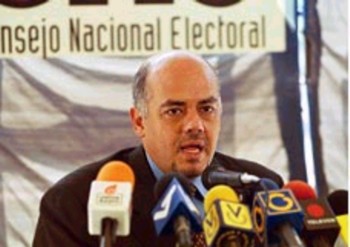
More than 1.800.000 new voters will participate in the revoking referendum, he said
(Here in Spanish)
The director Jorge Rodriguez revealed that although the results of the cadastre ordered by the CNE (Electoral National Committee), that he chairs, showed a "clear imbalance" in the location of the voting centers - that works against the citizens of the popular zones "there is no enough time" to open new points for the presidential revoking referendum.
Rodriguez informed in an exclusive interview, granted to the television transmitter Globovision, that, in order to correct the flaw, the electoral organism will make an educational campaign of information that will endeavour to obtain that "those subjects affected by the inequality may massively turn out" to exert their right to the vote.
The director stated that there was a record of signing in the Permanent Electoral Registry that surpassed all the expectations, which means that more than 1.800.000 new voters will participate in the recall of the 15 of August. He said that the organism would dedicate itself in the next days to tune up the automation contract, the verification of digital tracks agreement, as well as to the imprint of acts, ballots and to improve the electoral schedule.
Positive regulation
The chairman of the Andean Electoral Council, Nicanor Moscoso, went to the office of the CNE and guaranteed that they will participate as observers in the presidential revoking referendum of the 15 of August.
Moscoso met with the director Oscar Battaglini and, after the encounter, offered a press conference. He said in advanced that the institution will participate actively in the different phases allowed by the Venezuelan electoral council.
Moscoso was in agreement with the regulation of observation elaborated by the CNE although he did not know his content.
He is sure that the participation of the observers will make the process to be transparent and reliable.
July 12, 2004
Values and Interests
or, the bolivar bond market is soooooooooo boring...
So Justin's whole argument dissolves into what people used to call vulgar Marxism - the assumption that economic positions in society mechanically and automatically dictate people's political position. The rich are against Chavez because Chavez stands against their interests. Anything else is pretext or rhetoric. Moreover, since material position mechanistically determines political positions, Justin actually has a clearer understanding of why Teodoro Petkoff or Miguel Henrique Otero think the way they do than Teodoro or Miguel Henrique.
Good! It's a position that fits neatly into the logic of Chavez's central idea. A neat, morally satisfying ideological position. A position so neat and tidy it does away with the need to consider actual evidence.
Actual evidence, as we know, is boring. The Venezuelan public bond market, in particular, is a source of nearly limitless boredom to a good first world revolutionary. So it's maybe not surprising that Justin hasn't quite inquired into the dynamics of Venezuelan bolivar denominated public debt since 1998, the way it's grown more than six-fold in bolivar terms, coming to take up as much as half of banks' loan portfolios, setting off an interest-rate spiral, and - incidentally, becoming a huge, massive free lunch to the nation's barriga-verde oligarch bankers.
But wait, it doesn't make any sense! How could a government run by someone that talks like Chavez run a financial strategy that ends up yielding a massive redistribution in favor of oligarch bankers? This is not in the chavista script! It falls entirely outside the logic of his ideas. It is not explainable within the frame of reference of chavista ideology. Therefore, Justin's reaction is to assume, as a matter of course, that this must not be true. It cannot be true. It runs counter to his ideology - and when facts run counter to ideology, what does an ideological thinker say? Peor para los hechos...
Yet if he took a bit of time to look through the private banks' financial statements since 1998, he'd notice that while small and mid-sized businesses have collapsed en masse, while over half of industrial employers have folded, while informal employment and unemployment rise to the stratosphere, the banks wallow in pools of government cash, free money generated by the sky-high interest rates generated by the government's hyper-aggressive borrowing stance. This is, if you're willing to look at it objectively, a huge transfer of resources from small and medium employment-generating businesses to huge financial interests. However pretty Chavez's speeches might be, this is the actual legacy of his government.
Interestingly, almost all the bankers who've benefitted from this manguangua are virulently opposed to Chavez. Because they have interests, but they also have values, ideas, principles, and - just as importantly - children and grandchildren. Money is nice - but as any banker can understand, it doesn't do you any damn good to have money in a country with 13,000 murders a year, where you can't go outside at night and where it seems like a civil war could break out at any second.
The danger in exchanging the necessary insecurity of critical thinking for the total explanation of an ideology is not even so much the risk of falling for some usually vulgar, always uncritical assumption as of exchanging the freedom inherent in man's capacity to think for the strait jacket of logic with which man can force himself almost as violently as he is forced by some outside power.
So Justin's whole argument dissolves into what people used to call vulgar Marxism - the assumption that economic positions in society mechanically and automatically dictate people's political position. The rich are against Chavez because Chavez stands against their interests. Anything else is pretext or rhetoric. Moreover, since material position mechanistically determines political positions, Justin actually has a clearer understanding of why Teodoro Petkoff or Miguel Henrique Otero think the way they do than Teodoro or Miguel Henrique.
Good! It's a position that fits neatly into the logic of Chavez's central idea. A neat, morally satisfying ideological position. A position so neat and tidy it does away with the need to consider actual evidence.
Actual evidence, as we know, is boring. The Venezuelan public bond market, in particular, is a source of nearly limitless boredom to a good first world revolutionary. So it's maybe not surprising that Justin hasn't quite inquired into the dynamics of Venezuelan bolivar denominated public debt since 1998, the way it's grown more than six-fold in bolivar terms, coming to take up as much as half of banks' loan portfolios, setting off an interest-rate spiral, and - incidentally, becoming a huge, massive free lunch to the nation's barriga-verde oligarch bankers.
But wait, it doesn't make any sense! How could a government run by someone that talks like Chavez run a financial strategy that ends up yielding a massive redistribution in favor of oligarch bankers? This is not in the chavista script! It falls entirely outside the logic of his ideas. It is not explainable within the frame of reference of chavista ideology. Therefore, Justin's reaction is to assume, as a matter of course, that this must not be true. It cannot be true. It runs counter to his ideology - and when facts run counter to ideology, what does an ideological thinker say? Peor para los hechos...
Yet if he took a bit of time to look through the private banks' financial statements since 1998, he'd notice that while small and mid-sized businesses have collapsed en masse, while over half of industrial employers have folded, while informal employment and unemployment rise to the stratosphere, the banks wallow in pools of government cash, free money generated by the sky-high interest rates generated by the government's hyper-aggressive borrowing stance. This is, if you're willing to look at it objectively, a huge transfer of resources from small and medium employment-generating businesses to huge financial interests. However pretty Chavez's speeches might be, this is the actual legacy of his government.
Interestingly, almost all the bankers who've benefitted from this manguangua are virulently opposed to Chavez. Because they have interests, but they also have values, ideas, principles, and - just as importantly - children and grandchildren. Money is nice - but as any banker can understand, it doesn't do you any damn good to have money in a country with 13,000 murders a year, where you can't go outside at night and where it seems like a civil war could break out at any second.
The danger in exchanging the necessary insecurity of critical thinking for the total explanation of an ideology is not even so much the risk of falling for some usually vulgar, always uncritical assumption as of exchanging the freedom inherent in man's capacity to think for the strait jacket of logic with which man can force himself almost as violently as he is forced by some outside power.
¿Qué carajo pasa con la Coordinadora Democrática?
Sorry the headline is in Venezuelan Spanish, but I think it´s a major worry for all us Venezuelans living in Venezuela. What is going on? Why aren´t they doing something? Tuti: as a volunteer in the movement, can you offer any insights?
July 11, 2004
How Italian bar stool intellectuals come to think the way they think...
I've spent the last few weeks speaking to lots of random Italians about Venezuela - and last night, after asking any number of them what they know about Chavez and Venezuela, I had an epiphany. After talking to the Nth vaguely philochavista Italian bar-stool intellectual, I realized why they all think this way: there's a rarely acknowledged asymmetry in the information about Venezuela available to a news reader here, and in many ways it's exactly the opposite of what you might expect.
Chavista apologists see themselves as embattled purveyors of a truth the mainstream press wants to silence. But in fact, it's the opposition that rarely finds the space to tell its story in full to the newspaper readers of the first world. Unlike the chavistas, the opposition doesn't have an ideologically friendly and journalistically docile set of media outlets willing to tell their story, unadulterated, in full. Instead, they rely on a mainstream press that, though often villified as biased, has no choice but to make an effort at journalistic balance far beyond the norm in the lefty press.
If you read the mainstream papers intently, you realize that they're structurally different from the leftwing press. Whatever their personal feelings - and as first world liberals it's not hard to guess what they are - mainstream journalists are constrained by professional ethics to try to balance their reports and express, even if in extreme shorthand, the perceptions of both sides of the debate. Some do this better than others, but all are bound by the rules of the profession to at least make an attempt in that direction. So right next to the line about how "the opposition accuses Chavez of taking Venezuela on the path to Cuban-style communism" you will always read, "the government blames the opposition for the 2002 coup and the crippling general strike..." It may be extreme shorthand, but both sides are there.
Only the paranoia and persecution complex on the left makes it appear to them as though they're getting a raw deal in the mainstream press. But if you read the mainstream press closely, it's impossible to call it pro-opposition - in fact, the chavista's vision of an essentially oligarchical, privileged opposition angered essentially by Chavez's efforts at wealth redistribution is largely parroted by the mainstream press. The reality of an opposition that includes broad chunks of the Venezuelan left, millions of poor people and even the damn Trotskyite party is almost never acknowledged.
Still - as my good friend Hannah explains - to ideological thinkers, any story line that challenges, or casts doubt on, or complicates or even contextualizes a given ideological interpretation of events is, ipso facto, beyond the pale to an ideological thinker. Even mild criticism must be interpreted in terms intelligible within the frame of reference set out by the logic of their central idea. Put in other words, the structure of chavismo rules out the possibility of critical support or nuanced sympathy. Autocrats just won't settle for it. Patria o muerte.
Luckily for chavismo, the leftwing press, makes no analogous attempt to tell the entire story, to place it in context, to tell the story with all its ifs, ands and buts. There is no pretense in the leftwing press to try to put forward the other side's best argument, to try to understand the points of view of opponents as anything other than expressions of Bushophilia or economic privilege. Instead, Le monde diplomatique, Il Manifesto, The Nation, and the rest of them simply regurgitate the old, worn-out party line peddled out of Miraflores, a line that, as critically-minded Venezuelans know only too well, is riddled with inconsistencies, manipulations, and convenient lacunas of the memory.
A simple, morally satisfying falsification beats a messy, uncomfortable truth any day of the week. There is, of course, nothing new about that. Given the particularly ghastly record of the Bush administration on foreign policy, it becomes particularly easy for chavistas to manipulate the opinion of the well-meaning but underinformed. The mirror-image polarization of Venezuelan and first-world societies - ours around Chavez, theirs around Bush - makes it especially easy to sucker the uninitiated. As Greg Wilpert, Bernardo Alvarez, Ignacio Ramonet et. al. know only too well, half of Americans and 90% of Europeans don't need to know anything about a given story beyond what the Bush administration's position is. They'll adopt the opposite position uncritically, automatically, without the slightest need for consideration. It's a simple, straightforward dynamic, one that Hugo Chavez has gotten damn good at exploiting.
As a result, someone like Marjorie - an interested but ignorant gringa - barely has a chance. On an emotional level, her sympathy for Chavez will be automatic as soon as she hears one of his anti-Bush tirades. Reading the press gives her access only to a strangely warped slice of Venezuelan reality. She knows, in extreme schematized form, the opposition's basic beef with Chavez, and she knows, in quite some detail, the "heroic version" of the chavista revolution. But because there is no real right-wing analogue to the leftwing press in the first world (beyond Mary Anastasia O'Grady's columns in the Wall Street Journal), she really has no access to the heroic version of the opposition, to the detailed story about how and why the opposition has come to be so frontally opposed to Chavez and why, if a government in her country acted the way Chavez has acted in ours, she wouldn't stand for it for 10 seconds! Only a tiny minority who, like Marjorie, happen upon web sites like this one, has even a shadow of a chance to come to understand the problem more broadly and less ideologically.
So it's not surprising that Chavez has, in important ways, won the international opinion battle. First world news consumers have to do wayyy too much work to get a broader picture, including an obligatory turn through Google. The broad majority will simply read a couple of mainstream articles, mistake them for opposition apologism, then read a couple of leftwing press pieces, assume they're the real deal, and accept the pretty, reassuring, soothing, heroic vision of the embattled people's president doing battle against a rogue's gallery of privilege. It's really too much to expect anything more.
All of which brings us back to Orwell, and how truth and history mutate in the retelling. In time, if things keep going like this, the heroic version of chavismo will become the official story in broad parts of the first world. The April 11th cadena and the orden to activate Plan Avila have, in some ways, already been written out of the first world's understanding of that seminal moment in our contemporary history. In twenty years, I'm sure illuminated lefty history books on Latin America will report the glorious day when 8 million penniless people beat the CIA and the oligarchs on the streets of Venezuela.
Chavista apologists see themselves as embattled purveyors of a truth the mainstream press wants to silence. But in fact, it's the opposition that rarely finds the space to tell its story in full to the newspaper readers of the first world. Unlike the chavistas, the opposition doesn't have an ideologically friendly and journalistically docile set of media outlets willing to tell their story, unadulterated, in full. Instead, they rely on a mainstream press that, though often villified as biased, has no choice but to make an effort at journalistic balance far beyond the norm in the lefty press.
If you read the mainstream papers intently, you realize that they're structurally different from the leftwing press. Whatever their personal feelings - and as first world liberals it's not hard to guess what they are - mainstream journalists are constrained by professional ethics to try to balance their reports and express, even if in extreme shorthand, the perceptions of both sides of the debate. Some do this better than others, but all are bound by the rules of the profession to at least make an attempt in that direction. So right next to the line about how "the opposition accuses Chavez of taking Venezuela on the path to Cuban-style communism" you will always read, "the government blames the opposition for the 2002 coup and the crippling general strike..." It may be extreme shorthand, but both sides are there.
Only the paranoia and persecution complex on the left makes it appear to them as though they're getting a raw deal in the mainstream press. But if you read the mainstream press closely, it's impossible to call it pro-opposition - in fact, the chavista's vision of an essentially oligarchical, privileged opposition angered essentially by Chavez's efforts at wealth redistribution is largely parroted by the mainstream press. The reality of an opposition that includes broad chunks of the Venezuelan left, millions of poor people and even the damn Trotskyite party is almost never acknowledged.
Still - as my good friend Hannah explains - to ideological thinkers, any story line that challenges, or casts doubt on, or complicates or even contextualizes a given ideological interpretation of events is, ipso facto, beyond the pale to an ideological thinker. Even mild criticism must be interpreted in terms intelligible within the frame of reference set out by the logic of their central idea. Put in other words, the structure of chavismo rules out the possibility of critical support or nuanced sympathy. Autocrats just won't settle for it. Patria o muerte.
Luckily for chavismo, the leftwing press, makes no analogous attempt to tell the entire story, to place it in context, to tell the story with all its ifs, ands and buts. There is no pretense in the leftwing press to try to put forward the other side's best argument, to try to understand the points of view of opponents as anything other than expressions of Bushophilia or economic privilege. Instead, Le monde diplomatique, Il Manifesto, The Nation, and the rest of them simply regurgitate the old, worn-out party line peddled out of Miraflores, a line that, as critically-minded Venezuelans know only too well, is riddled with inconsistencies, manipulations, and convenient lacunas of the memory.
A simple, morally satisfying falsification beats a messy, uncomfortable truth any day of the week. There is, of course, nothing new about that. Given the particularly ghastly record of the Bush administration on foreign policy, it becomes particularly easy for chavistas to manipulate the opinion of the well-meaning but underinformed. The mirror-image polarization of Venezuelan and first-world societies - ours around Chavez, theirs around Bush - makes it especially easy to sucker the uninitiated. As Greg Wilpert, Bernardo Alvarez, Ignacio Ramonet et. al. know only too well, half of Americans and 90% of Europeans don't need to know anything about a given story beyond what the Bush administration's position is. They'll adopt the opposite position uncritically, automatically, without the slightest need for consideration. It's a simple, straightforward dynamic, one that Hugo Chavez has gotten damn good at exploiting.
As a result, someone like Marjorie - an interested but ignorant gringa - barely has a chance. On an emotional level, her sympathy for Chavez will be automatic as soon as she hears one of his anti-Bush tirades. Reading the press gives her access only to a strangely warped slice of Venezuelan reality. She knows, in extreme schematized form, the opposition's basic beef with Chavez, and she knows, in quite some detail, the "heroic version" of the chavista revolution. But because there is no real right-wing analogue to the leftwing press in the first world (beyond Mary Anastasia O'Grady's columns in the Wall Street Journal), she really has no access to the heroic version of the opposition, to the detailed story about how and why the opposition has come to be so frontally opposed to Chavez and why, if a government in her country acted the way Chavez has acted in ours, she wouldn't stand for it for 10 seconds! Only a tiny minority who, like Marjorie, happen upon web sites like this one, has even a shadow of a chance to come to understand the problem more broadly and less ideologically.
So it's not surprising that Chavez has, in important ways, won the international opinion battle. First world news consumers have to do wayyy too much work to get a broader picture, including an obligatory turn through Google. The broad majority will simply read a couple of mainstream articles, mistake them for opposition apologism, then read a couple of leftwing press pieces, assume they're the real deal, and accept the pretty, reassuring, soothing, heroic vision of the embattled people's president doing battle against a rogue's gallery of privilege. It's really too much to expect anything more.
All of which brings us back to Orwell, and how truth and history mutate in the retelling. In time, if things keep going like this, the heroic version of chavismo will become the official story in broad parts of the first world. The April 11th cadena and the orden to activate Plan Avila have, in some ways, already been written out of the first world's understanding of that seminal moment in our contemporary history. In twenty years, I'm sure illuminated lefty history books on Latin America will report the glorious day when 8 million penniless people beat the CIA and the oligarchs on the streets of Venezuela.
Subscribe to:
Posts (Atom)