January 17, 2006

The Petrostate that never went away: Part II

continued...

II: Our botched attempt at reform
Back in 1989, all you needed to do to realize how badly Venezuela needed reform was pick up a phone. On a bad day it could take half an hour or more to get a dial-tone. You’d unhook the phone, go make yourself a sandwich, check for a dial town, eat the sandwich, check for a dial tone again, wash your dishes and put away the mayonnaise, come back and check for a dial tone again…it was pretty ridiculous.

But once you’d managed to place the call, your troubles had only started: more often than not you’d have to go through the delightful ritual of the llamada ligada - the “linked call.” This was a queer little phenomenon where two entirely unrelated conversations would become entwined in the circuitry somehow, and you’d end up sharing your conversation with two complete strangers. Sometimes, these absurd little four-way interchanges would develop, as each set of callers tried to convince the other set to hang up and try their call again: of course, you didn’t want to be the one to hang up, because then you’d have to wait who-knows-how-long for a new dial tone.

Ah, the days of the nationalized phone company. Working with 40 year old equipment, CANTV (as the company’s called) was far, far behind the technological and service curves. Waiting times to get a new phone line could extend into months or years. Predictably, the delays spawned their own little hotbed of corruption: if you needed a new phone line, you had to pay off somebody inside CANTV to bump you to the front of the line.

Phone lines were such a scarce luxury that they carried a premium on the real-estate market: in the classified ads, people selling their apartments would advertise not just location and size, but, proudly, “con teléfono” – an item that would add a good 5% to the price of an apartment. Having a second phone line became the ultimate status-symbol, the height of conspicuous consumption.

It’s just one example, a particularly vivid one, but typical of the times. State-owned CANTV was prey to all the vices of clientelism run amok. Shielded from competition, the company could get away with bloody murder. As a consumer, you were powerless: a supplicant in the grip of a system that existed more to extract bribes than to provide phone service.

The CANTV-style attitude of total contempt for the user/citizen pervaded the state. Trying to get anything out of the bureaucracy was a nightmare. Registering your car or trying to get a passport or a cédula (a national ID card) became an exercise in frustration-control. Notoriously, even paying your taxes became a problem. Tax officials knew that you needed that little shard of official paper they controlled (the certificate that you’d paid your taxes) for a number of reasons – you couldn’t sell real estate without it, for instance - so you ended up in the incredible position of having to bribe an official for the privilege of paying your taxes! That’s how entrenched the culture of corruption was.

But the rot wasn’t confined to the micro-level: macroeconomically, the country was also in serious trouble. The Central Bank was more or less out of foreign reserves. Protected by years of tariff barriers and subsidies, Venezuelan businesses were inefficient, rent-seeking leeches cranking out substandard goods at inflated prices.

Thirty years of petrostate clientelism had turned the government into albatross around the nation’s neck. The public sector payroll was impossibly bloated. The petrostate model had degenerated into a full-employment scheme for governing party clients. In 1988, Venezuela had more public employees than Japan, but as the dark joke at the time went, “of course, in Japan they don’t get quality public services like we do here.” Lots of people on the state payroll showed up just twice a month to collect their paychecks, without doing any actual work. Many others treated their official salaries as a sort of retainer, but everyone understood that the real money was elsewhere – in the kickbacks, commissions and bribes that state jobs gave them access to.

A sprawling state-owned sector of the economy was made up of a single profit-making firm (PDVSA) and dozens of parasitic, loss-making firms that relied on oil revenue to stay afloat. Money that might have gone to build schools and hospitals went instead to prop up loss-making state sugar-refineries, banks, mining companies, airlines, even, famously, a fast-food joint in Caracas called "La Sifrina" (que tiempos aquellos!)

People were sick of it, and understandably so. But – and this is a crucial “but” – they didn’t see the need for root and branch reform. What they wanted was to see the petrostate fixed, not replaced. Venezuelan longed for the bonanza days of the 70s, when windfall oil revenues financed a huge and rapid expansion in consumer spending. If they were angry at politicians, it was because they thought politicians had failed to deliver on their basic mission to meet everyone’s needs by distributing the oil money fairly and generously. Do that, they figured, and the country could return to the good old days of the 70s.

Here we get back to the mental model that underpins the Venezuelan petrostate, and its founding myth that Venezuela is a fantastically rich country so all the state has to do is distribute the oil rents for everyone to live comfortably.

If you genuinely believe that, as 90% of Venezuelans still do, but you personally live in poverty, then the obvious inference is that the reason you’re poor is that somebody stole your fair share. Those adeco bastards!

Let me be clear about this: corruption really was a huge problem back then (still is.) But Venezuelans had wildly unrealistic notions how much their lives could improve if corruption was stamped out. Few grasped that even without corruption, the petrostate model was unworkable. The complicated structural and demographic reasons that made it fundamentally non-viable were not a part of the national debate. They were understood only partially even in academic and technocratic circles. So the perception that corruption was the whole of the problem in fact impeded a deeper examination of the real reasons the state had stopped working.

El Gocho pal '88
Lo and behold, the 1988 presidential election featured a candidate uniquely positioned to play into people’s anger at the state of the state: Carlos Andrés Pérez, who had actually been president once already, from 1974 to 1979, when the first big spike in petrodollars reached the country. CAP, as everyone called him, ran as an old style populist, promising to turn back the clock and govern just as he had the first time around. Venezuelans wanted a revamped petrostate, and he offered a revamped petrostate. Not surprisingly, he won by a landslide.
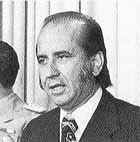

Now, what on earth CAP was thinking when he ran his campaign that way is still a subject of debate in Venezuela today. Looking back, it’s clear that the state was in no financial position to bankroll the whole of society anymore, and CAP must have known that. Some people think it was all a carefully calculated ploy from the start, that he knew he needed to talk the talk to get elected, but was aware all along that he wouldn’t walk the walk.

Not everyone agrees. As one delicious anecdote would have it, CAP was certain that he could revamp the petrostate because he had already worked out a preliminary deal with the incoming US administration. The soon-to-be secretary of the treasury was fully on board for a financial rescue package that would allow the Venezuelan government to keep doing business more or less as usual…and that incoming administration would be run by President Michael Dukakis. Oops.


Well, CAP won with a record number of votes, but of course Dukakis went down in flames. Literally weeks after being elected, CAP found himself at the head of a barely functioning, bankrupt state. He had little choice but to renege on pretty much everything he’d stood for during the campaign.

Instead, he announced a program of massive, IMF-sponsored structural reforms – lifting tariff barriers, dropping subsidies, privatizing state assets…a straightforward neoliberal, Washington Consensus type program. Now, it's easy to rant against the IMF, but context is key here. Given the scale of the mess that state finances were in, and the role petrodollar-funded patronage played in undermining state finances, there's a good case to be made that radical reform was badly needed with or without the IMF. Which, in general, is my critique of the standard critique of the IMF: put forward in a context-vacuum, it fails to take note of the entirely Venezuelan reasons why reform was necessary to overcome the bottlenecks generated by petrostate clientelism.

Be that as it may, it's also true that CAP's reforms were also a bald-faced betrayal of everything he’d stood for just weeks before he announced.

Venezuelans thought they’d elected CAP to fix the petrostate, instead, he immediately moved to dismantle it. It barely made a difference that the petrostate was badly in need of dismantling: anyone needing a phone-line in those days should have been able to see that. Consensus on the need for reform was confined to technocratic circles - the public sphere just was not on board.

The point is that there was nothing like political agreement for reform at that point. And CAP didn’t seem to think he needed to make the case for dismantling the petrostate. He thought he could just do it, steamroll over all opposition and present the country with a fait accompli. His thinking, apparently, was that the economic benefits of reform would be so evident within a couple of years that the critics of reform would be marginalized.

Alas, he miscalculated badly. First off, CAP was elected on an AD ticket, as the candidate of the party that benefited the most from the petrostate model. In fact, arguably the main source of resistance to CAP’s reform push was his own party. CAP might have had a road-to-Damascus moment sometime after Michael Dukakis imploded, but the rest of AD was still very much wedded to petrostate clientelism. And CAP’s reforms were plainly incompatible with their vision of the state.

Take CANTV. Sure, it was a nightmare for consumers, but who cares about consumers? For the AD patrons who got to run it, the phone company was a cherished power-base. Not only could they exploit their control over a scarce commodity – phone lines – to demand any number of bribes, enriching themselves and feeding their personal patronage networks, they could also use the company to listen in on their opponent’s phone conversations, to distribute CANTV jobs to clients, and, of course, to install multiple phone lines in their own homes. If you privatized the company, the phone system might start working, but the whole patron-client network it sustained would come crashing down.

Similar arguments could be made about any of four dozen other state institutions CAP wanted to sell off, streamline, or reform. From the state owned steel-maker to the public hotel network, every bit of the petrostate had a powerful set of AD caciques dead set against reform.

CAP's reform package would drive a dagger through the heart of the party’s whole racket - not surprisingly the caciques mobilized furiously against the president they’d just helped to elect.

Soon, CAP found himself engulfed in a rising tide of unmanageable protest and dissent. Every scrap of reform met strong resistance in congress. AD patrons exploited people's strong adherence to the petrostate cultural model to fuel resistance to reforms that would undermine their power bases. The IMF was predictably demonized, as was CAP for caving in to its demands. Many Venezuelans were genuinely outraged at what they saw as an unacceptable onslaught on their petrostate perks. In the end, too many people were too dependent on the cash that flowed through the patron-client networks for reform to be viable – and those who stood to lose the most were, by definition, easy to mobilize politically, precisely because they were part of the network.

The straw that broke the camel’s back came when the government cut back its fuel subsidies at the end February 1989. Public transport operators responded to a 10% increase in gas prices by doubling fares, and the shit hit the fan.
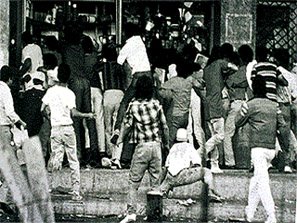

On February 27th, 1989, a group of far-left agitators in Guarenas, a Caracas suburb, started a small riot over the fare hikes. The riot spread incredibly quickly, first to Caracas itself and then throughout the country. For three days Venezuela went through an unprecedented spasm of rioting, arson, and very widespread looting. The police was helpless in the face of the sudden outburst of anarchy. Eventually, the government called out army troops with orders to shoot rioters on sight. At least several hundred people were shot dead in the next two days, by some estimates the real toll was over a thousand.
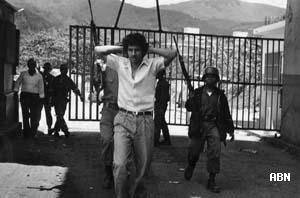

It was the end of Venezuela’s age of innocence.

The effect of the 1989 riots was in some ways analogous to 9/11 in the US: the event transformed the country deeply. Until then, Venezuelans had seen themselves as different, more civilized, more democratic, better than their Latin American neighbors. 31 years of unbroken, stable, petrostate-funded democracy had made us terribly cocky. In a sense, the riots marked Venezuela’s entry into Latin America. The country was no longer different: just another hard-up Latin American country struggling to put its democracy on a stable footing.
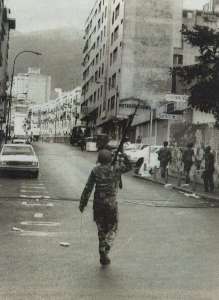

CAP’s reform program was seriously hobbled by the riots, but it continued, at half-steam, for another 4 years. Economically, it was a relative success – after a serious recession in 1989 that saw the economy contract by 10.9%, Venezuela experienced real economic growth for the first time since the 70s. Real per capita income was expanding steadily: 3.9% in 1990, 7.1% in ‘91, 3.6% in ‘92 - though, again this was helped by the spike in oil prices following Irak's invasion of Kuwait. From a narrowly economic point of view, it seemed to be working.

But none of that mattered to the old-style patrons, the 10,000 little caciques heading up administrative fiefdoms large and small throughout the country. What they cared about was power, and CAP’s program constituted too big a threat to their habitual way of getting it. From their perches in AD’s National Executive Committee, in congress, in the courts, the nationalized companies and the labor movement, they were extraordinarily well placed to wreck the reform drive.
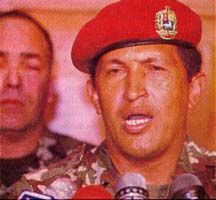
It was during the third year of this little CAP vs. AD psychodrama that a certain army lieutenant colonel first entered the public scene…and with a bang. On February 4th, 1992, a group of junior officers launched a bloody coup attempt against the elected government. The crazy adventure – the first time someone had tried to overthrow a Venezuelan government by force of arms since the 60s – left about a hundred dead. But it also turned its leader into a kind of folk hero – the valiant paratrooper willing to put his life on the line to stop CAP’s outrageous drive to dismantle the cherished petrostate.
The coup-plotting lieutenant colonel went to jail, where he whiled away two years reading (but not understanding) Rousseau, Bolivar and Walt Whitman.
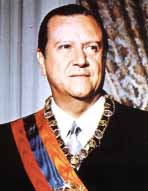
In those two years, the government faced a second, even bloodier coup attempt by officers loosely associated with the first. Eventually, CAP was impeached by his fellow AD party members on flimsy charges, and after a brief interim government, the presidency passed to yet another petrostate dinosaur – Rafael Caldera, who had also been president already, but even further back than CAP, in 1969-1974.

Like CAP, Caldera ran as an old style populist. Unlike CAP, Caldera governed like one.

The Return of the Mummy

By the time he reached power for the second time, Rafael Caldera was over 80 years old. He’d spent 58 of those years in front-line politics. Frail, some would say decrepit, his voice tremulous and barely audible, he wasn’t exactly the kind of leader you’d turn to for bold new ideas. Caldera tried to patch up the old petrostate system – the only one he understood – as best he could.
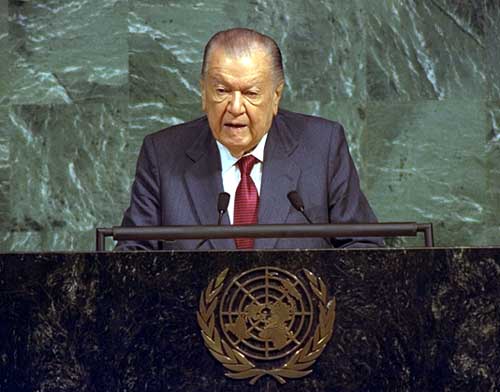


Predictably, he failed. Corruption continued unabated, cronyism as well, while the banking sector collapsed, the economy languished, and the nation’s collective impoverishment continued afoot. Eventually, he was persuaded of the need for some reform, including an important overhaul of the criminal system and of social security. But he didn’t understand, much less share, the notion that the basic model of the state he had spent a lifetime championing needed a total overhaul.

If the petrostate was well past its sell-by date in 1989, by the end of Caldera's term in 1998 it was putrefact. Nobody doubted that the country needed a serious shake-up, a massive jolt to move beyond the stagnation and decay of the last 20 years.

Indeed, all three of the candidates who ever looked to have a serious shot at power that year were anti-establishment figures, people who’d built political careers outside the traditional party system. The country faced a choice between a one-time Miss Universe turned centrist mayor of a wealthy district of Caracas, a reformist conservative governor from Carabobo State, Henrique Salas, and the aforementioned leftist Lieutenant Colonel (who’d been pardoned by Caldera and released from prison in the meantime.)

Disenchantment with the old party structures ran so deep that Copei didn’t even bother to try to run a party insider as candidate. Instead, they tried to co-opt the beauty queen, Irene Saez, who collapsed in the polls the second she accepted their nomination. As always, AD was the last to get the message: they nominated Luis Alfaro Ucero, a semi-literate 80 year-old cacique, a sort of capo di tutti i capi sitting at the pinnacle of the party’s patronage structure. The guy never got beyond 7% in the polls. The much vaunted adeco patronage machine had sputtered to a halt. Soon enough, it was all down to the governor and the coupster, and it was clear that the election would go to the one who best voiced the people’s virulent rage at the ongoing failure of the petrostate.
And if that’s the game you’re playing, nobody but nobody beats Hugo Chavez.

III: From institutional clientelism to the Chavista cult of personality

The scene went down in the middle of one of his infamous, never-ending televised speeches in 2004. President Chavez had barely hit his stride when something caught his eye. His tone changed. Concerned, he started looking towards the scaffolding to the left of the stage he was using, the one used to put up the lights for the speech.

"Hey, come down from there," he said in a soft, fatherly tone, "no, don't climb to the front, it's hot there because of the lights...that's right, climb down towards the back. Don't worry, you'll get to talk to me. I want to hear your problem. I saw you crying earlier, just, just come down from the scaffolding and come up here."

Soon, a 15 year old kid has climbed down from the scaffolding and is walking towards the stage. He's crying. Chavez calls him up to the podium. With the camera's running, millions of people watching, Chavez takes him, hugs him hard and holds him for, oh, 45 seconds or a minute, while he the kid tells him, in between sobs, how his father recently died and his mother is sick and he can't afford the medicines to make her better...Chavez listens at length, pets his hair, assures him that he's going to help him.

The crowd is ecstatic, chanting "that, that, that's the way to govern!"

Welcome to the new era of chavista postinstitutional clientelism. This sort of thing is typical of Chavez's governing style. The president never turns down a personal plea for help, at least not in public. His weekly TV call in show amounts to a parade of supplicants - each week, the lucky few who manage to get their calls through see their wishes for a job or a pair of crutches or an operation fulfilled. The president works hard to make the entire audience feel how much he wants to help them all, personally, one by one.

Obviously, this brand of clientelism is quite a different animal from the old adeco version. Just as obviously, it's still clientelism.

Chavez's peculiar contribution to the concept has been to cut out the middlemen. In the old system, each client's relationship was with the patron immediately above him. But the chavista patronage system only has two levels: the president and everyone else. The old system was held together on the basis of the personal bonds between people in adjacent levels of the pyramid. These days, the relationships that hold up the system are imagined rather than personal - the charismatic leader's bond with each of his followers individually.

Chavistas are, in a sense, imagined clients.

Though Chavez has spent billions of dollars on emergency social programs that effectively re-distribute petrodollars to his political supporters (the famous misiones) I'd argue that his success has almost as much to do with raw sentiment, with primary identifications. Many chavistas feel deeply, personally, almost mystically wedded to the president - the intensity of their emotions towards him are hard to overstate. I've heard journalists describe meeting chavistas who carry nothing in their wallets but an ID card, an icon of the virgin mary, and a picture of El Comandante.

That's a departure from what we'd seen before. In the old system, the relationship between patrons and clients was basically a quid-pro-quo, a matter of mutual interest. Insofar as feelings played into it at all, they didn't go beyond a certain deference born of respect and fear of the boss. With Chavez, the bond comes from the heart. Chavez's rhetoric is so powerful he makes people want to see him as a saviour: they want to cry on his shoulders, they want to redeem themselves through him.

In other words, Chavez's bright idea for moving beyond the outdated system of vertical interpersonal relations is to replace it with a cult of personality.

It's bad news.

In the old system, the state had two fully independent institutions: AD and Copei. It's true, it's terrible that there were only two real institutions around, that the
courts and the elections authorities and the nationalized companies and every other part of the state was subjugated to one party or the other. But at least there were two of them!

If nothing else, AD and Copei served to balance each other off. No truly transcendent decision could be made without at least a tacit agreement between the two.

Moreover, each of the two big parties was a complex institution in its own right. Their National Executive Committees were composed of factions that had to deliberate with one another to set the party's position on any given issue. Each faction would press the interests of a given constituency - the pro-business faction would haggle with the labor bureau to agree on the party's minimum wage policy and the peasant representatives would hash out the party's position on agricultural imports in talks with the technocrat wing. Each party had its own internal deliberative process. It was hardly a model of tocquevilian pluralism, granted, but at least some deliberation and interest-aggregation took place.

In the chavista state, there is only one institution: Hugo Chavez. Note that I'm not talking about the office of President of the Republic, I'm talking about Hugo Chavez personally. When an important policy decision has to be made, the only deliberations that matter take place between his ears.

All loyalties are directed at him personally. Supporters are in no doubt, their gratitude for the misiones is not directed at the state generally but at him personally. With the president locked in a circle circle of relentlessly sycophantic collaborators, all dissent is equated with treason. The one man who makes every relevant decision personally is never confronted with a view of the world that differs one iota from his own.Chavez has largely blurred the the institutional distinctions between state, government, party, presidency and president. The result is an accelerated decay in the state's institutional structure, to the point where no part of the state can act independently of Hugo Chavez personally. Venezuela today is an exercise in turbocharged personalism.

Clearly, some aspects of the petrostate model have changed - everyone recognizes this. What I'd like to highlight, though, are the elements of continuity - elements that are often underestimated in commentary about Chavez. If the basic petrostate trick is to turn control of the state's oil dollars into control of the state, Chavez has merely brought the system up to date, yielding a petrostate for the 21st century.

Of course, Chavez thinks of himself as the pre-eminent critic of the post-1958 state. But his critique is based on ideas that have always been at the heart of the petrostate's cultural model. Chavez certainly thinks he's rebuilding Venezuela's political and social structures from the ground up. But like so many self-described revolutionaries before him, he's blind to how much his vision has in common with the old regime.

Again, the central conceit of the petrostate cultural model is the idea that the state can and should use its oil wealth to bankroll society. Rather than a critique of the petrostate as such, what Chavez provides is a critique of the way it went astray in the 1970s and 1980s, and particularly of attempts to dismantle it, such as CAP's.

Chavez doesn't realize it it, but his outlook places him squarely in the intellectual tradition pioneered by Romulo Betancourt more than 50 years ago. Because the clear implication of his line of reasoning is that the old party bosses forfeited the state's mission, which was to distribute petrodollars to the people. Ultimately, Chavez is just peddling a very old petrostate line - the old longing to fix the petrostate, to reform the unreformable.

That longing has been the key to his political success. In beating the old petrostate drum, Chavez taps into a rich vein of Venezuelan culture. Breaking the petrostate's hierarchical social system is child's play compared to the monumental task of breaking the petrostate as an idea, as a collective understanding of what the state is for. And Chavez never challenged the dominant understanding on that score, he merely leveraged it to his own advantage.

In 1998, the voters wanted to hear someone tell them that the country is rich, that prosperity is their birthright, and that the only reason they are poor is that their share of the oil money was stolen. They wanted to hear that because that was what they intimately believed. And Chavez articulated it brilliantly. With amazing vigor and charisma, he captured the volcanic anger people felt about the breakdown of the old model. Chavez became their voice. So they voted for him. What could be more natural?

There's just one minor inconvenience: the Chavez era has made the petrostate model even more unworkable than it was at the outset. Oil production has fallen. Chavez's mismanagement of the oil industry has left the state dependent on periodic oil booms to generate the resource stream he needs to finance his promises.

That's worth a brief explanation. Those of us who don't work in the oil industry tend to think of oil wells more or less as water faucets: you want oil, you just turn the thing on. It doesn't quite work that way. As oil wells age, their pressure decreases, and increasingly complex methods are necessary to keep the black stuff flowing. That costs money, so, as oil wells get older, you need to invest more and more money just to stay even. Venezuela's rate of depletion runs at about 20% a year, meaning that, in the absence of new investment, that's how much our production capacity would fall each year.

Hugo Chavez either doesn't understand that or doesn't care. Since 1999 his government has pressured PDVSA so hard to hand over more and more cash that the oil men haven't had enough money on hand to even maintain capacity. Insufficient investment has sent Venezuela's capacity tumbling - from 3.8 million barrels per day in 1998, capacity had fallen to about 3.3 million b/d at the end of 2002. After the oil strike, capacity is thought to have shrunk farther still, though reliable data is hard to come by. In December 2005, the International Energy Agency, perhaps the most impartial source on the matter, reported Venezuelan production was down to 2.6 million b/d.

So one of the many, many contradictions and ironies of the chavista era is that the president hangs on to the petrostate's founding myth even as he chips away at the oil industry's ability to finance it. If the state couldn't really afford to bankroll society in 1988, and less still in 1998, it really, really can't today.

January 16, 2006

Institutional Decay Chronicles


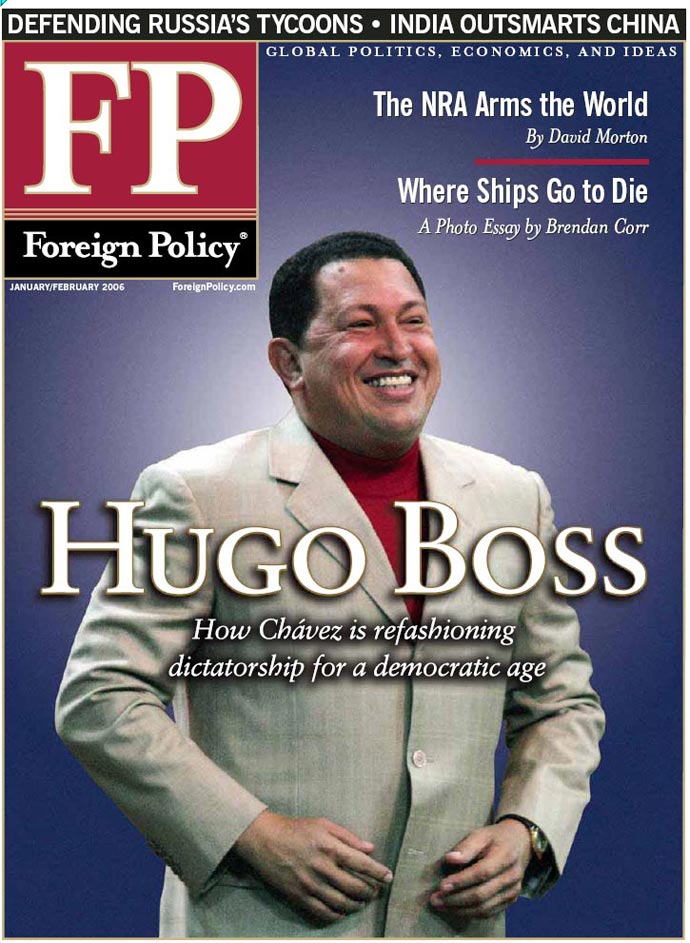
Huguito gets a front-page thrashing in the current issue of Foreign Policy. The piece by Argentine political scientist Javier Corrales is a good read, though I'm still trying to get my head around the idea of "competitive authoritarianism."

My only problem with it concerns an omission: Corrales doesn't mention the chavista takeover of the Fiscalia, the Prosecutor General's Office, as an important piece of the chavista takeover of the state. This is a common oversight - even some of the best foreign observers tend to miss the significance of having the only office that can launch a criminal investigation in the hands of a Chavez crony. To my mind, though, the emasculated fiscalia is at the center of the implicit guarantee of impunity for Chavez supporters and of the ongoing sotto voce threat to his detractors, and should be seen as at least as pernicious as the chavista Supreme Tribunal, if not more so.

In any case, Corrales' piece places particular emphasis on the debasement of Venezuela's state institutions - which I've always thought is the crux of what's objectionable about chavismo - so I'm going to put it on the Reader's Guide to Venezuela in the Chavez Era.

January 15, 2006

A postcard from the end of the world

It's 11:30 in Chile, and I'm watching TV.

Pundits and politicians are hard at work breaking down the triumph of Michelle Bachelet in today's Presidential elections. Instead of wondering why results are still missing in spite of very expensive electoral machinery, Chileans had official results with 99% of the votes counted by 9 pm local time. Instead of claims of fraud, they are breaking down the vote by gender line -in Chile, men and women vote separately, so it's possible to break down voting patterns- and by counties. All the information is already on the government's website. All this thanks to a transparent system based on a piece of paper, a pencil, a glass urn and an impeccable voter registry - a system that, in spite of being handled by the Interior Ministry, is impartial and trustworthy.

Is it healthy envy to ask myself why? Why can Chile have a working electoral system that everyone trusts, while Venezuela's citizens have en masse been forced to abandon the vote as an alternative? How can two countries with similar cultural circumstances have such different systems, with such vastly different outcomes? Only Jorge Rodríguez and his conscience can answer this.

In the meantime, I am amazed to see the international chavista brigade celebrate Bachelet's triumph as another swing to the left in the continent. Ms. Flanker, in the comments forum, has gone as far as saying that, since Bachelet's platform was based on modifying the private pension system, this is enough to place her bust on the lefty mantlepiece. These arguments show a deep, unabashed ignorance of what Chile has become and the type of policies that have driven its success.

Chile is the only Latin American country firmly on the way to development. It is developing thanks to many of the neoliberal policies that lefties decry. This is a country where a socialist President has inaugurated thousands of kilometers of ultra-modern highways built and managed by private companies in record time. Here, foreign businessmen come and build private parks that effectively cut the country in half (Google Douglas Tomkins for more details) and the discussion centers on whether or not the country has the right to build a road through his land. Chileans have access to modern health-care and pensions thanks to the participation of private industry. The system is not without flaws, but it is miles away from Venezuela's state-run system.

The country's main industry, copper, is wide open to local and foreign private investment. Tuition in public universities runs in the thousands of dollars per year, but this socialist government (and the coming one) have understood that effective subsidies are those that target the person in need, not those that provide free-for-alls that allow people who don't need them to benefit. This has helped put Chilean universities at the vanguard in the sub-continent.

This is a socialist government that has pledged to run a fiscal surplus, and Bachelet has pledged to continue on this path and promised not to raise taxes. Chile's socialist government has partnered private industry, and has signed free-trade agreements with the US, the EU, South Korea and China. Japan and India are soon follow.

Sure, there are problems in Chile. The pensions system is not working well, but Bachelet's reforms involve lower fees, more competition and tighter regulation. It has never crossed her mind that private industry should be shoved out of the system. Likewise, educational achievement has been lagging. But instead of blaming private education, the rich or the Catholic Church, like He-who-must-not-be-named has recently done, solutions are more innovative: vouchers, increased testing, teacher education, investment in "target" public shools. Income inequality is alarming, but she does not blame it on the rich.

So PSFs, here's some advice: try and not look so ignorant. Ms. Bachelet will preside over a government more "neoliberal" than any Venezuela has ever seen. More than CAP's, more than the second half of Caldera's, more than anything that Primero Justicia is proposing. She will also preside over a more succesful government than anything Venezuela has seen.

As I read Venezuelan news from afar tonight, my nostalgia mixes with rage. In spite of this, I am happy that my daughter could go vote with her Chilean parent today and learn what democracy is about. Some day, when she is older, I will tell her about how in Venezuela we had a democracy and we let it go to waste because we did not address its many flaws. I will also teach her to love Venezuela in spite of all her failures. I will teach her that the struggle for democracy is the most noble task our people face. And I will teach her that this includes her as well.

Chavez as divine retribution? Or Cardinal Castillo Lara off the deep end?

Lets get one thing straight: I enjoy seeing Chavez get a good tongue lashing as much as the next guy. But reading Cardinal Castillo Lara's scathing Divina Pastora homily-cum-campaign-speech, I can't shake the sense that the guy went way, way too far. Towards the end, he actually compares Chavez to the bubonic plague, musing that "perhaps our lord Jesus Christ has wanted to teach us a tough lesson for our faithlessness."

Is it just me, or is there a whiff of theological devaluation about this particular method of divine retribution? Time was when the good lord punished infidelity with plagues of locusts and such...these days? He sends down tinpot populists, I guess.

January 14, 2006

All aboard the Failure Express !

It's hard to take chavistas seriously when they try to hide the Chávez government's obvious failure in terms of infrastructure.

We know the government has failed in terms of housing. We know it failed to provide a solution to the slow and well-announced deterioration of the Caracas-La Guaira highway. We know the remodeling of the Maiquetía airport is still more than five years behind schedule. We know they are way behind in the repairs of Central Park's East Tower. And, thanks to the Internet, we are reminded they are way, way, way behind in finishing the Tuy Railroad. But then, what can you expect when you have such incompetent fools drilling the tunnels through which the train is supposed to pass?

The train of history seems to have passed them by.

January 13, 2006

World Social Forum Files: The Housing Crisis

With the World Social Forum meeting due to be held in Caracas later this month, I figure at least some of the 80,000 kids planning to travel to Caracas for this shindig will be scurrying around the Internet looking for information on the revolution. My next few posts go to them, with the heartfelt hope that you'll read them with an open mind. The piece below is an "oldie but a goodie" - written in June 2004, it tackles an issue that has, sadly, only become more relevant in the last few weeks. Keep it in mind as you travel that long, slow road from the airport up to Caracas.

No Magic Solutions for Venezuela's Housing Crisis
One of the most interesting articles I've written about Venezuela grew out of a meeting with five privileged white men who had held positions of some prestige under the old regime. They harshly condemned Chavez's performance and called for policy to take a radical new direction. They threw their hands up in frustration as they considered the government's folly, shook their heads gravely as they described how they'd been excluded from the spheres of power, and generally despaired over their powerlessness to influence policy in the slightest.

Alemo
The five were members of Alemo, a think-tank dealing with Venezuela's urban housing crisis. Professional architects and urban planners - most are professors at the Universidad Central de Venezuela - they have spent two decades in in-depth study of the challenges posed by Venezuela's mushrooming shantytowns, known as barrios. With a bureaucrat's fastidious concern for for detail, they have documented the problem, thought through the policy alternatives, costed the various possibilities, and published the lot. In their view, the rock-bottom, lowest-imaginable price-tag for bringing all of Venezuela's urban dwellers to a basic standard of safety and comfort would come to a harsh $60 billion.

The price-tag is astronomical - over 60% of GDP, over twice the government's global yearly spending. Even if, as Alemo urges, the cost is spread over 10 years, a $6 billion/year price tag would require quadrupling the country's housing budget.

It's hardly a surprise, since Alemo's study just quantifies the disastrous housing shortage you can see in any Venezuelan city. One-third of the country's housing stock consists of ranchos - shanties. However, fully half of all Venezuelans live in ranchos. Thousands of ranchos need to be bulldozed and replaced - they sit on geologically unstable ground, and could give way at the next rainstorm - while hundreds of thousands require investment to bring them up to minimal standards of safety and crowding. Moreover, hundreds of barrios need major investments to bring in basic urban amenities - from electricity and sanitation to schools, infermeries, playing fields and roads good enough for buses to use.

How did Alemo arrive at its $60 billion figure? The process was long and involved, but the innitial question was simple enough: what would it take to build a Venezuela where everyone who lives in a city has access to basic urban services, nobody lives at very high-risk areas for flooding or mudslides, nobody lives in extremely crowded or dangerously deteriorated housing, and the housing stock grows quickly enough to absorb the new families looking for places of their own as they hit their 20s?

To keep costs more or less reasonable, Alemo applied deep cost-cutting measures in their calculation, including a radical plan for the state to construct "proto-houses" (with all services, but minimal construction area) that residents would subsequently expand and complete, as well as financing mechanisms that would split costs between the state and beneficiary families. So the $6 billion/year tag is a rock-bottom figure, the very least the state could spend and still hope to meet its goals. Spend much less than that, and the problem deepens rather than receding.

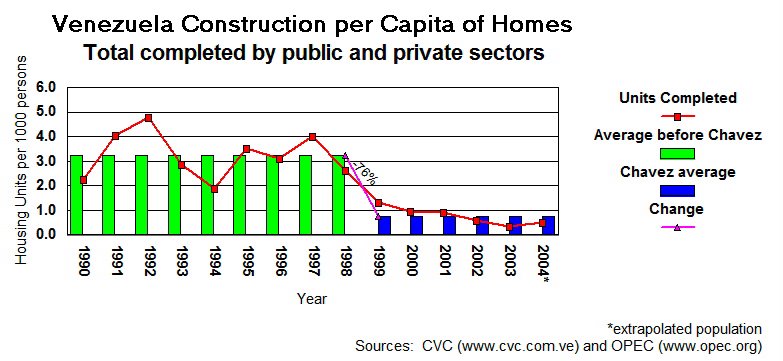
"Normally," I remember them telling me, "you'd need to build at least 100,000 new low-income houses a year - not to reduce current levels of crowding, but just to keep up with population growth - just to stay even. To start to make some headway against the truly appalling level of crowding in some ranchos, you'd be talking about 120,000 houses a year, at least. Since the start of the Chavez era, we've never seen more than 60,000 houses a year. So, in effect, we're going backwards: every house that you come up short from that 100,000 target means another family forced to choose between squatting on an empty plot of land and building a rancho with their hands, or staying put and living in increasingly intolerable crowding with their relatives."

Serious Planning
Of course, this is just one area of concern: expert NGOs could (and have) come up with similar analyses for hospitals, schools, social security, the fire-fighters, the police, prisons, essentially any part of Venezuela's huge, overbloated but underfunded state. Alemo's approach is based on a long, hard, careful, uncompromising look at the policy problem followed by specific proposals for budgeted, thought-through solutions. These are soft-hearts and hard-heads at work - their conviction is that the more urgent a human problem is, the more down-to-earth and meticulous the planning for a solution should be. You can call their outlook technocratic if you want, but in my book Alemo's outlook represent a hard-bitten marriage of idealism and pragmatism that eschews magical solutions and urges the state to tackle these matters with eyes wide open.

Now, how has the Chavez administration responded to Alemo's calls? The answer goes a long ways towards explaining my despair about the government. First, the chavistas purged Alemo members from all state institutions dealing with urban housing - putting the state's housing bureaucracy in the hands of doctrinaire chavistas that would neither produce independent estimates nor raise troubling questions. Then, it set out to confuse the issue, making oversized claims for its decidedly undersized achievements.

At no point since 1999 has Venezuela come anywhere near to building the 100,000 low income housing units per year that it would take to keep up with population growth, let alone make headway into the housing crisis. Yet the government, conscious that very few people know this, continues to obfuscate, touting its house-building totals - just 25,000 units in 2003 - as major revolutionary triumphs! Stop and think about what this means: 25,000 new houses built means 75,000 poor Venezuelan families were forced to either build themselves a shanty or stay on in impossibly cramped quarters...and the revolutionary people's government brags about this as a success.

What's the purpose of this detour into the minutiae of the Venezuelan low-income housing crisis?

Government supporters tend to start from the assumption that the only reason anyone might oppose Chavez is class self-interest. What's most irksome about Chavez to many of us, however, is the magical strain in his government's thinking: its blanket rejection of any kind of independent advice, criticism, or debate, and its outright disdain for specialist know-how and hard-knuckled planning. Its dogmatism, its deep suspition about the motives of critics, locks the government into stances that not only cannot solve the problems at hand, but, even worse, close down the spaces for genuine debate about them, banishing people like Alemo to the ranks of counter-revolutionary elements.

The results is a politics of social inclusion that remains confined to the rhetorical realm - Chavez's discourse certainly makes his constituents feel included - while deepening the country's social problems. Point out that Chavez's housing policy will force 50,000 families to squat and build shanties next year and you're condemned as a Bush-collaborator, an escualido fifth column that needs to be purged from the state.

It's hard to overstate the chilling effect the resulting climate of intimidation has on free and open debate, on honest deliberations of the country's problems. If you know the truth and the truth doesn't fit the party line, you learn to keep quiet just to protect yourself. Debate on a matter as seemingly apolitical as housing becomes deeply politicized, and those who question the government's policy are dismissed as CIA agents or coup-plotters before their criticisms are even considered.

This "management style" consistently rewards ideological conformity and magical solutions over serious planning. In such an environment, pleasing fictions are always preferable to uncomfortable facts.

So long as criticism is seen as prima facie evidence of treason, so long as critics' voices are ignored as a matter of principle, so long as the worst of motives are automatically ascribed to all who dissent, the government will continue to make policy inside an ideological bubble where loyalty counts for far more than serious planning. Instead of no-nonsense social policy, instead of budgeted estimates and effective projects, instead of serious plans aimed solving longstanding problems, we'll continue to get what we've been getting: ad hoc measures aimed at short-term political advantaged and divorced from any kind of serious analysis of what needs to be done in the long term.

Or, to say it in a single word, populism.


Chart contributed by Torres.

January 12, 2006

Killer Facts on Iran's Blogosphere...

Iran has an estimated three million to seven million Internet users, the most in the Middle East. Between 65,000 and 100,000 Iranians post blogs, many of them evading government filters by jumping from server to server. In 2004, however, the hard-liners began cracking down on Internet dissent, using both filtering technology and old-fashioned harassment. By October, twenty-one Iranians were imprisoned in connection with blogs. Most were technical administrators of Web sites, but seven were political writers.

Though it ranks 28th in number of overall-speakers, Farsi is the second most often-used language for blogging, after English.

Much more on the Persian blogosphere...

The flip-side of the oil boom...

Erm...ahem...[wipe away egg on face] cough-cough...post eliminated because it was all wrong...

January 11, 2006

Context, context, context!

Think too much has been made of Chavez's "christ-killer" remarks? The devil is in the context...

1. Iran said it will resume nuclear fuel research today,
despite Western warnings it could jeopardise any efforts to end the long-running standoff over Tehran's nuclear programme. The EU has warned the move would jeopardise any resumption of wider talks on ending the crisis with the West over Iran's nuclear activities.

Mohamed ElBaradei, the usually cool-headed boss of the UN's nuclear watchdog, said that by resuming nuclear fuel research in defiance of previous agreements, Tehran could have crossed a "red line" that made a tough response inevitable. "We are at a stage where what is happening this week could turn into a major crisis," ElBaradei told the BBC.


2. Iranian President Mahmoud Ahmadinejad was expected to convene a conference in Iran within a few days dedicated to denying the Holocaust.
In response, Israel began preparing for a campaign targeted at eliciting international condemnation of the conference.

The Israeli Yad Vashem Holocaust Memorial Centre said Wednesday it viewed with 'growing concern' what it termed Iran's continued Holocaust denial and called on the international community to act 'to prevent genocidal intentions from becoming genocidal capabilities'.


3. Venezuela and Iran have agreed to explore setting up a joint shipbuilding operation
in the South American country, Venezuela's state oil company said Friday. The preliminary agreement signed Monday envisions jointly building oil tankers, liquid natural gas tankers and other vessels, and training Venezuelans in shipbuilding technology.

Ties between the two oil-producing countries have tightened as President Hugo Chavez has sought to build international alliances to counter U.S. economic and political dominance. The two governments have signed dozens of agreements, including plans for a cement company, an auto parts plant and a project to build 10,000 homes in Venezuela. On Monday, they agreed to jointly survey and certify heavy crude deposits in Venezuela's oil-rich Orinoco river belt.

January 10, 2006

Goose? Check! Gander?...ummmm...no check...

Barquisimeto, Jan 09 2006. ABN.- The National Council for the Protection of Children and Adolescents in Barquisimeto opened an administrative procedure against Tal Cual over the article entitled "Dear Rosinés" by Laureano Márquez, published on November 25, 2005...for violating the honor, reputation, self-image, privacy and intimacy of child Rosinés Chávez Rodríguez, the youngest daughter of President Hugo Chávez.

Quite right. Dragging the president's kids into political diatribe is so disgusting...I say throw the book at the lot of them...

Burning bridges leaves you an island

If there's one thing we should've learned from watching Chávez tumble his way to a dictatorship, it's that there's a price to pay for the things you say. It seems that some in the opposition lack the strategic sense to know when to shut up.

I was thinking about this while reading the communiqué published by several hundred prominent opposition intellectuals and activists and sent to OAS Secretary General José Miguel Insulza. While everything in it is true, and while the language has obviously been tersed down from what was probably a more indignant first draft, I think this document is a mistake. Frankly, it's ruder and more condescending than it needs to be. It also fails to note the key point made in these reports: that current voting technology in Venezuela does not safeguard the secrecy of the vote.

When the OAS monitoring report came out, the Venezuelan government was furious about it. While the report considered the actual election process clean (rightly so - after all, there's no need to cheat when there is only one party competing), it also pointed out the many irregularities that prompted opposition parties to withdraw, including the damning recognition that the technology currently in place in the Venezuelan system compromised the secrecy of the vote.

When Mr. Insulza talked about this in a summit in Bolivia, Chávez went after him like the rabid dog that he is. Insulza then made his best effort to tone down his rhetoric and cool down the government hotheads.

This communiqué is a response to an interview Insulza gave to the influential Chilean daily El Mercurio. I read the interview, and although I was disappointed that he didn't give more weight to the numerous irregularities, it was clear to me that he was trying to get on the government's good side in order to continue working on fixing the flaws the Mission witnessed.

It's sad that so many in the opposition don't understand that for the OAS to play any constructive role in Venezuela, its leadership must be seen as impartial by the government. If the government does not like the OAS negotiator, then it will simply not participate in any sort of constructive dialogue.

Let's think of the opposite scenario: suppose that Insulza had publicly restated all the irregularities noted in the OAS document. Suppose, also, that Insulza had gone as far as saying that a Parliament without an opposition is not legitimate, and that therefore Venezuela must restore credibility by accepting the OAS Mission's recommendations. It doesn't take a genius to see that Chávez would have reacted virulently, denounced him as an agent of imperialism and started maneouvering to end his tenure in the OAS. It's not far-fetched to believe Chávez has that kind of power, given how he's become the hemisphere's Santa Claus. So the opposition would be left with the support of a jobless Insulza, and that's of no use to our cause.

The only way international bodies can be of any use in the establishment of democracy in Venezuela is if the current government does not see them as agents of the opposition. Sometimes that is going to require that the middle-man show Chávez some respect.

Denouncing this as treason or implying Insulza sold out to Chavez is an exercise in counter-productive reductionism, which will only deepen the opposition leadership's amateurish image. What Insulza is doing is diplomacy at work. Let's remember that Insulza managed to convince the British to let Pinochet go home, and he was the key architect in negotiating with Chile's far right for the dismantling of the most un-democratic aspects of Chile's constitution. He's no chavista, and he knows what he's doing. Now, can the opposition be a little more constructive and not get in its own way?

January 9, 2006

Credibility Stakes

Prominent Jewish rights group, the Simon Wiesenthal Center,
accused Venezuelan President Hugo Chavez on Wednesday of using what it said were anti-Semitic remarks and demanded an apology.
In a televised Christmas Eve speech, Chavez, a left-winger and a former soldier, said that "minorities, descendants of those who crucified Christ ... have grabbed all the wealth of the world for themselves."
Chavez, a Catholic, did not mention the Jewish people and in the same comments referred to the betrayal of Venezuelan liberation hero Simon Bolivar. But the group said his remarks represented central arguments of anti-Semitism -- accusing the Jews of killing Jesus Christ and associating them with wealth.
"Both elements have served as a perfect excuse to justify the most cruel persecution and killing during two millenniums," the Wiesenthal center said in a statement.

Justin Delacour opines,
as for Chavez's supposed "anti-semitic remarks," that story is entirely fabricated. He didn't say anything about Jews. As I pointed out at TPMcafe, Chavez often refers to Jesus Christ as the first socialist. When Chavez speaks of "minorities" that "crucified" Christ and Bolivar, he's referring to minorities in a political and socio-economic sense, not in an ethnic or religious sense. He's not directing his comments at Romans or Jews. He's referring to exactly what he says he's referring to: "minorities" (i.e. oligarchies, aristocracies, ruling classes, etc.) that have "appropriated the riches of the world" and "concentrated wealth in a small number of hands."
Now, for some folks, Chavez's populist discourse may sound a bit wacky, or it may smack of class warfare, but there's nothing anti-semitic in what he's saying.

But of course Justin knows more about anti-semitism than the Simon Wiesenthal Center...

January 7, 2006

Thirteenth Century Socialism

Thanks to Katy for pointing to this typically flabbergasting bit of Chavez non-sense. In the context of a long-winded attack against evil, greedy, neoliberal roasters who obdurately refuse to sell coffee for less than it costs them to buy the beans and roast them, Chavez threatened to nationalize the coffee-roasting industry. Putting his most reasonable face forward, Chavez blamed hoarding by the roasters for recent coffee shortages, saying the government is willing to "pay them what the coffee is really worth" and stressing he would approve only "just" price rises.

It's all more than this poor economics grad student can bear. The whole line of reasoning is medieval...and I mean that not as some esoteric slur, but as a straightforward description. The last time this kind of argument enjoyed intellectual standing was roughly 750 years ago, when Thomas Aquinas was on the cutting edge of economics and his theory of just price held sway. Put another way, Chavista economics has been discredited for half a millenium, give or take.

Call it Socialismo del Siglo XIII.

Of course, as a pretext to nationalize random industries it will do just fine: pinch manufacturer's margins away through absurd price controls, and when they refuse to play along, slam them for greed and take over their industries. Can't fail.

January 6, 2006

From my inbox...


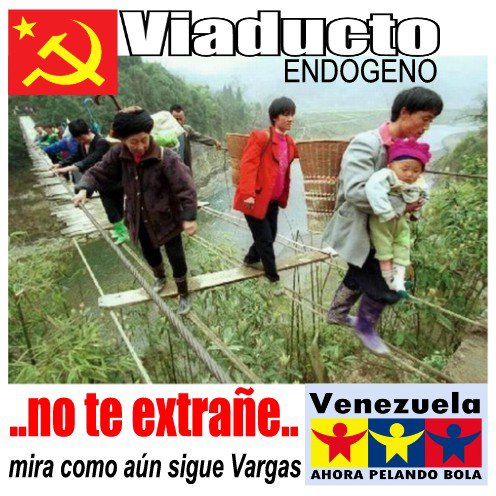
Translated: Endogenous Viaduct...don't be surprised, look at Vargas State...

Venezuela is now screwed...

Viaducto Chronicles

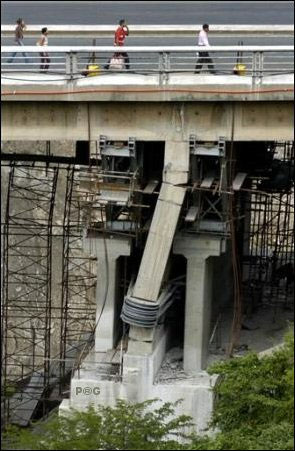
Yesterday, I had a good laugh about it, but all kidding aside the closure of the Caracas-La Guaira highway has staggering implications. The more I think about it, the more I realize what a mess this is. And it's not just a problem for Caracas and La Guaira, but for the whole country.

I have a feeling foreign readers will have a hard time grasping what a disaster this is, so I'll break it down for people who haven't been there...

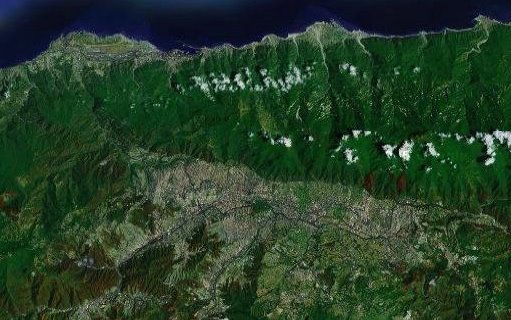
As you can see in this Google Maps image, Caracas is built on a high valley, set off from the sea by a string of mountains.


Thing is, the port and the airport are both on the seaside. The highway that was closed yesterday was the only proper road linking Caracas with the coast. With that highway closed:

1-There's no easy way to get in or out of Carcas by air.
2-There's no easy way to supply Caracas by sea.
3-The hundreds of thousands of people who live by the seaside and work in Caracas can't get to and from work.

There are two alternate routes to get from Caracas to La Guaira, the main seaside town. The first is the "old road" - a two-lane road that follows along the tracks the Spanish built in the sixteenth century, basically a glorified donkey-cart path. Without traffic, it takes about two and a half or three hours to go from Caracas to La Guaira on the old road - but, obviously, if you re-route all the highway traffic, the old road will turn into one gigantic, neverending traffic jam.

Worse still, the old road is fringed by some of Caracas's most violent slums for most of the way, and is known as one of the most dangerous in the country. Being stuck in traffic for hours on end on the old road is a truly scary prospect.

The only alternative would be the Carayaca road, which serves a hill-top village between Caracas and La Guaira and takes about four hours to transit at the best of times. I've never been on it, but I understand the Carayaca road peters out into a dirt track for most of the way. I doubt it's suitable for heavy trucking.

In terms of air travel, I suppose people will have to start using the Los Caracas airport (which is a small, private airport on the south side of Caracas that was never meant to be used by large jets) or the Valencia airport - which, at 3 hours away by road, is now closer to Caracas than Maiquetia (!) Diosdado Cabello was even talking about rerouting air traffic to Higuerote and Ocumare del Tuy - come on, those aren't even airports, they're more like landing strips! All the options are bad, but I suppose something can be worked out. For sure the hassle quotient will be high, and airlines will take a big hit.

In terms of shipping, I suppose the port of Puerto Cabello will have to take most of the load - but again, it's neither big enough or close enough to really substitute La Guaira. And you have to bear in mind that La Guaira port served not just Caracas, but much of the country. With the highway closed, the port is next to useless, and the consequences will be felt far beyond Caracas.

The worst hit will be the huge number of La Guaira residents who work in Caracas. The Central Coast has increasingly come to be used as a suburb by Caraqueños looking for relatively affordable housing. It will be months before they can commute to and from work again. How will they get by? I have no clue...

January 5, 2006

My little joke, and Rangel's

It's a bit silly and probably a little cruel, I know, but I have this little joke I like to play when I go down to Maiquetia to pick up foreign friends or journos flying into Caracas for the first time. On our way up to the city, as we start going over the infamous Viaducto Uno, I turn to them and say, "you know, for years engineers have been warning that this bridge could collapse any minute." They usually turn to me, half-horrified, hoping for me to tell them I'm just kidding. "Are you serious?" they'll ask, and I shoot back: "Serious as a heart attack."

I've been playing that little joke for years - I think it helps foreigners to start to get a feel for what they can expect in Venezuela.

Today, though, Vicepresident Jose Vicente Rangel one-upped me. On the day the one and only proper road connecting Caracas to its port and airport finally had to be shut down because the viaducto's collapse is now judged to be imminent, JVR told journalists:

"It wasn't known that this could happen, and whoever says the opposite is speaking recklessly. This happened due to the weather in recent days which have shifted the hillside. Fourteen million tons of earth are pressuring the bridge. That can happen to any construction in any country on earth."

Condorito style...PLOP!

Handouts or Handcuffs: The Leftist-Populist Dilemma

Here's a quick theory about the level of authoritarian repression you're likely to see in Latin America's growing crop of leftist-populist regimes:

ar = 1 / pg

where ar stands for authoritarian repression and pg for populist goodies.

It's pretty simple: a leftist-populist regime's number one objective is to stay in power. Since it can't offer its supporters genuine progress, economic growth or long-term poverty alleviation, a leftist-populist government has two ways to cement its hold on power: it can buy people's support and/or repress dissent. The more money a leftist-populist government has to buy support, the less it needs to turn to authoritarian repression to keep its handle on power.

The theory explains why hard-up Castro needs to ban political parties and jail journalists to keep control of Cuba, while petrodollar flush Chavez can achieve the same thing by handing out goodies.

Needless to say, penniless leftist-populists that get shy about repression have a way of getting tossed out of office (e.g. Allende, Ortega, Lucio Gutierrez, etc. etc.)

If the theory holds, Evo Morales is likely to have to turn to much harsher authoritarian repression much sooner than Chavez has had to: Evo just won't have the kind of money that allows Chavez to keep control without mass repression. If he gets too cute and fails to crack down, you can expect him to get booted out, whether by the ballot or the bullet.

Thing is, no country in Latin America can count on the kind of revenue stream PDVSA allows, so this is one grim theory for the region. Schafik Handal, Ollanta Humala, even a resurgent Daniel Ortega would face much tougher resource constraints than Chavez faces. Perhaps only Lopez Obrador could really hope to buy allegiances quite as ecumenically as Chavez has done. In a few years time Chavez could come to look like a relative liberal in the leftist-populist set.

No volverá a pasar, número uno...

Not freaked out by the prospect of a Nuclear Chávez yet? This may be a good time to start...
CARACAS, Venezuela, Jan 4 (Reuters) - Thieves in Venezuela have stolen equipment containing radioactive material used in the oil industry, in the latest in a string of similar incidents, officials said on Wednesday.

Angel Diaz, head of the energy ministry's nuclear affairs department, warned the Cesium-137 material could cause contamination if exposed. The equipment, used in oil prospecting, was stolen last week in eastern Anzoategui State.

Authorities arrested three police officers in December after they were linked to the robbery of a truck carrying a device containing Iridium-192, used to check oil pipelines.

Two other capsules with Iridium-192 went missing in March through negligence in two separate incidents. Both of those capsules have since been found, one dumped in Lake Maracaibo in the west of the country.

More...

January 4, 2006

Recipe for Misiones

Evo Morales has been swept into power, and he is soon to be followed by Chávez-clone Ollanta Humala who already seems to be benefitting from Mr. Chávez's (i.e. our) generous checkbook. So now seems to be a good time to go over the recipes for the much-ballyhooed Chavista misiones which will allow the new Presidents to appear as demi-gods to the PSFs, more interested in those appearing to help the poor rather than in actually helping them.

Misión Barrio Adentro
1. Import thousands of Cuban paramedics.
2. Disregard your own country's medical human resources.
3. Break your country's laws by allowing these paramedics to practice medicine unsupervised in your country.
4. Set them up to work in neglected poor areas, living with families and using some of these volunteers' living rooms as examination rooms.
5. Continue the neglect of your country's hospital and health-care infrastructure.
6. Denounce anyone who wonders why you don't create appropriate physical infrastructure for this Misión as a CIA agent.
7. Denounce anyone who wonders why you don't open the books of the Misión to see how much it costs the public as a CIA agent.
8. Denounce anyone who wonders if there are any books for the Misión as a CIA agent.
9. Denounce anyone who criticizes you for not using local doctors and instead relying on Cuban paramedics who may or may not have the necessary training and who operate illegally, as a CIA agent.
10. Denounce anyone who wonders why these Cubans are forcibly sent to Venezuela while their families are held hostage in Cuba, as CIA agents.

Misión Mercal
1. Set up a bunch of small supermarkets in neglected areas selling sub-par, imported food below cost.
2. Sell this food at a subsidized price to anyone who wants it, so the more a person consumes, the more that person will recieve in subsidies.
3. Expand your network to include middle-class areas.
4. Denounce anyone who wonders why a system that rewards those that consume more (i.e. are wealthier) with more subsidy money as a CIA agent.
5. Denounce anyone who wonders why middle-class people need subsidized food when that money could be spent in direct subsidies for poorer people, as a CIA agent.
6. Denounce anyone who wonders why the military staff managing Mercal demands Mercal providers to supply the government with buses to haul voters to the polls, as a CIA agent.
7. Denounce anyone who questions why the government needs to actually RUN supermarkets when trying to subsidize its poorest citizens (a worthy goal if any), as a CIA agent.
8. Denounce anyone who wonders about the sudden wealth of the Mercal generals as a CIA agent.
9. Denounce anyone who wonders if Mercal is a way of putting private supermarkets out of business as a CIA agent.
10. Denounce anyone who wonders why middle-men seem to be buying cheap stuff at Mercal and selling it to supermarkets at high prices as a CIA agent.
11. Denounce anyone who asks to see the books of Misión Mercal as a CIA agent.

Misión Cadivi
1. Subsidize the purchase of dollars.
2. Use these subsidies to keep private industry concentrated on getting subsidies from your government, and away from trying to unseat you.
3. Subsidize the wealthy who wish to travel overseas.
4. Subsidize the wealthy who wish to purchase stuff from the Internet.
5. Subsidize the wealthy who wish to withdraw cash from foreign ATMs.
6. Denounce anyone who wonders if directly subsidizing big businesses, wealthy Venezuelan tourists and foreign airlines is sound social policy, as a CIA agent.

Misión Robinson
1. Teach some people to read and write.
2. Proclaim the Unesco has declared your country illiteracy-free.
3. Deny any progress in literacy ever occurred prior to your arrival.
4. Denounce anyone who wonders why Unesco knows nothing about Venezuela being illiteracy-free, as a CIA agent.
5. Denounce anyone who still does not know how to read and write as a CIA agent.

Misión Identidad
1. Announce a massive plan to hand out ID cards and register people to vote.
2. Set up make-shift ID-card impression operations in sidewalks, bull-fighting rings and under coconut tress.
3. Don't ask for any corroborating data when handing out ID cards.
4. Nationalize and register to vote any foreigner who asks for it, making sure they know how to vote for you.
5. Deny indentity cards and passports to anyone who has dared to challenge you publicly.
6. Continue allowing your civil servants to enrich themselves by taking bribes for issuing passports.
7. Denounce anyone who wonders why Venezuela does not have a modern, reliable and accessible civil registry as a CIA agent.
8. Denounce anyone who wonders why thousands of people born prior to 1900 are registered to vote as a CIA agent.
9. Denounce anyone who wonders why there are voting centers where thousands of voters share the same last name and birthday as ... well, you know what.

Dedicated to all my Peruvian and Bolivian friends.

January 3, 2006

What would you rather have, a job or a misión?

To save or to consume? It's the most fundamental economic choice of them all. If you have $10 in your pocket you can buy beer or put it in a savings account. If you have a multi-billion dollar oil windfall you can hand it out to your political supporters or you can build infrastructure. Choices of this kind face economic agents up and down the line: Households face them, firms face them, governments face them, the rich face them, the poor face them, even Robinson Crusoe on his island would face them - everyone faces them.

But save...why would you save? Well, to invest. By investing, you can consume more later than you can consume today. The invest/consume decision is really about whether you'd rather consume a little bit less now or a little bit more later.

In terms of development, the reasoning is intuitively obvious and the empirical evidence is pretty well established. Poor countries that choose to invest less grow more slowly. Poor countries that manage to invest more grow more quickly.

In a sense, it's a tautology - just a fancy way of saying "countries that choose to consume less now and more in the future consume more in the future"...and it really is that simple...

Different countries at different times have found different institutional mechanisms to boost investment and each time the result has been a spurt of economic growth. Holland in the 17th century invented the stock market, which allowed far more efficient allocation of savings than ever before, boosting returns on investment and growth, and allowing this tiny sliver of northwestern Europe to become an authentic world hegemon for fifty years or so.

The Soviet Union in the 1950s invented crash-industrialization, where dictatorial violence was applied to force a massive reallocation of resources from current consumption to investment. In human terms, the results were terrible - in economic terms, Stalin's crash-industrialization drive led to one of the fastest episodes of economic growth in history.

My point here is obviously not to urge stalinist economic tactics, just to point out that the invest/consume decision is not limited to capitalist economies. Every economic decision-maker has to make it at every moment. And if the task is to launch a poor country on the road to self-sustaining growth, boosting the level of investment seems to be the trick.

This is a point that Harvard economist Dani Rodrik has made again and again in a series of very lucid recent papers.

Rodrik, a darling of the anti-WTO left, emphasizes that many different policies can achieve the ultimate goal of boosting investment. He stresses that there is no one-size-fits-all solution to the boosting-investment conundrum, that IMF-style policies often don't help, and that some of the most successful solutions out there (such as China's state owned Town and Village Enterprises) are very far removed from Western economic orthodoxies. And in this highly influential paper (co-authored with Venezuela's very own Francisco Rodríguez) - he argues that increased international trade (as well as trade openness) are consequences rather than causes of economic growth, which ultimately has to be sparked by an investment boom.

However much he may dissent from IMF orthodoxy, Rodrik's stress is always on investment as the key to unleashing a growth dynamic. (But only as a start-up mechanism, Rodrik doesn't dissent from the widespread consensus that launching a country into growth is a very different challenge from sustaining that growth.)

To my mind, Rodrik is perhaps the most lucid development economist out there today. I'm convinced by most of what he has to say...and I think any serious critique of chavista economics has to start with the simple realization that development policies succeed or fail depending on how they affect investment.

As I noted above, this is not a critique of socialism per se - socialism had an answer to the problem of how to boost investment (i.e. just decree it by dictatorial fiat.) But it is a critique of Chavez style populism - an economic "strategy" based entirely around handing out the state's revenue stream to sustain his supporters' current consumption. With even PDVSA, the state's cash cow, suicidally starved of investment, it's clear chavismo has no long-term vision for investing Venezuela's way to development.

In the end, though, investment means growth and growth means jobs. And it's a proper job with a proper income that allows people to make their way out of poverty. Chavez-style populism can offer people misiones, but only a concerted effort to boost investment can generate the jobs that people really need to stop being poor.

Which is why the best way to make the case against chavista populism is to put the consume/invest decision in the starkest possible terms. Ask people whether they'd rather have a job or a misión, and they'll choose the job every time...

Jackson Diehl on the hemisphere circling the drain...

WashPost op-ed columnist Jackson Diehl's take on the year to come from a gringo perspective...
Here's a sad but safe new year's prediction: U.S. relations with Latin America, which plunged to their lowest point in decades in 2005, will get still worse in 2006.

The year ended with a string of reverses. In a regional summit in Mar del Plata, Argentina, in November, President Bush was jeered by demonstrators and taunted by Venezuela's Hugo Chavez, who aspires to make Latin America anti-American and anti-democratic. He was seconded by Argentina's Nestor Kirchner, who in the past few weeks has moved from the hemisphere's camp of moderate democratic leftists toward Chavez's "revolutionary" embrace.

Then came the Chavez-backed victory in Bolivia of Evo Morales, a former llama herder and coca farmer who describes himself as Washington's "nightmare." Lacking any coherent policies of his own, Morales will probably take instruction from Chavez, Kirchner and Fidel Castro -- who at age 79 must believe he is finally seeing the emergence of the totalitarian bloc he and Che Guevara tried and failed to create in the 1960s.


More...

December 24, 2005

'Tis the season...


Please accept with no obligation, implied or implicit my best wishes for a socially responsible, gender neutral, celebration of the winter solstice holiday, practised within the most enjoyable traditions of the religious persuasion of your choice, or secular practices of your choice, with respect for the religious/secular persuasions and/or traditions of others, or their choice not to practice religious or secular traditions at all, together with a fiscally successful, personally fulfilling, and medically uncomplicated recognition of the onset of the generally accepted calendar year 2006, without prejudice for the calendars of choice of the rich tapestry of pre-columbine and extraeuropean cultures.

December 23, 2005

Chacon: Hard at work going soft on crime

Venezuela is one of the most violent countries on earth. Averaging 43 murders every single day, street crime in Venezuela can fairly be said to be totally out of control. The government, alas, doesn't seem to have noticed. Its response to the epidemic of violence has been silence.

Yesterday, finally, Interior Minister Jesse Chacon touched on the issue. His plan? To turn Venezuelan jails into "penitentiary communities" where prisoners can meet their families and work in a "humanized environment."

Now, I'm not generally given to right-wing tirades about coddling criminals, and given Venezuelan jails' tragic human rights record, any move to improve conditions should be welcomed. Nevertheless, Chacon's priorities strike me as bizarrely misplaced. In the midsts of the grinding daily bloodbath that grips the country, the interior minister's big new policy idea is to make jails nicer!

[shameless political aside: when will the opposition start to make political capital out of the government's utter lack of concern for people's safety?]

December 22, 2005

Top 10 reasons why there's no coffee in Venezuela's supermarkets

10. There's no coffee in Cuban supermarkets, either.
9. Chávez drank it all waiting for Evo Morales' election results.
8. They are smuggling it to Colombia and Brazil, where the lack of good coffee is noteworthy.
7. There's a lot of good coffee stuck in La Guaira, they just can't get it over the damn Viaducto.
6. Drinking coffee became imperialistic since we found out Starbucks is not an endogenous cooperative.
5. There's tons of coffee for you - if you didn't sign.
4. It's stored in a mythical chavista place where they store Venezuelan passports, the evidence in the Anderson murder and bi-directional super-spying DirectTV boxes.
3. There's plenty of good coffee in all Venezuelan stores. This is another media conspiracy.
2. It's being given away to the poor people of the Bronx to keep warm this winter.

and the #1 reason there's no coffee in Venezuelan supermarkets is of course...

1. It's a CIA conspiracy!

PS.- Of course, we all know the real reason is that the government, in a brilliant stroke of Soviet wisdom, increased the controlled price paid to growers and forbade the increase in the controlled price earned by manufacturers. Ergo, there is scarcity, as any first-year economics student could have predicted.

Even a broken clock tells the time twice a day

Most chavistas accuse us in the opposition of being rabid lunatics who only see their own side of the story, or something along those lines. So, in the interest of impartiality, and in accordance with the spirit of togetherness that we should embrace during the holiday season, I translate the following note from El Universal.

"On the last working day of the year, the court in charge of the murder of Ms. Maritza Ron has convicted
Yohon Carlos Jiménez Esalas, Henry José Parra Linero and Pedro Celestino Ramos Poche, aka 'the Altamira shooters', to 11 years of prison.

These three men opened fire against a group of demonstrators congregated in Altamira Square a few hours after the Presidential Recall election, to protest against the fraud denounced by leaders of the Democratic Coordinator.


The shooting resulted in the death of Ms Ron, 61,
and in the injuries of José Miguel Acheta, Elio Acevedo, Luisa Amelia Marcano, Hilda Mendoza, Jairo Martínez, Emilio Hernández, Nancy Castro and Ernesto Alvarenga.

The General Prosecutor's office, thanks to Prosecutors Alejandro Castillo and Yoneiba Parra, charges Parra Linero with intentional homicide with corresponding complicity, causing serious and minor injuries and illegal posession of a handgun. Jiménez and Ramos were charged with illegal posession of a handgun and public intimidation." (end of quote)

Now, I don't know where the "locked-up cat" is in all of this, and by no means does this change the overwhelming opinion from this side of the tracks regarding the incompetence and partiality of the Prosecutor General's office and the justice system in general. And I don't even want to comment on the fact that shooting at demonstrators and killing and injuring people only gets you 11 years in prison, which will probably end up being 6 thanks to parole, breaks for "good behavior" and other nonsense. However, credit where credit is due: if this is indeed the case and these guys are going to jail, then justice has been served in a higher measure than most of us expected. So there you go Isaías, Merry Christmas.

December 20, 2005

Taking Stock of Hong Kong

Well, I'm on my way back to Europe now, and I thought I'd write one last WTO post to bring together some of my thoughts about the week. I guess it's the first time I ever blog from a plane - brace yourselves, folks: I have a 13 hour flight ahead of me, so this one is going to be loooooong...

Yesterday's agreement left a lot of people feeling like the ministerial was a big waste of time. The Economist called it "little more than an expensive experiment in sleep deprivation." Even Pascal Lamy, the WTO Director General, accepted how modest progress has been: coming into Hong Kong, he said, the WTO had completed 55% of the work on the Doha Round, and after last week, "it's up to 60%." (Never mind that just two months ago Hong Kong was being billed as the meeting that would settle 99% of the round.)

In the end, Hong Kongers saw traffic go all haywire for an entire week and big chunks of their city trashed by protesters for the sake of a deal that only highlights its own shortcomings.

While the deal itself may be more like a symptom than a cure, it's also true that, diplomatically, all the big players walked away with at least some of what they wanted...

Pascal Lamy got what he wanted: even though the organization can't actually agree on any fundamental issues, the headline from the ministerial was still "WTO reaches agreement." This is important: the WTO's viability as an international organization was very much in the spotlight in Hong Kong, and the pressure to agree on something was immense. Lamy couldn't afford another spectacle like the one they had in Cancun, with incandescently pissed-off LDC ministers walking out left and right. To his credit, Lamy did not try to force a consensus on the developing countries - the tactic that created so much bad blood in Cancun - and instead let the delegations themselves build up an agreement. As a result, though the Doha Round is surely still on life support, it's not quite dead.

Brazil got what it wanted: the long-standing dream of consolidating a no-bullshit developing country block at the WTO - preferably under Brazilian leadership - was finally realized. In fact, the Brazilians did even better than that: they managed to rope in some developed countries - Canada, Australia and New Zealand - into their sprawling, 110-country coalition as well. Though it has a smaller, less dynamic, and slower-growing economy than India, Brazil managed to appoint itself tacit boss of a negotiating block that accounts for 80% of the world's population spread over five continents, from Vanuatu to Cameroon to Indonesia to Mexico to Uzbekistan. Amazingly, though they have very very different interests, the group held together. However crappy the ultimate deal, the summit was a very significant victory for Lula's diplomacy.

The West African Cotton Producers got what they wanted: a deal to end US export subsidies next year, and, in principle, for the US to cut domestic cotton subsidies faster than it cuts other agricultural subsidies (once such cuts are agreed - supposedly by the end of April.) The deal is incomplete - the language on cutting domestic cotton subsidies is vague and non-committal - but still, for four of the weakest, poorest, least powerful countries on earth to wrangle any concessions at all out of the Americans at a WTO negotiation is totally unprecedented - and, again, a testament to the value of Brazilian diplomacy, which put the 110-member developing country group squarely behind the West Africans' demands.

Alas, the EU also got what it wanted: permission to keep screwing African farmers for another seven years. Disgusting though I find it, I have to chalk it up as a success for them. The EU showed conclusively that intransigence and brinksmanship pay off in these negotiations. By holding out until the very, very last minute, they got a deal on agricultural export subsidies so weak it's hard to know what it even means.

It's not just that they extended the use of export subsidies for another seven long years, oh no. Though it hasn't gotten much press, it's also that the EU's commitment to end agricultural export subsidies is conditional - they'll only deliver if the US reforms its food aid program (which the EU sees as a disguised export subsidy) and Australia, Canada and New Zealand end their state marketing monopolies (e.g. the Canadian Wheat Board.) So it's more than the glacial pace of the phase-out, it's that they left the door open to come back and say "no fair! the US didn't reform its food aid enough, we're going back on the deal!" Ugh!

Finally, the US got what it wanted: positioning itself as the "honest partner" for the developing countries that the Europeans will not be: the kinder, gentler economic power at the WTO. The contrast between Portman's relative flexibility and the utter rigidity in Mandelson's position was impossible to miss. And the softly-softly approach got the US some negotiating outcomes they may not otherwise have achieved.

For one thing, the Hong Kong Declaration approved the "Swiss Formula" as the method for cutting industrial tariffs. It gets very technical very quickly, I realize, but the Swiss Formula is a mathematical formula designed to cut higher tariffs more than lower tariffs, leaving tariffs both lower and less dispersed than they started. (Everything you ever wanted to know about the Swiss Formula but were afraid to ask is here.) The Swiss Formula has always been the US's preferred tariff-cutting method (though, in one of those bizarre little WTO asides, it turns out Switzerland doesn't like it!) The detail that the devil is in still has to be worked out, but the Swiss Formula is generally seen as a very aggressive tariff-cutting mechanism.

A lot of people in the lefty-NGO community are horrified about this - and there's no question that, if implemented aggressively, Swiss Formula tariff cuts can be brutal. Personally, I'm holding out to see the details. Whether this is good or bad for development depends on how many coefficients they agree to, and the actual coefficients they decide on. Since the coefficients were the really hairy part of the negotiation, they obviously couldn't agree on them.

I'll say one thing, though. For a long time, one of the major complaints of the antiglobalization crowd about the WTO has been "peak tariffs" and "tariff escalation." Peak tariffs are very high tariff lines applied to just a few selected products - like rice in Japan, which faces a 200% tariff, even though the average tariff in Japan is under 3%. Tariff escalation is the practice of applying higher tariffs to processed products than to raw materials. The classic example of this is cashew nuts produced in Mozambique: if you apply a tariff of 1% on raw cashews but a 30% tariff on roasted cashews, you obviously build in an incentive for Mozambique to export the raw nuts, rather than to roast them in Mozambique. That's bad news for Mozambique's cashew-roasters, and for poor countries' efforts to industrialize in general.

My point here is that the Swiss Formula is the best way to address both of these problems. Its whole point is to lessen the dispersion of final tariff rates. The Swiss Formula makes peak tariffs impossible and tariff escalation ineffective. Since developed countries will likely have to cut tariffs more aggressively than developing countries, there's at least a chance that the agreement will be development friendly. It all depends on the actual coefficients they settle on, and there's a very big fight looming over those in the months ahead. But personally I don't see how these Oxfam types can spend 10 years railing against peak tariffs and tariff escalation and then turn right around and slam the one proposal guaranteed to do away with them.

The other major point where the US got what it wanted was in the so-called "Development Package" - the proposal to give the 32 poorest countries unrestricted access to rich country markets. During the negotiation, the least developed countries kept pushing for the deal to be made permanent, legally binding and to apply to all products coming from all least developed countries. On this issue, if on nothing else, the EU sided with the poor countries. But the US and Japan resisted it for two reasons: textiles and rice.

For the US, the big problem was with Bangladeshi textiles. Though classified as a Least Developed Country for WTO purposes, Bangladesh has become very, very competitive in the textile sector, and the US feared that an uncontrolled import surge from Bangladesh would put US clothes producers out of business. At one point, the US actually argued that, in the textile sector, Bangladesh is a developed country! (The Bangladeshi journalist who told me this tidbit couldn't control the sarcasm: "thank goodness that these Americans let us know about that: all those years I thought I was living in a really poor country and it turns out we were textile-developed all along!") Japan had similar concerns about Cambodian rice.

In the end, Japan and the US got their way: the final deal will give the poorest countries quota free/tariff free access to 97% of rich country markets, allowing rich countries to exempt 3% of their tariff lines. Moreover, the deal is described not as "binding" - meaning mandatory under international law - but as "lasting" - which is a legally meaningless word.

Still, that's something you might read about in the newspaper and think "dang...lasting agreement...97%...that's pretty good!" But, of course, LDC exports are concentrated in very few tariff lines. As the International Center for Trade and Sustainable Development - my favorite think-tank for WTO issues - points out:
This 3 percent reservation would account for some 330 tariff lines, according to Debapriya Bhattacharya, head of the Dhaka-based think tank, Centre for Policy Dialogue. "Given [LDCs'] undiversified export basket, 3 percent of tariff lines may essentially deprive them of market access for all of their products." He noted that 20-25 tariff lines account for some two-thirds of Bangladesh's total exports.

In other words, it's a big, big loophole. It brings to mind the quip from Deepak Patel, the Zambian trade minister who headed the G90 group of African, Caribbean and Pacific countries: "come on, folks, it doesn't do us any good at all to get tariff free market access for products we don't produce...a plan to give us tariff free access to the rich countries' supercomputer market is not very useful to us!"

There's just one thing to say about this aspect of the deal: it stinks. In fact, what they're doing is a long-standing gripe of poor country negotiators, and well-justified at that: "Developed countries keep telling us the WTO is good for us because it will allow us to trade our way out of poverty," they say, "ok, very good. So we start trading...but then, as soon as we start getting good at it, as soon as we find a market where we can really compete and export a lot, they freak out and start putting in loopholes to close those markets!" It's easy to see why Bangladesh feels it's being taken for a ride here.

Actually, as I think of it, the one country that seems to have gotten unambiguously screwed in Hong Kong is Bangladesh...

The big question, though, is whether the deal "preserves the development content" of the Doha Development Round. As you'll have gathered, I think it's too early to tell. That's a question I won't be able to answer until there's a final deal on the table. Certainly, there are some positive aspects. On all the main areas of negotiation, rich countries will have to make stronger commitments than poor countries. Though the cotton deal is limited and the "development package" could be better, they do represent progress.

Probably my biggest gripe about the Doha Round is that the agenda is all wrong. If developing countries wanted to undo some of the damage from the last round, they should've insisted that the TRIPs and TRIMs agreement be retrospectively weakened: those agreements really do place obstacles in the way of development strategies. They block some supply-side policies (like local content requirements, technology transfer provisions, and reverse engineering) that have helped most now-rich countries get rich. But TRIMs is off the agenda, and only very limited parts of TRIPs are being reviewed. On the other hand, the agenda could be worse: in Cancun the EU wanted to bring Investment and Government Procurement into the agenda - issues that would not have played in favor of developing countries. The meeting collapsed and the EU eventually gave up on that.

So, is this still a development round? In the end, I trust Celso Amorim and Kamal Nath more than I trust Oxfam or Action Aid. Developing country negotiators still seem to think that there's some "development content" to the round - and while they'd obviously hoped for more, they still think it's worth going forward with the round.

I do think it's awfully patronizing of the first world lefty NGOs to try to tell us they know what's in the poor countries' interests better than the poor countries' own ministers. It's true that the round will not produce some kind of dramatic sea-change in the trade regime, but then, it was never likely to. Developing country trade negotiators understood this, which is why they're cautiously welcoming the accord. Utopian by nature, campaigners were always bound to be disappointed by the grinding reality of a trade round.

So the negotiations will have to go ahead at WTO headquarters in Geneva over the next four months. Very obviously some significant compromises are needed to bridge the very wide gaps that remain between the various positions. Lamy acknowledged as much on Sunday, echoing something the Brazilians have been saying for months: trade ministers alone will not be able to save the Doha Round, heads of government will have to get involved. It's going to take a tete-a-tete between Bush, Chirac, Blair, Merkel, Lula and Manmohan Singh to bridge some of these gaps. In particular, the Europeans will need to face up to the fact that they can stonewall their way to a deal like the Hong Kong declaration, but that kind of tactic will not yield an overall agreement. In the big scheme of things they can have the Common Agricultural Policy as it currently stands or they can have a new Multilateral Trade Agreement...but they can't have both.

Well, if you've read this far - congratulations! You're procrastinating way more than usual|! Heh. OK. This time I really really really promise to stop ranting about the WTO.

December 18, 2005

WTO Conference Ends in Non-Failure!

Well I'll be danged...they reached a...erm...a deal?...ummm...well, they reached a something in Hong Kong after all!

I don't want to glorify this thing they're about to sign with the word "agreement" because it really isn't that...as everyone expected, the final declaration is 90% hole, 10% cheese. That 10% breaks down into three parts: an agonisingly unambitious compromise on an end date to agricultural export subsidies (2013 - the EU got an eight year stay of execution for those monstruosities), a deal on tariff-free market access for least developed countries (which itself contains very big loopholes,) and an agreement to end US cotton export subsidies by next year, (which the US congress may or may not agree to.)

In his first non-stupid comment this week, Mandelson quipped that the deal is "not enough to make the meeting a success, but enough to save it from failure." Now that's the stuff of stirring headlines!

As I stressed in my previous post, the issues they've agreed on make up a very, very minor portion of the WTO's overall agenda. They still don't have agreement on a formula for how to cut industrial tariffs, much less the details of how much each country would have to cut, how much more rich countries would cut than poor countries, how many exceptions each country could invoke, etc. They don't have an agreement on domestic cotton subsidies. They don't have an agreement on agricultural tariffs, or agricultural domestic subsidies, or even what should constitute a banned domestic subsidy. And the services annex they're agreeing to is more a framework for future negotiations than an actual agreement.

Today's text sets a new deadline of April 30 for the members to agree on all those issues! If they honestly think that's a realistic time frame, I want some of whatever they're smoking. If it took them six days of excruciating negotiations to reach this inconsequential nothing of a draft, it's very hard to see what could change between now and April to unblock the negotiations. Maybe trade negotiators are less grouchy in spring...

Suddenly, it's very quiet...

It's 1:15 p.m. in Hong Kong. Officially the conference has less than 4 hours to go, and ministers are still locked in confidential "green room" negotiations trying to work out a deal. It's very quiet in the press center now - nobody is talking to us, which may be a sign that negotiations finally got serious at the very-very-very-last-minute.

Early this morning the Indian Trade Minister, Kamal Nath came out to announce they had a deal, only to be contradicted by the Europeans minutes later. I guess ministers have gone from tired-and-cranky to exhausted-and-delirious.

Since there's nothing to do today but sit and wait, I thought I'd share my thoughts on some of the specific matters being negotiated here.

I think it's funny how the dynamics of these negotiations seem to push ministers into spending huge amounts of effort on issues that, in the end, don't really matter that much. As some disagreements drag on, they take on a symbolic dimension entirely out of proportion with their economic importance.

Cotton is a case in point. While the issue is very important to a few very poor countries, cotton is far from a major world market. Besides the Sahel, it's not even very important to the rest of the Least Developed Countries. But cotton has become very important symbolically, on two levels. First, it's just such a stark symbol of iniquity: 50,000 coddled gringo farmers get an astonishing $4 billion dollars a year in cotton subsidies, subsidies that aren't even WTO-legal under the existing agreements, huge subsidies for a tiny constituency that create serious problems for millions of the poorest farmers in the world. Whatever its grand-scheme importance, there's just no defending the current cotton regime, and there's no chance of persuading people the WTO is fair if it continues to allow this kind of tom-foolery.

But cotton is also important in terms of the cohesiveness of the developing country block. While Brazil has an interest in cotton, most of the other G20, G90, and G33 countries do not. So cotton became a kind of test-case for the solidarity of the developing country block. Would countries without a direct-stake in the negotiation stand firm in solidarity with the West African producers, or would they quietly let the cotton dossier slide as they negotiated agreements that mattered to each of them directly? So far, they've stuck together - which sends a strong signal to the US and the EU that the developing country coalition is sturdier than it has been in the past.

Another largely symbolic issue - and the one that negotiators seem to be spending most time on - is the call to set a definite deadline to end agricultural export subsidies. The issue is symbolically important because the use of export subsidies is such a blatant violation of the whole spirit of the WTO: their entire purpose is to distort world prices, they are inherently unfair. And, indeed, export subsidies have been banned in every market EXCEPT agriculture for ten years. So their continued use in the US and the EU is a grating form of trade injustice - to the developing country block there's just no plausible excuse for continuing to use them. What's more, all WTO members have agreed, in principle, to end agricultural export subsidies. It's just that they keep dragging their feet on setting an actual date. The developing country block has turned the end-date into a point of honor.

I'll grant that agricultural export subsidies are not economically insignificant, but it's also clear that they are far from the most significant distortion in agricultural markets. Domestic subsidies - the ones that aren't explicitly linked to exports - are much bigger than export subsidies, and far more trade-distorting. What's more, depending on which study you believe, first world agricultural tariffs are either as distortionary as export and domestic subsidies put together, or they're much more distortionary than domestic and export subsidies put together. Nobody disputes that: everyone knows that export subsidies are a pretty minor piece of the agricultural distortion puzzle. But the issue has acquired this symbolic significance in the negotiation, and so it takes center stage.

But the out-of-all-proportion issue that really stands out for me is services. Here, the gap between the significance of what's being negotiated and the superheated rhetoric surrounding it is really bizarre. In particular, the lefty NGO community has decided that Service liberalization is where the neoliberal onslaught is going to come in this round, so they're going all out to oppose a deal. In fact, the text being discussed is pretty damn innocuous, but they still attack it ferociously.

The fear is that bringing WTO disciplines to services could force countries to privatize essential services like public utilities, schools, hospitals, that sort of thing. But there is no element of compulsion in the text. All the EU was asking for was that countries commit themselves to negotiate bilaterally or in groups if another country (or group) expressed an interest in accessing one of their service markets. There was no "benchmarking" in the proposal, no requirement that countries liberalize a given number of markets, in fact, no requirement that they liberalize anything at all. Just a requirement that they negotiate.

This, if you listen to ATTAC, is the end of the world. The thin end of the wedge. Poor countries forced into negotiations would not be able to withstand the pressure to liberalize. Neoliberalism gone wild. Frankly, I find that attitude pretty patronizing: if there's one thing developing countries have shown in Hong Kong is that they can and will stand up for their interests in tough negotiations with developed countries. Getting your panties all up in a bunch over "compulsion" when all you're being compelled to do is negotiate seems like overkill to me. But, again, the service negotiation has a symbolic dimension that blows its importance out of proportion.

However, enough G90 (Africa, the Caribbean, and the Pacific Island States) members were concerned about this to take a tough negotiating stance that managed to get the "shall" changed to a "should" - developing countries, in the current draft, would not be compelled to negotiate if they don't want to. That seems to have been enough to mollify most of the G90 countries' concerns...which leaves Venezuela alone in taking a hard stance against the services agreement. But then, I guess it's not surprising Venezuela would take its lead from the PSF left in these negotiations.

I guess the reason these issues end up looming so large is "outrage displacement." Agreeing on agriculture broadly is very hard; agreeing on cotton and export subsidies narrowly seems much more doable. Given the mood of despair over the difficulties involved in the broader negotiations, countries tend to focus on "deliverables" - specific issues where agreement seems more likely. But the negotiating energy lavished on these deliverables gives them a symbolic dimension, and pretty soon negotiators start talking about them as though they were fundamentally important.

They're not, but in the Cabin Fever atmosphere of a ministerial it's easy to lose sight of that.