July 25, 2007

Brother, can you spare $49,665,810,000?

Quico says: According to people idle enough to actually keep track of these things, in the first half of the year the Chávez government announced plans to spend at least $49.7 billion dollars on projects abroad.

I write "at least" because the figure doesn't include the many, many foreign spending promises made "loosely," without announcing a specific price tag.

49 billion verdes is about one and a half times the government's total (oil and non-oil) revenue over that same period: these guys are literally pledging the country's money away faster than it comes in.

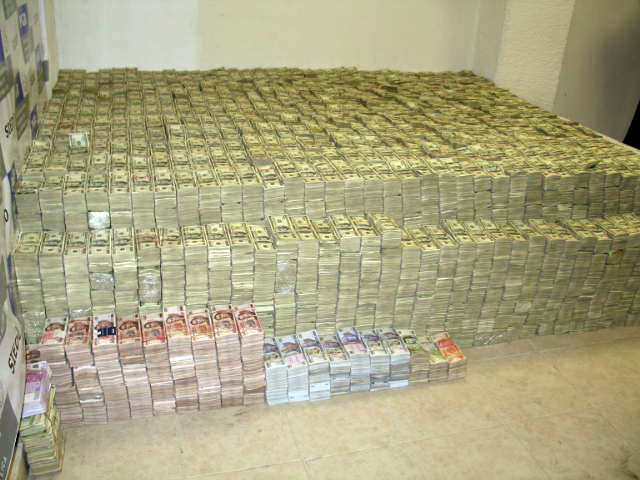
It's hard to get a gut level feel for exactly how much money $49.7 billion dollars is.

To give you a sense, here's what $206 million (mostly in $100 bills) looks like.


[This fearsome stash was confiscated from a drug cartel in México just recently.]

Now, the government has, on average, been pledging to spend this amount of money abroad every 21 hours. Indeed, between January and June, the Chávez government pledged to spend this amount of money 240 times over on projects abroad.

So, actually, $49.7 billion would look more like:


Nice, huh?

Actually, I propose the Mexican Drug Cash Pile (MDCP) as the standard unit of account for Bolivarian Foreign Spending.

The conversion rate would be 206,000,000 $ : 1 MDCP.

Bolivia got pledges for 6.4 MDCPs worth of new spending (mostly for energy exploration,) China 9.7 MDCPs (new refineries), Argentina - 15 MDCPs (for bonds), Cuba 21.9 MDCPs (for all kinds of stuff) , Russia 22.3 MDCPs (weapons), Nicaragua 23 MDCPs (refinery), and Iran gets a scrumptious 43 MDCPs (for super secret stuff).

But it's Ecuador that tops the bill with a whopping 46 Mexican Drug Cash Piles worth of new spending: some 9.5 billion of your and my dollars to build a shiny new refinery at Manabí.

Now, does anyone actually follow up on these pledges? Do they ever get audited? How many of these projects will actually get built?

And, erm, how many "commissions" can you pay with 49 billion bucks?

July 24, 2007

Chavez vs. The Grassroots

Quico says: Teodoro Petkoff has this little riff about how Venezuela's democratic roots just run too deep for an authoritarian model to really take hold. The relatively liberal habits of mind developed before Chávez came to power have "stuck", he says, and are now too deeply embedded in our collective psyche to just wither away and die.

I've often worried that that's just wishful thinking on Teo's part. But then you see things like this, and you see his point:

July 23, 2007

Beyond satire

Quico says: I wanted to make fun of this little rant, but on second thought, the thing satirizes itself:
Venezuelan President Hugo Chavez has vowed to expel foreigners who publicly criticise him or his government.

"No foreigner can come here to attack us. Anyone who does must be removed from this country," he said during his weekly TV and radio programme.

Mr Chavez also ordered officials to monitor statements made by international figures in Venezuela.

"How long are we going to allow a person - from any country in the world - to come to our own house to say there's a dictatorship here, that the president is a tyrant, and nobody does anything about it?" Mr Chavez said.

"It cannot be allowed - it is a question of national dignity," he said.

July 20, 2007

Role confusion

Quico says: So within the last 48 hours, we've found out that
and
Watch this space for more announcements from the super secret Sixth Motor of the Revolution. Next week, they'll tell us the Agriculture Ministry gets to run monetary policy and the Central Bank is going to be in charge of the army, after that the Defense Ministry will take over the schools while the Education Ministry organizes elections and CNE runs TVES.

Oh, and who'll pump out the oil? Avepane, of course...hey, you gotta have some continuity.

Verily I marvel at their strategic vision, at this fiendishly clever plan to confuse the hell out of the Marines when they invade. When the gringos go to snatch PDVSA, all they'll find is people making sneakers. When they storm into the National Assembly, they'll find a massive Vertical Chicken Coop instead. And when they try to take over the Supreme Tribunal they'll find it turned into a sprawling whorehouse.

Think I'm kidding? Think again: those last two bits are already in place...

July 18, 2007

The Petroleum Tax Credit

Quico says: Over the last two posts (here and here), I've explained why I think the Venezuelan state should distribute all of its oil income (yes, all of it) to the population and finance itself like any normal government would: through tax.

(This is an idea that reader Torres first put in my mind, but I'm going to stop calling it the Torres plan, because I don't think he would agree with the ideas in this post.)

The big question is: how could you make an oil rent distribution system progressive, efficient and fiscally feasible?

Simple: by making the payouts in the form of a tax credit.

The pitch is pretty straightforward. Citizenship is about rights, but it's also about responsibilities. All citizens have the right to an equal share of the nation's oil revenue, but they also have a responsibility to pay their taxes: this plan works by marrying that basic right with that basic responsibility.

As I envision it, the form you would use to declare your taxes is the same form that would entitle you to receive the Petroleum Tax Credit. If you don't file, you get nothing. And why should you? You've failed to hold up your end of the bargain.

So how does the system work, precisely?

Lets say Person A is unemployed and earns nothing at all. She still has to go down to her local Seniat office and sign a tax form that says "last year, I earned nothing at all." For her trouble, she gets her Petroleum Tax Credit: lets say Bs.50. (Remember, from next year the bolivar will be "fuerte!")

Person B is a buhonero earning Bs.100. To claim his tax credit, he has to pay tax on the money he's earned. Lets say the tax rate is 25%. He keeps the Bs.50 Petroleum Tax Credit, plus Bs.75 out of the Bs.100 he's earned. His after-tax income is Bs.125. As a result of the plan, he ends up Bs.25 better off: effectively, the plan works as a wage subsidy for people on low-incomes. (In practice, half of his Tax Credit would be withheld.)

How about Person C, a clerk who earns Bs.200? Just like anyone else, she gets the Bs.50 Petroleum Tax Credit, but she also has to pay Bs.50 in tax. So Person C is at the break even point - her after tax income is the same as her pre-tax income.

Person D is a lawyer, and he's doing great: he earns Bs.1,000. Even though he's relatively well off, he still gets his Bs.50 Petroleum Tax Credit: everyone does. But he has to pay a 25% tax on his earnings. That's Bs.250. So his net contribution to the state is Bs.200 - in his case, the entire Tax Credit has been "clawed back," and then some...

Not progressive enough for you? Lets add some higher income tax brackets.

Person E is a fat cat banker earning Bs.2000. But after the first Bs.1000 in income, the marginal tax rate jumps to 50%. Because he is a citizen of this country, Person E still gets his Petroleum Tax Credit. But he has to pay 25% tax on the first Bs.1,000 he's earned, (Bs.250) and 50% on the second Bs.1000 (Bs.500.) So he gets Bs.50, but pays Bs.750 in tax. His contribution is Bs.700.

Graphically, the system would look like this:
So, what's good about this plan?
  1. It's progressive: the richer you are the more you pay.
  2. It codifies the state's relationship with the individual. No more political manipulation of oil handouts. The money you get is a right, not a favor.
  3. It formalizes the informal economy. It gives poor people a powerful incentive to "go formal" and start declaring tax.
  4. It fights poverty. The basic Petroleum Tax Credit acts as a minimum income guarantee for everyone. Low wage earners get their wages boosted.
  5. It makes waste and corruption more politically visible: since the government has no alternative source of income, people realize that the money the government spends is money they gave it.
And what are the challenges?
  1. Tax administration: everyone has to be assessed. Seniat would need to step up its game immensely, and that will be expensive.
  2. Attempts at tax evasion are certain: People would have an incentive to file their taxes (to get the tax credit) but also to under report their income in the declaration. Seniat will have to develop its investigative capabilities substantially.
  3. Work disincentives: low wage earners would get to keep only 75% of what they earn, instead of 100% as is the case in the informal economy. They'll still file, for the credit, but their marginal propensity to work may fall.
Now, this is just a brief conceptual sketch. It would take substantial, detailed work to arrive at a full proposal that sets the tax credit, the marginal tax rates and the tax bracket thresholds at fiscally sensible levels.

And much qualification and refinement could be added: do children get part of their tax-credit in the form of education vouchers? Do you force adults to save part of it in pensions accounts? Lots and lots of detail would have to be worked out. It's a task I'm in no way qualified to undertake. But the system, at heart, would look something like this.

Torres for dummies

Quico says: Yesterday's post was probably too long and convoluted, so today I'll make it as simple as I can. Everybody loves a PowerPoint, right?

Here, in barest outline, is how distributing natural resource rents directly to people would change the way money and power flows through Venezuelan society.

(Solid arrows represent money flows:)


Petrostate clientelism works by reversing the dependence relationship between the state and the individual. Instead of the state depending on people for its livelihood, people depend on the state for theirs. This is a structural feature of the Venezuelan state, driven by the incentives inherent to state control over vast mineral wealth.

How can I be sure it's structural? Because, in a variety of guises, petrostate clientelism has survived all kinds of political shocks over the last 90 years. Rulers of vastly differing ideology, personality and personal probity have all wound up replicating it. Gómez may have had nothing in common with Caldera, CAP may have been the polar opposite of Pérez Jiménez, Chávez is as different as one could be from López Contreras. Yet the incentives for petrostate clientelism proved so strong that all of them ended up reproducing some version of it.

The only way to end petrostate clientelism is to get the state's hands out of the oil revenue cookie-jar. That is what's at stake here.

July 17, 2007

Torres in Bethlehem

Quico says: Everybody knows Jesus of Nazareth wasn't from Nazareth at all: he was born in a barn in Bethlehem. But what on earth was Mary doing gallivanting around Galilee nine-months pregnant? Luke's gospel explains the Romans had ordered everyone back to their hometown for a census, so Joseph had to go back to Bethlehem to register.

It's a detail I've always found extraordinary: a census in the ancient world? Can you imagine the logistical challenge? Why on earth would they go to all that trouble?

The answer, when you think about it, is not at all surprising: for tax, of course!

The Roman empire ran on tax. The Romans understood that if you're going to tax people, you need to know who lives where and how much money you can take from whom. There was no way to keep track of all that information without writing it all down. So the ancient census was really more like a huge tax assesment drive - a technological solution to a pressing political and administrative problem.

And it wasn't just Rome: all over the ancient world, empires came to realize that if they were going to levy taxes, they would need records of people and their property. The Persians held a tax census as far back as 500 BC, the ancient Indians starting from 288 BC, and the Chinese from at least 140 AD. Japan had its first tax census in 670 AD; England's Norman conquerors set about raising a census almost as soon as they'd defeated the natives in 1066. I guess it seemed obvious that if you're going to call yourself a conqueror, this is one of the first things you have to do.

The tax census was, in that sense, one of the fundamental institutions of civilization.

Through the census, relationships of subjection and tribute that had always lived "out in the open air of the spoken word" came to be embodied in paper, set down formally for the first time. In this way the written word came to mediate that most basic sphere of the individual's relationship with the state: his monetary obligation to it.

If you accept the image of state making as organized crime - the idea that the mafia don is the best contemporary analogy for the earliest stages of state building - then the tax census marks a step-change in the nature of the State. Because writing down a tax obligation, implicitly or explicitly, builds a safeguard into the individual's relationship with authority. Once Joseph's property had been registered in Bethlehem, once he'd "done his taxes," it became much harder to come back and try to charge him more arbitrarily. His obligations had, after all, been set down, affixed for posterity through writing, that artificial expansion of memory.

Census taking, though designed to extract money from people, had deeply subversive implications for the way a state and its subjects would henceforth interact. The tax census ensnared the state and the individual in ties of mutual obligation that couldn't have existed in an earlier era stage, when tribute was set by people rather than paper, and looked more like protection money than tax.

That citizen-state relationship would come to be dominated more and more thoroughly by the written word, the odd embodiment of authority in shards of dried tree pulp. As Briceño Guerrero puts it, that relationship would grow exponentionally, coming to envelop more and more aspects of each citizen's life until, by the twentieth century, it had metastasized into a tangle of:
ID cards, contracts, property titles, diplomas, protocols, mortgages, appointments, wills, dismissals, permissions, receipts, bills, decrees, resolutions, authorizations, sentences, letters, safe-conducts, credentials, resumes, work records, court briefs, payrolls, black lists, bank cards, credit cards, military cards, hanging folders, memos, forms, applications, notices, citations, agreements, bulletin boards, orders (of payment, arrest, eviction) certificates (of birth, marriage, death.)
At the root of it all, though, was the tax nexus: that primordial point of contact between power and the individual, as codified in the tax census: that original blueprint for all subsequent mechanisms of routinized bureaucratic control.


Nothing fascinates and mystifies me more than the gaping chasm we see in Venezuela between the laws as written and the society they are supposed to regulate. My documentary, Law of the Land was really an extended meditation on the subject, as is much of what I've written over the years.

It's a feeling that's both hard to explain and impossible to miss if you spend any length of time in the country. We have layers and layers of laws and regulation, and then we have reality - never the twain shall meet. I've been asking myself why that is for a long long time.

More and more, I think it has to do with the tax nexus. Or, rather, with the way oil distorts it, and along with it, the whole principle of authority-embodied-in-text.

See, for the ancient Romans and Indians, for the Chinese and the Normans, making written authority work was a necessity. They didn't make a census out of sociological curiosity: they saw it as a pragmatic solution to a pressing problem. They had to do it if their empires were to operate at all - that's where the money came from!

The written word had to have authority - not on some abstract level, but in the nitty-gritty business of regulating each individual's obligation to the state. It wasn't enough for power to flow through paper notionally - making the system work was a fiscal necessity.

Fast forward a couple of thousand years to Venezuela's contemporary history and you realize that making sure power flows through paper has never been a necessity here. Not counting the rump statelet we had in the 19th century (which was rarely able to extend authority effectively beyond Caracas itself) the rise of the Venezuelan state coincides quite precisely with the onset of massive oil revenue. When we talk about the petrostate in the Venezuelan context, we're not talking about the transformation of a pre-existing state: we're really talking about the only state we've ever had.

For the last 90 years or so, for as long as we've had a state worthy of the name, we've had a state that didn't really have to tax us to sustain itself. Making authority flow through paper has never been a matter of state survival, codifying authority's relationship with individuals has always been an ideal fondly to be wished for, never a need. When politically expedient, the Venezuelan state has always been quite comfortable letting laws and realities drift happily apart.

Now, in a sense, there's nothing new about this argument: Terry Lynn Karl has spent a distinguished career discussing the way oil pries apart the taxation nexus in rentier economies and de-links the state from society. But I'm trying to get at something slightly different here. While Karl focuses on the macro-social, high-politics of the petrostate's alienation from society, what grips me is the microlevel, the way the petrostate patterns each Venezuelan's individual relationship with authority.

In a normal country, citizens are keenly aware that the wealth the state spends is wealth they created. The hackneyed gringo letter-to-the-editor writer's catchphrase, "as a tax-payer, I..." captures it nicely. Citizens feel they own the state for the same reason they feel they own their toothbrush: they paid for it.

The petrostate turns this symbolic nexus on its head. The state doesn't depend on the citizen for money; the citizen depends on the state for money. The state has no prod, no pressing need to formalize and codify its relationship with citizens: why go to all that trouble, when you can just pump cash out of the ground?

I think this fact explains much of the mystery of the gap between the world of "papel sellado" and real life in Venezuela. The citizen is perpetually placed in the role of supplicant, continually conscious that he needs the state much more than it needs him. Seen in this light, it's not at all surprising that the state comes to see written authority as superfluous. Why bother?


The question, then, is what can be done about it? And here is where having extremely persistent commenters comes in really handy: those of you who read the comments section know that Torres has been pushing the solution to this morass for ages.

His idea is disarmingly simple: Take all the oil revenue, divide it by 26 million, and hand it out to people. That's it. Torres sees this as a poverty-alleviation scheme, and there's no doubt that many, many Venezuelans would be lifted out of poverty if his idea was implemented.

Now the main objection to Torres's plan is also pretty straightforward: you can't just deprive the state of all that oil revenue because the state needs that money to pay teachers, and road builders, and everything else the state does. The fiscal hole you would create would be far too dire for any politician to seriously entertain the idea. Indeed, when Manuel Rosales proposed a version of the plan, he didn't dare promise to distribute more than 20% of our oil revenue. I mean, you'd have to be crazy to go any higher than that, right?

It seems like a knock-out blow, at first - but like most good ideas, the apparent simplicity of Torres's plan conceals layers of possibility.

Certainly, if his idea was implemented, the state would find itself seriously short of cash in the short run. One way or another, the state would have to make up the shortfall simply to guarantee the minimal level of service its constituents have grown used to: people wouldn't stand for mass hospital closures and the like.

But where could the state possibly find the money to make up a shortfall on that scale?

In the same place every normal state in the world finds it: in its citizens' pockets!

This, I think, is the concealed genius of Torres' idea.

Yes, the state would need to claw back much of the oil money it gives out in the form of new taxes. But that, to my mind, is not a drawback: just the opposite, it's the idea's biggest selling point.

Distributing the nation's oil money and then clawing back a portion of it in tax would completely reverse the direction of dependence in the state-individual relationship. It would turn Venezuela into a normal country.

Suddenly, you would see tax become what it has never been in Venezuela - a major political issue. People would become keenly aware that the money that funds the state is money that comes out of their pocket. In one fell swoop, individuals would be transformed from supplicants into citizens. Demands for accountability would soar. The idea would drive a wooden stake through the heart of the petrostate model.

In time, the proposal could help mend the traditional chasm between the world of official paper and real life that has marred Venezuelan public life for so long. Forced to get serious about codifying its relationship with its citizens once and for all, the cavalier attitude of the state elite towards the authority of the written word would have to yield.

I don't think the process would be fast or dramatic - cultural change never is - but within two or three generations the habits of mind of petrostate dependency could be substantially weakened and something like the rule of law could start to take hold for the first time ever in our country.

I sat on the fence on Torres's idea for a long time, but I can't really think of another way of achieving these kinds of results. No amount of speechifying, no system of education, no volume of grassroots activism could achieve a fundamental shift in the individual's attitude to the state (and the state's attitude to the individual) so long as money and power in our society continues to flow in pretty much the same pattern as they did in the Gómez era. The template for state-individual relationships needs a violent shake-up. And Torres's idea, well, it would certainly do that.

July 15, 2007

Caracas: De Informele Stad

Quico says: It's great to run into a film about Venezuela that sets the politics to one side and focuses on the way the society actually works.

Caracas: De informele stad (Caracas: The informal city) was made by VPRO, the Dutch public broadcasting corporation. It chronicles architects Alfredo Brillembourg and Hubert Klumpner as they show Caracas's slums, how they operate, and what might be done about them. Here's a little taster - like the film, it's mostly in English and Spanish with Dutch subtitles:


I think it's really worth watching the whole thing. To do so, click here.

July 10, 2007

Gone fishing

Quico says: Katy and I are both out of town for the rest of the week. See y'all Monday.

July 9, 2007

Breakdown

Katy says: It's a beautiful Saturday in Caracas, and I'm standing on the shoulder of the Cota Mil, because the cab I was riding in just broke down. I begin to panic, sure I'm about to get kidnapped, expecting my driver's accomplices to jump up from the hill at any moment. I think about hailing another cab, but there's no way to do that in the middle of the highway, and there's nowhere to walk to.

Lucky for me, the guy had a fairly simple breakdown, and we were on our way again soon.

My trip to Venezuela was marred by things breaking down. It happened all the time. At one point, I had no running water, no phone and no Internet access. My cel phone worked intermittently, and the power at the offices where I spent part of my time went down twice in a week.

The Aeropostal plane that was supposed to fly me to Maracaibo stalled and died when we taxied off the gate - lucky for me this didn't happen in mid-air. I had to wait for four hours until I was booked on Aserca, the wait made all the more pleasant by the fact that Caracas' airport had no running water, due to "recurrent shortages in Vargas state", as the lady in the airport's speaker system reminded us every ten minutes or so. Funny, I thought, the lush, blooming trees that adorn the Vargas side of the Avila don't seem to have a problem finding water.

--------------

Life for the Venezuelan exile can be tough sometimes. Former Foreign Minister Miguel Angel Burelli once famously chastised the Venezuelan exile community in New York for not living in their country, saying they were going to die like Pedro Estrada, "looking for an arepera in every corner of Paris."

As obnoxious as it may sound, Burelli was part right: all the Venezuelans I know who live abroad (me included) have an unshakable and somewhat unhealthy nostalgia for the homeland. One of the reasons for this is that we tend to forget how these obnoxious little breakdowns, mostly caused by market failures, are part of the daily routine back home.

Take traffic. As much as people had warned me, it was still pretty shocking to find that Caracas traffic is two, three or four times worse than ten years ago. There are no new roads, and demand for cars has soared. Granted, a few train lines have popped up, but at least in the Eastern sections of the city, they don't make much of a difference. A simple trip from point A to point B six kilometers away usually takes more than an hour, any time, all the time.

The solution should be obvious - make it expensive for people to drive. You can do this either by taxing cars on the road more heavily (congestion taxes like those implemented in many of the world's cities, or even fuel taxes) or, to be more democratic, by keeping cars off the road during certain moments of the week. You can then use the proceeds to finance public transportation.

Another solution is opening up the building and maintenance of roads to the private sector. Santiago de Chile, for example, has recently been transformed by hundreds of kilometers of highways, all built by the private sector. Trouble is, for this "market" to work, you need to have clear property rights - the builder of a highway must be certain that she won't be "expropriated" or "nationalized" once she opens up her highway, something that is virtually impossible to ensure in today's Venezuela.

The inability of the government to find a solution to this particular market failure results in a much lower quality of life for ordinary caraqueños. The faces of the people caught in traffic reflect a lack of sleep and a general uneasiness that lowers people's productivity at work, diminishes their ability to be effective parents and, in general, makes them really unhappy.

-------------

The health-care industry, the most recent target of the government's attacks on all things private, also reflects a bucket-load of market failures.

While I was in Caracas, my mother had surgery at La Floresta Clinic, a somewhat upscale private health-care center in the Altamira sector of town. Given the prices we were quoted, I was expecting a modern facility with specialized care.

Instead, I found a small clinic last remodeled some twenty years ago. The hallways were noisy and crowded, the waiting rooms were uncomfortable, and the complete unavailability of a parking space was legendary.

When my mother's surgery was finished, we were told there were no rooms and were placed in a 25 square-foot cubicle in the top floor, separated from other surgical patients by three walls and a curtain. At least in a common room you would have a bit more elbow room, I thought. This was claustrophobic.

Luckily, the anesthesiologist was the son of an old fried from Maracaibo, and he pulled some strings and got my mother a private room, which was a bit larger and had a private bath. It was more comfortable, but still not up to the standards I felt we deserved after what we were paying for.

It turns out all private hospitals are the same in Venezuela. The government's infusion of cash, combined with their threats to nationalize everything has produced a curious mix: a large increase in demand that fails to generate its own supply. Middle-class folk now have more access to private health-care than they did, say, four years ago, but nobody invests in improving, expanding or modernizing facilities. It's government-induced gridlock, and it will only get worse if private health-care is eliminated as the government is announcing.

The same could be said of the airline industry. Venezuelan airlines are in dire straits because the government has a) increased cash in people's hands; b) prevented airlines from raising prices, the natural consequence to an increase in demand; c) inhibited the creation of more supply with their constant threats to private property, so that airlines do not invest; and d) competed unfairly with private airlines by starting their own state-owned, subsidized airline. The end result? Gridlock in the nation's airports and shabby service.

Education is another victim of these insane policies. Private schools find themselves in the curious situation of being in really bad financial shape while, at the same time, they have fewer spaces available than ever. The government's war on private schools (forbidding them from raising their fees to match inflation) is putting most of them at a high risk of having to close.

As usual with market failures, the middlemen always get their booty. For example, the hoops you have to go through to buy a car are memorable. My brother told me how he went to buy a car and was told there was a six-month waiting list, and that to get on the list they needed the information of the bank where they got their loans from. My brother informed the salesman that he wasn't working with any bank, that he had the money for the car in cash. The salesman told him that cash sales were not even eligible for the waiting list and that he could not help him.

It turns out that this particular market failure means car salesmen have hooked up with loan officers of the banks of their choice, so that in order to get a car from that particular salesman you need to go through his bank of choice, and the salesman gets a share of the bank's commission from the loan. Buying a car, as most everything in Venezuela, has become an exercise in "Who do you know and can they help me out?" Having the money to buy something makes no difference.

--------------

The country is in the midst of a consumption binge, and when the Marxist Revolution finally takes hold, people will not take it sitting down - or will they? While I wondered how people put up with all these inefficiencies, I found myself simply shrugging them off as the only way to maintain sanity and not have a fit every two hours or so when the next market failure hit me.

After fixing the malfunction, I talked to my cab driver about why he had such an old cab. He told me it was in great shape and he had just bought this car a few months ago, that he couldn't go through the paperwork of getting a loan to buy a new car, and that in any case, his cab was much newer than most of the other cabs circulating in Caracas' streets. I agreed.

So instead of getting angry at the guy for providing shabby service that could have endangered my life, I took a deep breath, shrugged off the experience, and gave him his customary tip. This is a lot of what life in Venezuela is like, and there's not much I can do about it in a ten-day visit.

July 8, 2007

The politics of fiscal retrenchment


Quico says: So, Finance Minister Rodrigo Cabezas finally figured out that if you prime the pump long enough, the thing just breaks. In a rare outbreak of economic common sense, he announced that the government plans to fight inflation by slowing public spending and mopping up $2.8 billion worth of liquidity. Even then, he knows he won't be able to bring inflation in at its 12% target, but hopes for 14%.

All that talk of fiscal discipline sounded possitively Friedmanesque. It was weird.

But the questions won't take long to crop up. What's going to happen on the next Aló, Presidente when Chávez has a marvelous new idea, turns to his money guy and says, "Rodrigo, be sure to set aside $450 million for this one"? Can we seriously picture him shooting back, "I'd like to, presidente, but remember, fiscal discipline!" ? And even if he did, could he also control PDVSA's autonomous spending? How about Fonden's? When Carlos Lanz calls Chávez and tells him ALCASA needs an emergency cash injection to continue operations, is Chávez going to let that veritable worker's paradise collapse just because Cabezas wants to shave half a point off the inflation number?

There are two interlocking problems here: the longstanding impossibility for any minister to make a credible commitment on Chávez's behalf, and the increasing fragmentation of the institutional mechanisms for exercising fiscal policy, which now include at least three parallel state budgets - PDVSA's, Fonden's and the normal budget - with no meaningful oversight over any of them.

Of course, it could be that Cabezas' announcement is driven more by income shortfalls than by a newfound commitment to fiscal discipline. Oil prices may not have fallen much, but oil production continues to tick down, and the operational problems in PDVSA have only grown over the last few years. So the revenue stream may be flattening out, but the expectation of continually improving standards of living financed by continually increasing state spending certainly hasn't.

Fiscal retrenchment is good policy but bad politics here: Chávez's performance legitimacy now rests on the state's ability to continually improve people's standards of living. His ideological legitimacy does as well, since he's emphasized so much that the private sector can't make everyone better off. So if the state can't deliver on people's economic aspirations, Chávez will face mounting social unrest: not, this time, from the opposition, but from his one-time supporters, whose expectations he won't be able to meet.

So far, under Chávez, poor people's incomes have risen faster than inflation, all on the back of extraordinarily fast growing oil revenues. But Cabezas' announcement is an implicit acknowledgement that that era is coming to an end. Public spending has now reached the point where it feeds directly into price rises rather than into increased aggregate demand. Cabezas, at least, seems to grasp that even if oil revenue did continue to rise, there would be little point in continuing to feed inflation by jacking up spending (but does Chávez?)

The exhaustion of the keynesian phase of chavista economic management will profoundly transform the politics of the Chávez era. Because there is a long, established tradition of social protest in Venezuela: and unrest always intensifies when the state runs short of the funds it needs to bankroll the needs of society. It's a cycle we've seen played out many times before.

How is Chávez going to deal with it? Is he going to call the protesters CIA stooges and throw them in jail? Or is he going to lecture them on the true socialist's stoic contempt for consumption - that lefty equivalent of the old right-wing paeans about the moral virtue of austerity?

And what will a fiscal retrenchment mean for people's perceptions of the new Hummered Elite? Things could get really tricky for chavismo on this score. Venezuelans' attitudes towards corruption have always tracked the oil cycle. People didn't much begrudge the AD elite's graft in the 70s because there was more than enough bread to go around back then, but they ressented corruption acutely in the 90s, when the lifestyles of the well-connected contrasted so starkly with their own.

For similar reasons, Chávez hasn't really paid a political price for his cronies' corruption on the up-side of the current oil cycle, but that luck is not likely to stay with him on the down-side. The revolution seems to be condenscing a process of popular disenchantment that took AD 30 years to accomplish in just a decade: a three-fold increase in efficiency!

Marcos the Apure Fisherman knows all about this sort of thing. As we enter the new era of chavista fiscal retrenchment, let us make, 2, 3, many Marcos the Fishermen!