August 4, 2007

Revolutionary Surplus Value

Quico says: So the Cuban government denies that it's getting Venezuelan oil for free, noting that La Isla pays for most of its oil bill through the services of Cuban doctors, sports trainers and other professionals in Venezuela.

Lets pick this one apart.

In the comments' section, Omar proposes the provocative concept of the Cuban-professional-to-oil-barrels terms of trade. The question is, what is the implicit cost to the Venezuelan treasury of a Cuban professional?

The short answer is, I don't know - and neither do you - because the terms of the deal are secret, and nobody knows precisely how many Cubans are working in the country. The original oil-for-Cubans treaty was never submitted to the National Assembly for approval, as the constitution mandates.

But lets guesstimate, generously, that there are 80,000 cubans working in Venezuela. We know that, last year, Cuba got $3.4 billion worth of oil shipments from Venezuela. Dividing $3.4 billion by 80,000 gives us an implied-cost-per-Cuban-per-year of $42,500.

Now, ask yourself this: how much of that does a Cuban professional actually get?

Turns out they get paid $2,400 per year, plus they get subsidised housing and food. Just to put a number to it, their all-in compensation package (wages + subsidies) might generously be estimated at $6,000 per year.

Fidel, on the other hand, gets seven times that much in Venezuelan oil.

To put it in terms chavistas can understand, the Cuban government made off with $36,500 in surplus value for each Cuban working in Venezuela last year. Or, in savage neoliberal terminology, their work in Venezuela was taxed at a rate of 86%...by a foreign government!

Granted, you can quibble with the numbers: they are admittedly (though necessarily) plucked from thin air. Cuba says it pays for about half its oil bill in cash: if true, then the cost-per-cuban-professional is less. Then again, 80,000 is a very high estimate of the number of Cuban professionals in the country: if there are fewer, then each one costs more.

That we even have to engage in this kind of speculation is a testament to the opacity of the whole deal. But whichever way you want to jig the numbers, the basic point stands: Fidel appropriates the lion's share of the remuneration for these people's work.

Because the basic issue here is one of ethics, not economics: Where the fuck does Fidel get off using his citizens' labor as payment for anything? If Chávez wants to buy professional services, how come it's Fidel that he pays, rather than the professionals? Are they Fidel's property?

In important ways, that's how they're treated. After all, when you want to rent a lawn-mower, you don't "pay" the lawn-mower, you pay its owner. And when Chávez wants to "rent" some Cubans, he doesn't pay the Cubans, he pays Fidel. Chávez and Fidel treat them as a rental good, as things whose use they're entitled to buy, sell or barter.

The actual Cubans are bystanders to the transaction: little more than chattel. Realistically, they can't refuse to go, because they have no negotiating power vis-à-vis the government: no independent unions, no right to strike, no possibility of working for someone else. Cuban professionals face a complete labor monopsony: it's the commie way or the highway. So it's not surprising that, at the end of the day, the amount of money that reaches their pockets is a tiny fraction of the amount their "owner" gets.

Now, can you imagine what the Penns and Glovers, the Tuckers and Chavezes of the world would say if the US government tried to exploit people quite this crudely? Can you picture the howls of outrage?

And then...how would you feel if, tomorrow, your government decided that it was going to start "paying" for imports of, I dunno, French cheese with your labor? How would you react if your government told you it had a secret agreement with France and it was going to ship you off to Marseille, where you would be paid one-seventh of the value of the cheese your government would get in return for your work?

Any takers?

...didn't think so...

Added later: the title turn-of-phrase, "Revolutionary Surplus Value", (plusvalía revolucionaria) is one of the many rhetorical jewels in J.M. Briceño Guerrero's The Savage Discourse, which also includes this chilling, prophetic passage:
I've also seen - and I wish I hadn't - that the revolution, when it's carried out seriously and succeeds, brings forms of injustice and oppression even more abominable than the current ones. I've seen those new forms of injustice and oppression in the eyes and the words of the most sincere, hardest working, most loyal revolutionary leaders. They feel themselves messianic saviors, avatars of history; they think they know my interests, my wishes, my needs, better than I do; they don't consult me or listen to me; they've struck off on their own as my representatives, as vanguards in my struggle; they are paternalist tutors; they pre-configure today that future olympus where they will make all decisions for my well-being and my progress; they'll make the decisions and they'll impose them on me in my name, through fire and blood in my name.

August 3, 2007

To think CAP got impeached for misappropriating 250 million...bolivars!

Quico says: Here's a galling number for you. In 2006, Venezuela sent Cuba oil shipments worth $3.4 billion. Cuba doesn't seem to be actually paying for it, as far as anyone can tell - which isn't very far, because the details of the deal and the payment mechanisms (if there are any) are secret.

3,400,000,000 dollars. Picture it. You can't? Of course you can't...you're only human.

As scientists know,
humans aren't very good at grasping the meaning of very large numbers. 3.4 billion is an abstraction too far for our weak little brains. I could tell you that the giveaway is worth nearly 2% of Venezuela's economy, almost three times the UN's guideline for developed countries' total foreign aid to poor countries. I could tell you it accounts for a staggering 15-20% of Cuba's GDP (depending on who's doing the counting). But those numbers are just as abstract: they fail to cause much of an emotional ripple.

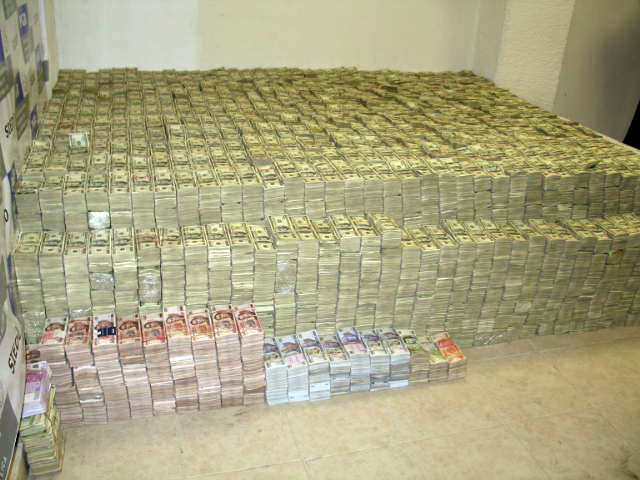
So I'll fall back on my favorite heuristic device, the Mexican Drug Cash Pile (MDCP). Earlier this year, this stash worth $206 million, mostly in $100 bills, was confiscated from a Mexican drug cartel:


Venezuela's oil giveaway to Fidel last year was worth over 16 MDCPs. About this much:


Basically, we pay for their totalitarianism.

August 1, 2007

Eat our dust, Paraguay!

Quico says: Sure, we didn't do so well in the PanAm Games, but in the league tables that really count, Venezuela is still on top of the game. The World Bank has just published its latest study on governance matters (covering 1996-2006), and Venezuela has edged out Paraguay for the coveted Western Hemisphere silver medal in freestyle corruption!

That's right, boys and girls, we're now officially more corrupt than the country where a President of the Republic got busted riding around in a stolen BMW.

That's no excuse for complacency, though. We still have a ways to go before we catch up with the undisputed hemispheric masters of the craft: the Haitians. But Hugo Chávez was never one to go down without a fight. (OK, except for Feb. 4th and April 11th.)

As new corruption allegations rain down on PDVSA, he is keeping the focus squarely where it belongs: on corruption in the oil industry before he came to power. Showcasing his determination to go for gold, he then confirmed his backing for PDVSA boss Rafael Ramírez, the man directly responsible for it all.

See, the Haitians might have the natural talent, but with leadership like that, we have what it takes to make it to the top.

July 31, 2007

Getting kidnapped: more trouble than it's worth

Quico says: Sometimes, amid all the high-fallutin' talk about the rise of authoritarianism and the creeping onslaught on basic liberties, we lose sight of chavismo's basic inability to make sensible policy. The latest VenEconomy Monthly deals with one of the more alarming recent examples: the Anti-Kidnapping Bill now making its way down the fetid intestinal track that is the chavista legislative bowel.

The proposed law sets out to combat kidnapping by making life as hard as possible for kidnap victims' families. It would make it a crime to fail to report a kidnapping or to pay ransom. Family members would face up to three years in prison for keeping a kidnapping quiet. "The law says that they are accomplices," is the way the AN's Interior Policy Committee Chair, Juan José Molina, puts it.

But if they do report a kidnapping, the law goes proactive on their asses: freezing the family's assets to prevent them from raising the cash to pay ransom. Presuming their guilt, the bill would effectively punish people for having a relative get kidnapped.

This government never saw a social problem fly it didn't want to swing a policy sledgehammer at. Much of the problem seems to come down to an ideological aversion to thinking through the incentive structures policies put in place for normal people. There's a whiff of capitalist decadence, I guess, about the whole notion of thinking through the incentives policies create: they just won't do it.

Lets do it for them.

Lets say (y que Dios no lo queira) your kid gets kidnapped. The law says you must put yourself in the hands of Venezuela's notoriously incompetent, overstretched, brutal and often criminal law enforcement authorities. If you don't, you're an accomplice and face years in jail. But if you do, your chances of ever seeing your relative alive again surely become vanishingly small: the cops will almost certainly fail to free him, and if you change your mind and decide you want to pay ransom, you won't be able to.

What are the pros and cons you'll weigh as you try to decide whether or not to report the crime? Surely, you'll be aware of the chance that, if you do report, the cop you report to is the cop who kidnapped your kid. And not just in theory. As VenEc reports,
In the last five-year period, 2002-2007, charges have been brought against 14 military personnel, seven members of the CICPC force, and 16 Metropolitan police officers for crimes related to kidnapping.
But lets say you do go to the cops. At that point, you leave the kidnappers only two options: release him without ransom or kill him. Which option do you think is more appealing, safer from the kidnappers' point of view? Hmmmm...

Now - and sorry to get so grim, but - lets say they do kill him, but the body doesn't turn up. The kidnapping can't be declared "over" without a death certificate, but you can't get a death certificate without a body. So your assets remain frozen indefinitely. Now that's going to make people want to report.

To follow this dismal dynamic one stomach-turning twist farther, don't you think kidnappers will catch on to this and turn it to their advantage? How long before ransom notes start including ghastly threats to not just kill your loved one but to destroy the body as well? How would you react to a note like that, knowing that reporting would mean an indefinite freeze on your assets on top of the death of your child?

And, at the risk of straying into unadulterated Macchiavelianism, if you were a completely unscrupulous businessman looking to thin out your competition, could you think of a more cunning way to get rid of a rival than to kidnap his kid, make sure the cops hear about it, and then disappear the body?

It doesn't take a rocket scientist to figure out what this law will do: criminalizing kidnap victims' families is only going to drive them underground, making them ever less willing to report to the authorities.

When crime statistics come out, this will show up as a sharp fall in reported kidnappings...and guess what will happen then? Pedro Carreño will come on VTV, a glowing smile on his face, to trumpet the governments progress in the fight against kidnapping.

July 29, 2007

"I'll take the gunbao chicken, some springrolls, and 32,000 b/d, please..."

Simón Boccanegra says: Some of the stuff that's been going down recently borders on Caribbean surrealism. The story about the Chinese drilling rigs is pure farce. Readers may remember that, some weeks ago, one of those Chinese rigs PDVSA has been importing blew up. Turns out that when the two rigs arrived, PDVSA's people realized the manuals were in Chinese. But instead of going to the Chinese oil company and asking their technicians for help, what did they do? The went to a Chinese restaurant in Anaco and asked the staff for a translation! Turns out the chinese guys working there were cantonese, and the manual was in mandarin, so they couldn't help the ingenious engineers from the red, very red PDVSA. Undaunted, they went back and tried to run the rig anyway. The result is already fodder for yesterday's newspaper: the thing blew up. It reads like a Three Stooges script, but it isn't.

Sea of Felicity

BBC says: Cuban athletes have made a hurried departure from the Pan-American games in Brazil, apparently amid fears of possible mass defections.

The delegation was rushed at short notice to Rio de Janeiro's airport, leaving the men's volleyball team no time to collect their bronze medals.

The athletes were said to have been ordered to leave the games before the finishing ceremony on Sunday.

It follows the defection of four Cuban athletes earlier in the tournament.

Such was the speed of the departure that some athletes were said to have had difficulty finding their luggage.

July 27, 2007

Rhetorical about-face


Katy says: As we eagerly await the unveiling of the Constitutional Reform that we will hopefully get a chance to vote on, it's strange to see the government, from Chavez on down, engage in a rhetorical battle with the opposition over the name of its key component: the end of presidential term-limits.

Under the current Constitution, Presidents can only be re-elected once for a second, consecutive six-year term. This means that Chavez, barring any changes, would not be able to run for President in 2012 no matter how much the TSJ tries to "interpret" the Constitution to allow him to do so.

The main reason underlying the reform of a Constitution tailor-made by his supporters a mere eight years ago is to do away with this limit, an idea I'm on the record as supporting. I'm probably on the wrong side of the fence on this one, given how everyone else seems to be panicking about the possibility of this reform passing. However, there's something appealing about the idea of letting chavismo run its course until people have finally tired of it once and for all.

Last year, when this idea was first floated by Chavez, he had no qualms in calling it "indefinite reelection." After all, that is what it is - the ability of a President to be re-elected as long as he wants, i.e., indefinitely. Yet in the past few months, coinciding with polling data showing the public strongly opposing the idea, the President has gone to great lengths to say that it's not an "indefinite re-election" because that term has "negative connotations," that what he is proposing is a "continuous re-election."

This is one of the rare instances of Chavez changing his rhetoric to appease the public. I would have expected him to plow through and continue using the term to sell his idea, to boast about it just like he boasted about PDVSA being a "red, very red" company when, during the campaign, the hidden video of the President of PDVSA using this term threatened to hurt him for about a second.

Yet the fact that the Revolution is trying to re-brand the idea of indefinite re-election indicates that the polling data is probably right, and chavistas are aware of it. Will the opposition continue using this term? Will chavistas manage to cloud the proposal with other stuff that may alarm the opposition, so as to confuse them and take the focus off indefinite re-election? Will chavistas re-brand the proposal succesfully? Will there be an election? Will we win? Will the CNE acknowledge the proposal's defeat? Stay tuned.

July 26, 2007

RCTV The Sequel: Scarier than the original

Quico says: So, as most people know, having gotten kicked off the public air waves, oppo broadcaster RCTV made a Freddie Kruegeresque return to haunt the government's dreams through cable and satellite.


You could've been forgiven for thinking that this was the government's goal all along: to slam this dissident voice in a gilded ghetto, limiting its reach to the 42% of relatively upscale Venezuelan homes that get pay-TV, and kicking it out of the other 58% of homes, where Chávez supporters tend to live.

Oh, but no. Even this politically declawed RCTV was more than the government was willing to tolerate.

Just today Conatel, the national telecoms regulator, ruled that, just like public broadcasters, pay-TV operators must carry cadenas: live propaganda broadcasts, usually of Chávez ranting, that all channels are forced to carry simultaneously, with little or no advance notice, for as long as the big guy feels like hearing the sound of his own voice.

(Which is deeply ironic: pay-TV's growth in the middle class has been fueled by the sense that it was the last televisual refuge from the ranting comandante...but now, Our Master's Voice will follow us even there.)

The point, of course, is that Cable and Satellite systems were never set up with cadenas in mind, so there's no obvious technical fix to the problem of putting the same thing on every channel at short notice. Nevermind that: Conatel now says that if RCTV doesn't join the cadenas, it'll have to be shut down all over again.

Now, think this one through. In a way, this is worse than the original decision to take RCTV off the air.

Back in May, when we all saw Chávez vs. RCTV: The Original, the government made a big deal of the distinction between shutting down a TV channel and getting it off the public airwaves. Communications Minister Willian Lara threatened journalists who incorrectly reported news of a "shut down" - no such thing, he said, a mere "non-renewal of a license to broadcast over the public airwaves."

Because, of course, the public airwaves are just that, public, and according to the constitution, state-controlled. That's why even Katy and I had to admit that, in some narrow legalistic sense, the state surely has the right to decide who does and doesn't get a broadcast license: the radioelectric spectrum is not infinite, and it's the state who decides who can and can't use it. (That, in shutting down RCTV, the state exercised that right arbitrarily and with total contempt for due process of law is another matter.)

It's precisely because the radio spectrum is public that the state has the right to "take it back" from its licensees whenever it wants to broadcast cadenas. It's the public character of the airwaves that was the government's rationale for the authoritarianish Law of Public Responsibility in Radio and Television: "so long as you publish over our airwaves," the argument went, "you gotta follow our rules."

Distasteful? Yes. Tone-deaf to basic freedoms? No doubt. And yet, not totally absurd, because the airwaves really are public.

The point, of course, is that there's nothing public about the strip of rubber-coated copper that runs between Intercable Headquarters and your bedroom wall. It's purely private. You pay for it. Nobody forces you to put it there. Nobody who doesn't want to have it is forced to get it just because they own a TV. Nothing in the constitution gives the state to interfere with it.

Surely, the government has no more right to impose cadenas on pay-TV than it has the right to put cadenas on phone calls. (Though, come to think of it, at this stage in the game, I really shouldn't put ideas into their heads...)

The point is that, with its behavior in The Sequel, the government shows that we were right all through The Original: it was authoritarianism, simple intolerance of dissent, that was driving them. And it still is.

July 25, 2007

Brother, can you spare $49,665,810,000?

Quico says: According to people idle enough to actually keep track of these things, in the first half of the year the Chávez government announced plans to spend at least $49.7 billion dollars on projects abroad.

I write "at least" because the figure doesn't include the many, many foreign spending promises made "loosely," without announcing a specific price tag.

49 billion verdes is about one and a half times the government's total (oil and non-oil) revenue over that same period: these guys are literally pledging the country's money away faster than it comes in.

It's hard to get a gut level feel for exactly how much money $49.7 billion dollars is.

To give you a sense, here's what $206 million (mostly in $100 bills) looks like.


[This fearsome stash was confiscated from a drug cartel in México just recently.]

Now, the government has, on average, been pledging to spend this amount of money abroad every 21 hours. Indeed, between January and June, the Chávez government pledged to spend this amount of money 240 times over on projects abroad.

So, actually, $49.7 billion would look more like:


Nice, huh?

Actually, I propose the Mexican Drug Cash Pile (MDCP) as the standard unit of account for Bolivarian Foreign Spending.

The conversion rate would be 206,000,000 $ : 1 MDCP.

Bolivia got pledges for 6.4 MDCPs worth of new spending (mostly for energy exploration,) China 9.7 MDCPs (new refineries), Argentina - 15 MDCPs (for bonds), Cuba 21.9 MDCPs (for all kinds of stuff) , Russia 22.3 MDCPs (weapons), Nicaragua 23 MDCPs (refinery), and Iran gets a scrumptious 43 MDCPs (for super secret stuff).

But it's Ecuador that tops the bill with a whopping 46 Mexican Drug Cash Piles worth of new spending: some 9.5 billion of your and my dollars to build a shiny new refinery at Manabí.

Now, does anyone actually follow up on these pledges? Do they ever get audited? How many of these projects will actually get built?

And, erm, how many "commissions" can you pay with 49 billion bucks?