| What do you think would happen supposing CNE counts the votes cleanly?
Manuel Rosales would have a good chance to win
Manuel Rosales would have some chance to win
Manuel Rosales would have a small chance to win
Manuel Rosales would have no chance to win
|
Current results |
 Katy says: Katy says: Manuel Rosales gave a lengthy interview to Valencia newspaper Notitarde. Here is a summary of what he had to say: - He repeated his promise to give the unemployed a minimum wage; details are fuzzy at this point.
- Came out in favour of restoring Central Bank autonomy.
- Came out strongly (and surprisingly) on voter secrecy and fingerprint scanners, saying "there is no way for anyone to know who is voting for whom, not with these machines, nor with any other established system." He said fingerprint scanners are useless, and only serve the purposes to give the government information on turnout in real time.
- Said that the main problem with crime is that the courts and the prosecutors are paralysed and overworked.
- Said that the military must return to what they were trained for, and placed emphasis (not surprisingly) on border patrolling.
- Criticized the government on its lack of respect for private property, saying "this government does not respect any private property, neither for those who have a small house or a plot of land, nor for those who may have a bigger house, a company, a car or an ice cream store. We all want property, we all want to own what is ours, but this government does not respect that."
- Talked about defining a new way of redistributing oil rents, using Norway and Iraq (!) as examples.
- Repeated his proposal to redistribute 20% of yearly oil income in the following way: a minimum wage for the unemployed, and a cash handout to middle class and poor families, defining these families according to certain guidelines to be developed.
- He promised to maintain social programs called "misiones".
- Emphasized his record defending the environment.
- He said that he would look for the "least traumatic" constitutional mechanisms to have a new National Assembly if elected.
- Came out in favour of abolishing the infamous Media Law, or "Ley Resorte".
(Note: The picture is of Valencia, home of "Notitarde", as a gift to my Valenciano friends for their once-wonderful, now-chavista city)
 Katy says Katy says: Excerpts from Manuel Rosales' press conference today. On his signing the Carmona decree: "It was a moment of confusion that stemmed from Chavez's resignation, which he later denied having made. I was in Zulia and I recieved a call asking me to come to Caracas urgently. I went to an event and I signed in attendance... Yes, I made a mistake, I acknowledge that, but it was made in good faith. Unlike Chávez, I did not plan it, I did not spend years plotting a coup that caused many deaths." On the current administration: "This is a lawless government, that does not respect human rights, freedom or private property." On his attitude toward chavistas: "If elected, I will do my best to make sure the rights of those currently in power are respected fully." On the National Assembly: "I will promote new elections to the National Assembly." Globovisión has filed a report here.
Sorry for the disappearing act, everyone. I'd figured I'd be able to blog sporadically from my vacation, but found out to my slight shock that Internet Points are rarer in Sicily than in Barinas. Living out of a tent is definitely not conducive to the blogging lifestyle. Thanks so much to Katy for keeping the home fires burning... Anyway, I come back just in time to find out Chavez has been working to fatten up my right-hand column. Great fun. 
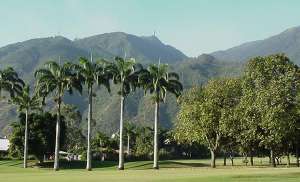 Katy says: Katy says: Caracas mayor Juan Barreto has expropriated four golf courses in the Caracas metropolitan area. At least that is what the Official Gazette says. No word yet on whether this is more hot air or whether they are actually going to invade the lots.
 (Katy says: I thought yesterday's editorial by Teodoro Petkoff deserved translating. In Venezuela, a Chinese story is simply a tall tale, a fishy story; my somewhat sarcastic comments are in italic)Chinese stories, by Teodoro Petkoff Tal Cual daily, August 28, 2006 (Katy says: I thought yesterday's editorial by Teodoro Petkoff deserved translating. In Venezuela, a Chinese story is simply a tall tale, a fishy story; my somewhat sarcastic comments are in italic)Chinese stories, by Teodoro Petkoff Tal Cual daily, August 28, 2006Our country's president definitely lives in a fantasy world, one that he builds for himself and his illusions to live happily ever after. Do you remember the movie (and an even better book!) The World According to Garp? Well, there should be a sequel: The World According to Chávez. This is a man who goes to China and in a country where capitalism runs wild, discovers "21st century socialism." (perhaps we should christen this the "Chavez in China" syndrome)In China, there is practically nothing left to privatise. The first time a Formula One race was held in Shanghai, Ferrari sold 80 of its ultra-expensive "Testa Rosa" models to China's new millionaires. (I wonder how many they would have sold in Caracas; do we see a Formula One race in our future? Perhaps they could drive from Caracas to La Guaira, although that would be more akin to the Paris-Dakar rally)Does Chávez know that in China, contrary to what happens in Venezuela, the private sector is not harassed? On the contrary, the Communist Party recently ammended its statutes to define the party not only as "a working-class and peasant party", but to include the emerging capitalist bourgeoisie and the emerging middle class that populates enormous shopping malls filled to the rim with the poshest boutiques Western capitalism has to offer. (I think Petkoff has never been to Sambil)The only thing left of "socialism" in China (in case there ever was anything that could be defined under this term) is the iron-grip dictatorship of the Communist Party. (with a variant - in China, at least there is a party pulling the strings; in our case, he wants all power for himself) The same thing happened in Vietnam. Chávez had recently proclaimed that there, he had found "his" model of "21st century socialism." (hmm, can there really be a working definition of "21st century socialism" if Chávez is still travelling around the world looking for it?)The flabbergasted Vietnamese leaders could not believe what was coming out of this extravagant character's mouth. The president of Vietnam's Chamber of Commerce had to come out and say that what our local fantasy-man was saying was "completely inappropriate" and that they did not share this view. (nevertheless, they said they would love to do business with him)But, like in China, Chávez did not see in either country the exuberant examples of (very savage, by the way) capitalist growth, but rather the dictatorship of the local Communist Party. This is what really appeals to him of archaeological socialism. (that, and the worship of decaying tropical pharaohs)On another run of ideas, when he speaks of the USA as "a dictatorship", he points out that Americans are subjected to "phone wire-taps", or as we say back home, that phone lines are "pinched". This is completely schizophrenic. (no, it's completely chavista, schizophrenics are ill and are not responsible for their acts)I assume that our overseas friends must think that in Venezuela, this practice is forbidden and severely punished. (just like Anderson's murder was severely punished)However, can Chávez possibly allege ignorance and not recall that here, in his own country, phone calls are not only recorded but have even recently replayed on state-owned television? Either this is a case of cynical double personality, or this is a master of deceit at work. (or it's just Chávez being Chávez)Trouble for him is that, what he says overseas is retransmitted here, so Venezuelans, including for example (chavista deputies) Darío Vivas and Ismael García, who until recently flashed on state-run television, "the channel of all Venezuelans", their own recordings of private conversations, must have been flabbergasted by Chavez's ability to lie without seeing his nose grow. (being "flabbergasted" would require a working conscience, something these two fellows seem to lack)After having spent almost one of his eight years in power travelling around the world, it would not be surprising to find that, like Jules Verne's character in Around the World in Eighty Days, the man had finally lost touch with reality. (funny, when he talks to his deputies, Chávez reminds me of Dr. Doolittle)
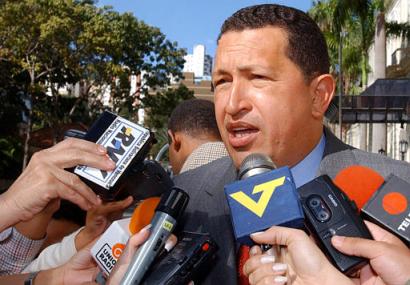 Katy says: Katy says: I'm feeling low on inspiration lately, partly due to the fact that I have a lot of work, and partly because it's August back home and things tend to shut down in August. But on surveying the news, I am struck by one of the main characteristics of Venezuelan politics: the over-abundance of cheap talk. Some of the main news items are: - A war of words between the Venezuelan and US government over somebody's bags. Memo to both: who gives a rat's ass?
- Caracas Mayor Juan Barreto announcing that they will take over buildings, golf courses and entire municipalities, and not carrying out any of it.
- Chávez announcing that China will invest heavily in our oil sector, and that we will double our oil shipments to that country. Aside from the fuzzy math behind this one, when after seven years all you have is plans and more plans, it means you are not doing your job. Furthermore, Venezuela produces slightly less oil than it did at the beginning of Chavez's government, just another sign that the government has yet to put their money where their mouth is (instead of putting it in Panamanian banks).
- Statoil announcing they will continue exploring for oil and gas in the Orinoco Delta, to go with ongoing plans for the Gasoduct to the South. In the meantime, Venezuela after 7 years still does not export a single whiff or drop (take your pick) of natural gas.
- Jesse Chacón announcing ongoing discussions regarding police reform. Again, seven years in the making, and they still don't know what to do about soaring crime rates, even announcing that when the reform is implemented, crime rates may actually increase, but that it would be a good sign.
Crime. Oil production. Private property. Venezuela's antagonism toward the US. Natural gas. Topics we cannot afford to just talk about. In the meantime, Danilo Anderson's killers are still on the loose, and nobody has been convicted for the deaths of April 11th. Pure talk, but nobody actually does anything.
By Bolivian author Juan Claudio Lechín, La Paz, Bolivia ( translated from the Spanish by Katy)Two years ago, Venezuela agreed to be the guest of honour at the 2006 La Paz book fair. Upon their arrival, I watched as they set up their stand, and approached them to inquire about a great friend who was supposed to arrive. One of the people in charge, a Ms. Claudia Pérez, told me he would arrive on the 16th. I asked for, and received, the prices of several books. They were standard market prices. I was beginning to enjoy listening to the delectable sounds of the Venezuelan accent, when some political wire crossed somewhere and, all of the sudden, the guests left the fair with no explanation. A trio from the “Cenal” gave a press conference like the ones we gave at “la Central” in the 70s. The hysterical mob was captained by Ramón Medero (president of Cenal) arguing, with his index engaged in passionate agitation, that this Bolivian fair (one that Venezuela has attended for the last 10 years) represented the “commercialisation of the book.” Imagine that! The representatives of a State that by way of “commercialising” oil receives 150 million dollars a day, throwing in the face of the poorest country in the Americas how they “commercialise” books. What a paradox. All of Bolivia’s millionaires added together do not reach a quarter of Cisneros’s fortune. But the moral scolding to their Bolivian fiefs did not end there. The bully accused the fair of being “for the bourgeoisie” and that they were with the people, thus taking his equipment to a parallel, insignificant fair that they had previously promoted. Moments later, one of his subordinates, a diplomat by the name of Mr. Bracho, said that, aside from all this, they had not been given enough space to sell the 45,000 books they had brought with them. How embarrassing, I could not believe such an outrage. The third standard-bearer of “bolivarian” double standards is a man with the face of an anaesthesiologist, official author of this theatrical regime. I met him once at the Cuiabá fair in Brazil. His mysteriousness and bird-like glare made me fear him like you would fear in inquisitor, and in spite of my personal history with Venezuela, I only dared cross a few polite words with him. His name is Luis Britto García, and I never thought one year later he would come to Bolivia to partake in this carnival of Pol-Pot-ian insult, something he did not do in Brazil where, like everywhere else, books are commercialised. He assured the crowd that “books must be instruments of liberation.” Age has not taught this cave-dwelling man that books are sometimes vehicles of liberation, and sometimes vehicles of oppression (like the one inflicted upon us), fantasy, entertainment, education, etc., but they always remain that: just a vehicle. Books are not an ideological tool but rather a communicational one. I believe the real goal is to drive Bolivian publisher and importers bankrupt, so that the market can be handed over to subsidized Cuban publishing houses that pay their workers pennies like the cheapest of all oppressing imperialists, and that edit only what the regime wants. The Cenal did not officially announce their withdrawal to their hosts, the Bolivian Book Chamber, whose members decided to take the high road and announce to the press that, in spite of everything, “Venezuela continues to be our guest of honour.” If rudeness and contempt have reached the minor details, I must assume that Venezuela has already penetrated all that is important in my country: State intelligence, armed forces, energy resources, electoral council, constitutional assembly and the like. I have been invited to the Caracas Book Fair this November. I wish to say to Venezuelan public opinion that I will not be in attendance. I will not be a participant in any sort of tribute to these bullies. I regret to have to let the Venezuelan people know of the rudeness of their government toward a country whose only fault has been to receive Chávez with open arms, to hug him, let him speak and bask in his narcissism for hours on end. But he was a Trojan horse with an occupying project. No. It’s not you, the extroverted, friendly, kind, talkative, generous Venezuelan people who authored this embarrassment: it is him and them, the usual lot, those that have been overcome by their vanity, those that have been made imbeciles by absolute power. We Bolivians are a bucolic people, we put up. But the day comes in which we blindly tear through the oppressors and, like in Jesús de Machaca, we end up eating their bodies. Please excuse my tone, but as the poet Vallejo says: “I want to write but the only thing that flows is foam.”
 Katy says: Katy says: I have always been curious about Trinidad and Tobago, our neighbor to the northeast. I have never been there but would would love to visit because, aside from being a beautiful place, my grandmother on my mother's side was born there. The Economist has an interesting article this week ("A Caribbean tiger") on Trinidad and Tobago's current economic boom. It starts off saying, "IF YOU fly into Port of Spain at night over the Gulf of Paria, you see the island of Trinidad ablaze with lights from roads, suburbs, shopping malls, building sites and a necklace of chemical and steel plants. The facing Venezuelan coast is dark. Since the late 1980s successive governments of Trinidad and Tobago have welcomed private investors willing to develop the country's offshore natural gas. That reverses the statist policies of Eric Williams, a Marxist historian who led the country to independence from Britain in 1962. It is also a contrast with today's Venezuela, where Hugo Chávez has been less keen on foreign investment. Cash is pouring into Trinidad. It has become the biggest supplier of liquefied natural gas to the United States, and the world's top exporter of methanol and ammonia. Last month Methanol Holdings, a Trinidadian-German group, agreed a loan of $1.2 billion for a new chemical complex. Essar, from India, wants to spend a similar amount on a steel mill. Alcoa and Alutrint, a Trinidad-Venezuelan joint-venture, each plan new aluminium smelters." Interesting read. Although bullish on T&T, I see many of the same ills there as in 1970s Venezuela. It reminded me of an article by National Geographic from the 70s called "Venezuela's Crisis of Wealth". Hopefully the Trinidadians (or is it TNTers?) will avoid our mistakes of the past.
 Katy says: Katy says: Roberto Smith withdrew from the Presidential race today, and immediately gave his support to Manuel Rosales. I owe it to Quico to comment on this while he is away since initially he was very enthusiastic about Smith's approach to campaigning. Over a year ago, Smith embarked on a journey that, in the light of today's events, may appear fruitless. Yet, if we take a closer look, we see many of the issues Smith brought to the forefront being picked up by opposition candidate Manuel Rosales and even by maverick comedian Benjamín Rausseo. Smith never made any headway in the polls, but seldom has right equalled popular. Smith began campaigning when the abstention movement was at its peak. Traditional and new opposition parties were still stained by the Recall Referendum debacle, and had not found a way to get in touch with mainstream voters and ni-nis. Smith's approach was simply to focus on proposals, on giving people hope of a different future and of not appearing to be "opposing" anything but rather "proposing" something. I've read the transcripts of his public appearances and, including today, I can't find a single instance when he has mentioned Chavez by name other than to say he simply is not chavista nor from the opposition. His message was clear: I am here to offer a way to develop. I want Venezuela to be a first-world country, and this is the way to do it. Even though the details were vague, the approach was fresh. Ni-nis, opposition voters and even some chavistas were sick of the confrontation, and continue to be sick of it today. Smith came in at a time when traditional politics was at an all-time low. Venezuelan discussion were either ruled by Chávez or by the abstentionist movement. The debate was centered on the electoral conditions and there seemed to be no way out of it. Whether that was right or wrong is beside the point; we were caught in a maze like Theseus, with no thread to help us out and with the minotaur wide awake. Yet Smith started campaigning, getting back to talking to people about their real problems and the disappointments from a revolution that seems to promise more than it delivers. He seemed to be the first to say "the hell with the marches, go talk to the voters!" Smith never really had any momentum, partly because he seemed to be too much of a maverick and did not have a team around him to better support his efforts. The distance he tried to mark from the opposition backfired on him, since it left him with no friends in the political world and no organization to help him reap the benefits of the changes in political tides that he either sensed or, in a way, helped create. The outcome was a sheepish concession today, finally seeing the writing on the wall after vowing to get to December come rain or shine. Still, his contribution was not minor. I think he has a great future in Venezuelan politics, as long as he remembers that all politics is local, and that you need to walk the walk so that people believe the talk.
 Katy says: Katy says: This little item made me chuckle. Turns out that Caracas is the place in the world where Britney Spears has been googled the most! So while Chávez insists on Cubanizing Venezuela, making sure we hate the evil empire more and more and preparing us for an inminent invasion, caraqueños are busier than anyone else googling Britney, Hillary Duff and the New York Yankees. How's that for gringo-lovin'? I don't know what this says about our country, but it's funny as hell.
Katy says: A loyal reader kindly took up the offer to translate Juan Barreto's speech. Thanks! This is a work in progress, so any suggestions for improvements are welcome. SPECIAL PROGRAM INVITEE: JUAN BARRETO (Mayor of Metropolitan Caracas) Caracas, August 22 Subject: The Inauguration of the Metropolitan Council for Public Political Planning. Juan Barreto, Mayor of Metropolitan Caracas: Some public officers have said that we don’t convene. I bring with me all the calls to convocation that we have made to all the mayors, to each councilor, I think that that is not the best politics, to make politics on the basis of a lie. But not only do we call on the mayors to convene, at their offices, and here we have the reports of the faxes, the emails, but we convene with the press, and here are the press clippings, or they don’t read the press or as a prostitute’s son they should check or they weren’t called to convocation by ignorance, or the invitations did not reach their councils by bad faith, the best way is to reproach us. As you will see, then, as an argument to ignore the strategic power that we are achieving and with much success are implementing, it is simply unpardonable; fortunately, the public knows where the truth lies. And as a dead dog I don’t know … as we are not going to continue discussing with those who will go to jail soon, and as we are not going to fall for the trap and the skirmish of those who call for civil disobedience or who prepare invasions of property to confuse the public, to disqualify the honourable politics of expropriation which we have been carrying out, we will attack with everything, that means that we will defend with the truth. We did not come here to fight, but neither will we allow ourselves to be dressed in lies, we did not come to fight but neither will we permit verbal thuggery, irresponsibility from the media, and glassy eyes of haughtiness from a putrid middle class, dulled by money, try to extract opportunity from public concession. Just as (Leopoldo) López took an office and burned the house of the MVR (chavista political party, Fifth Republic Movement) that he hasn’t paid for yet, by the way, there in La Castellana (an urbanization). Just as Radonsky took out Adolfo, that we are not going to do ourselves as decent people, took out Adolfo, ah, an officer who was involved in a coup that attacked the current Bolivarian Constitution and imprisoned Rodríguez Chacín, who fortunately came out live and well and is still around, and has a good memory, like they attacked the Cuban Embassy, the heroic Cuba of Fidel Castro, just like that we will pay with the same side of the coin by the other side of the face, they say that the party did not divide (allusion to homosexual conduct) but that it divided, I don’t know why. What tendency does each one have? How could they sit next to one another if one is with one current and another with the other? We will pay them with dignity, we will pay them with respect, we will pay with the truth, we will pay with tolerance, but we will not put up with one more lie. We will not put up with one more attack in the municipalities which they say they direct, we will not put up with one more illegal entry by force to the house of a neighbor, we will not put up with that they keep using people, that they keep changing the ordinances, that they keep illegally expelling neighbors of the municipalities that they say they govern. The law is for everyone and our duty as Metropolitan Council of Government and Public Politics is to tighten the belt of those who try to practice fascism in the Metropolitan Area. And if there is a need for a psychiatrist, we will find Blanco. And if we have to march to those municipalities so that the Law be respected, so that they tell the truth, so that they respect the public, and so that with manliness they show their faces and assume that they are traitors to the public, liars, hypocrites, and I won’t continue saying more because the public knows them by their little faces, the new face of the old politics, the old face, like the mask of the Pharaohs, of the buried mummies. Here we are going to govern them, because it is the people that govern and not the putrid elites, not the neoliberalism with its old and new faces. (Expletive: Carajo!) No more lies, boy. "That we don’t call for convocations, that there is no coordination, that there are no policies.” Of course! Because we aren’t privatizing lands, because we aren’t expelling people, because we don’t go around doing fraudulent business under the table, because we don’t have bank accounts abroad, and because we don’t have owners, because we believe in the people. And if you are going to come to this Council, you are going to do so under these conditions, in conditions that the public imposes and demands, in conditions of truth, and in conditions of respect, in conditions of equality. That you respect us, carajo, so that we respect you! That you respect us, carajo, so that we respect you! (sic) I think that here the little dog of the video went crazy, the video that I have and that I have not wanted to bring to the public’s attention. Here a dog went crazy. I have a video where this boy is with a dog, a dog that went crazy. Do we project it? Do we project the video that shows the dog or do we project the other? That Council is to tell the truth. This Council is to contrast ideas, this Council is to march together and I am willing to extend a hand and march together, but march together and extend a hand over the base of a good relationship, a relationship of truth, a relationship of respect, a relationship where the fascists don’t have any room, but where popular revolutionary democracy and socialism have the possibility of building a Bolivarian nation, the nation that we love, the nation of the future. We know how to confront, we don’t fear anything, nor blackmail, nor death. Those who with vests and airs of grandeur leveled on that 11th and 12th of April and then hid themselves will not intimidate us with their armed bands, and just as they try to intimidate in Chacao to Teresita, just as they try to intimidate in the buildings where they say they govern, sectors of the middle class changing ordinances, imposing criteria, changing rights to frontage and imposing new taxes, that is to say, trying to crush the people. We wait until today to respond to the lie. To respond to the lie in the face of the lie, and to say to the lie that the lie will not be back! Bring your projects, bring your arguments, bring your lawyers, bring your languages that we will discuss in the language that is needed. But that you better not keep repeating blasphemies that are nothing more than offenses to the citizens. I’m not offended by anything anymore. Of me everything has been said or almost everything. The only thing that has not been said is that “he was a fascist” and that will never be said. Therefore, and with all respect, if you want confrontation, we will give it on the street. If you want conciliation, we will give it on the street. If you want debate, we will give it on the street, if you are looking for a fight, we will fight on the street, and if you are looking for agreement, we will agree before the public, not in “conciliábulos”, not in “cenáculos”, not in elite circles nor in red district bars in Las Mercedes. And if with these rules of the game and these conditions that we are clarifying in no uncertain terms, you want to come together, then welcome. Welcome, welcome to the debate and if with these conditions you do not want to attend, you are just as welcomed. We will continue to discuss and will continue to build. This is the third reunion that we are having in the Teresa Carreño Theatre in just two days, yesterday in this Hall we had a swearing in of the Metropolitan Cultural Council, not with any different people that are likely here today. Yesterday we swore in delegates of the Metropolitan Council for Participatory Budget Planning, in this same Hall, at another time. And today we will hold a swearing in of delegates of the Metropolitan Council of Public Political Planning, a group responsible, elected directly by the people, for the people, to serve the people, and not supported by any transnational group, consulting service, a power space (?). Here we will bring, for example, the project that we have ready for the expropriation of the golf links of La Lagunita, and the construction of an urbanization for the middle sectors, with an integral park, because we have conducted serious studies that show that the square meter of lawn of a golf link consumes what 20 families of ten people use to survive in one week, and that is why the large golf clubs are being moved away from the large cities, so that 183 people can play, better it is that 1,800 people live. And now we will see them at the front, protesting “Don’t mess with my hole”, their little stick (golf club) in their hand and accompanied by whomever wants, López Sisco, Colomina, and their large etcetera of walking cadavers. We already have created the project for use of La Carlota (small inner city airport), and we will also submit it to consideration, to debate, and to the discussion of this airport. We have created the project of different nuclei of endogenous development in all the Metropolitan Area, incorporating those municipalities where popular sectors have been excluded from the best lands. The land in the Metropolitan Area has to be redistributed. The land cannot be privatized, we are of the land, we belong to the land, the land cannot belong to anyone. The land is not for enrichment, nor for privatized use, nor for the construction of luxury condominiums, the land has to be for life, the land has to be for health, the land has to be for happiness, and the land has to be distributed in terms of equality, and that applies to agricultural lands, to urban lands and to lands for use in condominium. And we are in the street to ratify, with the Metropolitan Council of Public Politics, the Decree of the Territorial Sectorial Law, the ordinance, approved by the Metropolitan Council, where we apply conditions to all those buildings that are more than 20 years old, that have been inhabited by people for whom the rules of the game have been changed and we will submit the illegal ordinances to the consideration of the Supreme Tribunal of Justice. We already have the writ and we are waiting for the date so that with a march we can take it to the Supreme Tribunal of Justice and repeal all those illegal ordinances that have been approved at the margin of the law in different municipalities, (issued to) those citizens and all those inhabitants of the Metropolitan Area. And if we have to expropriate complete municipalities, we will do it. So that they remain as councilors, because certainly they have also trampled on the councilor, and they will also see more of us in their municipalities, you know? Walking the streets liberally, with the people, let’s see if they don’t bite and become fascists, let’s see if they don’t take out their little pots. They are capable of respect and tolerance, but we, too, are capable of respect and tolerance. But we will not respect and tolerate lies, infamy, defamation, or fascism. Here, there is space for democracy, here, there is no space for intolerant fascism. A ka intolerance fascists, Stalinism. If you want to talk in democratic terms, with soft hands, all the misses that are here with us, the smiles of all the children are within your reach, the fraternal embrace is within your reach, but we will not accept that in a private reunion we come to agreement and afterwards you come out declaring another (expletive: vaina). That is why I did not call you for any more convocations, so that you would come crying to (my) desk, asking for help in the Tribunal. Thank goodness I have it recorded because in the office I record everything, so that you can’t say to me that that is not so, López. Because you are both cowards! One knows scoundrels and says (expletive: coño), this character like he.. then, we will say as Graucho, how does he want others to treat him, as a gentleman or as we really are, or better yet as Mario Moreno Cantinflas: "Excuse me for calling you a gentleman, it’s just that I don’t know you".
Katy says: I vowed to stay away from the topic of Barreto's tantrum (for sanitary reasons, mainly), but the more I think about it the more I am convinced: we should not pay too much attention to it. There is nothing we learned from Barreto or from chavismo yesterday that we did not already know. That they hate private property? We knew that. That they hate the middle class? That too. That their weapons are insults, intimidation and vulgarity? Check, check, check. That they want to expropriate golf courses? Fine, let's see them try it. I think the whole spectacle merits pity and sadness, but we should not be outraged. This is a clear provocation, intended to get the opposition to start marching, banging pots and pans and being all squalid again. They want to take us back to 2003. They need the guarimbas. By appearing to radicalize their discourse and their policies, they want to get us to radicalize too. What they want to accomplish by a mutual radicalization is for the political center to be free again, free for the leader to take possession of once he gets back from Timbuktu or wherever the hell he is currently, giving away our money. The risk this strategy entails is that, if radicalizing your position does not create the effect of radicalizing the other's position, you are basically handing the political center to your opponent. That is the opportunity we should be focusing on, and we should grab hold of it. If only one party radicalizes, the political center is left to us. The message now should be that Venezuelans have a clear choice: they can choose somebody who does not believe in private property or somebody who does. They can choose someone who divides and hates, or somebody who wishes to govern for all. It's simple, really. There is an old adage saying that when your political opponent is falling off a cliff, don't try and push him or you risk falling off with him. The best thing to do is to step aside and let your opponent self-destruct. Today, outrage would be a bad advisor. We should be careful in how we react and use Barreto's tantrum as a symbol of the Venezuela we do not want. We shouldn't react hastily. We should keep our cool.
 Katy says: Katy says: The internet is abuzz with Caracas Mayor Juan Barreto's tantrum last night, where he proved once again what a disgraceful, bigoted human being he is. I will not comment on it. I will not allow myself to morph into a scatological researcher for the purpose of mincing through the words coming out of chavista leaders and their supporters. Besides, my fellow bloggers Miguel, Alek and Daniel are doing a fine job getting the word out. My interest today lies in what this is intended to cover up for. Could it be that they want us to forget the government has announced an increase in its subsidies for the wealthy? See, when wealthy Venezuelans travel abroad, the government subsidizes them by offering dollars at a rate cheaper than the market rate, as I have explained before. The government has announced an increase in this massive subsidy, right when schools are out and people are flocking to Disney World to forget that Venezuela is in the hands of people like Barreto. Instead of threatening to take away their golf courses - which I believe will never happen - why not take away their subsidized cash?
 Katy says: Katy says: I'm busy with work these days, so I will only be posting lightly. There are, however, two news items I wanted to mention to get the comments going. Item #1: Last Sunday, Chávez inaugurated a new Children's Cardiological Hospital in Caracas. It appears as though the facility is well made, well-designed and contains state-of-the-art technology. If that is the case, then congratulations. After all, the much-maligned IVth Republic managed to inaugurate more than a few hospitals in their heyday, it was about time chavismo started doing the same. However, it appears as though access to the hospital is going to be restricted. I am not clear on the details, but Veneconomy alleges only patients from the Barrio Adentro system will qualify, but I checked the transcript of the ALó Presidente show and it was not clear what they meant. The Director of the Hospital says today that they will only accept children referred to them from eight public hospitals. She says, quite clearly, that children coming from private institutions will not be accepted. She also says the hospital will accept children from other Latin American countries. Again, the details are fuzzy at this point, and the Health Ministry's website does not clarify much, but something is not right if the hospital accepts children from other countries and does not accept Venezuelans who just happen to be treated at private institutions. Finally, the hospital does not appear to be functioning fully, in spite of having been inaugurated last Sunday. Item #2: Benjamín Rausseo is on the record today saying his candidacy " has not deflated." Bejnamín, ol' buddy: when you're being asked about your candidacy having deflated and you have to come out and deny it, it probably means it has deflated. Seems like the writing is on the wall for this little adventure.
 Katy says: Katy says: As I begin reading today's newspapers, I see that the New York Times has a couple of recent articles on Venezuela. One is a fairly tedious one about the boom in scotch sales in Venezuela. Yes, Venezuelans love Scotch, and yes, high oil prices mean Venezuelans will drink more and more expensive Scotch. It has happened before and it will keep happening. Big whoop. The other article was a bit more interesting, although not much new there either: Chávez's strengthening ties with Iran and other radical Middle Eastern states. A few things I found interesting: that the tractor factory Iran installed in Venezuela is actually functioning, that soon we will see Iranian Khodro Samand sedans rolling around Venezuelan streets, and that the Samand is actually not a horrible looking car (see picture). The shocker came when I saw the list of most emailed articles... the article on Chávez and Iran is - at 11:34 AM Eastern time - at the top of the list! I wonder what that means.
 Katy says Katy says: The singer of the reggaeton-du-jour Yasuri Yamileth (aka Panamanian songstress Catherine Severino, not the girl in the video btw) is in Caracas, and the "in" crowd held a bash for her. The petro-dollars come and go, but the joi-de-vivre remains the same. Can this be a country on the cusp of total cubanization? Can any self-respecting revolution allow this kind of behavior? You don't see this stuff in Minsk, Havanna or Tehran... Is "bochinche, bochinche, bochinche" our only real political movement? 'Til Monday. Behave folks, if not ... les saco la Yilé.
Katy says: I am going to ask Quico's loyal readers for a favor in an experiment I have in mind. Any time you see a pro-Chávez sign in a government building or institution such as this one, I'd like to know about it. So I want to ask all of you out there to take and/or circulate photographs showing electoral publicity for Chávez in a government building, and I'd like you to send them to me. Bruni is doing a great job of covering government advertising in her blog. We should do the same with government publicity in public buildings. So any time you go to a hospital, a courtroom or a school, and see publicity for Chávez's re-election, please snap a picture and send it to me. Any time you drive past a government building and there is a picture of Chavez, take a pic and send it. Include whenever you can the place where the photo was taken, and the date. My email is katycaracas@hotmail.com. I will make sure these are published on this website. Confidentiality is assured. La pelea es peleando - cuento con ustedes.
"No es la espada de Bolívar, es la chequera de Venezuela la que camina por América Latina." Manuel Rosales, upon announcing his campaign team.Trans: "It's not Bolívar's sword, but rather Venezuela's checkbook that is marching through Latin America." Note: This is in reference to Chavez's famous saying that Bolivar's sword, i.e. his revolution, was on the march through Latin America.
 Katy says: Katy says: I was driving in traffic today when, on the radio, people were talking about a speech OAS Secretary-General José Miguel Insulza made a few days ago at the General Convention of Chile's Socialist Party. Insulza was more or less saying that Chile's success was more political than economic, reminding people of the old adage that the only way to advance in politics is to negotiate and compromise. Insulza is a guy who got the right-wing opposition to vote in favor or dismantling most of the reforms in Pinochet's constitution, so he certainly knows what he is talking about. Since I was stuck in traffic, my mind started wandering and I began thinking about fingerprinting machines. Yesterday, CNE President Tibisay Lucena insisted that voters could not refuse to use fingerprinting machines when voting, as CNE director Vicente Díaz had suggested a few days earlier. For whatever reason, chavistas are dead set against doing away with these machine, no matter how unreliable or expensive they are. The opposition's case against the machines is three-fold. We allege that the machines violate the secrecy of the vote, that they allow the CNE to observe in real time who has voted and who hasn't, and that they are not reliable enough to prevent people from voting multiple times. The second point is apparently a non-issue, since the CNE has hinted that the machines will work off-line the day of the election. The first point I will not address here since I don't know the technical details of what can be done to prevent the sequence of the vote from being recorded. But here's a thought on the third point: why don't opposition representatives propose the use of both fingerprinting machines and indelible ink? Our side's argument has been that double voting was never a real issue since everyone had to dip their pinkies in indelible ink to vote. If chavistas are simply not going to negotiate regarding the machines, then why not use both methods at the same time? It's a no-lose proposal. The CNE could not possibly come up with a credible reason to deny the use of ink alongside the use of the machines. If the purpose is to prevent double voting, then what is the problem with having an extra safeguard? This one is relatively inexpensive, widely used internationally and one which our side is comfortable with. It is also something Venezuelans are familiar with. In order to advance, we will have to meet the CNE halfway. The best way to do it is by putting forward proposals that point in the same direction of the positions the CNE is publicly assuming. It will be difficult -though not impossible- for them to say no to this.
Katy says: The latest round in the dispute between Venezuelan blogger Alek Boyd and London mayor Ken Livingstone is not to be missed.
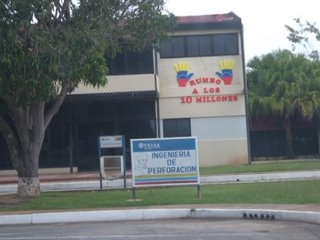 Katy says: Katy says: Here is a nice little picture I got today. It is from some sort of PDVSA office, and the slogan reads "toward 10 million", as in 10 million votes for Chávez. The two hands and the slogan are an integral part of Mr. Chávez's re-election campaign.
 Katy says: Katy says: Influential British magazine The Economist (registration required) has a very interesting article on national oil companies and how they have often served as cash cows for governments instead of behaving like profit-maximizing companies. Not surprisingly, the article starts off with tales of PDVSA, past and present. An excerpt: ...
"EXXON MOBIL is the world's most valuable listed company, with a market capitalisation of $412 billion. But if you compare oil companies by how much they have left in the ground, the American giant ranks a lowly fourteenth. All 13 of the oil firms that outshadow it are national oil companies (NOCs): partially or wholly state-owned firms through which governments retain the profits from oil production. Because these national champions control as much as 90% of the world's oil and gas, they can do far more than the likes of Exxon to assuage the current worries about supply and to influence the accompanying record prices. But like most state-owned firms, they are prone to over-staffing, underinvestment, political interference and corruption. Petróleos de Venezuela (PDVSA), one of the biggest (see chart on the next page), provides a cautionary tale of how bad they can be. Venezuela has exported oil since the 16th century, when the mother of the Hapsburg emperor, Charles V, had some shipped to Spain to treat his crippling gout. Big multinationals, such as Royal Dutch Shell, set up shop in Venezuela almost a century ago. By the 1930s the country was the world's second-biggest oil producer. Today it remains one of the main sources of American oil imports. There is also huge potential to expand production: if you include its near-endless supply of treacly "ultra-heavy" oil, Venezuela has the world's biggest reserves. Like many developing countries, Venezuela nationalised its oil industry in the 1970s. But its politicians were mindful of the extravagant mess that Pemex, Latin America 's biggest NOC at the time, had made of Mexico's oilfields since the 1930s. So the Venezuelans devised a structure to minimise the disruption. Former foreign concessions became free-standing divisions of PDVSA, with many of their existing managers left in place. From these sensible beginnings, PDVSA developed a reputation for professionalism and competence, matched by few other NOCs. The company was thought to be relatively free from the corruption and cronyism that had spread through Venezuela, fuelled by oil wealth. It was certainly efficient, producing as much oil as Pemex did with a third of the staff. In the 1990s the Venezuelan oil company embarked on a scheme to raise output to 6.5m barrels per day (b/d). This would be done by increasing its own production and farming out marginal fields to foreign firms. The idea, says Luis Giusti, who ran PDVSA from 1994 to 1999, was to make use of multinationals' technology and capital without surrendering the most lucrative opportunities to them. By 1998 some 36 foreign firms had set up shop and were rapidly expanding their output. PDVSA, meanwhile, had already reached 2.9m b/d and was seeking the government's blessing to invest more to increase its production capacity. But royalties were falling along with the oil price. With an election looming, the government slashed the company's investment budget instead. Output promptly started to fall and has never recovered. Partly because of geology and partly because of their age, Venezuela 's fields require a lot of maintenance. The oil they produce is more viscous and acidic than the norm, and so harder to handle. Less than a tenth of the fields simply spout oil thanks to the natural pressure of the reservoir. Keeping the remainder flowing requires constant injections of water or gas. Even so, their output declines at roughly twice the pace of oilfields in the North Sea. Venezuela has to add 400,000 b/d of new annual production capacity just to keep output stable, according to Mazhar al-Shereidah, an academic. That is even more expensive than it sounds, because each well produces only a small amount: perhaps 180 b/d, compared with as much as 7,000 b/d from some Persian Gulf wells. It takes Venezuela ten times more wells than Saudi Arabia to produce a third of the oil. No wonder that at the height of its expansion in 1997, PDVSA was investing $5.4 billion, according to Wood Mackenzie, a consultancy. But when President Hugo Chávez came to power in 1999, he started squeezing even more money out of the firm. By 2000 investment had fallen to $2.5 billion. Mr Chávez accused PDVSA of hiding its profits from the government through deceptive accounting. He also questioned the firm's expansion plans and overseas acquisitions. Above all, he decried its relative autonomy and appointed a number of hostile bosses to impose his authority. PDVSA's management, naturally, resented this. They joined a general strike in December 2002, along with half of the firm's 40,000 employees. Most of the skilled staff, including engineers and technicians, stopped work for two months. Since—like patients in intensive care—many of PDVSA's wells require constant monitoring and treatment, says Mr al-Shereidah, the strike killed lots of them. Analysts estimated that Venezuela lost as much as 400,000 b/d of production capacity for ever, not to mention billions of dollars in revenue. But the worst was still to come. Mr Chávez denounced the strikers as saboteurs and sacked them all. The toll was highest among skilled workers: two-thirds of managers and technical staff went. At a stroke, PDVSA lost almost all of its most experienced and best-qualified employees, with an irreplaceable understanding of the idiosyncrasies of its wells and fields. Critics say that the government restaffed the firm with incompetent cronies and placemen. Contractors whisper that it is having trouble spending even its reduced investment budget. Bids take months longer than necessary to complete, one contractor complains, because the procurement staff cannot get their technical specifications straight. Others point to an increase in fatal accidents and fires at PDVSA's refineries as proof that its workers are no longer up to snuff. Staffing has certainly become more political. Mr Chávez's cousin, Asdrubal, runs the firm's shipping arm. The president's brother, Adan, helps to co-ordinate the company's subsidised oil sales around the Caribbean as ambassador to Cuba . Those who signed a petition advocating a recall election for Mr Chávez complain that they cannot get jobs at PDVSA or its contractors. Politics has begun to intrude into the firm's strategy, too. Mr Chávez wants PDVSA to do less business in the United States and more in Latin America. In the name of regional integration, he is pushing for an expensive natural-gas pipeline from Venezuela to Brazil , which would "bring gas that does not exist to markets that do not exist", in Mr Giusti's view. In theory, the hugoducto, as the pipeline is sarcastically known, will be a money-making venture, but Mr Chávez has also dragooned the company into all manner of charitable works. He insists that the firm spend a tenth of its investment budget on social programmes, and has pledged its help, in the form both of cheap oil and technological assistance, to allies from Argentina to the Bahamas. Clearly, Venezuela's oil company no longer operates at arm's length from the government. Its head, Rafael Ramírez, is also the Minister of Energy and Oil. "The president tells PDVSA to commit suicide, and he says, 'Yes sir!'" gripes Elie Habalian, a former Venezuelan representative at OPEC, with a mock salute. The company is also becoming more secretive. It has de-registered its refining subsidiary, Citgo, at America's Securities and Exchange Commission, and so no longer files any public reports to the organisation. In Venezuela, the Ministry of Energy and Oil has only just released the 2003 edition of its annual statistical compendium on the company's performance. Its finances are certainly getting murkier: it now transfers much of its earnings directly to a development fund controlled by Mr Chávez, rather than sending them all to the central bank as it used to. Despite these worrying trends, the government claims that PDVSA has fully recovered from the strike and sackings, and is now producing more than it did beforehand. Officially, it is still planning to raise output to almost 4m b/d by 2012. But observers scoff at such notions. The company can no longer maintain its own fields, let alone complete the many new projects it is pursuing, says Diego González, who used to work for its gas division. Wood Mackenzie estimates that output slumped to less than 1.2m b/d in 2003. It subsequently recovered a bit, to 1.6m b/d, but is now falling again. These failings have not stopped Mr Chávez from forcing most foreign oil firms in Venezuela to go into partnership with its national champion. It is now running the resulting joint ventures—presumably no better than it runs its original fields. Other countries go further: Saudi Aramco, for one, has a monopoly on oil production in Saudi Arabia. PFCEnergy, a consultancy, calculates that 77% of the world's oil and gas is found in countries whose production is controlled by state-owned oil firms and their partners." ... Later on, the article says: ... " Happily, not all NOCs are as badly run as PDVSA. But their problems are similar, if not as severe. Many suffer from government meddling of one sort or another. Legal requirements to hire a certain number of locals have left the state firms of several Persian Gulf emirates hopelessly over-staffed. Russia uses its NOCs, Gazprom and Rosneft, as instruments of foreign policy. The governments of China and India, among others, oblige their state firms to sell petrol below the international price at the pump, even though they have to buy much of it on the open market. Bolivia, meanwhile, cannot decide whether it wants an NOC at all. It has opened its oil industry to foreign investment and then nationalised it no fewer than three times." ... The article is a must-read. It makes many of the same points Terry Karl made in The Paradox of Plenty, her legendary book on the many ills of petro-states. It is also a point reaffirmed by Quico in his post on Petrostates. Still, it is nice to see these important issues being raised yet again by a regarded publication such as The Economist that appeals to such a wide audience. Let's wait and see how the chavista propaganda machine try spin its way out of this mauling.
 Katy says: Katy says: Venezuelans woke up Sunday to the news that jailed union leader Carlos Ortega had fled Ramo Verde military prison along with three other jailed military officers. Ortega became famous as one of the opposition figureheads in the events of 2001-2003, particularly the general strike that shut down oil production and a big part of the economy. I know Quico is not a big fan of Ortega's, and neither am I, so I will leave the discussion about his tactics, his biography, his legal wrangling or his decision to flee prison to the comments forum. I would, however, like to draw attention to what this breakout says about the government. Leaving aside the issue of why a civilian union leader was serving time in a military jail (Guantánamo, anyone?), the fact that Ortega fled can be interpreted in many different ways. The first thing it says is that this government is too incompetent for its own good. For all of Carlos Andrés Pérez's political weakness post-1992, he made sure Hugo Chávez stayed in Yare Prison. Security at Yare was not top-notch, with the occasional reporter or coupster managing to sneak inside and record a conversation or a call to arms. But Pérez, Caldera and even freakin'-Ramón J. Velásquez made sure the guy did not flee under their watch. Caldera may have pardoned him, but before that Chávez remained in his cell. Upon closer inspection, one wonders if all is well in the Armed Forces. One of the reasons for putting Ortega in Ramo Verde was - I assume - that security is less prone to being compromised. After all, the Armed Forces were purged of non-chavista elements a long time ago, or so we are made to think. The Defense Minister is now saying there was internal complicity. If so, with whom? Is the military conspiring against the government? Who knew about this, and how? Will we ever know the truth? Who will be the scapegoat? Then there are the "situation-room" theories. One is that Ortega and the officers were allowed to flee so the government could kill them upon re-locating them. This one seems convoluted to me: if the government wanted to kill or disappear them, it could do so without so much hassle. Aside from that, what does the government gain by killing these guys? Another theory is that they are being set free to see if they lead the government to bigger fish. Sources informed me toward the end of last year that Gen. Néstor González González was hiding inside Venezuela. Could it be that Ortega made a deal with the government to lead them to the hiding general? Finally, it could be that the government intentionally set Ortega and the military free to remind the Venezuelan public about the oppositión's strike. With Ortega now free, the government can begin spinning theories about how Ortega is the mastermind behind the Rosales candidacy and other nonsense. Perhaps Ortega can mobilize the government's core voters (and in the process, turn ni-nis against the opposition) if he looms as a menace, as the ghost of strikes past. And if you think Ortega does not ignite the passions of hard-core chavistas, wait and see what happens in the comments part of this post. No explanation is completely satisfactory, but they all seem to work on some level. PS.- Thanks to Maria from the comments forum for the link to the picture...
 Katy says: Katy says: As everyone knows, Chávez went to Cuba to visit Fidel Castro, courtesy of Venezuelan taxpayers. Here's a question to test your knowledge of bolivarian/revolutionary knicknacks. The phallic item being held by Castro and Chávez in the picture on the left is: a) a vibrator b) Chávez's first-communion candle c) the dissected penis of Bolívar's white horse d) a light saber e) a copy of Simón Bolívar's dagger (Note: I believe the answer is e, but I am not sure)
 Katy says: Katy says: Venezuela has just announced that it will not participate as the guest of honor in the La Paz Book Fair. Our country's representatives allege that this fair supports a "mercantilistic" view of literature, and that instead Venezuela will host a counter-fair through which 25,000 books will be distributed freely, courtesy of Venezuelan taxpayers. The director of the National Book Center said that "books are not merchandise, but an instrument in the struggle for freedom", and that he wants literature "to stop being a privilege for the elites." (sic) Oh, how noble. If only this were a reflection of the government's actual policies at home. It is well known that, in Venezuela, books are outrageously expensive, thanks in part to high taxes and import tariffs. To drive this point home, I did a little experiment and compared some of the prices listed in Venezuela's Tecniciencia chain of bookstores with the primary bookseller of the empire and Satan himself, Amazon. Here's a sample: On Tecniciencia's website, a copy of Mario Vargas Llosa's "Travesuras de la Niña Mala" will set you back 45,000 bolívars, roughly US$21.42 at the fixed rate. I'm not sure this includes the Value-added tax or not, but let's be conservative and assume it does. The same book on Amazon costs you $13.57. Arthur Golden's "Memoirs of a Geisha" sells for Bs. 55,000 ($26.19) in Venezuela, and for US$7.99 in the US. Laura Restrepo's "Dulce Compañía"? Bs. 40,000 ($19.04) in Venezuela; $10.62 in the US. Laura Esquivel's "Malinche"? Bs. 50,000 ($23.80) in Venezuela, $15.61 in the US. J.K. Rowling's "Harry Potter and the Sorcerer's Stone"? Bs. 24,500 ($11.66) in Venezuela, $8.99 in the US. Azar Nafisi's "Reading Lolita in Teheran"? Bs. 58.000 ($27.62) in Venezuela, $9.72 in the US. Now, dear reader, I realize you are entitled to be skeptical about this back-of-the-envelope comparison. What about Venezuelan authors? Federico Vegas' wonderful must-read "Falke" (another post on this some other time) sells for Bs. 55,000 ($26.19). I couldn't find a price quote overseas, but Vegas' "Venezuelan Vernacular" goes for $11.95 in Burbank, CA (according to Abebooks) so the price for Falke probably won't be that far off. Chavista intellectual and author Luis Britto García's "Por los signos de los signos", published by our very own state publisher Monteávila Editores, sells for a healthy Bs. 30,000 on Tecniciencia, or $14.28. Perhaps Bolivians will get to read Britto García for free - and in the process find out what a piece-of-crap author he is. In fact, one of the few instances I found of books being cheaper in Venezuela was über-communist (and anti-chavista) author Domingo Alberto Rangel's "Gómez, el amo del poder". This book sells for a modest Bs. 20,000 ($9.52) at Tecniciencia. The same book is not listed in Amazon, but according to Abebooks, you can get a copy in Llibres de Companyia in trendy Barcelona, Spain, for a mere US$11.86. At least there appears to be some consistency to Rangel's values. Perhaps chavistas would do well buying the book, sitting at a café in the ramblas, buying themselves a Café Latte or some churros con chocolate and railing against capitalism when compared to chavista altruism. In the process, they should try and learn some communism from people who actually try to practice it. You see, you can't go around telling people you believe books should be available to all when your own country's tax policy prevents all but the rich from affording books. This, of course, is by no means a scientific study on the Venezuelan books market. It is a simple gimmick to llustrate the hypocrisy in giving away books in Bolivia while heavily taxing them at home. It's the world upside down, but if you are gullible enough to believe official propaganda, it's the dawn of the new man.
 Katy says: Katy says: Wednesday, August 1, 3:50 AM: Former CNE President and chavista figure, Jorge Rodríguez, goes to Clínica El Ávila (one of Venezuela's most prestigious private medical centers) for a checkup after a car accident. He ends up in Clínica La Floresta where he is diagnosed with two apparently small fractures in his ribs and a bump in his head. Wednesday, August 1: State news agency ABN reports the incident with the unbiased headline " Clínica Ávila refused medical attention to former CNE President". The news item does not include the clinic's response to these allegations. Thursday, August 3: El Universal says that the Prosecutor General's office has begun an investigation into the reasons why Rodríguez was denied treatment at Clínica El Ávila. Medical staff at the clinic allege that Rodríguez was taken to La Floresta in one of their ambulances after a woman accompanying Rodríguez (presumably his sister, Minister Delcy Rodríguez) went ballistic on the attending physician, who had to lock herself up in a room. Thursday, August 3: Clínica El Ávila President Mario García says that Rodríguez was taken care of like any other emergency patient, that his vital conditions were stable but that the attending physician had recommended a CAT scan to rule out internal problems. The physician informed Rodríguez that the Clinic's CAT scan was broken, and they suggested he go instead to Clínica La Floresta. Thursday, August 3: Venezuela's tax authority shuts down the administrative offices of Clínica El Ávila for 48 hours, apparently due to errors in some of the paperwork. There is no allegation of tax evasiuon or tax fraud. The procedure was done by 15 employees from the tax office, who inspected the Clinic accompanied by 42 inspectors from the Ministry of Health, who apparently inspected everything from medical machinery to the medicines being administered. Thursday, August 10: El Universal reports that the Health Ministry has shut down the Clinic's lab, pharmacy and three of its operating rooms. No word yet on whether the CAT scan machine was or was not in working conditions. Questions: - Why are tax authorities called on to investigate what is, by all accounts, a case of apparent medical malpractice? - Why is the government so keen on meddling in a private dispute between a private citizen and a private health-care facility? - Why is the Health Ministry so keen on inspecting one of the country's most presitigious private clinics, when public hospitals in Venezuela are in such shabby conditions? - Is there any truth to reports that Rodríguez had a portion of Clínica La Floresta vacated for his security personnel? - What ever happened to figuring out whether or not the CAT scan machine was functional? - If the machine wasn't functional, what role does the CADIVI roadblock play into it? - Why would the clinic that is supposedly denying medical treatment allegedly take Rodríguez to another clinic in one of its ambulances? - Do all tax/health inspections require a commando-style operation by 57 employees?
 Katy says: Manuel Rosales, two-term governor of the state of Zulia, in Western Venezuela, has just been confirmed as the single presidential candidate of a substantial portion of the opposition to Hugo Chávez's pseudo-socialist revolution. The announcement was made today in Caracas, after Venezuela's CNE decided yesterday that Rosales did not need to resign from his governorship but rather take a temporary leave of absence. Katy says: Manuel Rosales, two-term governor of the state of Zulia, in Western Venezuela, has just been confirmed as the single presidential candidate of a substantial portion of the opposition to Hugo Chávez's pseudo-socialist revolution. The announcement was made today in Caracas, after Venezuela's CNE decided yesterday that Rosales did not need to resign from his governorship but rather take a temporary leave of absence.
Zulia (where I am from, by the way) is Venezuela's most populous state. It is the home of a big chunk of Venezuela's oil wealth, as well as some of the best agricultural land in the country. It is also the home of some of Venezuela's most distinctive cultural manifestations, such as gaitas and the cult of the Virgin of La Chinita. Maracaibo, the state capital, is Venezuela's second-largest city. Once a sprawling big town riddled with problems, it has sort of come of age, and the city looks cleaner and more prosperous than many other places in the country.
Both Quico and I have expressed our misgivings about Rosales on several occasions. Both of us have come forward in favour of other candidates, such as Rausseo or Borges. However, today is not the time to dwell on these issues. I think it is a good moment to pause and reflect on all that is positive about this announcement.
Rosales' announcement is the product of intense political negotiations that began several months ago. This process involved lengthy discussions between three main candidates, several less popular ones, and Venezuela's NGOs. The fact that these people could sit down, see the urgency of what is coming to us, understand that unity is of the utmost importance, and come up with a reasonable solution at the right time is an enormous step forward for the opposition. Long gone are the extensive deliberations of the extinct Coordinadora Democrática, where nothing was ever solved, nobody had the lead voice, there was no vision and the message was never clear.
Some people have expressed misgivings about Rosales being the product of negotiations and not the product of primaries. There are several reasons why this criticism rings a bit hollow:
a) It was well known that the organization of the primaries was facing numerous logistical problems;
b) enthusiasm for the primaries was dwindling;
c) voters were afraid of participating in the primaries and ending up in some government list where they would be punished;
d) Súmate was being distracted from its role by the government's continuous harassment; and
e) the primaries would have probably yielded a Rosales victory anyway.
The way that Rosales was selected is a positive development. It is possibly the first time that different factions in the opposition have sat down, discussed what the country needs and come up with a solution. It is a big step toward proving that the opposition is capable of governing Venezuela in spite of its heterogeneity.
It was also refreshing to see the way Teodoro Petkoff, Julio Borges and the rest of the candidates came out and supported Rosales. Special mention goes to Borges, who was Rosales' main challenger and who has immediately put his party's logistical and intellectual resources at his disposal. There are rumours Rosales will announce in the next few days that Borges will be his vice-president should he win, but the fact that Borges' support did not come with a quid pro quo is certainly positive for the future.
What does Rosales bring to the table? His two main assets are an efficient record as a public servant and two electoral victories over Chávez and his barrage of tricks. His record is evident in Zulia's improvements in roads and public services. Rosales has also shown political deftness, working with both the federal government and, especially, with Maracaibo's chavista mayor. All over Maracaibo, you see a healthy competition between the public works sponsored by city hall and the works sponsored by the governor (the competition reaches somewhat tacky levels, given the enormity of the colourful signs announcing this or that sidewalk is being brought to you by either the mayor or the governor).
Rosales has skilfully hung on to his job in spite of the CNE's tricks and opposition voter apathy. He is very popular in Zulia, and it is likely he will carry this state in the election, tricks or no tricks. Zulianos are Venezuela's most region-proud bunch, and we tend to be more pragmatic in our ideology. It's my impression that, as a whole, Zulianos seem to be less prone to left-wing populism. We believe in entrepreneurship and in private property more than the rest of the country, and we can be sure that Rosales will bring these issues to the table.
As for Rosales' proposals, we'll have more time to discuss these later. From what he has already said, they combine most of the proposals brought forward by Petkoff and Borges, including a direct mechanism to hand out oil rents and the improvement of the misiones. He has also come forward against the war-like mentality that seems to pervade in the government lately, even borrowing some of Rausseo's lines by saying that airplanes will be changed to schools and missiles will be changed to hospitals.
Finally, Rosales is the product of decentralization, a complex political process started in the late 80s that has not quite achieved as much as promised in spite of its popularity. Decentralization has come under attack from the current administration. Chávez, as all good military men, hates independent subordinates, and he has implemented numerous initiatives destined to take away what little power regional and local governments had. Rosales is sure to propose further decentralization as a way of bringing power back to the communities and the states.
As I said before, today is not a day to criticize. The opposition is showing great maturity in coming up with a concerted solution at this stage of the game. Let's wait and see what happens with other candidates such as Rausseo or Smith, as well as what AD decides to do. In the meantime, let's celebrate the hope of putting a zuliano in Miraflores for the first time in our history.
From the road, Quico says: I don't know that much about Manuel Rosales - in itself a bad sign, given what a political junkie I am - but here it goes all the same: I think the guy is hopeless as a candidate, worse even than Borges. Here's why: There's one message that comes through loud and clear in all the public opinion research that's been done over the last few years: no volveran - they shall not return - is one chavista slogan that has legs. It's the one thing that chavistas and NiNis concur on, this deep seated disgust with the pre-Chavez political system. But it's a message Rosales seems not to get at all. By all accounts, Rosales is a retread adeco. His discursive style is as much a throw-back to 70s style AD populism as is his political organization. Isn't it fair to presume that if the guy looks like an adeco, sounds like an adeco, smells like an adeco and talks like an adeco, voters will conclude he's an adeco? His campaign launch line about Chavez's misiones being basically the same as the social programs of the pre-Chavez era underlines the basic problem with his whole approach: while, substantively, he may be right, the line catastrophically fails to realize the way Chavez's discourse of radical popular empowerment have changed the rules of the political game. As everyone knows, el pais cambio, ...everyone, that is, except for Manuel Rosales. The key political fact is that even if the misiones are just souped-up social programs, they don't feel that way to their recipients. That makes all the difference, because in politics perceptions are realities. Chavismo has moved the goal-posts of Venezuelan politics not just by mobilizing oil resources for the poor, but by going all out to ensure that the poor feel that state resources are mobilized on their behalf. I just don't see how a politico who doesn't understand that has a chance in December. People tell pollsters again and again that they want an alternative to chavismo that is, at the same time, an alternative to the legacy of puntofijismo. Rosales seems very far from being channelling that desire. As a candidate, I can't see how he could reach out beyond the traditional hardcore anti-chavez vote and win over the broad, politically homeless center that's so clearly the key to mounting a credible challenge in December. To say nothing of winning over wavering transactional chavistas. So, we'd be stuck with the same 40% that keeps voting against Chavez - and that's a best case scenario, because we know many of them will abstain on principle. This is not what the opposition needs. What the opposition needs is a candidate able to turn this race upside down, one able to innovate discursively, to mount an anti-Chavez discourse that is clearly, patently distinct from the pre-Chavez political tradition, that has a chance to make a serious bid for NiNi and wavering transactionals' votes. I don't think I need to spell this one out any further...
 Katy says: Zulia Governor Katy says: Zulia Governor Manuel Rosales is in a bind. He is mulling whether to be or not to be the opposition's main presidential candidate. Many people consider Rosales somewhat of an enigma. A man of few words, he has managed to be an effective local governor without the benefit of traditional political alliances. However, the thing that says most about the presidential aspirations of this Zulian Hamlet, is the fact that this is a dilemma at all. Rosales is in the position he thought he wanted. Polls show him leading (by a razor-thin margin) Julio Borges as the opposition's main hope. Teodoro Petkoff has cleared the race, and Borges himself has hinted that he is ready to work for Rosales should he decide he wants the banner. Rausseo has, so far, not become the overwhelming phenomenon that people feared he would. And yet Rosales still wonders. Venezuela's Supreme Tribunal said a few days ago that Chávez would not have to resign in order to run for President, but that other public servants would. However, in yet another judicially obscure ruling, it seems some people are still doubtful whether or not Rosales would have to resign or simply detach himself from his Governorship temporarily. Rosales seems to have the faint hope that the government would let him go back to his governorship should he run for President and lose. Rosales is now in the position of deciding whether he wants the Presidency enough to renounce everything he has achieved so far. The decision to run carries lots of risk: he risks losing control of the Zulia Governorship, losing the Presidency and, ultimately, losing his freedom because of the government's open case against him for signing the Carmona decree. And yet... the fact that he is mulling this issue when many cards are lined up in his favor says tons about his commitment to the cause, or lack thereof. If he is still doubting, perhaps he doesn't want it badly. Perhaps he is an accidental candidate, someone who is called upon to fill the void but has never really had Miraflores as his goal. Perhaps Venezuelan voters deserve better. If he really is that scared to lose his governorship, perhaps he should step aside and let Borges be the candidate. At least we know he really wants it.
 Katy says: Katy says: Loyal reader and fellow blogger Bruni (I assume those are her eyes at left) has a great post today regarding the accuracy of fingerprint scanning machines used by Venezuela's CNE. I recommend it! Here is the Spanish version, and here is The Devil's Excrement's English translation. Thanks to both!
Katy says: Did you know that, according to Prof. Marino González of Simón Bolívar University, the total spending on weapons Chávez has announced in the last year and a half (more than US$3 billion) is equivalent to a year and a half's worth of the budget assigned to the Ministry of Health? Did you know that, according to the same source, 57,607 children between the ages of 0 and 1 died between 1999 and 2004? Did you know that roughly 80% of these deaths (or 46,086) were preventable? 46 thousand Venezuelan babies have died during this administration because their families lived in deplorable conditions. Their parents' education probably did not reach third grade. Their houses did not have basic services such as sewage or running water. Medical attention before or during childbirth was probably inadequate, and pediatric care was probably not available to them. Of the 7,400 children between 0 and 1 who died in 2004, more than 2,000 of them died due to complications from childbirth, complications that could have been prevented with greater control during the pregnancy. 986 of these children died due to generalized infections, probably due to lack of access to antibiotics. 686 died due to diarrhea. 300 of these children died of infant malnutrition.
 Katy says: Katy says: Several things from the news this morning that are worth commenting. 1. If it's bad to be rich, Jorge Rodríguez is one baaaaad MFer. Former CNE President Jorge Rodríguez totalled his brand-new Audi yesterday. The circumstances of the crash are not yet clear. However, it is known that Mr. Rodríguez was giving a ride to one of José Vicente Rangel's staff members. It is also known that Rodríguez was in the process of starting a news program in Chávez's TV station, Telesur. And finally, Chávez's vice-minister (and Rodriguez's sister) Delcy Rodríguez claims privately-owned Clínica El Ávila refused to give Rodríguez treatment, something the Clinic denies. We wish Rodríguez a speedy recovery. We always enjoy his public appearances, specially because it reminds us that, contrary to what the Constitution says, he has never been impartial in the political debate. We also hope he can buy himself another car that 99.5% of the Venezuelan population could never afford. Go Jorge! (side note: Rodríguez managed to smash into yet another Audi - imagine that, things are going so well in Venezuela, that there is no space on Caracas' streets for so many Audis) 2. Confusing signs regarding the Primaries. Despite Súmate saying that everything is A-OK with the primaries, Julio Borges is announcing for the first time that he has doubts about the procedure. Negotiations between Borges, Petkoff and Rosales are ongoing, but one wonders if the primaries have the momentum to be carried out. Whatever the outcome, let's hope the resulting candidacy brings together all forces fighting toward the same objective. Unidad!
 Alright, Katy - if that is indeed your real name - things have gone far enough. I shall suffer your Guacharophobia in silence no more. The time has come for an Opinion Duel.
|
