July 1, 2004

Another courtroom thriller moment: You can't handle the truth!


"What do you mean I'm out of order?
You're out of order,
this whole courtroom is out of order!"

Litigation, litigation, litigation


Scott kindly provided us with the translated transcript of the proceedings:

Judge-"Mr. Saddam, the court would like to know more about the chemical agents. You know, the ones that you used to get your hair to look so...presidential, today."

Hussein-"First, let me thank the Coalition Provisional Authority for sponsoring my wardrobe, a nice Armani suit from Jordan. It's necessary to understand that ties are no longer needed in situations especially no longer with white dress shirts, as used to be the acceptance"

Judge-"The chemical agents, sir. We asked you about the products you are using"

Hussein-"It's a styling gel, a generic, that is provided in a little plastic bottle in all of the Coalition Provisional Authorities hotel rooms...I mean, cells. But they also have conditioners and these little soaps that have "C.P.A." embossed on them. And they smell like almonds. My skin has really improved as of late."

Judge-"Can you tell us whether you are dying your hair?"

Hussein-"I am the President of Iraq! You tell ME if YOU are dying your hair."

Judge-"You are out of order..."

Hussein-"No, you are...this whole court is out of order. Who would ASK such a question of me? Of ME? You, you who wear a simple $6 dollar crew cut...what did they use, a bowl around your head, boy?"

That's all the transcript I have so far...


That's Scott's transcript. Thanks again, Scott.

June 30, 2004

More stuff on National Prizes

There's more National Prize turmoil: Architect Oscar Tenreiro (not to be confused with his brother Architect Jesus Tenreiro), who was awarded the National Prize for Architecture released this article today on El Nacional:


Reflections on an award.
by Oscar Tenreiro

I think a National Prize, more than one of those recognitions that, in Venezuela, are like a forced exile, is a chance to communicate to others beyond the boundaries of what is routine. So, when gossip brought me the news that my name had been mentioned by the jury of any given year, I thought that whatever the political circumstances of the moment, I would accept it as a special moment to say things.

That's why, when at the end of February, a member of the jury called me up and told me: "Oscar, we awarded you the National Prize, we want to know if you'll accept it", I accepted, letting him know of my wish to say a few words at the award ceremony.

I had to wait for a returned call. There was a 2003 rule that did not allow prize winners to speak (¿?). I thought it was unusual that an awarded honor established that limitation, but I understood it better when a month later, I received, at home, an acceptance affidavit, which I had to sign, and which contained a paragraph that stated "I formally commit to appear at the award ceremony (...) on the date set by the CONAC." As I modified the paragraph with my own handwriting, I wondered why these days, being awarded a National Prize is equivalent to being summoned by a judge.

I had to look for a way to fulfill my wish to say things.

In the time since my signature of the affidavit until today, almost four months ago, the CONAC never officially acknowledged that the prize was awarded, something without precedent; and when I started doubting that the whole thing was even true, they called me on the 23rd for some information and on the 25th they left me a message saying that the prize would be awarded on the 30th of June.

The conditions to the outer limits of the law were going to be fulfilled, as lawyers say, so it was my turn for the wished-for communication.

And I decided to do it in two ways: One through this article, which I dedicate to personal aspects that I think are key; and another one through an interview that should be published today, or one of these days, in which I deal only with architectural themes and architects.

Oscar Tenreiro Degwitz


II

In the personal realm, I begin by saying that the recently appointed Minister of State for Culture was my professional partner until the end of the 90's, when he opted for other spaces. We were not only partners, but close friends.

We shared educational efforts at the UCV that some consider laudable. The family world of each other was present, as was the confidence, the sweet and the sour, even the sharing of a regrettable accident that almost compromised my life.

Tenreiro-Sesto almost became a composed name.

Political hopes also united us, mine derived of an early political activism rooted in a Christian vision, and in the tensions and grave omissions of a Venezuela post-Perez-Jimenez; his were related to the drama of the bloody Spanish polarization, a rationalized atheism that I always doubted and a form of Marxism that wanted to be democratic. This allowed us to share expectations: we believed, I thought, in a democracy that was perfectible, deep, and rooted in society as a mechanism of change.

We were on the same side.

Thus transpired our relationship of more than two decades.

Architecture was the background of many efforts generally interrupted by the highs and lows in the search of the goddess architecture in a pre-architectonic country . Many were his contributions, as an architect and as a human being, which I would have liked to do and have achieved half-way. That's why this prize is also, in great measure, his, and his name must, without a doubt, be present in whatever reflection of what I did as an architect since the mid-seventies until the early nineties. And what has been my educational career until my recent retirement. I hereby bear witness and pay tribute to his professional and human dedication, always generous and sacrificed, and only on occasion plagued by mixed-up encounters.


III

But today the situation has changed.

The Revolutionary myth, embodied by the official rhetoric and maneuvering, is descending upon Venezuela. And we know that the Myth, by definition, dominates the spirits. Everything is surrendered to him and is sacrificed for him. It matters little that it is only a mirage, as all of us who are on this side of Power know (Power blinds, of course). As any person with common sense, not possessed by the Myth, knows.

Myth has become reality in the psyche of many that were once friends or that I once admired. Holding the hand of a military caudillo from the worst of our nineteenth century, people whose elevated sights we never doubted and of whose honesty we once bore witness, have decided to sit at the table with all sorts of opportunists, with mediocre people who feel that their day has come, and the worst aspect of all, an army of assaulters of the public treasure, who act, as were denounced by Fermin Toro in the Valencia Convention of long ago, "as hungry dogs" attacking their prey. And all of it seasoned with the most authentic style and fascist execution that cuts across a militaristic, antidemocratic scene, well illustrated by the gorillas of the regime.

What can one think then?

What to say?

I say, after all possible reflection that I can muster, that I do not count myself amongst those who worship friendship despite all differences. I think there are differences that end a friendship, like that, plainly and with all it implies. And I say too, that those who in this moment of my country cannot distance themselves from the caudillo, reveal deficiencies that I can comprehend, but are placed on a riverbank where I have no friends.
-------------------------------------------------------

Chapeau, Mr. Tenreiro, Chapeau.


P.S.: Thanks Sydney, for the translation tweaking!

June 29, 2004

Latest news from Plaza Venezuela...

Something very weird is cooking, guys. I don´t know if you remember my text about the "Defensores de la Patria" and the taken buildings in Plaza Venezuela and the mural. Well, Jazmín Manuitt, the woman who was the frontspiece of the whole show was taken to jail yesterday. Today, the mural with the weapons and the skull was overpainted... in white! My suspicions are: 1) the buildings are still invaded; 2) Eliécer Otayza, former coup monger and stripper, is behind these guys. Something is cooking up there, I can feel it!

June 28, 2004

Some strategical hints...

Our dear Tuti is worried (really worried) about the strategies the CD should undertake to effectively get to the undecided citizens. Today, I saw twice the piece the Comando por el sí is airing ("Yo te propongo", using a very well know song as leit motiv, is a call for reconciliation and inclusion), and I think that they are on the right track.
You all know I´m more than a little bit crazy, so bear with me...

Yesterday, after talking to Tuti, just by chance I watched "The Lion King" on TV. Besides noticing this Disneyesque interpretation on Hamlet (for that is what it all boils to, dear CC bloggers), there is a magnificent scene. Pumba, Timon and Simba are lying on their back, looking at the stars, and Timon asks: "What do you think those lights up there are?". His own answer is a very shortsighted one: "Those are fireflies which stuck to that blue-black thing up there" (let´s say that as a naturalistic thinker, he uses his knowledge to explain something through his perceptions and experiences, and obviously gets it wrong). Then Pumba says: "I think those lights are great masses of burning gas" (which is the scientifical truth, isn´t it, Tuti?). He gets at it intuitively, and Timon starts laughing and tell Pumba that with him everything has to do with gas... Then Simba remembers his father, and tells them that those lights up there are the spirits of dead kings watching still over the world. Timon laughs, big time, and they go on with the story.
You´re surely thinking I finally went over the bend and someone better tell the asylum to get me to the paddled cell ASP, but let me explain myself.
The word "consider", ethymologically speaking, comes from "cum sider", "sider" being the same root of "sideral". To consider, to be considerate, is to take the "stars" on account,that is, to give a mythological dimension to events and images. What I´m trying to convey to you, and the reason I think the "Yo te propongo" side of the campaign is effective is because it touches an AFFECTIVE spot, just as Simba´s story about the stars. Pumba´s scientific explanations won´t do (sorry, Tuti, but I think that´s why I really laughed yesterday watching the Lion King after talking to you, so scientifically prone as you are), Timon interpratation (so similar, by the way, to what Chávez will use: "You are poor because someone is rich", the uncultured man using just his senses to interpret a very complicated issue) falls quite short: what the opposition needs is a way to relate affectively to the voters, showing them what Chávez´s rhetoric has endangered, if not destroyed. The end of the piece: "Let´s be Venezuela again", is exactly what I think everyone feels, that the country has changed for the worse. I expect Calvin goes into a rage and calls me a Fascist and other pretty things, but if Chávez uses Venezuelan myths and images to manipulate the voters, I don´t see why the opposition shouldn´t. I would "rescue" Bolívar, pounding on his civilian side (yes, guys, he had one, he wasn´t only a hero, he was also a citizen), and will also use other civilian "forefathers", like José María Vargas, Francisco de Miranda and Roscio for starters. That is on the "positive", "flower eating" hand.
On the other hand, let´s call it the black and dirty hand, I would again go to my hobby horse: The Lord of the Rings. There is a moment, in the novel (not in the awful movie someone should burn and erase from my memory) when Gandalf faces Saruman (remember Saruman´s power is in the voice, that is, his power is rhetorical), which should serve the CD as an example. Gandalf is not the first to speak, he lets Saruman do his "trick". Then he laughs and rejects his proposal, and so Saruman proceeds to speak to Théoden King, who also rejects him. So, little by little, Saruman´s tricks are exposed, not by denouncing them rationally or scientifically (sorry, Tuti), but by letting them expose themselves as "tricks" (remember the old sayings: "no tiene culpa la estaca si el sapo salta y se ensarta", or "por la boca muere el pez"). So, I think the "dirty" hand should be to confront Chávez´s discourse with its own inconsistency, showing its contradictions... For instance, a short spot with Chávez speaking about the abusive luxury of Pdvsa airplanes, but showing images of the airbus he bought for his personal use (which makes the other planes look like carritos por puesto); or for instance show him in two contradictory moods, like a lamb calling for peace and fraternity and then calling every citizen to arms. I think that that part, which some people call "Chávez versus Chávez", is very easy, and combined with messages of reconciliation like the "Yo te propongo" piece, ans stressing every second that this time it is a personal and indivudual responsibility (that is, making the voters feel responsible for their own destiny as citizens), it surely would prove effective.
(This message was posted just to start the discussion, guys. If you want to shoot the messenger, please use toy weapons).

June 27, 2004

The political prisoners of the Revolution: Capriles Radonski in the Helicoide

There is a direct proportion between the numbers of political prisoners of the Chavez Revolution, and the revolution's need to boost its image at the expense of victims it has designated for revenge.

Among the more illustrious members of this Club of Prisoners is Henrique Capriles (Radonski), mayor of the municipality of Baruta. Capriles is imprisoned in the Helicoide by the Chavez regime, using trumped up accusations. (*)

And to think that it was only in February 2003 that chavista propagandists, living comfortably abroad, were weaving spider webs, such as "there are no political prisoners in Venezuela" [María Páez-Victor (PhD., Sociology), "Why Canada Should Support Chávez" (CERLAC Bulletin 2.1). Uhh-huhh. Of course Páez-Victor's comment, which was offered on a silver platter to innocents at York University-Toronto, was rebutted when a member of the audience (moi) asked her if the name of General Alfonso Martínez meant anything to her. It did not as, beyond the torch she then carried for Chavez, Páez-Victor had lived outside the Venezuelan reality for a number of years. And so the rebuttal continued, mentioning that this General of the National Guard was under house arrest for several weeks, in spite of there being no charges laid against him, and in spite of his having a habeas corpus in his favor. Páez-Victor then obfuscated the issue, skipping merrily along to the next point in her marketing agenda.

Fast forward 16 months. The international brigade of apparatchiks has become more aggressive in its propagandizing of the Chavez regime. And members wait - always so comfortably outside the Venezuelan reality. For what? For the Second Coming that would be the crystallization of their verbal revolutionary dreams. While the regime, more threatened than ever by disfavorable international opinion, slithers, squid-like, squirting greater amounts of black ink to muddy the waters, to confuse, and to hide. Hence the snowballing of political prisoners. And the open joke that has become the rule of law in the regime of Hugo Chavez, now into its sixth year of incompetence and corruption.

Where is María Páez-Victor today? I suspect she's gone quiet in her defense of the revolution to foreign groups of innocents. But other delusional servants continue to parry and thrust. You can find some by lifting the rocks in haunts such as Venezuelanalysis.com or Le Monde Diplomatique. How about the Washington-based Center for Economic and Policy Research (CEPR)? Or a host of freelancers, such as filmmakers from Ireland, Donnacha O'Briain and Kim Bartley? And how can we forget a whole slew of 'caimanes' - alligators, if you will, among loyalists of the Cuban Revolutionary Party, Marta Harnecker comes to mind. These are the technicolor dreamers of a bygone era, the verbal mercenaries of packaged promises, the neo-imperialists of hidden agendas. They are all are marked by a common denominator: an inability, or unwillingness, to conduct solid, quantititative analysis to support their ideals. And so these princes and princesses of the proletariat market and sell their flim-flam dreams from far away, with no concept of practical realities inherent in an economy they completely disregard. While the poor, whose numbers have escalated in the past five years of the Chavez administration, are left with no option but to buy in, in exchange for dole. And tears when hunger is at the doorstep.

It could have worked out differently. And the majority of Venezuelans thought that this might be the case when Chavez was first elected on a very different platform than the one he changed after his investiture. No one disputes that a change was vastly necessary.

But this?

Just think what might have been: a partnership between government largesse and business efficiency - each keeping an eye on one another for the good the whole, working together to provide jobs and a measure of independent dignity to a far greater number than are the beneficiaries today.

But that was not the Chavez strategy from the get-go. Instead, the deliberate tactic was to polarize, slowly and inexorably. For what better way is there to divide and render submissive for conquering, a significant voice, which is the private sector in Venezuela? That is, a private sector significant only in voice and know-how, but puny financially, when compared to government coffers.

But I digress. Here then is the truthful account of Father Sirico, following which I have added news items relating to the trumped up accusations against Mayor Capriles.

...

(*)
A Caracas Mayor Pays
Dearly for Opposing Chavez


By ROBERT A. SIRICO
June 25, 2004; Page A11
The Wall Street Journal

Caracas

Pastoral work has taken me to many prisons over the years. But none has left an impression quite like the one I visited here on June 13.

Residents call it the Helicoide, or the Helix in English, because of its twisting, maze-like structure. It looks like New York's Guggenheim Museum but more brittle and fractured. Filled with criminals and political prisoners, and serving as the headquarters of the secret police, it is located in the center of the capital, in the Libertador district of Caracas, an urban jungle with five mayors for its 5 million residents.

One of those mayors, Henrique Capriles, is currently serving time here for "public intimidation," "abuse of power," and other such trumped up political accusations following a protest in front of the Cuban Embassy in 2002. He has not been charged with a crime, and has been denied bail. A kept court upheld his detention last month.

Everyone here, however, understands that Mr. Capriles is being jailed for political reasons. He is a well-known opponent of President Hugo Chavez and his regime, which is notorious throughout the region for its dangerous blend of political populism, domestic socialism, and protectionist and nationalist foreign relations. To defend it all Mr. Chavez has militarized the civilian government.

Because I was here to address a conference on globalization, and Mr. Capriles' case interests me, I was hopeful of visiting him. In a Catholic country where the Church is still held in high esteem, in part for its heroic resistance to the Chavez regime, it may have been my Roman collar that gained me entrance. Deep within the Helicoide, I found a pleasant, intelligent and affable young man who emanates a sense of inner strength.

These days Mr. Capriles sports a beard, which symbolizes his protest of the detention. He is the youngest man ever to be elected to Venezuela's Congress, and his political experience, including a stint as speaker of the House, predates the present regime of Castro-wannabe Chavez. Mr. Capriles was active in the formation of a new party, Primero Justicia (Justice First), which is trying to form a new political consensus here. He describes himself as a moderate and jokes that his friends say that he is sometimes too progressive.

Neither Mr. Capriles, who holds two law degrees, nor his lawyers fully understand the detention order against him. The authorities claim that he was involved in a conspiracy to assassinate Fidel Castro. The incident at the root of this claim is caught on film. It shows the mayor calming an agitated crowd that had surrounded the Cuban Embassy, located in his district, to protest against Cuba's influence in Venezuela. At the time, the Cuban ambassador thanked Mr. Capriles on television for his efforts. Nevertheless, the videotape showing the protest is the main evidence against him.

Sitting in a small visiting room on a ripped car seat that serves as a couch, one of my companions examines the walls and furnishings and Mr. Capriles gives a wide grin and says, yes, there are microphones everywhere. This should come as no surprise in a building built in the 1950s by dictator Marcos Perez Jimenez and now home to the secret police.

Mr. Chavez paints Mr. Capriles as a radical oligarch who "works for the empire." Such rhetoric is in style these days. Returning from the prison, we listened to Mr. Chavez booming on the radio. Like his idol Castro, he is given to marathon speech making. Attacking the upcoming referendum on his rule, he asserts that the battle is not against the "white oligarchy" of Venezuela. Instead it is against one enemy alone: George W. Bush! Thunderous applause follows.

If Mr. Chavez thought Mr. Capriles would retreat, he was mistaken; the prisoner remains optimistic both for his case and for his country. When I ask what sustains him, Mr. Capriles, whose grandmother was Jewish, fingers the rosary he wears around his neck and says, "You know, I am a third generation immigrant. My grandmother spent 26 months in the Warsaw ghetto under the Nazis. I have only been here 33 days. By comparison, this is nothing."

The real issue, he says, is judicial power. Without a strong and independent judiciary, there can be no freedom or stable democracy. Indeed, Human Rights Watch recently issued a 24-page report highlighting recent attempts to stack Venezuela's Supreme Court in anticipation of a referendum loss by the government.

This is my third visit to Venezuela, the first under Mr. Chavez. The change is notable. The streets are more violent and the entire atmosphere is politically charged -- with neighborhoods maintaining their own independent police forces. The government news channel broadcasts Cuban cartoons telling stories about what happens to those who betray the Revolution. As in Nicaragua, the literacy programs organized by Cuban "advisers" are thoroughly politicized.

In my conversations with a wide variety of Venezuelans -- priests and porters, blue-collar workers and journalists
-- it appears that everyone's focus is on the Aug. 15 recall referendum. There is a general sense that Mr. Chavez will try anything to remain in power, including imposing martial law to prevent the referendum. Another concern is the vulnerability of voting machines to tampering. (The company that has the service contract for them is partly owned by the Chavez government.)

A venerable former government minister, the oldest living member of Venezuela's first democratic government, told me that fraud is the main concern. Unless international organizations are watchful, it is likely Mr. Chavez will steal the referendum votes, and there is already talk from Chavistas of banning international observers.

In many ways, the case of Henrique Capriles symbolizes both the sadness and the hope that is Venezuela's. The sadness is that the best and brightest people in this nation should find themselves in this situation. The hope is that even people like Henrique Capriles are optimistic for the future of their country.

Father Sirico is president of the Acton Institute in Grand Rapids, Mich.


...


RELATED NEWS ITEMS:

On June 26, 2004, Union Radio reports that Deputy Gerardo Blyde of the First Justice party (Primero Justicia) indicated that the Nation's Public Defender, Isaías Rodríguez, is the "author of the represssion of the chavist regime and is to blame for the deprivation of civic liberty of Henrique Capriles Radonski, mayor of the Baruta municipality".

He (Blyde) criticized one of six crimes attributed to the mayor of Baruta as that of "ommission of action, based on the report from the Defender that Henrique had to stop the events that were occurring outside the Cuban Embassy the 12th of April (2002). That obligation does not involve municipal powers."


"The Vienna Convention, to which Venezuela is a signatory, establishes that State matters refer to National Public Powers, and in this manner, the representatives of this regime reflect an immense ignorance of this sense", said Blyde.


He asserted that nowhere in the world do "municipal police provide custody to diplomatic entities". Otherwise, he (Blyde) commented that in "the police record there is no proof that would compromise the mayor of Baruta".


The El Universal newspaper furthered those arguments, whereby the First Justice party (PJ) blames the Public Defender for Capriles' illegitimate imprisonment on account of the events in front of the Cuban Embassy on April 12, 2002.

Deputy Gerardo Blyde (PJ) noted that Capriles is imprisoned for being "a successful mayor", for belonging to an opposition party and because "Julián Isaías Rodríguez should never have been the Public Defender" because he has put the Public Ministry "at the service of his party and political convictions".

"Beyond laying the blame on secondary players such as (Danilo) Anderson, the head is called Isaías Rodríguez, who orders his subordinates to maintain the illegitimate deprivation of freedom of Henrique Capriles Radonski".
(Blyde) was more precise in that the accusation presented yesterday to the second tribunal of the metropolitan area accuses teh mayor of ommission of action, in that according to Anderson, Capriles had the obligation to act to avoid the violent acts that were occurring outside the Cuban Embassy on April 12, 2002, a function which does not correspond to the municipality.

Blyde explained that this function of protection of embassies corresponds to the National Public Power, according to the Vienna Convention as invoked by the Public Ministry.

The legal defender, Juan Martín Echeverría, noted that in the accusation, no mention was made of the video taken by Televen during the mayor's entry to the Cuban Embassy, a copy of which was sent a month ago to Scientific, Penal and Criminal Investigations.

This fact was not even mentioned in the accusation when the Penal Code requires to take into account, not only the proofs that favor but also those that implicate the one charged.

...


As The Revolution Turns. Stay tuned for the next installment.


Posted by Sydney Hedderich, courtesy José R. Mora.

June 25, 2004

The reports of international observers will be confidential

CNE will discuss and approve the rules governing voting center members and vote counting methods on Friday. The date for signing the services contract of the recall vote and the possibility of setting up fingerprint-reading machines in the electoral centers will be considered on Monday


The National Electoral Council (CNE) approved the rules for international observation, which states that the final reports of the international missions will be confidential. They also lay down that observers cannot make declarations and must sign a document whereby they commit themselves to observe the rules issued by the electoral authorities.

The article from the rule draft presented by the CNE's legal adviser, Andrés Brito, that gave precedence to Latin American electoral organization as observers was eliminated.

This modification allows the CNE to consider issuing invitations to the Carter Center, the Organization of American States (OAS), and the Centro de Asesoría y Promocion Electoral, Capel, as well as to the presidents of electoral courts in the continent, to act as guarantors of the presidential recall vote. Additionally, the creation of a follow-up committee, which will see that the rules for the international observation be obeyed, was approved.

Written notification

When the final voter list is approved and published by the CNE's directorate next July 24, the exact number of automated and manual electoral centers for the referendum would be known.

Electors "relocated" by the CNE will receive a letter informing them about the electoral centers where they should vote. Preliminary figures by the National Electoral Board suggest that 800-1,000 new voting centers will be created. The CNE has approved a budget of $80,931 for this process.

Military vote

The CNE's directorate unanimously ratified the right of the military forces to vote in the presidential recall vote. The directors will evaluate on Friday the rules for vote counting and members of the electoral centers. On Monday they will discuss the possibility of setting up fingerprint-reading machines and satellite transmission of the referendum outcome.

June 24, 2004

Absolutely Impartial

These are the faces of absolutely impartial "referees":


Carrasquero with the Maisantas, and


Carrasquero & Rodriguez with the CD.

Any wonder we distrust these guys?

Rodriguez looks positively uncomfortable in the meeting with the CD. ¿Shoegazing, anyone?

Likely voters

[Well, I'm in Perugia now - easily the most beautiful city you've probably never heard of - but more to the point, a place where I can sneak into the University computer labs and blog without worrying about the clock running. So I think I'll blog a bit while I'm here.]

I'll start with a note on the Datanalysis poll. The poll actually worried the hell out of me. The 57% YES number is predictable and probably right and consistent with past polling. That's not the problem, the problem is with the Likely Voters number.

Datanalisis has it at 65%. But this they arrive at by asking people if they plan to vote. As everybody knows (or should know) this can be a real concha-de-mango. Answers to this question, in the past, have always OVERestimated the number of voters. Sometimes by a lot. People are embarrassed to admit to a pollster that they don't intend to vote, this is a well-understood phenomenon. Therefore, the 65% figure is probably too high. Hard as it is for people like us to believe, there are still millions of Venezuelans who simply don't care about politics one way or another. This is a fact, and we need to just deal with it.

So as a note to those of you who think there'll be 8 million YES votes. Folks, aterrizen! There just won't be that many voters! Besides, a third of the country is Chavista, even Datanalisis knows that!

So, for what it's worth, I'll give you my numbers: 56% Yes, 59% turnout. The YES side wins, but not by much.

Last poll by Datanalisis

Bloomberg reports on the last poll by Datanalisis ...
Venezuela Chavez Would Lose Recall Vote, Poll Finds (Update1)
June 23 (Bloomberg) -- Venezuelan President Hugo Chavez would lose a recall vote scheduled for Aug. 15, according to a poll taken last month by independent Datanalisis polling agency.

Interviews of 1,300 Venezuelans, done in person between May 10 and May 19 in eight regions, found 57.4 percent of people who said they were likely to vote want Chavez removed, while 42.6 percent would vote for him to stay as president. The poll has a 2.7 percent margin of error.
(more)
They also say that, with a 65% of people expressing their intention to vote, 4.64 million would say YES. Much more than the 3.76 million threshold to revoke Chávez. The research was carried out before the 'reparos'.

June 23, 2004

Arriechi declares himself in disobedience

A few hours after the Constitutional Chamber of the Supreme Court of Justice (TSJ) approved his dismissal in a ruling that ratified a decision of the National Assembly, Magistrate Franklin Arriechi, president of the Cassation Chamber and first Vice President of the TSJ, declared himself in civil disobedience and announced that he will remain in office.

"Under the law, I have not resigned, I have not been dismissed in accordance with the Constitution and my tenure is not recallable, that is, I can lawfully remain in my post," said Arriechi, who described the decision as a political revenge.


The magistrate also said that Venezuela "is experiencing a constitutional breaking point," which is why he is disowning his dismissal, the new Law of the Supreme Tribunal of Justice and the authority of the National Assembly to fire him.


what shall we do with the bendito article 350 of the constitution?.

Ur-Fascism

I was looking for the original version of this on the internet, and came across of only this abridged version. The original was published, according to my source, in the New York Review of Books in 1995, and then an abridged version was released in Utne Reader, the famous liberal magazine, during the same year. It was later included in Eco's "Five Moral Pieces" in 1997. The essay is based on a lecture given by Eco in the wake of the Oklahoma bombings.


Eco analyzes and delivers for our consumption 14 features that are commonly found in fascistic movements throughout the world and I just thought it'd be interesting to analyze chavismo using these 14 features as a checklist of sorts.


An interesting fact I came across when looking for this piece on the internet is that a different version of those 14 features was released on the Internet by a political scientist named Lawrence Britt on the Free Inquiry Magazine, and it is often cited by liberals, radicals, anarchists and punks, with no reference to Eco. The points structure mirrors almost exactly that of Eco's but it is converted into political science jargon.


If you Google it you will get the same account of Dr. Britt doing his thing and coming up with these 14 common features, yet in his piece he never mentions Eco's essay.


Another nice touch in this issue is that even chavistas have used this piece. Yet, they choose to illustrate their translation of Britt's, not Eco's piece with, Ta-daaa, a picture of George W. Bush.


Talk about the "brizna de paja en el ojo ajeno".


Anyway, my fellow "Quico orphans", here it is:


Eternal Fascism:
Fourteen Ways of Looking at a Blackshirt

By Umberto Eco

Writing in New York Review of Books, 22 June 1995, pp.12-15. Excerpted in Utne Reader, November-December 1995, pp. 57-59.The following version follows the text and formatting of the Utne Reader article, and in addition, makes the first sentence of each numbered point a statement in bold type. Italics are in the original.
For the full article, consult the New York Review of Books, purchase the full article online; or purchase Eco's new collection of essays: Five Moral Pieces.


In spite of some fuzziness regarding the difference between various historical forms of fascism, I think it is possible to outline a list of features that are typical of what I would like to call Ur-Fascism, or Eternal Fascism. These features cannot be organized into a system; many of them contradict each other, and are also typical of other kinds of despotism or fanaticism. But it is enough that one of them be present to allow fascism to coagulate around it.


1. The first feature of Ur-Fascism is the cult of tradition.

Traditionalism is of course much older than fascism. Not only was it typical of counterrevolutionary Catholic thought after the French revolution, but is was born in the late Hellenistic era, as a reaction to classical Greek rationalism. In the Mediterranean basin, people of different religions (most of the faiths indulgently accepted by the Roman pantheon) started dreaming of a revelation received at the dawn of human history. This revelation, according to the traditionalist mystique, had remained for a long time concealed under the veil of forgotten languages -- in Egyptian hieroglyphs, in the Celtic runes, in the scrolls of the little-known religions of Asia.

This new culture had to be syncretistic. Syncretism is not only, as the dictionary says, "the combination of different forms of belief or practice;" such a combination must tolerate contradictions. Each of the original messages contains a sliver of wisdom, and although they seem to say different or incompatible things, they all are nevertheless alluding, allegorically, to the same primeval truth.

As a consequence, there can be no advancement of learning. Truth already has been spelled out once and for all, and we can only keep interpreting its obscure message.

If you browse in the shelves that, in American bookstores, are labeled New Age, you can find there even Saint Augustine, who, as far as I know, was not a fascist. But combining Saint Augustine and Stonehenge -- that is a symptom of Ur-Fascism.

2. Traditionalism implies the rejection of modernism.

Both Fascists and Nazis worshipped technology, while traditionalist thinkers usually reject it as a negation of traditional spiritual values. However, even though Nazism was proud of its industrial achievements, its praise of modernism was only the surface of an ideology based upon blood and earth (Blut und Boden). The rejection of the modern world was disguised as a rebuttal of the capitalistic way of life. The Enlightenment, the Age of Reason, is seen as the beginning of modern depravity. In this sense Ur-Fascism can be defined as irrationalism.

3. Irrationalism also depends on the cult of action for action's sake.

Action being beautiful in itself, it must be taken before, or without, reflection. Thinking is a form of emasculation. Therefore culture is suspect insofar as it is identified with critical attitudes. Distrust of the intellectual world has always been a symptom of Ur-Fascism, from Hermann Goering's fondness for a phrase from a Hanns Johst play ("When I hear the word 'culture' I reach for my gun") to the frequent use of such expressions as "degenerate intellectuals," "eggheads," "effete snobs," and "universities are nests of reds." The official Fascist intellectuals were mainly engaged in attacking modern culture and the liberal intelligentsia for having betrayed traditional values.

4. The critical spirit makes distinctions, and to distinguish is a sign of modernism.

In modern culture the scientific community praises disagreement as a way to improve knowledge. For Ur-Fascism, disagreement is treason.

5. Besides, disagreement is a sign of diversity.

Ur-Fascism grows up and seeks consensus by exploiting and exacerbating the natural fear of difference. The first appeal of a fascist or prematurely fascist movement is an appeal against the intruders. Thus Ur-Fascism is racist by definition.

6. Ur-Fascism derives from individual or social frustration.

That is why one of the most typical features of the historical fascism was the appeal to a frustrated middle class, a class suffering from an economic crisis or feelings of political humiliation, and frightened by the pressure of lower social groups. In our time, when the old "proletarians" are becoming petty bourgeois (and the lumpen are largely excluded from the political scene), the fascism of tomorrow will find its audience in this new majority.

7. To people who feel deprived of a clear social identity, Ur-Fascism says that their only privilege is the most common one, to be born in the same country.

This is the origin of nationalism. Besides, the only ones who can provide an identity to the nation are its enemies. Thus at the root of the Ur-Fascist psychology there is the obsession with a plot, possibly an international one. The followers must feel besieged. The easiest way to solve the plot is the appeal to xenophobia. But the plot must also come from the inside: Jews are usually the best target because they have the advantage of being at the same time inside and outside. In the United States, a prominent instance of the plot obsession is to be found in Pat Robertson's The New World Order, but, as we have recently seen, there are many others.

8. The followers must feel humiliated by the ostentatious wealth and force of their enemies.

When I was a boy I was taught to think of Englishmen as the five-meal people. They ate more frequently than the poor but sober Italians. Jews are rich and help each other through a secret web of mutual assistance. However, the followers of Ur-Fascism must also be convinced that they can overwhelm the enemies. Thus, by a continuous shifting of rhetorical focus, the enemies are at the same time too strong and too weak. Fascist governments are condemned to lose wars because they are constitutionally incapable of objectively evaluating the force of the enemy.

9. For Ur-Fascism there is no struggle for life but, rather, life is lived for struggle.

Thus pacifism is trafficking with the enemy. It is bad because life is permanent warfare. This, however, brings about an Armageddon complex. Since enemies have to be defeated, there must be a final battle, after which the movement will have control of the world. But such "final solutions" implies a further era of peace, a Golden Age, which contradicts the principle of permanent war. No fascist leader has ever succeeded in solving this predicament.

10. Elitism is a typical aspect of any reactionary ideology, insofar as it is fundamentally aristocratic, and aristocratic and militaristic elitism cruelly implies contempt for the weak.

Ur-Fascism can only advocate a popular elitism. Every citizen belongs to the best people in the world, the members or the party are the best among the citizens, every citizen can (or ought to) become a member of the party. But there cannot be patricians without plebeians. In fact, the Leader, knowing that his power was not delegated to him democratically but was conquered by force, also knows that his force is based upon the weakness of the masses; they are so weak as to need and deserve a ruler.

11. In such a perspective everybody is educated to become a hero.

In every mythology the hero is an exceptional being, but in Ur-Fascist ideology heroism is the norm. This cult of heroism is strictly linked with the cult of death. It is not by chance that a motto of the Spanish Falangists was Viva la Muerte ("Long Live Death!"). In nonfascist societies, the lay public is told that death is unpleasant but must be faced with dignity; believers are told that it is the painful way to reach a supernatural happiness. By contrast, the Ur-Fascist hero craves heroic death, advertised as the best reward for a heroic life. The Ur-Fascist hero is impatient to die. In his impatience, he more frequently sends other people to death.

12. Since both permanent war and heroism are difficult games to play, the Ur-Fascist transfers his will to power to sexual matters.

This is the origin of machismo (which implies both disdain for women and intolerance and condemnation of nonstandard sexual habits, from chastity to homosexuality). Since even sex is a difficult game to play, the Ur-Fascist hero tends to play with weapons -- doing so becomes an ersatz phallic exercise.

13. Ur-Fascism is based upon a selective populism, a qualitative populism, one might say.
In a democracy, the citizens have individual rights, but the citizens in their entirety have a political impact only from a quantitative point of view -- one follows the decisions of the majority. For Ur-Fascism, however, individuals as individuals have no rights, and the People is conceived as a quality, a monolithic entity expressing the Common Will. Since no large quantity of human beings can have a common will, the Leader pretends to be their interpreter. Having lost their power of delegation, citizens do not act; they are only called on to play the role of the People. Thus the People is only a theatrical fiction. There is in our future a TV or Internet populism, in which the emotional response of a selected group of citizens can be presented and accepted as the Voice of the People.

Because of its qualitative populism, Ur-Fascism must be against "rotten" parliamentary governments. Wherever a politician casts doubt on the legitimacy of a parliament because it no longer represents the Voice of the People, we can smell Ur-Fascism.

14. Ur-Fascism speaks Newspeak.

Newspeak was invented by Orwell, in Nineteen Eighty-Four, as the official language of what he called Ingsoc, English Socialism. But elements of Ur-Fascism are common to different forms of dictatorship. All the Nazi or Fascist schoolbooks made use of an impoverished vocabulary, and an elementary syntax, in order to limit the instruments for complex and critical reasoning. But we must be ready to identify other kinds of Newspeak, even if they take the apparently innocent form of a popular talk show.

* * *

Ur-Fascism is still around us, sometimes in plainclothes. It would be so much easier for us if there appeared on the world scene somebody saying, "I want to reopen Auschwitz, I want the Blackshirts to parade again in the Italian squares." Life is not that simple. Ur-Fascism can come back under the most innocent of disguises. Our duty is to uncover it and to point our finger at any of its new instances ? every day, in every part of the world. Franklin Roosevelt's words of November 4, 1938, are worth recalling: "If American democracy ceases to move forward as a living force, seeking day and night by peaceful means to better the lot of our citizens, fascism will grow in strength in our land." Freedom and liberation are an unending task.

Umberto Eco (c) 1995


P.S.: If anyone of you can find a full translated version please let me know, I'd be glad to replace it.
P.S.: Alex kindly came through and found the full version for us. Thanks, Alex.


June 22, 2004

Breaking News: Arrieche will be Arrecho tonight

According to informal sources within the TSJ, Franklin Arrieche's "Amparo Constitucional" from the 'administrative' act that removed him from office fro supposedly having cheated in his application to the post of TSJ magistrate was declared non-applicable by the Constitutional Hall of the TSJ.

The "Ponencia" was penned by Jesús Delgado Ocando and approved with the vote of Iván Rincón's deputy, Magistrate Carmen Zuleta. The other approving Judge was Jesus Eduardo Cabrera.

In approving this ponencia which denies Arrieche's constitutional rights, they have in effect discovered a new law doctrine: Law is applied retroactively EVEN if it is, as it is in this case, applied in detriment of the individual. Thus, a political part with a 2 person majority can in effect remove any one Magistrate they don't like. Call it Legal Science-Fiction, I call it pure fascism.

Other perverse forms of political cronyism

In another perverse twist of the chavista cultural policy machine, the National Literature Prize was 're-assigned' to Carlos Noguera after the original winner for this year declined it over the intended 'hijacking' of the prize-winner's political allegiances by the CONAC "intelligentsia".


The original winner, José León Tapia, declined the prize and its money award after he was asked to sign a "National Literature Prize Acceptance Affidavit". He made some observations to the conditions and rules regarding the awarding of the prize on a letter, dated March 11th, to now-Minister-of-Culture and PPT party member Architect Francisco "Farruco" Sesto. Tapia sort of refused to attend the ceremony because of medical reasons and because he seemed to suspect a political intention behind the awarding of the prize.


Sesto, then Miguel Márquez, were commissioned to award the prize in situ, in Barinas, the home of Tapia. Eventually Tapia declined the prize altogether citing ?personal and conscience motives? on a letter dated April 14th.


The newly appointed prize winner, Carlos Noguera, heads the Monte Avila Editores Latinoamericana publishing house, our state owned editorial house, which had a long history of political independence since it was founded in the seventies. Noguera is, to put it bluntly, not very independent from the chavista cultural machine. Under his watch, Monte Avila workers have been harassed over 'ideological' issues.


Anyway, it seems rather sad and pathetic to be awarded a prize under those circumstances. If Tapia did not want the prize, if he declined it, it should have remained like that. Award it next year. But this seems odd behavior, to say the least.

President Carter's Trip Report on Venezuela

Some Excerpts from:
President Carter's Trip Report on Venezuela, May 29-June 1, 2004
By Jimmy Carter
4 Jun 2004

The Carter Center has been deeply involved in Venezuela election processes for the past six years, having monitored the contest for president in December 1998 in which Hugo Chavez was elected ...
... At the request of the government and opposition forces, we joined the Organization of American States in a sustained effort to mediate between the major political groups. Early in 2003 I went to Caracas, met with the president and his adversaries, and spelled out two options for resolving the conflict, both of which complied with provisions of the constitution. In May of that year, we helped to negotiate a pact based on one of the options, which would permit the opposition to seek signatures of 20 percent of the registered voters (2,436,000)...
... Following the collection of 3,477,000 total signatures, the basic differences persisted, and the CNE accepted 1,911,000 of them as legitimate, rejected 375,000 as invalid ? and the CNE also decided that previous confirmed signers could withdraw their names. The Carter Center and the OAS deployed approximately 100 observers throughout the nation, coordinated by Rachel Fowler, with Dr. Jennifer McCoy the leader of our delegation and Francisco Diez as our in-country representative. OAS Secretary General Gaviria and I returned to Venezuela to monitor this "reparo" procedure ...
... On arriving in Caracas on Saturday, May 29, we had a thorough briefing from the OAS and Carter Center staff, and learned that there was a strong turnout on Friday, the first day, with about 360,000 names having been confirmed and 35,000 withdrawn ...
... He (Chávez) assured us that he was completely reconciled to participating in the recall referendum if the 20 percent level of signatories is reached. I had heard that he might resign from office and call for an election within 60 days, when he could claim that only 20 percent of the voters opposed him and run again for office against what would probably be a fragmented opposition. He completely discounted this possibility...
...They (the five members of CNE) assured us that the CNE would not resort, as in the past, to searching for technicalities on which to base disqualifications of citizens' preferences. In fact, at every voting site the original and four copies of each day's report (acta) are signed and certified, and the CNE, the government, the opposition, Chavez's political supporters and we international observers all receive identical documents. In a final analysis, there should be no dispute about the total count ...
... Our next meeting was with the chief justice of the Supreme Court, who assured us in eloquent terms of his objectivity and commitment to preserving the constitutional and legal premises on which the political life of Venezuela will be preserved. He also assured us that legal appeals on the recall process would not delay or suspend preparations for an eventual recall vote, unless the allegations were extremely grave ...
... Our observer teams returned from throughout the country and reported their experiences. A number of voters were turned away because of cedula (ID card) technicalities, and some who withdrew their names claimed to have been pressured by the government to do so, but the overall process was peaceful and orderly ...
... When Dr. McCoy, Dr. Diez, and I met with President Chavez for supper, we described the situation to him, he called Carrasquero, and a meeting was scheduled for the following morning. We gave the president our figures (about 650,000), which showed a margin of about 125,000 requiring a referendum ...
(The full document)
Perhaps it is a bit late, but I think it is still a good reading.

June 21, 2004

Turmoil and Tear

Sobre desmadres y desgarramientos
by Federico Vegas

I miss Pablo Antillano?s articles on Todo en Domingo.


I read one on water leaks that still resounds in my nights of insomnia. He once wrote something on the December 2002 strike. Based on the famous judgment by king Solomon, he described "how the government cusp on one side and the opposition 'super-cogollo' on the other, had preferred to divide the boy (the nation, the fatherland, the county, the people) and kill him, instead of finding a truly wise way out."


Of this case, which took place in Jerusalem, versions better adjusted to our times. I remember a story called "The Caucasian Chalk Circle" by Bertolt Brecht. In this second example, judge Dollinger hears two women out, Ana Otterer and Mrs. Zingli. Both claim to be the child?s mother. The judge ordered a circle to be drawn on the ground with chalk. The he said: "For this test, I've been inspired by a very old book."


Bertolt Brecht

"Both women should pull the boy by a hand. The one who manages to pull the boy out of the circle will be the one that feels a stronger love?. With a violent pull, Mrs. Zingli yanked the boy out of the circle made of chalk, while Anna looked bewildered and aghast. It was then, Dollinger knew who was the true mother.


The Caucasian Chalk Circle.

Antillano's allegory was valid in its intention, but forgot to place one of the most important characters in the story. Antillano presented a kind of tie in guilt between two equally aggressive mothers, and it is dangerous to use the implications of an ancestral tale only hallways. In Jerusalem and Augsburg, there is a mother who yields and a wise man that would not have allowed the ripping.


He might not have been interested then in establishing whether the true mother was either the opposition or the government, but it was certainly convenient to show the absolute absence of Solomon in the Venezuelan example, and establish who should play that role.


When we elect a President we have to keep in mind that undying judgment, which in words of Antillano, ?we carry planted in some part of our psyche and it is revealed, when we are confronted with dilemmas of justice, credibility, love, sacrifice.


Each new Solomon must redefine and redimension the conflicts of his time to grant us that justice, allow us that credibility, spread that love and make sense of our sacrifices.


In a country, where even the most officialist vision recognizes the existence of two antagonist halves preparing for a cruel struggle, a sane president should understand that, whether he likes it or not, he is the guide of both parts, and should be able to bring concord and harmony to his nation.


Our President, who has a bigger responsibility in this task, incarnates more and more fanaticism a hysterical mother who carries a child of dubious health. During the strike, he announced the firing of 18000 workers with the same fruition Marta Colomina describes an oil leak. Now he has declared himself in battle, using as generals those who should occupy themselves in performing a fair and effective government duty, and the money of all Venezuelans. He insists in confronting the tragedy of a torn country with a badly disguised smile, threats and mockery, even to the proposals of some opposition members who propose taking of his government work worthwhile initiatives.


To measure his respect to those who oppose him it suffices with thinking what kind of argument was offered to those who changed their signatures in just a few months, and his public and notorious reproaches to those who failed to achieve more ?convincements?.


The paradox is he started out by uniting the country with the same illusion, and then he started methodically dividing what he had united, until he made irreconcilable. An you can no longer speak of minorities and ?super-cogollos?. It?s difficult to find in our history anyone more apt for discord, for impenitent, denigrating and increasingly unfair aggression. Offering as only compensation the liberty to receive them.


It is one thing not to agree, and another to detest. He, especially with his words, has structured visceral loves and repulsions. His ambiguous refrain about his role until 2021, is perhaps his most painful and gomecist slogan. He mocks a Chavismo without Chávez, when that should be the proud legacy of a democrat after five years of rule.


The spirit of the referendum, points towards finding a solution to this state of turmoil and tear, not only to measure its proportions.


The objective of the constituyentes was to find a medium to let the governor of his great ineptitude for harmony and the need to find an alternative.


But justice has wise ways of operating: our president has been enforcing, with his unending yanking, our ability of integrating, to oppose him with a force that is calm and harmonious, plural and democratic, peaceful and brave, and with God's help, salomonic.


© 2004. CA Editora El Nacional.
Todos Los Derechos Reservados

Court-Packing in Venezuela

FindLaw columnist and human rights attorney Joanne Mariner notes an interesting parallel between American history and Venezuelan current events.

Court-Packing in Venezuela
By JOANNE MARINER
----
Monday, Jun. 21, 2004

In this country, decades ago, President Franklin D. Roosevelt once tried to remake the U.S. Supreme Court. Frustrated by court rulings that had struck down progressive social legislation, FDR proposed a bill that would have allowed him to name six new justices to the Court.

FDR's plan failed and his court-packing strategy was discredited. Although U.S. presidents subsequent to him have disagreed strongly with some of the Supreme Court's rulings, their ability to capture seats on the Court is limited. Rather than reconfiguring the Court in one fell swoop, they must proceed member by member, as justices die or leave voluntarily. (More)


June 20, 2004

Just to keep the ball rolling...

[Sorry guys, I've been busy killig tigers (that is how we call odd jobs here, to be clear with non Venezuelans: I'll never harm any feline) and have had not much time to breath, let's forget about archetypal reflection... but here goes a little pill.]

Roger Rondón, a deputy who is about to jump the fence and side with the opposition, said today that El Palito, Venezuela's most important refinery, is practically kaput. In his words, the gas is transported there from Amuay and other refineries, and then embarked as if it had been produced in El Palito. Who will pay for this... I mean, besides us?

June 19, 2004

Moral Council Suspends Justices Members of the Electoral Court

(From el-nacional.com)

The Moral Council unanimously decided to declare admissible the request of qualification of serious offense interposed by the deputy of the National Assembly, Ismael García, against Alberto Martini Urdaneta, Rafael Hernández and Orlando Gravina because of the sentences through which they declared fitting the request of a caution measurement and admissible the demand of nullity, interposed by leaders of the main opposition parties against the repairs of signatures that endorsed the president revoking referendum.
The Moral Council declared that these justices acted with serious and inexcusable ignorance of the constitution, the law and the right and diminished the fundamental principles set in the Constitution. He added that on the 11th of May 2004, the three Justices were notified of the process against them and were asked to submit writings of their respective defenses.
Urdaneta, Gravina and the Hernandez responded and alleged, among other aspects, that the Republican Moral Council was incompetent to know the interposed requests because it is not a jurisdictional instance superior to the Judicial Power and it is not a disciplinary board nor has it power to punish; that the caution measurement dictated by the Accidental Electoral Court was according to right and that this Court had competence to know the electoral contentious resource interposed by the deputies César Pérez Vivas, Henry Ramos Allup and others.
In view of the pleas of the aforementioned justices, the Republican Moral Council argues in his decision that articles 265, 273 and 274 of the Constitution attribute to the Citizen Power the qualification to categorize serious offenses by justice men or justice women of the TSJ, which is also established in articles 1, 2, 10, 11, 29, 32 and 33 of the Statutory Law of the Citizen Power, valid from the 25th of October of 2001.
On the essence of the matter, the Moral Council emphasized that, with its decision, the Accidental Electoral Court broke the independence between the Public Powers, since it not only suspended the regulatory norms of the CNE, but substituted it to dictate rules on validation of signatures that are the exclusive responsibility of the Electoral Power.
(Translated by Pedro)
If it is confusing you can read Francisco's posts about the justices here and here.

June 18, 2004

Why Chavez hasn't said a word?...coz' Rosales is the Governor of Zulia?

http://www.panodi.com/verde/portadaL.html


View from an extraction tower, thanks to Juanchon, for the pics.
a thought for our Zulianos, may the govt. do something, FAST!!

Good friends in the right places..

http://www.hrw.org/

Human Right Watch said Thursday that the new Law of the Supreme Tribunal of Justice of Venezuela is a clear evidence that the country's judicial system is not independent.

The organization's Americas Division Director José Miguel Vivanco underlined that Venezuela's current government has an enormous responsibility in the weakening of the autonomy and independence of the Judicial Power in the country.

Vivanco said that during his organization's investigations in Venezuela in May last year, the president of the TSJ, the Attorney General and a pro-government legislator tried to calm his concern about the poor independence of the judges.

"(They) insisted that those who have authority on the judges and magistrates demonstrate moderation and respect for the rule of law. However, this is totally irrelevant because a State that depends on the good will and self-control of those who exercise power is not truly a state of law," he said.

June 17, 2004

Why revoking Chavez is an uphill battle:

The total number of registered voters is roughly 12 million. Due to its importance we can assume the RR will motivate a high voter turnout of maybe 65%. So we are talking about a net voting universe of roughly 7,800,000 voters.


According to data from INE, the distribution of population according to social classes for 2002 is: Alta: 8.5%, Media: 15.8%, Baja: 45.4%, Muy Baja: 30.7%. This would indicate, assuming the abstention numbers remain constant throughout social classes (probably not true but good enough for this simple analysis), that there will be 663,000 voters from the highest social class, 1,232,400 voters from the middle class, 3,541,200 voters from the lower class, and 2,394,600 voters from the very low social class. Assuming the Yes vote is 80% for the highest class, 60% for the middle class, 40% for the lower class, and 30% for the very low social class, the total number of Yes votes would tally 530,400 from the highest social class, 739,440 from the middle class, 1,416,480 from the low social class and 718,380 from the very low class for a grand total of 3,404,700 votes.


Not enough to end Chavez's presidency!


Registered Voters % Voting Universe Voting
12,000,000 65.00% 7,800,000


Class % of Population Voters Si Vote Total Votes

alta 8.50% 663,000 80% 530,400
media 15.80% 1,232,400 60% 739,440
baja 45.40% 3,541,200 40% 1,416,480
muy baja 30.70% 2,394,600 30% 718,380

3,404,700

THIS IS GUSTAVO'S ANALYSIS. HE IS A VERY OPTIMISTIC GUY, BUT HE HAS AN ANALYTICAL MIND, USED TO SEE REALITY, AS HE WORKS AS A PROJECT MANAGER. I'M POSTING HIS VIEWS TO KEEP THE BALL ROLLING. THAT MEANS, ACTUALLY, THAT I HOPE HIS ANALYSIS ISN'T RIGHT, AND THAT I'M NOT RESPONSIBLE FOR HIS VIEWS...

(Just a note: I'll never make it as a blogger. I don't know how to make the numbers appear in order).

Rigging the Rule of Law: Judicial Independence Under Siege in Venezuela

(By Human Rights Watch)
I Summary
When Venezuelan President Hugo Chávez Frías faced a coup d'état in April 2002,
advocates of democracy in Venezuela and abroad roundly condemned the assault on the country's constitutional order. Today Venezuela faces another constitutional crisis that could severely impair its already fragile democracy. This time, though, the threat comes from the government itself.
Over the past year, President Chávez and his allies have taken steps to control the country's judicial branch, undermining the separation of powers and the independence of the judiciary in ways that violate basic principles of Venezuela's constitution and international human rights law.>>

Mujica on Union Radio

From Union Radio
Mujica: We should make definite the political project we have and work for the 'Yes'

The president of the Movement to the Socialism (MAS), and spokesman for the Democratic Coordinator (CD), Felipe Mujica, states that the immediate task of the opposition, "is to go immediately to make definite the task that implies to transmit clearly the intention of the political project which we have. They can have the confidence that we are going to get rid of Chávez ", He said.
Mujica expressed that the names of those who will constitute the commando for the campaign will be decided this Thursday, " it is an unwonted problem the fact that this has still not been done, we know that the pluralistic feature of the Venezuelan opposition has this problem. Nevertheless, the fact that this commando is still not constituted, does not mean that there is total paralysis, there are a pile of jobs and tasks that are being fulfilled at the moment ".
He maintains that the Democratic Coordinator cannot waste time discussing whether the question is well formulated or not, "we must assume that what we must do is to look for the 'yes' and to convince the Venezuelans for the alternative that we are looking for".
For the CD spokesman, the first thing that "we will do is to send directions regarding what we want from the campaign, it is an important point because we have assumed and we understand that the main thing is not only to revoke Chávez but to propose to the country a long term project".

Translated by Pedro, to move on with the topic.

June 16, 2004

We have the Question Ready....really?

The CNE aproved the question for the Recall.Globovision

¿Está usted de acuerdo con dejar sin efecto el mandato popular otorgado mediante elecciones democráticas legítimas al ciudadano Hugo Rafael Chávez Frías como presidente de la República Bolivariana de Venezuela para el actual periodo presidencial?. Se darán dos opciones de respuesta: 1) No y 2) Sí.


Do you agree to nullify the current presidential period of Hugo Rafael Chavez Frias' popular position reached through legal, democratic elections(blah, blah bombos y platillos).

1)NO , 2)SI.


You think this way of presenting the question will disconcert voters?...
you bet

June 15, 2004

Some archetypal reflections...

In youth my wings were strong and tireless,
But I did not know the mountains.
In age I knew the mountains
But my weary wings could not follow my vision.
Genius is wisdom and youth.

(Alexander Throckmorton)

Edgar Lee Masters
The Spoon River Anthology


From a very superficial point of view, archetypes work as blueprints, like a map of the bottom of the sea. There are underwater mountains and valleys, coral ridges, things that are unchanging or that change quite slowly. If you don't have the least notion of those peaks and valleys you can't see, you'll surely flounder, no matter how much you pray or how sure you are of the route. One of those archetypes (again, superficially put) is the Shadow, which sums up all the things about oneself one is unable to see because one is too damn sure about oneself. The image is this: consciousness is like a lighted candle; it illuminates just a part of the whole, so the rest (that is still part of the room) is cast into shadows one cannot see. (Please keep that notion in mind).
But the archetype I wanted to talk about in relation to Venezuela's present predicament is quite another one, and a very difficult one at that, mostly because it's a two-sided one: the puer-senex archetype.
While a lot of attention has been given to the Puer Aeternus and its negative traits (Marie Louise von Franz wrote a whole book about it), James Hillman introduced the idea that both archetypes are in fact a double fronted image that works, psychologically, as an axis that joins what is under with what is over. On one extreme is the Puer, the divine child, pure energy, pure creativity. Like a winged creature, it jumps from one project to another; like a Messiah, it can bear the sins of the world as his cross; like a warrior, he can courageously go into battle without calculations, strategies, even weapons. On the other extreme is the Senex, the Old wise man, clinging to valued traditions and symbols, full of knowledge, hoarding wisdom. It mistrusts and dislikes change, so, like Kronos or Saturn, he eats his own children (they say the revolution devours its own children too). Working together, the Puer acts like a dynamo, a motor, while the Senex, with its knowledge, indicates the way, prevents the energy from being misused, gives the Puer's energy a purpose.
The problem with these polar archetypes is that, when both sides aren't working together, there is a split, and the polarity becomes a polarization. In that polarization the negative or destructive aspects of each part of this archetype come to the forefront. Each side takes on itself the rightness and the light, so the other becomes the shadow, the monstrous oppressor or chaos that has to be overcome. Try to remember the sixties and the so called generational gap and you'll see what it means socially. Some forces are proposing a change, and some are opposing it. Creativity and the idea of purpose and design are unconnected, working separately, so where there could be a kind of order there ensue chaos and strife.
Before Chávez came to power, we all knew that Venezuela needed a change. A form of government had grown old, petrified, leaving most people outside its dynamics (think Caldera and Alfaro Ucero and you'll get what I mean). In that bleak panorama appeared the figure of Chávez. He spoke a different language, spoke his mind, seemed energetic, sincere. He had many of the more charming characteristics of the Puer (as a matter of fact, many older women felt he was like their own son, the younger felt him as the man they wanted), which can be equated to the winged figure of Eros. He embodied the new against the old, and so was welcome by the majority that felt the older regime was exhausted, dying (la moribunda constitución). I'm not saying that Chávez created the schism, but we have to recognize he took advantage of it, with all his qualities as a charmer, to impose a one-sided proceso which he is unable to explain clearly. He was then (and is still, for himself and many that still believe in him) the "new kid on the block", the Messiah. Taking advantage of the "polarization" produced by the split inside the archetype he cast over all those who oppose him his own shadow: they are "fascists", "coup-mongers" (forgetting he was a "coup-monger" himself about a decade ago). That is exactly what the Shadow archetype means: as he embodies all that is good, new and desirable, all the negative epithets go to the other side. The same thing works for the opposition in its blindness: there have been several moments in which the solution, pure Puer style, had to be immediate, automatic: "Chávez vete ya".
Going back to Chávez: he had then, and has now, a lot of the "negative" qualities of the Puer. Creative he is; nobody can doubt it: there's a new project, a new "mission", a new "commando" every other day. That none of those impulses result into anything worth mentioning is none of the Puer's or Chávez's business: he is there to be creative, to be adored (as a newborn child), not to show results (surely you've met people always full of projects and big ideas that come to nothing because they cannot stick to things long enough to make them work). Think, for an instant, why on hell did Chávez won the elections: he had an old cunning man on his side! Luis Miquilena gave him all his experience, directing his "creativity" towards the goal: power.
As I said before, when the schism in the archetype happens, the "destructive" aspect of each side comes to the forefront. See who is Chávez's most valued ally now: Fidel Castro, a perfect image of an old mean Senex who can devour a whole country so to keep power to himself, to prevent any change. The image is so obvious it's appalling we didn't notice that before. James Hillman says, in "Puer and Senex", that the negative qualities of both archetypes are the same: in short, things don't move. Energy without purpose spends itself in its own expression; purpose without energy is simply like a rock standing by itself.
Hillman also says that when both faces of the archetype work together there comes a movement that in the Renaissance was called "Festina lente", to make haste slowly (though for some it can also mean "to feast slowly", "let's go slow 'cause I'm in a hurry"). I think we, in the opposition, have learnt something about "Festina lente". There is energy, one supposes (or expects) unquenchable, in the swarm of young and old volunteers pushing silently for a Referendum. There is also, and I have to stress that, a sense of purpose and of urgency, that makes us go slow when we are really in a hurry... So, maybe taking the flower path, and by that I mean the flower-eating path, has been a kind of learning how to "make haste slowly"... I hope it works, and, moreover, I hope this text makes sense, 'cause I'm trying to be brief so as not to tire you, and feel I'm not saying all I want to say clearly.

World's least convincing slur

[OK, I'd pledged to lay off the blog during my trip, but this one I can't resist.]

Dear Al,

I guess the effort it would have taken to slide your mouse all the way to the "about the author" link and then click might have given you a hernia - if you'd risked it, though, you would have found out I didn't come to Europe to go camping, I live here!

Just to set the record nice and straight, here's how it is:

Ryanair tickets from Brussels South Charleroi to Venice-Treviso.....44 euros(tax included)
Pitching a tent at an Italian Campground.....3euro50 (split two ways)
Bread, butter, cheese, ham and apples for today's lunch and dinner.....4euro80
Half an hour's net café access to post this.....75 eurocent
Getting slammed in NarcoNews as a bloodsucking oligarch for traveling like this.....priceless

Beirut-Berlin-Caracas-Havana

A city is made of fragments. It is made of the memories we share as a community. Although individuals use, perceive and understand the city differently, there are common experiences, urban events that make the cities we live in, the cities we live in. It is hard, for instance, to picture the city of Caracas without the constant presence of the Parque Central towers in our midst as an urban landmark.


It is common to a lot of different perceptions and ways to use the city and it is a huge part of the quilt work that comprises the city of Caracas. A better example is the Avila Mountain which pervades collective consciousness of the city of Caracas and that of its individual inhabitants. Caracas cannot be understood and or experienced without the Avila because it serves as background and common thread too all our narratives. It is indeed what makes Caracas what it is.


Disclosure: I studied 10 years in a school that was smack dab in the Avila?s foot. I was never a climber or hiker, but I loved sitting around the school?s yard and watch the unobstructed view of the Avila the school had, for hours and hours.


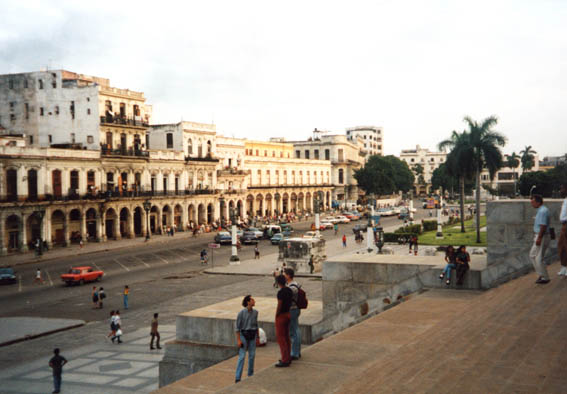
Cities, of course, are affected by its inhabitants and their circumstances. Cities rise, grow and fall mirroring the destinies of their dwellers. And politics, especially political strife and war (which is no more than diplomacy gone wrong) affect cities in ways that are not always predictable. Beirut, Berlin, Havana amongst a long list of cities, are prime examples of how war and/or politics can affect a city to the point where those common narrative threads that give cities their texture and depth are simply obliterated or affected in such ways that any notion of the same city ceases to exist or is at least cast into oblivion. Berlin for instance spent at least two thirds of the XXth century being first capital to the Nazi State, then war prize for the Allied Forces and lastly more than 30 years as two completely different cities divided by a very real, very absurd and abusive act of political confrontation.


One Berlin became a recluse center of power for a Soviet proxy regime with the worst Political Police known to man after the KGB; the other one became a virtual island of capitalism in a sea of collectivist nightmares, it was indeed a billboard for the western way of life. The fall of the Berlin Wall, and the subsequent reunification of Germany presented Germans with a very curious situation: a single city so deeply torn, that it took years for people to accept the very possibility that they were all Berliners in the end.


Beirut still bears to this day the scars of a confrontation of decades between different factions of what was a very civilized francophone country torn from within by religious extremism. And Havana which once was the Bordello of the Caribbean has become after decades, well, the Bordello of the Caribbean. The clientele and the reasons behind prostitution have changed, but seems to be stuck in time: 1950's time. Well, a very distressed 1950's time. In fact, Havana seems to be crumbling under the pressure of its own failure, or should I say the failure of its tyrannical political model. Havana seems to be paying a revolutionary punishment for its dissolute fame in the arly 1900's.


In the 5 years this government has been in power - yes, despite their constant promising, this government has been in power for almost 5 full years - Caracas has suffered a process of visible decay that has turned the budding Metropolis of the 90?s into a city that is at best a nightmarish shadow of its former self.


I'm not implying, by any means, that Caracas was a perfect city: it was unsafe and violent, traffic was always terrible, and the city was a patchwork of crappy half-assed solutions to problems, addressed without regards for consequences.


Despite all of that, Caracas was "La Sultana del Avila" and "La Sucursal del Cielo". It was not perfect, but it was somewhat liveable. We cannot blame this decay solely on chavismo. It would be stupid to overlook the obvious responsibility of previous administrations, but under no other government had we been robbed of so many urban icons and common spaces that were once the playgrounds not only of the Venezuelan ?oligarchy? as Chávez likes to call everyone who does not agree with him, but by the disenfranchised poor he?d like to convince of his dedication. There are virtual walls in Caracas that have become quite real. They have even transmutated into barbed wire and armed soldiers, or into unruly groups which attack any person, group or thing which does not fit into their molds of revolutionary purity. Plaza Venezuela, the Plaza Bolivar, amongst others have become the turf of violent mobs and gang wars for domination of whole zones of the city.


I propose we take a deep look at ourselves, and decide if we want let this madness go on. I propose we steal this city back from them and make it liveable once more. Even if it takes destroying the Wall that crosses Caracas in all directions and separates the city that is from the city it could be.


María Lionza's last stand

Penultimate vision of Maria Lionza
by Federico Vegas

That custom of leaving to chance and the Bible the solution to our problems, I exercise with the complete works of Jorge Luis Borges.


When something mortifies, astounds or confuses me too much, I open one of its tomes and can always find a good piece of advice.


Looking for enlightenment as a result of the tragedy of Maria Lionza?s repair, I came across one of Borges? first essays: The penultimate version of reality.


The title already has something to teach us: The story of María Lionza is missing its most important chapter. The word "version" also conveys a big load: in its medical meaning it refers to the "procedure to change the posture of a fetus that presents itself incorrectly for birth". For Maria Lionza that change in posture entailed an absolute torsion of her womb, while her birth continues.


Borges starts his essay referring to the theories of Count Korzybski. He adjudicated three dimensions to life: vegetable, animal and human. The vital style of plants is pure quietness and storing of energy. The vital style of animals is free movement and amassing space. Man hoards time, which is memory of the past and the prevision of the future.


This quote is pertinent to understand that the issue of the fragile Maria Lionza is perceived by the Mayor's office as an issue of space when its main significance lies in time. And space means nothing to us without the dimension of time. Without it, velocity and acceleration do not exist, neither do so haste nor slowness, and much less the memory of that we have visited. Without time we can perceive space but we cannot convert it into experience and reflection, thus losing the link with what's most human and humanist of our condition.


By defining this limitation to our perception to pure space as an animal facet, we do not want to qualify the labor of the Libertador Mayor?s office as an animal act, and we do not qualify it because it should be the exception and it is rather the rule.


We all become blind animals of prey slowly, so much that we've abandoned the visual in our urban travels and promenades. In our transit the aural is predominant and radio reigns. Sight, which has always been the principal sense in a stroll, has become opaque and indifferent, as if the glazing of cars and people's glasses were covered in butter. We concentrate ourselves in hearing and not in seeing. By stripping the city of time, i.e. its history, space loses its sense and is rendered indeterminate, tedious.


This is the reason behind the insistence for removal of Maria Lionza from the route for which it is paradigm and principal protagonist in the perception of space and the structuration of collective memory. The animal does not understand time and despises it. He thinks all spaces are equivalent for urinating or bury bones. Things are placed "where" they can be and it does not matter "when" they have been.


The animal does not perceive the value tradition gives to a specific place, does not comprehend the value of Maria Lionza's sculpture lies in the fusion with its surroundings, that it is inseparable from its landscape, that its stage is the freeway of which she is the principal episode.


Besides, Maria Lionza is a sculpture in which time predominates in its most caring and sentimental version. The disheveled works of Otero and Soto manipulate pure space. It is at least difficult, for those who pass these works to modify their feelings according to them; even being sentimentally involved with them. Conversely, Maria Lionza has born witness to a thousand things we have lived: she has seen us grow and has grown in front of us.


Thirty years ago I found her kitschy and démodé, later luxurious and tempting, then beautiful and emblematic, later still revealing and fundamental. I?ve come to feel for her tenderness and jealousy I don?t usually feel for inanimate objects. I believe today she is the best sculpture in this valley, and certainly the most loved, the most eloquent. Now that she has opened her interior to the sky and all of us, as symbol and sign of our profound division and incompetence, she deserves more than ever her sacrificial place: time and space we will not be able to forget anymore.


The ongoing argument on where to fix her is purely spatial and non-transcendental. Something tells me that she must be poured again to make her last another fifty years; it should be done where it can be done more practically and economically (and they should start repairing the other works of Colina as well).


But, where to place her? By God!
Let time speak and listen to it!
The sense of sight needs episodes to hang on to in a city that is sinking like a ship. Politics are not enough, we need to circulate and remember what we have been.


At this time I wonder what master Colina would say.


Perhaps his answer would be:
"Leave her, how and where she is!
She is finally alive and speaking to our times!"

June 14, 2004

Dilemmas for the campaign

The remake of the Comando Ayacucho is facing one dilemma after other in deciding a strategy for avoiding a considerable defeat in August.
1) To incite abstention or to attempt a massive vote in their favour.
2) To direct their message to the poorest ones or to get some possible votes from the middle class people.
3) To accept international observers or to reject them provoking doubts with regard to the results.

In my opinion, the opposition will have less problems to design a winning campaign.

PS. Just to test my posting attributes. Also to bring something new to the discussion

June 13, 2004

From NarcoNews: See what the "Illuminated left" does...

por Al Giordano...


"When it comes to ex-New York Timesman Francisco Toro (remember his exit as a Times correspondent because of his conflicts-of-interest as an activist for the "opposition" in Venezuela?), watch what he does, not what he says.
Toro, who has been among the bloggers who have claimed they want a referendum in Venezuela, apparently got what he wanted, now that Venezuela goes to the polls on August 15th.

So, it would follow that with just two months left in the campaign, Toro would be working hard for the victory that he always claims is in sight.

Right?

Wrong.

No sooner did Toro and his troops "win" the establishment of the referendum that they say they wanted (but really did not), then he's leaving on a "camping trip" ...to Europe!

Toro writes to his blog buddies:


"I am preparing to leave town on a camping trip to Slovenia and Italy. (Rough life, I know!)
Now, there is a man really committed to his cause, eh?

Do you think that Toro knows what he won't admit to his readers? That rolling up his sleeves and campaigning - like he urges his readers to do - is useless because the "opposition" is a minority in Venezuela and he knows damn well it is.

I mean, if the referendum were really winnable by his side, don't you think he would stand and fight?

No. Instead he sends the gullible into battle, while he goes off on a camping trip... in Italy...

(Gee. I didn't realize that operating an opposition blog in English could bring such perques and leisure opportunities! Where does the money for his Italian camping trip come from anyway?)

Sigh. And they take such indignant exception when Chavez and others call them "the squalid ones."

Captain Toro of the Titanic sees the iceberg ahead and, rather than be honest with his sailors about the need to reverse course, has commandeered himself a lifeboat, sailed off to the Mediterranean, and waved "hasta la vista, suckers" to the troops he leaves to fight his battles for him.

Watch what they do. Not what they say.

Narco News, on the other hand, will be covering the historic August 15th vote live from Caracas".

por Al Giordano (link to this beautiful piece of "information" was provided by J. R. Mora...)

(By the way, you CC bloggers, Quico WILL be here for the RR, so get your facts right! A little attention to the comments section will do, but then, yes, you only want your side. This stinks of people like Eva "Golilla" Golinger and the likes of her.)

June 12, 2004

One last shout...

...before heading to the train station.

Chavistas find it hard to understand the opposition's accusations of authoritarianism as anything other than a slur. But the recent appointment of the Comando Maisanta should serve to illustrate a few of our concerns. As we saw, the President appointed two dozen assembly members, ministers, oil officials and state governors, among others, to its campaign effort. The Finance Minister will also be in charge of campaign finances, and the energy minister will be expected to contribute as well.

Now, the transit from democracy to authoritarianism starts with the corruption of basic conceptual differentiations that are at the center of the Republican system of government. The state, in any normal conception of democratic life, is different from the government, which in turn is different from the governing party, which is different again from the president. In Chavismo all these differentiations are blurred to the point of dissappearance. A government that campaigned on ending cronyism in the distribution of oil revenues finds its Energy Minister on the board of an electoral campaign! The conflict of interest is never discussed, or even explicitly acknowledged. The kidnapping of national resources for the express electoral advantage of one side and against all the others is something the country hadn't seen since 1957.

When state=government=governing party=president, the basic conceptual architecture of democracy breaks down. This may be defended on revolutionary grounds, but not on democratic grounds. So I find it especially galling that the Venezuelan government is now prosecuting Sumate's leaders on the grounds of "perverting the Republican system of government," under the creepily authoritarian article 132 of Venezuela's 70 year old penal code.

June 11, 2004

How the blog was won...

The story starts when Dr. Toro goes on a camping trip and lets some of his readers take his blog over... How will it end? Will he ever regain control over his lost kingdom?

(This was just to see if I could really post things)

Forero on the case

The New York Times (registration required) ran an in depth article about evoting in the recall referendum today. Lots of questions, very few precise answers.

The Smartmatic-Bizta-Cantv Offer

This was prepared for the regional elections. I've translated it from Spanish. I can't help but notice that the auditoria-en-caliente (on the spot auditing) is built into the system.

How do you vote with SBC?

1-The elector registers at the voting table, as happens in every election.

2-The staff at the voting table introduces the voter to the voting machine, which shows an electronic ballot that looks exactly the same as the ballots that all Venezuelans are used to.

3. The voter selects his preferred candidate touching the sensitive parts of the screen on the electronic ballot. There is no need to use pencils, or to struggle to fill in little ovals. The use of the electronic ballot is extremely easy, including for people who cannot read or write.

4. The machine allows the voter to verify his or her choice, showing the selected candidates on a color screen. The voter may change his choice as many times as he or she wishes before confirming the vote.

5. When the voter is sure of having chosen the right candidate, he presses the "Vote" button on the machine's screen. The machine stores the electronic vote permanently and securely. Since there is no possibility of error, the new machine eliminates the possibility of numerical inconsistencies.

6. The machine prints a physical vote that allows the voter to conduct an on-the-spot audit of his or her vote, confirming that it has been registered correctly.

7. To conclude the voting act, the voter folds the physical vote and places it in a ballot box. The physical votes back up the electronic vote in case of an audit, and cannot be forged.

What happens with the electronic votes?

1. Automated and secure vote registry: Once the voter has made his choice, it is stored in the machine in a permanent and secure way. The security and encryption technologies used in the new machine prevent the vote from being erased or manipulated in any other way, either in the machine or once it is transmitted to the tallying system. The old [ES&S scanner] machines kept the information insecurely, which allowed anyone to access and manipulate votes at leisure.

2. Encrypted transmission and storage: At the end of election day, the machines transmit the results of the vote to the tallying system. This transmission is encrypted and authenticated over telephone lines, guaranteeing zero data loss or manipulation. The tallying system receives the results of the vote and stores them in an encrypted fashion. These results can only be decoded by the tallying software.

3. 100% automated tallying and adjudication: The new automated system guarantees that the tallying and adjudication will happen automatically and instantaneously, which will prevent results being modified in any way. Previous elections relied on manual tallying and adjudication, allowing the easy manipulation of results of the vote on the part of tallying officials, either by mistake or intentionally.

4. Publication of results via the web: As soon as the automated tallying results are produced, whether partial or total, they will be published directly on the National Election Council web page, for access by the general public