January 28, 2004

Jimmy Carter, Hugo Chavez, CNE, OAS, Most of the Opposition and Caracas Chronicles Agree...

The CNE verification roller-coaster saga continues, a rapid-fire alternation of seemingly dreadful news and, now and then, heady optimism. Today, at least, the news is good.

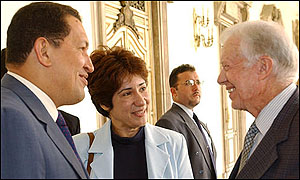
It took just 48 hours for Jimmy Carter, who commands unique respect across the political spectrum in Venezuela, to personally broker a sensible compromise that nearly all sides can live with.

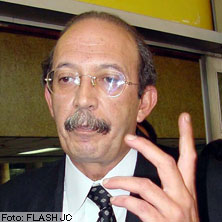
Teodoro is understandably ecstatic.


Almost all the stakeholders are reading from the same hymn book now - itself a fantastic achievement. Now that all sides have agreed that Carter Center/OAS observers should be granted broad access to every part of the signature verification process, it only makes sense for all sides to pledge to accept CNE's eventual decision, whatever it may be.

The only question now is why Accion Democratica insists on holding the opposition as a whole back from undertaking this tremendously significant commitment.

...sigh...

As for the politics of all of this, I think Miguel over on Devil's Poop has it about right when he writes,

I have believed for quite a while that Chavez's strategy is simply to proceed forward and go to the recall referendum. He believes that the magic number of 3.8 million votes by the opposition simply will not be reached as most Venezuelans are apathetic about the whole conflict. He may be right in his assessment. I never cease to remind people that in the heyday of his popularity Hugo Chavez never received more than 3.757 million votes. He was really popular among those that voted, but abstention was 43.7% of the registered population. A repeat of that, adding a bit of 'Misiones', some doses of populism, some threats and the number may not be reached. However, this also implies that Hugo Chavez may not get more than 2.4 million votes in his favor, severely damaging the President's image. Abstention will in fact be the deciding factor, if it is near 50% the recall fails assuming the 60%-40% split against Chavez polls indicate. If it is near 40% the recall is successful.

Andy Webb-Vidal's FT piece, comes to the same conclusion after alluding to (but not quite giving us) fresh poll data "suggesting that the opposition's chances of unseating Mr Chavez at the ballot box have collapsed, while he continues to enjoy a steady 35 to 40 per cent backing - which could be enough to save him."

Of course, in the end you can get that Excel spreadsheet to toss back any result you want. It all comes down to turnout, and that, by nature, is unpredictable.

Pura Cova
In the same piece, Andy dishes some delicious inside nuggets into the murky world of opposition decision-making, and reports Manuel Cova is quickly becoming a consensus candidate for key parts of the opposition, specifically the TV station owners - who, like it or not, have a big say in the matter.

Knowing how the four horsemen operate, they've probably focus grouped and polled the hell out of this decision. It's not surprising Cova would come out on top: he's black, working class, and frighteningly bright and eloquent. His judgement as post-Ortega head of the Labor Movement has not always been perfect, but it's been far better than what came before. And I'm sure they see him as a safe pair of hands.

Yes, he's an adeco at heart, but I very much doubt a President Cova would take orders from AD's CEN. To be frank, I think we could find much worse consensus candidates than Cova - and if they play it right, he could play a big role in boosting turnout to a recall vote.

January 26, 2004

The oracle speaks...

...other pundits I read, but Teodoro Petkoff I follow. Teodoro is more than an analyst. He is a consistent voice for reason, principle and good sense in a political atmosphere where these qualities are sadly too rare.

So today, when he uses his TalCual editorial to warn CNE head Francisco Carrasquero to look again into Zamora's allegations of irregularities inside CNE, I sit up and take notice.

As Teodoro reminds us, TalCual has editorialized in favor of CNE 35 times over the last few months. His comments are not those of a wrecker. They're those of a principled observer, concerned by consistent reports of irregularities. Teodoro understands that CNE needs to take action on these allegations to preserve its own credibility.

Teodoro Petkoff speaks with a moral authority few in Venezuela command. We can only expect his views are taken seriously for once.

Nag: those of you who read Spanish and have not done so really ought to consider subscribing to TalCual. Top notch reporting, enlightened editorializing...the paper is in a league of its own. They really need readers' support to keep publishing.

January 25, 2004

New on Caracas Chronicles

Things are changing on this blog!

1.By sisterly demand, now you can post your comments at the end of each entry.

2.Check out the very silly, very fun mixed websites you can make with this very cool toy: TopFX website mixer. Great fun.

3.Also by reader demand, the RSS site feed is up! Now you can get Caracas Chronicles delivered to your PDA or newsreader automatically. The RSS site feed is here. And if all of that is gobbledygook to you, it is to me as well!

4.There's a new bio that tells you considerably more than you probably want to know about me.

Caracas journalism good enough to translate

Aliana Gonzalez must be one of the gutsiest and most talented journalists in Venezuela today. Though I don't know her personally, I contacted her to ask permission to translate and reprint this powerful piece. Too often my polemics about the rule of law and the chaos of the zero-prosecution society must seem abstract, distant, irrelevant. Some probably figure that the rule of law is something only the bourgeoisie worries about. Read Death at Dawn, and think again.

Death at Dawn


by Aliana Gonzalez, photos by Ilich Otero
reprinted from the Jan. 21st edition of TalCual, translated by me

Rusleidy Lopez is still scared.

The policeman was very clear: "if ever we find out you've said anything, we're coming back for you". On Monday, at 3:00 p.m., they went by the house dressed as civilians, armed, with their bullet-proof vests on and yelled "the women of this barrio are going to cry tears of blood." That night, she decided to sleep at her mom's place again.


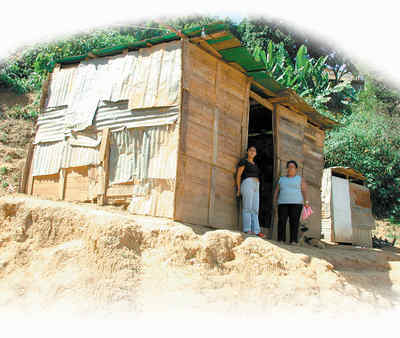
Rusleidy's home

The splattered blood that Orlando Jovany Sosa, her husband, left as he died is still visible on the wood and zinc walls, papered over with newsprint and magazine covers. On january 8th, at 4 in the morning, Policaracas (Caracas Municipal Police officers) and CICPC officers arrived at her house dressed in black and wearing ski masks. Some let their faces be seen.

"We were sleeping," she says "and I heard steps. I got up from bed, peered through a hole, and I saw the alley was full of policemen. I woke up Jovany. They kicked down the door, came in, and threw me out of the house. They took me into the woods and told me to stay there, because otherwise they would kill me as well. A quarter of an hour later they fired into the dumpster. Then they asked me 'what was the name of your husband?' 'Orlando,' I said, but they say 'you lie, they used to call him the Zombie.'"

Rusleidy had her twentythird birthday yesterday.

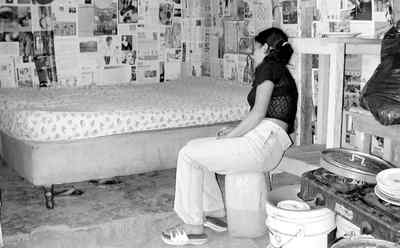
She had lived with Jovany for five years, when he was 15 and she 17. Her house was a small room with a dirt floor and a bed as the only furniture.

The kitchen - a two-burner gas stove - is set on top of an overturned bucket, almost at floor level. In big bags she keeps what little she owns.

The house has no drinking water, she has to keep some in a pitcher. The bathroom is a letrine.

There is no fridge, no closet, no cupboards.


Rusleidy at home

This "Mata de Mango" area, in the El Setenta shantytown of El Valle, is on the edge of the city, near the woods. Even though misery is the rule, they enjoy a unique view of the city: you can see the Helicoide, the cementery, the highway and even Las Acacias.

Forced to sign
Rusleidy was taken that day to CICPC - the investigative police [equivalent to the FBI.] Dawn was breaking.

"They grabbed me by the sweater," she says, "then by the neck and they put a gun to my ribs. I told them they were choking me and another officer said to let me go. When my mom and dad arrived, they threw me in a patrol car. I still didn't know what had happened to Jovany."

"I was in an office at CICPC headquarters until 9:30 that morning."

"An officer came and told me: 'you know that your husband didn't have a shootout with us, but we killed him because he's being accused of murder.'"

"They told me they would write a letter, and that if I didn't sign it, then I would pay for what they'd found in the house. The letter said that Jovany was running away from the cops, he took shelter at the house, had a shootout with them, but I managed to escape."

In the house, the cops found a gun and a little money.

"I don't know whose gun it is. I know Jovany was keeping it. The money was mine, from my work as a street hawker." After signing, the cops told her that "it's very dangerous to mess with the police; don't even think about making a formal complaint."

Look me in the face
Migdales Gonzalez, on the other hand, is not scared. She's the mother of Kelvin Gonzalez, who was killed by the same officers one hour later, at the other end of the barrio.

The version published in the press is that both had shootouts with the police. On top of the long distance between the two houses, there's the fact that neither had bullet holes on the walls, making the hypothesis fragile.

"I'm over my fear," Migdalis says, "I told the cop the same day they killed Kelvin: look me in the face, you killed my son and I'm not going to stay quiet about it, so you can go look for me at home to kill me."

Gonzalez is indignant with the director of the Policaracas for his statements.

"He said that everybody in this barrio is into drugs, that that's why they didn't say Kelvin and Jovany were neighborhood bullies. I've been working every day for years, and I am a respectable woman. People here get up early in the morning and go work and sweat for their money. Doesn't he respect people? I'm indignant that that is the explanation he gives, faced with the truth of the barrio. If they were really involved in shooting a cop, why didn't they arrest them and try them, so they could pay for their crime?"

In El Setenta the police has taken five lives, in similar circumstances, in less than four months.

Daniel Centeno, on October 9th, Cesar Augusto Kacen, four days later.

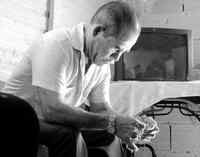
Daniel Centeno's dad

Kacen was 43 years old and was a nightwatchman in the public transport parking lot, on the barrio's sports field. At about 11:30 at night on 13th of October, Policaracas went up there. He was on the court, waiting for the minibuses.

A neighbor heard him beg and screem, calling for his mom, before the gunshot. "We buried Cesar ourselves because he had no family. His family moved away from the barrio years ago, and he stayed behind. He made a living carrying gas tanks, sand bags, and lately as a watchman. He had his problems, but he's grown up and he never messed with anyone," said Migdalis Gonzalez.

The other victim is Edison Jose Mendez. It was on December 12th, in identical circumstances as Jovany Sosa and Kelvin Gonzalez. Policaracas went in with ski masks, at 6 a.m., kicked out his family members, shot him, and then spread the word that he'd died in a shootout.

The epicenter of crunch time

or, Let the observers observe!


Zamora: Can-of-worms opener.

The last 24 hours were awful for the National Electoral Council. In the middle of a politically explosive process to verify the several million signatures backing the opposition's request for a recall referendum against Chavez, the council now faces some very serious allegations.

One of the five board members, Ezequiel Zamora, went public with allegations of sabotage in the signature verification process. He claimed "some" CNE verifiers had excluded authorized personnel from the "physical verification process." Somewhat cryptically, he said "the percentages are not coming out properly." He was careful to keep politics out of his statement, but it's not hard to fill in the gaps. He said the problems could delay an already delayed decision and demanded that CNE staff follow the board's directives strictly.

The gravity of these allegations hardly needs to be stressed. Mature leadership is desperately needed to steer CNE out of this mess - the alternative is too volatile to even consider. Can they work this out internally and come up with a solution that rescues the organization's credibility?

CNE chairman Francisco Carrasquero claims the whole thing is a big misunderstanding. I hope he's right. Even if he is, he should learn from this snafu and allow the international observers unfettered access to every part of the process. When observers are not present, it's easy for "misunderstandings" to generate a huge amount of suspicion that can be deeply damaging to the whole process. Especially if the accusations are false, Carrasquero should realize that the ONLY chance he has of convincing the world that CNE procedures are clean is by letting Carter Center/OAS watch everything.

It's significant that it was Ezequiel Zamora blowing the whistle in public. A nominally opposition-minded member of the council, Zamora had surprised everyone with his spirit of negotiation and bipartisanship. He's joined the chavista majority on more than a few votes, yielding a lot of 4-1 votes instead of the 3-2 decisions conventional wisdom had expected. Zamora may not like Chavez, but he's far from an opposition radical, far from a loose cannon. His statement was meant to bring staff into line, to keep the process transparent, not to throw it into crisis.

One other crucial decision remains on the council's plate. The matter of how much access Carter Center/OAS should have to the most critical stages of the verification process has yet to be discussed officially by the board. Much hangs on this decision, which could come as early as Tuesday.

My feeling is that the government fears close international observation more than anything else, because it would make the task of obstructing the referendum that much more difficult. It's disheartening that Chavez die-hard Congressman Nicolas Maduro went public hours later to accuse the OAS of imperialism for its request to observe every part of the process. This speaks volumes about how effective the observation mission has been in dissuading foul play. And it puts renewed urgency on the call for CNE to allow observers into every nook and cranny of the entire process.

The council will need to make some hard choices in the hours ahead. To exclude Carter Center/OAS observers from parts of the verification process in this climate is a recipe for disaster. If the board wants to retain its credibility, it must conduct all procedures in broad daylight in front of credible, experienced observers of unquestioned credibility.

A thumbs-up from the Carter Center/OAS mission is the only way to keep an eventual decision credible to all parties. Jimmy Carter did not spend half his adult life chasing a Nobel Prize only to squander his credibility at the last minute by signing off on a bogus election process.

This, right now, is the epicenter of crunch time. The country needs responsible leaders to take it through this very difficult juncture. If the provocateurs get their way, this little crisis could derail the referendum process altogether. This would really be a catastrophe.

The CNE Board has to take stock of the historic responsibility of the moment. It must understand that unfettered observation is better for both sides. If I'm wrong and the signatures really are bogus, as the government claims, it's especially in the government's interest to have impartial observers in hand. CNE's decision to strike down the referendum will only be credible in Venezuela and the world if an institution like the Carter Center certifies the process that determined they are fake. Otherwise, nobody will believe them.

These are the kinds of situations that separate heroes from villains, people of integrity from opportunists. CNE must step up to the plate. Because the tag-line on this blog is dead serious. Venezuela really is teetering on the edge of a civil war, and killing the recall through opaque back room maneuvers in the absence of international observers would be an excellent way to push the country over that edge.

January 24, 2004

More notes on CNE...

I'm not sure what's up with Venezuelanalysis.com's weasel tactic of not giving their write-ups by-lines. They just say "by Venezuelanalysis.com" and leave it at that. Hmmm...leaves me unsure who to yell at when they write things like this:

Government officials and political groups that support the Chavez administration have made numerous claims of alleged fraud committed by the opposition in the signature collection process to call for a recall referendum on President Chavez. 2.5 million valid signatures are required to trigger the recall. The opposition officially claims they collected 3.4 million. However, opposition political figures have privately commented that only 1.9 were collected.

Hmmm...ok, so if you're willing to use the illegally obtained, unconfirmed and unsubstantiated Escovar Salom 1.9 million figure, how is it that you're not citing the internal MVR report leaked to El Universal where they admit they think the opposition handed in just over 3 million signatures? The line between newswriting and propagandizing gets real thin on some of these things...

More importantly, why don't you guys spend some staff resources fleshing out exactly how the megafraude happened? As Cesar Miguel Rondon insightfully points out, the government's strategy in this regard seems to be mostly to scream itself hoarse repeating the word "megafraude! megafraude!" without ever giving a detailed explanation of the actual mechanics of the fraud, of how the megafraude actually happened. Who signed illegally? When, where and how? We want details, not slogans!

I understand MVR handed in a report on the matter to CNE, but I haven't seen any of the details yet. And many of the charges made in Tarek's little presentation make little sense: if foreigners, children, or dead people signed, or if people signed more than once, that'll be automatically weeded out by cross-checking the signatures against the Electoral Registry database anyway! So really, the question is what part of the megafraud was done in a way that it can't be caught by the checks already planned?

The only candidate I can think of is massive, gigantic scale identity fraud. The government would need to prove that between 600,000 and 1,000,000 people got fake cedulas to go sign. The only way to catch this would be through the fingerprint - basically, at least one in five signatures would have to be shown not to correspond to the fingerprint it sits next to.

Which brings us to this whole fingerprint hubbub. We really need to be clear about it: 40% of the fingerprints are uncheckable. They got smudged because CNE, under pressure from the government, chose to print the forms on Central Bank safety paper that was never designed to take fingerprints. Still, you can work with the other 60%, I suppose.

People in the council are talking about testing a "representative and exhaustive statistical sample" of fingerprints, which reads like a contradiction in terms to me: it's either representative or exhaustive. Still, if they get working on it now, I suppose you can do it. What kind of sample size would you need to get a sufficiently small margin of error, to determine conclusively whether 20% or more of the signatures are a result of identity theft? Couple of thousand? How long would that take to do? It does sound doable, at first blush.

But on this subject, at least, I do understand the opposition's skittishness. Who's to say the government won't lean on the "exhaustive" part more than on the "representative" part and say they test 150,000 fingerprints? Kooky, yes, but this is Venezuela we're talking about!

For my part, I still think we need to rally around CNE - no use poking holes in the only life-raft we've got. One thing I know for sure: Carter Center/OAS has much more access, expertise, and credibility than I do.

I am not prepared to write against CNE until they do.

January 23, 2004

Time to get off CNE's case...


Today, OAS head of mission Fernando Jaramillo (pictured) said there is no basis for the skepticism surrounding CNE. He said the Carter Center/OAS mission has closely watched every part of the verification process so far, and it seems to be going well.

Given the mission's unparalleled access, impartiality, and international credibility, it's senseless to contradict them. The opposition should realize that it only undermines its own credibility if it keeps criticizing the agency at this point. If and when the observers say that CNE has gone off track, then our suspicions will have credibility.

Until that happens, better for the opposition to shut up.

Jaramillo also asked for similar, wide-ranging access in the upcoming, highly sensitive, parts of the verification process.

Let's hope they get it.

It's the inequality, stupid

It struck me yesterday, in the middle of a late-night email back-and-forth with Greg, that this racial debate is a distraction from another, much more important debate we ought to be having about Venezuela. My criticism of the charge of racism is right, but kind of beside the point. Venezuela has its own, home-grown mechanisms for systematic exclusion. It just happens that they're based not on skin color, but on class.

Racism may be a cannard, but classism is very real, alive and well in Venezuela.

Rich people in Venezuela relate to poor people in deeply prejudicial ways. I've seen it, up close, many times - and I haven't always had the confidence or clarity to object to it.

Venezuela is an outrageously unequal society, there is no debating that. In a way, it's not surprising that people like Danny Glover or Greg Pallast come here, see the very evident social gap and the very negative attitudes that the rich have about the poor, notice that the rich are mostly light-skinned and the poor normally darker-skinned, and Q.E.D! Racism!

The line of reasoning is wrong, for the reasons I wrote about before, but the social gap is real, the stereotypical negative attitudes the rich have about the poor are real, and the poor are evidently excluded from most of the institutions of a decent society. Their grievances are real, and justified.

If I'm forced to play the game of finding something good to say about Chavez, this is what I'll fall back on: so far as diagnostics go, I agree with 95% of what he said in 1998. The Chavez of 1998 is a far cry, needless to say, from the Chavez that runs the country now. Back then, it was hard to object to his critique: his style might have been too shrill and pugnaceous by half, but he wasn't making this stuff up.

What's more, he put the problem front and center, he burst through layers of upper class denial, he made the social divide the issue - which is a good thing, because the social divide really is the issue. And for all of that he is to be commended.

It's just a shame his policies in power have made all of the problems concerned far worse.

Social exclusion exists on two levels: the social and the economic. Socially, exclusion is a system of customary ideas and practices about the role of the poor in society, about the institutions and spaces and opportunities are open to them. And there's no doubt that the poor are excluded, excluded from all kinds of institutions, excluded from access to decent schools and well equipped hospitals, to all basic state services, to things like water and social security and a shot at the army officer corps. And there's no doubt that this has terrible psychological effects on people: it has to be devastating to not only be poor, but to be poor alone, faced with the contempt of the powerful. The result was a lot of justified frustration, of a deep sense of grievance at those who were not so excluded.

The question is, why are the poor excluded?

To my mind, it's obvious the reason has everything to do with money. If you're too poor to live in an area with electricity, water, or gas, if you're too poor to afford a private school place, if you're too poor to buy insurance or at least medicine for the hospital staff, if you're too poor to have time help your children with your homework, if you're too poor to even eat properly, you can't even begin to overcome the barriers that keep you excluded from those institutions.

I realize my view here is oddly Marxist. I think the economic substructure determines the ideological superstructure - it's the fact that the poor have no money that causes exclusion, not the fact that the rich don't like them. In fact, the economic substructre explains the superstructure: it's the stress of a deeply unequal society that generates the mutual distrust and negative attitudes. Economic differences cause bad blood - always have, always will - and if you want to build inclusion, you have to start by making positive steps to reduce inequality.

Chavez's view, seems to be the reverse: that the symbolic exclusion, the negative attitudes, the stereotypes, the use of language the poor could not understand, the callousness of the rich towards the suffering of the poor, that these are the root causes of social exclusion. Therefore, if you want to include the poor, what you do is you forcibly remove the symbolic privilege of the rich - especially their control of any part of the state aparatus - and then talk to the poor for 4 or 5 hours every Sunday making strenuous efforts to pet their collective ego, telling them they're revolutionary heroes and that the state is there for them and that the most powerful man in the country is singlemindedly devoted to them and to their interests, etc. etc. etc. ad nauseum (for me, literally) You privilege the "social" over the "economic", which seems to me another way of saying you privilege rhetoric over results.

What Chavez has proposed to his supporters, has never been a poverty fighting strategy. Not a serious one, anyway Ð certainly not one with the least possibility of success. What he's proposed is a- a hodge podge of ad hoc programs done with no long term planning, no transparency, and no strategic focus, and b- (far, far more importantly) talk therapy. In important ways, Chavez intends to talk the poor out of their exclusion.

That poverty has increased seems to me like a matter of simple common sense: thereÕs no such thing as poverty reduction amidst rising prices, falling formal employment, a shrinking economy and an informal sector that grows and grows.

But even in terms of inequality, the government has made things worse, despite all the rhetoric. As even pro-Chavez observers tacitly acknowledge, a salient feature of Chavez's five years of management of the economy has been an odd series of giveaways to the some of the richest people in the country.

For 3 years (1999-2002) the government pursued a policy of deliberately overvaluing the currency, in effect selling dollars at a discount to holders of bolivars, as a way of trying to control inflation (the "inflation anchor" of Giordani fame.) The strategy worked in the short term, but it was patently unsustainable: you can't keep selling 1.2 watches for one watch vouchers forever without running out of watches. That wave had to break sooner or later, and when it did, it was obvious that the result would be higher inflation - which only drove people to trade even more of their bolivars for dollars. Every businessman in the country that had the money to buy dollars, did.

The policy was an incredible giveaway for anyone who had any savings at all to protect - they could buy hard currency at very attractive rates, and escape the hideous country-risk of having your savings in a country Hugo Chavez runs. Of course, the poor didn't have that benefit - without enough money to eat, much less to save, they remained nailed to the cross that is the bolivar, at the mercy of the terrible price rises that Chavez's unsustainable forex policy would inevitably spring on them one day.

(Oh no, he's talking technocrat again! Ugh!)

To translate: the rich got out, the foreign reserves went down, the exchange rate finally collapsed, inflation jumped, the poor got screwed, and the rich got away unscathed. Worse still, this is what VenEconomy - VenEconomy, for christ's sake, that most unremittingly right wing of rags - had been warning consistently for literally years!

They didn't listen.

The poor got screwed.

Our readers made a ton of money.

The record is even more scandalous when you look at the banks. The government's strategy to finance itself solely with bolivar-denominated bonds was a boon for the bankers. They got to lend huge portions of their portfolios at very attractive interest rates with minimal risk. The debt came in the guise are government paper: zero risk, if the textbooks are to be believed.

The strategy was a huge giveaway to the banks, many of which did quite nicely for themselves by more or less abandoning the business of providing consumer or small business credit and dedicating themselves mostly to buying government bonds. Again, the fat cat bankers walked off with wads of cash, but the poor sap who owns a textile factory in Aragua and wants to borrow money to buy more sewing machines to employ more people is squeezed out, and the people who might have gotten jobs at that factory got screwed. It's called crowding out.

All of this was happening against a backdrop of dropping PDVSA production capacity, faltering state finances, a shrinking economy, a huge wave of industrial bankruptcies, a bloody crime wave, growing unemployment, rapidly growing informal sector "employment" (street-hawking and odd jobs), falling average household incomes, and falling food-consumption and calory-intake statistics - which are just sanitized ways of talking about hunger. A bankrupt government ruling over a bankrupt nation. Ideal.

There is no doubt in my mind at all that the gap between rich and poor has widened. There's no doubt in my mind that for the vast majority of the poor, the material conditions of life have deteriorated. Indeed, due to the extreme polarization of the classes now, there's no doubt in my mind that the cultural manifestations of the gap, the negative attitudes and stereotypes, have also gotten much worse. If the rich feared the poor before, how much more do they fear them now when they see large numbers of them in a frenzy of hero worship towards an evident charlatan who only makes them poorer.

The conjunction of economic obscurantism, scorn for technocratic expertise, indifference to long term planning and a near-suicidal unwillingness to listen to critics - all liberally sprinkled with corruption - pushed the government to do things that are not just bad for the country, but worse for their own supporters than for anyone else. Ad hoc social programs are fundamentally unable to overcome the force for exclusion that growing poverty and inequality generate. It's putting the horse before the cart.

The country does need a radical program of long-term reform, one that will change the socio-economic structure permanently, that'll open opportunities to the poor and the excluded and improve their standard of living slowly but surely over a generation.

Instead, what it's getting is talk, lots and lots and lots of talk, redemptive talk, stirring talk, but talk nevertheless.

The fundamental problems are not being addressed, and they're getting worse.

January 22, 2004

I have a funny relationship with Greg Wilpert...

...who's one of the of the Venezuelanalysis.com people. We don't agree on anything, but we ought to. We're both academics who want to address a broad audience. We share a basic concern for the poor; we make genuine efforts to write with integrity. I think he's a bit naive, but then he thinks I'm a bit naive too. We've never actually met in person, but probably ought to. Most importantly, we seem to be able to hold a debate across ideological lines, which is rare enough to be valuable in Venezuela these days.

His latest piece in Venezuelanalysis.com is, in part, a response to my earlier post on racism. As so often happens, I find myself surprised and slightly confused with Greg's line of argument. He starts with a frank admission that 95% of Venezuelans don't see race as a problem, which is a good start. But then he goes on to say they're wrong, that a hidden form of racism is prevalent in Venezuela. He urges us to believe Greg Pallast and Richard Gott (even though they're a-not venezuelan b-don't live in venezuela and c-are white,) over the judgments of the vast majority of dark-skinned people in Venezuela.

I'm afraid this strikes me as insulting, and highly implausible. How is it that two gringo lefties are able to magically peer through this veil of appearances and get at the deeper racial dynamics at play? Does he really mean that 95% of Venezuelans (including, by statistical necessity, a huge number of dark-skinned Venezuelans) are either too stupid or too ideologically brainwashed to notice a major reason for their oppression? Greg, man, if you really think Greg Pallast and Richard Gott understand more about race relations in Venezuela than 95% of the people there, you're less aware of your own cultural blinders than you imagine.

The Transafrica Forumsters got it wrong. The editorial cartoons calling them "quemados" (burnt ones) were not racist. Even to decry them as racist demonstrates a serious inability to get to grips with the way race works in Venezuela.

Racism is a system of social control, a social and psychological framework for keeping a given ethnic group subjugated, scared and excluded. Racism is the mechanism whereby one ethnic group controls and oppresses another ethnic group.

All of that is absent in Venezuela, and you know it.

When race does not map onto ethnicity neatly - which you've admitted is the case in Venezuela - a cartoon like the "tour de los quemados" is a commentary on skin color, on appearance, not on ethnic identification. It's worth noting that "quemado" has the secondary meaning of "having lost their credibility" in Spanish - the cartoon had is supposed to be a humorous double entendre. Ask 100 black people on the streets of Caracas if they were offended by it, and how many do you think will declare themselves oppressed by it?

Venezuela, thankfully, does not need the skittishness about discussions of race that dominate the US. Because race is so much less important, so much less divisive, it's possible to talk about it in a depoliticized way, even in a humorous way, without stirring the tidal waves of social conflict that similar talk unleashes in the US

It's only when approached from the standpoint and using the mental categories of race relations in the US that a cartoon like that is re-interpreted as racist. Outside the context of an ethnic struggle like the one in the US, a cartoon like that loses all its bite. The undercurrent of menace, of deep foreboding that a racist remark has in the US is absent in a place where 95% of the people just don't think about themselves or those around them in racial terms.

So what I would say to the Transafrica Forum is simple: the US is not the whole of the world. You spend two thirds of your time telling George W. Bush precisely that, it stuns me that it's so hard to convince you of it. The mental categories, the norms and understandings that govern race relations in the US are not fixed and universal. They are particular to your country. Please don't shove them down our throats.

In order to understand Venezuela - or indeed any foreign culture - you need to put that mental framework aside for a minute and learn, really open yourself and learn, how a different society operates. And once you do, you might, just might, come to realize that some things that seem perfectly unquestionable in one cultural framework - that a cartoon making a reference to skin color is necessarily racist, for instance - actually don't hold in another cultural context.

If you don't make a commitment to learn about and understand the particularities of a given country's social and cultural system, I just don't see where you get off pontificating about it. (That goes for Amy Chua also.) This is why I try to write only about Venezuela in this blog: it really bugs me when people write about topics they don't understand, and I refuse to do it.

To my mind, people like Gott, Pallast and Chua have failed to understand the dynamics of our mestizo society. They and the Transafrica Forumsters end up exercising a funny sort of reverse cultural imperialism on us: foisting their highly politicized, divided and divisive racial framework on a society that has no use for it at all, and in fact would do much better to export its model than to accept any imports! Sure, their rhetoric makes for delicious chavista propaganda in the first world, but it adds pathetically little to an audience's understanding of what's actually happening in this country.

So Greg, please, if you want to have a discussion of income inequality, social exclusion, and privilege, let's have it. I think I can show Chavez has deepened each of those, not with rhetoric, but with statistics. But please don't falsify Venezuela's reality by making claims about race relations that are not only wrong, but destructive.

January 21, 2004

So, why doesn't the attorney general ever investigate political violence?

Because he's too busy implementing a kind of freelance foreign policy, that's why.

Honestly, Venezuelanalysis.com should be embarassed even to invoke Isaias Rodriguez's name...but no. Appropriating some of the boss's chutzpah, they revel in his revolutionary exploits while gently sweeping under the rug his spectacular failure to enforce the law - his job, one would've thought.

January 20, 2004

Planning for the worst case scenario...

I'm increasingly worried about the climate of deep skepticism in the opposition about the National Electoral Council's impartiality. Too many people seem to think Chavez owns the council, that the stitch-up is in place, that the referendum will die at in some smoke-filled backroom in the CNE and that the time to start making some unorthodox "Plan B" is now.

The council may have a nominal 3-2 chavista majority, but people who know the board members well are adamant that most will put country above party and vote with their consciences. The government may count on them for some relatively minor favors - like the timing of regional elections - but can Chavez really order them to stop the recall against the objections of their consciences? I really doubt it.

Too many of the anti-CNE opinions making the rounds are just shrill and uninformed. These attitudes are dangerous. They undermine CNE's ability to do its job, they undermine the credibility of the one institution we can't do without. They push the country into confrontational maximalism, the attitude that has already yielded two major debacles over the last 20 months.

It's time for the opposition to sit back, take a deep breath, and think about its options. Venezuela's best ally in the search for a peaceful solution to the crisis, the Carter Center's Francisco Diez, assures that their monitoring mission of the signature validation process continues apace, and that the council is rapidly overcoming the obstacles that have come up.

In the Carter Center/OAS monitoring mission, the country has an exceedingly prestigious witness, a truly honest broker that has no reason at all to lie, to shill for either side. If the Carter Center/OAS mission starts making anti-CNE noises, the opposition's skepticism will acquire unprecedented credibility. Until it does, our skepticism only makes us seem immature and unwilling to accept a contrary decision.

Yes, I understand that, as usual, Chavez's threats and blusters make it much harder to keep an even keel here. But this is crunch time, and the opposition has to understand that it makes no sense for us to demand that the president accept any CNE decision if we aren't willing to do the same.

So the opposition needs to think very carefully about how we would react if - heaven forbid - CNE does rule against the recall vote. The anger that would seize all of us in that scenario would be hard to control. But anger is the single worst source of advice possible in this case. Knee-jerk responses will lead us where they've always led us in the past: up the garden path.

Until the Carter Center/OAS mission says otherwise, it's counterproductive for the opposition to write off CNE.

So, here's a heretical proposal: if the CNE rules against the referendum and if the Carter Center/OAS mission does not condemn that decision as clearly fraudulent, we should keep our cool, accept the ruling, and declare that we will treat the August 1st regional elections as a "virtual referendum."

This is not as crazy as it sounds: now that the opposition seems to have reached a consensus on the thorny topic of how to select candidates to those elections, the way is clear to "referendumize" the regional elections. And with the pent up anger people would feel due to the failure of the recall petition, antichavez turn out would be sky high, provided the opposition is smart about campaigning.

Trouncing the government in our first chance to go to the polls, right after being denied a referendum, would send a powerful message about the resilience, patience and maturity of the opposition. Losing our cool and starting to push for an unorthodox solution would only substantitate the government's charges of golpismo.

Chavez can't keep us away from the ballot box forever, and as soon as we get there, he's doomed. His one shot at staying in power is making us blunder, making us lose our cool, goading us out onto his territory: violence, confrontation, aggression.

We can't win on that level; we shouldn't try.

But the Carter Center/OAS mission will be the key. Keep your eye on Francisco Diez. Only the Carter Center/OAS observers have the access and the credibility to denue an illegitimate decision as such. If that happens, we're in a Milosevic/Fujimori/Shevardnaze scenario, and all bets are off.

January 19, 2004

The Unspoken Amnesty

This morning, it happened again.

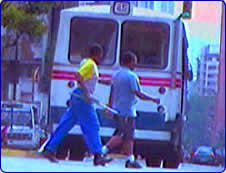
A group of MAS activists - anti-Chavez socialists - was attacked by a small mob of government supporters as they tried to - sin of sins - lay a wreath to the memory of Simon Bolivar, Venezuela's independence war hero.

Shouting "get out of here, escualidos" and "you can't come here, this is our territory" the attackers used mostly sticks and stones.

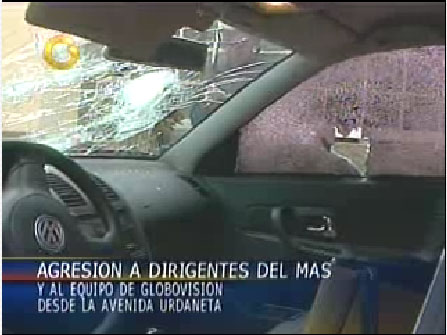
However, some were armed and some fired at a car carrying a Globovision camera crew. (It's on video.)

Four people were sent to hospital. One MAS supporter was badly hurt after getting his head bashed in with a tube.


A Globovision camera crew got video footage of a group of government supporters approaching the scene with weapons.

The message from today's attack is simple: we own Bolivar. In revolutionary times, Simon Bolivar cannot be the simbol of national unity it has always been: Bolivar has been appropriated by the president's cult of personality, hijacked for petty political gain.

It's as though Republican mobs started attacking Democrats for wanting to pay homage to the memory of George Washington.


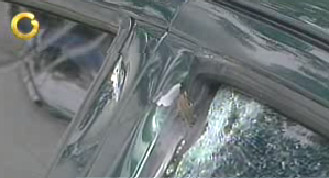
This is how one MAS activist's car ended up. The owner was driving the car, trying to escape the area, when it was attacked.

When the car carrying the Globovision camera crew was spotted, the pro-government group turned and shot at them. The camera was running as the car sped past a group of them, and you could hear shots ring out after them (great footage - dangerous!)

The Guardia Nacional eventually arrived at the scene - but instead of arresting the attackers, they had a nice chat with them to ask them to cool it. As Miguel points out when the Guardia has dealt with peaceful opposition protests in the past, it's often tear gas and swinging batons. But when it's an aggressive chavista mob?

Velvet gloves.


Globovision car's windowsill.

It's difficult to overstate how destabilizing episodes like this are. But what's even more destabilizing is the authorities' ongoing passivity (complicity?) in the face of this violence. The climate of impunity that surrounds these episodes are a major reason why the country is teetering on the edge of civil war.

Any decent government presented with this much evidence would move against the assailants, regardless of which side they claim to support. If the government refuses to put a stop to this kind of violence - and after witnessing its track record over dozens of similar incidents, there's no reason to think they're about to change - the only possible conclusion is that it's deliberate, that at some point a high level political decision was taken to protect anyone who uses violence to defend the revolution.

This unspoken amnesty is at the top of my list of reasons for opposing the government. To my mind, nothing makes the Chavez regime so stomach-churningly unacceptable as this blatant double standard.

Reading news like today's, it's hard for me to contain my anger. I have friends who work for Globovision, I can't help thinking about them in situations like this. So yes, it is personal, but it's also eminently political.

Today's attacks demonstrate all over again the depths of the government's cynicism, of its ethical bankruptcy and old fashioned thuggishness.

More than anything, the fact that events like today's have become "normal", routinized, almost banal betrays the chavistas' deep contempt for the principles they claim to espouse, for the basic ideas repeated again and again in the constitution they themselves wrote and exalted again and again in the president's speeches. It's a big lie.

There is no excuse for allowing today's assailants to get away with this. If the chavistas took their own claims to being progressives and democrats seriously, they would know this. After all, the attack was hardly detective novel stuff: it happened right in the center of the city, less than a block from congress, in broad daylight, and there's video footage of some of the assailants. There is no excuse for the fiscalia to sit on its hands. It's an open-and-shut case.

But will the attackers be prosecuted?...

Let me put it this way:

Challenge to any government sympathizer reading this

I'll bet you $100 that the people who roughed up the MASistas and and shot at the Globovision camera crew, whoever they were, will not be prosecuted for this so long as Chavez is in power.

Hell, I'll make it doble contra sencillo - my $100 that they'll be protected vs. your $50 that they'll be prosecuted.

Any takers? Greg Wilpert, if you're reading this? Danny Glover? Dr. Weisbrot?...anyone at all?

January 17, 2004

Venezuela's debt hell...

While Hugo Chavez talks a beautiful left-wing game, his policies have pushed Venezuela into a massive and unnecessary debt crisis. The government's ongoing money problems make it impossible to fund the social agenda Chavez never shuts up about, and have triggered a socially disastrous spike in inflation. What's worse, the government was warned again and again that this would happen, but simply dismissed critics. Bushwhackers would do well to note the parallels here, in terms of deafness to criticism and fiscal recklessness.

At some point, you have to step back from the rhetoric and say, "ok, yes, but what's the government actually doing, in terms of policy, and what impact are those policies having on people?" Words are nice, but sometimes you have to look at the numbers.

It's little wonder revolutionaries seldom stop to do so: the answers are not kind to them.

Last October, Descifrado posted this fascinating, bone-chilling gloss on Central Bank economist Jose Guerra's projections for public finances in 2004.

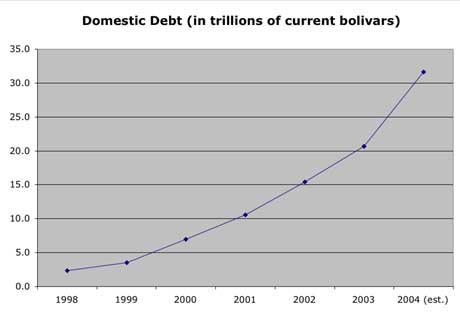
Guerra says that if the government borrows as much money as it has said it wants to borrow from the internal (i.e. bolivar denominated) credit markets in 2004, its total domestic debt would rise to 36.1 trillion bolivars - a fifteen-fold increase on the Bs.2.3 trillion domestic debt Chavez inherited when he reached power.

Even in terms of dollars, the growth of the domestic debt is staggering: by the end of this year it could total $16.1 billion (figuring the bolivar at the officially projected Bs.1950:$.) That's four times as much as the $4 billion debt Chavez inherited in 1999. The domestic debt, if things continue to go this way, will be worth 20% of GDP: a fifth of the value of the economy, by the end of 2004.

But that's not the worst of it.

The worst of it is that most of this mountain of new debt has come in the form of short term treassury bills, at very high interest rates - often 25-30% a year. As Venezuelan banks became more and more exposed to the government, they became less and less willing to buy long term DPN bonds: they needed their money back in 3 or 6 months, not 3 or 4 years.

As anyone who's gone a bit overboard with credit cards knows, high-interest short-term borrowing quickly snowballs out of countrol. Compound interest is a merciless foe. And the very high interests the government has been paying for these short term loans have sent the domestic debt spiraling out of control.


Source:
Finance Ministry Website


The payment schedules that result when a debt is growing this fast are brutal.

The government's obvious response is devaluation. If you owe Bs.1,600, and the exchange rate is Bs.1,600 to the $, then you owe $1. But if you devalue the currency - if you let the exchange rate slide to, say, Bs.3,200 to the dollar - you find that under the new exchange rate those Bs.1,600 you owe are magically only worth 50 cents! Your bill has been cut in half! And since most of your income is in dollars (think oil), you have an obvious interest in "watering down" the domestic debt by letting the bolivar devalue more and more against the dollar.

An out of control domestic debt is an inducement to aggressive devaluation.

Problem is, each time the government devalues the currency even further, the result is more inflation. And inflation is devastating for people on low incomes.

The irony is that, when you look at it closely, the revolution's economic management turns out to be deeply regressive, even reactionary. Everyone is losing, yes, but proportionally, the poor lose more of their purchasing power than the rich do. The reason is simply that the rich have savings in dollars, so they can shield themselves from the ups and downs in the bolivar's value.

The poor don't have that privilege: they live day to day. When you're on a fixed income, living close to subsistance level, price rises of 25 or 30% or more each year mean hunger. In the barrios, inflation is not some distant macroeconomic aggregate, some abstraction. In the barrios, inflation means destitution. It means eating two meals a day, when you used to be able to afford three, or just one meal a day if you used to eat two. It means giving up breakfast.

These are the kinds of sacrifices that a broad swathe of the working class people who voted for Chavez have had to make. Chavez's strategy to borrow-and-spend his way to social justice has been a disaster for them.

Sadly, the government just doesn't have the money to take the sting off: it's all going to service the mushrooming domestic debt. Debt repayment now dwarfs the president's social agenda in the government's spending priorities. Guerra projects that domestic debt service payments alone could gobble up a shocking 94% of the government's huge oil revenues. That's nearly all the money from the country's fabled oil industry up in smoke, just like that, just to service the debt.

Populist "misions" make for nice headlines, but the cold hard figures tell a different story. Guerra forecasts the government will spend 57% more on servicing its domestic debt than it spends on all public investments put together - things like building new roads, schools, hospitals, and such. The domestic debt service will cost nearly as much as total state spending on education, health and social security all put together (87% as much.) In fact, debt service will cost 43% of all current government income.

Servicing the domestic debt has become so expensive that even if the government had a sensible and coherent plan to tackle poverty - which it emphatically doesn't - it wouldn't matter: there simply isn't enough money to pay for it. Nearly half of what the government takes in goes to service the debt; what's left is barely enough to pay the public sector wage bill.

Belatedly, the government has accepted the arithmetic impossibility of continuing along the current path: there just aren't enough bolivars in the banks to keep borrowing in Venezuelan currency. Instead, they've started to do what critics told them to do all along: borrow dollars and swap bolivar obligations for longer term dollar bonds.

It's too little, too late. The first of the swaps was for just $1 billion - to yield a frightening 10.25% (in $$$!) That leaves another $15 billion to go, and it's hard to imagine international markets making that kind of money available this year. The government's refusal to switch to dollar borrowing earlier has already cost this poor country billions of dollars - the damage is done.

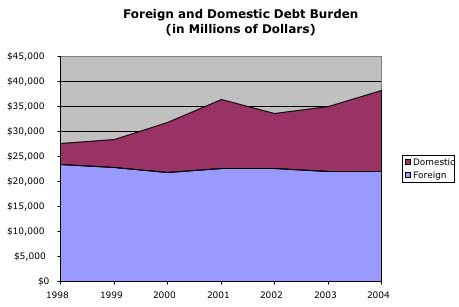
To put it another way, the Chavez's government's pigheaded incompetence has saddled a whole new generation of Venezuelans with debt. The total debt burden (foreign and domestic) has jumped 45% in 5 years, in dollar terms, from $25 billion to $36.4 billion.


Sources:
Finance Ministry Website
Central Bank of Venezuela Website
Jose Guerra estimates, cited in Descifrado


If the government's swap strategy works, you'd see the blue part of this chart swallow up much of the purple part as the government "swaps" domestic bonds for foreign ones. The total will not fall as a result, though the repayment schedule would be far less murderously onerous.

The worrying part is that the government will now be tempted to devalue the bolivar before swapping any more bonds. This would allow it to buy back more bolivar debt with fewer newly borrowed dollars. Again, that would just be a way of passing on the costs of the government's failed strategy to the population as a whole - via inflation.

It's just sad.

The net result of all this rather icy technocratic talk is real suffering in the barrios and towns of Venezuela. The government's money crunch means less money for all the things that could help people out of poverty: less for social programs, less for schools, less for hospitals. Meanwhile, people's needs only grow: more hunger, more unemployment, more destitution, more desperation.

And all for no good reason at all. All to make some ideological point about not needing the IMF, about being able to tough it out without international credit markets. As with any revolution, in chavismo ideological purity comes first; the needs of the people are an afterthought.

The thing that drives me and other government critics crazy is that WE TOLD THEM SO! I've been writing about this topic for five years now, only usually in the future tense, warning that the things that are happening would happen. Dozens of independent economists can say the same. We tried to explain to the government why this strategy would not work, we shouted ourselves hoarse trying to get them to understand that these policies would end up screwing the very people Chavez wanted to champion.

We wrote about it again and again, warning that the borrow-in-bolivars-only strategy was unsustainable, short-sided and stupid, explaining again and again that domestic credit markets were not deep enough to bankroll the government, drawing out the social implications of this course of action, appealing even to the government's sense of self-preservation by explaining to them that the strategy would cripple their ability to finance Chavez's social agenda.

The government interpreted our protests as the "squeals of pigs being taken to the slaughterhouse" - just the protestation of an old elite worried about losing its privileges. They took our criticisms as evidence of the revolutionary bona fides of their policies. We were variously dismissed, ignored, mocked, attacked, derided and generally disregarded as "savage neoliberals."

Now, billions of wasted dollars later, it's not the independent analysts who lost out. We're sure as hell not going to bed hungry. For the privileged, the crisis means being able to afford only one maid instead of two, or having to hang on to a 5 year old car for another couple of years before changing models. They're not the ones bearing the brunt. It's the millions of poor Venezuelans who believed Chavez when he promised them a better life who are bearing the brunt.

They're the ones who'll go to bed on an empty stomach tonight.

---
Late addition

In today's El Universal, Emeterio Gomez urges the opposition to do a bit of a mea culpa, before pilloring Chavez's economic management. From 1973 through 1998, he points out, the opposition did the exact same thing Chavez is getting raked over the coals for doing now.

Point taken.

January 16, 2004

A thought experiment...

Imagine you wake up on just a normal Friday morning, turn on your local news radio station and hear this, read in newscaster's deadpan:

According to DC police chief, Larry Forester, the Barry Goldwater Tactical Combat Unit of [pro-Bush urban guerrilla group] the Ethanallens, who operate in Georgetown, attacked a group of District of Columbia police officers just outside the Foggy Bottom-GWU metro station. The attackers used both handguns and rifles. Four people were wounded, including two bystanders who were on the way to ride the metro, along with a metro worker, who is being treated at the local hospital. The DC Police officer and one of the bystanders received bullet wounds to the face.

It's just too far-fetched, isn't it, even as a send-up.

The spooky thing is that if you'd been listening to news radio in Caracas this morning, that's what you would have heard. Well, a Venezuelanized version thereof, anyway.

The pro-Chavez guerrilla group in question is the Tupamaros, a Marxist group far older than chavismo that now enthusiastically supports the revolution.

Perhaps alone in the world today - the tupas, as they're known - occupy the ultimate oxymoronic/magic realist political position: they're a pro-government guerrilla movement.

(Think about that - how does that even work?!!)

The government does not control the Tupamaros, and it's not clear to what extent they take orders from Chavez personally. But what is clear is that they're heavily armed, and effectively control entire housing estates in the West Side of Caracas. What's also clear is that the Tupas sporadically carry out urban warfare opperations against the "enemies of the revolution" - and often against the PM, the Caracas Metropolitan Police.

The PM is seen as the enemy because their chain of command ends at the desk of Alfredo Pena, the fiery antichavista mayor of Caracas who was elected with more votes than Chavez himself got in the city. What the bystanders did to deserve a bullet in the face only the tupas know.

It's hard to exagerate just how destabilizing events like today's shootings could be. But the worst of it, the most destabilizing part of it, is the government's very public and very chronic refusal to ever investigate, much less prosecute, any act of political violence perpetrated by any Chavez follower.

Is it really too much to ask for the president to try to maybe do something to stop the urban guerrillas who support him from shooting cops randomly at tube stations?

What kind of mad reality are we living in when you can actually write a question like that last one and mean it?!


Reader mail
From: Cesar Date: Fri, 16 Jan 2004 6:27 PM
To: caracaschronicles at fastmail.fm

Hi Francisco,

I read your last post (Jan 16th) and I'd like to tell you that I too worry
about all this madness. I worry that all this will become normal like so
many other bizarre things are "normal" in our country. I struggle, for
example, to explain to my US friends why Venezuelan homes have so many metal
bars on their windows, something I didn't think about before coming to the
US because I considered them normal, even though deep inside me I knew it
was very wrong. In the same way, Venezuelans of the future may see as normal
to have armed groups controling part of the cities. And then we'll be
doomed.

I fear that the Chavez era has opened a Pandora's box for which we will not
recover in a long time, if ever. I mean the political violence that is now
part of our society. I have, however, some hope that in a post-Chavez era,
without his inciendary verb, all this tension will fizzle down and the
current violent politics will give way to more constructive ways.

Cesar

January 15, 2004

WWMLKD?

"Nothing in all the world is more dangerous than sincere ignorance and conscientious stupidity."
-Dr. Martin Luther King Jr., Strength to Love, 1963

"Shallow understanding from people of good will is more frustrating than absolute misunderstanding from people of ill will."
-Dr. Martin Luther King Jr., Letter from Birmingham Jail, 1963

Danny Glover and the members of his Transafrica Forum continue to protest that theirs is not a pro-government propaganda visit, or at least that's what they say, in between one pro-government propaganda event and the next.

In the latest non-propaganda propaganda coup, flanked by government grandees, the Transafrica forumsters opened a photo exhibition on the life of Dr. Martin Luther King, Jr. The occasion raises, in my mind, a simple question: what would Dr. King do if he was alive today and faced with a government like Chavez's?

WWMLKD?

After years of being harassed, spied on, intimidated, threatened and roughed up by the government, would he really support a government that routinely harasses, spies on, intimidates, threatens and roughs up its opponents?

After a lifetime spent trying to focus attention away from something as fleeting and banal as skin color, would he really support a government that plays on racial differences to bolster its support?

After working tirelessly for the economic empowerment of the most disadvantaged Americans, would he really support a government that has impoverished more people faster than any other in Venezuela's history?

After risking his life to ensure the voting rights of all US citizens, would he really support a government that works tirelessly to block the rights of Venezuelans to vote in a recall referendum?

And would Dr. King, who was so passionate about Christ's counsel to love your enemy, would he really support a government based almost entirely on the vilification of those who disagree with the leader, on the demonization of dissent, the equation of disagreement with treason?

WWMLKD?

"Man must evolve for all human conflict a method which rejects revenge, aggression and retaliation. The foundation of such a method is love."
-Dr. Martin Luther King Jr.

January 13, 2004

The worst part about Chavez's new strategy...

...is that it actually seems to be working.

Right now, Hugo Chavez has a single goal: survival in power.

Oh sure, he'll talk about the revolution this and the revolution that and isn't it terrible how they want to take away the revolution, but Venezuelans long ago learned that revolution is merely one of a family of words Chavez uses as a rough synonym for "me."

[The others being "mvr", "government," "fiscalia", "Armed Forces", "state", "Magallanes", "law", "central bank reserves" and "constitution" - narcissists have a hard time with ego boundaries.]

Of course, plotting and surviving is Chavez's strength, the one activity he has a credible shot being called an "expert" in. Chavez plotted a coup for TEN YEARS between his Saman de Guere oath in 1982 and the actual coup-attempt on Feb. 4th, 1992! Plotting is hard-wired into his political imagination. Arguably, Chavez can't really tell the difference between politics and plotting. In any case, he can't seem to differentiate the opposition movement from a conspiracy any better than he can differentiate his political plotting from the practice of governing.

So it's Chavez the military conspirator who's facing this stability crisis; that's the mindset he brings to the problem. A quick assesment shows his hand is pretty weak, for two reasons: 1-He knows he cannot dominate the country's institutions the way he once could. 2-He know's the government is out of money.

So put yourself in his shoes? what do you do? Well, unless the other side makes a major blunder, you're gonna lose. The strategy, then, will be to try to goad the other side into making that mistake.

Think tactically: how can you put the opposition under pressure, how can you push it towards making a major blunder before the recall vote? How can you divide them?

Can't be that hard: the opposition is famously unable to agree on anything beyond its animosity to Chavez. It ranges from the Trotskyite Marxist Bandera Roja party to reactionary pro-Bush generals. It's not particularly hard to play on divisions. If they were ever forced to sit down and negotiate with each other, they probably couldn't agree on what to put on a pizza.

So what if they were forced to sit down and agree on a single, unified slate of nominations for state and local elections later this year? And what if you could force them to start negotiations right now, when they'd much rather focus on the recall vote?

Chavez must have asked himself: what are the chances that the opposition can stick together through a deal that complex, made up of hundreds of smaller local and regional deals?

It's just a lucky thing for him, then, that nationwide elections for governor and mayor are due later this year. It was not clear, juridically, whether those elections should take place in late July-early August, or in December. But it looks like this is the kind of favor Chavez can still expect a favorable hearing on from "his" CNE members.

Jorge Rodriguez has already announced the July/August timeline as the CNE's preferred timing for the regional votes. The political parties would have to present their nominations several months earlier - by March, no later. That'll probably fall in the middle of the referendum campaign: the worst time for a crisis.

If the opposition wants to go to the state and local elections as a united front, they need to sit down around a table right now and get that back room air good and smoky. A deal is crucial. Surely, if adeco dinosaurs are good for anything at all (which is questionable), they're good for cutting a backroom deal on candidacies. Now would be an excellent time for them to exercise some of those skills.

The deal will require real negotiation skills and painful concessions from everyone. The state and local election involve key decisions on the future of a whole generation of budding young politicos from literally every corner of the country. Even if a deal is reached, the disappointed will outnumbered the nominated by a ratio of 5 or 6 to one. Will those 5 or 6 also-rans turn around and support the recall effort with the same zeal if they know they will not be mayor or governor after the next election? Chavez is gambling the answer is no.

Chavez's gambit was subtle, well played. It could well work.

But as Pompeyo Marquez says, if the opposition parties are not able to work out their differences over something so ultimately petty as governorships and mayorships then they don't deserve to win the recall.

Of course, there's a distinct possibility that Chavez has blundered, that by forcing the opposition to put up or shut up, he's providing a much needed prod for the opposition politicos to get serious about picking leaders once and for all. Once the regional nominees are picked, the opposition could be far more coherent than it has been so far, much better able to act as a unit. It's hard to forecast these things.

But chances are that the opposition's propensity to prima donnaish maximalism will sink a comprehensive deal. Some parties are bound to walk off the table, the opposition negotiations could descend into a kind of battle royal. Even if you don't end up in some nightmare scenario, the negotiations will obviously be a distraction to a political leadership that wants to focus like a laser beam on the recall.

Of course, the opposition is well aware what the government is up to. They've been taken for a ride by Chavez more than once already - and I think, I hope, they've learned something over the last couple of years. I hope they'll understand how important it is for the country's future that they put their differences aside and reach a deal quickly. Really it would be very difficult for voters to forgive if the typical old infighting took precedence over the country's future here. Their fledgeling credibility is at stake.

Chavez probably figures that even if a deal is reached, it will still favor him, because a-there's a good chance voters will be unimpressed by the opposition nominees and b-it'll give him someone to demonize, someone to run against during the recall referendum, relieving him of the painful burden of having to run against himself.

So, for Chavez, it's a win-win situation.

For the opposition, on the other hand, it's both a challenge and a test.

How useless can Hugo Chavez get?

Man, just when you thought Hugo Chavez couldn't get any more useless, he outdoes himself again. I mean, if you're going to have a far left lunatic run your country, you might guess you'd at least get some nice meaty Bushwhacking out of him. Not even!

The coward actually praised Dubya's latest remarks on Venezuela, calling them "very precise." Honestly, what's the use of this guy? A propensity to rant against the neoimperialist cabal in Washington was, as far as I'm concerned, the only redeeming feature of the Chavez regime. But he doesn't even dare, not when it's Bush personally...useless, I tell you, useless!

It's official: the 30 days to verify the signatures start today.

Official train crash date: February 12th.

CNE must announce whether or not it will call a recall vote by that date.

Mark it on your calendars.

Likelihood of serious destabilization/violence on February 13th: high.

Only in Venezuela do we schedule deep political crises with such precision.

January 11, 2004

Yet another open letter Danny Glover probably won't read...

So, Danny Glover is in Caracas to witness the revolution's great strides in helping black Venezuelans. But does he have any clue how race relations actually work in Venezuela? More importantly, can he and the rest of the US left be bothered to find out?

If you want to annoy, really annoy, a Venezuelan opposition member, tell him that he's only against Chavez cuz he's white and rich, engaged in a sotto voce oligarchical conspiracy to keep black Venezuelans poor and oppressed. Then kick back and enjoy the show, as his muscles tense up, his veins bulge, and, if you look closely, you see a bit of steam coming out of the guy's ears. Fun!

Not that I'm immune: the righteous race-struggle pap chavismo puts out abroad may be the single most misleading, destructive, and intellectually dishonest part of their international public relations campaign. It's a line they barely ever use in Venezuela: it just doesn't mobilize the masses, cuz it's so transparently bogus...but it sure does come in handy when you want to rally first world lefties to the cause.

The strategy rankles so much because it so clearly flies in the face of Venezuela's day-to-day reality. Racism may be the only acute social problem Venezuela doesn't have. Yet, by its very nature, a charge of racism is fiendishly difficult to refute without sounding, well, like a racist.

So it's easy to see why the government uses this line. The charge is devastatingly effective as a propaganda tool in the first world. Americans and Europeans are extremely sensitive to charges of racism, and any group tarred with the label becomes immediately suspect.

But the fact is that portraying Venezuela's political struggle as race-based is just plain silly. Anyone who has spent more than five minutes in Caracas can tell you why: there are remarkably few black people in Venezuela, and remarkably few white people as well! A good 80% of the country is mestizo - mixed blood - covering a chromatic scale of browns that does not consider itself either white or black - just "moreno", or "cafe con leche", just plain brown.

This gives rise to a social dynamic that is totally different from what you see in the United States. In the U.S., you're either white or black, period. These days you can be "other", on the census forms, but in everyday life you will be assigned to one or the other of the racial categories, and you'll be treated accordingly. If you're white you eat jell-o, listen to Bryan Adams, pray in a nice white episcopalian or evangelical church, think OJ Simpson did it, and can't dance. If you're black, you eat fried chicken, listen to Al Green, pray at a Southern Baptist Church, think OJ was framed and dance like you were born to dance.

Yes, those are stereotypes. This is exactly the point. You can come up with a list of immediately recognizable stereotypes for whites and blacks in the US, because in the US racial categories are really ways of describing ethnic groups. After a long history of segregation, the two groups evolved in radically different ways. Each acquired a unique culture. Blacks and whites in the US cook different things, vote in different ways, they live in different places, hell, they even speak with different accents. They are two separate ethnic groups, and what are described as "racial" problems in the US usually really boil down to ethnic tensions. This is why the phrase "African American" became established: because in the US, it really isn't about black or white, it's about membership in a group.

But in Venezuela - and this is the key thing that Danny Glover and Ignacio Ramonet seem determined not to understand - it just doesn't work this way. Racial categories do not map onto ethnic groups like they do in the U.S. Black people in Venezuela eat the same things as brown people and white people. They speak with the same accent. They live in the same neighborhoods. Except for Barlovento, they listen to the same music and dance the same dances. They go to the same churches, they pray in the same way. Their skin colors may be different, but they know full well what their ethnicity is: they're Venezuelans! Describe any black person in Caracas as "Afro-Venezuelan" and they'll just stare at you in incomprehension.

So the dynamic of ethnic tension that pervades the US cannot really arise in a country like Venezuela: we're just too much alike. The thing that really confuses gringos is that, unlike in the US, race actually is just about skin color in Venezuela. For instance, I remember talking to a lot of confused Venezuelans in 2001, when Colin Powell was appointed US Secretary of State. "They keep saying he's the first ever black secretary of state, but, but look at him! He's not black! He's nowhere near black!" I tried to explain that, in the US, the thing that made a person black or white was not actually his skin color, but rather his ancestry, family history, and belonging to a given ethnic group. Mostly, I got blank stares back. It seemed so evident to them: "no, no, you don't understand: look at his skin. Is it black? No! How can they say he's black if his skin is cafe con leche? It doesn't make any sense..."

And at that point, I stopped arguing, cuz clearly he was right: it's US attitudes towards race that make no sense at all...the way we deal with it seems like a model of inclusive common sense in comparison.

Most gringos would be really surprised, probably inspired, and definitely confused if they saw the way white and brown and black Venezuelans relate to each other. Every American I've ever met is stunned to realize that seemingly racially loaded terms like "catire" (blond) and "negro" are tossed around casually, both in public and private, as terms of endearment. Lovers use "negro" and "negra" as pet names - pillow talk fodder. Parents call their fairest skinned kid "catire" across the breakfast table. Chavez's Education Minister, Aristobulo Isturiz, is nicknamed El Negro Aristobulo by both supporters and detractors, both when talking about him and when talking to him. It's a totally unremarkable thing.

Relations between people of different skin colors are remarkably fluid, in all sorts of circumstances. I've seen German-born, blue eyed Chavista political organizers in Barinas state leading groups of brown-skinned pro-Chavez campesinos with no problems at all. I've seen black TV presenters from the anti-Chavez media bossing around white staffers in his production team as though it was the most natural thing in the world (it is!) Because their culture is the same, when a black Venezuelan and a white Venezuelan talk, race is nowhere near the forefront of their minds...it's an aesthetic detail, probably closer to what happens when a blond North American chats with a brown-haired North American.

You see this throughout the society. In Venezuelan high schools, you never see the situation you see in racially mixed US high schools, where blacks tend to hang out overwhelmingly with other blacks, and whites usually only make friends with other whites. Venezuelan high school students mix, make friends, go to parties, fondle each other, cheat on tests and riot against the cops with an inclusive color-blindness that would be the pride of any good first world liberal.

(If you've seen "City of God", you have a sense for just how color-blind these societies can be...though the film is about Brazil, a shocking amount of what it shows would hold in Venezuela also, including both the appalling everyday violence and the easy mingling of people with different skin colors.)

This kind of matter-of-fact mixing can happen because, deep down, Venezuelans of different races don't see each other as fundamentally different, they don't endow differences in skin color with the kind of deep social meaning that skin color acquires in a society as racially polarized as the US. In Venezuela, skin color really is skin deep.

Sure, it's true, the lighter your skin, the more likely it is you're well off, for historical reasons. And you do sporadically hear pretty tasteless jokes about negros, that's also true. But stacked against the mountain of everyday conviviality between the races, these signs of prejudice don't amount to a hill of beans. I mean, the undercurrent of real menace that a racist joke carries in South Carolina is wholly absent here, which is why you'll hear jokes about race in Venezuela told in racially mixed groups, and as often as not by darker skinned people. Plus, remember, any time you gather more than 3 or 4 Venezuelans together, chances are that you'll have a "racially mixed group"...it's just a fact of demography.

Venezuela's is very far from an apartheid society: there are any number of dark-skinned people who've made it, and (especially these days) any number of very poor light-skinned people. Does someone in a barrio have it easier if he's light skinned? Does someone in a board room have it harder if he's dark skinned? I really don't think so, in either case.

The point is that race and skin color don't have the same social meaning everywhere. That's the thing that's so frustrating about trying to talk to first world lefties who've been told that the political crisis in Venezuela is basically about race. They import the little mental schema they've developed to think about race in their own societies, and they transfer them willy-nilly onto a totally different context, onto a society where the same biological fact - skin color - has a vastly different and far less salient social and political significance.

It is, in the end, just another instance of U.S. cultural imperialism, of the laziness that comes with being the biggest and the most powerful. Americans don't think they have to go through the trouble of actually learning about the social dynamics of other societies because they're actually so self-obsessed, so enamored of their own navels, that they can't really conceive that other societies work differently from their own.

The left in the U.S. imagines that this is purely a problem of the right. But as Danny Glover's visit makes clear, good chunks of the US left also resist the effort of the imagination it takes to conceive of a society that's really, deeply unlike yours, a society that cannot be understood using the intellectual categories you've developed to understand your own society. This is hard work, it's not easy or comfortable or reassuring. But if the endless paeans to the wonders of diversity, tolerance and cross-cultural understanding are to be anything beyond cliches, the U.S. left ought to take a long, hard look at its own myopia, its own difficulties with understanding political dynamics that are genuinely different from what its used to.

And proving that old editors never die...
...they just start doing it over email, my ex-boss Toby Bottome writes in:

A nit: it's not 80% as you say.

The Fundacredesa study determined 97% of all Venezuelans (defiend as born here of a venezuelan-born mother) carried all three genetic markers in their blood - white, black and indigena..

January 9, 2004

Put it another way...

If the government does get its way, and the Central Bank does hand over the "millardito", what will the government do? It can't pay Venezuelan farmers in dollars, the dollar is not the currency here!

The government will have to use that billion dollars to buy a corresponding number of bolivars (Bs.1.6 trillion!) And what is the only institution the government is legally allowed to use to trade dollars for bolivars? Why, the Central Bank, of course!

So the government would turn right around and return the billion dollars to the Central Bank. In return, the Central Bank would have to "pay" for those dollars in Bolivars. The rub, of course, is that the central bank will have to print those Bs.1.6 trillion, just crank up the printing presses and go!

This is why the proposal is crazy, and hyperinflationary. The billion dollars will end up right where it started: in Central Bank reserves. But the same number of dollars will back 1.6 trillion new bolivars, bolivars created out of thin air.

So the "request" for a millardito is just a bit of smoke and mirrors: those reserves aren't going anywhere, not under the current control system. What the government is really saying is, "central bank! hermanazo! we're having a bit of a cash-flow problem...how about printing us up a fresh batch of Bs.1.6 trillion to spend?"

And when you run a currency like that...well, ask any Peruvian or Argentinian or Weimar German what happens...

January 8, 2004

Note on the latest deranged Chavez plan…

The president's plainly unconstitutional request for the Central Bank to hand over “just one little billion” in foreign reserves lays bare, yet again, his economic obscurantism, not to mention his criminal tendencies. I mean, this is no longer just about stupid policy: this is actually theft.

Yes, yes, I know...I shouldn't even blog about it. These types of topics tend to make a sure cure for insomnia. It's the kind of story only bankers and economists seem to get worked up about: discussing the details heatedly in a kind of secret code only they understand. Most people can't start to make heads or tails of what's at stake.

But it's important, really important: fantastic sums are at stake. We're talking about the outright theft of a sum roughly 70 times larger than the $16 million Carlos Andres Perez was impeached for misappropriating!

For the non-economically minded, I'll try to make it as painless as possible:

Imagine an economy where the currency is the wristwatch.* Twice a month, you're paid your salary in a certain number of watches. You go to the store, do your groceries, and at the check-out counter you hand over some of your watches to pay. The system has been in place for so long that it's seen as natural by everyone in the society.

However, there are some fairly obvious drawbacks: people are forced to walk around with little bundles of watches to spend, and making change is hard – what good is 0.25 of a watch?

Seeing these difficulties, a bright young technocrat proposes an idea. Why not set up a central repository for the watches - call it the Watch Bank - and have that new institution issue a voucher for each watch a citizen decided to store there. Citizens would consign their watches, and thereafter use the more convenient vouchers for day to day transactions.

Vouchers could be issued for multiple watches, coins worth fractions of a watch could be made available to help with making change, the voucher system would be far more convenient for everyone involved. And, of course, at any time any citizen could back to the Watch Bank and redeem his vouchers for the number of watches they stand for.

Impressed, the government implements this proposal, and the new voucher economy is launched. People like the new system much better: it’s just much less of a hassle than carrying all those watches around all the time.

In time, the country’s constitution is altered to make the role of the Watch Bank more explicit. The Bank, clearly, must be a public sector, not-for-profit institution. Trust in the Bank’s vouchers will become the cornerstone of the financial system’s stability, so preserving their value will be established as the Watch Bank's main goal. Our hypothetical constitution might read (in an Art. 318), “the fundamental purpose of the Watch Bank of Venezuela is to achieve price stability and preserve the value, in Venezuela and abroad, of its vouchers.”

In particular, the constitutional framers will explicitly seek to shield the Bank – and its watches - from the grubby designs of the politicians in power. Some article of their constitution (say, oh, Art. 320, just to throw out a number), might read, “the Watch Bank of Venezuela shall not be subordinated to orders from the executive branch, and shall not aid or finance fiscal deficits.”

The reason is intuitively evident: the watches the Bank holds are not the Bank's property – they are the voucher holders’ property. The watches belong to the voucher holders - this is why every Watch Bank voucher is stamped with the words "pagable en las oficinas del banco" - payable at the bank's offices.

If the Bank suddenly decides to start giving away those watches to the government - or anyone else - some citizens will find themselves holding vouchers for watches that the Watch Bank no longer holds.

At first, say, the Bank holds 100 watches. If it has 100 outstanding vouchers in the economy, the system is obviously solid: plenty of watches to go around.

But what happens if, say, the government forces the Bank to hand over 20 of the watches? Well, then the bank will be left holding just 80 watches, but - big but - there are still 100 vouchers for watches swimming around the economy. If all 100 voucher-holders decide to all go to the Bank at the same time and ask for their watches back, there's gonna be a problem.

If you have 100 vouchers, but just 80 watches in the Bank, what is the real value of each of those 100 vouchers? Is one voucher still really worth one watch? Of course not. For all practical purposes, the vouchers have been devalued. The assets they stand for have been stripped. If those 100 vouchers can only buy 80 watches, each voucher is now really only worth 0.8 of a watch. 20% of their value has vanished.

It’s been stolen.

Substitute dollars for watches, Bolivars for vouchers, and Central Bank for Watch Bank, and this is pretty much the situation we have in Venezuela right now. In demanding the Central Bank hand over a substantial chunk of its foreign reserves to the government, the President is proposing, in the most public way possible, the theft of a billion dollars from the holders of Venezuelan currency. It’s little wonder the current Central Bank directors will not even consider the request: if they went along with this lunacy, they’d open themselves up to massive criminal charges in any future government.

Honest now, I want to hear from a Chavista on this one. Please explain this one to me…because I see this kind of thing and it becomes harder and harder for me to fathom how anyone who’s not on the take can continue to support a government that launches public campaigns to piss all over its own constitution in order to steal from its own citizens.

I mean, some significant line is being crossed here. This isn’t even just bad policy anymore: it’s outright thievery.

*apologies to Alex Dalmady for shamelessly ripping off his analogy…

January 7, 2004

The bonfire of the government's rhetoric...

Pointing out inconsistencies between Chavez's rhetoric and his government's actions is like shooting fish in a barrel. Still, sometimes it's fun to shoot fish in a barrel.

Five years ago, Chavez built his economic vision around an angry diatribe against surreptitious attempts to privatize the nation's oil industry.

Today, the Chavez government surreptitiously sells off Venezuelan oil assets abroad under cover of darkness, with no public consultation or debate whatsoever.

Five years ago, Chavez roused crowds by denouncing the opaque business practices and outright corruption in the public oil sector.

Today, Chavez agrees a no-tender, one-on-one sell-off of a key state oil asset to none other than a Russian oligarch-led conglomerate, Alpha, which initially made its billions by bribing Russian officials to walk away with billions in dollars in assets paid at a tiny fraction of their value - the infamous 90s sweetheart privatization deals.

Five years ago, Chavez laid out a vision of radical democracy, grassroot people power, with direct voters' participation in key decisions.

Today, Chavez makes every key government decision in isolation, and his government is fighting tooth and nail against a very broad-based call for a recall vote, one of the very people-power reforms he championed as recently as two years ago.

Five years ago, the government denounced the economic enslavement of the foreign debt burden, and started to only borrow in bolivars, instead of going to international credit markets to borrow dollars. Economists of every stripe warned that they would soon tap out Venezuela's banks, crowding out local borrowers, and would end up being forced to borrow larger and larger sums of shorter and shorter term bonds at higher and higher interest rates from more and more exposed banks.

Today, the government implicitly admits that the critics were right all along. The government announces, finally, a $1 billion bond placement in New York, as part of a massive restructuring plan to swap bolivar denominated bonds with long term dollar denominated bonds - i.e., what critics had demanded all along. As usual, it's too late: the local debt has already more than sextupled in bolivar terms, and tripled in dollar terms, leaving the nation many millions of dollars worse off than it would be if the government had followed independent advice all along. And the new dollar bonds are no bed of roses: yielding over 10% (in $$$! - country-risk, is the relevant euphemism) the bonds are a massively expensive way for Venezuela to borrow...though still less suicidally non-sustainable than the crazy borrow-only-in-bolivars strategy.

Five years ago, Chavez slammed the old regime for the judicial "tribus" and the absence of truly independent legal institutions.

Today, the government unilaterally shuts down politically-uncomfortable apellate courts, creating a massive constitutional vacuum, and now proposes, through a plainly illegal maneouver, to pack the Supreme Tribunal with 10-12 additional (Chavista) judges, to ensure the Tribunal's tractability. Coming at the political moment it comes, the move is widely feared by the opposition who see it as part of a broader plan to strike down the recall referendum petition through a court decision with the Made in Miraflores seal.

And, the jewel:
Five years ago, Chavez was still celebrating his coup-plotting days, spending successive February 4ths - the anniversary of his bloody attempted coup in 1992 - as though they were national holidays. After April 2002, and in a truly Orwellian inversion, he switches and starts calling ALL of his opponents - from the catholic church to the far right to the far left to the far center - "golpistas", coup plotters, as the ultimate political epithet.

Today, having established the word coup-plotter as the worst political insult, and after having repeatedly grumbled about the U.S.'s supposed role in the April 11th coup - what that role might have been was, of course, never specified - reports emerge that the US believes Chavez directly financed the protests that brought down president Sanchez de Lozada in Bolivia - in fact, financing a coup!

So is this a government of the left, the right, or what? Is that even a meaningful question when you're faced with this kind of absurdist excess?

As Manuel Caballero once said, Chavez is neither a communist, nor a leninist, nor an anarchist nor a trotskyite nor a castrista nor a fascist nor a reactionary nor a militarist; Chavez is a chavista.

Snippet of conversation with my Malaysian prof...

Him: But how much democracy is there, exactly, in Venezuela? I mean, the situation there is not like in Malaysia, is it, where the opposition are not allowed anywhere near a TV camera, and elections are "blacked out" if the governing party don't get over 2/3rds of the vote?

Me: Well, it's a far different thing. In Malaysia you have an actual authoritarian regime, full stop. In Venezuela, the problem is that we have some kind of tropicalized dadaist fantasy instead of a government. Your problem is bigger, no doubt, but ours is much more entertaining.

January 6, 2004

Contrast and compare:

(or, case study on what happens when your vote is secret, but your signature ain't...)

Item 1:
Article 145 of the Venezuelan Constitution: Civil servants are at the service of the state, not of any political partiality. Their hiring and dismissal shall not be determined by their political affiliation or orientation[...]

Item 2:
26 fired for participating in signature gathering drive. Opposition lawyer Tulio Alvarez has taken on the cases of 26 civil servants, "tenured" employees at the Planning Ministry, who have been unceremoniously fired for participating in the signature gathering drive for a Recall Referendum. "They are not respecting the Civil Service tenure, nor the right to stable work, and the only way those affected can raise their voice is to go to the Administrative Courts, but any decisions those courts take can only be appealed to the Corte Primera (First Administrative Court,) which is currently closed."

[Remember that the government unilaterally ordered the Corte Primera shut down after its magistrates handed down a string of rulings deemed insufficiently revolutionary. The Corte Primera has yet to be replaced with anything.]