February 7, 2004

Notes for a Progressive Post-Chavez Agenda

The opposition has been rightly criticized for failing to offer a coherent, attractive vision of a future after Chavez. It's important to start this debate now, putting forward a positive, optimistic vision of what Venezuela could achieve if it had a genuinely forward-looking, genuinely inclusive government.


Any post-Chavez government will face a seriously daunting set of institutional, economic, and fiscal and social policy problems. Part of the reason I came back to grad school is that I was tired of participating in a public debate where everyone is obsessed with politics but nobody seems to have the slightest concern with policy. But it's policies that solve problems, not politics. Coming up with credible, inclusive development-oriented policies will not be easy, but it can be done.


1-Institutional Reform.
This, it seems to me, will be the biggest challenge facing the next government. Venezuela's public institutions are so frayed at this point that only a program of root-and-branch reform can redeem them.


First, an analogy. In the first world, you can picture leaders as operators at a sophisticated industrial plant. They sit up in their control room surrounded by flashing lights, buttons, and levers - the machinery of the state. That machines give them information about how the plant is operating, they analyze that information, evaluate it, and then make decisions about what series of buttons they'll push and what series of levers they'll pull to get the plant to do what they want. In time, they will receive feedback from the plant, analyze it again, and push buttons anew. First world people rarely even stop to think about how it is that the decisions taken in the control room become actual policy on the ground - everyone just takes it for granted that the system works.


Now, shift to Venezuela. We also have our leaders sitting up there in their Miraflores control room, and superficially it looks like what they're doing is not so different from what leaders in the rich countries are doing. They're getting information, making decisions, pressing buttons, pulling levers. But look closer and you'll realize the plant they're running is so old, misdesigned, clunky, and under-maintained, that the information it gives them is gibberish, and half the buttons aren't connected up. You pull a lever and chances are the thing comes off in your hand. Long ago, somebody stole the wires connecting the lever to the parts of the plant it's supposed to control. And the plant itself is so rusty and neglected that even if the control-room worked, the machinery at the other end is just unable to do what it's supposed to.


If you want anything done at the plant, you have to get out of the control room, find the one guy on the factory floor who knows how a part of the machine works, slip him Bs.50,000 and ask him to go do it by hand.


Now, part of the problem with Chavez is that he hasn't the slightest clue what the various flashing lights are supposed to mean or what the various levers are supposed to do. He's just not very good at all this formal decision-making jazz, he has no knack at all for pushing buttons and pulling levers. In fact, he's broken more than a few that still more or less worked when he got to power, like the FIEM button and the Conatel lever. For the most part, though, the machines were broken when he got there.


Chavez has dealt with the problem mostly by just going around the broken-down machinery - by using the army to distribute social welfare instead of the civilian Social Development bureaucracy, or his party to put on the various Misiones. I can certainly understand his frustration with the dysfunctional machinery of the state, but just bypassing the existing institutions doesn't strike me as a very promising solution in the longer term. Instead of fixing the institutions we had, the government seems to have given up on them altogether.


Now, what does this mean for the post-Chavez era? First things first: thinking that you can fix the problem simply by putting someone more competent in the control room is silly. What Venezuela needs, is a small army of engineers, electricians and repairman willing to go through systematically and fix not just the machines, but also the linkages between that control room and the machines. They need to replace the burnt out wires, mend any number of components that stopped working a long long time ago, and get the plant to something like proper running order.


This is going to be slowwww, laborious, unglamorous, boring work - not nearly as glamorous as running a revolution. The Venezuelan state is huge - over 1 million employees - and famously resistant to change. Some of the institutions - like the Social Security Institute - are so screwed up they'll probably have to be scrapped and replaced. Many others will need to be rebuilt from the ground up. We're talking the Consumer Protection Agency, we're talking the Judicial Police and the National Statistics Institute and the tax collection agency, and the Cinemateca Nacional and the entire Education Ministry. I could bore you to tears listing the completely screwed up state institutions in Venezuela badly in need of reform...the list is long. Very long.


Why does this matter?
These reforms are important because having a proper bureaucracy is the key to ending some of the most damaging features of both the pre-Chavez and the Chavez era: corruption and cronyism. When the formal machinery of the state doesn't work, your access to the state's services, contracts and payroll is predicated mostly on who you know on that shop floor. This sets up an insider/outsider dynamic, where people with privileged access gain and everyone else is excluded.


Now, Venezuelans hate this. They hated it so much, they voted for Chavez on his promise to end it. The sad thing is that instead of fixing the problem, the government has just substituted the old-AD cronies with its own. Quitate tu pa poneme yo.


To my mind, if democracy means anything, it means equal protection under the law. The whole point of a rational bureaucracy is that it treats everyone the same. It may not be particularly nice treatment, but it's equitable. Think Weber here.


When you go to get a driver's license at a DMV in the US, for instance, you find yourself in a line of people all being treated in the same way - people whose abstract equality is honored by the bureaucratic sameness doled out to them. In fact, this routinized sameness is such an unremarkable feature of first world bureaucracies, people in the first world don't stop to think about it very often. Like so many of the institutions Venezuela needs and lacks, a routinized, rational bureaucracy is something Americans and Europeans just take for granted.


But what happens when I go to get my driver's license in Caracas? Well, I have two options - I can either wait in line for N hours with everyone else, be given contradictory information and made to wait who knows how long for the actual license, or I can just pay off one of the inspectors and get VIP treatment, cafecito, fast-track paperwork, even the answers to the test, for God's sake. Everyone is equal, but people with money or connections are way more equal than everyone else.


So the breakdown in the machinery of the state not only breeds corruption, it also makes a mockery of the constitutional principle that all citizens are equal and should be treated equally by the state.


And if the DMV example seems somewhat glib, scroll down and read Death at Dawn to see what happens when institutional breakdown and the blithe disregard for the rule of law seeps into the law enforcement system. The decoupling of the police from the formal legal system is one of the most alarming instances of institutional breakdown over the last five years. Rebuilding those linkages, reconnecting those levers and buttons, is a really pressing task.


Institutional reform is about inclusion, real inclusion. It's about building a society where everyone actually does have an equal claim on the state's protection and resources by virtue of citizenship rather than connections or ability to pay. Institutional reform is about making sure that when Rusleidy calls on the state for protection, she gets the same level of attention as a well-connected chavista would. In fact, if I had to prioritize the list of institutions in need of intensive reform, I'd put the police, the prosecution service, the courts and the prisons at the very top of the list.


But overhauling the state is also important for economic and social reasons. Institutional reform is a pre-requisite to successful implementation of any kind of serious development policy. The state we have now is so bloated and hapless, it can't possibly serve as an competent manager for a long-term process of sustainable and sustained development. You need modern, forward looking public institutions that can bridge the divide between different groups in society, you need leadership that systematically seeks to include all stakeholders when it comes time to design policies, and that works to build agreements between those stakeholders. Development can't happen without good governance.


Now, institutional reform will not be easy in Venezuela. The habits of mind associated with corruption and cronyism have deep roots. You're not going to get rid of them overnight. But you're just not going to have a proper democratic society until you have functioning institutions. Since I refuse to accept that Venezuela will never be a proper democratic society, I'm forced to believe that institutional reform will be difficult but not impossible.

2-Economic reform
The Venezuelan economy is hurtin'. Bad. By some accounts, over half the manufacturing firms in the country went out of business over the last 5 years. The survivors are, more often than not, in very bad financial shape. An exception is the banks, and companies that moved aggressively to protect their assets off-shore in 1999-2002. On the whole, though, the economy has lost substantial capacity. Badly needed capital has simply been destroyed, or fled the country. Without the built-in safety net of oil revenue, the country would undoubtedly already be facing hyperinflation. The combined effects of a fantastically hapless government and a sporadically self-destructive opposition have depressed living standards substantially.


So the first thing any new government must do is re-establish confidence in its ability to run the economy competently. That alone would provide much needed stimulus, and allow the return of a good portion of the capital that fled from 1996 to 2002, as well as attracting new capital from abroad. Establishing a reputation for stability and a track record of real positive interest rates for savers would, over time, raise the level of domestic spending, lowering the country's dependence on foreign capital. This much a post-Chavez government could achieve relatively quickly, just by appointing well-qualified people to key positions and asking them to make some soothing, pro-market noises.


Unfortunately, reaching macroeconomic stability is only the first in a long series of policies needed to launch a country into sustained and sustainable development. On this issue I agree partially with the critics of neoliberal globalization: it's foolish to think that just liberalizing markets and looking after macroeconomic equilibria will bring growth and development. The government does have to establish a reputation for sound economic management, but it can't stop there. It has to do a lot more than that.


Now, that's not a call to return to the discredited policies of the 60s and 70s. The era of big government is over. But it is a call to eschew the kind of market fundamentalism people like Joe Stiglitz have built a career out of criticizing.


It's important to think outside the box on this one. Ideological rigidity can really harm efforts to make sensible economic policy. The slogans of the right, where less state involvement is always better, are just as untenable as the slogans of the left, where more state intervention is always better. Governments need to be canny about their policy interventions, moving aggressively to promote policies that will make a difference without losing sight of the market mechanism's unique ability to allocate resources efficiently.


Take fisheries policy.
In November 2001, the Chavez government forced them to travel farther from the coastline to fish in order to preserve the fish stocks nearer to the coast, which are important to local small-scale "artesanal" fishermen. The policy was actually a good one, environmentally and socially, but it has been difficult to implement because of the ill-will of the large-scale fishermen, who were cut out of the decision-making process.


Now, how would a serious, development minded government have handled a problem like this? The key is to sit down at a table where ALL the stakeholders represented - including both the large and the small scale fishermen, but also the people who process the fish, the people who make and repair the boats, the transport companies that take the fish to market, the coastal neighbors, along with policy makers, environmental experts and marine biologists who understand the population dynamics of the fish species involved. When you make an effort to include stakeholders, you make it much more likely you'll find a consensus that benefits everyone in the sector, or that at least tries to be sensitive to the needs of everyone involved. The government's role is to first be an honest broker, and then to implement decisions that give no one everything they asked for but gives everyone part of what they asked for.


In this pluralist-bargaining model of public policy-making, people from many different points of view come together to try to solve common problems creatively and cooperatively. Perhaps what the commercial fishermen need are new trawlers that travel further using less fuel, allowing them to fish further out at sea without going out of business. Maybe the government can help finance that investment through preferential loans, or investment tax credits. Perhaps what the artesanal fishers need is a bit of technical advice on how to start coastal fish-farms, using cages to breed many more fish than they could catch in the open, and increasing everyone's income. Or maybe the commercial and the artesanal fishermen can brainstorm the problem and come up with a fantastic, creative solution no outside expert could have thought of.


In the pluralist model, the state becomes a forum where the various elements of civil society can come together to work out solutions to specific problems. Pluralist bargaining is all about pragmatism, about collective problem resolving, about results. Of course, many of you are probably thinking this is a pipe-dream. But I don't think it's so crazy to hope that we could get there one day. Certainly, as a model of how the state should operate, one could find much worse. And this kind of approach has worked wonders in many countries, yielding policies that stakeholders feel especially committed to because they took part in their design and implementation. The pluralist state doesn't bark orders at its constituents. It helps constituents design rules that make sense to them for solving the problems they're having.


Mind the Technical Base
But on top of macroeconomic stability and a state that works hard to craft pragmatic, consensus policies to address specific economic problems, there's a third element I think will be crucial to launching Venezuela on a path to self-sustained growth: science and technology - or more specifically, science and technology policy.


Probably this is a matter of "desviacion profesional" because, well, it is my field of study. But actually, there's very good reason to believe that the intersection of science, engineering and business is the place where economic growth, real economic growth, actually happens. If Venezuela is to integrate into a liberalized world economy in a way that raises living standards in the long run, the only viable way to do so is by substantially upgrading the private sector's scientific and technological capacity.


Why? Because in the current world economy, the division between traditional industries and knowledge-intensive industries is quickly vanishing. As international markets integrate and competition intensifies, firms many traditionally "low tech" industries are forced to invest in science and technology just to survive.


Take fish farming, which I know entirely too much about after writing a research paper about it last week for school. Not so long ago, fish farming involved nothing more than stocking a natural pond with fish and feeding them with agricultural refuse like rice-bran. In Europe these days, however, fish farming has become a science-based export industry that relies on an increasingly sophisticated understanding of fish biology, nutrition, reproductive cycles, genetics, and fish epidemiology. You need a Ph.D. in wave dynamics to design the ponds at some of the more sophisticated european fish farms these days. This is not a simple industry.


Of course, if you go to Bangladesh, you'll also find a huge fish-farming sector. However, those fish farms are nothing like the ones in Europe. The traditional, low-tech fish farms in Bangladesh can only compete with the European operations by paying very low wages to their workers - which is viable enough in Bangladesh.


Now, in some senses, the amazing thing is not that the Bangladeshis can actually compete with the Europeans. What's really amazing is that the Europeans - with their vastly higher salaries - can compete with the Bangladeshis.


The reason is straightforward enough: Each European worker is orders of magnitude more productive than each Bangladeshi worker. The Europeans compete almost entirely on the basis of their technical dexterity - which overwhelms the Bangladeshi's wage advantage. With their access to plenty of capital capital and scientific know-how, the high tech European fish farms can remain economically viable without having to scrimp on wages.


So how can a country like Bangladesh hope to stay in a market like this, facing the scientific might of Europe? Basically, they have two choices: they can lean on their wage-advantages harder and harder and keep underselling their rivals by exploiting their workers harder and harder, or they can increase the productivity of each worker so they can afford to pay more without compromising their profitability. It's pretty obvious to me what the more socially desired economic strategy would be.


What is true for Bangladeshi fish farmers is true for leather apparel makers in Mérida, for automotive parts makers in Valencia and precision engineering firms in Caracas and cheese makers in Lara. Ultimately, the only hope the poor countries have of escaping the poverty trap is to make a conscious effort to upgrade their scientific and engineering capabilities - and not just in "high tech sectors," but throughout the economy.


A progressive technology policy geared at deepening and broadening the knowledge intensity of the entire economy is crucial to achieving this. Universities and public research institutes need to design research portfolios specifically intended to develop areas of knowledge of relevance to local firms. R&D grants and tax credits, public funding for research institutes, and efforts to make specialist knowledge available to economic agents throughout the economy should allow Venezuela to embark on the development path that other successful late developing economies have followed.


Cases like South Korea, Chile, Singapore, Ireland and Taiwan demonstrate amply that it really is possible to make the transition from mass poverty to mass-middle class comfort in a single generation. In each of those, governments first established their macroeconomic bona fides, then instituted inclusive models of economic policy-making that stress the importance of public-private partnership, and then pushed their local firms relentlessly up the technical ladder - giving them incentives to constantly invest in developing ever more sophisticated products using ever more knowledge-intensive production methods, and pushing them ever closer to the international technological frontier. In time, these policies produced firms able to compete and win in liberalized global markets. It's a model well-worth emulating.


Now, it's obviously a matter of some concern that four of the five countries I've just listed were dictatorships at the time of their economic miracles. It seems to be true that democratic governments usually have a harder time implementing the kinds of proposals I've been describing than enlightened-autocracies. But it's not impossible to combine the two.


The experience of Ireland proves that you don't need an autocratic government to implement a serious development agenda. Some would argue that Ireland was only able to achieve such spectacular growth because of the direct transfers it has receive from the European Union. But in many ways, Venezuela's oil wealth is not that different, macroeconomically, from Ireland's structural transfers from Brussels. In both cases, it's money that appeared in government coffers more or less out of thin air. The point, obviously, is not how much money the government has access to (if that was the case, Venezuela would be Switzerland!) - the point is how smart you are when the time comes to make policy.


The Aalborg Consensus
In academic circles in Europe, at least, there's a growing sense that the policy mix I've been describing could serve as a new model for sustainable and sustained development. Sometimes called the Aalborg Consensus (after the university in Denmark where it was first formulated) the policy mix is an extension and re-interpretation of the standard neoliberal model, rather than a wholesale rejection of it. The hope is that the Aalborg recipe of macroeconomic stability, inclusive stakeholder-centered policy making, and a strategic tech policy could become the backbone of a progressive, theoretically rigorous, pragmatic and viable alternative to the Washington Consensus.


The model was developed by Swedish and Danish researchers seeking to theorize the success of their own economies. As a Scandinavian-inspired model, the stress is on cooperation and technical dexterity, together with political legitimacy and inclusiveness. It has been argued that the Aalborg Consensus fits the historical experience of the late-industrializers in Asia with uncanny precision. In an era of increasing disenchantment with the market fundamentalism of the neoliberal model, the Aalborg Consensus offers both a theory of why neoliberalism has not worked (because it ignores the technical base) and a prescription for how to combine trade liberalization with meaningful economic development.


My belief is that in the next few years we'll see the Aalborg Consensus emerging as the alternative to neoliberal globalization. But that's also my hope. I mean, I don't know about you, but I would much rather embark on a development strategy patterned on what happens in Denmark than one patterned on what happens in the US.


3-Fiscal and social reform.
It might seem like an odd choice to pair up for analysis, but in fact fiscal and social policies are two sides of the same coin. Public services are financed out of the public purse, so looking after the solvency of the public finances is not a bad idea if you intend to institute a serious, long term social policy plan.


Because social policy is expensive business. The state is years behind on its social commitments, on its commitment to build enough schools, houses, and courthouses. The state is years behind in terms of instituting all kinds of social services, and a good part of this is down to the fact that the Venezuelan state is, more often than not, broke.


There are really two problems here: the state is too small a part of the economy, and the economy itself is too small. On the one hand, state revenue for 2004 is projected to total about 16 of GDP in the budget - including almost 8% of GDP in oil income. Aside from this "free money" coming from the oil industry, the Venezuelan state only captures 8.4% of the economy as tax revenue.


Compare that to the situation in most of the first world, where public sectors generally tax and spend at least 25% of GDP, and more like 35-45% in Europe. Those are, of course, much richer countries - but they also have substantially larger public sectors. That's what it takes to finance the large welfare states their electorates demand.


So the challenge is twofold. First, the next government needs a credible strategy to grow the economy substantially over 20 or 30 years. But at the same time they expand the economy, they also need to expand the public sector's share of that economy.


The alternative is to squabble over a shrinking pool of resources. Venezuela's experience over the last 6 years powerfully illustrates this. Even though the government has made a huge effort to raise spending from 24.8% of GDP to 28.4% of GDP from 1999 to 2002, real public spending barely budged. The overall contraction of the economy overwhelmed their efforts to expand public spending. After adjusting for inflation, public spending is a bit lower now than it was in 1998. That's without taking into account population growth.
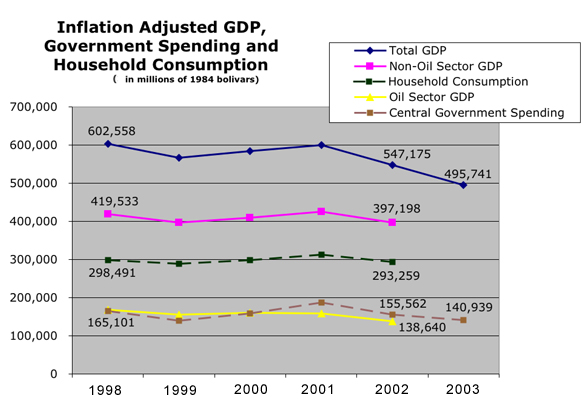

Sources: Finance Ministry and Central Bank. Not all data are available for 2003 yet.

And that's to say nothing of the huge burden of domestic debt the government has taken on over these five years.


With the government trying to milk more and more money out of a smaller and smaller economy, pressure grows to turn to short-sighted, damaging methods of financing. Stunts like the "millardito" pick the pockets of the most economically vulnerable by feeding inflationary pressures and crowding out the private sector. The upshot is that private household consumption is pinched - and the pinch falls hardest on the lowest income people, who are least able to afford price rises.


Those are the rules of the negative sum game that is Chavez-era Venezuela. The government has great social sensibility, but left to squabble over a rapidly shrinking cake, its thirst for cash to spend comes to the detriment of the rest of society. The question is how to go from this lose-lose situation to a positive-sum game, one where a growing economy and a reformed and strengthened state can start delivering quality social services for the first time.


Imagine.
It doesn't have to be this way. If the country can find a path to strong and sustained economic growth, the government would be able to capture larger and larger shares of national income without having to pick the pockets of Venezuelans via the inflation tax. In just six years, public spending could double in real terms, growing from its current 20-something share of GDP to 40% of GDP at the same time as household consumption and gross fixed capital formation (investment) grow substantially.


The figures are a lot more meaningful in per-capita, constant dollar terms.
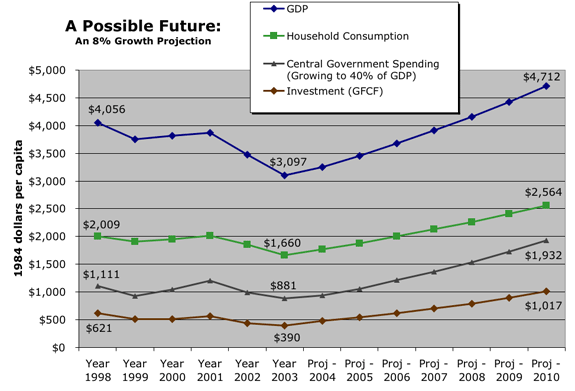

Sources for 1998-2003: Finance Ministry and Central Bank. 2004-2010 are my projections.

This is not to suggests that the Venezuelan state will be cash flush by 2010, even in the best of scenarios. Paying for all of the nation's public schools, hospitals, armed forces, bureaucrats, pensions, unemployment benefits, cultural activities, sports, housing, training, research and development, cops, judges, court houses, prosecutors, roads, ports, bridges, firefighters, social workers and more out of just $1,930 per person per year is still a stretch. But you go a hell of a lot farther with $1,930 than you do with $880. Similarly, trying to get by on $2,560 per person is not easy for any family - but it's a hell of a lot easier than getting by on $1,660.


It takes thinking in these terms to take stock of the real scale of the problems facing Venezuela, and to set out serious, inclusive plans for a post-Chavez future that's worth striving for.


Take the shantytowns.
About half of Venezuelas live in what's sometimes euphemistically called "self-built housing." Many people in Venezuela's barrios lack access to the basics of urban living like garbage collection, police protection, sanitation, transport, electricity and access to cooking fuel. Moreover many shanties are built on dangerous sites, like the unstable hillsides around Caracas that sporadically give way to mudslides. Being forced to live in such dangerous places is one of the bitterest inequalities poor Venezuelans endure today.


A team of architects and urban planners linked to UCV, Alemo, has studied the problem carefully to try to determine the minimum public investment necessary to upgrade all shantytowns, nationwide, to minimum acceptable standards of crowding, health, safety, and access to urban services as well as to build enough decent new low-income housing to keep up with population growth. They conclude a project like that would cost $60 billion over the next 10 years.


Now, how realistic is that? Today, that's about a third of all public revenue - way more than the country can afford.


But what would happen if the state could get into a position by 2010 where it has $50 billion to play with each year. Well, then a figure like the one Alemo suggests becomes far more feasable. $6 billion would still be a large outlay, but it could imaginably be accommodated. As matters stand now, though, with a government that has less than $25 billion to spend each year, investments on that order of magnitude are just not feasible. The government might attempt some specific urban regeneration projects in a few areas, but it simply can't finance an infrastructure project on the scale needed to meet Venezuela's massive urban housing problem.


Instead, the government finds itself picking winners and losers again. At present, ministers boast of building 40,000 new homes a year - though, like most government figures, this one is impossible to audit or confirm.


The problem is that that figure covers just a third of the new housing needed to meet the growth of population. Venezuela has a young population, and 120,000 houses a year are needed just to stay even. So for every family that got its hands on a government-built house last year, two others were forced to either build themselves homes - often in dangerous areas with no basic services - or to stay in unacceptably crowded housing with relatives. The government extends basic social provision only to a (relatively) privileged few instead of putting in place a serious program to help all citizens in need equally.


These problems are all connected.
The reasons the government can't put together a decent housing policy are the same reasons it can't make decent policy in general. The state is broken down and broke. No one part of the system can't change unless all the others change. And the whole system can't change unless each part of it changes. A competent, stakeholder-centered, tech-savvy state that helps foster economic growth is needed to spur rapid economic growth. Rapid economic growth is necessary to finance a state strong enough to finance solutions to the very serious social problems the country faces.


If you actually care about the living conditions of the poor you have every reason to advocate fast economic growth. Growth is very well documented to be the best remedy for poverty out there, not only due to the jobs it generates, but also because it gets the government the money it needs to make effective social policy. It doesn't do poor people any good for the government to be really really concerned about them if it's is too broke to help them.


What's true of the housing crisis is true of every other social problem. If crime is out of control right now, this is at least partially due to the fact that the government simply can't afford to hire enough cops, prosecutors, judges, public defenders, prison guards and court clerks. If the poorest 25% of Venezuelans go to school for an average of just 4 years, that's at least partially because the state can't afford to hire enough teachers and build enough schools. If there's no gauze in the hospitals, that has more than a little bit to do with the fact that the state is broke. Every problem Venezuela has is made worse by the public sector's never-ending money crunch.


Once the state has the resources it needs, the organizational culture it needs, the technical dexterity it needs and the understanding of itself as a consensus-builder it needs, then it can start to implement serious policies for development. Building that state will not be easy or quick, but I think it's worth a try.

February 6, 2004

Bye bye comments...

Grrrrr. For some reason, the comment software I was using (CommentThis!) just stopped working. I had to switch to a different system, so all the comments people had posted so far went bye-bye. Not so happy about that.

Skool

Believe it or not, in between extended bouts of blogging, I do actually go to school sometimes.

No, really, I do.

My course work is over now. I have four months to whip up a research proposal that, if all goes well, should keep me busy for the following three years.

At the moment, I'm trying to select a dissertation topic, and there's a huge amount of anxiety involved. Megan suggested I blog some of the research ideas I'm having, and ask y'all for feedback. I'm not having an easy time picking a topic and committing to it, so...

Why not? It's the 21st century!

OK...so, the only constraint, given the nature of my program, is that I have to write about the "economic and policy aspects of technical change" - a somewhat nebulous formulation that, if I had to explain it, comes down to an exploration of the way economically-relevant knowledge (i.e. technology) is generated, diffused, and applied. Intech is all about researching this topic in the context of the poor countries. How can poor countries upgrade their technical capabilities in order to develop? That's kind of the underlying question behind all the research here.

So, that's what I have to write about. Of course, for a doctoral dissertation, the research has to be brutally specific. So the question is, within that broad field, what exactly am I going to research. I'm basically flip-flopping between two ideas.

1-Knowledge flows in the Venezuelan Energy Sector after the Dismantling of Intevep. As you may know, Intevep was the R&D arm of PDVSA. 800 Ph.D. level scientists were working there on any number of projects until last year's strike, when they were all fired. This raises a series of good research questions: is knowledge and technical capability "destroyed" when you dismantle a large R&D operation? Or is it just transformed, diffused through the economy as the fired scientists rush off to get jobs in other sectors of the economy taking their knowledge with them? Or are these guys all just selling CDs on the Boulevard de Sabana Grande? And what happens to the knowledge-intensity of the oil industry when Intevep is no longer around? Does it wither away, or do you just substitute foreign-generated knowledge for indigenous capacity?

Pros: It would be easy to track down and survey these guys, and it would be fascinating to track them over the next two or three years to see what becomes of their lives and their research capacity. Plus, the literature on R&D in the third world is mostly about what happens when things go right - there are very few studies of what happens when you have an institutional crisis.

Cons: Possibly a not-very-interesting topic if Chavez stays in power, and the majority of the Intevep scientists either emigrate or end up as long-term unemployed. Also, it could take 10 years to complete.

Note: If anyone reading this knows a fired Intevep scientist, please, please, please send me an email and put me in touch!

2-Best Practice in Technology Policy in the WTO Era Lots of people fret that one of the unintended consequences of the WTO agreements is that they close down the spaces available to poor countries to implement policies to upgrade their technical capabilities. Some very bright people argue that traditional tech-policy instruments are no longer possible when you ban sectoral policies, commit to treating local and foreign firms in the same way, adopt strong cross border intellectual property regimes and end of the principle of special and differential treatment for poorer countries. Others say that what you need is creative policy-makers who understand the WTO rules and are smart enough to generate "work-around policies" - designed to advance tech policy goals while remaining within the letter of the WTO agreement.

My goal would be to identify and study one or more of these clever work-around policies. We're talking R&D tax incentives, publicly financed research institutes, pro-innovation sectoral policies and the like that are WTO-compliant, yet are written in such a way to favor indigenous capacity development. The research questions would be things like: are these clever work-arounds really all that clever (i.e. effective)? Is it really possible to have an effective tech-policy in the context of WTO? How much of the problem can you "fix" with creative policy-making, and how much of it is just inherent to the structure of WTO agreements?

Pros: Much more broadly applicable than the Intevep idea. Relevant to a raging academic/political controversy. Doable in four years. Would allow me the time to teach myself a hell of a lot about the detail of WTO, which I've always wanted to do. Feasibility not contingent on Chavez.

Cons: Not about Venezuela. About a topic that I don't know a lot about at this stage. Could be impossibly dry and dull. I have no idea which policies where I would choose to study as "best practice", and I'm not that sure how to even identify them.

OK, there you have it. The point here is feedback! Send me an email. Post a comment. Help me out here!

February 5, 2004

Shocking!

24 hours ago, I would not have thought it possible. But today, Venezuelanalysis.com publishes a thoughtful, sophisticated critique of FTAA.

I was really surprised, I kept waiting for the document to shoot off in some indefensible tangent, but it never does. Actually, the critique of FTAA is perfectly respectable, snafu-free, and pretty much along the lines of the Brazil-India-South Africa position in the last few rounds of WTO negotiations.

Sure, I find the anti-capitalist background music fairly annoying, but that's neither here nor there. My one real criticism is that the document doesn't do what it claims to do: it doesn't really set out an alternative development strategy. The piece tells us much more about what the government is against than what it's for. They pick out the three or four most blatantly indefensible aspects of FTAA and keep their fire closely focused on that.

That's not a bad rhetorical strategy, but what results is not really a comprehensive analysis of FTAA, much less a coherent statement of an alternative strategy. We find out at the end that they want to set up a Convergence Fund, which I'm all for, but it's clear that without a strategic vision of what such a fund should be devoted to or how it should be handled chances are that, in Venezuela at least, it would turn into just another hotbed of corruption.

Still and all, the critique is largely on the money. I've been studying these questions as part of my doctoral program, and it's clear whoever wrote this knows what s/he's talking about. Latin America has every reason to fear FTAA's phony agricultural "liberalization," and should resist it. There is an evident need to reintroduce an acknowledgment of structural asymmetries into the talks, and to bring back the principle of special and differential treatment for poor countries - a principle unwisely sacrificed during the Uruguay round. And the biopiracy concerns are very real. There is a growing consensus on these issues in the poor countries - witness the collapse of the Doha and Cancun talks - and that's great.
So, it turns out that, at least at Bancoex, there are a few people who can actually speak economics. That's encouraging. Still, it would be nice to hear more about their proposed alternative. Because the tragedy right now is that, while there's an emerging consensus around this critique of liberalization, there is nothing like a consensus on what to do instead. At times, it feels like the document just pines for a return to Import Substitution strategies of the 60s and 70s. That, I'm pretty sure, would be a disaster all over again.

February 4, 2004

Another 4F

As though on cue to make my point about its divisive, willfully provocative nature, the government that never ceases to attack its opponents of coupsterism pulls out all the stops to celebrate the anniversary of the violent 1992 coup attempt led of course by El Comandante.

Sad, really.

But the country will leave his extremism behind, and it will do so legally. Another reason to believe so is in today's Tal Cual:

[Carter Center mission head] Francisco Diez explained carefully that the analysis of the verification process the Carter Center is performing consists in choosing a statistical sample of forms which they will process following the same steps and the same criteria, according to the norms and regulations, that CNE has been applying to them. Once those criteria have been applied and results obtained, the Carter Center will issue a projection that, theoretically, should resemble the results CNE hands down.

This sampling, analysis and projection work has been taking place more or less at the same time as the official process, which is why Diez said the results should come out "almost simultaneously."


If you understand a bit about the way statistics work, you'll understand that this is close to a fool-proof safeguard. CNE cannot cheat without getting caught and unmasked. And that's only one of the reasons they will not cheat.

Francisco Diez also announced that the Carter Center will double the size of its mission, from 6 experts to 12.

Whose fault is it anyway?

One last thing on this Rivas piece: when government supporters are backed into a corner in trying to defend Chavez's economic record, sooner or later they'll turn around and blame the opposition - especially the strike. "See! It's your fault!" they'll say.

Sigh. It's true, as far as it goes. The strike was terribly damaging economically. That's the reason I opposed it.

But once you start playing the blame game like that, you get farther from a constructive answer, not closer. Ultimately, it's neither the government nor the opposition that's to blame. It's the fight between the government and the opposition that's to blame. It's the two-bulls fighting each other in a china shop effect. So long as you're playing the blame game, you're contributing to that fight, and to the problem.

If there's one thing that's been drilled into my head in my doctoral program is that a fluid, trusting, cooperative relationship between the public and the private sectors is one of the most important determinants of long run economic development. When firms trust the government, when they see the government as an ally, when goverment makes their concerns its concerns, when the two make an effort to work together towards a common goal, then development can start to happen. In fact, a good number of the researchers I'm studying see the extent, fluidity and ease of public-private interactions as one of the key explanatory variables in development.

Because development is a positive-sum game, and it can only happen when stakeholders on both the private and the public sectors see it as a positive-sum game, and cooperate accordingly. The tragedy in Venezuela, the underlying reason for the crisis, is that the political atmosphere has deteriorated to such an extent that public-private cooperation and partnership is impossible. The sides spend their time and energy blaming each other, shouting at each other, writing long blog entries to villify one another, instead of trying to work together towards a common goal. That's the tragedy.

The task now is to build an institutional structure where such routine cooperation is possible. It won't be easy. So long as Chavez is in power, it won't be possible.

February 3, 2004

Economics salad

Over at venezuelanalysis.com, Emilio Rivas posts this bitchy, incompetent semi-response to stuff recently published here, so I thought I should take the bait...it's just too tempting...

I don't know who Emilio Rivas is, but I know what grade I would give him if I had to evaluate the paper he's just published at Venezuelanalysis - a straightforward F. The guy has what an old prof of mine would call "una ensalada de economia en la cabeza." Rivas makes basic mistakes of economic reasoning and ends up unwittingly making my point for me.

Start with the title: this economic miracle jazz. Rivas cites forecasts of 6-7% GDP growth this year as a sign that a "miracle" is around the corner. But as any economics undergrad - or anyone with a bit of common sense, really - can tell you, if you've just come from a 10% contraction last year and this year you only grow by 6 or 7%, you haven't even clawed your way back to where you were two years ago. How this qualifies as an "economic miracle" is murky.

Rivas doesn't know it, but alluding to the oligarchical strike last year weakens his case. As he points out, 2003 was effectively an 11-month year. Even if the pace of economic activity doesn't change at all this year, the statistics would still show growth of 8.3% - simply because 12 months is 8.3% more months than 11 months. Put differently, unless economic growth exceeds 8.3% this year, the economy can't be said to be operating at a faster pace than last year at all!

(As for 3-year projections of 6% growth - this is a wish cloaked as an assertion mascarading as an argument.)

So, c'mon, this economic miracle stuff is surely just a bit of propagandistic flourish. It's not serious analysis.

But the thing that really tickled me about Rivas' argument is the type of data he trots out to make his case. I mean, the world must be crazy when I, the reactionary fascist right wing capitalist running dog, am citing household consumption statistics and informal employment figures and food consumption numbers, while Rivas, proponent of the radical left wing people's collectivist egalitarian revolution gives us THE CARACAS STOCK MARKET INDEX! And the bond market! And Central Bank monetary aggregates! These are the great triumphs of the people's revolution?! What the hell kind of alternate universe are we in?

Rivas, hermano, you're making my point. What I've been saying all along is that if you happen to be privileged enough to have access to the stock market, or to be a banker, or to be an international bond-holder, then this government has actually been quite good to you. But how many people do you know in the barrio who own CANTV stock? How many who're invested in emerging market sovereign debt? Hell, I'm the one who invests in emerging market sovereign debt here, not them!

Do I really need to remind you that you're supposed to be the left-winger here, and me the right?

Lordy, lordy, lordy...

I know Chuo Torrealba


Chuo

I admire Chuo Torrealba. I think Chuo Torrealba has been a voice for sanity in an insane period of our history. So it pains me to write that I think Chuo Torrealba has gone off the deep end.

Chuo's harsh attack on CNE this morning on Primera Pagina was baffling. Using highly aggressive language, Chuo ranted for 20 minutes over a procedural detail that CNE is actively trying to remedy. These kinds of attacks only undermine CNE's credibility and its ability to get the country out of the mess it's in.

It's hard for me to understand why the opposition continues to shoot itself in the foot again and again on this. We have so much at stake, so much riding on CNE's success, I just can't fathom why leaders like Chuo go public with statements that undermine CNE's chances of success. It is simply not true that Chavez owns CNE - many, many in the Council are working extraordinarily hard to get a real count of the actual signatures. Stories of 18-hour days are not uncommon. The internal wreckers do not own the council. The opposition has everything to gain from helping the silent, decent majority inside CNE to win. Whatever happened to "todo por el referendo"?

Much of it is a matter of tone - Chuo (like most of us) has a lot to learn from Teodoro Petkoff's measured, constructive approach to nudging CNE into doing the right thing. This morning, Chuo crossed over that line from critical supporter to wrecker. Chuo is smarter than this - he has to understand our interest in keeping CNE viable.

I mean, when even the legendarily level-headed Chuo Torrealba loses his cool this way, I worry. I really worry.

Sigh...only Francisco Diez can save us now.

(I'm trusting, erm, certain sisterly readers to forward this post to el que te conté...)

February 1, 2004

More on the zero-prosecution society

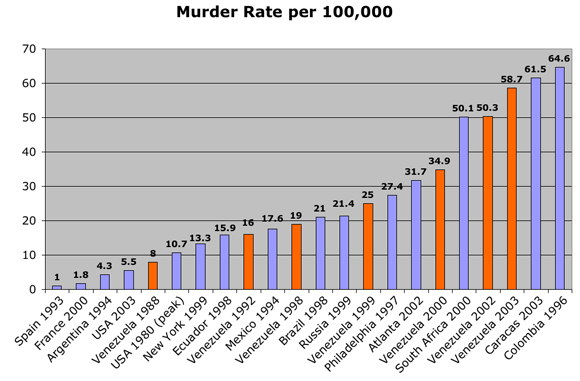
Today El Universal reports there were 13,500 murders in Venezuela in 2003.

It's a staggering number. Let's put it in perspective.

The figure is three times higher than the 4,300 murders in 1998, the year before Chavez took office. The murder rate has tripled, from 19 per 100,000 inhabitants to 59 per 100,000, just in the last five years. Murder is over seven times as common today as it was in 1988.

Internationally, Venezuela has left behind even notorious South Africa in the league tables. Only war-torn Colombia has a consistently higher murder rate than Venezuela. Interestingly, in Colombia and South Africa the murder rate has been falling in recent years. Venezuela is the only country towards the top of this table that has a rapidly-growing murder rate.

Venezuela's murder rate is now between 3 and 4 times that of other countries in the region like Ecuador and Brazil. 15 years ago, our murder rate was roughly comparable to that of the US. Today, it's over 10 times higher.

One final, shocking basis for comparison. According to the tally kept by the Iraq Body Count project, between 8,000 and 10,000 civilians have been killed in the guerrilla war in Iraq over the last year. Iraq has a population roughly comparable to Venezuela - meaning a Venezuelan is more likely to be killed by street violence than an Iraqi is to die in the insurgency.


Source: a dozen separate webpages I found through Google.

Disturbingly, 2,000 people died in "shootouts with the police" last year. As you know, "shootout with the police" is often - not always, but often - the excuse police death squads use after killing suspects in cold blood.

The government continues to more or less ignore this problem. There's no time! They have a revolution to run!

January 29, 2004

How did Venezuela get so unstable?

Time to step back from the political play-by-play – in this post, I want to explain to a broader audience how on earth Venezuela got into such a huge mess in the first place. I realize how baffling our political crisis must seem to an outsider. Here's a conceptual primer.

It seems like it's been much longer, but the political crisis in Venezuela has been going on for 27 months. It all started with the approval of 49 new laws by presidential decree on November 13th, 2001 - more than two and a half years after Hugo Chavez took office. The crisis has waxed and waned since, but it has never gone away.

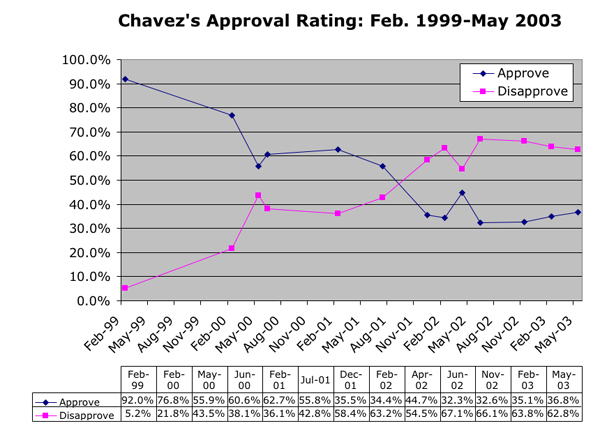
Until mid-2001, Chavez had basked in stratospheric approval ratings, and his dominance over the country's politics had been total. For a number of reasons, those poll numbers started to drop at the beginning of 2001. Within months, what had been an 80%-20% country had turned into a 40%-60% country, with a majority opposing Chavez for the first time.

That’s the first thing to bare in mind: the political crisis only really started after this turn around in the polls.


Source: Datanalisis. Question wording: "how do you evaluate the work of President Hugo Chavez for the welfare of the country?" Sample size: 1,000. Interviews conducted generally at respondents' homes.

Chavez's honeymoon was long and eventful. In those first two and a half years in power, he completely reshaped the Venezuelan political landscape. He commissioned a new constitution, packed the supreme court with cronies, changed the country’s official name, packed the prosecution service with cronies, crushed the old political class into irrelevance, packed the electoral council with cronies, declared himself leader of a revolution, packed the public administration with cronies and made generals sell discount vegetables to the poor. Through it all, he basked in the people's genuine adulation for it.

49 laws
After pushing through his radical political reforms and being re-elected with 60% of the vote in 2000, Chavez moved on to his substantive agenda. In November 2000 he used his two-thirds majority to get the National Assembly to grant him special powers to legislate by decree. For twelve months, the president had carte blanche to change any law he wanted in any way he wanted. It was pretty extraordinary, but in the zero-opposition atmosphere before the turn around in the polls, he got away with it.

The way Chavez handled this unique opportunity says much about his core ideology, and created the political crisis the country is still wading through today. Instead of consulting with stakeholders, as had been the tradition in Venezuela, Chavez drafted the new legislation behind closed doors, with no public consultation. In fact, most of the 49 laws he decreed were presented as a fait accompli on November 13th, 2001 - the very last day of his special powers period.

There was no public debate, no public scrutiny, no chance to influence policy at all.

Now, contrary to how it has sometimes been presented, for the most part the new laws were not all that radical. Some, like the Lands' Law, were bound to be controversial, but many others were quite innocuous. They were markedly statist in many places, yes, and cumbersome and unrealistic in many others, but really the fight that developed was much more about process than content.

What really alarmed the opposition was the president's strident unilateralism, his angry refusal to even talk about the reforms with evident stakeholders before enacting them into law.

Take commercial fishermen, just as an example. The new Fisheries Law Chavez decreed radically changed the ground rules in their industry. It limited the range of waters they're allowed to fish, so it evidently affected them, and negatively. But since they were never consulted about it, none of their quite legitimate concerns could be taken into consideration. The Chavez law had no provisions at all to soften the blow, no phase in period, no investment tax breaks to help meet the regulations, no technical assistance to help the fishermen comply, nothing. None of the mechanisms the fishermen might have bargained for were in the law simply because the government refused, as a matter of principle, to bargain with them.

Worse still, when the fishermen protested, the government denounced them as counterrevolutionary elements and enemies of the people. This cemented the growing perception that the government was not just indifferent to them, but actively hostile.

The irony is that the Fisheries' Law is arguably quite a good, forward-looking piece of environmental legislation. By refusing to even try to build a consensus around the new rules and instead antagonizing the stakeholders, Chavez undermines the possiblity that it will ever be implemented properly.

It’s the sectarianism, stupid
It's easy to forget that, back in late 2001, all the opposition movement was really asking for was for the government to "correct course." We demanded space for dialogue, for a formal channel of communication with the government and some chance to scrutinize and comment on policy proposals before they were enacted into law. "Rectification" was the word on everyone's lips. It was Chavez’s strident refusal to legislate inclusively that led to the very first one-day general strike, on Dec. 10th, 2001 - and even then, what the strikers demanded was for the government to sit down and discuss the new laws, nothing more.

Again and again, Chavez responded with bluster and scorn. He demonized those who complained about our exclusion, often substituting ad hominem attacks and vicious broadsides for political argument. He made it clear to us that the revolutionary state was there to disenfranchise us, to free the political arena from the pernicious influence of counterrevolutionary thinking.

This was especially ironic given that Chavez's early political rhetoric was predicated around a single word: participation. Throughout 1998 and 1999, when he was riding high in the polls, Chavez never stopped talking about radical, grass-roots democracy, about empowering the people, and opening state decision-making to the masses. That rhetorical line lasted exactly as long as his majority in the opinion polls did.

By late 2001, opinion polls showed vast majorities of Venezuelans favoring a change in tone from the government. 85% of respondents (including, necessarily, a good number of chavistas) told IVAD's pollsters that they wanted Chavez to "change his attitude." In effect, what Chavez was proposing was shutting out the majority of the public from the political process...all in the name of "participatory democracy"!

Chavez equated all dissent with treason; all dissidents were branded enemies. It was not hard to recognize the autocratic thrust of this style of politics.

For the government, letting anyone from outside "the process" participate in policy-making would have meant accepting the opposition's legitimate right to speak for a substantial portion of the country. The government understood that sitting down to talk to those fishermen would have meant honoring the right of dissenters to exercise full citizenship rights, and implicitly abandoning the official fantasy that only hyperprivileged coup-plotters opposed the government. This Chavez has never been prepared to do.

Much of what the opposition wanted was a show of respect from the regime, some symbolic acknowledgment of our right to participate in our political process freely.

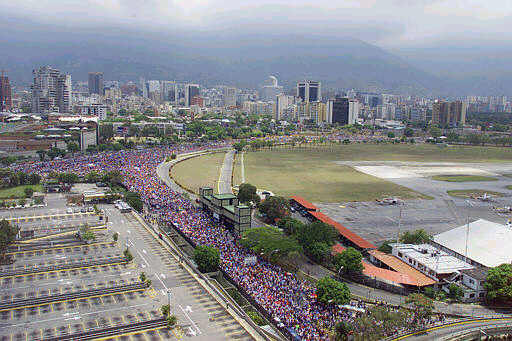
By early 2002, after the government had made it clear it would not extend such symbolic recognition, the opposition changed strategies. We imagined we could force the government's hand by taking to the streets in protest. We figured that if hundreds of thousands of us marched on the streets of Caracas, it would be impossible for the government to continue to dismiss us as an irrelevant plutocratic fringe.

One huge street march after another was organized, some nearing a million participants. Even then, even against the evidence of their and everyone else's senses, the government continued to dismiss the opposition movement as little more than a coup-plotters' private club. The vicepresident's pig-headed refusal to recognize the blindingly evident became the stuff of punchlines (and angry tirades) in opposition circles.


These people do not exist.

It's not surprising that many in the opposition went possitively batty after being dismissed and villified in this way again and again. To this day, the government maintains that the dozens of polls and scores of marches are a media fabrication. Go through the official media, Venpres or VTV, and you’ll be left in no doubt: a fringe of oligarchical wreckers notwithstanding, the country is overwhelmingly united behind Chavez.

How this profession of faith squares off with their panicked attempts to stop a recall vote has always been particularly hard to understand. But the president's attitude towards the political rights of those who disagree with him has never been particularly nuanced. Talking about the boxes containing the forms with several million signatures for a recall referendum, Chavez recently said they were "full of trash."

That, in the end, is what our citizenship rights are to him: trash.

Why, oh why does Chavez behave this way? It's one of those imponderables, but my guess is that it comes down to his own narcissistic fantasies-cum-ideology. Chavez truly believes he has a democratic mandate for revolutionary change, and if you really think you're leading a revolution, the notion of recognizing the political rights of counter-revolutionaries and class enemies is plainly nonsensical.

Within the government's sectarian view of political reality, excluding dissidents makes good sense. If your aim is to politically destroy a given group, what could possibly be the point in reaching a settlement with them? When it comes down to it, you might cooperate with your adversaries, but your enemies you fight.

Cooperate or fight?
At its root, the conflict reveals a wide gulf between the basic political philosophies of the two sides, between the ways that, deep down, each understands political life. The government sees politics as a zero-sum game between social classes. There is a fixed amount of power in society, and social classes continually fight over it. One class’s loss is another’s gain. In order for the poor to win, the rich have to lose. There is no room for negotiation and accommodation between opponents in this simplified Marxist worldview, only struggle.

The opposition, on the other hand, has a pluralist view of political reality. To a pluralist, the total stock of power in society is not fixed; it can grow or shrink over time. Games can be either positive-sum or negative-sum – one side’s gain is not necessarily the other side’s loss – so opponents have a natural interest in cooperating. In this view, the other side's loss is nothing for your side to cheer about – it could simply mean that you will also lose out soon. To a pluralist, nothing could seem more natural than consulting new policies widely and taking a keen interest in the input of the stakeholders, whether they're politically close to you or not.

Chavez's ideology is fundamentally incompatible with pluralist bargaining and cross-class co-operation. The zero-sum view leads him naturally towards maximalism - a tendency to equate consensus with surrender. Ideological rigidity becomes a badge of honor when you see the world in such terms, compromise becomes a matter of shame.

Protests coming from the other side – “the squeals of pigs on their way to the slaughterhouse,” Chavez dixit - come to be seen as indicators that great strides are being made on the road to social justice: if the old elite is really, really unhappy that must mean that they are losing power in society, and if they’re losing power in society that must mean the poor are gaining a corresponding amount of power. Perversely, making the other side unhappy becomes a policy goal, insofar as you see the unhappiness of your enemies as a sure-fire indicator that you're empowering your supporters.

The possibility that in marginalizing your enemies you might set off a negative-sum game where everyone loses is just never considered.

It's in this context of a clearly autocratic government determined to exclude all dissenting views that we have to examine what has happened over the last 27 months. Opponents' reactions to Chavez's autocracy have sometimes been extreme, destructive and unjustified. Both in April 2002 and in the December-January general strike, it's obvious to me that the opposition made big, bad mistakes. It's also clear that those mistakes were over-reactions to very real grievances against a government that had made a point of excluding us from public life.

What Venezuela has learned over the last 27 months is that, in the absence of old-style dictatorial repression, such sectarian governance is deeply destabilizing. The instability it generates makes it impossible for the government to reach its social goals. The gigantic can of worms Chavez has opened in terms of dissent, protest and instability, makes it impossible for his government to help the poor.

Because the dirty little secret is that political life is not, in fact, a zero-sum game. As the last few years should make more than evident, it's perfectly possible to govern in a way that screws both the rich and the poor. So long as we're led by those who imagine that every anti-rich policy is, by definition, pro-poor, we'll be stuck in the miserable negative-sum game Venezuela has become.

January 28, 2004

Jimmy Carter, Hugo Chavez, CNE, OAS, Most of the Opposition and Caracas Chronicles Agree...

The CNE verification roller-coaster saga continues, a rapid-fire alternation of seemingly dreadful news and, now and then, heady optimism. Today, at least, the news is good.

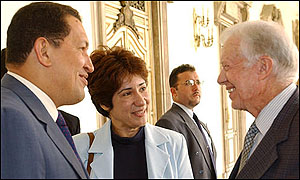
It took just 48 hours for Jimmy Carter, who commands unique respect across the political spectrum in Venezuela, to personally broker a sensible compromise that nearly all sides can live with.

Teodoro is understandably ecstatic.


Almost all the stakeholders are reading from the same hymn book now - itself a fantastic achievement. Now that all sides have agreed that Carter Center/OAS observers should be granted broad access to every part of the signature verification process, it only makes sense for all sides to pledge to accept CNE's eventual decision, whatever it may be.

The only question now is why Accion Democratica insists on holding the opposition as a whole back from undertaking this tremendously significant commitment.

...sigh...

As for the politics of all of this, I think Miguel over on Devil's Poop has it about right when he writes,

I have believed for quite a while that Chavez's strategy is simply to proceed forward and go to the recall referendum. He believes that the magic number of 3.8 million votes by the opposition simply will not be reached as most Venezuelans are apathetic about the whole conflict. He may be right in his assessment. I never cease to remind people that in the heyday of his popularity Hugo Chavez never received more than 3.757 million votes. He was really popular among those that voted, but abstention was 43.7% of the registered population. A repeat of that, adding a bit of 'Misiones', some doses of populism, some threats and the number may not be reached. However, this also implies that Hugo Chavez may not get more than 2.4 million votes in his favor, severely damaging the President's image. Abstention will in fact be the deciding factor, if it is near 50% the recall fails assuming the 60%-40% split against Chavez polls indicate. If it is near 40% the recall is successful.

Andy Webb-Vidal's FT piece, comes to the same conclusion after alluding to (but not quite giving us) fresh poll data "suggesting that the opposition's chances of unseating Mr Chavez at the ballot box have collapsed, while he continues to enjoy a steady 35 to 40 per cent backing - which could be enough to save him."

Of course, in the end you can get that Excel spreadsheet to toss back any result you want. It all comes down to turnout, and that, by nature, is unpredictable.

Pura Cova
In the same piece, Andy dishes some delicious inside nuggets into the murky world of opposition decision-making, and reports Manuel Cova is quickly becoming a consensus candidate for key parts of the opposition, specifically the TV station owners - who, like it or not, have a big say in the matter.

Knowing how the four horsemen operate, they've probably focus grouped and polled the hell out of this decision. It's not surprising Cova would come out on top: he's black, working class, and frighteningly bright and eloquent. His judgement as post-Ortega head of the Labor Movement has not always been perfect, but it's been far better than what came before. And I'm sure they see him as a safe pair of hands.

Yes, he's an adeco at heart, but I very much doubt a President Cova would take orders from AD's CEN. To be frank, I think we could find much worse consensus candidates than Cova - and if they play it right, he could play a big role in boosting turnout to a recall vote.

January 26, 2004

The oracle speaks...

...other pundits I read, but Teodoro Petkoff I follow. Teodoro is more than an analyst. He is a consistent voice for reason, principle and good sense in a political atmosphere where these qualities are sadly too rare.

So today, when he uses his TalCual editorial to warn CNE head Francisco Carrasquero to look again into Zamora's allegations of irregularities inside CNE, I sit up and take notice.

As Teodoro reminds us, TalCual has editorialized in favor of CNE 35 times over the last few months. His comments are not those of a wrecker. They're those of a principled observer, concerned by consistent reports of irregularities. Teodoro understands that CNE needs to take action on these allegations to preserve its own credibility.

Teodoro Petkoff speaks with a moral authority few in Venezuela command. We can only expect his views are taken seriously for once.

Nag: those of you who read Spanish and have not done so really ought to consider subscribing to TalCual. Top notch reporting, enlightened editorializing...the paper is in a league of its own. They really need readers' support to keep publishing.

January 25, 2004

New on Caracas Chronicles

Things are changing on this blog!

1.By sisterly demand, now you can post your comments at the end of each entry.

2.Check out the very silly, very fun mixed websites you can make with this very cool toy: TopFX website mixer. Great fun.

3.Also by reader demand, the RSS site feed is up! Now you can get Caracas Chronicles delivered to your PDA or newsreader automatically. The RSS site feed is here. And if all of that is gobbledygook to you, it is to me as well!

4.There's a new bio that tells you considerably more than you probably want to know about me.

Caracas journalism good enough to translate

Aliana Gonzalez must be one of the gutsiest and most talented journalists in Venezuela today. Though I don't know her personally, I contacted her to ask permission to translate and reprint this powerful piece. Too often my polemics about the rule of law and the chaos of the zero-prosecution society must seem abstract, distant, irrelevant. Some probably figure that the rule of law is something only the bourgeoisie worries about. Read Death at Dawn, and think again.

Death at Dawn


by Aliana Gonzalez, photos by Ilich Otero
reprinted from the Jan. 21st edition of TalCual, translated by me

Rusleidy Lopez is still scared.

The policeman was very clear: "if ever we find out you've said anything, we're coming back for you". On Monday, at 3:00 p.m., they went by the house dressed as civilians, armed, with their bullet-proof vests on and yelled "the women of this barrio are going to cry tears of blood." That night, she decided to sleep at her mom's place again.


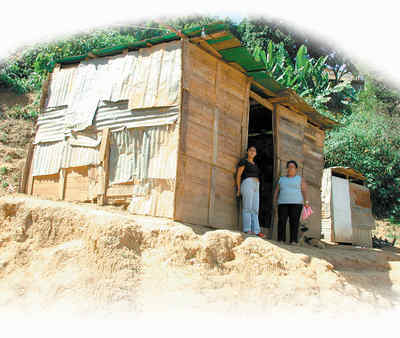
Rusleidy's home

The splattered blood that Orlando Jovany Sosa, her husband, left as he died is still visible on the wood and zinc walls, papered over with newsprint and magazine covers. On january 8th, at 4 in the morning, Policaracas (Caracas Municipal Police officers) and CICPC officers arrived at her house dressed in black and wearing ski masks. Some let their faces be seen.

"We were sleeping," she says "and I heard steps. I got up from bed, peered through a hole, and I saw the alley was full of policemen. I woke up Jovany. They kicked down the door, came in, and threw me out of the house. They took me into the woods and told me to stay there, because otherwise they would kill me as well. A quarter of an hour later they fired into the dumpster. Then they asked me 'what was the name of your husband?' 'Orlando,' I said, but they say 'you lie, they used to call him the Zombie.'"

Rusleidy had her twentythird birthday yesterday.

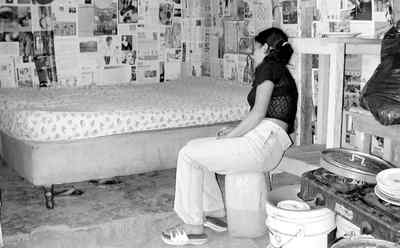
She had lived with Jovany for five years, when he was 15 and she 17. Her house was a small room with a dirt floor and a bed as the only furniture.

The kitchen - a two-burner gas stove - is set on top of an overturned bucket, almost at floor level. In big bags she keeps what little she owns.

The house has no drinking water, she has to keep some in a pitcher. The bathroom is a letrine.

There is no fridge, no closet, no cupboards.


Rusleidy at home

This "Mata de Mango" area, in the El Setenta shantytown of El Valle, is on the edge of the city, near the woods. Even though misery is the rule, they enjoy a unique view of the city: you can see the Helicoide, the cementery, the highway and even Las Acacias.

Forced to sign
Rusleidy was taken that day to CICPC - the investigative police [equivalent to the FBI.] Dawn was breaking.

"They grabbed me by the sweater," she says, "then by the neck and they put a gun to my ribs. I told them they were choking me and another officer said to let me go. When my mom and dad arrived, they threw me in a patrol car. I still didn't know what had happened to Jovany."

"I was in an office at CICPC headquarters until 9:30 that morning."

"An officer came and told me: 'you know that your husband didn't have a shootout with us, but we killed him because he's being accused of murder.'"

"They told me they would write a letter, and that if I didn't sign it, then I would pay for what they'd found in the house. The letter said that Jovany was running away from the cops, he took shelter at the house, had a shootout with them, but I managed to escape."

In the house, the cops found a gun and a little money.

"I don't know whose gun it is. I know Jovany was keeping it. The money was mine, from my work as a street hawker." After signing, the cops told her that "it's very dangerous to mess with the police; don't even think about making a formal complaint."

Look me in the face
Migdales Gonzalez, on the other hand, is not scared. She's the mother of Kelvin Gonzalez, who was killed by the same officers one hour later, at the other end of the barrio.

The version published in the press is that both had shootouts with the police. On top of the long distance between the two houses, there's the fact that neither had bullet holes on the walls, making the hypothesis fragile.

"I'm over my fear," Migdalis says, "I told the cop the same day they killed Kelvin: look me in the face, you killed my son and I'm not going to stay quiet about it, so you can go look for me at home to kill me."

Gonzalez is indignant with the director of the Policaracas for his statements.

"He said that everybody in this barrio is into drugs, that that's why they didn't say Kelvin and Jovany were neighborhood bullies. I've been working every day for years, and I am a respectable woman. People here get up early in the morning and go work and sweat for their money. Doesn't he respect people? I'm indignant that that is the explanation he gives, faced with the truth of the barrio. If they were really involved in shooting a cop, why didn't they arrest them and try them, so they could pay for their crime?"

In El Setenta the police has taken five lives, in similar circumstances, in less than four months.

Daniel Centeno, on October 9th, Cesar Augusto Kacen, four days later.

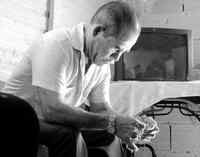
Daniel Centeno's dad

Kacen was 43 years old and was a nightwatchman in the public transport parking lot, on the barrio's sports field. At about 11:30 at night on 13th of October, Policaracas went up there. He was on the court, waiting for the minibuses.

A neighbor heard him beg and screem, calling for his mom, before the gunshot. "We buried Cesar ourselves because he had no family. His family moved away from the barrio years ago, and he stayed behind. He made a living carrying gas tanks, sand bags, and lately as a watchman. He had his problems, but he's grown up and he never messed with anyone," said Migdalis Gonzalez.

The other victim is Edison Jose Mendez. It was on December 12th, in identical circumstances as Jovany Sosa and Kelvin Gonzalez. Policaracas went in with ski masks, at 6 a.m., kicked out his family members, shot him, and then spread the word that he'd died in a shootout.

The epicenter of crunch time

or, Let the observers observe!


Zamora: Can-of-worms opener.

The last 24 hours were awful for the National Electoral Council. In the middle of a politically explosive process to verify the several million signatures backing the opposition's request for a recall referendum against Chavez, the council now faces some very serious allegations.

One of the five board members, Ezequiel Zamora, went public with allegations of sabotage in the signature verification process. He claimed "some" CNE verifiers had excluded authorized personnel from the "physical verification process." Somewhat cryptically, he said "the percentages are not coming out properly." He was careful to keep politics out of his statement, but it's not hard to fill in the gaps. He said the problems could delay an already delayed decision and demanded that CNE staff follow the board's directives strictly.

The gravity of these allegations hardly needs to be stressed. Mature leadership is desperately needed to steer CNE out of this mess - the alternative is too volatile to even consider. Can they work this out internally and come up with a solution that rescues the organization's credibility?

CNE chairman Francisco Carrasquero claims the whole thing is a big misunderstanding. I hope he's right. Even if he is, he should learn from this snafu and allow the international observers unfettered access to every part of the process. When observers are not present, it's easy for "misunderstandings" to generate a huge amount of suspicion that can be deeply damaging to the whole process. Especially if the accusations are false, Carrasquero should realize that the ONLY chance he has of convincing the world that CNE procedures are clean is by letting Carter Center/OAS watch everything.

It's significant that it was Ezequiel Zamora blowing the whistle in public. A nominally opposition-minded member of the council, Zamora had surprised everyone with his spirit of negotiation and bipartisanship. He's joined the chavista majority on more than a few votes, yielding a lot of 4-1 votes instead of the 3-2 decisions conventional wisdom had expected. Zamora may not like Chavez, but he's far from an opposition radical, far from a loose cannon. His statement was meant to bring staff into line, to keep the process transparent, not to throw it into crisis.

One other crucial decision remains on the council's plate. The matter of how much access Carter Center/OAS should have to the most critical stages of the verification process has yet to be discussed officially by the board. Much hangs on this decision, which could come as early as Tuesday.

My feeling is that the government fears close international observation more than anything else, because it would make the task of obstructing the referendum that much more difficult. It's disheartening that Chavez die-hard Congressman Nicolas Maduro went public hours later to accuse the OAS of imperialism for its request to observe every part of the process. This speaks volumes about how effective the observation mission has been in dissuading foul play. And it puts renewed urgency on the call for CNE to allow observers into every nook and cranny of the entire process.

The council will need to make some hard choices in the hours ahead. To exclude Carter Center/OAS observers from parts of the verification process in this climate is a recipe for disaster. If the board wants to retain its credibility, it must conduct all procedures in broad daylight in front of credible, experienced observers of unquestioned credibility.

A thumbs-up from the Carter Center/OAS mission is the only way to keep an eventual decision credible to all parties. Jimmy Carter did not spend half his adult life chasing a Nobel Prize only to squander his credibility at the last minute by signing off on a bogus election process.

This, right now, is the epicenter of crunch time. The country needs responsible leaders to take it through this very difficult juncture. If the provocateurs get their way, this little crisis could derail the referendum process altogether. This would really be a catastrophe.

The CNE Board has to take stock of the historic responsibility of the moment. It must understand that unfettered observation is better for both sides. If I'm wrong and the signatures really are bogus, as the government claims, it's especially in the government's interest to have impartial observers in hand. CNE's decision to strike down the referendum will only be credible in Venezuela and the world if an institution like the Carter Center certifies the process that determined they are fake. Otherwise, nobody will believe them.

These are the kinds of situations that separate heroes from villains, people of integrity from opportunists. CNE must step up to the plate. Because the tag-line on this blog is dead serious. Venezuela really is teetering on the edge of a civil war, and killing the recall through opaque back room maneuvers in the absence of international observers would be an excellent way to push the country over that edge.

January 24, 2004

More notes on CNE...

I'm not sure what's up with Venezuelanalysis.com's weasel tactic of not giving their write-ups by-lines. They just say "by Venezuelanalysis.com" and leave it at that. Hmmm...leaves me unsure who to yell at when they write things like this:

Government officials and political groups that support the Chavez administration have made numerous claims of alleged fraud committed by the opposition in the signature collection process to call for a recall referendum on President Chavez. 2.5 million valid signatures are required to trigger the recall. The opposition officially claims they collected 3.4 million. However, opposition political figures have privately commented that only 1.9 were collected.

Hmmm...ok, so if you're willing to use the illegally obtained, unconfirmed and unsubstantiated Escovar Salom 1.9 million figure, how is it that you're not citing the internal MVR report leaked to El Universal where they admit they think the opposition handed in just over 3 million signatures? The line between newswriting and propagandizing gets real thin on some of these things...

More importantly, why don't you guys spend some staff resources fleshing out exactly how the megafraude happened? As Cesar Miguel Rondon insightfully points out, the government's strategy in this regard seems to be mostly to scream itself hoarse repeating the word "megafraude! megafraude!" without ever giving a detailed explanation of the actual mechanics of the fraud, of how the megafraude actually happened. Who signed illegally? When, where and how? We want details, not slogans!

I understand MVR handed in a report on the matter to CNE, but I haven't seen any of the details yet. And many of the charges made in Tarek's little presentation make little sense: if foreigners, children, or dead people signed, or if people signed more than once, that'll be automatically weeded out by cross-checking the signatures against the Electoral Registry database anyway! So really, the question is what part of the megafraud was done in a way that it can't be caught by the checks already planned?

The only candidate I can think of is massive, gigantic scale identity fraud. The government would need to prove that between 600,000 and 1,000,000 people got fake cedulas to go sign. The only way to catch this would be through the fingerprint - basically, at least one in five signatures would have to be shown not to correspond to the fingerprint it sits next to.

Which brings us to this whole fingerprint hubbub. We really need to be clear about it: 40% of the fingerprints are uncheckable. They got smudged because CNE, under pressure from the government, chose to print the forms on Central Bank safety paper that was never designed to take fingerprints. Still, you can work with the other 60%, I suppose.

People in the council are talking about testing a "representative and exhaustive statistical sample" of fingerprints, which reads like a contradiction in terms to me: it's either representative or exhaustive. Still, if they get working on it now, I suppose you can do it. What kind of sample size would you need to get a sufficiently small margin of error, to determine conclusively whether 20% or more of the signatures are a result of identity theft? Couple of thousand? How long would that take to do? It does sound doable, at first blush.

But on this subject, at least, I do understand the opposition's skittishness. Who's to say the government won't lean on the "exhaustive" part more than on the "representative" part and say they test 150,000 fingerprints? Kooky, yes, but this is Venezuela we're talking about!

For my part, I still think we need to rally around CNE - no use poking holes in the only life-raft we've got. One thing I know for sure: Carter Center/OAS has much more access, expertise, and credibility than I do.

I am not prepared to write against CNE until they do.

January 23, 2004

Time to get off CNE's case...


Today, OAS head of mission Fernando Jaramillo (pictured) said there is no basis for the skepticism surrounding CNE. He said the Carter Center/OAS mission has closely watched every part of the verification process so far, and it seems to be going well.

Given the mission's unparalleled access, impartiality, and international credibility, it's senseless to contradict them. The opposition should realize that it only undermines its own credibility if it keeps criticizing the agency at this point. If and when the observers say that CNE has gone off track, then our suspicions will have credibility.

Until that happens, better for the opposition to shut up.

Jaramillo also asked for similar, wide-ranging access in the upcoming, highly sensitive, parts of the verification process.

Let's hope they get it.

It's the inequality, stupid

It struck me yesterday, in the middle of a late-night email back-and-forth with Greg, that this racial debate is a distraction from another, much more important debate we ought to be having about Venezuela. My criticism of the charge of racism is right, but kind of beside the point. Venezuela has its own, home-grown mechanisms for systematic exclusion. It just happens that they're based not on skin color, but on class.

Racism may be a cannard, but classism is very real, alive and well in Venezuela.

Rich people in Venezuela relate to poor people in deeply prejudicial ways. I've seen it, up close, many times - and I haven't always had the confidence or clarity to object to it.

Venezuela is an outrageously unequal society, there is no debating that. In a way, it's not surprising that people like Danny Glover or Greg Pallast come here, see the very evident social gap and the very negative attitudes that the rich have about the poor, notice that the rich are mostly light-skinned and the poor normally darker-skinned, and Q.E.D! Racism!

The line of reasoning is wrong, for the reasons I wrote about before, but the social gap is real, the stereotypical negative attitudes the rich have about the poor are real, and the poor are evidently excluded from most of the institutions of a decent society. Their grievances are real, and justified.

If I'm forced to play the game of finding something good to say about Chavez, this is what I'll fall back on: so far as diagnostics go, I agree with 95% of what he said in 1998. The Chavez of 1998 is a far cry, needless to say, from the Chavez that runs the country now. Back then, it was hard to object to his critique: his style might have been too shrill and pugnaceous by half, but he wasn't making this stuff up.

What's more, he put the problem front and center, he burst through layers of upper class denial, he made the social divide the issue - which is a good thing, because the social divide really is the issue. And for all of that he is to be commended.

It's just a shame his policies in power have made all of the problems concerned far worse.

Social exclusion exists on two levels: the social and the economic. Socially, exclusion is a system of customary ideas and practices about the role of the poor in society, about the institutions and spaces and opportunities are open to them. And there's no doubt that the poor are excluded, excluded from all kinds of institutions, excluded from access to decent schools and well equipped hospitals, to all basic state services, to things like water and social security and a shot at the army officer corps. And there's no doubt that this has terrible psychological effects on people: it has to be devastating to not only be poor, but to be poor alone, faced with the contempt of the powerful. The result was a lot of justified frustration, of a deep sense of grievance at those who were not so excluded.

The question is, why are the poor excluded?

To my mind, it's obvious the reason has everything to do with money. If you're too poor to live in an area with electricity, water, or gas, if you're too poor to afford a private school place, if you're too poor to buy insurance or at least medicine for the hospital staff, if you're too poor to have time help your children with your homework, if you're too poor to even eat properly, you can't even begin to overcome the barriers that keep you excluded from those institutions.

I realize my view here is oddly Marxist. I think the economic substructure determines the ideological superstructure - it's the fact that the poor have no money that causes exclusion, not the fact that the rich don't like them. In fact, the economic substructre explains the superstructure: it's the stress of a deeply unequal society that generates the mutual distrust and negative attitudes. Economic differences cause bad blood - always have, always will - and if you want to build inclusion, you have to start by making positive steps to reduce inequality.

Chavez's view, seems to be the reverse: that the symbolic exclusion, the negative attitudes, the stereotypes, the use of language the poor could not understand, the callousness of the rich towards the suffering of the poor, that these are the root causes of social exclusion. Therefore, if you want to include the poor, what you do is you forcibly remove the symbolic privilege of the rich - especially their control of any part of the state aparatus - and then talk to the poor for 4 or 5 hours every Sunday making strenuous efforts to pet their collective ego, telling them they're revolutionary heroes and that the state is there for them and that the most powerful man in the country is singlemindedly devoted to them and to their interests, etc. etc. etc. ad nauseum (for me, literally) You privilege the "social" over the "economic", which seems to me another way of saying you privilege rhetoric over results.

What Chavez has proposed to his supporters, has never been a poverty fighting strategy. Not a serious one, anyway Ð certainly not one with the least possibility of success. What he's proposed is a- a hodge podge of ad hoc programs done with no long term planning, no transparency, and no strategic focus, and b- (far, far more importantly) talk therapy. In important ways, Chavez intends to talk the poor out of their exclusion.

That poverty has increased seems to me like a matter of simple common sense: thereÕs no such thing as poverty reduction amidst rising prices, falling formal employment, a shrinking economy and an informal sector that grows and grows.

But even in terms of inequality, the government has made things worse, despite all the rhetoric. As even pro-Chavez observers tacitly acknowledge, a salient feature of Chavez's five years of management of the economy has been an odd series of giveaways to the some of the richest people in the country.

For 3 years (1999-2002) the government pursued a policy of deliberately overvaluing the currency, in effect selling dollars at a discount to holders of bolivars, as a way of trying to control inflation (the "inflation anchor" of Giordani fame.) The strategy worked in the short term, but it was patently unsustainable: you can't keep selling 1.2 watches for one watch vouchers forever without running out of watches. That wave had to break sooner or later, and when it did, it was obvious that the result would be higher inflation - which only drove people to trade even more of their bolivars for dollars. Every businessman in the country that had the money to buy dollars, did.

The policy was an incredible giveaway for anyone who had any savings at all to protect - they could buy hard currency at very attractive rates, and escape the hideous country-risk of having your savings in a country Hugo Chavez runs. Of course, the poor didn't have that benefit - without enough money to eat, much less to save, they remained nailed to the cross that is the bolivar, at the mercy of the terrible price rises that Chavez's unsustainable forex policy would inevitably spring on them one day.

(Oh no, he's talking technocrat again! Ugh!)

To translate: the rich got out, the foreign reserves went down, the exchange rate finally collapsed, inflation jumped, the poor got screwed, and the rich got away unscathed. Worse still, this is what VenEconomy - VenEconomy, for christ's sake, that most unremittingly right wing of rags - had been warning consistently for literally years!

They didn't listen.

The poor got screwed.

Our readers made a ton of money.

The record is even more scandalous when you look at the banks. The government's strategy to finance itself solely with bolivar-denominated bonds was a boon for the bankers. They got to lend huge portions of their portfolios at very attractive interest rates with minimal risk. The debt came in the guise are government paper: zero risk, if the textbooks are to be believed.

The strategy was a huge giveaway to the banks, many of which did quite nicely for themselves by more or less abandoning the business of providing consumer or small business credit and dedicating themselves mostly to buying government bonds. Again, the fat cat bankers walked off with wads of cash, but the poor sap who owns a textile factory in Aragua and wants to borrow money to buy more sewing machines to employ more people is squeezed out, and the people who might have gotten jobs at that factory got screwed. It's called crowding out.

All of this was happening against a backdrop of dropping PDVSA production capacity, faltering state finances, a shrinking economy, a huge wave of industrial bankruptcies, a bloody crime wave, growing unemployment, rapidly growing informal sector "employment" (street-hawking and odd jobs), falling average household incomes, and falling food-consumption and calory-intake statistics - which are just sanitized ways of talking about hunger. A bankrupt government ruling over a bankrupt nation. Ideal.

There is no doubt in my mind at all that the gap between rich and poor has widened. There's no doubt in my mind that for the vast majority of the poor, the material conditions of life have deteriorated. Indeed, due to the extreme polarization of the classes now, there's no doubt in my mind that the cultural manifestations of the gap, the negative attitudes and stereotypes, have also gotten much worse. If the rich feared the poor before, how much more do they fear them now when they see large numbers of them in a frenzy of hero worship towards an evident charlatan who only makes them poorer.

The conjunction of economic obscurantism, scorn for technocratic expertise, indifference to long term planning and a near-suicidal unwillingness to listen to critics - all liberally sprinkled with corruption - pushed the government to do things that are not just bad for the country, but worse for their own supporters than for anyone else. Ad hoc social programs are fundamentally unable to overcome the force for exclusion that growing poverty and inequality generate. It's putting the horse before the cart.

The country does need a radical program of long-term reform, one that will change the socio-economic structure permanently, that'll open opportunities to the poor and the excluded and improve their standard of living slowly but surely over a generation.

Instead, what it's getting is talk, lots and lots and lots of talk, redemptive talk, stirring talk, but talk nevertheless.

The fundamental problems are not being addressed, and they're getting worse.

January 22, 2004

I have a funny relationship with Greg Wilpert...

...who's one of the of the Venezuelanalysis.com people. We don't agree on anything, but we ought to. We're both academics who want to address a broad audience. We share a basic concern for the poor; we make genuine efforts to write with integrity. I think he's a bit naive, but then he thinks I'm a bit naive too. We've never actually met in person, but probably ought to. Most importantly, we seem to be able to hold a debate across ideological lines, which is rare enough to be valuable in Venezuela these days.

His latest piece in Venezuelanalysis.com is, in part, a response to my earlier post on racism. As so often happens, I find myself surprised and slightly confused with Greg's line of argument. He starts with a frank admission that 95% of Venezuelans don't see race as a problem, which is a good start. But then he goes on to say they're wrong, that a hidden form of racism is prevalent in Venezuela. He urges us to believe Greg Pallast and Richard Gott (even though they're a-not venezuelan b-don't live in venezuela and c-are white,) over the judgments of the vast majority of dark-skinned people in Venezuela.

I'm afraid this strikes me as insulting, and highly implausible. How is it that two gringo lefties are able to magically peer through this veil of appearances and get at the deeper racial dynamics at play? Does he really mean that 95% of Venezuelans (including, by statistical necessity, a huge number of dark-skinned Venezuelans) are either too stupid or too ideologically brainwashed to notice a major reason for their oppression? Greg, man, if you really think Greg Pallast and Richard Gott understand more about race relations in Venezuela than 95% of the people there, you're less aware of your own cultural blinders than you imagine.

The Transafrica Forumsters got it wrong. The editorial cartoons calling them "quemados" (burnt ones) were not racist. Even to decry them as racist demonstrates a serious inability to get to grips with the way race works in Venezuela.

Racism is a system of social control, a social and psychological framework for keeping a given ethnic group subjugated, scared and excluded. Racism is the mechanism whereby one ethnic group controls and oppresses another ethnic group.

All of that is absent in Venezuela, and you know it.

When race does not map onto ethnicity neatly - which you've admitted is the case in Venezuela - a cartoon like the "tour de los quemados" is a commentary on skin color, on appearance, not on ethnic identification. It's worth noting that "quemado" has the secondary meaning of "having lost their credibility" in Spanish - the cartoon had is supposed to be a humorous double entendre. Ask 100 black people on the streets of Caracas if they were offended by it, and how many do you think will declare themselves oppressed by it?

Venezuela, thankfully, does not need the skittishness about discussions of race that dominate the US. Because race is so much less important, so much less divisive, it's possible to talk about it in a depoliticized way, even in a humorous way, without stirring the tidal waves of social conflict that similar talk unleashes in the US

It's only when approached from the standpoint and using the mental categories of race relations in the US that a cartoon like that is re-interpreted as racist. Outside the context of an ethnic struggle like the one in the US, a cartoon like that loses all its bite. The undercurrent of menace, of deep foreboding that a racist remark has in the US is absent in a place where 95% of the people just don't think about themselves or those around them in racial terms.

So what I would say to the Transafrica Forum is simple: the US is not the whole of the world. You spend two thirds of your time telling George W. Bush precisely that, it stuns me that it's so hard to convince you of it. The mental categories, the norms and understandings that govern race relations in the US are not fixed and universal. They are particular to your country. Please don't shove them down our throats.

In order to understand Venezuela - or indeed any foreign culture - you need to put that mental framework aside for a minute and learn, really open yourself and learn, how a different society operates. And once you do, you might, just might, come to realize that some things that seem perfectly unquestionable in one cultural framework - that a cartoon making a reference to skin color is necessarily racist, for instance - actually don't hold in another cultural context.

If you don't make a commitment to learn about and understand the particularities of a given country's social and cultural system, I just don't see where you get off pontificating about it. (That goes for Amy Chua also.) This is why I try to write only about Venezuela in this blog: it really bugs me when people write about topics they don't understand, and I refuse to do it.

To my mind, people like Gott, Pallast and Chua have failed to understand the dynamics of our mestizo society. They and the Transafrica Forumsters end up exercising a funny sort of reverse cultural imperialism on us: foisting their highly politicized, divided and divisive racial framework on a society that has no use for it at all, and in fact would do much better to export its model than to accept any imports! Sure, their rhetoric makes for delicious chavista propaganda in the first world, but it adds pathetically little to an audience's understanding of what's actually happening in this country.

So Greg, please, if you want to have a discussion of income inequality, social exclusion, and privilege, let's have it. I think I can show Chavez has deepened each of those, not with rhetoric, but with statistics. But please don't falsify Venezuela's reality by making claims about race relations that are not only wrong, but destructive.

January 21, 2004

So, why doesn't the attorney general ever investigate political violence?

Because he's too busy implementing a kind of freelance foreign policy, that's why.

Honestly, Venezuelanalysis.com should be embarassed even to invoke Isaias Rodriguez's name...but no. Appropriating some of the boss's chutzpah, they revel in his revolutionary exploits while gently sweeping under the rug his spectacular failure to enforce the law - his job, one would've thought.

January 20, 2004

Planning for the worst case scenario...

I'm increasingly worried about the climate of deep skepticism in the opposition about the National Electoral Council's impartiality. Too many people seem to think Chavez owns the council, that the stitch-up is in place, that the referendum will die at in some smoke-filled backroom in the CNE and that the time to start making some unorthodox "Plan B" is now.

The council may have a nominal 3-2 chavista majority, but people who know the board members well are adamant that most will put country above party and vote with their consciences. The government may count on them for some relatively minor favors - like the timing of regional elections - but can Chavez really order them to stop the recall against the objections of their consciences? I really doubt it.

Too many of the anti-CNE opinions making the rounds are just shrill and uninformed. These attitudes are dangerous. They undermine CNE's ability to do its job, they undermine the credibility of the one institution we can't do without. They push the country into confrontational maximalism, the attitude that has already yielded two major debacles over the last 20 months.

It's time for the opposition to sit back, take a deep breath, and think about its options. Venezuela's best ally in the search for a peaceful solution to the crisis, the Carter Center's Francisco Diez, assures that their monitoring mission of the signature validation process continues apace, and that the council is rapidly overcoming the obstacles that have come up.

In the Carter Center/OAS monitoring mission, the country has an exceedingly prestigious witness, a truly honest broker that has no reason at all to lie, to shill for either side. If the Carter Center/OAS mission starts making anti-CNE noises, the opposition's skepticism will acquire unprecedented credibility. Until it does, our skepticism only makes us seem immature and unwilling to accept a contrary decision.

Yes, I understand that, as usual, Chavez's threats and blusters make it much harder to keep an even keel here. But this is crunch time, and the opposition has to understand that it makes no sense for us to demand that the president accept any CNE decision if we aren't willing to do the same.

So the opposition needs to think very carefully about how we would react if - heaven forbid - CNE does rule against the recall vote. The anger that would seize all of us in that scenario would be hard to control. But anger is the single worst source of advice possible in this case. Knee-jerk responses will lead us where they've always led us in the past: up the garden path.

Until the Carter Center/OAS mission says otherwise, it's counterproductive for the opposition to write off CNE.

So, here's a heretical proposal: if the CNE rules against the referendum and if the Carter Center/OAS mission does not condemn that decision as clearly fraudulent, we should keep our cool, accept the ruling, and declare that we will treat the August 1st regional elections as a "virtual referendum."

This is not as crazy as it sounds: now that the opposition seems to have reached a consensus on the thorny topic of how to select candidates to those elections, the way is clear to "referendumize" the regional elections. And with the pent up anger people would feel due to the failure of the recall petition, antichavez turn out would be sky high, provided the opposition is smart about campaigning.

Trouncing the government in our first chance to go to the polls, right after being denied a referendum, would send a powerful message about the resilience, patience and maturity of the opposition. Losing our cool and starting to push for an unorthodox solution would only substantitate the government's charges of golpismo.

Chavez can't keep us away from the ballot box forever, and as soon as we get there, he's doomed. His one shot at staying in power is making us blunder, making us lose our cool, goading us out onto his territory: violence, confrontation, aggression.

We can't win on that level; we shouldn't try.

But the Carter Center/OAS mission will be the key. Keep your eye on Francisco Diez. Only the Carter Center/OAS observers have the access and the credibility to denue an illegitimate decision as such. If that happens, we're in a Milosevic/Fujimori/Shevardnaze scenario, and all bets are off.

January 19, 2004

The Unspoken Amnesty

This morning, it happened again.

A group of MAS activists - anti-Chavez socialists - was attacked by a small mob of government supporters as they tried to - sin of sins - lay a wreath to the memory of Simon Bolivar, Venezuela's independence war hero.

Shouting "get out of here, escualidos" and "you can't come here, this is our territory" the attackers used mostly sticks and stones.

However, some were armed and some fired at a car carrying a Globovision camera crew. (It's on video.)

Four people were sent to hospital. One MAS supporter was badly hurt after getting his head bashed in with a tube.


A Globovision camera crew got video footage of a group of government supporters approaching the scene with weapons.

The message from today's attack is simple: we own Bolivar. In revolutionary times, Simon Bolivar cannot be the simbol of national unity it has always been: Bolivar has been appropriated by the president's cult of personality, hijacked for petty political gain.

It's as though Republican mobs started attacking Democrats for wanting to pay homage to the memory of George Washington.


This is how one MAS activist's car ended up. The owner was driving the car, trying to escape the area, when it was attacked.

When the car carrying the Globovision camera crew was spotted, the pro-government group turned and shot at them. The camera was running as the car sped past a group of them, and you could hear shots ring out after them (great footage - dangerous!)

The Guardia Nacional eventually arrived at the scene - but instead of arresting the attackers, they had a nice chat with them to ask them to cool it. As Miguel points out when the Guardia has dealt with peaceful opposition protests in the past, it's often tear gas and swinging batons. But when it's an aggressive chavista mob?

Velvet gloves.


Globovision car's windowsill.

It's difficult to overstate how destabilizing episodes like this are. But what's even more destabilizing is the authorities' ongoing passivity (complicity?) in the face of this violence. The climate of impunity that surrounds these episodes are a major reason why the country is teetering on the edge of civil war.

Any decent government presented with this much evidence would move against the assailants, regardless of which side they claim to support. If the government refuses to put a stop to this kind of violence - and after witnessing its track record over dozens of similar incidents, there's no reason to think they're about to change - the only possible conclusion is that it's deliberate, that at some point a high level political decision was taken to protect anyone who uses violence to defend the revolution.

This unspoken amnesty is at the top of my list of reasons for opposing the government. To my mind, nothing makes the Chavez regime so stomach-churningly unacceptable as this blatant double standard.

Reading news like today's, it's hard for me to contain my anger. I have friends who work for Globovision, I can't help thinking about them in situations like this. So yes, it is personal, but it's also eminently political.

Today's attacks demonstrate all over again the depths of the government's cynicism, of its ethical bankruptcy and old fashioned thuggishness.

More than anything, the fact that events like today's have become "normal", routinized, almost banal betrays the chavistas' deep contempt for the principles they claim to espouse, for the basic ideas repeated again and again in the constitution they themselves wrote and exalted again and again in the president's speeches. It's a big lie.

There is no excuse for allowing today's assailants to get away with this. If the chavistas took their own claims to being progressives and democrats seriously, they would know this. After all, the attack was hardly detective novel stuff: it happened right in the center of the city, less than a block from congress, in broad daylight, and there's video footage of some of the assailants. There is no excuse for the fiscalia to sit on its hands. It's an open-and-shut case.

But will the attackers be prosecuted?...

Let me put it this way:

Challenge to any government sympathizer reading this

I'll bet you $100 that the people who roughed up the MASistas and and shot at the Globovision camera crew, whoever they were, will not be prosecuted for this so long as Chavez is in power.

Hell, I'll make it doble contra sencillo - my $100 that they'll be protected vs. your $50 that they'll be prosecuted.

Any takers? Greg Wilpert, if you're reading this? Danny Glover? Dr. Weisbrot?...anyone at all?