Folks, for the next nine days I'm going to be away from the blog - tomorrow I fly off to the one shindig PSF's love to hate the most: the WTO Ministerial Conference in Hong Kong. I'll be covering it for VenEconomía, and doing some networking for my dissertation research.
I'm actually really looking forward to it. Oh to be at the epicenter of the world economy! A WTO Ministerial is a trade policy researcher's shangri-la. 148 ministers along with their delegations and thousands upon thousands of lobbyists, journalists and NGOs...everyone who is anyone in trade politics all in one place at one time. Lemme tell you it was a MESS trying to get a hotel room!
But never fear: Pepe Mora and Katy have agreed to ghost blog while I'm away. Now, you two...don't blog anything I wouldn't blog...

December 10, 2005
December 9, 2005
Just Priceless
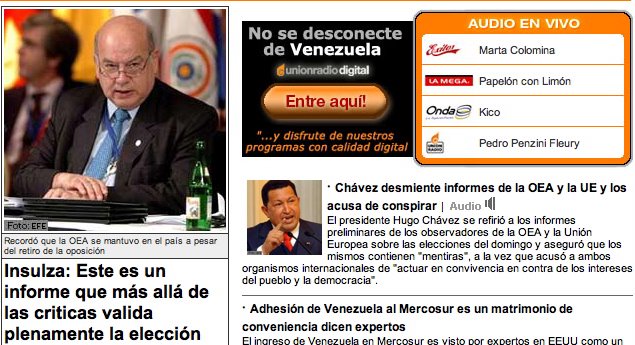
OAS Secretary General: The Election was fair!
Chavez: The guy is a liar and a conspirator!
oh brother...
...doesn't revolutionary discipline demand that we take our comandante at his word and conclude the election wasn't fair?!...digo yo...


Chavista Trade Policy: Something for nothing...
I can't say I really get it. Not two months ago Chavez was denouncing Mercosur as a "failed neoliberal experiment" and now we're about to join it. Though I know most of you don't believe it, I really am working on a PhD dissertation on trade policy in between breaks from blogging, so this is one issue I can claim expertise on.
Conventional economic theory tells us two basic things about what happens when you liberalize imports. First: the economy as a whole is made better off. Second, the gains are not evenly distributed. While everyone is made a little bit better off, some are made much worse off.
To see why, take a simple example. Say our farmers can produce corn for 100 per kilo. Foreign farmers can produce it for 95. When you liberalize imports, the price of corn to our consumers drops, so everyone is made a little bit better off. At the same time, our corn farmers suddenly find they can't compete, so they're wiped out of the market.
In the lingo, gains from import liberalization are diffuse, but costs are concentrated.
This explains why countries rarely liberalize unilaterally even if economic theory shows that the diffuse gains are bigger than the concentrated losses. Governments, in general, pay more attention to organized groups that mobilize to lobby for a given policy than they do to calculations of overall welfare or economics textbooks. Since each consumer is made only a little bit better off by import liberalization, consumers as a group find it difficult to organize themselves to petition the government for liberalization. But since producers stand to lose a lot, they have a much easier time banding together to lobby for protection.
Of course, that tells only half the story, because countries also have sectors that stand to gain from trade. If, say, our producers can make neckties for 95 a kilo, but it costs their producers 100 to produce that many neckties, our necktie producers obviously stand to gain a lot from access to their market. Liberalization would make neckties slightly more expensive in our country, but the costs to our necktie consumers are diffuse, while the gains to our necktie producers are concentrated. The equation is exactly reversed.
In that case, our necktie producers have every incentive to lobby our government for better access to their market. But when our government sits down to ask their government to open up their necktie market, it has to offer something in return. Since their corn producers are interested in better access to our corn market, there's a fairly obvious bargain to be struck: we'll liberalize our corn market if you'll liberalize your tie market. This, in extreme shorthand, is the reason trade negotiations happen.
The whole point of trade negotiations, then, is to overcome a problem of collective action by making sure someone in our country has a strong interest in seeing our own markets liberalized. If our government tries to liberalize corn unilaterally, corn farmers will work hard to block it, and there'll be no other group similarly organized to argue in favor of liberalization. By bargaining off access to our corn market against access to their tie market, trade negotiations set up a situation where our tie producers have a strong incentive to push our government to liberalize our corn market - as an indirect way of gaining access to their tie market. It's a pretty nifty trick.
This little framework is enough to explain why Chavez's decision to join Mercosur is puzzling to say the least. In effect, Venezuela will be opening up its market to Argentina and Brazil's world-beating agricultural producers. Not surprisingly, Venezuela's agricultural producers are none too happy about this. Venezuelan manufacturers are similarly freaked out. In exchange for their sacrifice, though, we'll get access to...um...to...what precisely? Venezuela's major export commodity is oil, but we already have free access to their energy markets! If there is some Venezuelan export sector chomping at the bit for better access to Southern Cone markets, I haven't heard about it. So, in effect, Chavez proposes to give them access to our farm market in exchange for...nothing!
It's true that there are a number of sectors where Venezuela has a potential comparative advantage, and joining mercosur provides new opportunities for those sectors. However, a pile of economic research - most of it from left-leaning academics - argues convincingly that better access to foreign markets is very rarely enough to turn potential comparative into actual export success. To do that, you need a whole raft of government measures - from R&D tax credits and export credit to specialized training institutes and improved property rights - to help boost domestic producers' competitiveness to the point where they actually can crack foreign markets. Needless to say, those supply-side policies are not in place in the Bolivarian revolution.
In practical terms from Venezuela's point of view, joining Mercosur is a lot like liberalizing our imports unilaterally. Now, there's an old and venerable economic argument in favor of unilateral liberalization. I'm not going to get into that debate here, but I will point out that it's an argument one associates more with Adam Smith, Milton Friedman and Jagdish Baghwati than with Ezequiel Zamora, Jorge Giordani, or Martha Harnecker. How, exactly, the decision to enter Mercosur fits in with Chavez's whole verbal diarrhea about food security, endogenous development, land reform, etc. etc. I haven't the slightest clue. It's more like neoliberalismo del siglo 21, really...
Conventional economic theory tells us two basic things about what happens when you liberalize imports. First: the economy as a whole is made better off. Second, the gains are not evenly distributed. While everyone is made a little bit better off, some are made much worse off.
To see why, take a simple example. Say our farmers can produce corn for 100 per kilo. Foreign farmers can produce it for 95. When you liberalize imports, the price of corn to our consumers drops, so everyone is made a little bit better off. At the same time, our corn farmers suddenly find they can't compete, so they're wiped out of the market.
In the lingo, gains from import liberalization are diffuse, but costs are concentrated.
This explains why countries rarely liberalize unilaterally even if economic theory shows that the diffuse gains are bigger than the concentrated losses. Governments, in general, pay more attention to organized groups that mobilize to lobby for a given policy than they do to calculations of overall welfare or economics textbooks. Since each consumer is made only a little bit better off by import liberalization, consumers as a group find it difficult to organize themselves to petition the government for liberalization. But since producers stand to lose a lot, they have a much easier time banding together to lobby for protection.
Of course, that tells only half the story, because countries also have sectors that stand to gain from trade. If, say, our producers can make neckties for 95 a kilo, but it costs their producers 100 to produce that many neckties, our necktie producers obviously stand to gain a lot from access to their market. Liberalization would make neckties slightly more expensive in our country, but the costs to our necktie consumers are diffuse, while the gains to our necktie producers are concentrated. The equation is exactly reversed.
In that case, our necktie producers have every incentive to lobby our government for better access to their market. But when our government sits down to ask their government to open up their necktie market, it has to offer something in return. Since their corn producers are interested in better access to our corn market, there's a fairly obvious bargain to be struck: we'll liberalize our corn market if you'll liberalize your tie market. This, in extreme shorthand, is the reason trade negotiations happen.
The whole point of trade negotiations, then, is to overcome a problem of collective action by making sure someone in our country has a strong interest in seeing our own markets liberalized. If our government tries to liberalize corn unilaterally, corn farmers will work hard to block it, and there'll be no other group similarly organized to argue in favor of liberalization. By bargaining off access to our corn market against access to their tie market, trade negotiations set up a situation where our tie producers have a strong incentive to push our government to liberalize our corn market - as an indirect way of gaining access to their tie market. It's a pretty nifty trick.
This little framework is enough to explain why Chavez's decision to join Mercosur is puzzling to say the least. In effect, Venezuela will be opening up its market to Argentina and Brazil's world-beating agricultural producers. Not surprisingly, Venezuela's agricultural producers are none too happy about this. Venezuelan manufacturers are similarly freaked out. In exchange for their sacrifice, though, we'll get access to...um...to...what precisely? Venezuela's major export commodity is oil, but we already have free access to their energy markets! If there is some Venezuelan export sector chomping at the bit for better access to Southern Cone markets, I haven't heard about it. So, in effect, Chavez proposes to give them access to our farm market in exchange for...nothing!
It's true that there are a number of sectors where Venezuela has a potential comparative advantage, and joining mercosur provides new opportunities for those sectors. However, a pile of economic research - most of it from left-leaning academics - argues convincingly that better access to foreign markets is very rarely enough to turn potential comparative into actual export success. To do that, you need a whole raft of government measures - from R&D tax credits and export credit to specialized training institutes and improved property rights - to help boost domestic producers' competitiveness to the point where they actually can crack foreign markets. Needless to say, those supply-side policies are not in place in the Bolivarian revolution.
In practical terms from Venezuela's point of view, joining Mercosur is a lot like liberalizing our imports unilaterally. Now, there's an old and venerable economic argument in favor of unilateral liberalization. I'm not going to get into that debate here, but I will point out that it's an argument one associates more with Adam Smith, Milton Friedman and Jagdish Baghwati than with Ezequiel Zamora, Jorge Giordani, or Martha Harnecker. How, exactly, the decision to enter Mercosur fits in with Chavez's whole verbal diarrhea about food security, endogenous development, land reform, etc. etc. I haven't the slightest clue. It's more like neoliberalismo del siglo 21, really...
December 8, 2005
That Useless Election for the Red Caudillo
By Guido Rampoldi in La Repubblica
Translated by me
This article caught my eye for several reasons. For one thing, it's rare to see foreign journalists grasp how hollow Chavez's claim to be leading a revolution really is, and Rampoldi is unsparing on that point. For another, it's always significant when a left-wing paper turns on Chavez, and this piece appeared in La Repubblica, which is sort of like the Italian version of The Guardian.
The hot gift in Caracas this Christmas is the chavito, an action figure depicting Hugo Chavez in his movement's red uniform. The buyers are both those who love the president, who buy it so their kids will also learn to love him, and those who hate him, who buy it perhaps to skewer it with needles. Saturday night, on the eve of the parliamentary election, an entertainer on State TV showed the cameras two chavitos, and said "tomorrow, you can vote either for this one or this one" to laughter from the chavista candidates around him. They chatted about the opposition - all of it "coup-mongering and fascist," and, why not, anti-patriotic - and later about the empire, imperialism, in short, the US, the opposition's alleged benefactors. Then we saw video links from various rallies, with fireworks, patriotic and revolutionary songs and people in red shirts chanting: fascists, golpistas, imperialists, enemies of the people. Finally Chavez himself turned up, reciting a poem along with a guitar player. Then it was back to the studio, and the chants again: fasicsts, golpistas, imperialists.
Seeing all this, just hours before the start of voting, you had the impression they had just defrosted that South American left that never learned anything from its own mistakes. Tenacious, unhinged, incorregible.
Add to that the fact that in Washington you have the Bush administration and that the Venezuelan opposition is remarkably dim, and it's not hard to imagine where the sum of so much ineptitude was going to lead: to the Nth disaster.
Sunday's parliamentary elections were certainly a step in that direction. The biggest Opposition parties decided to boycot them when they discovered the electronic voting system made it possible to identify voter's choices. But a technical compromise was possible, and the choice to abandon the elections was determined by fear. They were headed for a humiliating defeat, according both to the polls and to the state of mind of an antichavista electorate that believes neither in the deformed democracy you see on state-TV nor in an Opposition lacking a coherent identity.
So Chavez will no longer be restrained by parliament. Up to now, his partisans had enough votes to govern, but not to change the constitution. After Sunday, he'll be able to get his way on the most far-fetched of projects, even becoming president for life as one of his parliamentarians has proposed. Worse yet, with the Opposition absent from parliament, the country now lacks the only institution that might mediate the conflict between two Venezuelas unable to build a single national community and convinced that the other side is a tool of foreign interests: of Cuba, or of the United States.
When you ask the red shirts how Chavez's six years in power have changed their lives, they speak first of Mercal. These are stores in poor neighborhoods where anyone can buy, at political prices, food imported by the government...with the following results: the poor finally eat top grade Argentine and Uruguayan beef, the rich pay half as much as they used to (since access to Mercal is open to all), and Venezuelan ranchers are in crisis.
In the ranking of gratitudes, after Mercal you hear about health care, which has been overhauled thanks to a massive influx of Cuban doctors, and later about schools where adults learn to read and write or get training for a job. Moreover, Chavez has given a small push to programs for refurbishing poor neighborhoods - which, however, were started decades earlier - and has restarted land reform, though not truly aggressively.
According to the propaganda, this would amount to Bolivarian Socialism, a new, revolutionary economic model. But if that's case, we would also have to consider Italy's Christian Democrats to be Bolivarian Socialists, for everything they did in the 20 years after the war, and using the same method as Chavez: privileging first and foremost their own electorate.
The fact is that it's easy to be bolivarian towards your own supporters when you govern the world's fifth oil exporter at a time when oil is above $50 a barrel. Probably, the old social democrats and christian democrats who used to rule the country would have been just as generous: the crisis that brought them down reached its peak in the late 90s, when oil sunk to $9 per barrel.
What would have made a real difference would have been deep structural reforms, especially in the public administration. Yet even chavistas admit that the public administration has not changed.
For instance, those sections of the police widely feared for their rapacity and violence. Hundreds of complaints accuse them of fighting crime with torture and premeditated murders.
This happened in the past also. But today, the atmosphere is even more favorable to such abuses. After all, a former member of the Caracas police special forces - in fact, death squads - is a chavista mayor of a part of Caracas and uses "we will take back the city" as a slogan - you can read it painted on walls just steps from the presidential palace.
The opposition didn't much care about this variable-geometry legality until it realized it was tremendously exposed. The chavistas have taken control of the Supreme Court boosting its membership from 20 to 32, and the chief judge qualifies as "revolutionary" the justice it imparts. The number of judges with temporary appointments has grown to a full 75% of the total, keeping them nice and tame.
Made public by a pro-government web site, the list of the 3 and a half million Venezuelans who signed the petitions for a referendum against Chavez has become a tool of political discriminition in the hands of the public administration. Through new laws, they've tamed the fury of the private TV stations, which until two years ago were arguably even worse than state TV, but are now either circumspect or indifferent (because they risk hyperbolic fines and shut downs.) They've also aimed straight at the journalists: they risk 30 month jail sentences if they criticize too strongly even a National Assembly member or a general, up to five years if they publish news that "disturb public order." In the new Penal Code, blocking a street can land you in jail from 4 to 8 years, and according to the Supreme Tribunal there is nothing illegal about prior censorship.
Until now, the government has resorted these pointed weapons only rarely.
But when the time comes, they'll be ready. In October, the Bush administration added Venezuela to the list of five enemies of the United States, even if it's on the third tier. In response, Chavez ordered his armed forces to prepare for "asymetrical warfare", to be taken to the enemy through "non-conventional tactics, such as guerrillas and terrorism." Whether or not he really believes in the prospect of a power play by Washington, trumpeting the possibility is extremely useful as a way to keep his country underfoot, and, in a few years time, to launch a more explicit authoritarianism: if the nation is under attack, who could protest if the president arrests the traitors, crushing the enemy's fifth column?
Translated by me
This article caught my eye for several reasons. For one thing, it's rare to see foreign journalists grasp how hollow Chavez's claim to be leading a revolution really is, and Rampoldi is unsparing on that point. For another, it's always significant when a left-wing paper turns on Chavez, and this piece appeared in La Repubblica, which is sort of like the Italian version of The Guardian.
The hot gift in Caracas this Christmas is the chavito, an action figure depicting Hugo Chavez in his movement's red uniform. The buyers are both those who love the president, who buy it so their kids will also learn to love him, and those who hate him, who buy it perhaps to skewer it with needles. Saturday night, on the eve of the parliamentary election, an entertainer on State TV showed the cameras two chavitos, and said "tomorrow, you can vote either for this one or this one" to laughter from the chavista candidates around him. They chatted about the opposition - all of it "coup-mongering and fascist," and, why not, anti-patriotic - and later about the empire, imperialism, in short, the US, the opposition's alleged benefactors. Then we saw video links from various rallies, with fireworks, patriotic and revolutionary songs and people in red shirts chanting: fascists, golpistas, imperialists, enemies of the people. Finally Chavez himself turned up, reciting a poem along with a guitar player. Then it was back to the studio, and the chants again: fasicsts, golpistas, imperialists.
Seeing all this, just hours before the start of voting, you had the impression they had just defrosted that South American left that never learned anything from its own mistakes. Tenacious, unhinged, incorregible.
Add to that the fact that in Washington you have the Bush administration and that the Venezuelan opposition is remarkably dim, and it's not hard to imagine where the sum of so much ineptitude was going to lead: to the Nth disaster.
Sunday's parliamentary elections were certainly a step in that direction. The biggest Opposition parties decided to boycot them when they discovered the electronic voting system made it possible to identify voter's choices. But a technical compromise was possible, and the choice to abandon the elections was determined by fear. They were headed for a humiliating defeat, according both to the polls and to the state of mind of an antichavista electorate that believes neither in the deformed democracy you see on state-TV nor in an Opposition lacking a coherent identity.
So Chavez will no longer be restrained by parliament. Up to now, his partisans had enough votes to govern, but not to change the constitution. After Sunday, he'll be able to get his way on the most far-fetched of projects, even becoming president for life as one of his parliamentarians has proposed. Worse yet, with the Opposition absent from parliament, the country now lacks the only institution that might mediate the conflict between two Venezuelas unable to build a single national community and convinced that the other side is a tool of foreign interests: of Cuba, or of the United States.
When you ask the red shirts how Chavez's six years in power have changed their lives, they speak first of Mercal. These are stores in poor neighborhoods where anyone can buy, at political prices, food imported by the government...with the following results: the poor finally eat top grade Argentine and Uruguayan beef, the rich pay half as much as they used to (since access to Mercal is open to all), and Venezuelan ranchers are in crisis.
In the ranking of gratitudes, after Mercal you hear about health care, which has been overhauled thanks to a massive influx of Cuban doctors, and later about schools where adults learn to read and write or get training for a job. Moreover, Chavez has given a small push to programs for refurbishing poor neighborhoods - which, however, were started decades earlier - and has restarted land reform, though not truly aggressively.
According to the propaganda, this would amount to Bolivarian Socialism, a new, revolutionary economic model. But if that's case, we would also have to consider Italy's Christian Democrats to be Bolivarian Socialists, for everything they did in the 20 years after the war, and using the same method as Chavez: privileging first and foremost their own electorate.
The fact is that it's easy to be bolivarian towards your own supporters when you govern the world's fifth oil exporter at a time when oil is above $50 a barrel. Probably, the old social democrats and christian democrats who used to rule the country would have been just as generous: the crisis that brought them down reached its peak in the late 90s, when oil sunk to $9 per barrel.
What would have made a real difference would have been deep structural reforms, especially in the public administration. Yet even chavistas admit that the public administration has not changed.
For instance, those sections of the police widely feared for their rapacity and violence. Hundreds of complaints accuse them of fighting crime with torture and premeditated murders.
This happened in the past also. But today, the atmosphere is even more favorable to such abuses. After all, a former member of the Caracas police special forces - in fact, death squads - is a chavista mayor of a part of Caracas and uses "we will take back the city" as a slogan - you can read it painted on walls just steps from the presidential palace.
The opposition didn't much care about this variable-geometry legality until it realized it was tremendously exposed. The chavistas have taken control of the Supreme Court boosting its membership from 20 to 32, and the chief judge qualifies as "revolutionary" the justice it imparts. The number of judges with temporary appointments has grown to a full 75% of the total, keeping them nice and tame.
Made public by a pro-government web site, the list of the 3 and a half million Venezuelans who signed the petitions for a referendum against Chavez has become a tool of political discriminition in the hands of the public administration. Through new laws, they've tamed the fury of the private TV stations, which until two years ago were arguably even worse than state TV, but are now either circumspect or indifferent (because they risk hyperbolic fines and shut downs.) They've also aimed straight at the journalists: they risk 30 month jail sentences if they criticize too strongly even a National Assembly member or a general, up to five years if they publish news that "disturb public order." In the new Penal Code, blocking a street can land you in jail from 4 to 8 years, and according to the Supreme Tribunal there is nothing illegal about prior censorship.
Until now, the government has resorted these pointed weapons only rarely.
But when the time comes, they'll be ready. In October, the Bush administration added Venezuela to the list of five enemies of the United States, even if it's on the third tier. In response, Chavez ordered his armed forces to prepare for "asymetrical warfare", to be taken to the enemy through "non-conventional tactics, such as guerrillas and terrorism." Whether or not he really believes in the prospect of a power play by Washington, trumpeting the possibility is extremely useful as a way to keep his country underfoot, and, in a few years time, to launch a more explicit authoritarianism: if the nation is under attack, who could protest if the president arrests the traitors, crushing the enemy's fifth column?
December 7, 2005
The EU Electoral Observation Mission's Preliminary Report
is here.
Key Findings:
Wide sectors of the Venezuelan society do not have trust in the electoral process and in the independence of the electoral authority.
The legal framework contains several inconsistencies that leave room for differing and contradictory interpretations.
The disclosure of a computerized list of citizens indicating their political preference in the signature recollection process for the Presidential Recall Referendum (so-called “Maisanta Program”) generates fear that the secrecy of the vote could be violated.
The CNE, in a positive attempt to restore confidence in the electoral process, took significant steps to open the automated voting system to external scrutiny and to modify various aspects that were questioned by the opposition.
The CNE decision to eliminate the fingerprint capturing devices from the voting process was timely, effective and constructive.
The electoral campaign focused almost exclusively on the issue of distrust in the electoral process and lack of independence of the CNE. The debate on political party platforms was absent.
Both State and private media monitored showed bias towards either of the two main political blocks.
The EU EOM took note with surprise of the withdrawal of the majority of the opposition parties only four days before the electoral event.
Election Day passed peacefully with a low turnout. While the observers noted several irregularities in the voting procedures, the manual audit of the voting receipts revealed a high reliability of the voting machines.
These elections did not contribute to the reduction of the fracture in the Venezuelan society. In this sense, they represented a lost opportunity.
This bit, in the inside pages, is just priceless:
Key Findings:
This bit, in the inside pages, is just priceless:
The use of the electoral technique known as Morochas, which allows the duplication of parties in order to avoid the subtraction of the seats gained in the plurality-majority list from the proportional list, certainly defies the spirit of the Constitution, but it is technically allowed by the mixed system of representation laid out in the Basic Law of Suffrage and Political Participation.So the morochas are legal but unconstitutional...WTF!?!??
JVR's Election
Another one for the Chavez-as-Pinky, JVR-as-The-Brain archive, this time from Phil Gunson's piece in the Miami Herald:
At times I really get the sense we underestimate JVR's role in Chavez's success. The guy is brutal but incredibly effective. The events of the last two weeks can be seen as a kind of monument to José Simiente's political instincts. Nobody on our side is anywhere near as macchiavelian or effective...
Western diplomats in Caracas meanwhile criticized what they said were last-minute changes to soften the wording of the OAS report -- and alleged that the changes were made under strong pressure from the Venezuelan government.
The Herald was told by diplomats from both EU and OAS member states that OAS observer mission chief Rubén Perina received calls from Venezuelan Vice President José Vicente Rangel and electoral council chairman Jorge Rodríguez after the draft report had already been prepared.
The OAS had planned to present its report at a news conference early Tuesday. But it canceled the conference at the last minute and the report was distributed on the Internet.
At times I really get the sense we underestimate JVR's role in Chavez's success. The guy is brutal but incredibly effective. The events of the last two weeks can be seen as a kind of monument to José Simiente's political instincts. Nobody on our side is anywhere near as macchiavelian or effective...
December 6, 2005
More on Dec. 4th as seen from abroad...
As we await the International Observers' preliminary reports on the December 4th vote (due out this afternoon), we can chew on some of the foreign media coverage of the election.
There's finally a bit of comfort for the opposition in this understatedly scathing article by Andy Webb-Vidal in the Financial Times:
But the extremely influential and unmistakably antichavista Economist runs a lead paragraph straight out of Jose Vicente Rangel's wet dreams
Meanwhile, Spain's El Pais runs a tough editorial criticizing the opposition withdrawal, but also blasting Chavez's antidemocratic tendencies. Opening graf:
There's finally a bit of comfort for the opposition in this understatedly scathing article by Andy Webb-Vidal in the Financial Times:
Hugo Chávez, Venezuela’s president, on Monday awoke to hear the type of election result usually reserved for the most power-hungry of dictators: 100 per cent of the seats.
The unofficial result, from polls held on Sunday to select the composition of the single-chamber legislature, signals a victory of sorts for the militaristic, left-leaning ruler of the world’s fifth-largest oil exporter.
But critics said it was a hollow victory that left Venezuela in a twilight zone between democracy and dictatorship - and a result that would catapult the country towards Mr Chávez’s model of “21st century socialism”.
Preliminary results from the National Electoral Council (CNE), which on Monday was still calculating the final tally, showed that only 25 per cent of eligible voters cast ballots in polls boycotted by opponents. A fifth of ballots cast were blank.
But the extremely influential and unmistakably antichavista Economist runs a lead paragraph straight out of Jose Vicente Rangel's wet dreams
A FREE and fair election in which the president’s supporters win all of the seats in the legislature? It sounds more like the kind of contest Saddam Hussein used to “win” in Iraq with 99% of the vote. But on Sunday December 4th, the party of Venezuela’s president, Hugo Chávez, and groups close to him seem to have done just that, after all but one of the opposition parties pulled out of the election. Mr Chávez’s Fifth Republic Movement (MVR) won 114 seats out of 167. Allied parties took the rest.
Meanwhile, Spain's El Pais runs a tough editorial criticizing the opposition withdrawal, but also blasting Chavez's antidemocratic tendencies. Opening graf:
The Venezuelan Opposition has made a mistake in boycotting Sunday's legislative elections, overwhelmingly won by partisans of president Hugo Chavez. The formidable abstention, at 75%, undoubtedly undermines the representative nature of the new, monochrome National Assembly, but it does not invalidate its decisions. The basic result of the vote is that the opposition has ceased to exist in politically organized form. The parties opposed to Chavez - promised an unmitigated defeat by the polls - have taken cover behind the scarce credibility of the voting procedure and the unmistakable pro-government bias of the electoral authorities to justify their boycott. As we await preliminary reports from the international observers, nothing right now suggests serious irregularities.
Opinion Duel: Day Two
Well, Alek was pretty unsparing in his first post, so I went ahead and responded pretty strongly.
Though, we obviously don't agree on much, I've always appreciated Alek's willingness to engage in proper debate. We'll see what he writes back...
Though, we obviously don't agree on much, I've always appreciated Alek's willingness to engage in proper debate. We'll see what he writes back...
December 5, 2005
Second Venezuela Opinion Duel: Alek Boyd thinks I've lost my marbles
Well, the Second Venezuela Opinion Duel is under way. Alek Boyd sent his opening salvo a while back, but I hadn't responded pending the election.
I'm writing a reply now, I'll post it tomorrow.
I'm writing a reply now, I'll post it tomorrow.
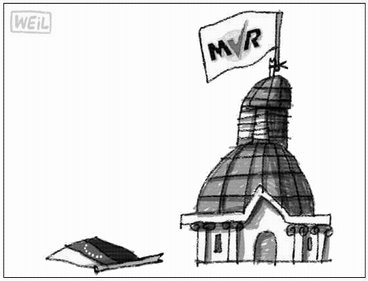
Euphoria Unhinged
I'm not just trying to bolster my credentials as official Party Poop here, but the euphoria over at Daniel and Miguel's blogs, as well as other Oppo cyberspace hangouts, strikes me as really really bizarre. Maybe it's because I'm not in Caracas - or maybe it's because it's easier to keep perspective from a distance - but I can't for the life of me figure out what the Oppo has to celebrate.
First off, suggesting that 75% abstention means 75% of the voters support the Opposition is deeply, deeply silly. In the 2000 parliamentary elections - which would tend to have higher turnout anyway, because you were electing a president as well - abstention was 44%. Out of the 56% that did vote, a little over half voted for Chavez. Say 30% of the overall electorate.
So, frankly, I don't see how 25% turnout is a terrible result for the government. Of course, we can't be sure that figure wasn't "massaged" - because CNE steadfastly refused to hand-count all the ballots as Article 172 of LOSPP mandates. But assuming provisionally that that's the right figure, it's just a 5 percentage point drop from 2000. Actually, I'd say the government did pretty well to motivate that many people to vote, considering there was no real contest, and no presidential vote.
First off, suggesting that 75% abstention means 75% of the voters support the Opposition is deeply, deeply silly. In the 2000 parliamentary elections - which would tend to have higher turnout anyway, because you were electing a president as well - abstention was 44%. Out of the 56% that did vote, a little over half voted for Chavez. Say 30% of the overall electorate.
So, frankly, I don't see how 25% turnout is a terrible result for the government. Of course, we can't be sure that figure wasn't "massaged" - because CNE steadfastly refused to hand-count all the ballots as Article 172 of LOSPP mandates. But assuming provisionally that that's the right figure, it's just a 5 percentage point drop from 2000. Actually, I'd say the government did pretty well to motivate that many people to vote, considering there was no real contest, and no presidential vote.
The Day After
If you were hoping that high abstention would "delegitimate" the government internationally, today's foreign newspapers make for some depressing reading. Chavismo's lead in the polls is the key reason cited for the Opposition pullout. The general consensus is that, faced with the prospect of humiliating defeat, the Opposition withdrew in a childish hissy-fit. Our concerns about CNE partiality, illegality, etc. etc. are given passing mention in articles focusing on the Oppo harakiri. Whether professional diplomats and others paid to track these things more closely will come away with a different perception is an open question - but hyperbolic Oppo predictions that "the world will have to open its eyes to the real nature of the regime" will have been sorely disappointed.
This is really not so surprising, considering the polling context. Choosing to abstain when you're ahead sends a strong signal to the world - just ask Alejandro Toledo. But choosing to abstain when you're getting clocked in the polls looks far too much like the weasel way out of a bind. This may be unfair - anyone following Venezuelan politics closely over the last few years knows exactly how opaque and partisan CNE has been - but then, politics is about effectiveness, not fairness. The opposition would understand this if it wasn't so obdurate about swallowing its own hype.
Just to be clear, I don't mean to criticize the Opposition's decision to abstain - a decision I share. But I do mean to bring a level of sanity to the overblown expectations some had harbored that abstaining would somehow radically overhaul international perceptions of the Chavez government. Sumate's line, that December 4th marks a critical inflection point in Venezuelan history, seems aggressively optimistic to me. The only real difference, as far as I can tell, is that chavismo will no longer need to amend the National Assembly rules of order every two weeks to do exactly what it wants.
If anything, overall international perceptions hardened yesterday. Setting aside the right and left-wing fringes - and lets face it: Carlos Alberto Montaner and Thor Halvorssen aren't really any more influential than Ignacio Ramonet and Larry Birns - the way the world perceives the political dynamic in Venezuela is that we have a charismatic (if erratic and authoritarian) leftist in power facing a comically immature, by-and-large reactionary Opposition with a tin-ear for politics and a purely defensive stance. Nothing the world saw yesterday goes against the grain of this conventional wisdom.
That's the bed the Opposition leadership made for us, and now we get to lie in it.
Fact is, there are no shortcuts. There is no way to change foreign perceptions until we start winning the political argument in Venezuela. I think this can be done. There are plenty of chavista weaknesses a smart, disciplined, optimistic, forward-looking, savvy opposition could exploit. Chavez may be popular, but his government isn't. Even in the middle of an oil boom, polls show high levels of dissatisfaction with its performance. Chavistas resent its corruption as much as we do, or more. The internal contradictions in the Chavez organization have been simmering for years, and are bound to boil over sooner or later. Popular enthusiasm for the project can't be sustained beyond sporadic spending sprees. People want an alternative.
Those of us who reject Chavez have a year to build that alternative. Now that the Oppo old guard has purged itself from parliament, we have a unique chance to do so freed from the dead-weight of Fourth Republic associations. Vamos a dale...
This is really not so surprising, considering the polling context. Choosing to abstain when you're ahead sends a strong signal to the world - just ask Alejandro Toledo. But choosing to abstain when you're getting clocked in the polls looks far too much like the weasel way out of a bind. This may be unfair - anyone following Venezuelan politics closely over the last few years knows exactly how opaque and partisan CNE has been - but then, politics is about effectiveness, not fairness. The opposition would understand this if it wasn't so obdurate about swallowing its own hype.
Just to be clear, I don't mean to criticize the Opposition's decision to abstain - a decision I share. But I do mean to bring a level of sanity to the overblown expectations some had harbored that abstaining would somehow radically overhaul international perceptions of the Chavez government. Sumate's line, that December 4th marks a critical inflection point in Venezuelan history, seems aggressively optimistic to me. The only real difference, as far as I can tell, is that chavismo will no longer need to amend the National Assembly rules of order every two weeks to do exactly what it wants.
If anything, overall international perceptions hardened yesterday. Setting aside the right and left-wing fringes - and lets face it: Carlos Alberto Montaner and Thor Halvorssen aren't really any more influential than Ignacio Ramonet and Larry Birns - the way the world perceives the political dynamic in Venezuela is that we have a charismatic (if erratic and authoritarian) leftist in power facing a comically immature, by-and-large reactionary Opposition with a tin-ear for politics and a purely defensive stance. Nothing the world saw yesterday goes against the grain of this conventional wisdom.
That's the bed the Opposition leadership made for us, and now we get to lie in it.
Fact is, there are no shortcuts. There is no way to change foreign perceptions until we start winning the political argument in Venezuela. I think this can be done. There are plenty of chavista weaknesses a smart, disciplined, optimistic, forward-looking, savvy opposition could exploit. Chavez may be popular, but his government isn't. Even in the middle of an oil boom, polls show high levels of dissatisfaction with its performance. Chavistas resent its corruption as much as we do, or more. The internal contradictions in the Chavez organization have been simmering for years, and are bound to boil over sooner or later. Popular enthusiasm for the project can't be sustained beyond sporadic spending sprees. People want an alternative.
Those of us who reject Chavez have a year to build that alternative. Now that the Oppo old guard has purged itself from parliament, we have a unique chance to do so freed from the dead-weight of Fourth Republic associations. Vamos a dale...
December 2, 2005
December 1, 2005
The Mariches Effect
by Diego Bautista Urbaneja
translated by me
It's as though a fragile equilibrium was broken. Until last Friday, the arguments for and against voting on December 4th just about balanced each other off. Some were going to vote and some were going to abstain. I don't know in what proportion. What's for sure is that the government was on the brink of achieving its goal, that is, for not everyone to vote and not everyone to abstain. That way, they would win without having to steal the election, with manageable turnout figures that could, if needed, be manipulated. CNE was ladeling out "concessions" to the opposition adequately, alongside arbitary moves and causes for mistrust, keeping the oppoosition split and allowing the government to achieve its goal without real problems. What was going to happen was not, incidentally, anyone's fault, it was just a function of the way that various opposition groups debated with one another about how they should react faced with parliamentary elections under the conditions created by CNE.
MARICHES. That "equilibrium" was broken in the now famous voting simulation in Fila de Mariches, where it was shown that the voting machines do store the sequence of votes allowing CNE to infer how each person voted, and violating the principle of the secret vote. This created a new situation.
The doubts, which for part of the electorate had been subsiding through the improved conditions that had been "achieved" (we need to keep this kind of question between quotation marks) and the arguments in favor of voting, shot up virulently. The balance of positions we talked about went up in smoke, and a psychological avalanche was unleashed in favor of abstentionism.
After Mariches, it was no longer possible to ask the voter to go to the polls, unless new conditions were met by CNE. The opposition had to ask for changes in electoral conditions, and it was in a strong position to do so.
CNE's decision to do away with the finger-print scanners, which re-established the secrecy of the vote, could have meant a significant increase in the credibility of elections. It could have translated into an unexpected increase in the number of voters.
CNE's strategy might have been broken in one of two ways: through mass abstention or mass voting. What happened in Mariches opened the doors to the first of these scenarios, a price CNE could not afford to pay. This is why they did away with the finger-print scanners. But they stopped there, making it their final "concession", to see if they could keep the opposition divided. And indeed, limited though it was, doing away with the finger-print scanners might have opened the doors to the other option: mass voting.
But it didn't work out that way. Right now, CNE is paying the price for its cynicism. Many will feel emotionally satisfied. They will feel that, for once, CNE didn't get away with it, though we do not know the price we shall have to pay for it.
But we made the wrong move. The right move would have been to take advantage of the withdrawal of the finger-print scanners to call for mass voting, breaking the government's divisionist strategy, and forcing it to either lose or try to steal the election. This didn't happen. On Monday the fifth we'll have to face the results of what we've done.
translated by me
It's as though a fragile equilibrium was broken. Until last Friday, the arguments for and against voting on December 4th just about balanced each other off. Some were going to vote and some were going to abstain. I don't know in what proportion. What's for sure is that the government was on the brink of achieving its goal, that is, for not everyone to vote and not everyone to abstain. That way, they would win without having to steal the election, with manageable turnout figures that could, if needed, be manipulated. CNE was ladeling out "concessions" to the opposition adequately, alongside arbitary moves and causes for mistrust, keeping the oppoosition split and allowing the government to achieve its goal without real problems. What was going to happen was not, incidentally, anyone's fault, it was just a function of the way that various opposition groups debated with one another about how they should react faced with parliamentary elections under the conditions created by CNE.
MARICHES. That "equilibrium" was broken in the now famous voting simulation in Fila de Mariches, where it was shown that the voting machines do store the sequence of votes allowing CNE to infer how each person voted, and violating the principle of the secret vote. This created a new situation.
The doubts, which for part of the electorate had been subsiding through the improved conditions that had been "achieved" (we need to keep this kind of question between quotation marks) and the arguments in favor of voting, shot up virulently. The balance of positions we talked about went up in smoke, and a psychological avalanche was unleashed in favor of abstentionism.
After Mariches, it was no longer possible to ask the voter to go to the polls, unless new conditions were met by CNE. The opposition had to ask for changes in electoral conditions, and it was in a strong position to do so.
CNE's decision to do away with the finger-print scanners, which re-established the secrecy of the vote, could have meant a significant increase in the credibility of elections. It could have translated into an unexpected increase in the number of voters.
CNE's strategy might have been broken in one of two ways: through mass abstention or mass voting. What happened in Mariches opened the doors to the first of these scenarios, a price CNE could not afford to pay. This is why they did away with the finger-print scanners. But they stopped there, making it their final "concession", to see if they could keep the opposition divided. And indeed, limited though it was, doing away with the finger-print scanners might have opened the doors to the other option: mass voting.
But it didn't work out that way. Right now, CNE is paying the price for its cynicism. Many will feel emotionally satisfied. They will feel that, for once, CNE didn't get away with it, though we do not know the price we shall have to pay for it.
But we made the wrong move. The right move would have been to take advantage of the withdrawal of the finger-print scanners to call for mass voting, breaking the government's divisionist strategy, and forcing it to either lose or try to steal the election. This didn't happen. On Monday the fifth we'll have to face the results of what we've done.
¿Qué está pasando, Dios mio?
With Primero Justicia's decision to pull out of Sunday's vote, four out of the six main Opposition parties are out of the race. MAS appears split, its leadership's ability to persuade anyone to vote is questionable. Only Un Nuevo Tiempo, the Zulia-state regional party and Governor Manuel Rosales' personal vehicle is still clearly in.
The political parties' leadership has been typically incoherent on this whole affair. First, they spent a year and a half convincing their supporters CNE had cheated and couldn't be trusted. Absurdly, they decided to take part in the parliamentary elections anyway. But since they'd already convinced their followers CNE would cheat, they unsurprisingly found it impossible to enthuse them about voting. In the end, they were forced to reverse their position at the last minute to avoid a humiliating defeat. You can call it "responding to the grassroots" if you want - but if the government exploits it shrewdly (which they will) the pervasive distrust in Jorge Rodriguez's CNE could demobilize the opposition for years to come.
One big question is how this will all play out in next year's presidential election. Having pulled out this time, the Oppo parties can hardly participate next year unless conditions improve considerably. But then, think how easy that makes it for CNE to allow Chavez to run virtually unopposed. Just refuse to go any further to meet opposition concerns than you went this time and...ta-da!
I have a feeling that's what's behind Teodoro Petkoff's highly critical stance against the Oppo parties' decision to pull out. How on earth will they mobilize their supporters next year having set this precedent? It's not clear to me at all - and it does look like yet another case of the Opposition planning for the next 24 hours while chavismo plans for the next 24 years.
One pedestrian reality - nearly forgotten amid the hubbub - is that we now face five years of a National Assembly made up exclusively of chavista psychophants. That's not a good prospect any way you slice it: God only knows what they'll think up.
Another almost-forgotten historic milestone is that, for the first time since Pérez Jiménez, Venezuela will have a parliament with no adecos and no copeyanos. AD and Copei will now have to spend their time outside of the National Assembly, and the experience might just imaginably push them to do some serious work on reconfiguring, reforming, and repositioning themselves for a vastly changed political reality - a task they have really put off for way too long. If they fail to do that - and lets face it, they probably won't manage it - they'll probably disappear...which wouldn't be such a bad thing, if you ask me...
Shut out of parliament, all the Opposition parties will finally get a chance to devote themselves entirely to reconnecting with a country they've been badly out of step with for years. Who knows, if they can withstand the growth of chavista authoritarianism sure to go hand-in-hand with an all-chavista A.N., it might even do them some good.
The political parties' leadership has been typically incoherent on this whole affair. First, they spent a year and a half convincing their supporters CNE had cheated and couldn't be trusted. Absurdly, they decided to take part in the parliamentary elections anyway. But since they'd already convinced their followers CNE would cheat, they unsurprisingly found it impossible to enthuse them about voting. In the end, they were forced to reverse their position at the last minute to avoid a humiliating defeat. You can call it "responding to the grassroots" if you want - but if the government exploits it shrewdly (which they will) the pervasive distrust in Jorge Rodriguez's CNE could demobilize the opposition for years to come.
One big question is how this will all play out in next year's presidential election. Having pulled out this time, the Oppo parties can hardly participate next year unless conditions improve considerably. But then, think how easy that makes it for CNE to allow Chavez to run virtually unopposed. Just refuse to go any further to meet opposition concerns than you went this time and...ta-da!
I have a feeling that's what's behind Teodoro Petkoff's highly critical stance against the Oppo parties' decision to pull out. How on earth will they mobilize their supporters next year having set this precedent? It's not clear to me at all - and it does look like yet another case of the Opposition planning for the next 24 hours while chavismo plans for the next 24 years.
One pedestrian reality - nearly forgotten amid the hubbub - is that we now face five years of a National Assembly made up exclusively of chavista psychophants. That's not a good prospect any way you slice it: God only knows what they'll think up.
Another almost-forgotten historic milestone is that, for the first time since Pérez Jiménez, Venezuela will have a parliament with no adecos and no copeyanos. AD and Copei will now have to spend their time outside of the National Assembly, and the experience might just imaginably push them to do some serious work on reconfiguring, reforming, and repositioning themselves for a vastly changed political reality - a task they have really put off for way too long. If they fail to do that - and lets face it, they probably won't manage it - they'll probably disappear...which wouldn't be such a bad thing, if you ask me...
Shut out of parliament, all the Opposition parties will finally get a chance to devote themselves entirely to reconnecting with a country they've been badly out of step with for years. Who knows, if they can withstand the growth of chavista authoritarianism sure to go hand-in-hand with an all-chavista A.N., it might even do them some good.
November 30, 2005
CNE? The government? Same difference...
One last one for today: The idea of postponing the election has been ruled out.
Who announced this transcendent decision, you ask? Vicepresident José Vicente Rangel!
Just minutes after Rangel spoke to journalists, CNE head Jorge Rodriguez was on the air ratifying his boss's decision...
Han llegado al colmo del descaro de poner a JVR a anunciar las decisiones del CNE...y después dicen que es invento que el CNE y el gobierno son la misma vaina...
(Sorry, but some things I can only express in Spanish!)
Who announced this transcendent decision, you ask? Vicepresident José Vicente Rangel!
Just minutes after Rangel spoke to journalists, CNE head Jorge Rodriguez was on the air ratifying his boss's decision...
Han llegado al colmo del descaro de poner a JVR a anunciar las decisiones del CNE...y después dicen que es invento que el CNE y el gobierno son la misma vaina...
(Sorry, but some things I can only express in Spanish!)
Hinterlaces Sez:
According to the latest Hinterlaces poll, carried out before this week's pullout by AD, Copei and Proyecto Venezuela, 71% of voters were planning not to vote on December 4th, 9 percentage points higher than in their previous poll.
Other results:
75% have little or no confidence in CNE's impartiality.
70% believe hand-counting votes is a more transparent system than automated tallying.
43% back Chavez, but only 13% are "militant chavistas."
Other results:
USA ex machina
The fidelista playbook in action: Alí Rodríguez blames the US for the opposition parties' withdrawal. See? Everything bad that happens in Venezuela is the gringos' fault...
And another one...
For those who doubt that it's viable to cheat by manipulating the Electoral Registry, it turns out that Giovanni/Geovanny/Jovany José Vásquez, the Colombian alleged paramilitary/psychiatrist and key witness in the Danilo Anderson murder case, is registered to vote in Venezuela, and actually did vote on the Recall Referendum last year, according to the government's Lista Maisanta.
Making Sense of the Oppo Parties' Withdrawal
Over at Devil's Excrement, Miguel writes a very lucid post explaining the Opposition parties' decision to withdraw from the December 4th vote. (Note that Miguel, for reasons he has explained carefully, thinks conditions were safe enough to vote.) I'll sum up the best parts of his piece:
It reminds me of that one bit in Bill Cosby, Himself. Cosby walks into his kitchen and catches his four year old daughter clambering up the kitchen cupboard to get a (forbidden) cookie. By the time she notices him, her hand is literally in the cookie-jar. Without missing a beat, in her sweetest little voice, she looks up and says "I was getting a cookie for you!"
Nothing is quite so infuriating as catching someone in the act and still hearing them deny the obvious. After the Fila de Mariches debacle, the Opposition expected some sign of contrition from a Jorge Rodriguez very evidently caught in a long-running lie - preferably his resignation, but at the very least an apology.
Instead, the overall dynamic went something like this:
Whether anger at all this is a good reason to withdraw from the vote is up for debate...but it's certainly an understandable reason.
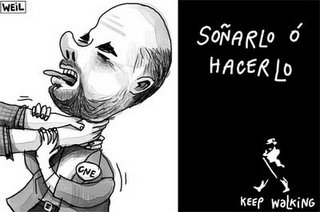
The inimitable Weil
In the meantime, Sumate issued a tough statement. Key bits:
Imagine you have been involved in some tough political negotiations. For the last year and half (and three elections) you have seen hundreds of millions of dollars spent on voting technology you disagree with, but you've come to believe a few things about it. One thing you believe, because you have been told with a straight face, time and time again, is that it is impossible to know how people voted. Then the following things happen:
1) A group of technical people tell you that this is not the case. The sequence of votes is easily known by inspecting the hard drive. They not only tell you, but proceed to show it and prove it in front of the international observers and the CNE.
You bring this up and the reaction from CNE head Jorge Rodriguez is: Impossible! Smartmatic, my people, my technical people, have all told me this is simply not possible. This is simply an attack on the CNE, you people are trying to boycott the whole process.
2) Another meeting is held with the head of the CNE, showing him the evidence that the sequence can indeed be known. On the advice of his technical people he offers to erase the hard dives within 72 hours of the vote removing all evidence and traces of it.
You go back to your technical people and they laugh at you.
3) At this point Rodriguez offers to disconnect the machines, which certainly does not seem to help much, since even if they are disconnected they keep the sequence which can be used later to know the votes.
4) Finally you get him to accept the removal of the fingerprint machines. This eliminates the problem unless they somehow manage to keep a precise record of the order in which people vote in 27,000 voting centers. This seems acceptable, until the annoncement is made publicly and Rodriguez says this is simply a concession to lower abstention and threatens that even if they are being graciously removed in this election, they will be there a year from now for the 2006 Presidential election.
How would you feel?
It reminds me of that one bit in Bill Cosby, Himself. Cosby walks into his kitchen and catches his four year old daughter clambering up the kitchen cupboard to get a (forbidden) cookie. By the time she notices him, her hand is literally in the cookie-jar. Without missing a beat, in her sweetest little voice, she looks up and says "I was getting a cookie for you!"
Nothing is quite so infuriating as catching someone in the act and still hearing them deny the obvious. After the Fila de Mariches debacle, the Opposition expected some sign of contrition from a Jorge Rodriguez very evidently caught in a long-running lie - preferably his resignation, but at the very least an apology.
Instead, the overall dynamic went something like this:
1-CNE breaks the law and lies about it.
2-The Opposition proves CNE broke the law and lied about it.
3-CNE grudgingly accepts to stop breaking the law (for one election only,) while continuing to lie about it and attack the Opposition parties.
4-(and this is the part the Opposition really can't swallow) CNE presents step 3 as a concession!
Whether anger at all this is a good reason to withdraw from the vote is up for debate...but it's certainly an understandable reason.
The inimitable Weil
In the meantime, Sumate issued a tough statement. Key bits:
CNE lied to the country
For more than a year (and three elections,) CNE gave assurances that the voting machines did not store the sequence of votes. Now they have to accept:
1-Political responsibility for having lied to the country.
2-Administrative responsibility for having used public funds to buy machines that violate Venezuelans' political rights.
Sumate will keep fighting for the truth
We have consistently demanded minimum democratic conditions for the Parliamentary vote to be a Clean Election... That's why we demand compliance with the Constitution and the Electoral Laws:
A. Publishing the electoral registry with addresses
B. Doing away with the finger print scanners and the electronic voter rolls nationwide once and for all; reprogramming the voting machines and auditing the source code again
C. Hand-counting all the ballot papers
...moreover, the "morochas" are unconstitutional.
November 29, 2005
Opposition Logic
Ten days ago, the Opposition parties had no problem going to a vote despite all the well-known CNE irregularities.
Last week, Opposition technicians demonstrated that one of those irregularities - the finger-print scanners - could indeed be used to track who voted for whom.
The Opposition then asked CNE to suspend the use of the scanners.
Two days ago, CNE chief Jorge Rodriguez agreed.
The Opposition response? To withdraw from the elections!
Quien los entiende?
Whether you think going to elections is wise or not, the timing of the decision is just baffling. There's no imaginable reason to think conditions were safe enough to vote 10 days ago, but not today. If anything, conditions improved a notch over the last 48 hours. So, painful as it is to say it, I think JVR has it right for once: the opposition saw the writing on the wall, realized they can't mobilize their own supporters, noticed they were on the verge of a humiliating wipe-out, and cut their losses.
Last week, Opposition technicians demonstrated that one of those irregularities - the finger-print scanners - could indeed be used to track who voted for whom.
The Opposition then asked CNE to suspend the use of the scanners.
Two days ago, CNE chief Jorge Rodriguez agreed.
The Opposition response? To withdraw from the elections!
Quien los entiende?
Whether you think going to elections is wise or not, the timing of the decision is just baffling. There's no imaginable reason to think conditions were safe enough to vote 10 days ago, but not today. If anything, conditions improved a notch over the last 48 hours. So, painful as it is to say it, I think JVR has it right for once: the opposition saw the writing on the wall, realized they can't mobilize their own supporters, noticed they were on the verge of a humiliating wipe-out, and cut their losses.
IranMania!

Iran and Venezuela are to sign a contract to produce two Iranian passenger car models - the "Samand" and the "Pride" - in this Latin American country, the Persian service of the Iranian Students News Agency (ISNA) reported.
November 28, 2005
We're being played...
More and more, I have the sense CNE is playing the opposition like a fiddle. Today's concession, agreeing not to use finger-print scanners on December 4th, looks very much like another carefully calibrated move to fulfill CNE's twin goals of providing international electoral legitimacy to an autocratic regime while dividing and demobilizing the opposition.
The tactical retreat on the finger-print scanners makes perfect sense in the context of this two-pronged strategy. There was a real threat of Opposition parties withdrawing en masse from Sunday's vote given last week's finger-print scanning debacle and Zulia governor Manuel Rosales's ultimatum on pulling out of the election if the finger-print scanners were left in place. An election without the Opposition is not much use for international legitimation. CNE needs the parties to play ball if it wants chavismo to keep the "democratically elected" label, and if it needs to throw the finger-print scanners into the pyre to achieve that, it's more than willing to do so.
But the retreat was also partial, and certain to rekindle the near civil-war between opposition participationists and abstentionists. For every Blyde arguing that there are now enough safeguards to vote, there'll be a Toro pointing to the farcical "hot" audit as a reason not to. Prolonguing the internal squabbling in the Opposition works brilliantly to achieve CNE's other goal: keeping the opposition divided and demobilized.
Does anyone else have a feeling that José Vicente Rangel is behind all this? I don't have any proof, just a vague feeling that only JVR is quite smart and macchiavelian enough to think up something like this...
The tactical retreat on the finger-print scanners makes perfect sense in the context of this two-pronged strategy. There was a real threat of Opposition parties withdrawing en masse from Sunday's vote given last week's finger-print scanning debacle and Zulia governor Manuel Rosales's ultimatum on pulling out of the election if the finger-print scanners were left in place. An election without the Opposition is not much use for international legitimation. CNE needs the parties to play ball if it wants chavismo to keep the "democratically elected" label, and if it needs to throw the finger-print scanners into the pyre to achieve that, it's more than willing to do so.
But the retreat was also partial, and certain to rekindle the near civil-war between opposition participationists and abstentionists. For every Blyde arguing that there are now enough safeguards to vote, there'll be a Toro pointing to the farcical "hot" audit as a reason not to. Prolonguing the internal squabbling in the Opposition works brilliantly to achieve CNE's other goal: keeping the opposition divided and demobilized.
Does anyone else have a feeling that José Vicente Rangel is behind all this? I don't have any proof, just a vague feeling that only JVR is quite smart and macchiavelian enough to think up something like this...
Pre-Election FAQ
With less than a week to go to the December 4th Parliamentary elections, I thought it was time for a nice FAQ...
Does Venezuela's National Electoral Council (CNE) follow the law?
We know for a fact that CNE violates important elections laws and constitutional principles. They include the constitutions's Article 63 on secret voting, and Article 186 on proportional representation in parliamentary elections, as well as the Framework Law on Suffrage and Political Participation's Article 172 on the need to manually count all the ballots and Article 120 on CNE's duty to publish the electoral registry.
Does the CNE tell the truth?
We know for a fact CNE lies. CNE produced repeated assurances that the finger-print scanning machines could not be used to match particular voters to their votes. The voting simulation carried out in Fila de Mariches last week proved conclusively this was a lie...
Is CNE partisan?
Well, duh...
Will CNE steal the election?
Probably not. The pro-Chavez parties CNE openly favors are ahead in the polls. In part, this is because many (most?) opposition voters are planning to stay away from the vote on Sunday. Under such circumstances, CNE has no need to cheat numerically for chavismo to win the election.
(Note: this is a point about numerical fraud. I mean only that CNE will not need to tamper with the automated results for chavismo to win. That there has been a host of other irregularities - from the Electoral Registry manipulations to gerrymandering, voter intimidation, and use of state resources to favor pro-government candidates - is too well-established to merit much discussion.)
If CNE has no need to cheat numerically, why does it keep lying and breaking the law?
Well, ask yourself this: what's the purpose of having a docile CNE from the point of view of Chavez's overall political strategy?
As far as I can see, a chavista CNE has two overriding goals. The first is to provide international legitimacy to an autocratic regime by making sure the government can continue claim the "democratically elected" label. The second is to ensure Chavez's grip on power by dividing and demobilizing the opposition.
So CNE has to perform a delicate balancing act. It needs to persuade the Opposition that it can cheat if the need arises, and that there is nothing the opposition can do about it. At the same time, CNE needs to convince international elections monitors that it does not steal elections.
The easiest way for CNE to achieve both goals is to convince the opposition not to trust it. Better yet, it can work to convince the more radicalized parts of the opposition not to trust it. By doing that, they depress opposition turnout and add fuel to the fire of the opposition civil war on whether to vote or abstain. And if large chunks of the opposition don't vote, CNE doesn't have to actually steal the election...which, of course, helps enormously in meeting the goal of international legitimation.
So CNE's flouting of important electoral laws is not in contradiction with the argument that they will not steal the election. Just the opposite - by flouting the law, CNE increases intra-opposition bickering and depresses antichavista turnout, which makes it unnecessary to cheat numerically.
By manipulating the system just enough to keep the opposition in a state of permanent demobilized frustrechera - frustration mixed with anger - but not quite enough to bring on strong condemnation from abroad, CNE manages to square the circle. Chavez gets to have his cake and eat it too.
How well is CNE doing on attaining its twin goals?
Brilliantly.
What will happen on December 5th?
The government will win 115-130 or more of the National Assembly's 167 seats. The international elections monitors will note a series of irregularities, but will be forced to concede there was no overall numerical fraud. The Opposition will sink further into immobilism. The new government supermajority will announce plans to ammend the 1999 constitution to allow Chavez to be re-elected indefinitely.
We know for a fact that CNE violates important elections laws and constitutional principles. They include the constitutions's Article 63 on secret voting, and Article 186 on proportional representation in parliamentary elections, as well as the Framework Law on Suffrage and Political Participation's Article 172 on the need to manually count all the ballots and Article 120 on CNE's duty to publish the electoral registry.
We know for a fact CNE lies. CNE produced repeated assurances that the finger-print scanning machines could not be used to match particular voters to their votes. The voting simulation carried out in Fila de Mariches last week proved conclusively this was a lie...
Well, duh...
Probably not. The pro-Chavez parties CNE openly favors are ahead in the polls. In part, this is because many (most?) opposition voters are planning to stay away from the vote on Sunday. Under such circumstances, CNE has no need to cheat numerically for chavismo to win the election.
(Note: this is a point about numerical fraud. I mean only that CNE will not need to tamper with the automated results for chavismo to win. That there has been a host of other irregularities - from the Electoral Registry manipulations to gerrymandering, voter intimidation, and use of state resources to favor pro-government candidates - is too well-established to merit much discussion.)
Well, ask yourself this: what's the purpose of having a docile CNE from the point of view of Chavez's overall political strategy?
As far as I can see, a chavista CNE has two overriding goals. The first is to provide international legitimacy to an autocratic regime by making sure the government can continue claim the "democratically elected" label. The second is to ensure Chavez's grip on power by dividing and demobilizing the opposition.
So CNE has to perform a delicate balancing act. It needs to persuade the Opposition that it can cheat if the need arises, and that there is nothing the opposition can do about it. At the same time, CNE needs to convince international elections monitors that it does not steal elections.
The easiest way for CNE to achieve both goals is to convince the opposition not to trust it. Better yet, it can work to convince the more radicalized parts of the opposition not to trust it. By doing that, they depress opposition turnout and add fuel to the fire of the opposition civil war on whether to vote or abstain. And if large chunks of the opposition don't vote, CNE doesn't have to actually steal the election...which, of course, helps enormously in meeting the goal of international legitimation.
So CNE's flouting of important electoral laws is not in contradiction with the argument that they will not steal the election. Just the opposite - by flouting the law, CNE increases intra-opposition bickering and depresses antichavista turnout, which makes it unnecessary to cheat numerically.
By manipulating the system just enough to keep the opposition in a state of permanent demobilized frustrechera - frustration mixed with anger - but not quite enough to bring on strong condemnation from abroad, CNE manages to square the circle. Chavez gets to have his cake and eat it too.
Brilliantly.
The government will win 115-130 or more of the National Assembly's 167 seats. The international elections monitors will note a series of irregularities, but will be forced to concede there was no overall numerical fraud. The Opposition will sink further into immobilism. The new government supermajority will announce plans to ammend the 1999 constitution to allow Chavez to be re-elected indefinitely.
November 26, 2005
Another hole in CNE's Swiss Cheese-style Credibility
For months, Sumate has been saying that the combination of the finger-print scanning machines CNE has decided to use and electronic voting machines would allow CNE to deduce who had voted for whom, by matching up the sequenced records from the two machines.
Just to be sure we're all on the same page, I'll illustrate precisely what this is about. Say, at a given voting table, Juana Catalina is the first person in line. She gets her finger-print scanned first, which identifies her as indeed being Juana Catalina. Pepe Barrigón is in line right behind her, so he gets his finger-print scanned second. At the end of the day, the finger-print scanner machine's record shows:
1-Juana Catalina
2-Pepe Barrigón
etc. etc.
Juana then goes on to vote. She chooses MVR. Pepe Barrigón goes in second, he chooses Primero Justicia. The voting machine record shows:
1-MVR
2-Primero Justicia
etc. etc.
If CNE gets to look at both sequenced records, how hard would it be to figure out who voted for whom? Not very. Sumate has said again and again that this system does away with the constitutional principle of secret voting. In light of the dark history of political discrimination behind the Tascon List, the opposition has been alarmed about this.
For months now, CNE chairman Jorge Rodriguez has openly mocked the allegedly artificial "opinion current" Sumate has created over the secrecy of the vote, saying it was simply not true and just an attempt to discredit CNE.
Except, two days ago, when CNE carried out a voting simulation in front of International and Venezuelan elections monitors, Opposition technicians who were given access to all records were able to tell each person who participated in the simulation which party they had chosen. The machines do store sequenced records, it is possible to infer who voted for whom by looking at them, and the Opposition proved it.
The funniest thing about this whole affair - if funny is the right word here - is that when the whole scheme was laid bare for all to see, CNE and Smartmatic technicians declared themselves shocked, shocked! that the system they had spent years designing, developing, and implementing could do such a thing! Heavens, we never knew!
...sigh...all I can do about it is add another CNE Illegality du Jour...
Just to be sure we're all on the same page, I'll illustrate precisely what this is about. Say, at a given voting table, Juana Catalina is the first person in line. She gets her finger-print scanned first, which identifies her as indeed being Juana Catalina. Pepe Barrigón is in line right behind her, so he gets his finger-print scanned second. At the end of the day, the finger-print scanner machine's record shows:
1-Juana Catalina
2-Pepe Barrigón
etc. etc.
Juana then goes on to vote. She chooses MVR. Pepe Barrigón goes in second, he chooses Primero Justicia. The voting machine record shows:
1-MVR
2-Primero Justicia
etc. etc.
If CNE gets to look at both sequenced records, how hard would it be to figure out who voted for whom? Not very. Sumate has said again and again that this system does away with the constitutional principle of secret voting. In light of the dark history of political discrimination behind the Tascon List, the opposition has been alarmed about this.
For months now, CNE chairman Jorge Rodriguez has openly mocked the allegedly artificial "opinion current" Sumate has created over the secrecy of the vote, saying it was simply not true and just an attempt to discredit CNE.
Except, two days ago, when CNE carried out a voting simulation in front of International and Venezuelan elections monitors, Opposition technicians who were given access to all records were able to tell each person who participated in the simulation which party they had chosen. The machines do store sequenced records, it is possible to infer who voted for whom by looking at them, and the Opposition proved it.
The funniest thing about this whole affair - if funny is the right word here - is that when the whole scheme was laid bare for all to see, CNE and Smartmatic technicians declared themselves shocked, shocked! that the system they had spent years designing, developing, and implementing could do such a thing! Heavens, we never knew!
...sigh...all I can do about it is add another CNE Illegality du Jour...
CNE Illegality du Jour
From the Constitution of the Bolivarian Republic of Venezuela
Artículo 63. El sufragio es un derecho. Se ejercerá mediante votaciones libres, universales, directas y secretas...
Article 63. Suffrage is a right. It shall be exercised through free, universal, direct and secret voting...
Artículo 63. El sufragio es un derecho. Se ejercerá mediante votaciones libres, universales, directas y secretas...
Article 63. Suffrage is a right. It shall be exercised through free, universal, direct and secret voting...
November 24, 2005
The Secret Life of Foreign Reserve Dollars
From the comments forum:
Is it really correct to say they haven't saved? They have $30 billion in foriegn reserves. A few years ago it was only $12 billoin.
Marc | 11.24.05 - 1:17 pm | #
Marc,
This is a common misconception. But foreign reserves are not government savings. Ni es lo mismo ni es igual.
It gets a bit abstract, but I think the easiest way to grasp this is to follow the path of a dollar from a foreign consumer's pocket into the Venezuelan economy.
When you buy gas at a Citgo station, you give PDVSA a dollar. PDVSA has to pass your dollar on to the Venezuelan government. But the Venezuelan government doesn't spend dollars, it spends bolivars. It has no use for your dollar until it's been turned into bolivars.
So what happens? PDVSA takes your dollar to the Venezuelan Central Bank and exchanges it for 2150 bolivars. PDVSA gives the 2150 bolivars to the government, and the government spends them.
What happens to your dollar? The Central Bank puts it in the Foreign Reserves account so that holders of bolivars who want to buy that dollar in the future can do so. This, actually, is the economic sense of having dollars in foreign reserves - they're the asset that backs the value of the bolivars in circulation.
The point here is that the dollars in the Central Bank's Foreign Reserve account represent bolivars the government has already spent.
That's why you can't think of them as government savings.
FIEM dollars are something else altogether. The point of FIEM was to keep some dollars obtained when oil prices are high from becoming bolivars until the price of oil drops again.
In high-oil years, the Central Bank was supposed to set aside part of the dollars PDVSA earned. Instead of issuing bolivars against those dollars right away, the Central Bank was supposed save them in a special fund designated FIEM. Only when oil prices dropped was the Central Bank supposed to issue bolivars against those dollars so the government could spend them.
At that point, the dollars would be moved from the FIEM account to the Foreign Reserves account.
Incidentally, this framework also explains why traditional economists were aghast at Chavez's call to spend "excess foreign reserves." Though details were murky for a long time, the government seemed to be asking the Central Bank to hand your dollar back to PDVSA so PDVSA could turn right around and buy bolivars from the Central Bank with your dollar again.
In effect, Chavez was asking the Central Bank to issue bolivars against the same dollar twice.
When you think it through, you realize that, if you do that, the total number of dollars in Central Bank Reserves stays the same, but the total number of bolivars in circulation grows.
Economist after economist had a conniption trying to explain that this was just a fancy way of asking the Central Bank to print new bolivars that weren't backed by anything to finance a government spending binge.
As every economist knows, this is how hyperinflations start.
Because once you start down that path, there is nothing to stop the government, six months down the line, from saying "well golly gee, look at those foreign reserves, they're still mighty high! We want to spend them again! Come on, Central Bank, cough up some more bolivars!..." Once you've set that precedent, that's a game you can keep playing again and again and again...
The last I heard of this absurd little spat is that the Central Bank and the government reached a compromise on "excess reserve" spending. The government agreed to use existing Foreign Reserves only for dollar-denominated purchases (to import food, for instance, or to fund Chavez's various foreign allies), and not to issue new bolivars against old dollars.
This is a fudge, since under normal circumstances foreign reserve dollars aren't free: the government has to buy those dollars from Central Bank using the bolivars it has. The compromise is the mirror image of the situation described above - by spending "excess reserves" this way, the number of bolivars in circulation stays the same, while the number of dollars in foreign reserves will drop. You're still fiddling with the ratio of bolivars-in-circulation-to-dollars-in-foreign-reserves in a pretty dubious way. But it's probably less damaging than flooding the domestic economy with lots of new bolivars created out of thin air.
Is it really correct to say they haven't saved? They have $30 billion in foriegn reserves. A few years ago it was only $12 billoin.
Marc | 11.24.05 - 1:17 pm | #
Marc,
This is a common misconception. But foreign reserves are not government savings. Ni es lo mismo ni es igual.
It gets a bit abstract, but I think the easiest way to grasp this is to follow the path of a dollar from a foreign consumer's pocket into the Venezuelan economy.
When you buy gas at a Citgo station, you give PDVSA a dollar. PDVSA has to pass your dollar on to the Venezuelan government. But the Venezuelan government doesn't spend dollars, it spends bolivars. It has no use for your dollar until it's been turned into bolivars.
So what happens? PDVSA takes your dollar to the Venezuelan Central Bank and exchanges it for 2150 bolivars. PDVSA gives the 2150 bolivars to the government, and the government spends them.
What happens to your dollar? The Central Bank puts it in the Foreign Reserves account so that holders of bolivars who want to buy that dollar in the future can do so. This, actually, is the economic sense of having dollars in foreign reserves - they're the asset that backs the value of the bolivars in circulation.
The point here is that the dollars in the Central Bank's Foreign Reserve account represent bolivars the government has already spent.
That's why you can't think of them as government savings.
FIEM dollars are something else altogether. The point of FIEM was to keep some dollars obtained when oil prices are high from becoming bolivars until the price of oil drops again.
In high-oil years, the Central Bank was supposed to set aside part of the dollars PDVSA earned. Instead of issuing bolivars against those dollars right away, the Central Bank was supposed save them in a special fund designated FIEM. Only when oil prices dropped was the Central Bank supposed to issue bolivars against those dollars so the government could spend them.
At that point, the dollars would be moved from the FIEM account to the Foreign Reserves account.
Incidentally, this framework also explains why traditional economists were aghast at Chavez's call to spend "excess foreign reserves." Though details were murky for a long time, the government seemed to be asking the Central Bank to hand your dollar back to PDVSA so PDVSA could turn right around and buy bolivars from the Central Bank with your dollar again.
In effect, Chavez was asking the Central Bank to issue bolivars against the same dollar twice.
When you think it through, you realize that, if you do that, the total number of dollars in Central Bank Reserves stays the same, but the total number of bolivars in circulation grows.
Economist after economist had a conniption trying to explain that this was just a fancy way of asking the Central Bank to print new bolivars that weren't backed by anything to finance a government spending binge.
As every economist knows, this is how hyperinflations start.
Because once you start down that path, there is nothing to stop the government, six months down the line, from saying "well golly gee, look at those foreign reserves, they're still mighty high! We want to spend them again! Come on, Central Bank, cough up some more bolivars!..." Once you've set that precedent, that's a game you can keep playing again and again and again...
The last I heard of this absurd little spat is that the Central Bank and the government reached a compromise on "excess reserve" spending. The government agreed to use existing Foreign Reserves only for dollar-denominated purchases (to import food, for instance, or to fund Chavez's various foreign allies), and not to issue new bolivars against old dollars.
This is a fudge, since under normal circumstances foreign reserve dollars aren't free: the government has to buy those dollars from Central Bank using the bolivars it has. The compromise is the mirror image of the situation described above - by spending "excess reserves" this way, the number of bolivars in circulation stays the same, while the number of dollars in foreign reserves will drop. You're still fiddling with the ratio of bolivars-in-circulation-to-dollars-in-foreign-reserves in a pretty dubious way. But it's probably less damaging than flooding the domestic economy with lots of new bolivars created out of thin air.
The Tragically Forgotten FIEM
People don't like to hear it. It's technical, impersonal, dull. It doesn't serve up an identifiable bad guy you can blame. But economists who've looked at the question seriously agree: the reason the Venezuelan economy has done so badly since the 70s has everything to do with the instability of the world oil market.
With our exports massively concentrated in oil, swings in world oil prices wreak havoc with the economy. Worse still, a governing class that chronically overspent when prices were high only to find itself hanging from the brush when prices fell magnified the destabilizing effect of the cycle.
I remember listening enthralled to my Tio Pepe (that's Jose Toro Hardy to you) tell me this story when I was just 15 years old. (OK, I was a weird teenager - you'd probably already guessed as much.) Back then, Tio Pepe had a dream. "If only we could put in place some sort of mechanism to even out oil revenues between high-oil years and low-oil years, we could smooth out the swings and turn oil revenues from a liability to an asset for the country."
In 1998, Tio Pepe, along with Luis Giusti, persuaded the Caldera administration to put the dream into practice. They called it the Investment Fund for Macroeconomic Stabilization - FIEM, after its Spanish acronym.
The rule was disarmingly simple: first, compute the average price of the Venezuelan oil export basket over the last five years. When current prices are above that five year moving average, save the difference. When prices are below the average, make up the shortfall from your savings.
For example, if the average selling price of Venezuelan oil over the last five years is $20/barrel but the price today is $25/barrel, you can spend $20 but you have to save the other $5 in FIEM. And if the average is $20 but the price today is only $17, you're allowed to spend $3 from your FIEM savings.
That way, when oil prices head south public spending doesn't have to contract so brutally. And when oil prices go up, you don't go on a destructive "Gran Venezuela" style spending binge.
FIEM might have become the most significant piece of economic legislation in Venezuela since Medina Angarita's Hydrocarbons Law...except, of course, Chavez won the election later that year. By late 1999, the government was already fiddling with FIEM, making the save and spend rules much more complicated. By 2000, the government was violating the new rules they themselves had set. In 2002 we had the FIEM scandalet, when Chavez publicly admitted to misappropriating $1.4 billion earmarked for FIEM and, predictably, faced no consequences.
By now, hardly anyone talks about FIEM anymore...which is a crying shame, because oil prices are sky-high again, and the government is spending it all as fast as it comes in...again.
With the Venezuelan export basket hovering at an astronomical $35-$50/barrel throughout this year, FIEM has hardly budged. Right now, the balance in FIEM is at $728 million - basically unchanged from the last couple of years. Once again, we're not saving when times are good...which guarantees yet another brutal series of cuts in public spending when (not "if") oil prices drop. Actually, given Chavez's spooky radicalism, foreign creditors may be especially tight-fisted with Venezuela when oil prices drop - which could make the retrenchment particularly harsh.
But nobody talks about this anymore. It's sad, really...
With our exports massively concentrated in oil, swings in world oil prices wreak havoc with the economy. Worse still, a governing class that chronically overspent when prices were high only to find itself hanging from the brush when prices fell magnified the destabilizing effect of the cycle.
I remember listening enthralled to my Tio Pepe (that's Jose Toro Hardy to you) tell me this story when I was just 15 years old. (OK, I was a weird teenager - you'd probably already guessed as much.) Back then, Tio Pepe had a dream. "If only we could put in place some sort of mechanism to even out oil revenues between high-oil years and low-oil years, we could smooth out the swings and turn oil revenues from a liability to an asset for the country."
In 1998, Tio Pepe, along with Luis Giusti, persuaded the Caldera administration to put the dream into practice. They called it the Investment Fund for Macroeconomic Stabilization - FIEM, after its Spanish acronym.
The rule was disarmingly simple: first, compute the average price of the Venezuelan oil export basket over the last five years. When current prices are above that five year moving average, save the difference. When prices are below the average, make up the shortfall from your savings.
For example, if the average selling price of Venezuelan oil over the last five years is $20/barrel but the price today is $25/barrel, you can spend $20 but you have to save the other $5 in FIEM. And if the average is $20 but the price today is only $17, you're allowed to spend $3 from your FIEM savings.
That way, when oil prices head south public spending doesn't have to contract so brutally. And when oil prices go up, you don't go on a destructive "Gran Venezuela" style spending binge.
FIEM might have become the most significant piece of economic legislation in Venezuela since Medina Angarita's Hydrocarbons Law...except, of course, Chavez won the election later that year. By late 1999, the government was already fiddling with FIEM, making the save and spend rules much more complicated. By 2000, the government was violating the new rules they themselves had set. In 2002 we had the FIEM scandalet, when Chavez publicly admitted to misappropriating $1.4 billion earmarked for FIEM and, predictably, faced no consequences.
By now, hardly anyone talks about FIEM anymore...which is a crying shame, because oil prices are sky-high again, and the government is spending it all as fast as it comes in...again.
With the Venezuelan export basket hovering at an astronomical $35-$50/barrel throughout this year, FIEM has hardly budged. Right now, the balance in FIEM is at $728 million - basically unchanged from the last couple of years. Once again, we're not saving when times are good...which guarantees yet another brutal series of cuts in public spending when (not "if") oil prices drop. Actually, given Chavez's spooky radicalism, foreign creditors may be especially tight-fisted with Venezuela when oil prices drop - which could make the retrenchment particularly harsh.
But nobody talks about this anymore. It's sad, really...
November 23, 2005
CNE Illegality du Jour
From the Framework Law on Suffrage and Political Participation:
Articulo 172 - Una vez finalizado el proceso de escrutinio, se elaborará un acta que expresará los resultados del mismo, según los formatos y especificaciones que determine el Consejo Nacional Electoral. El acta registrará el número de votos válidos para cada candidato y partido participante y el de los votos nulos de la elección correspondiente, igualmente deberán indicarse el número de boletas depositadas y de votantes en cada elección...
Article 172 - Once the vote tallying process is finalized, an official report will be produced to express the results, according to the format and specification determined by the National Electoral Council. The official report shall register the number of valid votes for each participating candidate and party, and the number of null votes in the election, as well as indicating the number of ballots deposited and the number of voters in each election...
(emphasis added)
Articulo 172 - Una vez finalizado el proceso de escrutinio, se elaborará un acta que expresará los resultados del mismo, según los formatos y especificaciones que determine el Consejo Nacional Electoral. El acta registrará el número de votos válidos para cada candidato y partido participante y el de los votos nulos de la elección correspondiente, igualmente deberán indicarse el número de boletas depositadas y de votantes en cada elección...
Article 172 - Once the vote tallying process is finalized, an official report will be produced to express the results, according to the format and specification determined by the National Electoral Council. The official report shall register the number of valid votes for each participating candidate and party, and the number of null votes in the election, as well as indicating the number of ballots deposited and the number of voters in each election...
(emphasis added)
Creatively destroying the Traditional Opposition
Here's a train of thought I've been mulling since I started studying Innovation Economics (sometimes called Neoschumpeterian Economics.)
The basic insight in this field is that innovations disrupt markets. When a superior technology hits the market, firms selling older technologies either adapt or die. When the DVD comes onto the market, firms manufacturing VHS tapes either invest in machinery and know-how to produce DVDs, or decline until they're out of business.
Schumpeter called this process "creative destruction" - because the old VHS industry is destroyed in the process. Neoschumpeterians see creative destruction as the basic mechanism that underpins economic progress.
I think we can interpret Venezuelan politics - and more specifically Venezuelan political communications - by analogy. Chavez's rhetoric is the DVD here, AD/Copei style rhetoric is the VHS.
Chavez's political communications include a series of innovations that disrupted the political market. He spoke to normal people, in language that normal people can understand, about topics that normal people care about, in a style that normal people identify with. In 1998, this was a total novelty in Venezuela.
Since then, the Opposition has been trying to compete with Chavez using an outdated, no-longer appropriate rhetorical technology. For the last seven years, the Opposition has kept talking to the elite, in language only the elite can understand, about topics only the elite cares about, in a style that only the elite identifies with.
Seven years on, the Traditional Opposition is still cranking out VHS tapes and wondering why people refuse to buy them.
One way to think about December 4th is as the date when Venezuela's producers of political VHS tapes finally go out of business. They might have adapted and survived, but they didn't, so they won't.
Is this a bad thing? I don't think so. Eventually, we'll need a New Opposition that understands the new conditions in the political market. An Opposition that unabashedly copies the innovative features of Chavez's rhetoric, that uses language normal people can understand, touches on topics normal people care about, and does it in a style they can identify with.
Actually, given the Traditional Opposition's manifest inability to adapt, I'd say they're just getting in the way at this point. On December 4th, they'll be creatively destroyed...and then, maybe, our side will realize that nobody wants political VHS tapes any more, and somebody will start cranking out anti-Chavez DVDs.
Regular readers know exactly who I have in mind here...
The basic insight in this field is that innovations disrupt markets. When a superior technology hits the market, firms selling older technologies either adapt or die. When the DVD comes onto the market, firms manufacturing VHS tapes either invest in machinery and know-how to produce DVDs, or decline until they're out of business.
Schumpeter called this process "creative destruction" - because the old VHS industry is destroyed in the process. Neoschumpeterians see creative destruction as the basic mechanism that underpins economic progress.
I think we can interpret Venezuelan politics - and more specifically Venezuelan political communications - by analogy. Chavez's rhetoric is the DVD here, AD/Copei style rhetoric is the VHS.
Chavez's political communications include a series of innovations that disrupted the political market. He spoke to normal people, in language that normal people can understand, about topics that normal people care about, in a style that normal people identify with. In 1998, this was a total novelty in Venezuela.
Since then, the Opposition has been trying to compete with Chavez using an outdated, no-longer appropriate rhetorical technology. For the last seven years, the Opposition has kept talking to the elite, in language only the elite can understand, about topics only the elite cares about, in a style that only the elite identifies with.
Seven years on, the Traditional Opposition is still cranking out VHS tapes and wondering why people refuse to buy them.
One way to think about December 4th is as the date when Venezuela's producers of political VHS tapes finally go out of business. They might have adapted and survived, but they didn't, so they won't.
Is this a bad thing? I don't think so. Eventually, we'll need a New Opposition that understands the new conditions in the political market. An Opposition that unabashedly copies the innovative features of Chavez's rhetoric, that uses language normal people can understand, touches on topics normal people care about, and does it in a style they can identify with.
Actually, given the Traditional Opposition's manifest inability to adapt, I'd say they're just getting in the way at this point. On December 4th, they'll be creatively destroyed...and then, maybe, our side will realize that nobody wants political VHS tapes any more, and somebody will start cranking out anti-Chavez DVDs.
Regular readers know exactly who I have in mind here...
November 22, 2005
CNE Illegality du Jour
From the Constitution of the Bolivarian Republic of Venezuela:
Artículo 186. La Asamblea Nacional estará integrada por diputados y diputadas elegidos o elegidas en cada entidad federal por votación universal, directa, personalizada y secreta con representación proporcional...
Article 186. The National Assembly shall be composed of deputies elected in each federal entity through universal, direct, personalized and secret voting with proportional representation...
(emphasis added)
Artículo 186. La Asamblea Nacional estará integrada por diputados y diputadas elegidos o elegidas en cada entidad federal por votación universal, directa, personalizada y secreta con representación proporcional...
Article 186. The National Assembly shall be composed of deputies elected in each federal entity through universal, direct, personalized and secret voting with proportional representation...
(emphasis added)
The sounds of repression
If you understand Spanish, don't miss this one (MP3 format - large file.)
Rocío San Miguel, a professor of Human Rights Law, legal advisor to the National Council on Borders and longstanding civil servant, was fired from her public sector job in retaliation for signing the Recall Referendum petition last year. She called her boss, Council Executive Secretary Feijoo Colomine, to ask for redress. She also taped the call - and put it on the internet this week.
The result makes for enthralling, stomach turning, compulsive listening...
One bit of news shines through clearly: it was Vicepresident José Vicente Rangel who ordered the firing of civil servants who signed against Chavez.
Rocío San Miguel, a professor of Human Rights Law, legal advisor to the National Council on Borders and longstanding civil servant, was fired from her public sector job in retaliation for signing the Recall Referendum petition last year. She called her boss, Council Executive Secretary Feijoo Colomine, to ask for redress. She also taped the call - and put it on the internet this week.
The result makes for enthralling, stomach turning, compulsive listening...
One bit of news shines through clearly: it was Vicepresident José Vicente Rangel who ordered the firing of civil servants who signed against Chavez.
CNE Illegality du Jour
From the Framework Law on Suffrage and Political Participation (LOSPP):
Artículo 120 - Con sesenta (60) días de anticipación por lo menos a la realización de una elección, el Consejo Nacional Electoral deberá publicar el Registro Electoral vigente para dicho proceso, sujeto únicamente a las modificaciones que pudieran surgir de recursos interpuestos con posterioridad al cierre del Registro, colocándolo para su consulta en todos los Centros de Actualización y sedes de la Oficina del Registro Electoral.
Article 120 - No later than sixty (60) days before holding an election, the National Electoral Council shall publish the Electoral Registry in force for that process, subject only to the changes that may arise from legal challenges (recursos) brought after the Registry has been closed, and place it for consultation in all Updating Centers and seats of the Office of the Electoral Registry.
Artículo 120 - Con sesenta (60) días de anticipación por lo menos a la realización de una elección, el Consejo Nacional Electoral deberá publicar el Registro Electoral vigente para dicho proceso, sujeto únicamente a las modificaciones que pudieran surgir de recursos interpuestos con posterioridad al cierre del Registro, colocándolo para su consulta en todos los Centros de Actualización y sedes de la Oficina del Registro Electoral.
Article 120 - No later than sixty (60) days before holding an election, the National Electoral Council shall publish the Electoral Registry in force for that process, subject only to the changes that may arise from legal challenges (recursos) brought after the Registry has been closed, and place it for consultation in all Updating Centers and seats of the Office of the Electoral Registry.
November 21, 2005
ABN Photographer Soon to Lose Job
What the hell is wrong with Agencia Bolivariana de Noticias these days?! Normally, if Chavez calls a march and nobody shows up, you expect them to run pictures like this:
 See? Taken from a low angle, nicely set up to make the march look bigger than it really was. This is normal: any self-respecting autocratic regime has a propaganda arm designed to crank out images like this.
But then, how did this other picture make it onto their coverage of Saturday's Chavez-the-Mariachi rally?
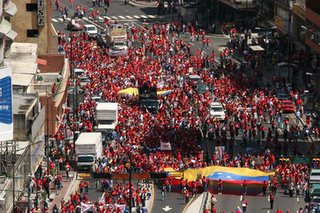 I mean, c'mon! They didn't even crop it off on top and on bottom to make it look like it went farther on either side!
Don't these ABN types learn anything in those Prensa Latina seminars they send them to in Havana? Frankly, I'm outraged! We send them oil, and they can't even train our journalists to disinform us properly! Shoddy, shoddy propagandizing, I say...
That picture, along with this next one, strike me as totally amazing.
 Jesus! Is this really as many people as they can drum up to march along with Chavez? Not so long ago, this is about how many chavistas would turn up outside Miraflores on any given day just to hand in a papelito asking for a personal favor! What the hell happened?
[Thanks to Daniel for the image tip.]
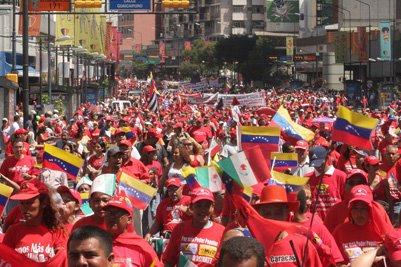 See? Taken from a low angle, nicely set up to make the march look bigger than it really was. This is normal: any self-respecting autocratic regime has a propaganda arm designed to crank out images like this.
But then, how did this other picture make it onto their coverage of Saturday's Chavez-the-Mariachi rally?
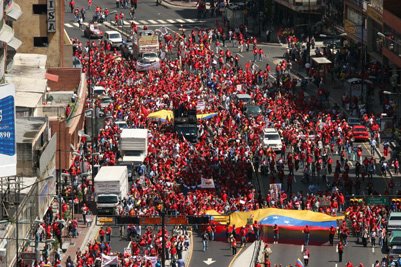 I mean, c'mon! They didn't even crop it off on top and on bottom to make it look like it went farther on either side!
 Don't these ABN types learn anything in those Prensa Latina seminars they send them to in Havana? Frankly, I'm outraged! We send them oil, and they can't even train our journalists to disinform us properly! Shoddy, shoddy propagandizing, I say...
That picture, along with this next one, strike me as totally amazing.
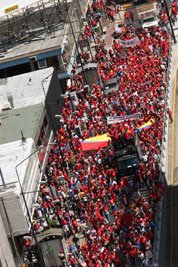 Jesus! Is this really as many people as they can drum up to march along with Chavez? Not so long ago, this is about how many chavistas would turn up outside Miraflores on any given day just to hand in a papelito asking for a personal favor! What the hell happened?
[Thanks to Daniel for the image tip.]
November 19, 2005
CNE to audit self...slowly, very slowly...
CNE's decision to grant itself an amazing five weeks to conduct its "hot" audit, has rekindled my interest in electoral nuts-and-bolts. The CNE Audit "Instructivo" - the official instructions for the audit - starts on page 58 of this large PDF document. The vote-tallying procedure (acto de escrutinio) is set out from page 74 of the same document.
Sumate's big beef with the Escrutinio procedure is that nowhere does it instruct polling workers to physically count all the ballot papers issued. Articles 168-174 of the Framework Law on Suffrage and Political Participation, set out the rules for the vote-tallying process in some detail. According to Article 172, the "Acta de Escrutinio" - the Vote Tally Report that serves as an official record of votes in each polling station - must contain both a count of the total number of ballots that were cast and the automated tally of how many votes each candidate and party got.
The Acta de Escrutinio needs to contain both these counts because Article 220, paragraph 1, says an acta is invalid if the two numbers don't match. The only way to determine whether the two numbers match or not is to actually count the ballot papers.
(Somewhat bizarrely, the law does not say you need a hand-count of how many votes each candidate and each party got, you just need a hand-count of how many ballots were cast in total. This is meant to ensure the automated count does not contain more votes than there are actual ballot papers.)
Under the rules CNE has published, ballot papers will only be counted for a single box in a sample making up about 45% of voting tables. The votes will be audited by a hand-count, but instead of being immediately matched against the automated results, they will be sent to CNE, which will have five weeks to build a data base and conduct a statistical study of discrepancies.
A few things to note about these rules:
Since only CNE will get to see the hand-count data, CNE will effectively audit itself - how many companies get away with that?
The audit procedure contains no mechanism whereby hand-counts trump automated counts in the event of a discrepancy.
By the time the audit is published, 5 weeks after the vote, the election results will long since have been announced and the seats adjudicated - and there's no mechanism for re-adjudicating a seat in the event that the audit demonstrates fraud.
Though not directly related to the audit, the Vote Tallying (escrutinio) procedures AGAIN call for Actas de Escrutinio to be printed after the machine has been connected to CNE headquarters and the data been sent in (article 46, page 75 of the document I linked to above.) This week, Jorge Rodriguez pledged to backtrack on this item. Still, it is hard to figure this sequencing was in there in the first place, given the grave misgivings about bi-directional communications it has always aroused.
Frankly, if this is how they propose to go about it, it's hard to see what good auditing could do. It's silly to think a procedure this opaque, this slow, and this CNE-centric could really convince anyone who currently doubts CNE's probity. Ultimately, if the political will was there, CNE could run a credible hot audit, one that would end once and for all opposition misgivings about its fairness. It could, but it hasn't.
Sumate's big beef with the Escrutinio procedure is that nowhere does it instruct polling workers to physically count all the ballot papers issued. Articles 168-174 of the Framework Law on Suffrage and Political Participation, set out the rules for the vote-tallying process in some detail. According to Article 172, the "Acta de Escrutinio" - the Vote Tally Report that serves as an official record of votes in each polling station - must contain both a count of the total number of ballots that were cast and the automated tally of how many votes each candidate and party got.
The Acta de Escrutinio needs to contain both these counts because Article 220, paragraph 1, says an acta is invalid if the two numbers don't match. The only way to determine whether the two numbers match or not is to actually count the ballot papers.
(Somewhat bizarrely, the law does not say you need a hand-count of how many votes each candidate and each party got, you just need a hand-count of how many ballots were cast in total. This is meant to ensure the automated count does not contain more votes than there are actual ballot papers.)
Under the rules CNE has published, ballot papers will only be counted for a single box in a sample making up about 45% of voting tables. The votes will be audited by a hand-count, but instead of being immediately matched against the automated results, they will be sent to CNE, which will have five weeks to build a data base and conduct a statistical study of discrepancies.
A few things to note about these rules:
Frankly, if this is how they propose to go about it, it's hard to see what good auditing could do. It's silly to think a procedure this opaque, this slow, and this CNE-centric could really convince anyone who currently doubts CNE's probity. Ultimately, if the political will was there, CNE could run a credible hot audit, one that would end once and for all opposition misgivings about its fairness. It could, but it hasn't.
Ana Julia Jatar pulls no punches...
Ana Julia Jatar's speech to the US House of Representatives' Subcommittee on the Western Hemisphere (PDF file) last Thursday was as tough and synthetic a statement of the case against Chavez's assault on democratic institutions as I could think of.
I especially liked the way she closed:
I especially liked the way she closed:
I did not come to speak to this prestigious audience to ask for help, nor did I come to persuade the US Congress of the need to interfere in our destiny. Venezuela has a long history of self determination and we will continue to stand for it. But I did come today to make you reflect about our current challenges and opportunities. Fish don’t know they are in water. They take water for granted. Venezuelans used to take freedom for granted, not knowing what the institutional underpinnings of their freedom were. Today those institutional foundations have been taken away. History is full of lessons about countries where governments are not constrained by laws. Venezuela is becoming one more exhibit in that gruesome old lesson.
...y un rato con la oposicion...
Juan Forero finally tosses us a bone in today's New York Times...
I still wish he'd write something on institutional degradation, but hey, you take what you can get...
SHE'S the Venezuelan government's most detested adversary, a young woman with a quick wit and machine-gun-fast delivery who often appears in Washington or Madrid to denounce what she calls the erosion of democracy under President Hugo Chávez.
In a highly polarized country, María Corina Machado has emerged as perhaps the most divisive figure after Mr. Chávez, a woman who is either beloved or reviled.
I still wish he'd write something on institutional degradation, but hey, you take what you can get...
November 18, 2005
CNE backtracks (a bit)
This afternoon, CNE backtracked on the use of Electronic Voter Rolls, and gave assurances that voting machines will not be connected to phone lines until actas have been printed out, striking out two of the points on my Imaginary Memo to the EU EOM.
CNE also agreed to audit a larger number of voting tables, but the press reports I've seen do not make clear if they will agree to publish the audit results immediately. It's a crucial point. An audit is only "hot" if you publish results as soon as they're available.
If you have info on this, please share.
CNE also agreed to audit a larger number of voting tables, but the press reports I've seen do not make clear if they will agree to publish the audit results immediately. It's a crucial point. An audit is only "hot" if you publish results as soon as they're available.
If you have info on this, please share.
December 5th Chronicles
It's almost certain that the Opposition parties will get taken to the cleaners in the Dec. 4th parliamentary elections. The question is, what are their leaders going to say on Dec. 5th?
They could fall back on their old standby and allege fraud - but imagine how powerless and ridiculous that would sound. For one thing, it's too obvious they don't have the support to win an election right now. For another, they knew full well the kind of CNE they were accepting when they agreed to go to elections - they spent the last year and a half rubbishing it!
So that's not a great option. Alternatively, they could blame the loss on low turnout, pointing the finger the rabble-rousing Art. 350-invoking abstentionist crowd. Tempting, but that would only add fuel to the fire of the near civil-war between Opposition electoralists and abstentionists.
Two bad options so far. So, what's left? Well, Venezuela is the Land of the Possible, so they might just tuck their tail between their legs and congratulate MVR on its win.
How do you think this will go?
Current Results
Free Web Polls
They could fall back on their old standby and allege fraud - but imagine how powerless and ridiculous that would sound. For one thing, it's too obvious they don't have the support to win an election right now. For another, they knew full well the kind of CNE they were accepting when they agreed to go to elections - they spent the last year and a half rubbishing it!
So that's not a great option. Alternatively, they could blame the loss on low turnout, pointing the finger the rabble-rousing Art. 350-invoking abstentionist crowd. Tempting, but that would only add fuel to the fire of the near civil-war between Opposition electoralists and abstentionists.
Two bad options so far. So, what's left? Well, Venezuela is the Land of the Possible, so they might just tuck their tail between their legs and congratulate MVR on its win.
How do you think this will go?
Current Results
Free Web Polls
November 17, 2005
Imaginary Memo to the EU Election Observation Mission
Lets be clear. The basic reason the Opposition will lose the Dec. 4th parliamentary elections is that more people want to vote for the government than for the Opposition. Denying this would be an idle exercise in buck passing - though one so comfortable for Oppo leaders, we can be sure we will hear it. For too long, the Opposition has used CNE's partiality as an excuse to avoid the work of building up its political support. Until it does that, it won't win an election even if a gaggle of angels is put in charge of CNE.
With that proviso firmly in mind, it's also important to understand that CNE is not run by a gaggle of angels. The list of grievances with the Elections Authority has grown longer, not shorter, since last year's referendum. At the moment, the key items are:
Dodgy Voter Roll: The Permanent Electoral Registry grew from 12.310.031 voters to 14.245.614 voters - 16% - in just seven months, from December 2003 to June 2004. Basic safeguards to ensure that all those registered are eligible to vote were not applied. Opposition parties cannot audit the voter roll, because the CNE refuses to publish it.
Unexplained "Migrations": As many as 30% of voters have been "migrated" (switched) from one voting center to another, with no explanation.
Opaque tallying: CNE has consistently ignored its legal obligation to tally votes publicly.
Voter Intimidation: The use of electronic voter lists together with electronic voting machines allows CNE to infer which voter voted for which party, undermining the secrecy of the vote. Given the history of using information about voter preferences to discriminate against opposition supporters, this system results in voter intimidation.
Possibility of electronic tallying fraud: Electronic voting machines will connect with CNE headquarters before each machine produces a print-out of its voting results, opening the possibility of "bi-directional electronic traffic" - meaning that machines may end up producing a tally report beamed back to them from CNE headquarters. In last years referendum, there is evidence that there was back-and-forth electronic communications between voting machines and CNE headquarters throughout the day.
Absence of a credible audit: The all-important "hot audit" - the manual recount of paper ballots in a representative sample of voting centers - will be published five weeks after the election, giving plenty of time for manipulation.
Morochas: Through administrative fiat, CNE will allow the use of the "morochas" - a mechanism that deliberately and unfairly manipulates of the mixed uninominal/list venezuelan voting system. The trick is designed to magnify the number of parliamentary seats allocated to the largest party, in violation of the constitutional principle of Proportional Representation.
Abusive use of state resources: Though not directly under CNE control, the government continues to use state resources to give unfair advantage to pro-Chavez candidates.
It's true that even without these various manipulations, the government would still win the election. That does not make them acceptable. Hopefully, the EU elections observation mission will take note.
Just last week, the OSCE produced a harsh report on the Azerbaijani elections for irregularities roughly comparable to those outlined above, despite the fact that the Azerbaijani government would likely have won those elections even without fraud. We urge the EU EOM to apply European standards consistently.
With that proviso firmly in mind, it's also important to understand that CNE is not run by a gaggle of angels. The list of grievances with the Elections Authority has grown longer, not shorter, since last year's referendum. At the moment, the key items are:
It's true that even without these various manipulations, the government would still win the election. That does not make them acceptable. Hopefully, the EU elections observation mission will take note.
Just last week, the OSCE produced a harsh report on the Azerbaijani elections for irregularities roughly comparable to those outlined above, despite the fact that the Azerbaijani government would likely have won those elections even without fraud. We urge the EU EOM to apply European standards consistently.
November 16, 2005
Clues from Azerbaijan on EU Elections Monitoring
The major innovation in the upcoming Dec. 4th parliamentary elections is the presence of an EU monitoring mission in Venezuela. How tough will the new observers be? Hopefully, at least as tough as the OSCE mission the EU sent to monitor parliamentary elections in Azerbaijan last week.
From Radio Free Europe
So that's a fairly tough assessment. In its preliminary document on the conduct of the elections, published just a day after the voting, the Organization for Security and Cooperation in Europe, in charge of running the EU monitoring mission, noted the following shortcomings:
On the inside pages of the OSCE preliminary report, we find bits like:
Overall, I think if the EU brings this level of scrutiny to the Dec. 4th election, CNE has something to worry about.
From Radio Free Europe
November 7th, 2005
OSCE, EU Question Azerbaijani Vote
Observers from the Organization for Security and Cooperation in Europe (OSCE) said today that parliamentary elections in Azerbaijan that culminated in yesterday's voting failed to meet several international standards, RFE/RL's Azerbaijani Service reported.
The OSCE's election-observation mission noted some improvements in the way the election was run, but it said the shortcomings that were observed led the mission to believe that the election "did not meet a number of OSCE commitments and Council of Europe standards for democratic elections."
The international observers in Baku said the elections' shortcomings included, among other things, a faulty count of the ballots and interference by local authorities.
Citing alleged massive irregularities, opposition representatives have said they it will not recognize the outcome of the vote. The opposition has called on its supporters to hold a peaceful march in Baku tomorrow.
Meanwhile, EU External Relations Commissioner Benita Ferrero-Waldner said earlier today that she regrets reports of electoral violations in Azerbaijan's legislative elections.
"While we are still not knowing all elements in order to draw our conclusions, we understand there are reports of some violations of election procedures and also of the rights of opposition candidates that have been occurring throughout the country, especially in provincial and rural areas," Ferrero-Waldner said.
So that's a fairly tough assessment. In its preliminary document on the conduct of the elections, published just a day after the voting, the Organization for Security and Cooperation in Europe, in charge of running the EU monitoring mission, noted the following shortcomings:
Local executive authorities often interfered in the campaign and failed to act impartially, and were regarded by many as serving only the interests of pro-government candidates; No effective sanctions were imposed on representatives of local executive authorities who, in violation of the law, interfered in the election process, diminishing confidence in the rule of law; The composition of election commissions favored pro-government candidates, at times undermining confidence in the independence and impartiality of the election administration; Restrictive interpretations of campaign provisions and pressure on an independent TV channel limited voters’ access to diverse information; The CEC and constituency election commissions (ConECs) generally failed to address a number of issues in an effective manner, such as the use of voter cards, military voting and the handling of complaints; There was a lack of uniformity in updating voter lists and issuance of voter cards; At least 38 constituencies deviate from legal norms regarding the number of registered voters per constituency.
On the inside pages of the OSCE preliminary report, we find bits like:
There are still shortcomings in the legal framework that have had an adverse effect on the conduct of the elections. The composition of election commissions favors the incumbent authorities and undermines confidence in the independence of the election administration. The provision for voter cards would only be effective if there was strict control and accountability in their distribution.
The OSCE/ODIHR Elections Observation Mission observed cases of abuse of administrative resources such as the use of offices, vehicles and employees for campaign purposes.
In its prime time news and current affairs programs, the AzTV (Azerbaijan's VTV) demonstrated clear bias. Media monitoring results show that in the eight weeks preceding the election, AzTV provided 97 percent of its political and election prime time news coverage to the activities of the President, the presidential administration, the government and the YAP. This coverage was overwhelmingly positive in tone. In contrast, the news programs on AzTV largely ignored activities of opposition candidates. Thus, AzTV failed to meet its legal obligation to create equal conditions for the candidates and political parties. No legal sanctions were imposed on AzTV.
There was a presence of candidate representatives and non-partisan domestic observers in nearly all polling stations visited. However, there were observations of domestic observers and PEC members being expelled or dismissed from polling stations. The international elections observation mission observed local executive officials and observers of YAP candidates interfering in or directing the process, or otherwise attempting to influence voters. The presence of video cameras filming voting and, in some instances, individuals - including exit pollsters in some cases - attempting to influence voter choices or identify voters with their votes, appeared intimidating to voters.
Overall, I think if the EU brings this level of scrutiny to the Dec. 4th election, CNE has something to worry about.
November 15, 2005
Not so hot...
Last year, Venezuela had a big debate over the importance of the "hot audit" (auditoria en caliente) for the credibility of electronic election results.
A hot audit is when the paper-trail produced by the voting machines is audited on election night. It means the paper ballots the machines produce are counted immediately after voting ends in a representative sample of voting centers, and the results of the hand-count are compared against the electronic results right away.
Today, Sumate told the OAS Elections Observers that the National Electoral Council's plan for the Dec. 4th election is to publish the results of their "hot" audit next year!
Cripes, it'll be deep frozen by then.
A hot audit is when the paper-trail produced by the voting machines is audited on election night. It means the paper ballots the machines produce are counted immediately after voting ends in a representative sample of voting centers, and the results of the hand-count are compared against the electronic results right away.
Today, Sumate told the OAS Elections Observers that the National Electoral Council's plan for the Dec. 4th election is to publish the results of their "hot" audit next year!
Cripes, it'll be deep frozen by then.
November 14, 2005
Do you swear to tell the truth, 85% of the truth, and no more than 15% of lies, so help you God?
In the very first post to this blog, all the way back in September 2002, I wrote that, "these days, what I find it hardest to convey to my friends who live outside Venezuela is this strong undercurrent of farce that now permeates public life here." Three years later, I still have the same problem.
Consider, if your patience allows, the Danilo Anderson Case. (Newbies can read a highly simplified summary of it here.)
So far, the official version is that the CIA wanted to have him killed. So, how did they go about this? Apparently, the cleanest, simplest, most low-risk way the CIA could think of having a guy killed was to outsource the job to a sprawling conspiracy including a high profile journalist, a catholic cardinal, an anti-Fidel cuban exile, a pro-government General, an anti-government General...along with others to be named as the prosecutors think them up, I guess. Then the CIA arranged for that motley crew to travel to Miami, Santo Domingo and Panama to plan the hit abroad. (Seriously, this is the government's story!)
Now, you might think "well, if it's not true they'll surely have alibis, and they'll be able to show they weren't in Miami Santo Domingo and Panama on the dates when the alleged conspiracy took place." But not so fast! Sure they have alibis, and sure there are no records of them traveling to those places on those dates, but as the Prosecutor General knows, that's only because the CIA provided these people with "doubles" back home to shore up their alibis, and arranged secret international travel for them so no records of their movements could be found in any subsequent investigation. Clever, those gringos, huh?
Well, maybe not so clever. Apparently, these same hyper-sophisticated CIA agents able to find exact dopplegangers for dozens of suspects and to move them all over the hemisphere without anyone noticing weren't quite sophisticated enough to tell the Generals involved to, erm, remove their uniforms and name-tags as they carried out this conspiracy, since the government's one and only witness claims he could identify them because they were wearing their uniforms, name tags and all, as they conspired!
Right.
This key witness, the guy on whose testimony the Prosecutor General is hanging the entire indictment on, was later found to have a long criminal record in Colombia, mostly for crimes centered on his, erm, difficulties with truth-telling. Among the seven indictments he's faced we find one that led to a conviction for passing himself off for a forensic expert, a physician, and a psychiatrist. This was back in 1999. Yet just a few days ago, our Prosecutor General went in front of the cameras to bolster his witness's credibility because the guy is...you guessed it, a psychiatrist!
Then, this weekend, the whole superwitness farce took an even more improbable turn as the Prosecutor General gave an interview to Caracas daily Ultimas Noticias and said that after careful study of the guy's testimony, the Prosecutor General's Office had collectively determined that "at least 85% of what he says is true." Puzzle this one through...doesn't that imply that a good 15% of what he says is a lie?
But hey, what's a lie here and there between friends? It's not as though he'll be under oath or anything...
Consider, if your patience allows, the Danilo Anderson Case. (Newbies can read a highly simplified summary of it here.)
So far, the official version is that the CIA wanted to have him killed. So, how did they go about this? Apparently, the cleanest, simplest, most low-risk way the CIA could think of having a guy killed was to outsource the job to a sprawling conspiracy including a high profile journalist, a catholic cardinal, an anti-Fidel cuban exile, a pro-government General, an anti-government General...along with others to be named as the prosecutors think them up, I guess. Then the CIA arranged for that motley crew to travel to Miami, Santo Domingo and Panama to plan the hit abroad. (Seriously, this is the government's story!)
Now, you might think "well, if it's not true they'll surely have alibis, and they'll be able to show they weren't in Miami Santo Domingo and Panama on the dates when the alleged conspiracy took place." But not so fast! Sure they have alibis, and sure there are no records of them traveling to those places on those dates, but as the Prosecutor General knows, that's only because the CIA provided these people with "doubles" back home to shore up their alibis, and arranged secret international travel for them so no records of their movements could be found in any subsequent investigation. Clever, those gringos, huh?
Well, maybe not so clever. Apparently, these same hyper-sophisticated CIA agents able to find exact dopplegangers for dozens of suspects and to move them all over the hemisphere without anyone noticing weren't quite sophisticated enough to tell the Generals involved to, erm, remove their uniforms and name-tags as they carried out this conspiracy, since the government's one and only witness claims he could identify them because they were wearing their uniforms, name tags and all, as they conspired!
Right.
This key witness, the guy on whose testimony the Prosecutor General is hanging the entire indictment on, was later found to have a long criminal record in Colombia, mostly for crimes centered on his, erm, difficulties with truth-telling. Among the seven indictments he's faced we find one that led to a conviction for passing himself off for a forensic expert, a physician, and a psychiatrist. This was back in 1999. Yet just a few days ago, our Prosecutor General went in front of the cameras to bolster his witness's credibility because the guy is...you guessed it, a psychiatrist!
Then, this weekend, the whole superwitness farce took an even more improbable turn as the Prosecutor General gave an interview to Caracas daily Ultimas Noticias and said that after careful study of the guy's testimony, the Prosecutor General's Office had collectively determined that "at least 85% of what he says is true." Puzzle this one through...doesn't that imply that a good 15% of what he says is a lie?
But hey, what's a lie here and there between friends? It's not as though he'll be under oath or anything...
Moderating the comments forum
It's with a heavy heart that I've decided to turn on the Moderation option on the Haloscan comments forum. This will unnecessarily slow things down, but the discussion was getting ridiculous. For the moment, I'll moderate the thing myself, but if anyone else would like to volunteer to help me (Torres?) that would be great.
I hate the idea of having to post explicit rules on these things, common sense ought to be enough. Obviously it isn't, so here are the rules.
The Rules
The moderator(s) have the right, but not the obligation, to edit or delete:
The moderator(s) will strive to make decisions on which topics to post on the basis of relevance and civility rather than ideology.
...heavy sigh...
I hate the idea of having to post explicit rules on these things, common sense ought to be enough. Obviously it isn't, so here are the rules.
The Rules
The moderator(s) have the right, but not the obligation, to edit or delete:
- - Posts that are defamatory, libelous, obscene, abusive, harassing, threatening, off-topic, unintelligible, or unnecessarily antagonistic, or in any other way inappropriate, as determined exclusively by the moderator(s).
- - Posts which are submitted repetitively, without bearing on the discussion topic, or otherwise deliberately disrupt the forum.
- - Posts which attack or insult another forum user or the moderator(s), or their families.
The moderator(s) will strive to make decisions on which topics to post on the basis of relevance and civility rather than ideology.
...heavy sigh...
Illiberal Democracy
Ibsen Martínez has a lovely - if typically pedantic - article in yesterday's El Nacional. The gist? Venezuela has become the "most perverse and polimorphous, evanescent and changing example of Illiberal Democracy", as conceived by Fareed Zakaria. Ibsen is too hard to translate, so I'll just point to it for the Spanish readers.
One bit, though, is too lovely to pass up:
"This is a country where, in just one recent day, Chavez can hold a friendly meeting with Felipe González, prince of the modern European social democrats, at the same time as the police raids and closes down the newspaper El Impulso on a flimsy tax pretext. A country whose Public Prosecutors openly intimidate opponents, and whose head of government, at the same time, spends its time designing continental integration strategies based on oil diplomacy; where the prison overcrowding crisis and extrajudicial executions, which today have reached their highest level in decades, coincide with acts revindicating the human rights of afrovenezuelans and indigenous peoples; where the electoral registry has been used to call almost a dozen elections in the last seven years and to institute, in parallel, a political apartheid that violates the right to work...To combat this diabolical complexity we will need a politics that is more realistic and assertive than the sifrino hissyfit of staying home on election day 'because Jorge Rodriguez sold out,' hoping perhaps to see Oswaldo Alvarez Paz and Cardinal Castillo Lara announce, around 7 p.m. on Globovision, the definitive 'endogenous delegitimation' of the regime."
One bit, though, is too lovely to pass up:
"This is a country where, in just one recent day, Chavez can hold a friendly meeting with Felipe González, prince of the modern European social democrats, at the same time as the police raids and closes down the newspaper El Impulso on a flimsy tax pretext. A country whose Public Prosecutors openly intimidate opponents, and whose head of government, at the same time, spends its time designing continental integration strategies based on oil diplomacy; where the prison overcrowding crisis and extrajudicial executions, which today have reached their highest level in decades, coincide with acts revindicating the human rights of afrovenezuelans and indigenous peoples; where the electoral registry has been used to call almost a dozen elections in the last seven years and to institute, in parallel, a political apartheid that violates the right to work...To combat this diabolical complexity we will need a politics that is more realistic and assertive than the sifrino hissyfit of staying home on election day 'because Jorge Rodriguez sold out,' hoping perhaps to see Oswaldo Alvarez Paz and Cardinal Castillo Lara announce, around 7 p.m. on Globovision, the definitive 'endogenous delegitimation' of the regime."
November 13, 2005
CIA ex machina
One thing the Anderson Case has made clear is how the Chavez government intends to put its anti-gringo rhetoric to work. See, from now on, everything bad that happens in Venezuela is the CIA's fault. It's fantastic! Any hole in any official story can be papered over with that old fidelista standby - the vague allusion to the CIA.
Say the Anderson conspirators have alibis. No problem! The CIA instructed them to get dopplegangers to fake them! Say there are no records of them being in Panama or Miami on the dates of the supposed conspiracy? Of course! The CIA obviously helped them to get around undetected!
It's so simple, yet so effective. There's no need to prove anything. Just say the magic word, and all your problems magically disappear!
Too good to be true? It's even better than that. It's not just that you can justify any authoritarian excess with some murky CIA allegation, it's that the International Ñángara Batallion eats it up with mustard! They love it! They'll line up behind you, endorse any unhinged theory you want to throw at them! They'll toast you as a revolutionary! Folks...authoritarianism has never been easier...
Say the Anderson conspirators have alibis. No problem! The CIA instructed them to get dopplegangers to fake them! Say there are no records of them being in Panama or Miami on the dates of the supposed conspiracy? Of course! The CIA obviously helped them to get around undetected!
It's so simple, yet so effective. There's no need to prove anything. Just say the magic word, and all your problems magically disappear!
Too good to be true? It's even better than that. It's not just that you can justify any authoritarian excess with some murky CIA allegation, it's that the International Ñángara Batallion eats it up with mustard! They love it! They'll line up behind you, endorse any unhinged theory you want to throw at them! They'll toast you as a revolutionary! Folks...authoritarianism has never been easier...
November 12, 2005
Danilogate Fails to Crack Gringo Media
Venezuela may be up in arms about the Danilo Anderson case, but the English language media has met the story with a collective yawn. Out of curiousity, I just did a Google News search for "Danilo Anderson". Every story the search yields is from a Venezuela based organization - the DJ, Petroleumworld, (which picked up my highly compressed summary - thanks!) VHeadline, and, of course, Prensa Latina, which more or less counts as Venezuelan by now.
The AP and Reuters wrote a single story each when the first arrests were made and haven't touched it since.
It's strange, the way a story can utterly dominate the Venezuelan press with nary a ripple making it through to English-language readers. In a way it's understandable - Danilogate is too convoluted even for many Venezuelans to understand, so I can well imagine the trouble foreign journos would face in trying to sell it to editors back home. I see the general silence as a function of the tyranny of the 800-word limit - there's no way to explain what happened briefly, so gringo papers just won't run with it.
Still, they're missing a great yarn - L'Affaire Danilo just keeps getting more and more bizarre. Yesterday, El Tiempo, a Bogota Daily, reported that Geovanny Vasquez de Armas, the prosecution's one and only witness, has been in and out of court in Colombia since 1996 on fraud and impersonation charges.
Deliciously, back in 1999 he was convicted to 36 months in jail for impersonating a psychiatrist. Recall that three days ago Isaias tried to puff up the guy's credibility saying "hey, he's a psychiatrist!"
But there's much much more where that came from. Vasquez de Armas got busted in Colombia for faking a medical degree from Johns Hopkins University and for faking claims that he was accredited by the FBI and other US authorities as a forensic scientist. In total, Isaias's supergrass has been accused of fraud and related charges seven times in Colombia. Just for good measure, he told Colombian police he was fluent in German - another howler.
As Teodoro pointed out in Tal Cual yesterday, the truly silly thing is that the Venezuelan Prosecutors apparently failed to conduct any kind of background check on the guy they planned to hang their whole indictment on. Curioser and curioser...
The AP and Reuters wrote a single story each when the first arrests were made and haven't touched it since.
It's strange, the way a story can utterly dominate the Venezuelan press with nary a ripple making it through to English-language readers. In a way it's understandable - Danilogate is too convoluted even for many Venezuelans to understand, so I can well imagine the trouble foreign journos would face in trying to sell it to editors back home. I see the general silence as a function of the tyranny of the 800-word limit - there's no way to explain what happened briefly, so gringo papers just won't run with it.
Still, they're missing a great yarn - L'Affaire Danilo just keeps getting more and more bizarre. Yesterday, El Tiempo, a Bogota Daily, reported that Geovanny Vasquez de Armas, the prosecution's one and only witness, has been in and out of court in Colombia since 1996 on fraud and impersonation charges.
Deliciously, back in 1999 he was convicted to 36 months in jail for impersonating a psychiatrist. Recall that three days ago Isaias tried to puff up the guy's credibility saying "hey, he's a psychiatrist!"
But there's much much more where that came from. Vasquez de Armas got busted in Colombia for faking a medical degree from Johns Hopkins University and for faking claims that he was accredited by the FBI and other US authorities as a forensic scientist. In total, Isaias's supergrass has been accused of fraud and related charges seven times in Colombia. Just for good measure, he told Colombian police he was fluent in German - another howler.
As Teodoro pointed out in Tal Cual yesterday, the truly silly thing is that the Venezuelan Prosecutors apparently failed to conduct any kind of background check on the guy they planned to hang their whole indictment on. Curioser and curioser...
Subscribe to:
Posts (Atom)