Nothing in the world of WTO negotiations is quite the way you'd expect. One startling example is the sprawling controversy over the US Food Aid program - at first sight, one of these motherhood-and-apple-pie programs only a monster could oppose. Hey, humanitarian disasters happen, people go hungry, and the US has a mechanism to make sure they get enough to eat: who could possibly be against that?
Plenty of people, it turns out, including - remarkably - many of the recipient countries. Lofty rhetoric aside, it's been clear to them for some time that the way the US operates its Food Aid program is just an agricultural surplus disposal mechanism in disguise. When a good harvest threatens to create a glut of food in the US, which could cause farm gate prices to collapse, the US government steps in to buy the excedent. Rather than storing it or letting it rot in the fields, they then package it up in nice, star-spangled banner sacks and ship them off to the third world - whether the food is needed or not. In fact, more than a few studies show that US Food Aid shipments are closely correlated with the size of the harvest in the US in any given year, and not at all related to food shortages abroad.
From an economic point of view, then, US Food Aid often amounts to an agricultural export subsidy by another name. The effect of so much cynical largesse is typically to depress prices in the recipient countries - hey, for local farmers, "free" is a tough price to compete with. Food Aid shipments thus tend to drive local producers out of the market, arguably exacerbating local poverty conditions.
The surreal outcome of all of this is that, in the Doha Round, one of the thorniest of the "second-tier deadlocks" involves very poor countries begging the US to stop giving them free food, while US negotiators manouver furiously to keep those aid flows going!
Into this fray comes the European Union, which gives its food aid mostly in the form of cash. It's true that US Food Aid works to depress food prices in recipient countries, so the program puts EU food exporters at a disadvantage in those markets. But it's hard to believe that's the real reason the EU is so fantastically worked up about the problem.
My feeling is that the EU is always looking for new issues to put on the table to divert attention from its own very high farm tariffs. Food aid offers the EU a rare chance to be seen siding with the poorest countries against the big, bad US - and a chance to argue that they're not the only ones to use agricultural export subsidies, it's just that the US calls them something else.
Now, the EU has been driving a very hard bargain on this issue - actually, a bargain entirely out of proportion to the issue's actual relevance to EU farmers. And here you start to see the way the structure of the negotiations gives ample room for tactical posturing and diversionary negotiating stances. It's hard to believe that the EU really cares all that much about US Food Aid, but it's easy to see how keeping the discussion centered on Food Aid ensures that it's the US that does the squirming, not the EU. The EU can then use the issue as leverage in the rest of the negotiations - and, of course, looking for second-tier issues to hold as bargaining chips against the first tier issue is much of what the minor sport of WTO positioning is all about.

May 5, 2006
Primer on the WTO's Triangular Deadlock
Well, I've just finished my week-long WTO Negotiation Simulation (so be prepared to be bored silly with the details.)
I have to say it was fantastic. The session was run by real-world trade negotiators, which kept it sophisticated and realistic. The simulation chairman, who represents South Africa in the real talks, pushed us hard to reach an agreement - which, at the cost of some realism, we did. None of us, however, was under any illusion that our simulated agreement could work in the real world. Just the opposite: as the simulation progressed, it became clear to all of us that the "zone of possible agreement" could only be reached if all the delegations gave up not on this or that peripheral point, but really on their main negotiating goals. In that sense, the exercise was valuable mainly in giving us a much more detailed, nuanced understanding of where the tangle of deadlocks really lie and why the multiple impasses have been so unmanageable.
For the few of you who really care, and at the cost of some heavy-duty oversimplification, it goes something like this:
At the center of the Doha Round there's a three-way deadlock between the three main players on the three main topics up for negotiation - a fundamental impasse we came to call "the triangle." The three players are the European Union, the United States, and the G20 group of relatively advanced developing countries - which includes Brazil, India, South Africa, Thailand, Argentina and China (and, incidentally, Venezuela as well.) The basic problem now is that these three have to agree on three very tough topics: agricultural tariffs, agricultural subsidies, and industrial tariffs.
Each of the three big players has two offensive interests (where they try to get the other two to liberalize) and one defensive priority (where they want to avoid having to liberalize themselves.) The kicker, of course, is that each player's defensive priority is also the other two players' offensive priority. Visually, it's like this:
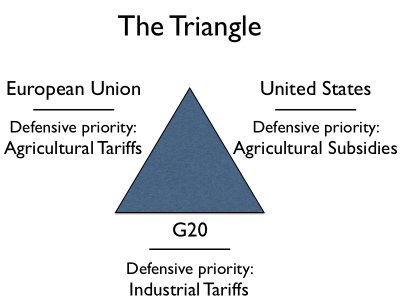
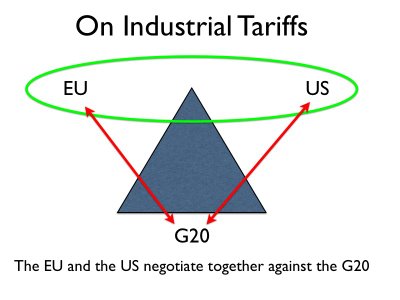
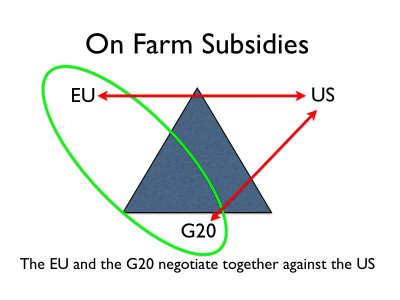
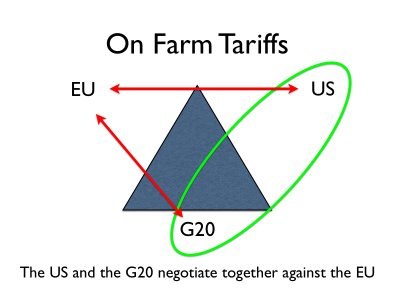
Of course, this is a highly schematic way to set it out, and leaves out a lot of contradictory detail - the lavishly tariff-coddled US sugar industry could only smirk at all this. Still, as a first approximation to the deadlock, the triangle is a pretty good tool. It allows you to appreciate the neat symmetry in the three-way deadlock. Each issue pits two of the blocks against the third, in a kind of round-robin of futile alliances:
Why does it end up breaking down like this?
Well, take the Europeans first. The EU negotiates defensively on agricultural tariffs because EU farmers are protected chiefly by high tariff walls, and many would find it very hard to survive without them. So the EU's first negotiating priority is to avoid having to cut them seriously. Though European farmers also benefit from high subsidies, the EU's Common Agricultural Policy has been extensively reformed in the last two years to ensure those subsidies are allowed under WTO rules - so the EU has an interest in seeing other partners, especially the US, reform and lower their own farm subsidies as well. At the same time, European industrialists are strongly interested in selling their manufactured goods all over the world, so their foremost offensive priority is to get lower industrial tariffs in the US and G20 markets.
The United States, on the other hand, negotiates defensively on agricultural subsidies, and offensively on agricultural and industrial tariffs. US farmers are protected mostly by high subsidies, which have not been reformed to conform with WTO rules. So the US Trade Representative's major red-lines concern avoiding deep cuts in farm subsidies. Although US farmers also benefit from high tariff walls, on the whole they are not as high as Europe's. US farmers operate on a larger scale than European farmers and have higher productivity, so they could survive and thrive with lower tariffs if the EU would also drop theirs. And just like the Europeans, US industrialists are strongly interested in selling their manufactured goods all over the world, so negotiating for lower industrial tariffs in the EU and G20 markets is an offensive priority.
Though there's a lot of heterogeneity in the G20 - hell, Egypt is a G20 country! - on the whole G20 farmers enjoy few subsidies and strong comparative advantages in agriculture: if world food markets were not so distorted, the G20 would "feed the world." Their negotiators therefore push to secure deep cuts in farm tariffs and subsidies in the rest of the world. Though the G20 is officially an agriculture-only club, and therefore doesn't have an official position on industrial tariffs, everybody knows that many G20 industrialists - particularly in Brazil, Argentina, South Africa and India - are not competitive enough to survive if industrial tariffs are cut substantially, so most G20 countries negotiate against having to lower their own industrial tariffs. (This, obviously, doesn't apply to China.)
The tangle of irreconcilable differences arising from the triangle is frightful. The European Union will only agree to cut its own farm tariffs if the US cuts its farm subsidies and the G20 sharply lowers its industrial tariffs, but both the US and the G20 find these proposals unacceptable. The US will only cut its own farm subsidies if the EU sharply lowers its farm tariffs and the G20 quickly drops its industrial tariffs, but both the EU and the G20 find those proposals unacceptable. And the G20 - well, if they had a position on industrial tariffs, which they don't, it would be that they would only drop their own industrial tariffs if the EU and the US will cross their own "red-lines" on farm tariffs and subsidies respectively, which neither is willing to do. Put together, the three sets of red-lines generate an insurmountable deadlock.
The Obvious Solution
Now, you don't have to be a negotiations expert to notice a fairly straightforward potential solution to all this: for all three players to make deep concessions on their own defensive priorities at the same time. That way, each would give on their one defensive issue, but get on their two offensive priorities. This, in fact, is the solution we reached in the simulation exercise. And, of course, the real negotiators in Geneva are not stupid: they realized long ago that if there is going to be a deal, it will have to be something along those lines.
What's really interesting, though, is that this kind of common-sense solution just won't fly: they've been trying to hammer out a deal along those lines for 5 years now, and there seems to be no way to square the triangle.
The reason, I think, is that trade negotiators consistently prioritize their defensive interests over their offensive interests. As one of the speakers quipped to us this week, "no WTO negotiator has ever lost his job for saying 'no', but plenty have lost their jobs for saying 'yes.'" And with good reason: the costs you incur from caving on your defensive interests are real, rapid, and tangible. But the benefits from getting a concession on your offensive interests are uncertain, evanescent, nebulous...if they come, they rarely come right away.
If you take away a European farmer's tariff protection he notices, immediately, because the price he gets for his product falls. If the EU gets Brazil to agree to lower its own industrial tariffs, on the other hand, any given European exporter may or may not get any of the benefits. He may find that those lower tariffs just allow their US or Chinese competitors to make off with the extra market share. They may find that Brazilians don't like their brands as much as expected. The boat carrying their product could sink. Any number of problems could crop up that overwhelm the benefits, to him, of the agreed cuts in Brazilian tariffs. So getting that lower tariff in Brazil is a gain for the EU, but it's a gain in a strangely nebulous, highly uncertain, off-in-the-future kind of way.
Defensive bias
For these reasons, producers are generally much more interested in lobbying to protect their defensive interests than they are in lobbying to further their offensive interests. Defense has a built-in advantage in the Doha Round, and the primacy of defensive interests in the triangle seems to be the main reason for the impasse.
This is a problem in all three trade blocks, but it's not a symmetrically distributed one: it's much more of a problem in Europe than elsewhere. European politicians are petrified of the reaction they could get from their farmers if they cut farm tariffs deeply, no matter what concessions they get elsewhere. The problem is compounded by the low level of engagement by the EU's offensive interests: the industrial lobby, whose support European negotiators badly need, sees little to gain from further tariff cuts abroad, largely because industrial tariffs are already, generally, quite low worldwide.
Interestingly, the US that has the most flexible position in the round, because their defensive priority is the easiest to fudge: the way the negotiation has developed is that only the most "trade distorting" farm subsidies would be sharply cut, while subsidy programs that are designed to be "minimally trade distorting" are still allowed. In theory, the US could agree to sharply lower its "bad" subsidies and then just shift the money over to "good" subsidies, leaving gringo farmers as well-off as they were before. All they would have to do is reform their farm policies. Indeed, that's precisely what the EU did with its own Common Agricultural Policy in the last few years. It's not politically easy, but it's not the end of the world either. For that reason, both in my simulation and in the real negotiations, the US has had a more moderate position than the EU and the G20. "Caving", for the US, would mean reforming their farm subsidies, not giving them up outright. So the US side of the Triangular Deadlock looks to be the most manageable of the three.
The G20, meanwhile, has the most offense-minded position of the three: the benefits from liberalization to their agricultural exporters are quite well established and visible to their farm lobbies. The G20's problem is a bit different: their defensive priority is industrial tariffs, but those are already very low for most products in almost all countries. In order for a G20 concession on industrial tariffs to be meaningful for the EU and the US, the G20 countries would need to make extremely aggressive cuts on the tariff lines they still have. The EU, for instance, is calling for a deal that radically cuts all tariffs and allows no single tariff to remain above 15%. This is an extremely aggressive stance, and one several G20 countries simply couldn't stomach. Kirchner, in particular, would never in a million years agree to a cut on that scale. Though the G20 does not have a single position outside of agriculture, the working guess is that the group wouldn't agree to cut its highest tariffs below 40% or so. (Needless to say, the second G20 countries float that sort of position, the EU loses all interest in serious agricultural tariff cuts.) My point here is simply that the gaps we're looking at are so wide that any question of somehow "splitting the difference" is entirely unrealistic.
Esperando en la bajadita...
Then again, this central deadlock has been clear for some time. The more valuable part of the simulation (for me anyway) was the realization that even if you somehow managed to untangle the triangular deadlock, the negotiations could still well fail. That's because a number of other deadlocks continue to lurk in the shadows of the negotiations, concealed only by the fact that the three-way big-player deadlock is even worse.
These other deadlocks are far from negligible, though. For one thing, the G10 countries (Japan, South Korea, Switzerland, Norway and Co.) are even more protectionist in agriculture than the EU and the US, so even a proposal agreeable to the three big players may not be acceptable to the G10. For another, the African, Caribbean and Pacific Group demands a separate, quicker, deeper deal to liberalize cotton (a main export product for some of their members) which sets them on a collision course with perhaps the most powerful agricultural lobby in the US. The ACP countries also demand compensation for the loss of their preference margins, which is implicit in any tariff-cutting proposal. And the G33, (yet another group, this time of larger, poorer developing countries, and led by Indonesia) has demanded two large loopholes against having to cut many of their own farm tariffs that is acceptable neither to the US nor to the G20.
These are, if you will, second-order deadlocks in the sense that they don't involve irreconcilable differences among the three big players. The EU and the US tend to think that many of these problems could be finessed with increased aid offers - though the possibility of buying off the G33 with a fat check is highly iffy. The thing that sort of staggered me about the negotiation simulation was realizing that even if the Triangular Deadlock magically disappeared tomorrow, the second-order deadlocks could well be deep enough to prevent an agreement.
At the end of all this, I'm left with a much more nuanced understanding not just of why there has been deadlocked, but also of why the deadlock has overpowered every attempt at a solution. Though trade diplomats are still hammering away on the round in Geneva, it's not hard to see that these are pro-forma efforts. On the whole the round has been given up as hopeless.
My guess is that in the next few months, the WTO's Director General will be forced to acknowledge that the existing differences cannot be bridged, and the round will go into a sort of deep freeze. Interestingly, there is no settled method to officially bury the corpse of a round, so negotiations would likely be suspended rather than ended, in the hope that they can be revived, somehow, at some point down the line. In the meantime, the US and the EU would concentrate on hammering out bilateral deals to advance their trade interests, and the G20, G33 and ACP would rely more and more on the WTO's existing dispute-settlement system to advance theirs.
Historical experience, however, suggests that when trade negotiations are not moving forward, the tendency is for countries to resort to more and more protectionism. If the de facto failure of the round leads to considerable backsliding, then it's imaginable that in a few years the big players will come back to the negotiating table with a renewed sense of mission. If, in the meantime, the US and France elect themselves presidents who are more committed to multilateralism, then its just about imaginable that the round could rise from the ashes sometime around 2009. Until then, though, it's dead. It's deader than dead.
I have to say it was fantastic. The session was run by real-world trade negotiators, which kept it sophisticated and realistic. The simulation chairman, who represents South Africa in the real talks, pushed us hard to reach an agreement - which, at the cost of some realism, we did. None of us, however, was under any illusion that our simulated agreement could work in the real world. Just the opposite: as the simulation progressed, it became clear to all of us that the "zone of possible agreement" could only be reached if all the delegations gave up not on this or that peripheral point, but really on their main negotiating goals. In that sense, the exercise was valuable mainly in giving us a much more detailed, nuanced understanding of where the tangle of deadlocks really lie and why the multiple impasses have been so unmanageable.
For the few of you who really care, and at the cost of some heavy-duty oversimplification, it goes something like this:
At the center of the Doha Round there's a three-way deadlock between the three main players on the three main topics up for negotiation - a fundamental impasse we came to call "the triangle." The three players are the European Union, the United States, and the G20 group of relatively advanced developing countries - which includes Brazil, India, South Africa, Thailand, Argentina and China (and, incidentally, Venezuela as well.) The basic problem now is that these three have to agree on three very tough topics: agricultural tariffs, agricultural subsidies, and industrial tariffs.
Each of the three big players has two offensive interests (where they try to get the other two to liberalize) and one defensive priority (where they want to avoid having to liberalize themselves.) The kicker, of course, is that each player's defensive priority is also the other two players' offensive priority. Visually, it's like this:
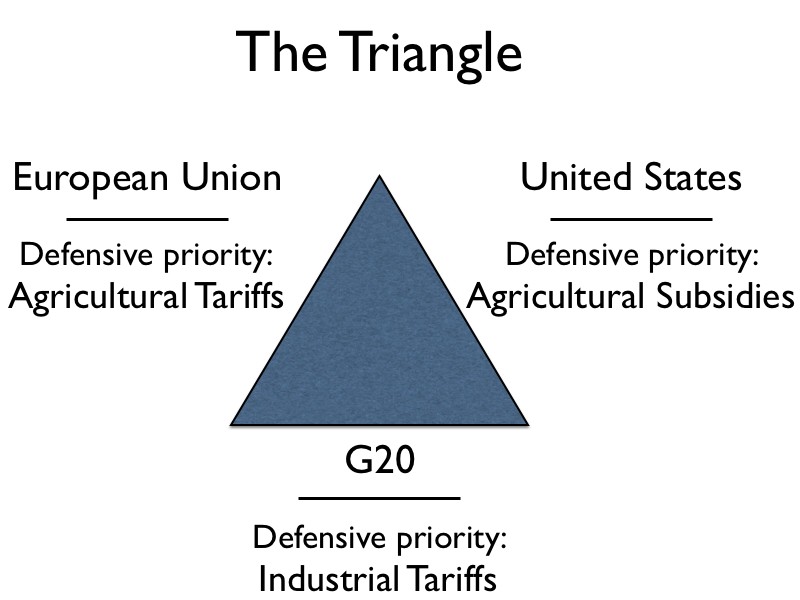
Of course, this is a highly schematic way to set it out, and leaves out a lot of contradictory detail - the lavishly tariff-coddled US sugar industry could only smirk at all this. Still, as a first approximation to the deadlock, the triangle is a pretty good tool. It allows you to appreciate the neat symmetry in the three-way deadlock. Each issue pits two of the blocks against the third, in a kind of round-robin of futile alliances:

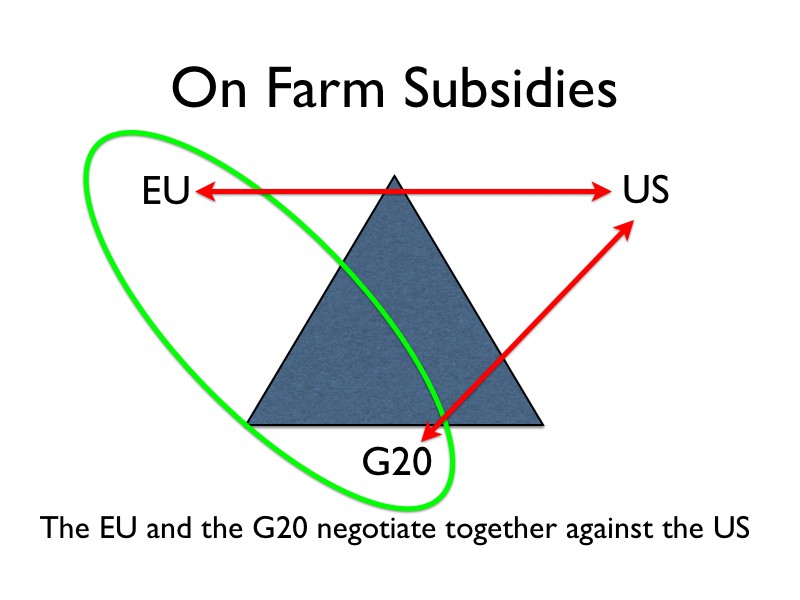
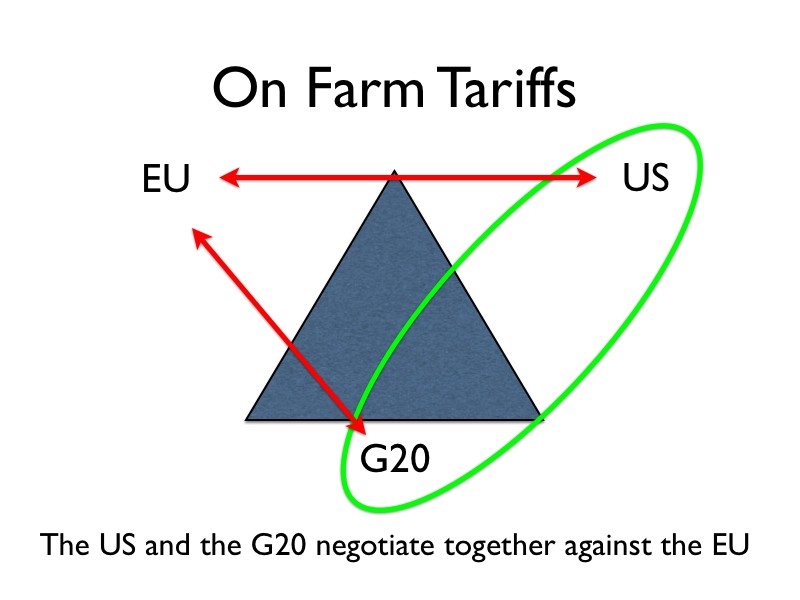
Why does it end up breaking down like this?
Well, take the Europeans first. The EU negotiates defensively on agricultural tariffs because EU farmers are protected chiefly by high tariff walls, and many would find it very hard to survive without them. So the EU's first negotiating priority is to avoid having to cut them seriously. Though European farmers also benefit from high subsidies, the EU's Common Agricultural Policy has been extensively reformed in the last two years to ensure those subsidies are allowed under WTO rules - so the EU has an interest in seeing other partners, especially the US, reform and lower their own farm subsidies as well. At the same time, European industrialists are strongly interested in selling their manufactured goods all over the world, so their foremost offensive priority is to get lower industrial tariffs in the US and G20 markets.
The United States, on the other hand, negotiates defensively on agricultural subsidies, and offensively on agricultural and industrial tariffs. US farmers are protected mostly by high subsidies, which have not been reformed to conform with WTO rules. So the US Trade Representative's major red-lines concern avoiding deep cuts in farm subsidies. Although US farmers also benefit from high tariff walls, on the whole they are not as high as Europe's. US farmers operate on a larger scale than European farmers and have higher productivity, so they could survive and thrive with lower tariffs if the EU would also drop theirs. And just like the Europeans, US industrialists are strongly interested in selling their manufactured goods all over the world, so negotiating for lower industrial tariffs in the EU and G20 markets is an offensive priority.
Though there's a lot of heterogeneity in the G20 - hell, Egypt is a G20 country! - on the whole G20 farmers enjoy few subsidies and strong comparative advantages in agriculture: if world food markets were not so distorted, the G20 would "feed the world." Their negotiators therefore push to secure deep cuts in farm tariffs and subsidies in the rest of the world. Though the G20 is officially an agriculture-only club, and therefore doesn't have an official position on industrial tariffs, everybody knows that many G20 industrialists - particularly in Brazil, Argentina, South Africa and India - are not competitive enough to survive if industrial tariffs are cut substantially, so most G20 countries negotiate against having to lower their own industrial tariffs. (This, obviously, doesn't apply to China.)
The tangle of irreconcilable differences arising from the triangle is frightful. The European Union will only agree to cut its own farm tariffs if the US cuts its farm subsidies and the G20 sharply lowers its industrial tariffs, but both the US and the G20 find these proposals unacceptable. The US will only cut its own farm subsidies if the EU sharply lowers its farm tariffs and the G20 quickly drops its industrial tariffs, but both the EU and the G20 find those proposals unacceptable. And the G20 - well, if they had a position on industrial tariffs, which they don't, it would be that they would only drop their own industrial tariffs if the EU and the US will cross their own "red-lines" on farm tariffs and subsidies respectively, which neither is willing to do. Put together, the three sets of red-lines generate an insurmountable deadlock.
The Obvious Solution
Now, you don't have to be a negotiations expert to notice a fairly straightforward potential solution to all this: for all three players to make deep concessions on their own defensive priorities at the same time. That way, each would give on their one defensive issue, but get on their two offensive priorities. This, in fact, is the solution we reached in the simulation exercise. And, of course, the real negotiators in Geneva are not stupid: they realized long ago that if there is going to be a deal, it will have to be something along those lines.
What's really interesting, though, is that this kind of common-sense solution just won't fly: they've been trying to hammer out a deal along those lines for 5 years now, and there seems to be no way to square the triangle.
The reason, I think, is that trade negotiators consistently prioritize their defensive interests over their offensive interests. As one of the speakers quipped to us this week, "no WTO negotiator has ever lost his job for saying 'no', but plenty have lost their jobs for saying 'yes.'" And with good reason: the costs you incur from caving on your defensive interests are real, rapid, and tangible. But the benefits from getting a concession on your offensive interests are uncertain, evanescent, nebulous...if they come, they rarely come right away.
If you take away a European farmer's tariff protection he notices, immediately, because the price he gets for his product falls. If the EU gets Brazil to agree to lower its own industrial tariffs, on the other hand, any given European exporter may or may not get any of the benefits. He may find that those lower tariffs just allow their US or Chinese competitors to make off with the extra market share. They may find that Brazilians don't like their brands as much as expected. The boat carrying their product could sink. Any number of problems could crop up that overwhelm the benefits, to him, of the agreed cuts in Brazilian tariffs. So getting that lower tariff in Brazil is a gain for the EU, but it's a gain in a strangely nebulous, highly uncertain, off-in-the-future kind of way.
Defensive bias
For these reasons, producers are generally much more interested in lobbying to protect their defensive interests than they are in lobbying to further their offensive interests. Defense has a built-in advantage in the Doha Round, and the primacy of defensive interests in the triangle seems to be the main reason for the impasse.
This is a problem in all three trade blocks, but it's not a symmetrically distributed one: it's much more of a problem in Europe than elsewhere. European politicians are petrified of the reaction they could get from their farmers if they cut farm tariffs deeply, no matter what concessions they get elsewhere. The problem is compounded by the low level of engagement by the EU's offensive interests: the industrial lobby, whose support European negotiators badly need, sees little to gain from further tariff cuts abroad, largely because industrial tariffs are already, generally, quite low worldwide.
Interestingly, the US that has the most flexible position in the round, because their defensive priority is the easiest to fudge: the way the negotiation has developed is that only the most "trade distorting" farm subsidies would be sharply cut, while subsidy programs that are designed to be "minimally trade distorting" are still allowed. In theory, the US could agree to sharply lower its "bad" subsidies and then just shift the money over to "good" subsidies, leaving gringo farmers as well-off as they were before. All they would have to do is reform their farm policies. Indeed, that's precisely what the EU did with its own Common Agricultural Policy in the last few years. It's not politically easy, but it's not the end of the world either. For that reason, both in my simulation and in the real negotiations, the US has had a more moderate position than the EU and the G20. "Caving", for the US, would mean reforming their farm subsidies, not giving them up outright. So the US side of the Triangular Deadlock looks to be the most manageable of the three.
The G20, meanwhile, has the most offense-minded position of the three: the benefits from liberalization to their agricultural exporters are quite well established and visible to their farm lobbies. The G20's problem is a bit different: their defensive priority is industrial tariffs, but those are already very low for most products in almost all countries. In order for a G20 concession on industrial tariffs to be meaningful for the EU and the US, the G20 countries would need to make extremely aggressive cuts on the tariff lines they still have. The EU, for instance, is calling for a deal that radically cuts all tariffs and allows no single tariff to remain above 15%. This is an extremely aggressive stance, and one several G20 countries simply couldn't stomach. Kirchner, in particular, would never in a million years agree to a cut on that scale. Though the G20 does not have a single position outside of agriculture, the working guess is that the group wouldn't agree to cut its highest tariffs below 40% or so. (Needless to say, the second G20 countries float that sort of position, the EU loses all interest in serious agricultural tariff cuts.) My point here is simply that the gaps we're looking at are so wide that any question of somehow "splitting the difference" is entirely unrealistic.
Esperando en la bajadita...
Then again, this central deadlock has been clear for some time. The more valuable part of the simulation (for me anyway) was the realization that even if you somehow managed to untangle the triangular deadlock, the negotiations could still well fail. That's because a number of other deadlocks continue to lurk in the shadows of the negotiations, concealed only by the fact that the three-way big-player deadlock is even worse.
These other deadlocks are far from negligible, though. For one thing, the G10 countries (Japan, South Korea, Switzerland, Norway and Co.) are even more protectionist in agriculture than the EU and the US, so even a proposal agreeable to the three big players may not be acceptable to the G10. For another, the African, Caribbean and Pacific Group demands a separate, quicker, deeper deal to liberalize cotton (a main export product for some of their members) which sets them on a collision course with perhaps the most powerful agricultural lobby in the US. The ACP countries also demand compensation for the loss of their preference margins, which is implicit in any tariff-cutting proposal. And the G33, (yet another group, this time of larger, poorer developing countries, and led by Indonesia) has demanded two large loopholes against having to cut many of their own farm tariffs that is acceptable neither to the US nor to the G20.
These are, if you will, second-order deadlocks in the sense that they don't involve irreconcilable differences among the three big players. The EU and the US tend to think that many of these problems could be finessed with increased aid offers - though the possibility of buying off the G33 with a fat check is highly iffy. The thing that sort of staggered me about the negotiation simulation was realizing that even if the Triangular Deadlock magically disappeared tomorrow, the second-order deadlocks could well be deep enough to prevent an agreement.
At the end of all this, I'm left with a much more nuanced understanding not just of why there has been deadlocked, but also of why the deadlock has overpowered every attempt at a solution. Though trade diplomats are still hammering away on the round in Geneva, it's not hard to see that these are pro-forma efforts. On the whole the round has been given up as hopeless.
My guess is that in the next few months, the WTO's Director General will be forced to acknowledge that the existing differences cannot be bridged, and the round will go into a sort of deep freeze. Interestingly, there is no settled method to officially bury the corpse of a round, so negotiations would likely be suspended rather than ended, in the hope that they can be revived, somehow, at some point down the line. In the meantime, the US and the EU would concentrate on hammering out bilateral deals to advance their trade interests, and the G20, G33 and ACP would rely more and more on the WTO's existing dispute-settlement system to advance theirs.
Historical experience, however, suggests that when trade negotiations are not moving forward, the tendency is for countries to resort to more and more protectionism. If the de facto failure of the round leads to considerable backsliding, then it's imaginable that in a few years the big players will come back to the negotiating table with a renewed sense of mission. If, in the meantime, the US and France elect themselves presidents who are more committed to multilateralism, then its just about imaginable that the round could rise from the ashes sometime around 2009. Until then, though, it's dead. It's deader than dead.


May 4, 2006
Two interesting bits...
Interesting bit #1: Julio Borges welcomes the New CNE's decision to allow Venezuelan universities to audit the much-disputed Electoral Registry.
Interesting bit #2: Chavez rebuts allegations that he is meddling in other countries' internal affairs in a single phrase that magnificently joins his special brand of water-tight intellectual rigor and sense of subtlety with his trademark understated sophistication: "¡Qué injerencia, ni que nada!" (I'll let someone braver than me try to translate that one.) Chavez explains the strange phenomenon whereby some ill-intentioned people have misinterpreted his, erm, threat to end diplomatic relations with Peru if Peruvians vote for the wrong presidential candidate as "meddling" by saying that the desperate Latin American right wing made it all up. Meanwhile that standard-bearer for the desperate Latin American right wing, Ollanta Humala, condemns and deplores Chavez's earlier statements...go figure...
Interesting bit #2: Chavez rebuts allegations that he is meddling in other countries' internal affairs in a single phrase that magnificently joins his special brand of water-tight intellectual rigor and sense of subtlety with his trademark understated sophistication: "¡Qué injerencia, ni que nada!" (I'll let someone braver than me try to translate that one.) Chavez explains the strange phenomenon whereby some ill-intentioned people have misinterpreted his, erm, threat to end diplomatic relations with Peru if Peruvians vote for the wrong presidential candidate as "meddling" by saying that the desperate Latin American right wing made it all up. Meanwhile that standard-bearer for the desperate Latin American right wing, Ollanta Humala, condemns and deplores Chavez's earlier statements...go figure...
Documenting the documentable...
Here's just a taste of the Venezuela Chapter of the Interamerican Commission on Human Right's 2005 Annual Report:
IV. CIVIL SOCIETY
A. Risk of segregating a sector of Venezuelan society because of its political dissent
324. In 2005, the Commission received a mounting number of complaints and information indicating a worrisome trend in discriminatory actions against persons who make public their dissent from government policies and those who called for the removal of President Hugo Chávez Frías, in the referendum on revoking the presidential mandate that was held August 15, 2004. The Commission considers that the discriminatory actions based on one’s political opinion have a serious and grave detrimental impact on the observation and enjoyment of fundamental rights enshrined in the American Convention. A pronouncement by the Commission on Human Rights of the United Nations on this question recognizes that “…tolerance involves a positive acceptance of diversity and that pluralism encompasses the willingness to accord equal respect to the civil, political, economic, social and cultural rights of all individuals … tolerance and pluralism strengthen democracy, facilitate the full enjoyment of all human rights and thereby constitute a sound foundation for civil society, social harmony and peace[.]”[320]
325. In this regard, the Commission states its concern over the existence of a tendency to intimidate, harass, and stigmatize persons or organizations who speak out against government policies or officials. Even though over the last year the extent of social conflict characterized by violence and confrontation in public demonstrations has diminished, the Commission is concerned about the weakening of democratic checks and balances on the exercise of governmental authority, especially basic guarantees for the exercise of human rights advocacy, freedom of expression, and freedom to engage in opposition politics. The Commission was also alerted to the existence of a growing number of discriminatory acts by State entities and private sectors in giving employment and public services contracts for ideological or other related reasons. According to this information, those who have political disagreements with the current government would end up unemployed or negatively impacted by these discriminatory acts because of their views.
326. The complaints received include allegations that one of the tools used in this new pattern of discrimination is the so-called “Tascón list,” which contains the signatures of those persons who in 2004 submitted the request to call a referendum to revoke the mandate of President Hugo Chávez Frías. According to publicly-known information, the total list of the names of those persons was made public on the web site of the Movimiento Quinta República (MVR); beginning with Luís Tascón, this led to the dismissal of a large number of public employees, in various parts of the country, without recognition of their labor benefits.
327. The Commission learned that even though on April 15, 2005, the President of the Republic made an appeal to the regional authorities and those who work with them to archive and bury the so-called Tascón list[321], complaints persist to this day that “the list” is still being used to limit the signers’ access to basic services and social welfare programs, and that they continue being dismissed or not given employment in private firms as well as state enterprises.[322] Following are a few examples:
On April 15, 2005, the Center for Human Rights at the Universidad Católica Andrés Bello (CDH UCAB) and Provea filed an appeal against the decision of the 21st Oversight Court of the Criminal Circuit for the Caracas Metropolitan Area, which decided to consider concluded the investigation into the President and other officials of the CNE [Consejo Nacional Electoral] for applying pressure tactics to get citizens Rocío San Miguel, Magally Chang, and Thaís Peña to withdraw their signatures from the call for the referendum on revocation of the presidential mandate. Rocío San Miguel, Magally Chang, and Thaís Peña went to court to ratify their complaint alleging they had been dismissed in 2004 for political reasons, and with respect to which they have been pursuing various judicial remedies. The three of them worked in the CNF as legal counsel, public relations executive, and personnel assistant, respectively. On May 1, 2004, they were dismissed, without any reprimand in their files or any reorganization of the entity giving rise to a reduction in force. It is indicated that when they were given the notices, the Executive Secretary of the CNF informed them orally and individually that the dismissal was for having signed on against the President of the Republic.
The president of the public-sector workers’ union Federación Unitaria Nacional de Empleados Públicos (FEDEUNEP) stated that he has documented 780 cases of persons negatively affected by political discrimination, and the sanctions meted out by those public employees who applied this measure against those who signed petitions for the referendum to be held. Of this total, 200 were dismissed, 400 were subjected to pressure tactics, and 180 transferred. According to the records of the FEDEUNEP, at the Ministry of Interior and Justice (MIJ) 20 persons were dismissed; in the Deposit Guarantee and Bank Protection Fund (FOGADE), 42, although it is estimated that the actual figure is 120; in the water works (Operadora de Acueductos) of the Capital District and the states of Vargas and Miranda (Hidrocapital), 12; in the city government of Sucre, seven; in the National Elections Council (CNE), five; in the Ministry of Higher Education (MES), two; in the Ministry of Production and Commerce (MPC), two; in the National Parks Institute (INPARQUES); in the Urban Transportation Fund (FONTUR), four; in the Caracas Metro, 11; in the Corporation for Recovery and Development of the state of Vargas (CORPOVARGAS), 3; in Venezolana de Televisión (VTV), one; and also one each in the office of the Governor of Guárico, the National Sports Institute (IND), the National Tourism Institute (INATUR), the Office of the Controller of the state of Mérida, the National Council on Culture (CONAC), the Instituto Universitario del Este, the Commission for the Administration of Foreign Exchange (CADIVI), the Ministry of Labor (MINTRA), the Ministry of Finance (MF), the Ministry of Agriculture and Lands (MAT), the Ministry of Infrastructure (MINFRA), the Ministry of Health and Social Development (MSDS), the Ministry of Science and Technology (MCT), the Hospital Universitario; the municipal government of Libertador, and the Metropolitan Education Zone.
Manuel Cova, Secretary General of the Confederación de Trabajadores de Venezuela (CTV), alleged that ”political-labor persecution continues in the public sector through the list of those who signed the request for the presidential referendum, disseminated by deputy Luis Tascón.” Cova said that “in recent days 421 workers from city hall and the governor’s office in Miranda were removed from their positions by dismissals and forced retirement.”
Gloria Pacheco, representative of the first slate in the upcoming elections of the Venezuelan Dentistry Association (COV: Colegio de Odontólogos de Venezuela), alleged that Venezuelan dentists who participate in the Misión Barrio Adentro (MBA) program are being threatened with dismissal for political reasons: “the regional coordinating body of dentists who work in the Barrio Adentro program in Barinas, Olida Santiago, brought together her subordinates to tell them that in the upcoming elections for the Board of Directors of the COV they had to place their ballots open in the ballot boxes, so they could be identified by the slate they were voting for, and anyone who did not do so would be fired.” Pacheco indicated that "this, clearly, is a flagrant violation of the Constitution and the Law on Voting and Political Participation, which provides that voting is universal and by secret ballot."
328. One of these basic pillars of democratic government is respect for the fundamental rights of individuals under the principle of equality and non-discrimination. The consolidation of democracies requires stepped-up participation of all social sectors in the political, social, and cultural life of each nation. In this regard, Article 1 of the American Convention establishes the need for the States party to “undertake to respect the rights and freedoms recognized herein and to ensure to all persons subject to their jurisdiction the free and full exercise of those rights and freedoms, without any discrimination for reasons of race, color, sex, language, religion, political or other opinion, national or social origin, economic status, birth, or any other social condition.”
329. Given that the American Convention does not define discrimination, one can take as a basis the definitions contained in the International Convention on the Elimination of All Forms of Racial Discrimination and in the Convention on the Elimination of All Forms of Discrimination Against Women to argue that discrimination is any distinction, exclusion, restriction, or preference based on certain motives, such as race, color, sex, language, religion, political or other opinion, national or social origin, economic position, birth or any other social condition, which has the purpose or effect of nullifying or impairing the recognition, enjoyment or exercise, on an equal footing, of human rights and fundamental freedoms of all persons.[323] Accordingly, the Commission considers that any treatment that may be considered discriminatory with respect to the rights enshrined in the Convention is, per se, incompatible with it.[324]
330. The Commission is of the view that the lack of equitable participation impedes the broad development of democratic and pluralist societies, exacerbating intolerance and discrimination. The inclusion of all sectors of society in the processes of communication, decision-making, and development is fundamental to ensuring that their needs, opinions, and interests are considered in designing policies and in decision-making.[325]
331. The Commission notes that the discriminatory acts of the State against persons who have an ideology or political opinion different from whatever administration is in office may take on more subtle indirect forms which at times may be more effective for deterring criticism or for exercising coercion that leads to a change of position, at least in public, resulting in greater apparent alignment with the positions of the governing party. The Commission finds that dismissing employees and obstructing access to social benefits, among other measures, to punish those persons who express their voice of dissent from the administration are violations of human rights and should be subject to generalized censure, and should be investigated.
332. In this context, and with a view to encouraging analysis, the Commission takes this opportunity to refer to some decisions of the United Nations Human Rights Committee[326] and the European Court of Human Rights that exemplify the case-law in international law, and which are relevant for discouraging a possible deepening of a culture of discrimination and intolerance for political pluralism in Venezuela.
333. In Yong Joo Kang vs. Republic of Korea[327], the Human Rights Committee of the UN held that the application of “an ideology conversion system” to a prisoner convicted of espionage for distributing publicly available information violated his right to freedom of expression. The petitioner, along with other acquaintances of his, was an opponent of the military regime. In 1984, he distributed pamphlets in which he criticized the regime and the use of the security forces to harass him and others. In January, March, and May 1985, he distributed dissident publications that addressed political, economic, social, and historical matters. On July 1, 1985, the petitioner was arrested without court order by the Agency for National Security Planning (ANSP) and tried on charges of violating the National Security Law, and sentenced to life in prison, after the Criminal District Court of Seoul related on his confessions.
334. In his communication, the petitioner argued that being coerced to change his political opinion and the withholding of benefits (such as the possibility of release on parole) if he did not “convert” were tantamount to a violation of his right to freedom of conscience. The Committee concluded that the “ideology conversion system” to which the author had been subjected while he served his sentence was coercive and applied in a discriminatory fashion for the purpose of changing the political opinion of a prisoner, offering him incentives in the way of special treatment in prison and a greater possibility of parole, constituting a violation of Article 19(1) of the International Covenant on Civil and Political Rights.
335. In a case decided by the European Court of Human Rights, Vogt vs. Germany[328] (1995), the European Court held that the state’s action of placing the petitioner at a disadvantage, mindful of her political convictions as an active member of the German Communist Party since 1972, violated Articles 10(2) and 11 of the European Convention. The case had to do with the dismissal of a language teacher from a public high school for having participated in public events as a member of her party and having run as a candidate in regional parliamentary elections in 1982. The dismissal went forward even though the petitioner had a satisfactory record in her performance as a professional and even though those activities were held outside of the school setting. In 1982 the Regional Council of Weser-Ems brought disciplinary proceedings against the petitioner for breach of the duty of every public servant to serve and swear loyalty to the Constitution, as she was involved in political activities of the German Communist Party since 1980. For her part, the petitioner argued that her political activity as a member of the Communist Party was lawful, and that every citizen has the right to participate in political activities.
336. In view of the international case-law on the matter, even the possibility that discriminatory actions might be taking place in Venezuela because of the political or ideological expression of persons is highly alarming. The Commission maintains that every person has the right to legitimately exercise his or her freedom of expression, assembly, association, and conscience, and that these constitute a form of pluralism that is necessary to ensure the rights recognized in the various international human rights instruments, and to strengthen democratic institutions. The obstruction or intimidation of persons seeking to exercise these liberties strips individuals and the various sectors of society of instruments for defending their interests, protesting, criticizing, making proposals, and exercising oversight and active citizenship in their pursuit of popular sovereignty within the democratic framework.
B. Human rights defenders[329]
337. In 2005 harassment and intimidation of human rights defenders continued. The Commission was informed that judicial proceedings were instituted against human rights defenders, whose purpose is allegedly to silence their reports. In addition, high-level officials continued to question the legitimacy of their work. The IACHR expresses its grave concern over the impact these statements could have on the security of human rights defenders.
1. Threats and violence against human rights defenders
338. The Commission has learned that a climate of hostility and threats to the lives and physical integrity of human rights defenders continues to exist in Venezuela. In this respect, the Commission was informed that on January 23, 2005, in the city of Caracas, eight alleged officers of the Metropolitan Police entered and searched, without court order, the residence of Luís Rafael Ugas, president of the Fundación para las Garantías, Prevención y Defensa de los Derechos Humanos (FUNGAPDEHCA). According to the information provided to the Commission, the police agents arbitrarily and illegally detained Mr. Ugas’s brother, when they found that Mr. Ugas was not home. Ten days later, Rafael Ugas was intercepted in the street by four unidentified individuals, who placed him in a vehicle. There he was beaten and cigarette burns were inflicted on his back several times. Before being released, death threats were made to Mr. Ugas.[330]
2. Discrediting of human rights work by state authorities
339. Since 2001 the Commission has received repeated reports of state acts aimed at de-legitimizing and criminalizing the actions of Venezuelan and international human rights organizations working in Venezuela. In 2005, the IACHR has observed an increase in such reports due to the statements made by representatives of the Legislative branch, the Executive branch, the Public Ministry, and the even Judicial branch. High-level members of these government bodies have publicly accused several human rights organizations and their members of being part of a pro-coup strategy, or of having improper ties with foreign countries supposedly plotting to destabilize the Government.[331]
340. The Commission is concerned by the statements made by public authorities aimed at discrediting and stigmatizing human rights defenders, especially when such statements are made by members of the Judiciary in charge of judicial investigations or proceedings against defenders. In addition, the Commission considers it lamentable that high-level state officials have made statements aimed at attacking the professionalism of persons who have appeared before the organs of protection of the inter-American system. In this respect, the Commission has learned of the statements by Attorney General Isaías Rodríguez, discrediting the professional activity of attorney Carlos Ayala Corao in his participation before the Inter-American Court of Human Rights[332]; and the statements by Interior and Justice Minister Jesse Chacón, in which he discredits the work of human rights defender Humberto Prado just days after he appeared in a hearing at the headquarters of the IACHR concerning the prison situation in Venezuela.[333]
341. As reported to the Commission, these statements seek to get human rights organizations to desist from making use of the international protection mechanisms, and help maintain and intensify the risk that human rights defenders face to their personal integrity. Official speeches and pronouncements that stigmatize, de-legitimize, and criminalize the work of human rights defenders have been followed by statements and opinion articles by persons close to the government that suggest that human rights defenders are participating in criminal acts aimed at overthrowing the established government. These declarations seek to create a mistaken perception in society regarding the work of human rights defenders.
342. The Commission was informed of this situation in a communiqué dated June 29, 2005, in which the Ministry of Foreign Affairs suggested that the organizations providing counsel to the victims in one of the cases before the Inter-American Court were seeking to use human rights for economic and political gain. To this communiqué followed various editorial opinions in the media known as aligned with the government where the representatives of the victims which participated in the Court’ hearing were single out as conspirator against the regime[334].
343. The Commission recommends that the Government foster a culture of human rights in which the role of human rights defenders in guaranteeing democracy and the rule of law in society is recognized. Public officials should refrain from making statements that stigmatize human rights defenders or that suggest that human rights organizations operate improperly or illegally, merely because of their work promoting and protecting human rights.
3. Restrictions on access to international financing
344. The Commission has been informed that the State has imposed restrictions on the operation of human rights organizations by making it impossible for them to gain access to resources provided through international cooperation.[335] This prohibition, in a context in which financing for civil society organizations in Latin America and the Caribbean generally comes from foreign cooperation, in fact makes it impossible for organizations working in the area of human rights to operate. In previous reports, the Commission has referred to judicial measures that unlawfully restrict the work of organizations by preventing them from participating in public matters, based on their having received funds from international cooperation.[336]
345. In 2005, the Commission received more reports indicating that criminal proceedings were being instituted against several human rights organizations in retaliation for having raised and executed funds from foreign cooperation.[337] Those charges, according to available information, have been made in keeping with provisions of the Criminal Code, whose vague and imprecise content violates the principle of legality and makes it possible to consider any conduct criminal.
346. Specifically, human rights defenders have noted that Article 132 of the Criminal Code is being used to criminalize organizations’ foreign financing.[338] Through this provision, several members of human rights organizations are currently being investigated for the crime of requesting foreign intervention in Venezuela’s domestic political affairs, because they raised money for the legitimate exercise of constitutionally and internationally recognized rights exercising and societal efforts to keep tabs on the State, and fostering political participation.
347. The Commission recalls that the punitive power of the State and its justice organs should not be used to harass those who are engaged in legitimate activities. States have the duty to investigate those who violate the law in their territory, but they also have the duty to take all measures necessary to prevent state investigations from being used to submit to unfair or unfounded trials persons who legitimately call for respect for and protection of human rights.
4. Instituting criminal actions to the detriment of the work of human rights defenders
348. The Commission has also received reports of criminal proceedings being instituted against human rights defenders on charges of defamation, libel, and conspiracy. According to what was reported to the Commission, such proceedings are brought for the purpose of hindering the work of human rights defenders. The Commission received information that indicates that the prosecutors from the Public Ministry in charge of those investigations have committed procedural irregularities that limit the defense of the accused, including restrictions on access to the terms of the indictments and the discretional blocking of the production of evidence. In particular, it is noted that in the proceedings instituted against human rights defenders, the actions of the prosecutorial authorities are always aimed at shifting the burden of proof to the accused, contrary to the principle of the presumption of innocence.[339]
349. The Commission has also learned of judicial proceedings and steps supposedly aimed at carrying out international measures of protection, by which the burden of proof is shifted, and they end up being used against the beneficiaries of such measures. Threats and acts of harassment such as phone threats and being followed are very difficult to prove, which could lead to the authorities initiating criminal inquiries against the defenders on charges of simulation of a criminal act. The Commission was informed that these measures, in addition to seeking to subordinate international rulings to domestic law, are aimed at getting human rights defenders to assume the role of being the ones to lodge the complaints, which, given Venezuela’s system of criminal procedure, shifts the burden of proof to them, requiring them to prove that the facts they allege are true.[340]
350. For the IACHR, the pronouncement by the Twenty-ninth Court illustrates the that it is ill-advised to submit the decisions of international human rights organs to the review and decision of domestic judicial organs, and therefore it urges that this judicial interpretation be recognized as that which is most compatible with international law and the American Convention, as indicated in the introductory section of this chapter.
351. The Commission reiterates that the failure to implement effectively and in good faith the measures of protection granted by the organs of the inter-American system increases the risk to these persons, which in turn weakens democracy and the rule of law. In addition, the Commission is concerned that cases of violence and harassment targeting human rights defenders, even though criminal inquiries have been instituted, have remained in total impunity to date.
May 3, 2006
Thank you, Mr. Chávez
Katy says: I have many friends who left Venezuela in the early '90s to study abroad, thanks to Fundayacucho's loan programs. Some of these friends of mine stayed abroad, and some came back home. Some paid back their debts, some had their debts condoned, and some never even bothered to pay just like Fundayacucho never bothered to charge them. Some of their outstanding debts run in the thousands of dollars.
Most of these friends of mine went to private school and private university. Although they didn't have the money for graduate studies abroad, they weren't exactly middle class either.
Yesterday, President Chávez announced that Fundayacucho would no longer issue loans. From now on, it will only issue scholarships. He also announced that all outstanding debts would be pardoned. I believe his exact words were "the loans system is over, and whoever owed money does not owe anything anymore." He said that this new system erradicates a mercantile vision of the program and implements a revolutionary vision - or something like that.
So, Mr. Chávez, on behalf of my well-to-do friends who benefit from this policy, I thank you.
PS.- They still won't vote for you. Don't take it personally.
Most of these friends of mine went to private school and private university. Although they didn't have the money for graduate studies abroad, they weren't exactly middle class either.
Yesterday, President Chávez announced that Fundayacucho would no longer issue loans. From now on, it will only issue scholarships. He also announced that all outstanding debts would be pardoned. I believe his exact words were "the loans system is over, and whoever owed money does not owe anything anymore." He said that this new system erradicates a mercantile vision of the program and implements a revolutionary vision - or something like that.
So, Mr. Chávez, on behalf of my well-to-do friends who benefit from this policy, I thank you.
PS.- They still won't vote for you. Don't take it personally.
May 2, 2006
Keller's snapshot
Katy says: Alfredo Keller has made public the results of his April study, which seem to confirm that:
- 8 months before the election, Chávez has a commanding lead in the polls (no surprise there);
- getting out the vote will be key for both camps; and
- people like the idea of an opposition primary.
May 1, 2006
Inmature Maduro
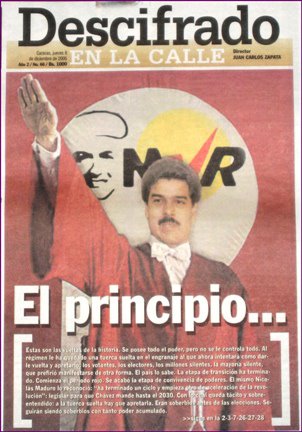
Katy says: One of the bad things about having a candidate with a history in the IVth Republic is that the campaign can quickly center on the past and not on Venezuelans' current ills.
Case in point: Nicolás Maduro, president of the National Assembly, speaking today at a pro-government May Day rally, criticized Teodoro Petkoff because the Caldera government allegedly "stole" workers' compensation benefits. It's never too late to retread issues that may have been relevant 8 or 9 years ago, and in all fairness, Maduro should have added: "... and the Chávez government let them get away with it!" After all, nobody is in jail for this alleged swindle.
Perhaps Venezuelan scientists should find a way to create politicians whose head is not so full of gas.
PS.- The pic is from Daniel Duquenal's blog, originally from Descifrado.
April 30, 2006
WTO Posts
When I'm not rambling about Chavez, I'm preparing a doctoral dissertation about the World Trade Organization. Here are a few posts on that entirely unrelated topic.
First off, there's my attempt to syntethize, in non-technical language, why it is the current round of WTO negotiations is hopelessly deadlocked:
Primer on the WTO's Triangular Deadlock
Second is this short write-up on the way the deadlock is concentrated on just a handful of products:
Arroz con leche, te quiero proteger...
Next, a note on how the WTO's monstrously convoluted Agricultural Subsidy classification system came into being:
Creative Diplo-bureacrats and their Little Boxes
Then, a write-up summing up the outcome of the December 2005 WTO Ministerial Conference in Hong Kong:
Taking Stock of Hong Kong
My post from Day 4 of the Hong Kong ministerial, explaining the European Union's oddly inflexible position:
Mandelson's Straightjacket
My post from Day 3 of the Hong Kong ministerial, noting the developing world's increased engagement with the negotiations:
The WTO Turned on its Head
This post from Day 2 of Hong Kong is an early attempt to deconstruct some of the more baffling aspects of WTO Diplo-bureaucratic jargon - particularly that most slipperly of formulations - "a balanced agreement."
Beginners' Guide to WTOese: "A Balanced Agreement"
First off, there's my attempt to syntethize, in non-technical language, why it is the current round of WTO negotiations is hopelessly deadlocked:
Second is this short write-up on the way the deadlock is concentrated on just a handful of products:
Next, a note on how the WTO's monstrously convoluted Agricultural Subsidy classification system came into being:
Then, a write-up summing up the outcome of the December 2005 WTO Ministerial Conference in Hong Kong:
My post from Day 4 of the Hong Kong ministerial, explaining the European Union's oddly inflexible position:
My post from Day 3 of the Hong Kong ministerial, noting the developing world's increased engagement with the negotiations:
This post from Day 2 of Hong Kong is an early attempt to deconstruct some of the more baffling aspects of WTO Diplo-bureaucratic jargon - particularly that most slipperly of formulations - "a balanced agreement."
April 29, 2006
Unconstitutional decisions #4,931,674 and #4,931,675
It's a detail, but telling: three of the "substitute National Electoral Council members" elected by the National Assembly are party hacks: Freddy Díaz, who worked on Chavez's campaign steering committee in 1998, Luis Salamanca - who was a Causa R adviser, and Pedro Díaz Blum who was actually a Proyecto Venezuela assemblymember until a few months ago!
Substantively, it doesn't much matter: substitute CNE members are mostly ornamental figures. Still, article 296 of the best-constitution-on-earth is explicit: CNE appointees must be "people not linked to organizations with political ends."
Which brings me back to an old theme: chavistas violate the constitution just for sport.
I mean, think about it: two of the three aforementioned party hacks are opposition people. Maduro & Co. are not even violating the constitution for petty political advantage here. They just do it from this weird mix of insouciancee and scorn. From a kind of deeply ingrained disdain for written rules that's unrelated to any particular political calculus. They have the assembly to themselves, the nominations committee virtually to themselves, they have no reason at all to violate the constitution just to toss the opposition some token CNE subs. But still, they do. They do.
Addendum from my inbox: The smart money says Diaz Blum is not there just because the chavistas enjoy violating the constitution. In fact he is a 'ficha' of MVR heavyweight (and onetime power-broker) Francisco Ameliach.
I'm not sure at which point he switched sides, but it would be interesting to learn a little more about his fellow 'opposition' suplente, to see if a small, but perfectly-formed pattern should emerge.
Curiously, though, it seems as if Ameliach is losing power within the chavista hierarchy. He appears to be out of the CTN, and indeed, the fact that the best his cne manoeuvrings could produce was one miserable suplente suggests his star is waning.
Substantively, it doesn't much matter: substitute CNE members are mostly ornamental figures. Still, article 296 of the best-constitution-on-earth is explicit: CNE appointees must be "people not linked to organizations with political ends."
Which brings me back to an old theme: chavistas violate the constitution just for sport.
I mean, think about it: two of the three aforementioned party hacks are opposition people. Maduro & Co. are not even violating the constitution for petty political advantage here. They just do it from this weird mix of insouciancee and scorn. From a kind of deeply ingrained disdain for written rules that's unrelated to any particular political calculus. They have the assembly to themselves, the nominations committee virtually to themselves, they have no reason at all to violate the constitution just to toss the opposition some token CNE subs. But still, they do. They do.
Addendum from my inbox: The smart money says Diaz Blum is not there just because the chavistas enjoy violating the constitution. In fact he is a 'ficha' of MVR heavyweight (and onetime power-broker) Francisco Ameliach.
I'm not sure at which point he switched sides, but it would be interesting to learn a little more about his fellow 'opposition' suplente, to see if a small, but perfectly-formed pattern should emerge.
Curiously, though, it seems as if Ameliach is losing power within the chavista hierarchy. He appears to be out of the CTN, and indeed, the fact that the best his cne manoeuvrings could produce was one miserable suplente suggests his star is waning.
Sovereignty is in the eye of the beholder...
Is it just me, or have Chavez's lunatic outbursts been getting exponentially weirder? Yesterday, Chávez ripped brutally into Peruvian presidential candidate Alan García - calling him corrupt, a thief, and vowing to break diplomatic relations with Peru if he wins the election.
Showing for the Nth time that he doesn't grasp the fact that "Hugo Chavez" and "the Venezuelan State" are not synonyms, he said "if García wins, I will withdraw my ambassador" (not Venezuela's ambassador, mind you, or our ambassador, no: my ambassador.)
He capped off his unhinged little rant with a stirring "¡Viva Humala!"
(Of course, between you and me, there's no question that Alan Garcia is a derranged charlatan. Hey, that's ok for me to say, and for you to say, and for a drunk at a bar to say, but not for a damn foreign head of state to say!)
In the last seven days, then, Chavez has decided it's his job to tell the Colombians how to run their trade policy and the Peruvians who they should elect president. Charming!
This is all enormously fresh from the guy who blows a gasket any time anyone anywhere makes any comment that could even obliquely be seen as in some way impinging on Venezuelan sovereignty. Meddling, I suppose, only violates sovereignty when the bad guys do it: when Chavez does it, it's revolutionary solidarity.
Showing for the Nth time that he doesn't grasp the fact that "Hugo Chavez" and "the Venezuelan State" are not synonyms, he said "if García wins, I will withdraw my ambassador" (not Venezuela's ambassador, mind you, or our ambassador, no: my ambassador.)
He capped off his unhinged little rant with a stirring "¡Viva Humala!"
(Of course, between you and me, there's no question that Alan Garcia is a derranged charlatan. Hey, that's ok for me to say, and for you to say, and for a drunk at a bar to say, but not for a damn foreign head of state to say!)
In the last seven days, then, Chavez has decided it's his job to tell the Colombians how to run their trade policy and the Peruvians who they should elect president. Charming!
This is all enormously fresh from the guy who blows a gasket any time anyone anywhere makes any comment that could even obliquely be seen as in some way impinging on Venezuelan sovereignty. Meddling, I suppose, only violates sovereignty when the bad guys do it: when Chavez does it, it's revolutionary solidarity.
April 28, 2006
By their fruits ye shall know them...
Well, we finally have a new CNE. How does it look? At first sight, not great:
How will this fearsome fivesome act? We'll have to see. The widely rumored choice of Lucena as chairwoman is not a good sign. But I'd say to watch the voting pattern: if you start seeing a lot of 3-to-2 decisions, that's bad. If they start holding meetings without letting Diaz Silva know (like they were doing with Solbella) - that's bad.
(Incidentally, Noticiero Digital had great fun noting that pro-Chavez daily Panorama scooped the National Assembly on its own vote!)
- Tibisay Lucena: Only re-appointed CNE member, has always voted faithfully alongside Jorge Rodriguez. Government cadre.
- Sandra Oblitas: Until now head of CNE's Caracas office, she signed to ask for the recall of opposition Assembly-members and has contributed to pro-Chavez newspaper Proceso. Government cadre.
- German Yepez Contreras: UCV history prof, current subsitute CNE member, Aporrea poster, nominated by the "Moral Branch." Government cadre.
- Janeth Hernandez: Maracucha political science prof, some of her academic writing makes her seem sensible. Hard to pin down.
- Vicente Diaz Silva: Sociologist, Noticiero Digital poster. Token opposition guy. The new Solbella Mejias.
How will this fearsome fivesome act? We'll have to see. The widely rumored choice of Lucena as chairwoman is not a good sign. But I'd say to watch the voting pattern: if you start seeing a lot of 3-to-2 decisions, that's bad. If they start holding meetings without letting Diaz Silva know (like they were doing with Solbella) - that's bad.
(Incidentally, Noticiero Digital had great fun noting that pro-Chavez daily Panorama scooped the National Assembly on its own vote!)
April 27, 2006
Jurassic Trade Policy
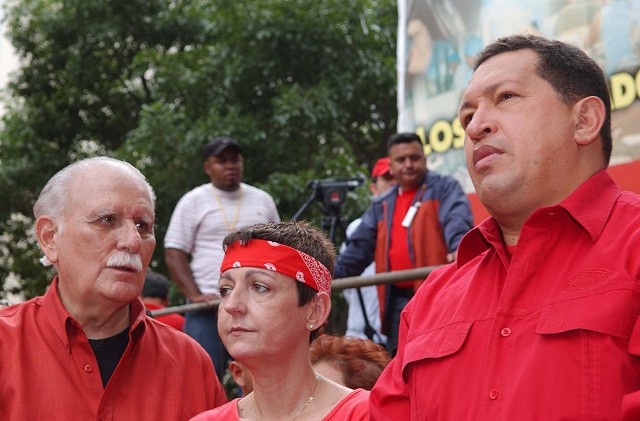 You can always count on Maria Cristina Iglesias to come up with aggressively ill-conceived policies. While her boss promises to further the cause of Latin American integration by threatening to break up the Andean Community unless Peru and Colombia do what he wants, the Minister of Light Industries and Trade delivers the coup de grace: a not-particularly-veiled threat to resort to massive protectionism, perhaps going as far as banning imports of all products currently produced in Venezuela.
There's so much wrong with this idea it's hard to know where to start to pick it apart. Lets try...
Under WTO-rules (GATT article XIX), Venezuela is only allowed to break its tariff-lowering commitments temporarily and surgically, as a response to an import surge in a specific product that "causes or threatens serious injury to domestic producers" of the same product. That's called a "safeguard measure" and it's perfectly WTO-legal.
But Iglesias doesn't seem to be talking about targetted, temporary safeguards for specific products facing import surges: she's talking about across the board protection for all Venezuelan industries. (As far as I know, no development economist has ever advocated such a thing - not even List.) If Maria Cristina wants Venezuela to break its WTO commitments on this scale, she's calling for Venezuela to violate its international treaty obligations on trade. (Nevermind that under the best-constitution-in-the-world's article 23, Venezuela's international treaty obligations are constitutionally binding.) If Venezuela does that, all its trade partners have the right, under GATT article XXIII, to retaliate by withdrawing their own tariff concessions to an extent equivalent to Venezuela's violation.
Iglesias may be banking that no one is going to slap punitive duties on oil - and she's probably right about that. But all other Venezuelan export products would likely face serious market-access difficulties abroad. The result, if it plays out this way, would be to further deepen Venezuela's already highly disruptive reliance on a single, volatile commodity for export revenues...turning us from a country that exports almost nothing but oil into a country that exports nothing but oil.
But, in fact, the WTO-angle is not even the worst of it. The truly damaging part is what such a policy would do to Venezuela's political economy. By limiting imports on this scale, we would be sliding back 30 years in terms of industrial policy - all the way back to the halcyon days of CAP I, when high import barriers produced a pampered class of rent-seeking local industrialists growing ever richer while producing sub-par, over-priced products that didn't have any prospect of ever becoming internationally competitive and survived only because Venezuelan consumers had no choice but to buy them. The massive waste of resources such a policy entails not only makes the poor poorer, but it tends to established a new industrial elite that depends on state favors to survive: blanket protectionism breeds blanket corruption.
This is a film we've seen before, and frankly it doesn't deserve a sequel. The more the bolivarianos heaps scorn on the 4th republic, the more their policies recreate its worst aspects.
April 26, 2006
A CNE prediction
Katy says: Venezuela's National Assembly (AN) will elect a new Electoral Council today. The board will be elected from a list of 126 candidates filtered by a Committee mostly made up of government representatives. While this may be a routine appointment in normal democracies, it is hard to over-estimate how key this decision is for the future course of political developments in Venezuela.
The 100% chavista AN has been showing a bit more openness than expected the past few days. It has even gone so far to meet with teams from the current opposition presidential pre-candidates. Tomorrow, Borges, Rosales and Petkoff are due to meet the AN representatives.
If this spirit of cooperation prevails, we may get a CNE that is accepted by all parties and the ghosts of massive abstention will be held down - for now. However, if the AN decides to appoint people perceived to be blatantly pro-government to the board - such as current CNE board members Oscar Battaglini, Tibisay Lucena, Oscar León or even current CNE attorney Andrés Brito - it is not hard to foresee what the reaction from the opposition camp will be.
In this scenario, the pressure from the radical wing of the opposition on the pre-candidates will be enormous. Opposition primaries may be dealt a death-blow, and all bets would be off.
As Quico has pointed out before, mistrust in the CNE has been the root cause of an almost total demobilization of opposition political forces in the past few years. Many in the non-chavista camp see this as a deliberate effort on the part of the government - to create enough mistrust to demobilize opponents, but maintain international standards so that foreign observers can still validate your work.
Tomorrow's decision, if it comes, will give us an indication of whether the government wants to continue playing this game or not.
Judging from the track record of AN appointments, this guest-blogger thinks any combination of the four mentioned above will make it to the final board, hence seriously damaging its credibility from the get-go. Let's hope this doomsayer is proven wrong.
(With apologies to Quico, who is not terribly fond of CNE discussions lately)

The 100% chavista AN has been showing a bit more openness than expected the past few days. It has even gone so far to meet with teams from the current opposition presidential pre-candidates. Tomorrow, Borges, Rosales and Petkoff are due to meet the AN representatives.
If this spirit of cooperation prevails, we may get a CNE that is accepted by all parties and the ghosts of massive abstention will be held down - for now. However, if the AN decides to appoint people perceived to be blatantly pro-government to the board - such as current CNE board members Oscar Battaglini, Tibisay Lucena, Oscar León or even current CNE attorney Andrés Brito - it is not hard to foresee what the reaction from the opposition camp will be.
In this scenario, the pressure from the radical wing of the opposition on the pre-candidates will be enormous. Opposition primaries may be dealt a death-blow, and all bets would be off.
As Quico has pointed out before, mistrust in the CNE has been the root cause of an almost total demobilization of opposition political forces in the past few years. Many in the non-chavista camp see this as a deliberate effort on the part of the government - to create enough mistrust to demobilize opponents, but maintain international standards so that foreign observers can still validate your work.
Tomorrow's decision, if it comes, will give us an indication of whether the government wants to continue playing this game or not.
Judging from the track record of AN appointments, this guest-blogger thinks any combination of the four mentioned above will make it to the final board, hence seriously damaging its credibility from the get-go. Let's hope this doomsayer is proven wrong.
(With apologies to Quico, who is not terribly fond of CNE discussions lately)
April 25, 2006
The outlines of a three horse race...
The three main opposition pre-candidates to challenge Hugo Chavez in December's election held a press conference today and vowed that only one of them will be on the ballot against Chavez. They did not say how they intend to decide which of them gets to challenge Chavez, leaving open the possibility of a primary or a backroom deal.
It was a slightly strange situation, given that Rosales hasn't officially announced his bid yet, but it sure looks like the race for the oppo nomination is turning into a three-way race between these guys. Their pledge that only one of them will face Chavez in December must count as a rare instance of grown-up behavior in the Opposition leadership, and their pragmatism about methods also strikes me as uncommonly far-sighted.
All of this is good news, but before striking off in some hyperventilatory spree of misplaced euphoria, it's important to keep the fundamentals in context:
The challenges an eventual candidate will have to face are formidable. Chavez will enjoy an obscene funding advantage - not just in terms of paying for the actual campaign, but also through his ability to manipulate the flow of petrodollars to his political clientele for political impact. An asymetrical campaign, is what Teodoro calls it.
Plus Chavez is still personally popular, and GQR reports that 43% of poll respondents think the country is on the right track against just 29% who think it's on the wrong track. And that's without even mentioning everyone's favorite hope-crushing three-letter acronym...
It was a slightly strange situation, given that Rosales hasn't officially announced his bid yet, but it sure looks like the race for the oppo nomination is turning into a three-way race between these guys. Their pledge that only one of them will face Chavez in December must count as a rare instance of grown-up behavior in the Opposition leadership, and their pragmatism about methods also strikes me as uncommonly far-sighted.
All of this is good news, but before striking off in some hyperventilatory spree of misplaced euphoria, it's important to keep the fundamentals in context:
The challenges an eventual candidate will have to face are formidable. Chavez will enjoy an obscene funding advantage - not just in terms of paying for the actual campaign, but also through his ability to manipulate the flow of petrodollars to his political clientele for political impact. An asymetrical campaign, is what Teodoro calls it.
Plus Chavez is still personally popular, and GQR reports that 43% of poll respondents think the country is on the right track against just 29% who think it's on the wrong track. And that's without even mentioning everyone's favorite hope-crushing three-letter acronym...
Decisive Deadline Dropped: Doha Deal Deemed Deader Dan Dodo
Breaking news for the one or two of you who give a rat's ass about trade negotiations: with a week to spare, trade ministers have already given up on the April 30th deadline for a new WTO agreement.
With his archetypically French flair for the eyebrow-raising quip, WTO Director General Pascal Lamy told reporters “we may have missed the deadline but we are not in deadlock.” Of course, it's his job to put the best face possible on setbacks big and small; everybody knows that missing this deadline makes it virtually certain that no WTO agreement will be signed before 2009, and possibly for much longer.
Trade ministers have already shifted their attention to a Byzantine debate about whether it would even be helpful to set a new deadline at this point. Of course, a good number of them have surrendered to the by-now-traditional pleasures of the post-missed-deadline round of bitter recriminations (read that last link with an eye out for how incredibly annoyed the Americans are getting at Mandelson's famously smarmy brand of public relations.)
With his archetypically French flair for the eyebrow-raising quip, WTO Director General Pascal Lamy told reporters “we may have missed the deadline but we are not in deadlock.” Of course, it's his job to put the best face possible on setbacks big and small; everybody knows that missing this deadline makes it virtually certain that no WTO agreement will be signed before 2009, and possibly for much longer.
Trade ministers have already shifted their attention to a Byzantine debate about whether it would even be helpful to set a new deadline at this point. Of course, a good number of them have surrendered to the by-now-traditional pleasures of the post-missed-deadline round of bitter recriminations (read that last link with an eye out for how incredibly annoyed the Americans are getting at Mandelson's famously smarmy brand of public relations.)
April 22, 2006
The local angle...
This one's fun: The Sofia News Agency is covering Teo's campaign launch under the headline Son of Bulgarian Emigrant Runs for Venezuela President. Way to do them proud in the old country!
April 21, 2006
The publicity effect of primaries
Katy says: Gerardo Blyde is a keen analyst and one of the finest minds in Venezuelan politics. In an article published in today's El Universal, Blyde makes the case for primaries, among other things he touches upon. In it, he says that primaries "with a simple, manual voting procedure and a transparent count of all the ballots, will be a clear signal to the world of just how democratic the Venezuelan opposition is, and that when it trusts the referee and the rules are clear and applied to all, it is capable of mobilizing and voting."
A neat idea: primaries to gain legitimacy, so that if and when push comes to shove and we have to take a more radical position, the image of the non-chavista camp voting in a clear election is still fresh on people's minds. Whether you are an abstentionist or not, it is hard to argue that it is better for the world to have this image of what the opposition is about than this other one.
A neat idea: primaries to gain legitimacy, so that if and when push comes to shove and we have to take a more radical position, the image of the non-chavista camp voting in a clear election is still fresh on people's minds. Whether you are an abstentionist or not, it is hard to argue that it is better for the world to have this image of what the opposition is about than this other one.


April 20, 2006
Teodoro Petkoff, presidential candidate
 Katy says: Quico is off on vacation, but I'm sure if he were online he would have translated Petkoff's entire speech tonight announcing his run for the Presidency. So being the good baby-sitter that I am, and in spite of being pro-Borges, I am translating it: (besides, it helps turn the page on the awful comments thread from the previous post - you should all be ashamed of yourselves)
"Cordial greetings. My name is Teodoro Petkoff and I will only take a minute of your time. I have decided to run for President. This cannot go on. The anguish, the division and the fear cannot go on. We cannot go on living in a permanent state of conflict. We cannot have progress and move forward if part of our population is discriminated against thanks to the Tascón and Maisanta lists. Who gave them the right to deny people their work and their bread, solely for political reasons? In spite of the loads of money the government spends, people are not moving up, jobs are not being created and no one is safe, whether it be in the streets or in their own homes.
I invite you to help build a country where we can all live in peace, personal safety and with good jobs. Where our differences are solved without violence. I demand clean elections, so they can give us an honest and capable government that represents everyone, including those who oppose it. We Venezuelans deserve to live better. I invite you to help me build a Venezuela that knows no fear. Thank you very much."
April 19, 2006
Goodbye Cúcuta, Hello Boa Vista
Katy says: If this breaking news is true, Chávez has just announced that Venezuela is leaving the Andean Community, a reversal of a decades-long policy of the Venezuelan state. No word yet on what private companies think, specially those with heavy investments in Colombia. They are probably as surprised by this move as everyone else.
One is left wondering whether the flourishing drug trade between Chávez's Venezuela and Colombia's Farc will be affected.
One is left wondering whether the flourishing drug trade between Chávez's Venezuela and Colombia's Farc will be affected.
April 18, 2006
Lies my newspaper told me: preference erosion
One thing I've discovered is that it's useless trying to get a handle on the WTO negotiations from what you read in the press. The subject is too technical, the journalists too harried and clueless, and so the inaccurate cliches flow thick and fast. It's not surprising that the quality of public debate on trade is so low: the media really fall down when it comes to covering this stuff.
One particularly pervasive and pernicious lazy-journalist ruse is the tendency to portray the negotiations - and especially the agricultural negotiations as a contest between rich and poor countries. The story-line goes something like this: the poorest farmers in poorest countries get systematically screwed by rich-country agricultural policies. The EU and the US spend tens of billions of dollars subsidizing their fat-cat food industries, unfairly pricing African farmers out of the market. The WTO agriculture negotiations are basically about getting the rich countries to give up unfair farm subsidies so that the poorest countries can compete.
It's not exactly surprising that this story line has taken hold. It's a clear, compelling narrative, and do-gooder NGOs (as well as negotiators themselves) often portray the negotiations in these terms. Trouble is, it's deeply misleading...to the point of mischaracterizing the fundamental dynamic at play.
This lazy-journalist-version leaves out two closely-related facts that undermine it fatally:
In fact, the poorest countries not only get a pass on the biggest trade barrier protecting rich country markets (tariffs), but once their products reach rich country markets, they sell at the higher, articially inflated prices produced by those high tariffs.
Effectively shut out of this deal are poor (but not very-poor) country farmers, who don't get preferential access. The reality is that doing away with rich country subsidies and tariffs would tend to hurt the poorest countries by eroding the value of their trade preferences. The more overall tariff levels fall, the less things like EBA and AGOA are worth to the poorest countries. The main beneficiaries from liberalization would be still-poor-but-not-quite-destitute countries which would see their farm exports suddenly becoming competitive. In other words, this is not about Mali vs. France; this is about Mali vs. Brazil.
This problem, known as "preference erosion," is now at the center of the talks.
Obviously, this story line is wayyyy too complicated (and morally unappealing) for lazy journos to pick up, so you'll struggle to find it in the press. But the main fault line in the WTO's agricultural negotiations is not poor countries vs. rich countries. It's a coalition of the poorest countries' farmers and the richest countries' farmers against a coalition of somewhat-less-poor countries' farmers and rich country consumers!
One particularly pervasive and pernicious lazy-journalist ruse is the tendency to portray the negotiations - and especially the agricultural negotiations as a contest between rich and poor countries. The story-line goes something like this: the poorest farmers in poorest countries get systematically screwed by rich-country agricultural policies. The EU and the US spend tens of billions of dollars subsidizing their fat-cat food industries, unfairly pricing African farmers out of the market. The WTO agriculture negotiations are basically about getting the rich countries to give up unfair farm subsidies so that the poorest countries can compete.
It's not exactly surprising that this story line has taken hold. It's a clear, compelling narrative, and do-gooder NGOs (as well as negotiators themselves) often portray the negotiations in these terms. Trouble is, it's deeply misleading...to the point of mischaracterizing the fundamental dynamic at play.
This lazy-journalist-version leaves out two closely-related facts that undermine it fatally:
- Subsidies as such account for only a small part of rich country farmers' effective protection - the bulk of their policy-generated edge (as much as 90% according to some studies) comes from high tariffs on farm imports, and
- Most of the very poorest countries already have preferential, tariff-free access to rich country markets, through things like the European Everything-but-Arms agreement (EBA) and the US African Growth and Opportunities Act (AGOA).
In fact, the poorest countries not only get a pass on the biggest trade barrier protecting rich country markets (tariffs), but once their products reach rich country markets, they sell at the higher, articially inflated prices produced by those high tariffs.
Effectively shut out of this deal are poor (but not very-poor) country farmers, who don't get preferential access. The reality is that doing away with rich country subsidies and tariffs would tend to hurt the poorest countries by eroding the value of their trade preferences. The more overall tariff levels fall, the less things like EBA and AGOA are worth to the poorest countries. The main beneficiaries from liberalization would be still-poor-but-not-quite-destitute countries which would see their farm exports suddenly becoming competitive. In other words, this is not about Mali vs. France; this is about Mali vs. Brazil.
This problem, known as "preference erosion," is now at the center of the talks.
Obviously, this story line is wayyyy too complicated (and morally unappealing) for lazy journos to pick up, so you'll struggle to find it in the press. But the main fault line in the WTO's agricultural negotiations is not poor countries vs. rich countries. It's a coalition of the poorest countries' farmers and the richest countries' farmers against a coalition of somewhat-less-poor countries' farmers and rich country consumers!
April 16, 2006
The upside-down of WTO negotiations...
The WTO is one of those things that only get weirder the more you learn about them. One baffling fact - the one my dissertation is centered on - is that the negotiating positions are backwards: the countries pushing hardest for an agreement are the ones that, on the whole, stand to lose the most from an agreement. The countries resisting a deal, meanwhile, are the ones that would benefit most from one.
That Carnegie Endowment paper is pretty explicit on this point: it's the EU and Japan that stand to gain most from a Doha Agreement. Thing is, those are the negotiating partners pushing hardest to stop a deal. Even more strange is the fact that, against conventional wisdom, developed countries would be big winners from an agriculture agreement, while developing countries would lose, in the aggregate, from a farm deal.
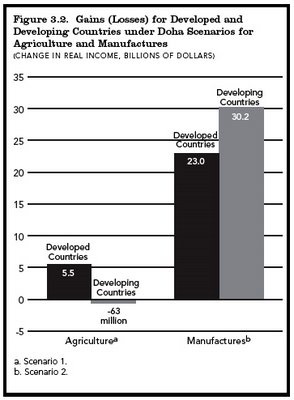
Welcome to the upside-down world of WTO negotiations!
The reason this happens is that what's good for the EU on aggregate is not what's good for politically influential constituencies in the EU.
In fact, the main source of gains for the EU from an aggricultural deal comes not from gaining access to foreign markets, but merely from being freed from the deadweight of the wasteful tariffs and subsidies to farmers that now weigh down the EU budget. The EU's $90 billion a year common agricultural policy and high tariffs on imported food hurts, first and foremost, EU citizens, who end up paying more in taxes (to pay for subsidies) and more on food (which sells at inflated prices.) By agreeing to withdraw those tariffs and subsidies, the EU could lessen its tax burden, make food cheaper for consumers, and improve the prospects of agricultural exporters in the rest of the world. Everybody wins, right?
Well, no. Not quite. EU farmers definitely lose in such a scenario, and lose big, since they currently get almost half of their revenue from Brussels handouts. It's those farmers who are mobilized against a deal. They're 2% of the EU's population, but they're organized, mobilized, savvy, and have the best lobbyists money can buy. At this point, they more or less own Brussels' trade policy - and they've worked hard to make sure the European Commission adopts a negotiating stance so rigid that no agreement is really possible in the next two weeks. (The same story, more or less, goes for farmers in Japan, South Korea, Norway and Switzerland.)
The other point is that the main gains to be had from a WTO deal are nothing to do with trade negotiations, as such. The developed countries could achieve most of these gains on their own, without having to negotiate with anyone, by just dropping their counterproductive tariffs and subsidies on their own.
Is this screwed up? Well, from an economic point of view, it certainly is. From a political point of view, though, it's perfectly understandable.
Trade reform spreads gains and losses unevenly. If the EU cuts farm tariffs and subsidies, the benefits are evenly spread out between 400 million consumer. But the costs are concentrated among just 8 million farmers. Numerically, the gains to the 400 million consumer are far larger than the losses to the 8 million farmers. But for any individual European consumer the gains are too small to really make a dent, whereas for any individual European farmer the losses are large enough to put them out of business.
Is it surprising that European farmers organize and lobby hard to prevent reform? Not really. Is it really surprising that European consumers can't be bothered? Not really.
Still, the end result is this bizarre state of affairs where EU negotiator work feverishly to stop a deal that would benefit the EU the most, and developing country ministers maneouver feverishly to clinch an agreement that would, on the whole, hurt them.
That Carnegie Endowment paper is pretty explicit on this point: it's the EU and Japan that stand to gain most from a Doha Agreement. Thing is, those are the negotiating partners pushing hardest to stop a deal. Even more strange is the fact that, against conventional wisdom, developed countries would be big winners from an agriculture agreement, while developing countries would lose, in the aggregate, from a farm deal.
Welcome to the upside-down world of WTO negotiations!
The reason this happens is that what's good for the EU on aggregate is not what's good for politically influential constituencies in the EU.
In fact, the main source of gains for the EU from an aggricultural deal comes not from gaining access to foreign markets, but merely from being freed from the deadweight of the wasteful tariffs and subsidies to farmers that now weigh down the EU budget. The EU's $90 billion a year common agricultural policy and high tariffs on imported food hurts, first and foremost, EU citizens, who end up paying more in taxes (to pay for subsidies) and more on food (which sells at inflated prices.) By agreeing to withdraw those tariffs and subsidies, the EU could lessen its tax burden, make food cheaper for consumers, and improve the prospects of agricultural exporters in the rest of the world. Everybody wins, right?
Well, no. Not quite. EU farmers definitely lose in such a scenario, and lose big, since they currently get almost half of their revenue from Brussels handouts. It's those farmers who are mobilized against a deal. They're 2% of the EU's population, but they're organized, mobilized, savvy, and have the best lobbyists money can buy. At this point, they more or less own Brussels' trade policy - and they've worked hard to make sure the European Commission adopts a negotiating stance so rigid that no agreement is really possible in the next two weeks. (The same story, more or less, goes for farmers in Japan, South Korea, Norway and Switzerland.)
The other point is that the main gains to be had from a WTO deal are nothing to do with trade negotiations, as such. The developed countries could achieve most of these gains on their own, without having to negotiate with anyone, by just dropping their counterproductive tariffs and subsidies on their own.
Is this screwed up? Well, from an economic point of view, it certainly is. From a political point of view, though, it's perfectly understandable.
Trade reform spreads gains and losses unevenly. If the EU cuts farm tariffs and subsidies, the benefits are evenly spread out between 400 million consumer. But the costs are concentrated among just 8 million farmers. Numerically, the gains to the 400 million consumer are far larger than the losses to the 8 million farmers. But for any individual European consumer the gains are too small to really make a dent, whereas for any individual European farmer the losses are large enough to put them out of business.
Is it surprising that European farmers organize and lobby hard to prevent reform? Not really. Is it really surprising that European consumers can't be bothered? Not really.
Still, the end result is this bizarre state of affairs where EU negotiator work feverishly to stop a deal that would benefit the EU the most, and developing country ministers maneouver feverishly to clinch an agreement that would, on the whole, hurt them.
A WTO Update
You can always tell when I'm spending less time obsessing about Venezuela and more time working on my dissertation by the volume of posts here. I'm preparing for a conference next months so I've been more or less immersed in WTO land...so this may be as good a time as any to vent on my other topic...
A better time, in fact, since the latest self-imposed WTO deadline is just two weeks away. April 30th is the latest, no joking, this-time-we-mean-it "deadline" to agree a detailed outline for a Doha Round deal. Of course, you could fill a barrel with no joking, this-time-we-mean-it deadlines the WTO has set itself and then missed - but there are good reasons to think the April 30th deadline is more real than most.
President Bush's "fast-track authority" is set to expire in June 2007 and there's no prospect of renewal. The conventional wisdom is that if the April 30th deadline slips, there will be no time to work out a complete deal by summer 2007, which would send the whole negotiating round into a kind of limbo until less protectionist winds start blowing in Washington.
At the moment, there's no sign of a last minute breakthrough...which suits me just fine, last thing I need is these jokesters throwing my research into chaos by signing a deal while I'm spell-checking my final draft.
This latest deadlock is not particularly new. The last round of negotiations went through two near-death experiences very much like this one (one in 1989, then again in 1991) before finally emerging in 1994 - nine years after negotiations had been launched. The current round, which was launched in 2001, looks to take at least as long, if not longer.
It's an odd place to hang out, WTO land. The thing that really strikes me, as I go about my research, is the huge gap between how important people generally assume the WTO to be and how important it actually is. Frankly, if I chose to do a dissertation about it it's because I also figured the WTO was a big deal, but the deeper you get into the numbers, the more you wonder what the immense fuss is about.
Exhibit A is this increasingly infamous paper by Berkeley economist Andrew Rose. The guy ran an immense trade data set through a standard Gravity Model and found, to the embarrassment of trade diplomats near and far, that the WTO and its predecessor, the GATT, have made no difference at all in expanding trade. Published in the most prestigious Economics journal there is - the American Economic Review - and therefore checked, re-checked, peer-reviewed, and re-peer-reviewed to within an inch of its life - it can hardly be dismissed as shoddy scholarship.
Actually, a bit of a cottage industry seems to be springing up around Rose's paper, as economists try to poke holes in it and salvage the notion that, y'know, the WTO isn't just a colossal waste of everyone's time. As far as I know, Rose's findings have yet to be disproved.
Exhibit B is this report by the Carnegie Endowment for International Peace, and more broadly, the family of Applied General Equilibrium (AGE) models economists use to simulate the likely impact of a trade agreement. These are, basically, fantastically complicated systems of equations meant to approximate the operation of the world economy based on standard, neoclassical assumptions of perfect competition and constant returns to scale. The Carnegie research suggests that a successful Doha Round deal would expand worldwide economic welfare by $40 to $60 billion per year.
That sounds like a lot of money, but when you figure it in relative terms, you realize we're talking about 0.15-0.20% of world income. That's a fifth of a penny on the dollar! Even in the (totally unrealistic) scenario of full trade liberalization (i.e. zero tariffs and quotas for all products in all markets) we're still talking about just a 0.53% boost in world GDP. The World Bank's model, which seeks to capture dynamic efficiency gains as well as static gains, puts the income boost from full liberalization at just under 1% of world GDP, and gains from a plausible Doha deal at about 0.35%. However you tweak the model, these are not large numbers.
Surely, it's possible to pick nits with these models - which don't consider service liberalization or intra-industry trade arising from imperfect competition and increasing returns to scale. But then, nobody can figure out a way to put numbers to those things. For all their faults, the AGE models are the best models we have, and together with Rose's historical research they tell a fairly convincing and consistent story: you can credit the WTO for preventing the sort of cataclysmic collapse in world trade flows we saw in the 1930s, you can credit it for bringing a measure of institutional predictability to world trade, but you can't argue it has made (or is likely to make) a big difference in the world economy, whether for better or for worse.
Which, of course, brings us back to the start of the post...if a Doha Round agreement is likely to make little if any difference to the world economy, why do soooo many people get so fantastically hot-under-the-collar about the WTO? I think the answer hinges on two facts: first, while on aggregate the WTO doesn't make much difference, for a few specific people working in a few specific industries in a few specific countries it does make a big difference, and second, those people have strong incentives to try to persuade the rest of us that the sky will cave in if the WTO does (or doesn't) reach a new agreement.
At the same time, the WTO's grandiloquent title tends to make it sound far weightier than it really is - would there really be massive street protests if the organization had been named more descriptively? Would Seattle had been trashed to protest a meeting of the International Standing Committee for the Partial Harmonization of Tariffs and Other Trade Practices? I doubt it.
(But then, would I have chosen to write a dissertation on such a body??...hmmmm...better not go there...)
A better time, in fact, since the latest self-imposed WTO deadline is just two weeks away. April 30th is the latest, no joking, this-time-we-mean-it "deadline" to agree a detailed outline for a Doha Round deal. Of course, you could fill a barrel with no joking, this-time-we-mean-it deadlines the WTO has set itself and then missed - but there are good reasons to think the April 30th deadline is more real than most.
President Bush's "fast-track authority" is set to expire in June 2007 and there's no prospect of renewal. The conventional wisdom is that if the April 30th deadline slips, there will be no time to work out a complete deal by summer 2007, which would send the whole negotiating round into a kind of limbo until less protectionist winds start blowing in Washington.
At the moment, there's no sign of a last minute breakthrough...which suits me just fine, last thing I need is these jokesters throwing my research into chaos by signing a deal while I'm spell-checking my final draft.
This latest deadlock is not particularly new. The last round of negotiations went through two near-death experiences very much like this one (one in 1989, then again in 1991) before finally emerging in 1994 - nine years after negotiations had been launched. The current round, which was launched in 2001, looks to take at least as long, if not longer.
It's an odd place to hang out, WTO land. The thing that really strikes me, as I go about my research, is the huge gap between how important people generally assume the WTO to be and how important it actually is. Frankly, if I chose to do a dissertation about it it's because I also figured the WTO was a big deal, but the deeper you get into the numbers, the more you wonder what the immense fuss is about.
Exhibit A is this increasingly infamous paper by Berkeley economist Andrew Rose. The guy ran an immense trade data set through a standard Gravity Model and found, to the embarrassment of trade diplomats near and far, that the WTO and its predecessor, the GATT, have made no difference at all in expanding trade. Published in the most prestigious Economics journal there is - the American Economic Review - and therefore checked, re-checked, peer-reviewed, and re-peer-reviewed to within an inch of its life - it can hardly be dismissed as shoddy scholarship.
Actually, a bit of a cottage industry seems to be springing up around Rose's paper, as economists try to poke holes in it and salvage the notion that, y'know, the WTO isn't just a colossal waste of everyone's time. As far as I know, Rose's findings have yet to be disproved.
Exhibit B is this report by the Carnegie Endowment for International Peace, and more broadly, the family of Applied General Equilibrium (AGE) models economists use to simulate the likely impact of a trade agreement. These are, basically, fantastically complicated systems of equations meant to approximate the operation of the world economy based on standard, neoclassical assumptions of perfect competition and constant returns to scale. The Carnegie research suggests that a successful Doha Round deal would expand worldwide economic welfare by $40 to $60 billion per year.
That sounds like a lot of money, but when you figure it in relative terms, you realize we're talking about 0.15-0.20% of world income. That's a fifth of a penny on the dollar! Even in the (totally unrealistic) scenario of full trade liberalization (i.e. zero tariffs and quotas for all products in all markets) we're still talking about just a 0.53% boost in world GDP. The World Bank's model, which seeks to capture dynamic efficiency gains as well as static gains, puts the income boost from full liberalization at just under 1% of world GDP, and gains from a plausible Doha deal at about 0.35%. However you tweak the model, these are not large numbers.
Surely, it's possible to pick nits with these models - which don't consider service liberalization or intra-industry trade arising from imperfect competition and increasing returns to scale. But then, nobody can figure out a way to put numbers to those things. For all their faults, the AGE models are the best models we have, and together with Rose's historical research they tell a fairly convincing and consistent story: you can credit the WTO for preventing the sort of cataclysmic collapse in world trade flows we saw in the 1930s, you can credit it for bringing a measure of institutional predictability to world trade, but you can't argue it has made (or is likely to make) a big difference in the world economy, whether for better or for worse.
Which, of course, brings us back to the start of the post...if a Doha Round agreement is likely to make little if any difference to the world economy, why do soooo many people get so fantastically hot-under-the-collar about the WTO? I think the answer hinges on two facts: first, while on aggregate the WTO doesn't make much difference, for a few specific people working in a few specific industries in a few specific countries it does make a big difference, and second, those people have strong incentives to try to persuade the rest of us that the sky will cave in if the WTO does (or doesn't) reach a new agreement.
At the same time, the WTO's grandiloquent title tends to make it sound far weightier than it really is - would there really be massive street protests if the organization had been named more descriptively? Would Seattle had been trashed to protest a meeting of the International Standing Committee for the Partial Harmonization of Tariffs and Other Trade Practices? I doubt it.
(But then, would I have chosen to write a dissertation on such a body??...hmmmm...better not go there...)
April 14, 2006
Propagandizing the Chavista Party/Government/State/Nation
 I hadn't seen this when I wrote yesterday's post, but this photo-rant (in Oil Wars, of all places) nicely illustrates the collapse of the distinctions between party, government, state and nation (and leader) I was criticizing...
Novelties
I've updated the links column with some deliciously incriminating Chavez-hugs-a-tyrant pics, and added a link in the Reader's Guide to this very lucid piece on Chavez in the May 2006 issue of The Atlantic. I also added a link to yesterday's post - since everyone seemed to like it, and I did as well.
April 13, 2006
III. The "democratic revolution" is a contradiction in terms
Democracy implies a clear delineation of the conceptual boundaries between "party," "government," "state," and "nation."
Democracy conceives of the state as the institutional incarnation of the nation, something larger and more permanent than the government. The state is led but not owned by the government. The government is led but not owned by the party in power.
Democracy conceives of politics as the realm of legitimate competition between parties for temporary control of the government. In a democracy, governments come and go but the state is permanent, because it transcends partisan differences - understood as normal and healthy - and accomodates the periodic changes in control of the government that naturally result from elections.
Revolution, as Chavez understands it, is a refutation of this understanding. It starts from a rejection of the conceptual differentiation between party, government, state and nation. It express itself in the drive to establish permanent control over the government, the state and the nation while flattening the conceptual boundaries between the them. This process takes place both on a symbolic and a substantive level.
Symbolically, Chavez has mixed partisan with national symbols from the start. By adopting the Libertador's name, his original political vehicle - the Bolivarian Revolutionary Movement - broke the long established norm that lifted Bolivar, the primary symbol of a unitary national identity, above the partisan fray.
Once in power, the co-optation of Bolivar's name for partisan purposes reached undreamed of new heights, from the subtle process that has made the word "bolivariano" basically synonymous with "chavista" to the decision to stick the now hyper-politicized word in the country's official title.
"Bolivarianism" - for 150 years the glue that held together our national identity - has morphed into a locus of official partisan identification, while remaining a locus of national identity. This process tends to meld partisan loyalty with patriotism, undermining the possibility of a non-partisan national identification. Dissenters are left without even a country they can call their own - literally, since the politization of bolivarianism turned "Republica Bolivariana de Venezuela" more into a provocation than a description.
Later, the revolution moved to strip away the neutrality of even the most basic symbols of national allegiance, politicizing the nation's flag and its coat of arms. (Can the National Anthem be far behind?) Time and time again, loci of identification that had served to bind the nation together have been turned into symbolic wedges, into instruments for the delegitimation of dissent and the marginalization of dissenters. Hand in hand with this process, the revolution works to transform the unquestioning acceptance of Chavez's every utterance from a free expression of opinion into a litmus test of patriotic allegiance.
So the cries of "traitor" and "vendepatria" increasingly launched against those who dissent are in no way coincidental: they're the logical outcome of the conceptual flattening at the center of the revolution. In the chavista imagination, party, government, state and nation have been melded into a single undifferentiated soup. Having erased those distinctions, chavistas have lost sight the notion, fundamental to democracy, that citizens can oppose the government without opposing the state, or object to the party without betraying the nation. It is not surprising that, swimming in the undifferentiated conceptual stew that is the revolutionary party/government/state/nation nexus, chavistas cannot recognize the distinction between disagreement and treason.
On the substantive level the revolution also seeks to stamp its mark permanently on the instruments of state power in ways that further flatten the conceptual distinctions that sustain democracy. State resources are used openly and systematically for partisan purposes. Courts come to serve the revolution rather than the state - a political rather than a national project. PDVSA is turned into an appendage of Chavez's political program. The Armed Forces morph slowly but surely into a pretorian guard, where loyalty to the party becomes indistinguishable, to participants, from loyalty to the nation.
On both the symbolic and the substantive level, these revolutionary moves are in direct contradiction with the conceptual apparatus that sustains democracy. They are intended to negate the possibility of alternance. They do so by erasing the conceptual distinctions that give meaning to the democratic process, to the process of partisan competition for control over the government within the context of a permanent, transcendent state conceived as the institutional expression of the unity of the nation. As such, revolutionary values strike at the heart of democratic system. Flattening the distinction between party, government, state and nation, they leave any future government in the position of having to lead an explicitly chavista state, of commanding an Armed Force that conceives of itself as the protector of the revolution, of governing through a personalized bureaucracy, under a flag and coat-of-arms willfully manipulated into symbols of chavista hegemony.
Democracy conceives of the state as the institutional incarnation of the nation, something larger and more permanent than the government. The state is led but not owned by the government. The government is led but not owned by the party in power.
Democracy conceives of politics as the realm of legitimate competition between parties for temporary control of the government. In a democracy, governments come and go but the state is permanent, because it transcends partisan differences - understood as normal and healthy - and accomodates the periodic changes in control of the government that naturally result from elections.
Revolution, as Chavez understands it, is a refutation of this understanding. It starts from a rejection of the conceptual differentiation between party, government, state and nation. It express itself in the drive to establish permanent control over the government, the state and the nation while flattening the conceptual boundaries between the them. This process takes place both on a symbolic and a substantive level.
Symbolically, Chavez has mixed partisan with national symbols from the start. By adopting the Libertador's name, his original political vehicle - the Bolivarian Revolutionary Movement - broke the long established norm that lifted Bolivar, the primary symbol of a unitary national identity, above the partisan fray.
Once in power, the co-optation of Bolivar's name for partisan purposes reached undreamed of new heights, from the subtle process that has made the word "bolivariano" basically synonymous with "chavista" to the decision to stick the now hyper-politicized word in the country's official title.
"Bolivarianism" - for 150 years the glue that held together our national identity - has morphed into a locus of official partisan identification, while remaining a locus of national identity. This process tends to meld partisan loyalty with patriotism, undermining the possibility of a non-partisan national identification. Dissenters are left without even a country they can call their own - literally, since the politization of bolivarianism turned "Republica Bolivariana de Venezuela" more into a provocation than a description.
Later, the revolution moved to strip away the neutrality of even the most basic symbols of national allegiance, politicizing the nation's flag and its coat of arms. (Can the National Anthem be far behind?) Time and time again, loci of identification that had served to bind the nation together have been turned into symbolic wedges, into instruments for the delegitimation of dissent and the marginalization of dissenters. Hand in hand with this process, the revolution works to transform the unquestioning acceptance of Chavez's every utterance from a free expression of opinion into a litmus test of patriotic allegiance.
So the cries of "traitor" and "vendepatria" increasingly launched against those who dissent are in no way coincidental: they're the logical outcome of the conceptual flattening at the center of the revolution. In the chavista imagination, party, government, state and nation have been melded into a single undifferentiated soup. Having erased those distinctions, chavistas have lost sight the notion, fundamental to democracy, that citizens can oppose the government without opposing the state, or object to the party without betraying the nation. It is not surprising that, swimming in the undifferentiated conceptual stew that is the revolutionary party/government/state/nation nexus, chavistas cannot recognize the distinction between disagreement and treason.
On the substantive level the revolution also seeks to stamp its mark permanently on the instruments of state power in ways that further flatten the conceptual distinctions that sustain democracy. State resources are used openly and systematically for partisan purposes. Courts come to serve the revolution rather than the state - a political rather than a national project. PDVSA is turned into an appendage of Chavez's political program. The Armed Forces morph slowly but surely into a pretorian guard, where loyalty to the party becomes indistinguishable, to participants, from loyalty to the nation.
On both the symbolic and the substantive level, these revolutionary moves are in direct contradiction with the conceptual apparatus that sustains democracy. They are intended to negate the possibility of alternance. They do so by erasing the conceptual distinctions that give meaning to the democratic process, to the process of partisan competition for control over the government within the context of a permanent, transcendent state conceived as the institutional expression of the unity of the nation. As such, revolutionary values strike at the heart of democratic system. Flattening the distinction between party, government, state and nation, they leave any future government in the position of having to lead an explicitly chavista state, of commanding an Armed Force that conceives of itself as the protector of the revolution, of governing through a personalized bureaucracy, under a flag and coat-of-arms willfully manipulated into symbols of chavista hegemony.
April 12, 2006
II. The "democratic revolution" is a contradiction in terms
The essence of a revolutionary regime is permanence. The essence of a democratic regime is alternance. "No volverán" is the essential revolutionary slogan - the ideological rejection of the possibility of alternance. A regime founded on the promise of "no volverán" incubates skepticism about its commitment to democracy.
The prominence of "no volverán" as a chavista slogan explains much of the opposition's basic unwillingness to believe in this or any other chavista appointed elections authority. "After all," their thinking goes "they have already announced it clearly - no volveremos." Seen in this light, any and every CNE concession is a sop to international opinion. The radical opposition sees the revolution as purely revolutionary, the "democratic" part as little more than window-dressing.
I think that's a mistake. The tension encapsulated in the oxymoron is the defining characteristic of chavismo. The government long ago decided that its ultimate goals can only be met if Chavez can retain some minimally plausible claim to democratic legitimacy. Without the strategic ambiguity embodied in the phrase, chavismo would not be chavismo.
The opposition, by withdrawing from the vote, has tried to force the government's hand, to push it into resolving the tension between democracy and revolution by becoming frankly and exclusively revolutionary (and thereby, anti-democratic.) That is a trap the government has not and will not fall into.
The balancing act the government is pushed to attempt is necessarily precarious - although that's momentarily obscured by the oil bonanza. Absent the petrowindfall, the tensions inherent in chavismo's foundational oxymoron will become harder and harder to manage. The only question is whether the opposition will be in any way able to capitalize on those difficulties when the time comes.
The prominence of "no volverán" as a chavista slogan explains much of the opposition's basic unwillingness to believe in this or any other chavista appointed elections authority. "After all," their thinking goes "they have already announced it clearly - no volveremos." Seen in this light, any and every CNE concession is a sop to international opinion. The radical opposition sees the revolution as purely revolutionary, the "democratic" part as little more than window-dressing.
I think that's a mistake. The tension encapsulated in the oxymoron is the defining characteristic of chavismo. The government long ago decided that its ultimate goals can only be met if Chavez can retain some minimally plausible claim to democratic legitimacy. Without the strategic ambiguity embodied in the phrase, chavismo would not be chavismo.
The opposition, by withdrawing from the vote, has tried to force the government's hand, to push it into resolving the tension between democracy and revolution by becoming frankly and exclusively revolutionary (and thereby, anti-democratic.) That is a trap the government has not and will not fall into.
The balancing act the government is pushed to attempt is necessarily precarious - although that's momentarily obscured by the oil bonanza. Absent the petrowindfall, the tensions inherent in chavismo's foundational oxymoron will become harder and harder to manage. The only question is whether the opposition will be in any way able to capitalize on those difficulties when the time comes.
April 11, 2006
I. The "democratic revolution" is a contradiction in terms
At the center of the Chávez Revolution we have a contradiction in terms. In democracies dissent is healthy, alternance the norm. In revolutions dissent is treason, alternance impossible. You can be democratic or you can be revolutionary. You can't be both.
The strategic ambiguity inherent to this oxymoron is unsustainable. Chavez has been particularly successful at maintaining the fiction that the two concepts can co-exist within a single political project. They can't.
The strategic ambiguity inherent to this oxymoron is unsustainable. Chavez has been particularly successful at maintaining the fiction that the two concepts can co-exist within a single political project. They can't.
April 10, 2006
20 points for Borges

Katy says: A few weeks ago, Quico asked me to post my thoughts on why I think Julio Borges is the best of the current group of non-Chavista pretenders. At the time, I hand’t really thought of Borges as superior to the other contenders (Petkoff, Rosales and Smith) because I believe any one of these four would do a better job than our friend Hugo. I did think, though, that Borges was being underestimated by non-Chavista talking heads. As I thought about this post, I concluded that Borges, like recent polls are showing, is indeed the leader of the non-chavista pack. What follows are 20 reasons why I believe this to be true.
- Borges is, at heart, a philosopher. Chávez is a military man. Two disciplines cannot be more different.
- Borges’s father was a prominent Valencian neurologist, and his mother a Catalan immigrant and a well-respected bioanalyst. Julio, the youngest of five siblings, was educated at Don Bosco and San Ignacio schools in Caracas – quite a distance from Chavez’s rural upbringing in Sabaneta de Barinas. Although some might construe his upper middle-class upbringing as a handicap in reaching out to poorer voters, Borges is working hard to prove them wrong.
- Unlike Chávez and many of the people governing with him, Borges attended university. Borges went on to study law at UCAB, philosophy at UCV and Boston University, and public policy at Oxford.
- Whereas Chavez’s character was shaped in the halls of the Military Academy and in the remnants of defunct guerrilla movements during Venezuela’s most prosperous and corrupt period, Borges’s character was formed in the student movements that propped up during the disastrous years of the end of the 1980s. His distaste for what the military did in 1989 and 1992 helped make him a firm believer in civilian control of the Armed Forces.
- Among the field of candidates, Borges is the sole representative of the post-Black Friday generation, one that, in his words, “was born in a crisis, grew up hearing about the crisis and now lives and raises its children in the midst of a crisis.” Borges has been trying to frame Venezuela’s current woes as the failure of an entire generation, Chávez included. He has a point.
- While some highbrow analysts derided the TV Show that made him famous, Justicia Para Todos, the show actually won international awards, and people in the barrios still remember him for it. In fact, lower-class voters participating in focus groups have identified Borges as having a strong character, in part because they recall Borges’s alter ego in Radio Rochela, where the fake judge would throw his hammer in anger at the people in the court. And yet the show was not meant to be a vehicle for Borges’s personality; it was meant to be a way to bring, through the use of mass media, the idea of justices of the peace to people that have never had access to justice. It seems to have served its purpose well.
- In recent focus groups, lower-middle class voters have been asked to describe Borges, and the word that keeps coming up is “arrecho”, a Venezuelan slang-word meaning "daring" or "with a strong character". They have also described him as fair and decisive.
- One of the factors that distinguishes Borges’s candidacy from the others is that it is rooted in a process to form a political party out of the ashes of the IVth Republic. Primero Justicia understand the links between the decline of Venezuelan democracy and the decline of political parties: traditional parties fell prey to rent seeking and corruption and ceased being agents for change and progress. However, it sees the demise of all political parties as a step backward for our democracy. Instead of the chavista phenomenon, that sees in a populistic, caudillesque and military “movement” the solution, Primero Justicia is a civilian political party, with multiple leaders, tendencies and yes, even infights. Right now, it is perhaps the only relevant political party in Venezuela. (Side note: inside sources from within the party tell me the rift between Borges’s group and the Leopoldo López/Liliana Hernández faction is serious, although getting better).
- Because of his background and personality, Borges can be portrayed as aloof, elitist and a bit snobbish. While none of this is true, Borges understands that as long as his enemies from either side of the spectrum are the ones portraying him on the media, he doesn’t stand a chance. This realization, along with the need to differentiate Primero Justicia from the rest of the opposition pack, has led him to take to the streets and start meeting people face-to-face, bringing his message of "Popular Progress" and his persona to let voters form their own opinion about him.
- Borges’ proposals are rooted in sensible economic and social policy. Although the campaign is young and government programs have not been made public, we already have some information on Borges’s proposals for the country.
- The cornerstone of Primero Justicia’s program is a deep reform of the justice system, with an increase in the number of judges, an expansion in the number of justices of the peace, and transparent mechanisms for naming and overseeing judges. The cornerstone of the chavista justice project is politicized judges few in number and in temporary positions. Organizations such as Human Rights Watch have warned of the dangers of the chavista stranglehold of the judiciary. Primero Justicia understands that the first step towards creating a civilized society that can provide progress for all, is having an accesible and impartial justice system.
- Borges’s program will focus on improving current “Misiones” so that they do not exclude people on the basis of their political beliefs. Surprisingly, polls by Greenberg Research, among others, have found this to be the issue most likely to appeal to swing voters.
- Borges is the only major candidate proposing a radical reform of oil production and the way it benefits people. Borges favors increasing Venezuela’s oil production under the sensible notion that the only way the country will develop is by producing more of what we do best. In theory, Chávez also favors increasing production, as witnessed by several PDVSA expansion plans he has announced over the years but so far failed to implement.
- Borges is the only candidate currently proposing direct cash layouts to all Venezuelans from excess oil profits. Borges believes that these funds could be used to set up a working national pensions system. They could also be used to fund youth training and universal health care. As the Constitution says, oil belongs to the people, not the State, and Borges believes it’s time to start taking this seriously.
- For several years now, Primero Justicia has been proposing legislation to tackle the high unemployment levels of the past seven years, including incentives to hire young people and women. This also includes an emphasis on favoring labor-intensive sectors such as construction and tourism. Chavista congressmen have duly shelved PJ’s legal initiatives, and the result has been double-digit unemployment for more than five years now.
- Borges favors massive title holding for barrio dwellers, as well as giving away or selling highly valued government land to those who need it most. One of Primero Justicia’s main criticisms of the government (and in this they have been almost unique) is that the “deeds” or “titles” it occasionally gives out to slum-dwellers are not really transfers of property rights, but rather a primitive form of leasing. In part based on the influential work of people like Hernando de Soto, Primero Justicia believes that unless we are able to bring the enormous capital of our informal sector into formal society, underpriviledged classes will never find their way up.
- Borges has been the only candidate so far to embrace the idea of primaries for opposition candidates. He believes in unity, but he also believes this unity should come from the people, not from backroom dealings between political parties with self-appointed bargaining power and no voters.
- Borges’s role in the opposition has been marked by complicated decisions. In a move that probably halted the rise of his party, Borges and company decided to join forces with Fourth Republic dinosaurs like Pompeyo Márquez, Henry Ramos Allup and Enrique Mendoza in the now extinct Coordinadora Democrática. In spite of Primero Justicia representing a break both from chavismo and from parties such as AD and Copei, PJ was instrumental in forging unified candidates for the National Assembly. In spite of their uneasiness with old-style politicians, they have always been willing to play the unity card. This gives them ample room to be able to forge alliances in the future, an essential condition for post-Chávez governability.
- Borges does not believe that arguing with the CNE should be the main focus of non-Chavista candidates. He knows that any negotiation with the current or future CNE is useless unless one has real popular support. In that sense, his current strategy of forging ahead with his campaign while at the same time embracing Sumate’s conditions for electoral transparency is the correct one.
- Borges in understated and unassuming. When I met him during our mutual years at UCAB, he seemed to be driven, intellectual and somewhat shy. He was not given to petty small talk, nor is he one who likes to hear the drone of his own voice for hours. It is hard to imagine him conducting a six-hour edition of Aló, Presidente.

Subscribe to:
Posts (Atom)