It's always a nice day behind the keyboard when you're implicated in a transnational conspiracy. Yesterday, Julio Makarem and Ricardo Valbuena - of North American Opinion Research (in)fame(y), published a rambling, menacing, two page ad in Ultimas Noticias and El Nacional denouncing Alek Boyd and Gustavo Coronel (plus assorted hangers on) of all kinds of nasty things for reporting on their shoddy, shoddy operation.
As self-justification, the ad is counterproductive enough to make you weep: crammed full of chavista buzzwords and rhetorical flourishes ("parlamentarismo de calle," the "illusion of democracy under puntofijismo," etc. etc.) and flouting their official connections (by demanding a parliamentary investigation and a personal meeting with Chavez) Makarem and Valbuena do a much better job than their critics ever could at proving what we've been saying all along: that they're dyed-in-the-wool chavistas.
As intimidation, the ad is more than hopeless. Whether you love his writing or hate it (or, as I do, both) - one thing is clear: you won't get Alek off your back with this kind of shenanigan. Having earned a permanent spot on his shit list, Makarem and Valbuena can now look forward to years of further research published on VCrisis. Same goes for Gustavo...
Public relations management doesn't get much more self-defeating than this. Makarem and Valbuena work off the maxim that if you get stung by a wasp, you get a club, follow it back to its nest, and whack it. Breathing new life into a story that would have died of disinterest all by itself, they get half of Noticiero Digital up in arms about it, major gringo blogs noting it, and, of course, many more journalists aware of the story.
Thanks, guys! When it comes to discrediting your own "polling" y'all are way more effective than the oppo's English-language blogosphere...
My, my. For sure the funnest thing to come out of this absurd little hubbub is this piece in Miami's El Nuevo Herald, where Gerardo Reyes checks out the address NAOR lists as its main office in the States, only to be met with blank stares by the office workers there. Hillarity ensues when Carlos Sanchez, NAOR's chief hack back in Caracas, shrugs the whole thing off, saying he only deals with the Latin American "side" of the business (as though there were another "side") and so can't comment on the fact that his company's headquarters doesn't exist. (For the Spanish readers out there, Reyes's piece really is required reading.)
NAOR's hackistry really is appalling, but sometimes I almost feel for them. Maybe these guys are just really unlucky - starting with the fact that they picked that name for a pro-Chavez mystery-pollster just before El Supremo recast his entire rhetorical arsenal around a denunciation of all things North American. Man! That's just bad luck.
Bad, however, doesn't even begin to describe the web-design NAOR hired to skirt the charge that they didn't even have a damn website. Registered just over a month ago, NAOR's new website just about makes your eyes bleed in the process of transmitting virtually no information. That awful, awful beeping! Plus, just to add to the already thick web of their government connections, they hired the same web-designer behind National Assembly TV. Dig dig, dig dig...
There are any number of angles you could take on this little saga. I should probably excorciate Alek for undermining the credibility of his own research by weighing it down with random insults and deliciously juicy but rumor-based little morsels that, even if true, he probably can't prove. (Why speculate when you have them by the cojones?!) I could follow up on the UCV social scientists tracking NAOR's activities. I might decry the fact that it is these unpollsters that Jorge Rodriguez cites to prove that no, really, the country really does trust him, or track down some more material on Makarem clan's assorted other business ventures.
For now, though, I'll just bask in NAOR's total credibility self-destruct.

March 10, 2006
March 9, 2006
Some rhetorical questions nobody seems to ask...
What I'm getting at is that Opposition politicos seem to have a warped understanding of what a political party is.
A political party is supposed to be an institutional mechanism that alligns and coordinates the political activities of broad sectors of society sharing a basic vision even if, unsurprisingly, its members disagree on various points.
In order to aggregate their strengths, party members come to understand that they have to accept a measure of discipline, a broad commitment to cooperate, to sing from a single hymn sheet even if they might each quibble with some of the notes. This doesn't mean that they contract-out their judgment to party leaders, or that they stop discussing their disagreements. It means that they agree to process their disagreements through an institutional mechanism that prevents their petty disputes from impairing their collective ability to act effectively in the broader political sphere.
For these reasons, in most Western countries politicians understand that for a political party to be at all effective, it needs to be broad. Ken Livingstone can share a political party with Tony Blair, Dennis Kucinich with Joe Lieberman, and Felipe Gonzalez with Rodriguez Zapatero.
Does that mean they stop disagreeing? No. It means that they understand that, on balance, their agreements outweigh their disagreements and that the benefits, in terms of political effectiveness, they get from processing their disagreements inside a single organization outweigh the costs of fragmentation.
This line of reasoning just doesn't seem to occur to the Venezuelan Opposition, where parties proliferate not because their leaders disagree on anything substantial, but simply because each would rather be a bigger fish in a smaller pond than a smaller fish in a bigger pond.
The costs of this attitude, in terms of disorganization, disaggregation, mixed messages, wasteful bickering, intra-coalition competition and overall incoherence barely figure in their calculation. So parties proliferate ad infinitum, with a cacique-to-indio ratio that increases exponentially until none of the parties is able to be at all effective...or even to exist, in any meaningful sense, beyond the confines of a TV studio.
It's hardly surprising that a political opposition "organized" in this way can't lead the anti-Chavez movement, and ends up, instead, reacting to waves of opinion it can't control.
My point in raising these questions - especially the last one - is that Chavez is a big, big problem - so big, in fact, that the obsessive concern with attacking his government stiffles debate on a series of lesser, but still very important problems - like the little matter of the self-defeating fragmentation of opposition parties. It's always more comfortable for an Antonio Ledezma or a Cesar Perez Vivas to rant against Chavez than to question the crazy structure of the opposition.
So they don't. And we don't. And so we're ineffective...in great part, because we can't be bothered to sort out a political organization within the anti-Chavez camp that might make us effective.


March 7, 2006
Teodoro and South Korea
Today's Tal Cual editorial brought a smile to my face. Fresh from a trip to South Korea, Teodoro Petkoff develops a serious reflection on development strategies, and begins to sketch out the policies that could address Venezuela's deep structural problems.
Emerging from the abyssIn this editorial, Teodoro shows himself as a transformational thinker - not someone who'll be content with tinkering around the edges of povert or managing our abysmal backwardness, but someone with a vision to transform the country into a radically different, more prosperous, more human place. Thinking about South Korea, thinking about what it takes to turn a poor country into a rich country is what we need to resist the tyranny of low aspirations, to the depressing myopia of revolutionaries who aspire only to redistributing too small a cake rather than working to generate enough wealth for all. Even posing the question in these terms is a radical departure for a Venezuelan politician, and a necessary one at that...
In 1950 South Korea had a per capita income below $100 per year. At the time, ours was around $3,000. Today, the income per head in that Asian country is about $15,000 and we are, if we exclude the recent oil windfall years, more or less where we were half a century ago. Since then, Korea has had to overcome the devastating consequences of the three years of war that set its two halves against one another, and now operates as one of the small powers of the world economy.
Without oil, without iron, without bauxite, it has a cutting age heavy naval industry which puts out the largest ships that travel the world's seas; its automotive industry is world class and Korean cars travel every road in the world; its electronics industry is among the best in the world. Incidentally, South Korea spends 3% of its GDP on science and technology.
That's one of the secrets of its success. Its stunning infrastructure and the millions of homes built at an astounding rate speak of the country's dynamism, where poverty levels are also among the lowest in the world.
It's worth pointing to the sense of nationhood, of national purpose, that gave continuity over decades to an economic policy based on a strong state, a disciplinary state, that set out great national goals and set out the means to achieve them, stimulating that which became, over time, a powerful private sector, guided by state policies towards the world market. South Korea faced up to globalization and did it with particular success.
No doubt there are problems, but the contrast between what happened in that small Asian country and what has happened in ours over the last half century is too striking not to spark in depth reflection about ourselves. Especially now, when our country, again flooded with unimaginable financial resources, heads once again towards wasting an opportunity to overcome our backwardness, poverty and weakness.
A trip to South Korea reaffirms our conviction that if others can take on the road to development, it is within our reach also. But first of all, we need a sense of national purpose, an encompassing accord that sharpens all our strengths and takes advantage of our immense possibilities.
And then they were ten...
Well, the 10 "civil society representatives" for the CNE Nominations Committee have been picked. Just to review the whole process:
The ten civil society representatives who will sit alongside the 11 chavista Assembly Members on the CNE Nominations Committee are:
As it stands, I count 3 chavistas, 3 or 4 antichavistas (depends how you classify Humberto Mendoza), 1 Ni Ni, and 2 or 3 unknown quantities. This means the ultimate CNE Nominations Committee will have at least 14 chavistas (the 11 AN members plus Muziotti, Guerrero Quintero and di Stefano.)
The government is clearly in the driver's seat here. It would take an ocean of naïveté to think the Assembly would select a CNE board Chavez doesn't approve of - a movement that has explicitly attacked the representative role of the Assembly and promoted loyalty to the leader as the cardinal political virtue cannot seriously be expected to make a decision this sensitive without at least his tacit approval. After all, Chávez es el pueblo.
So after this whole byzantine rigmarole, we're more or less where we've been all along: does Chavez want a broadly acceptable CNE, or does he prefer to run alone? It's his call to make...
- First, the National Assembly selects a Preliminary Committee of Assembly Members to select Civil Society's representatives on the CNE Nominations Committee. (Done.)
- That Preliminary Committee solicits input from civil society organizations for people to sit on the CNE Nominations Committee. (Done)
- The Preliminary Committee checks the people suggested by civil society to serve on the CNE Nominations Committee and drafts a preliminary list of vetted candidates. (Done)
- The National Assembly selects ten people from the list drafted by the Preliminary Committee to serve as Civil Socety representatives on the CNE Nominations Committee (this happened yesterday.)
- Those ten Civil Society representatives sit on the CNE Nominations Committee alongside 11 National Assembly Members. (This is the next step.)
- The 21-member CNE Nominations Committee solicits civil society for possible CNE board members.
- The CNE Nominations Committee picks a short-list of qualified, impartial candidates for the CNE board
- Chavez chooses the five he likes best. (OK, ok, officially the National Assembly selects five names from the CNE Nominations Committee's short-list by a two-thirds majority, but lets get real here.)
The ten civil society representatives who will sit alongside the 11 chavista Assembly Members on the CNE Nominations Committee are:
- Antonieta di Stefano, chavista, Misión Cultura bureaucrat.
- Orlando González, no Google Trail.
- Alberto Lovera De Sola, opposition, sifrino civil society activist and anti decree-1011 agitator.
- José Luis Machado, opposition, one-time deputy chairman of the Lara State Bar (Colegio de Abogados.)
- Rafael Madrid Maya, no Google Trail.
- Humberto Rafael Mendoza, ambiguous Google Trail (could he be this Humberto Mendoza, Teodoro Petkoff's lawyer?)
- Gilberto Guerrero Quintero, chavista, former Supreme Tribunal substitute magistrate, expert on leasing law.
- Fernando González Jiménez, antichavista. Skimpy Google trail, but did sign this anti-government petition.
- José Diógenes Muziotti, chavista, nominated to CNE last time around by something called the Frente Bolivariano Popular Unico de Trabajadores y Cesantes Petroleros, Petroquímicos, Metalúrgicos y de la Construcción del Estado Zulia.
- Marlene Robles de Rodríguez, hard to pin-down, but appears Ni-Niish. Chairwoman of the Carabobo State Bar (Colegio de Abogados)
As it stands, I count 3 chavistas, 3 or 4 antichavistas (depends how you classify Humberto Mendoza), 1 Ni Ni, and 2 or 3 unknown quantities. This means the ultimate CNE Nominations Committee will have at least 14 chavistas (the 11 AN members plus Muziotti, Guerrero Quintero and di Stefano.)
The government is clearly in the driver's seat here. It would take an ocean of naïveté to think the Assembly would select a CNE board Chavez doesn't approve of - a movement that has explicitly attacked the representative role of the Assembly and promoted loyalty to the leader as the cardinal political virtue cannot seriously be expected to make a decision this sensitive without at least his tacit approval. After all, Chávez es el pueblo.
So after this whole byzantine rigmarole, we're more or less where we've been all along: does Chavez want a broadly acceptable CNE, or does he prefer to run alone? It's his call to make...
March 6, 2006
Iran-Venezuela trade volume to hit $11b
I don't know what to make of a newsreport that cites the Venezuelan capital as Karakas, but for what it's worth, Mehr News reports the Iranian deputy minister of industries and mines for economic and international affairs thinks bilateral trade between Iran and Venezuela will hit $11 billion:
Construction of two dairy factories and a box-making company, an agricultural MOU, and the contract on cooperation of Iran-Venezuela Chamber of Commerce are other issues agreed by the two parts, he further explained.More
Tehran and Venezuela also inked MOUs on building the plastic parts of automobiles, and establishment of the production line of home appliances, he noted. At the first phase of producing home appliances, 100,000 refrigerators will be produced, followed by other appliances such as washing machines at the next stages, he added.
Shaterzadeh put the current volume of bilateral contracts at $7 billion, stating, “The figure is predicted to be increased to $11 billion by signing the new agreements.”
March 5, 2006
Reading the CNE Nominations Committee Tea Leaves
The process for selecting the five members of Venezuela's National Electoral Council (CNE) is about as convoluted as convoluted gets - it reminds you of nothing so much as the process for selecting Venetian doges. Just to recap how it all works:
Today, the Preliminary Committee completed step 3, handing down a list of 57 vetted civil society candidates for the CNE Nominations Committee. I decided to spend three hours of this lazy Sunday googling them one-by-one.
The punchline: the preliminary list includes 16 chavistas, 11 opposition members and six nominees that are not clearly affiliated with one side or the other. The rest of the list doesn't have a discernible Google Trail.
Highlights from my little Google Hunt:
- First, the National Assembly selects a Preliminary Committee of Assembly Members to select Civil Society's representatives on the CNE Nominations Committee. (Done.)
- That Preliminary Committee solicits input from civil society organizations for people to sit on the CNE Nominations Committee. (Done)
- The Preliminary Committee checks the people suggested by civil society to serve on the CNE Nominations Committee and drafts a preliminary list of vetted candidates. (We are here.)
- The National Assembly selects ten people from the list drafted by the Preliminary Committee to serve as Civil Socety representatives on the CNE Nominations Committee (this is the next step.)
- Those ten Civil Society representatives sit on the CNE Nominations Committee alongside 11 National Assembly Members.
- The 21-member CNE Nominations Committee solicits civil society for possible CNE board members.
- The CNE Nominations Committee picks a short-list of qualified, impartial candidates for the CNE board
- Chavez chooses the five he likes best. (OK, ok, officially the National Assembly selects five names from the CNE Nominations Committee's short-list by a two-thirds majority, but lets get real here.)
Today, the Preliminary Committee completed step 3, handing down a list of 57 vetted civil society candidates for the CNE Nominations Committee. I decided to spend three hours of this lazy Sunday googling them one-by-one.
The punchline: the preliminary list includes 16 chavistas, 11 opposition members and six nominees that are not clearly affiliated with one side or the other. The rest of the list doesn't have a discernible Google Trail.
Highlights from my little Google Hunt:
- The chavistas include Ismael Garcia's Lawyer (Leon Izaguirre) a former MVR mayor of Tinaquillos (Dimas Ramos Cava), and a former "substitute magistrate" of the Supreme Tribunal (Gilberto Guerrero Quintero), as well as a far out Chavista poet (José Humberto Guariguata) and a revolutionary co-op bureaucrat (Samuel Rojas.)
- The oppo group includes a member of Mujeres por Venezuela (Beatriz Barbosa), a Monte Avila University (i.e. Opus Dei) professor (Ernesto Fronjosa), Queremos Elegir co-founder José Cova, the Bandera Roja chairman of the Federacion de Centros Universitarios (Ivan Stalin González Montaño), Asamblea de Educacion's Rodolfo Rico and Momento de la Gente's Cira Romero. Intriguingly, it also includes an Emilio Regalado Pacheco who, his Google Trail suggests, may be a Proveo member. Maybe Alek can tell us more about this guy.
- The Ni-Ni group's most notable member is Antonio París, president of the Universidad Central de Venezuela.
- Some member's of that sad breed - the Google Trail-less - include: Arturo Álvarez Vegas, Esperanza Aquerreta Camacho, Rafael Madriz Maya, Dorys Medina, José Inés Molla, Miriam Josefina Naranjo Ortega, Adan Rafael Navas Nieves, Mary Reina Rojas Serra, Braulio José Romero Barrios, Eliécer Salinas Del Pino, Ismer Romer Serrano Flores, Lucía Patricia Suárez de Gómez, Miguel Ángel Vásquez Gómez, Enrique Vásquez de la Torre, Edgar Rafael Velásquez. If any of those names rings a bell, do write in.
March 4, 2006
The road not taken...
This piece about Lula in the current Economist is absolutely required reading: proof that the democratic left in Latin America can reduce poverty and inequality without oil windfalls, without populist spending binges, without empty grandstanding, without antagonizing the US and without undermining the institutional underpinnings of democracy or prosperity. Instead, Lula has done it by thinking long-term, being humble enough to learn from his mistakes, and adopting policies that make sense:

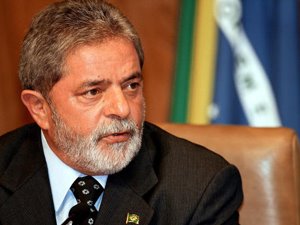
Lula's leapIn fact, the whole piece reads like a catalog of Chavez's wasted opportunities. Read it all.
That the mass of Brazilians seems prepared to overlook the PT's misdeeds suggests that Lula got two big things right: the economy and poverty alleviation. Comparing Brazil's vital indicators when Lula took over with the same ones now “is like looking at two different economies”, says Vinod Thomas, former head of the World Bank in Brazil. In the autumn of 2002, Brazil's currency, the real, plunged, largely because the markets feared Lula's arrival. Inflation, already in double digits, threatened to spike higher and the yield on Brazil's dollar bonds was 25 percentage points above that of American Treasuries. The new government swerved away from disaster. The finance minister, Antonio Palocci, raised the target for the public sector's primary surplus (before interest payments) by half a percentage point to 4.25% of GDP, persuading the markets that Lula could be trusted to pay Brazil's public debt. The central bank steadied the real and raised interest rates to choke inflation.
An economy that swooned every time confidence in emerging markets wobbled now looks steadier. Spurred by a devaluation in 1999 and buoyant demand for commodities, exports have boomed, turning a current-account deficit into surplus. Mr Palocci has used the inflow of dollars to pay off foreign creditors, including the IMF. Soon, Brazil will no longer have to worry about a falling real driving up its debt burden. The risk premium has fallen to a record low of two percentage points.
...
Lula points out that the government has not raised a single tax rate yet. Revenue is up because profits are higher and tax collection is better. As this improves, “we'll be able to reduce the tax burden by cutting rates and expanding the base of contributors”. For Lula, sure growth is worth more than fast growth. “I don't want to grow 10% or 15% a year. I want a lasting cycle of growth averaging 4% or 5%.” There will be “no magic in the economy”, he says. This year growth should be around 3.5%.
But stability has its own subtle magic. It protects the value of salaries and encourages business to plan long term. “The capital market is now an option” for financing infrastructure, says Paulo Godoy, president of the ABDIB, a group representing infrastructure firms. Despite high interest rates, consumer credit surged after the government let banks lend to consumers against their paycheques. This contributed to what will no doubt be the PT's favourite campaign statistic: 3.5m jobs created in the formal sector between 2003 and 2005.
This points to a second achievement: a reduction in poverty and inequality—the blight that Lula was elected to combat. A poverty index tracked by the Fundação Getulio Vargas (FGV), a business school, fell from 27.3% of the population in 2003 to 25.1% in 2004. Strong economic growth in 2004 helped. More important, says Marcelo Neri of FGV, was a sharp drop in inequality, which is “now at its lowest level in the past 30 years, and still falling.”
Dangerous Liaisons
 Knight Ridder newspaper readers throughout the US woke up today to find this piece by Steven Dudley in their morning paper:
Chavez's wooing of Iran called troublingThing is, when you're dealing with two regimes as opaque as these two, you get the distinct feeling that the public, above-board ties are very much the tip of the iceberg. What do these guys get up to behind closed doors? You can't help but wonder...
They started with an agreement to build tractors, but Iran and Venezuela have quickly moved to oil, cement, homes, auto parts, shipbuilding and perhaps even nuclear energy. The new friendship between the two deeply anti-American governments was further cemented last month as Iranian Parliament speaker Gholam Ali Haddad Adel headed a delegation that visited Venezuela and drew expressions of support from populist President Hugo Chavez.
"It's a natural byproduct of their confrontation with the United States," said Armando Duran, a columnist and former Venezuelan foreign minister. "Chavez looks for an alliance with those who confront the U.S." Iran is not the first or last openly anti-Western Middle Eastern government that has warm relations with Caracas. As an OPEC member, Chavez courted Libya leader Moammar Gadhafi and Iraqi President Saddam Hussein, and last month endorsed the Palestinian government of Hamas, which Washington and Europe regard as a terrorist organization.
But few countries are as embroiled in as serious an international controversy as Iran, accused of seeking nuclear weapons. Venezuela joined Cuba and Syria as the only countries to vote in the International Atomic Energy Agency last month against reporting Iran to the U.N. Security Council.
More...
March 3, 2006
The Daily Journal goes to the dark side...
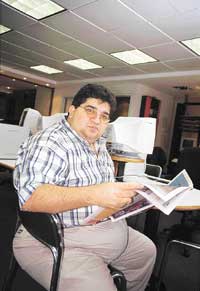 The Daily Journal, Venezuela's only English-language newspaper, has been bought by Julio Augusto López, the Peruvian-born, government-connected empresario behind the new-style, pro-Chavez Diario de Caracas.
 López, who first tried to buy the DJ back in 2003, has big plans for the paper...but then, every new DJ owner in memory has had "big plans" for the paper until they collide with the harsh realities of publishing in a foreign language for a tiny market. (Though one suspects none of the previous owners had pockets anywhere near as deep as him.)
Now, the venerably old but consistently loss-making DJ is hardly a publishing powerhouse in Caracas. With a skeleton staff and circulation figures that have long prompted snide quips about how "en vez de dar noticias da lástima," this is far from a major coup for the government's communications strategy. Still, go to any given newsstand in Venezuela and the DJ is the only thing you'll find in English. Just the latest fallen domino...
March 2, 2006
International solidarity turned on its head...
Chavez supporters tend to applaud his moves to stick it to the gringos by raising the price of oil. The argument ignores a basic, but seldom-acknowledged fact: as this International Energy Agency study (PDF format) finds rising oil prices hurt poorer countries more than richer ones.
By working to jack up oil prices, Chavez exports poverty rather than abating it.
The adverse economic impact of higher oil prices on oil-importing developing countries is generally more severe than for OECD (developed) countries. This is because their economies are more dependent on imported oil and more energy-intensive, and because energy is used less efficiently. On average, oil-importing developing countries use more than twice as much oil to produce a unit of economic output as do OECD countries. Developing countries are also less able to weather the financial turmoil wrought by higher oil-import costs.
The economic impact on the poorest and most indebted countries is most severe. On the basis of IMF estimates, the reduction in GDP in the sustained $10 oil-price increase case would amount to more than 1.5% after one year in those countries. It is estimated that the loss of GDP averages 0.8% in Asia and 1.6% in very poor highly indebted countries in the year following a $10 oil-price increase. The loss of GDP in the Sub-Saharan African countries would be more than 3%.
Asia as a whole, which imports the bulk of its oil, would experience a 0.8% fall in economic output and a one percentage point deterioration in its current account balance (expressed as a share of GDP) one year after the price increase. Some countries would suffer much more: the Philippines would lose 1.6% of its GDP in the year following the price increase, and India 1%. China's GDP would drop 0.8% and its current account surplus, which amounted to around $35 billion in 2002, would decline by $6 billion in the
Other East Asian countries would see deterioration in their aggregate current account balance of more than $8 billion. Asia would also experience the largest increase in inflation in the first year, on the assumption that the increase in international oil price would be quickly passed through into domestic prices. The inflation rate in China and Thailand would increase by almost one percentage point in 2004.
Latin America in general would suffer less from the increase in oil prices than Asia because net oil imports into the region are much smaller. Economic growth in Latin America would be reduced by only 0.2 percentage points.
The cost of fuel imports relative to GDP is particularly high in Africa. In 2000, Sub-Saharan African countries spent 14% of their GDP on fuel imports. As a consequence, sharp fluctuations in oil prices can lead to big shifts in their current account balance, often amounting to more than 1% of GDP. This generally leads to a rapid economic adjustment involving a sharp contraction in domestic consumption, because these countries have very limited access to international capital market to finance a temporary increase in the current account deficit.
By working to jack up oil prices, Chavez exports poverty rather than abating it.
If fungibility opposes us, we shall fight against it and make it obey us
What with this stuff about the Citgo Buy-cott, and Chavez's ongoing threats to "cut off" oil supplies to the US, Dilbert comes to the rescue:


(Do you understand what fungible means?)

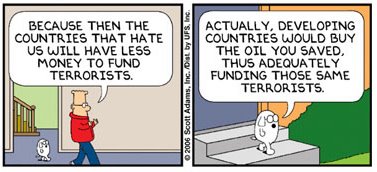
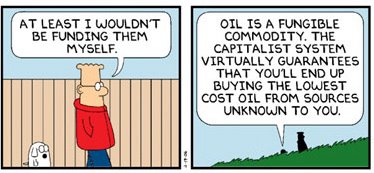
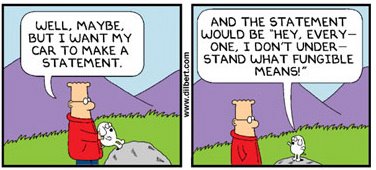
(Do you understand what fungible means?)
March 1, 2006
Venezuela as Strategic Threat to the US?
Well, that Stratfor article I reprinted has vcrisis up in arms. Alek indulges his tendency to look for the fifth leg on the cat, suggesting only a conflict of interest could explain Friedman's piece. John Sweeney, in a delightfully spiteful little hatchet job on his old boss, takes a different tack, claiming Friedman doesn't know what he's talking about and that Chavez does represent a security threat to the US via the Iranian/North Korean connection.
Alek argues, correctly, that Chavez has never placed commercial interests at the top of his agenda. This is true, as far as it goes, but misses the point: what Chavez does place at the top of his agenda is staying in power, and he can only stay in power by spending oil dollars hand-over-fist. But Chavez can only affect US energy interests by exiting the oil market entirely. Doing so would mean foregoing the revenue stream that keeps him in power. Much of the point of Friedman's piece is that this will never ever happen.
John Sweeney comes at it from a different angle. Friedman argues that "Latin American countries in general are of interest to Washington, in a strategic sense, only when they are being used by a major outside power that threatens the United States or its interests." Sweeney retorts that if Friedman wasn't so damn ignorant, he would realize that this is precisely what's happening, via the Iran/North Korea connection.
Sweeney says that Iran and Venezuela signed a secret treaty for nuclear cooperation last year, and adds that Iranian and Cuban geologists are already prospecting Bolivar state for uranium deposits. He says there are secret negotiations underway with North Korea for conventional weapons purchases, and that 100 to 120 North Korean Special Force agents are in Venezuela conducting training on asymetrical warfare. He also charges that Venezuela is currently discretely seeking "one or two nuclear warheads" through these ties.
If these things are really happening, then Venezuela would certainly become a top-tier security threat for the US. The problem, though, is that all we have to go on is John Sweeney's say-so. No documents, no details of the operations, no specifics, not much really. This doesn't mean this stuff isn't going on, it just means that the story can't possibly get any traction if it's this abstract.
Still, the possibilities are intriguing. If Venezuela is really pursuing these avenues, the US will eventually find out. And if that happens, Venezuela will rocket to the top of its geopolitical worry-list. There's just no way the Americans would allow a nuclear armed opponent in the Western Hemisphere. What now seem like oceans of BS about asymmetrical warfare could become very very real indeed. But if this is the game we're playing, we need proof, we need a solid, documented case out in the public domain. Incendiary accusations alone sure won't do it...
Alek argues, correctly, that Chavez has never placed commercial interests at the top of his agenda. This is true, as far as it goes, but misses the point: what Chavez does place at the top of his agenda is staying in power, and he can only stay in power by spending oil dollars hand-over-fist. But Chavez can only affect US energy interests by exiting the oil market entirely. Doing so would mean foregoing the revenue stream that keeps him in power. Much of the point of Friedman's piece is that this will never ever happen.
John Sweeney comes at it from a different angle. Friedman argues that "Latin American countries in general are of interest to Washington, in a strategic sense, only when they are being used by a major outside power that threatens the United States or its interests." Sweeney retorts that if Friedman wasn't so damn ignorant, he would realize that this is precisely what's happening, via the Iran/North Korea connection.
Sweeney says that Iran and Venezuela signed a secret treaty for nuclear cooperation last year, and adds that Iranian and Cuban geologists are already prospecting Bolivar state for uranium deposits. He says there are secret negotiations underway with North Korea for conventional weapons purchases, and that 100 to 120 North Korean Special Force agents are in Venezuela conducting training on asymetrical warfare. He also charges that Venezuela is currently discretely seeking "one or two nuclear warheads" through these ties.
If these things are really happening, then Venezuela would certainly become a top-tier security threat for the US. The problem, though, is that all we have to go on is John Sweeney's say-so. No documents, no details of the operations, no specifics, not much really. This doesn't mean this stuff isn't going on, it just means that the story can't possibly get any traction if it's this abstract.
Still, the possibilities are intriguing. If Venezuela is really pursuing these avenues, the US will eventually find out. And if that happens, Venezuela will rocket to the top of its geopolitical worry-list. There's just no way the Americans would allow a nuclear armed opponent in the Western Hemisphere. What now seem like oceans of BS about asymmetrical warfare could become very very real indeed. But if this is the game we're playing, we need proof, we need a solid, documented case out in the public domain. Incendiary accusations alone sure won't do it...
Chavez Galactico
According to the BBC's By Greg Morsbach,
Venezuelan scientists are going to China to begin work on Venezuela's first satellite - the first step on the way to a national space programme. President Hugo Chavez has earmarked around $0.5bn (£287m) to get the space agency off the ground in 2007.
The 30 scientists will be joined by another 60 next year to build the satellite along with China. Venezuela's government hopes to use it to broadcast many of its own radio and TV programmes throughout Latin America.
The Simon Bolivar satellite is supposed to be launched into space by August 2008. Mr Chavez wants the satellite to be blasted into orbit from a Venezuelan launch pad.
The Venezuela government intends to put several satellites into space, some of which will be used for geological surveys of the Earth.(!!?!??!!)
Venezuela's military will play a key role in the space programme and so the satellites could eventually be used to gather intelligence.
February 28, 2006
If geography opposes us, we shall fight against it and make it obey us
Well, the oil sabers they are a'rattlin' again as Chavez's Oil Tsar Rafael Ramírez resumes threats to start selling Venezuelan oil to China instead of the US. The threat seems formidable, but only if you studiously avoid thinking through its implications.
Currently, Venezuelan oil travels 3,200 km. to get to the US Gulf Coast. Middle Eastern oil travels 7,000 km. or so to get to China. Overall, oil has to be shipped over some 10,000 km. to satisfy both countries' demand.
What would happen if Venezuela were to go through with its threat?
First off, Venezuelan oil would have to travel over 15,000 km. to get to China. And the US? Well, every barrel of oil China buys from Venezuela instead of the Middle East is a barrel of Middle Eastern oil it frees up for other buyers. The US, facing a sudden shortfall, would presumably buy it. And that Middle Eastern oil would have to travel about 12,000 km. to get to the US.
So demand that might have been satisfied by shipping oil over a total of 10,000 km. will now take 27,000 km. of shipping to satisfy.
(In fact, it's even worse than that: in the short-term, most of the refineries able to handle Venezuela's sour crude are in the US Gulf Coast - so Venezuelan oil would likely end up being shipped to the US, refined, pumped back into a tanker as products and shipped off to China!)
At the end of this whole silly rigmarole, does the US get any less oil than before? No.
Does China get any more oil than before? No.
Is the total amount of oil in the market altered? No.
Is the world price changed? No.
The only difference is that oil travels farther from producer to consumer, raising transportation costs all around. The US and China pay more for their oil imports, Venezuela and the Middle East get less from their oil exports. Only the shippers gain.
Viva la revolución, no joda!
Currently, Venezuelan oil travels 3,200 km. to get to the US Gulf Coast. Middle Eastern oil travels 7,000 km. or so to get to China. Overall, oil has to be shipped over some 10,000 km. to satisfy both countries' demand.
What would happen if Venezuela were to go through with its threat?
First off, Venezuelan oil would have to travel over 15,000 km. to get to China. And the US? Well, every barrel of oil China buys from Venezuela instead of the Middle East is a barrel of Middle Eastern oil it frees up for other buyers. The US, facing a sudden shortfall, would presumably buy it. And that Middle Eastern oil would have to travel about 12,000 km. to get to the US.
So demand that might have been satisfied by shipping oil over a total of 10,000 km. will now take 27,000 km. of shipping to satisfy.
(In fact, it's even worse than that: in the short-term, most of the refineries able to handle Venezuela's sour crude are in the US Gulf Coast - so Venezuelan oil would likely end up being shipped to the US, refined, pumped back into a tanker as products and shipped off to China!)
At the end of this whole silly rigmarole, does the US get any less oil than before? No.
Does China get any more oil than before? No.
Is the total amount of oil in the market altered? No.
Is the world price changed? No.
The only difference is that oil travels farther from producer to consumer, raising transportation costs all around. The US and China pay more for their oil imports, Venezuela and the Middle East get less from their oil exports. Only the shippers gain.
Viva la revolución, no joda!
February 25, 2006
A foray into Iraq
Well, it's carnival now, so in the season's spirit of reckless abandon I'll break all my rules and post something that has absolutely nothing to do with Venezuela. This piece is from The New Republic and I'm reprinting it simply because the reporting is so strong and the writing is so compelling.
It's not that I necessarily agree with Kaplan, it's that I'd give one and part of the other to be able to write like him...
See you all after the holiday...
It's not that I necessarily agree with Kaplan, it's that I'd give one and part of the other to be able to write like him...
Centripetal Force
by Lawrence F. Kaplan
Baghdad, Iraq - For a return visitor, Baghdad International Airport offers a fitting portal into the new Iraq. Unlike the military side of the airport, where U.S. transport planes and helicopters operate in an industrious roar, the civilian side, which usaid renovated in 2003, now languishes in disrepair. Iraqi Airways flights, on which it was possible to light up a cigarette until recently, still come and go. But, in the terminal itself, the rest room floors are smeared with excrement, wires hang from the ceiling, and pay phones have been ripped from the walls. An emblem of war and poverty? Not really. The transportation minister, an ally of Moqtada Al Sadr and his rebellious Mahdi Army, has delegated responsibility for the airport's maintenance to the children of Sadr City, the Shia slum and the Mahdi Army's Baghdad base of support. The 14-year-olds in blue jumpsuits smoke, huddle, and even play tag. What they do not--and cannot--do is maintain an airport.
Not everything the U.S. enterprise touches here turns to gold. But everything it lets go of does seem to turn into dirt. With U.S. reconstruction aid running out, Iraq's infrastructure, never fully restored to begin with, decays by the hour. Iraq's political arena, from which the Americans had no choice but to withdraw, has dissolved into something unrecognizable, carved up for sectarian advantage and without a center to keep its parts from spinning away. In both cases, the United States may have given all it reasonably could be expected to give. But, when it comes to America's withdrawal from Iraq's security arena, a process that accelerates with each passing week, the only explanation can be that the White House, for all of its high-minded rhetoric about standing with Iraq, has decided not to. The insurgency continues to rage. Iraq's security forces still cannot operate on their own. And, as what was once a largely one-sided Sunni campaign of terrorism rapidly approaches something like parity (with the Shia taking up arms in their own defense), the likelihood of a civil war has surged. So, too, contrary to the delusions of war supporters and critics alike, has the importance of the Americans.
As the war takes a sectarian turn, the United States begins to look, even to many Iraqis, like an honest broker, more peacekeeper than belligerent. Sheik Humam Hamoudi, one of Iraq's most powerful Shia and a leader of the Supreme Council for Islamic Revolution in Iraq (sciri), knows this better than most. He sits, literally, atop the Iraqi government--in a sprawling office suite above Baghdad's convention center, where Iraqi politicians wheel and deal. As with many Shia politicians, Hamoudi, donning a clerical robe and turban, becomes animated when the subject turns to the U.S. military's campaign against Sunni insurgents. If anything, he believes it has been prosecuted with insufficient vigor. And, although he complains that the Americans have placed undue restraints on the Shia-dominated security forces, he likens the effect of a U.S. withdrawal from Iraq to "a child when he wants to walk and you ask him to play football." Absent the Americans, he says, Baghdad would be transformed into another Beirut.
Hundreds of miles to the west, in an Arabesque villa that rises out of the desert near the Syrian border, Sheik Abdullah Al Yawar--Hamoudi's mirror image in the Sunni community--echoes his concern. Al Yawar wields so much power in this insurgent hotbed that U.S. Army officers say he can turn the violence on and off like a faucet. For the moment, at least, he has turned it off, responding to pleas and aid from his American interlocutors. But he worries that the same Iraqi security forces that Hamoudi claims the United States has muzzled operate with too little American oversight. He claims they have been running amok through his province, beating and arresting his constituents and chanting Shia slogans. "If the Americans leave," he warns, "there will be rivers of blood." In their own way, then, both sheiks see the U.S. military presence for exactly what it has become: a buffer--between Iraq's sects and between relative order and complete mayhem.
---
Whether you measure Iraq's well-being through its infrastructure, politics, security, or even geography, one thing is clear: Where the Americans do not operate, very little else does. The level of corruption that pervades Iraq's ministerial orbit, for instance, would have made South Vietnam's kleptocrats blush. The problem extends beyond a simple lack of good governance. In a case that has been highly publicized in the Iraqi press, Sunni lawmaker Mishaan Al Juburi was recently charged with embezzling funds meant to pay for the protection of an oil pipeline in Iraq's north. Not all that unusual, but prosecutors suspect he then funneled the money to insurgents who blew up the pipeline.
According to a U.S. Government Accountability Office report published earlier this month, an interagency group of State Department, military, and contracting officials concluded that "critical infrastructure facilities constructed or rehabilitated under U.S. funding have failed, will fail, or will operate in suboptimized conditions following handover to the Iraqis." Absent U.S. oversight, politicians from competing sects have transformed the ministries into personal fiefdoms, where expertise counts for nothing and connections for everything. And, just as the ministries have proved impervious to direction from above, local factories and refineries ignore the ministries.
One of the reasons Baghdad has only a few hours of electrical power each day is that electricity plants in the provinces refuse to provide it--reasoning, as the head of a plant in Iraq's south put it, that Baghdad had enough power under Saddam Hussein. Although partly a consequence of the security situation, corruption has helped drive every public service measure--electricity, potable water, heating oil--down below its prewar norm.
The dysfunction works its way down to the street, too, which becomes apparent on a visit to the home of Bakr (he asked that his last name not be used), an engineering student who lives in the middle-class Waziriya neighborhood. One morning, as he was studying, Bakr explains, he looked out his window and noticed men setting up a mortar in the middle of the street. As the government encourages all Iraqis to do, he called the Interior Ministry's emergency line, 130, to report the insurgents. "They didn't answer," Bakr recounts.
"The next day, my friends warned me not to call, because your telephone number appears and they sell it to the insurgents." He insists we drive his Opel--the Humvee of the Sunni, as Iraqis call it--to an adjacent neighborhood so he can prove the point. There, faded on a wall, hangs the picture of a young man and the announcement of his death. The dead man, Bakr explains, got through to the emergency line.
nother casualty has been the authority of Prime Minister Ibrahim Jafari, whom the ministries routinely ignore. On the day the preliminary results of December's elections were announced, Jafari invites the election commissioners for dinner. The liberal activist Mustafa Al Kadhimiy wrangles two invitations, and, as we wait at the gate, Jafari's guards radio back and forth on their walkie-talkies--signing off with what, even in Iraq, stands out as religious phrasing: "Yes, believer." A concrete path leads to a footbridge and then across a moat, winding around Jafari's villa until it ends in a heated tent, which, Mustafa notes disapprovingly, is of Iranian vintage. But it is Jafari's relations with Iraq, not Iran, that most concern American officials here. Unlike his predecessor, Iyad Allawi, Jafari has a reputation for being cerebral, detached, and, most of all, weak.
His dinner guests look utterly exhausted. "The Sunni parties attack us," explains chief electoral officer Adil Al Lami. "We receive violence, assassination attempts." One commissioner seems to be on the brink of a nervous collapse. But not Jafari. As the commissioners pick at their kebobs, the prime minister announces that he has completed one of Thomas L. Friedman's books. Have I read The Lexus and the Olive Tree? As a television in the corner of the room conveys images of the carnage outside, Jafari admits to being partial to the works of Noam Chomsky. Why won't Chomsky come to Iraq? he asks. The commissioners don't know what to say. And, apart from expressing doubts about a Chomsky visit, neither do I. Later, asked if the prime minister offered this line of conversation for the benefit of a visiting American, a source close to Jafari responds, "No, this is how he talks in public. No one understands what he is talking about. But Iraqis--they like this. If they can't understand him, they think he knows something." Indeed, Jafari has become well-known for delivering inscrutable speeches that wander from Western philosophy to Arab literature and back again, leaving even seasoned translators perplexed. The confusion extends to his deliberations with the Americans. "Today, with our current government," Jafari tells me, "we tell the MNF [multinational forces] when to go. ... The MNF wait for our orders." Yet, when pressed on his relationship with coalition forces, Jafari sounds a more humble--and increasingly familiar--note. "If they leave today," he says, "we would be defeated."
Jafari's weakness notwithstanding, the imperial taint that colored the Coalition Provisional Authority (CPA) and its handpicked successor, Allawi, made it impossible for either to govern effectively. While Iraqis subsequently voted along sectarian lines, in this hollowed-out state, where tribe and religion remain the basic affiliations, this hardly came as a surprise. Even Mithal Al Alusi, one of a dwindling band of liberals still committed to the dream of a secular Iraq, has come to terms with the pathologies of Iraqi political life. Alusi made the mistake of traveling to Israel in 2004, and, for his sins, insurgents murdered his two sons. Bodyguards ring his house; a gun lies beside him on the couch. "The mistakes here are by the Iraqi side, not the American side," he says. "The Iraqi politicians only believe it is in their interest to push sectarian divisions." Kadhimiy echoes the sentiment. "Iraqi politics, it has moved beyond the Americans, except, you know, on security issues," he says. "There, the Americans, they still control everything."
---
With security having been the exclusive property of the Americans for so long, Iraqis still ask when full ownership of their country will be returned to them. The million-dollar trophy that National Security Adviser Mowaffaq Al Rubaie keeps in his home study suggests the restoration has begun. For many Americans, the memory of Iraqis (supported by U.S. forces off-screen) pulling down Saddam's statue in Al Firdos Square still provides an inspirational bookend to the U.S. invasion. For Iraqis today, the statue--or at least its head--just provides a bookend. As the national security adviser tells it, in the aftermath of the invasion, a senior American officer tried to abscond with Saddam's head. But he only made it as far as Kuwait, where the authorities alerted Rubaie, who subsequently reclaimed the head for Iraq. So here it sits, in the national security adviser's study, where Iraqi elites express their hatred for Saddam by hitting him on the head with the soles of their shoes. "I put it here to remember Saddam is always here," he explains.
Iraqi forces, Rubaie concedes, have not reached the point where they can operate independently of the Americans. As if to prove the point, an American military officer in civilian clothes hovers in the background, answers the national security adviser's phone when a reporter calls, lives and travels with Rubaie, and, his fellow government ministers say, probably does much of the national security adviser's job for him. At the same time, Iraq's security forces have started to emerge from the shadow of their American instructors. Their training has been accelerated, and, in the near future, Rubaie sees "Iraqi security forces taking over, Iraqi forces taking the front line, [and] MNF doing logistical and support [functions]. By the end of 2007," he predicts, "we're very likely to see the last U.S. soldier."
According to the U.S. military, the Iraqi police force currently fields about 121,000 men, close to the number planned for, while the Iraqi armed forces number about 106,000 soldiers, nearly two-thirds of the force estimated for the end of this year. The Iraqi army no longer melts away in combat, nor does it suffer from mass desertions, as it did during its first battles in 2004. Army recruits now undergo a basic training course similar in length to their American counterparts, officers attend service schools, and Iraqis provide much of the instruction. As the security forces grow more competent, they have rapidly expanded the amount of territory under their control, which now includes several neighborhoods in Baghdad and large swaths of western Iraq.
But the professionalism of Iraq's security forces can be overstated, which becomes apparent to me a week later in western Iraq. As a U.S. Army convoy approaches within a few hundred yards of a U.S. outpost at a castle in Tall Afar, gunfire erupts on all sides. The Humvees speed toward the castle gate, where an Abrams tank links up with them, providing the convoy with extra firepower as it winds its way toward a forward operating base outside the city. The shooting, officers back at the base say at first, came from insurgents. Neither I nor the soldiers caught in the middle of it had that impression, and an officer later confirms what we know to be true: The Iraqi police, overwhelmingly Sunni in this area, and the Iraqi army, overwhelmingly Shia and Kurd, were firing on one another.
Sectarian clashes present one problem. The fact that the Army still cannot operate without access to U.S. firepower, logistics, communication, and intelligence presents another. Even conceding the Bush team's fanciful premise that Iraq will have 110 combat battalions operating by the end of the year (compared with three fully effective battalions a year ago and 40 today), American officers dismiss as wishful thinking the official line that Iraqi troops can replace U.S. troops on a one-to-one basis and then operate just as effectively as their American mentors.
As for the Iraqi police, if civil war comes to Iraq, it may be ignited as much by them as by the insurgents. For Iraq's police are, to an extent not fully grasped in Washington, not police at all. As one of his parting acts in June 2004, CPA chief L. Paul Bremer signed Order 91, outlawing militias in Iraq. In response, thousands of Shia militiamen exchanged their street clothes for police uniforms. As they have gotten better at combating Iraq's Sunni guerrillas, the insurgency, at least in Baghdad and its southern outskirts, has weakened, with attacks declining since last fall. The only problem is that brutality is one of the tactics that achieved these results.
The Interior Ministry's extrajudicial antics first came to light last November, when U.S. troops stumbled across a torture chamber in Baghdad operated by Interior police. Every week brings more handcuffed and decomposed bodies discovered in garbage dumps, rivers, and hastily dug pits. "Scores of individuals are regularly detained in the middle of the night and without judicial warrant," a recent report by the U.N. Assistance Mission for Iraq says. "The rule of law continues to be challenged by the existence of militias and other groups who continue to act with impunity, confirming an urgent need for the State to assert control over its security forces." But these forces were never the state's to begin with. Unlike the Iraqi army, which operates in tandem with U.S. forces, the police recruit and operate locally, and, until recently, they did so largely free of U.S. supervision.
To rein in the brutality, American commanders have dispatched 4,000 military advisers to work and live alongside police and commando units. Sciri's Hamoudi, for one, chafes at the interference, claiming the Americans--by condemning abuses at the Interior Ministry and thereby creating a "general feeling that the U.S. and British are biased toward Sunnis"--have strayed too far from the embassy compound. Pointing to comments by American Ambassador Zalmay Khalilzad, Hamoudi says, "When the U.S. or British ambassador intervenes to press against Shia, it is illogical." But there is a logic at work here. Just as the Americans create a buffer for Iraq's Shia by training and equipping their security forces to combat the insurgency, they're also building a buffer for Iraq's Sunnis, who increasingly rely on the U.S. military to keep those same forces in check. In areas like Salman Pak and Tall Afar, the once viscerally anti-American Sunni population has even turned to the Americans for protection.
For a glimpse of what Iraq would look like in the event of a precipitous U.S. withdrawal, one need look no further than Tall Afar, where there was a precipitous U.S. withdrawal. Before the Third Armored Cavalry Regiment (3rd ACR) launched its offensive to clear Tall Afar last September, the city, like Falluja before it, had become a horror show. With only 400 soldiers from the 25th Infantry Division patrolling the roughly 10,000-square-mile sector around it, officers say, there simply weren't enough troops to pacify the city. During the Falluja offensive in November 2004, police stations across the province fell to insurgent attacks, and Tall Afar itself fell under guerrilla control. On the western side of the city, tension between Sunni and Shia tribes escalated into open warfare; the remnant of the Shia-dominated police force launched brutal reprisals against the population; and forces loyal to Abu Musab Al Zarqawi moved into the city, mounting their own campaign of atrocities--killing patients in the local hospital, kidnapping and beheading hostages, and forcing children to act as human shields. "I know people at home will roll their eyes," says one American officer, "but Restore Rights [the September 2005 operation to clear Tall Afar] cleansed this place of something genuinely evil."
Police headquarters in Tall Afar is located on the grounds of a centuries-old Ottoman castle, which sits on a large hill in the center of the city. From its parapets, one can usually see the entire city, but it is pouring rain, and even tanks slide in the mud. The castle also houses the mayor of Tall Afar, Najim Abdullah Jabouri, who, until recently, was the city's police chief as well. The mayor still operates as the city's de facto sheriff--a bullet-riddled police vest hangs on the wall of his office. The power has gone out, and it is freezing and nearly pitch-black, but the mayor seems relieved just to be here. Only a few months ago, he says, "Zarqawi was ejecting Shia from the city; and the sky--it was raining mortars. Now, we target the insurgents, not each other." Even today, 3rd ACR has Tall Afar locked down, with tanks on street corners and patrols crisscrossing the city. "The American Army is mediator and judge," the mayor says. "It is a higher authority than any institution in Iraq." So desperate, in fact, is the mayor to block 3rd ACR from leaving that he has penned a letter to President Bush, pleading for the unit to stay. "Our security forces are not well-equipped," he explains. "We are undertrained, nowhere near the situation where we can take care of our own responsibilities."
Still, the violence in Tall Afar has declined sharply. Following Operation Restore Rights, attacks on U.S. forces in Tall Afar dropped from about seven per day to one. At first, the city's Sunni leaders refused to cooperate with U.S. forces, citing the brutality of a Shia commando brigade operating in the area. But 3rd ACR had the brigade pulled back, and it released detainees whom the Sunni sheiks would vouch for. In addition, explains Lieutenant Colonel Christopher Hickey, whose Sabre Squadron operates out of the castle that houses police headquarters, "I knew I needed Sunni police to get information from the population. The Shia police were just inflaming sectarian violence." After pressing local leaders to encourage police recruits, Sunnis began to sign up, eventually swelling an exclusively Shia force of 200 into a majority Sunni force of 1,700. And, as Hickey predicted, intelligence tips began flowing in. The regiment also poured millions of dollars into the city, funding 150 water, electricity, school, and cleanup projects. At the same time, it embedded advisers with Iraqi army and police units. Today, 3rd ACR personnel live among Iraqi platoons and among the population itself, having fanned out across the city and established 29 patrol bases--including directly between the warring Sunni and Shia tribes.
---
Having melted into a once-hostile population center, the Americans have become an essential part of the landscape here--their own tribe, in effect. Seen from a helicopter roaring above Nineveh province, telephone wires provide the only evidence of modernity among the ancient forts, castles, and clay huts that dot the plain below. In this primitive universe, it's easy to confuse the door gunners, their aviation helmets emblazoned with Superman logos (the "S" actually stands for their unit, Stetson Troop), with actual supermen. Which many Iraqis do: Wedged between tribes of Sunnis Arabs, Turkomen, Shia, and Kurds, a regal and persecuted people--the Yazidis--call Nineveh province home. The Yazidis, who, among other things, don't wear blue, don't eat lettuce, and take a somewhat nuanced view of Satan (their Muslim neighbors have accused them, falsely, of being devil worshippers), initially confused the arrival of the Americans with the Second Coming. An officer at the forward operating base in Sinjar elaborates: "They think that, um, we're Jesus."
The Yazidis aren't the only ones. At a base in central Iraq a few days earlier, two U.S. helicopters taxi to a halt near a C-130. The crew chiefs jump out and guide two rows of detainees, handcuffed and blindfolded, away from the prop blast. A detainee's fate, as I learned last year on stumbling across a similar scene in Baghdad, depends largely on his destination. The idea of prisoners begging to get into Abu Ghraib may seem like a stretch, but, more than anything else, they fear being turned over to the Iraqi security forces. They know the Americans probably won't kill them, and that, in all likelihood, they will be released in a few days.
As for the Americans themselves, the soldiers value their roles here just as much as the local population does. Back at regimental headquarters, framed pictures of the fallen line the wall--3rd ACR has lost 42 men during its yearlong tour, and many more have been terribly wounded, including the regiment's command sergeant major. And, yet, contrary to the faux moral posturing of those who claim to speak for the troops back home, when the troops do speak, what they say is invariably some variation of "leave us alone to do our job." The soldiers' confidence in their mission derives in part from a sense of ownership that the Army has about Iraq. While Colin Powell's reported warning on the eve of the invasion--"If you break it, you own it"--applies even as the war grinds toward the end of its third year, for the Army at least, it is equally true that, when you break it, it owns you. Having bled so much here, the officer corps cannot entertain the possibility that they did so in vain. Its members truly believe that victory, even at this late date, may be within reach.
In Tall Afar, it genuinely is. To be sure, 3rd ACR, which a Pentagon review of dozens of units in Iraq rated as the most adept at counterinsurgency, hardly counts as a typical unit. There are, to begin with, the officers gathered around the commander, among them a Harvard graduate student wounded here and a Middle East historian who can recite every detail about British operations around Tall Afar in the 1920s. There is the Iraqi-American interpreter who has established himself as a power broker among Nineveh's clans. There is the regiment's self-contained aviation squadron, its gunships baring snarling shark's teeth and its scout choppers having shut down infiltration across the Syrian border. Then there are the soldiers themselves, who benefited from unusual training (devoted largely to counterinsurgency as well as to Iraq's customs and language) and whose professionalism in dealing with Iraqis arguably has yielded more diplomatic triumphs than the combined exertions of every Foreign Service officer in Iraq.
There is, finally, the commander himself. With his raspy voice and shaved head, Colonel H.R. McMaster bears a closer likeness to the brusque officers that Robert Duvall brought to life in Apocalypse Now and The Great Santini than to the tweedy scholar on the book jacket that made him famous. McMaster's Ph.D. dissertation, which scolded the joint chiefs of staff for not protesting more forcefully Lyndon Johnson's march to war in Vietnam, appeared in 1997 as a book--Dereliction of Duty--that became required reading at the Pentagon. A parade of retired generals has wielded Dereliction of Duty as a club against today's military leaders, charging them with the same sins that the book accuses their Vietnam-era predecessors of committing. But, if McMaster sees parallels to the civil-military relations of the Vietnam era, he's not saying. When it comes to the operational realm, however, he freely concedes to drawing from the Army's experience in Vietnam. "The important thing that emerges from Vietnam is that the political, economic, and military have to go together," he says. "You have to isolate insurgents from external support. You have to develop security forces. You have to provide security for the population." Which is exactly what he did in Tall Afar, having enshrined the principles of counterinsurgency in his unit's tactics well before the term returned to favor in Washington last year. The press, in turn, has anointed McMaster a latter-day John Paul Vann, and an army of journalists has descended on this remote corner of western Iraq. (A sergeant complains that his soldiers still distract themselves with tantalizing images of Lara Logan, the swimsuit model-cum-"60 Minutes" correspondent, who dropped in from the sky recently.)
In an Army that has spent three years launching big-unit sweeps, relying heavily on firepower and otherwise heeding ground commander Lieutenant General Thomas Metz's admonition not to "put much energy into trying the old saying 'win hearts and minds,'" 3rd ACR has done exactly the reverse. Yet, rather than duplicate the Tall Afar operation in towns and cities across Iraq, the White House's "National Strategy for Victory in Iraq" declares, "Our forces will increasingly move out of the cities ... and conduct fewer patrols and convoy missions." The administration intends to draw down troop levels to 100,000 by the end of the year, with the pullback already well underway as U.S. forces surrender large swaths of the countryside and hunker down in their bases. The plan infuriates many officers, who can only say privately what noncommissioned officers say openly. "In order to fix the situation here," Sabre Squadron's Sergeant José Chavez says, "we need at least 180,000 troops." Iraq, however, will soon have about half that. An effective counterinsurgency strategy may require time and patience. But the war's architects have run out of both.
---
Al Yawar, the most powerful Sunni sheik in 3rd ACR's area of operations, cannot grasp this essential truth. So he has invited Colonel Joel Armstrong, the regiment's one-man State Department, to lunch. En route, Armstrong's helicopter and another Black Hawk flying escort wind along creek beds, hugging the desert floor. Eventually, the bleached landscape below yields a surprise: a miniature Versailles. A few hundred yards from the sheik's compound, the choppers set down next to a horse corral. An army of security guards--tribesmen with New York Yankees caps--usher the colonel and his fellow officers inside, where the combination of marble floors, ornate chandeliers, gilded wall trim, and a roaring fireplace casts them all in an orange glow. As for the sheik, despite the robe, headdress, and gold sash tied across his waist, he bears an uncanny resemblance to John Gotti.
He wields a similar power, having, as the colonel points out, "convinced his people not to fight us and be peaceful." The sheik presents Armstrong with a list of detainees he wants released and asks about a paving project the Americans have promised. The local mayor, it seems, has embezzled the funds, and Al Yawar would like the Americans to supervise the project more closely. More than that, he would like assurances the Americans will stay. "The government is not listening to the Sunnis," he explains. The Iraqi army, in particular, incenses him. "They hit and kick people. They are not from this region." By contrast, "The Americans--they are in the middle. They are on neither side. This is why we trust them. But, if the Americans leave, who will I talk to?"
Back at the base after lunch, Armstrong mulls over the meeting. Along with the rest of the regiment, he will head home soon. During his year here, he developed a close relationship with the sheik, and he will clearly miss his Iraqi counterpart. Armstrong shares some of the sheik's concerns, and he shares what could well be the epitaph for the U.S. enterprise in Iraq. "We're only an honest broker," he says, "so long as we're here."
See you all after the holiday...
February 24, 2006
Demands of the Living Dead
There's tremendous pathos in this El Universal story about the creme de la creme of the Living Dead Opposition making 10 "demands" for improved electoral conditions before they'll participate in December's presidential elections.
For one thing, Accion Democratica doesn't seem to have realized that they are no longer a parliamentary party - so ingrained are the habits of mind of parliamentarism that they continue to press demands on the all chavista National Assembly as though they still had seats there, as though they hadn't maneouvered furiously to keep the opposition from participating last December.
Worse still are Antonio Ledezma's Alianza Bravo Pueblo and the Polo Democratico - groups that oscillate bafflingly between refusing to recognize the Chavez regime (under Article 350) and pressing demands on it. All I can do is groan. Apparently nobody passed these guys the memo explaining that you can't make demands of an entity you don't recognize.
Anyway, this grisly parade of Opposition museum pieces has put together a list of 10 conditions to participate in elections, and however unseemly the petitioners, the petitions are hard to argue with.
The good news is that the more extreme elements of the Traditional Opposition have put their demands forward explicitly. If a new CNE were to accept them formally, there would be no reason to continue the idiot controversy surrounding voting conditions, and the country could move on to an actual election campaign. The Has Been Opposition is not insisting on the more radical proposals making the rounds out there, such as doing away with electronic voting altogether, so there is no need to alter any laws to meet their concerns. Indeed, for the most part, the list just restates what LOSPP already says.
So if the government wants to end this useless polemic, it now knows precisely how to do it.
For one thing, Accion Democratica doesn't seem to have realized that they are no longer a parliamentary party - so ingrained are the habits of mind of parliamentarism that they continue to press demands on the all chavista National Assembly as though they still had seats there, as though they hadn't maneouvered furiously to keep the opposition from participating last December.
Worse still are Antonio Ledezma's Alianza Bravo Pueblo and the Polo Democratico - groups that oscillate bafflingly between refusing to recognize the Chavez regime (under Article 350) and pressing demands on it. All I can do is groan. Apparently nobody passed these guys the memo explaining that you can't make demands of an entity you don't recognize.
Anyway, this grisly parade of Opposition museum pieces has put together a list of 10 conditions to participate in elections, and however unseemly the petitioners, the petitions are hard to argue with.
- Naming a new CNE Board: The National Assembly is already working on this. (But will the new board be credibly non-partisan?)
- Manual counting of all ballot papers: Note they want ballots counted, not votes. This is what the strangely-worded Law on Suffrage and Political Participation (LOSPP) requires, though Jorge Rodriguez's CNE has steadfastly refused to budge on this point, for reasons that escape me.
- Guaranteeing secret voting: Again, this is motherhood-and-apple-pie stuff.
- Preventing data transmission during the vote: This is a key point, but it's also a point CNE had conceded in the run-up to the December 4th vote.
- Cleaning up the Electoral Registry: An audit of the electoral registry has already been announced.
- Doing away with finger-print scanners and electronic voter rolls: A major bone of contention. These machines are neither mandated nor banned by the law, but CNE had agreed not to use them in the run-up to December 4th.
- Setting and publishing electoral norms within established periods: An ongoing opposition gripe. LOSPP sets out explicit time limits for when various parts of the election rules must be published, and CNE routinely ignores them.
- Creating a plural National Electoral Watchdog: This is a new one. Point?
- Preventing the Armed Forces from interfering in voting: Another long-running opposition gripe, Army personnel have taken on a far more active role in running voting centers than the law allows. Legally, they are supposed to provide security and nothing else, in fact they have at times checked ID cards, refused entry to opposition witnesses, run the tallying procedure, etc.
- Restricting the use of public funds in the campaign: For as long as Venezuela has had elections, ruling parties have abused their access to state funds for campaign purposes. This has always been illegal, and has always been done.
The good news is that the more extreme elements of the Traditional Opposition have put their demands forward explicitly. If a new CNE were to accept them formally, there would be no reason to continue the idiot controversy surrounding voting conditions, and the country could move on to an actual election campaign. The Has Been Opposition is not insisting on the more radical proposals making the rounds out there, such as doing away with electronic voting altogether, so there is no need to alter any laws to meet their concerns. Indeed, for the most part, the list just restates what LOSPP already says.
So if the government wants to end this useless polemic, it now knows precisely how to do it.
February 23, 2006
The Caracas-Washington Rift in Geopolitical Perspective

I liked this Stratfor piece for its clear-eyed, myth-busting perspective. Friedman argues, quite convincingly if you ask me, that for all the day-to-day diplomatic heat, a cool-headed, realist calculus shows that Venezuela is not really a geopolitical problem for the US. Not at the moment, anyway (though watch that Hamas money!) I reproduce the second-half of the piece, putting my favorite bits in bold:
The United States and the 'Problem' of Venezuela
By George Friedman
Venezuela has become an ongoing problem for the Bush administration, but no one seems able to define quite what the issue is. President Hugo Chavez is carrying out the Bolivarian revolution in Venezuela and feuding with the United States. He has close ties with Cuba and has influenced many Latin American countries. The issue that needs to be analyzed, however, is whether any of this matters -- and if it does, why it is significant.
[...]
In reality, Chavez's ability to challenge the United States is severely limited. The occasional threat to cut off oil exports to the United States is fairly meaningless, in spite of conversations with the Chinese and others about creating alternative markets. The United States is the nearest major market for Venezuela. The Venezuelans could absorb the transportation costs involved in selling to China or Europe, but the producers currently supplying those countries then could be expected to shift their own exports to fill the void in the United States. Under any circumstances, Venezuela could not survive very long without exporting oil. Symbolizing the entire reality is the fact that Chavez's government still controls Citgo and isn't selling it, and the U.S. government isn't trying to slam controls onto Citgo.
Washington ultimately doesn't care what Chavez does so long as he continues to ship oil to the United States. From the American point of view, Chavez -- like Castro -- is simply a nuisance, not a serious threat. Latin American countries in general are of interest to Washington, in a strategic sense, only when they are being used by a major outside power that threatens the United States or its interests. The entire Monroe Doctrine was built around that principle.
There was a fear at one point that Nazi U-boats would have access to Cuba. And when Castro took power in Cuba, it mattered, because it gave the Soviets a base of operations there. What happened in Nicaragua or Chile mattered to the United States because it might create opportunities the Soviets could exploit. Nazis in Argentina prior to 1945 mattered to the United States; Nazis in Argentina after 1945 did not. Cuba before 1991 mattered; after 1991, it did not. And apart from oil, Venezuela does not matter now to the United States.
From the American point of view, an intervention that would overthrow Chavez would achieve nothing, even if it could be carried out. Chavez is shipping oil; therefore, the United States has no major outstanding issues. A coup in Venezuela, even if not engineered by the United States, would still be blamed on the United States. It would increase anti-American sentiment in Latin America, which in itself would not be all that significant. But it also would increase hostility toward the United States in Europe, where the Allende coup is still recalled bitterly by the left. The United States has enough problems with the Europeans without Venezuela adding to them.
Taken in isolation, Venezuela can't really hurt the United States. If all of South America were swept by a Bolivarian revolution, it wouldn't hurt the United States. Absent a significant global power to challenge the United States, Latin America and its ideology are of interest to Latin Americans but not to Washington.
This explains the strange standoff between Venezuela and the United States, and Washington's basic indifference to events in Latin America. Venezuela is locked into its oil relationship with the United States. Latin America poses no threat on its own. The chief geopolitical challenge to the United States -- radical Islam -- intersects Latin America only marginally. Certainly, there are radical Islamists in Latin America; Hezbollah in particular has assets there. But for them to mount an attack against the United States from Latin America would be no more efficient than mounting it from Europe. The risk is a concern, not an obsession.
For the United States, its border with Mexico matters. For the Venezuelans, high oil prices that subsidize their social programs and buy regional allies matter. Both want Venezuelan oil to keep pumping. Aside from the one issue that they agree on, the United States can live and is living with Chavez, and Chavez not only lives well with the United States but needs it -- both as a source of cash, through Citgo, and as a whipping boy.
Sometimes, there really isn't a problem.
The piece usefully points out the basic weakness in the endless chavophile incantation of past gringo misdeeds in the region: the changed geopolitical landscape. It always makes me smile when PSFs invoke the American intervention against Arbenz, say, to bolster the plausibility of the CIA plotting to rile up Venezuelan bus drivers. Like their Beloved Leader, they don't seem to have noticed that the bipolar strategic competition that drove the logic behind those interventions is dead and buried.
But I suppose for chavistas, it wasn't geopolitics that drove US meddling in the region, but rather some innate evil in the US government - an essentialist position that shows up the zealotry in their stance. For Chavez and his supporters, the gringos don't need a strategic reason to destabilize Venezuela: they do so, Disney villain style, purely because they're bad, bad, BADDDDD.
February 22, 2006
Narcissism-Leninism Chronicles
Teodoro Petkoff writes this spicy Tal Cual editorial on Carabobo Governor Luis Felipe Acosta Carles's delirious sycophancy after he took out these mammoth billboards all over the country - including in Caracas, miles and miles from his state:

Fun bits:
Fun bits:
This gigantic billboard should give pause to those pious souls who still believe that Venezuela is seeing a process of great social changes. History has shown many times that the sham at the heart of supposedly revolutionary regimes becomes ever more visible when pictures and statues of their leaders start peppering the landscape, gradually becoming nightmarishly omnipresent. History, that cruel surgeon, also shows that the end of such regimes goes hand in hand with the clouds of dust kicked up by those statues and billboards as they're toppled by the people.
Before they become official media policy, the giant photos start out as an expression of the most abject adulation. First up are the bootlickers, who quickly realize how pleasing to the autocrat's ego, particularly for Narcissist-Leninists, it is to see their image splashed across streets, avenues, buildings and parks. Later on come the propaganda "experts," who turn adulation into an instrument of the "revolution's" media policy.
So far, we're in the boot-licking stage. All around we see governors, ministers, any little bureaucratic chiefs "decorating" the façades of their offices with smiling images of I, the Supreme, while city walls are slowly taken over by "art" works with the same smiling subject. On the PDVSA building in Maracaibo, for instance, there's a roof-to-ground-floor billboard which would be the envy of Stalin himself. Of course, the adulatee rejoices in seeing his image splayed out everywhere his gaze falls. His pleasure feeds, in turn, the diligence of those who come to realize they're falling behind in this bootlicking tournament.
February 21, 2006
Extra! Extra! Chavismo has a good idea!
Read all about it!!
OK, so they're seven years late, and they're only reviving an old PDVSA idea, but still, chavismo wants to restart the Natural Gas for Vehicles (GNV) program.
The GNV Program is brilliant any way you look at it:
Environmental: Natural gas is extremely clean, emitting about half the greenhouse gases associated with gasoline and close to none of the toxic gases and particulate emissions that foul up the local air. And since Natural Gas is, well, a gas, it can't seep into the groundwater.
Economic: Natural Gas is outrageously cheap in Venezuela, even without government subsidies.
Fiscal: The more GNV PDVSA sells domestically, the fewer scarce resources it has to devote to wasteful and ecocidal gasoline subsidies and the more gasoline it can sell abroad, at much higher international prices.
Technological: The GNV program creates a network of local firms that specialize in converting gasoline engines to run on Natural Gas. These local firms accumulate know-how in a technology likely to be critical over the next half-century, and may have strong positive externalities.
The only serious drawback is the high cost of converting regular gas stations to sell GNV. But much of that investment has already been made, in the mid-90s, when PDVSA established a nationwide system of GNV service stations. (The other drawback is that the damn gas tank you have to install in the trunk of your car eats up half the luggage space - but that doesn't affect public transport, which is the main target of the program.)
Obviously, it would have been better to keep the program running continuously. Seven years ago, Venezuela had the third largest GNV vehicle fleet in the world. Today, I imagine we've slipped back a few notches and fallen behind the technology curve some.
Still, I'd assumed PDVSA was planning to let GNV die out. They're bringing it back, and that's great.
OK, so they're seven years late, and they're only reviving an old PDVSA idea, but still, chavismo wants to restart the Natural Gas for Vehicles (GNV) program.
The GNV Program is brilliant any way you look at it:
The only serious drawback is the high cost of converting regular gas stations to sell GNV. But much of that investment has already been made, in the mid-90s, when PDVSA established a nationwide system of GNV service stations. (The other drawback is that the damn gas tank you have to install in the trunk of your car eats up half the luggage space - but that doesn't affect public transport, which is the main target of the program.)
Obviously, it would have been better to keep the program running continuously. Seven years ago, Venezuela had the third largest GNV vehicle fleet in the world. Today, I imagine we've slipped back a few notches and fallen behind the technology curve some.
Still, I'd assumed PDVSA was planning to let GNV die out. They're bringing it back, and that's great.
February 20, 2006
The Broken Input Side
Why is it that Chavez's government can't seem to learn?
I think it's worth pondering the way revolutionary dogmatism, conditioned by an automatic assumption that all criticism is animated by a hidden agenda, feeds into intolerance of dissent, leaving the revolution impervious to outside input. When you are are 100% certain you are right, you can only infer that anyone who disagrees with you does so out of tainted motives.
It's a short step from that to concluding that only traitors dissent. And when you dismiss all dissent as treason, you leave yourself unable to absorb any information that comes from outside a restricted circle of ideological correctness.
Dogmatism leads to intolerance, and intolerance to political catatonia.
I think it's worth pondering the way revolutionary dogmatism, conditioned by an automatic assumption that all criticism is animated by a hidden agenda, feeds into intolerance of dissent, leaving the revolution impervious to outside input. When you are are 100% certain you are right, you can only infer that anyone who disagrees with you does so out of tainted motives.
It's a short step from that to concluding that only traitors dissent. And when you dismiss all dissent as treason, you leave yourself unable to absorb any information that comes from outside a restricted circle of ideological correctness.
Dogmatism leads to intolerance, and intolerance to political catatonia.
February 17, 2006
Typical CIA Stuff: Infiltrating the Bus Drivers
Straight out of the Fidel playbook, we get this stomach turning tidbit: in the wake of Condi Rice's calls for an international anti-Chavez front, National Assembly chairman Nicolas Maduro accuses Caracas's bus drivers of playing along with a US conspiracy to destabilize the government by threatening to strike on the flimsy pretext that too many of them are getting shot by street criminals. At one point, Maduro actually suggested the CIA has a campaign to kill Caracas bus drivers to goad the rest into striking. It's not so much that you couldn't make this stuff up, it's that you wish you had to...
This should clear up a few things:
Every time a US government official speaks negatively about Venezuela, s/he gives an opening for chavismo to turn that statement into repression.
It's not just big-wig oligarch politicians and journalists who need to worry about the equation of dissent with treason. The government is just as happy this paranoid logic it to bus drivers.
No accusation of gringo-evil doing seems to far-fetched or silly for chavistas to put forward with a straight face.
If the US wants to put diplomatic pressure on Chavez, it should do it quietly, out of mike range. Doing it publicly only invites more repression.
This should clear up a few things:
February 16, 2006
How isolated is Venezuela on Iran's nukes?
Lets see...the countries supporting the IAEA motion to refer Iran's nuclear program to the UN Security council were:
Argentina, Australia, Brazil, Belgium, Canada, China, Colombia, Ecuador, Egypt, France, Germany, Ghana, Greece, India, Japan, Republic of Korea, Norway, Portugal, Russian Federation, Singapore, Slovakia, Slovenia, Sri Lanka, Sweden, United Kingdom, United States, Yemen.Folks, France, Germany, Egypt, Russia, and Yemen are part of the gringo conspiracy against our new allies. Argentina, too! (et tu, Kirchner?) Even Libya wouldn't stand by the mullah's in Tehran!
Countries against: Cuba, Syria, Venezuela.
Abstentions: Algeria, Belarus, Indonesia, Libya, and South Africa.
Proliferation Chronicles
Al Jazeera sez:
Iran hints at Venezuelan nuclear tie
Iran is open to helping Venezuela develop nuclear technology for peaceful purposes, but the two Opec members have not yet held talks about such cooperation, an Iranian lawmaker says.
Gholamali Haddadadel, Iran's parliament speaker, said: "Although we have not had any conversations until now with Venezuelan authorities, we would be willing to study the possibility."
Venezuela last year said it was interested in developing nuclear technology with the possible help of Argentina, Brazil or Iran for civilian energy and medical purposes.
The Iranian delegation visiting Venezuela to boost ties between the two nations signed a joint statement ratifying "the right of all nations to make peaceful-use nuclear energy" and condemned the "imperialism" of foreign powers.
Venezuela joined Syria and Cuba this month at the International Atomic Energy Agency (IAEA) in opposing the UN watchdog's decision to send the Iran nuclear energy dispute to the UN Security Council, which could impose sanctions.
Our friends in Tehran...
Why am I horrified about Venezuela's growing ties with Iran? Ask the French:
Watch Hugo start calling Chirac Monsieur Danger...
France Says Iran's Atomic Program Is a Military Cover
PARIS (AP) -- France's foreign minister said Thursday that Iran's nuclear program was a cover for clandestine military activity, in an unusually direct attack on Tehran for a European diplomat.
''No civilian nuclear program can explain the Iranian nuclear program. It is a clandestine military nuclear program,'' Douste-Blazy said on France-2 television. ''The international community has sent a very firm message in telling the Iranians to return to reason and suspend all nuclear activity and the enrichment and conversion of uranium, but they aren't listening to us.''
The International Atomic Energy Agency reported Iran to the U.N. Security Council on Feb. 4 over suspicions about its nuclear activities. France, Britain and Germany have led European negotiations that have failed to persuade Iran to suspend parts of its nuclear program.
''Now it's up to the Security Council to say what it will do, what means it will use to stop, to manage, to halt this terrible crisis of nuclear proliferation caused by Iran,'' Douste-Blazy said.
Watch Hugo start calling Chirac Monsieur Danger...
February 15, 2006
"Power to the Communities!"
Bypassing official bureaucracy to give power directly to grassroots groups is one of those "motherhood-and-apple-pie" banners only a truly heartless escualido monster could possibly oppose. Problem is, as soon as "power" becomes "money," incentives fall into place for people to try to get their hands into the cookie jar. And if there's one thing we know for sure about corruption it's that without appropriate oversight, rent-capturing opportunities mean corruption.
Descifrado runs this tasty item on some of the problems involved. It's a nice case study of the way beautiful slogans transmogrify into ugly realities in the Chavez era:
Descifrado runs this tasty item on some of the problems involved. It's a nice case study of the way beautiful slogans transmogrify into ugly realities in the Chavez era:
The ghost of corruption haunts grassroots chavismo
President Chavez's order to fast-track the mechanisms to transfer money directly to "the community" for barrio projects has caused serious worries among those charged with implementing the policy. The officials in charge are starting to face serious difficulties implementing control mechanisms to make sure the money isn't stolen along the way. So called "social comptrollership" remains nothing but a campaign slogan. According to Miguel De Gregorio, an adviser to the program, unless a Social Comptrollership law is approved along with a Citizen Participation law, any step to turn funds over to the communities will take place without meaningful oversight.
As soon as Chavez ordered the creation of Community Councils empowered with administering state funds, pro-government mayors started appointing "their people" to the committees. There are some 3,600 Community Council chairmen already, and Defense Minister Garcia Carneiro has told the regional command centers of the National Guard to appoint still more, since his ministry will be charged with running the program. Since they have no legal status, the community councils could turn into a money pit for the Bs.2.2 trillion (US$1 billion) budgeted to be transferred to them in the coming days. These hurried transfers, under the banner of giving "power to the communities, may do nothing but strengthen a culture of corruption that is already growing like a fungus around officialdom.
February 14, 2006
Chavez's Mushy Majority
A full year before the 2004 recall referendum, when the opposition believed unanimously that Chavez could not win such a vote, a single voice - utterly isolated - stood up to tell us this was not the case. Alfredo Keller made more than a few enemies with that line, but the guy is a serious pollster, so he called it as he saw it. For this alone it's worth taking his analyses seriously.
In Keller's latest poll, carried out at the end of last year, 52% reported they would vote for Hugo Chavez in a hypothetical election. Not bad at all - and, in fact, about 10 points higher than in mid-2005. What's interesting, though, is what happens when Keller asks follow-up questions designed to gauge the strength of Chavez's support.
Keller notes that 32% of voters are what he calls "transaccional chavistas," whose support based on a clientelist quid pro quo: my vote for your misión money. Another 14% is what he describes as "bureaucratic chavistas," people with more direct links to the state aparatus who depend on Chavez for their public sector jobs and perks. As for "radical chavistas" - those whose support is based specifically on ideological grounds - Keller places it at a mere (though boisterous and visible) 6% of the electorate. For all the sound and fury, this is just the "historic 6%" of ñángaras who've voted for the Venezuelan left since times immemorial.
 Keller's point is that chavismo "duro" - the hardcore, reliable voters Chavez can always count on - is confined to about 20% of the electorate: the radicals and the bureaucratic chavistas. These are the people who voted on December 4th.
The rest of Chavez's majority is mushy. The "transaccionals," who account for 3 out of every 5 chavista votes, are unreliable, and increasingly hard to mobilize on rhetorical grounds alone. Most of them, for instance, didn't turn up last December. Which is why Chavez can't win without AD-style clientelist spending binges in the run-up to elections as a way to firm up his poll numbers.
Another interesting survey finding is that 74% of voters express distrust in the electoral institutions; only 26% trusts CNE. In other words, most transactional chavistas distrust CNE. Secret voting is an especially sensitive topic for transactionals, since they're particularly concerned about endangering their access to petrostate handouts. Whether or not those fears are justified, they play an important role in intimidating "wavering transactionals."
All of which goes some way towards explaing Chavez's attacks against OAS Electoral Observation Mission's reccomendation to overhaul CNE: the overwhelming perception that something's not quite right with all these voting machines plays to Chavez's advantage, both by demobilizing the opposition and by keeping wavering transactionals in line.
For the most part, all of this is bad news for the opposition. Chavez is not going to be short of petrodollars to spend on his transactionals this year. It's very doubtful whether the opposition can find a candidate able to appeal to both traditional antichavistas and wavering transactionals. And Chavez will get the ultimate say on whether to appoint a new CNE able increase trust in the electoral system.
For all that, it's important to realize that the myth of the unstoppable, unified chavista juggernaut is just that, a myth. Chavez's support is broader than it is deep: a savvy opposition campaign run by a talented, effective candidate could poach enough transaccionals to win this thing. Not to say that it will happen...just that it could.
In Keller's latest poll, carried out at the end of last year, 52% reported they would vote for Hugo Chavez in a hypothetical election. Not bad at all - and, in fact, about 10 points higher than in mid-2005. What's interesting, though, is what happens when Keller asks follow-up questions designed to gauge the strength of Chavez's support.

Keller notes that 32% of voters are what he calls "transaccional chavistas," whose support based on a clientelist quid pro quo: my vote for your misión money. Another 14% is what he describes as "bureaucratic chavistas," people with more direct links to the state aparatus who depend on Chavez for their public sector jobs and perks. As for "radical chavistas" - those whose support is based specifically on ideological grounds - Keller places it at a mere (though boisterous and visible) 6% of the electorate. For all the sound and fury, this is just the "historic 6%" of ñángaras who've voted for the Venezuelan left since times immemorial.
 Keller's point is that chavismo "duro" - the hardcore, reliable voters Chavez can always count on - is confined to about 20% of the electorate: the radicals and the bureaucratic chavistas. These are the people who voted on December 4th.
 The rest of Chavez's majority is mushy. The "transaccionals," who account for 3 out of every 5 chavista votes, are unreliable, and increasingly hard to mobilize on rhetorical grounds alone. Most of them, for instance, didn't turn up last December. Which is why Chavez can't win without AD-style clientelist spending binges in the run-up to elections as a way to firm up his poll numbers.
Another interesting survey finding is that 74% of voters express distrust in the electoral institutions; only 26% trusts CNE. In other words, most transactional chavistas distrust CNE. Secret voting is an especially sensitive topic for transactionals, since they're particularly concerned about endangering their access to petrostate handouts. Whether or not those fears are justified, they play an important role in intimidating "wavering transactionals."
All of which goes some way towards explaing Chavez's attacks against OAS Electoral Observation Mission's reccomendation to overhaul CNE: the overwhelming perception that something's not quite right with all these voting machines plays to Chavez's advantage, both by demobilizing the opposition and by keeping wavering transactionals in line.
For the most part, all of this is bad news for the opposition. Chavez is not going to be short of petrodollars to spend on his transactionals this year. It's very doubtful whether the opposition can find a candidate able to appeal to both traditional antichavistas and wavering transactionals. And Chavez will get the ultimate say on whether to appoint a new CNE able increase trust in the electoral system.
For all that, it's important to realize that the myth of the unstoppable, unified chavista juggernaut is just that, a myth. Chavez's support is broader than it is deep: a savvy opposition campaign run by a talented, effective candidate could poach enough transaccionals to win this thing. Not to say that it will happen...just that it could.
Hamas Watch
Hamas scored a major diplomatic coup the other day when they got invited to Moscow. Now that Hamas has broken out of the ummah diplomatic ghetto with an invitation to meet with a permanent member of the UN Security Council, the stakes are much lower for Venezuela. J.V. Rangel is savvy enough to understand that:
When asked if his country would welcome Hamas leaders, Venezuelan Vice President Jose Vicente Rangel responded, “What is the problem?” stating with absolute certainty that Hamas officials would be welcome in his country. The statement follows last week’s invitation to Hamas leaders from Russian President Vladimir Putin, a move that sparked angry reactions in Israel, the United States and European Union.But do note, when the Russians announced they would talk to Hamas, they stressed he would use the chance to press the group to change its violent ideology. No such talk out of Rangel...which keeps the more important question open: will Chavez give them money?
February 13, 2006
The Not-Quite-Impossible Dream: A Decent CNE
There's an interesting story in El Universal today about the internal wranglings in the National Assembly over what to do with CNE. Though Chavez will undoubtedly have the last word, chavistas in the Assembly are split, partucularly on whether to leave Jorge Rodriguez in overall charge of the council. As it stands, it appears that PPT, the Communist Party, Podemos, and Francisco Ameliach's MVR faction want to see a new CNE chairman, while Nicolas Maduro, Iris Varela, and Willian Lara would like to see Rodriguez (and, potentially, all his colleagues) stay.
Three things to note:
Three things to note:
- Maduro et. al. would appear to be Chavez's preferred bunch in the Assembly, so the smart money has to be on Rodriguez staying (ugh!)
- The prospect - discounted as pure fantasy by so many in the opposition - of a decent(er) CNE is not quite out of the question yet - chunks of the Assembly are lobbying actively for it.
- The debate itself proves the old political science adage that if you take a group of people who agree on everything, lock them in a room together and come back in a few months, you'll find parties and factions emerging. This is not to say that we have a genuinely parliamentary process in Venezuela - since everyone agrees that Chavez will make the ultimate decision - but is nevertheless interesting.
Subscribe to:
Posts (Atom)