Venezuela may be up in arms about the Danilo Anderson case, but the English language media has met the story with a collective yawn. Out of curiousity, I just did a Google News search for "Danilo Anderson". Every story the search yields is from a Venezuela based organization - the DJ, Petroleumworld, (which picked up my highly compressed summary - thanks!) VHeadline, and, of course, Prensa Latina, which more or less counts as Venezuelan by now.
The AP and Reuters wrote a single story each when the first arrests were made and haven't touched it since.
It's strange, the way a story can utterly dominate the Venezuelan press with nary a ripple making it through to English-language readers. In a way it's understandable - Danilogate is too convoluted even for many Venezuelans to understand, so I can well imagine the trouble foreign journos would face in trying to sell it to editors back home. I see the general silence as a function of the tyranny of the 800-word limit - there's no way to explain what happened briefly, so gringo papers just won't run with it.
Still, they're missing a great yarn - L'Affaire Danilo just keeps getting more and more bizarre. Yesterday, El Tiempo, a Bogota Daily, reported that Geovanny Vasquez de Armas, the prosecution's one and only witness, has been in and out of court in Colombia since 1996 on fraud and impersonation charges.
Deliciously, back in 1999 he was convicted to 36 months in jail for impersonating a psychiatrist. Recall that three days ago Isaias tried to puff up the guy's credibility saying "hey, he's a psychiatrist!"
But there's much much more where that came from. Vasquez de Armas got busted in Colombia for faking a medical degree from Johns Hopkins University and for faking claims that he was accredited by the FBI and other US authorities as a forensic scientist. In total, Isaias's supergrass has been accused of fraud and related charges seven times in Colombia. Just for good measure, he told Colombian police he was fluent in German - another howler.
As Teodoro pointed out in Tal Cual yesterday, the truly silly thing is that the Venezuelan Prosecutors apparently failed to conduct any kind of background check on the guy they planned to hang their whole indictment on. Curioser and curioser...

November 12, 2005
November 11, 2005
Anderson Cover-Up Chronicles
Seldom has the ethical rot at the heart of chavismo found a more pungent manifestation than in the Prosecutor General's bizarre cover-up following Danilo Anderson's murder. Teodoro Petkoff masterfully takes apart Isaias Rodriguez's line in this delightful Tal Cual editorial. Miguel has taken the time to translate to some of the inside coverage from Tal Cual, detailing the case's time-line and Isaias's bizarre shifting declarations over the last few months.
I'm not really a Danilologist (and believe me, there are more than a few out there - the Venezuelan press seems to have gone for an All-Danilo-Anderson-All-The-Time format over the last few days), so I am not qualified to write at length on the case. But you don't need to be an expert to recognize the heavy stench of cover-up hanging over this whole sad affair...the bizarre story from the bizarre single witness, the total, almost comical absence of corroborating evidence, the mind-boggling decision to keep Anderson's co-blackmailers at the helm of the investigation into his murder, the opportunistic use of an assassination to jail political enemies, the whole thing is one big fat bucket of shit.
I've said it before and I'll say it again, there's no better proof of the government's calamitous moral bankruptcy than the fact that Isaias Rodriguez is Prosecutor General.
I'm not really a Danilologist (and believe me, there are more than a few out there - the Venezuelan press seems to have gone for an All-Danilo-Anderson-All-The-Time format over the last few days), so I am not qualified to write at length on the case. But you don't need to be an expert to recognize the heavy stench of cover-up hanging over this whole sad affair...the bizarre story from the bizarre single witness, the total, almost comical absence of corroborating evidence, the mind-boggling decision to keep Anderson's co-blackmailers at the helm of the investigation into his murder, the opportunistic use of an assassination to jail political enemies, the whole thing is one big fat bucket of shit.
I've said it before and I'll say it again, there's no better proof of the government's calamitous moral bankruptcy than the fact that Isaias Rodriguez is Prosecutor General.


November 8, 2005
The Extremely Abridged Version of the Danilo Anderson Saga
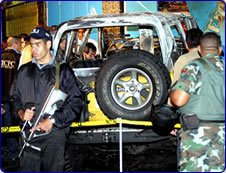
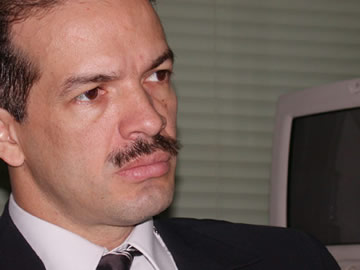 It all started on the evening of November 18th, 2004 when this prosecutor, Danilo Anderson, got blown up. Guy gets into his SUV, the thing explodes, his body is instantly incinerated.
 This was a big shock for everyone. I mean, Venezuela is not Colombia, political assasinations are very rare. So people were really stunned when this happened.
Thing is, Anderson was not just any old prosecutor. The guy had been assigned a series of very high profile, highly politically sensitive cases. For sure he was seen as a chavista, and his investigations were suspiciously consistent in always implicating government critics and always exonerating government supporters.
"So the opposition had him killed," you might be thinking.
Well, it sure looked that way at first. Obviously, that was the chavista line. The government made a huge to do about it. The guy was mourned on the floor of the National Assembly. He was decorated post-mortem. Congressmen cried, ministers demanded justice, the prosecutor general vowed to leave no stone unturned in flushing out the evil oppositionists who did it. He became the first bona fide chavista martyr, a rallying cry for the government, definitive proof of how evil and twisted their opponents were.
So far, so good: a nice, neat narrative of opposition evil-doing. But soon, elements started coming out that didn't quite seem to fit in with that story-line.
Two days after the murder, two former cops disappeared off the streets, only to turn up a week later, almost naked and apparently drugged, wandering in the streets of Valencia. The two are brothers, Rolando and Otoniel Guevara, and they claim they were tortured by Disip - Venezuela's secret police. The government blamed them for carrying out the crime. Their cousin Juan Guevara, another former cop, was later implicated in the murder as well. The three were eventually convicted of carrying out the hit and sentenced to long sentences, though the evidence against them was spotty - there was no physical evidence linking them to the crime.
Two other suspects are now dead. Antonio Lopez Castillo, was killed in a strange shoot-out with police on the streets of Caracas. His body had something like 15 bullets in it by the time it got to the morgue. A fourth suspect, Juan Carlos Sanchez, died in mysterious circumstances. The police claim he died in a shootout with them in a Barquisimeto motel nine days after Danilo's murder. The Guevara brothers claim he was with them at the Disip detention center in Caracas, and died under torture.
Then, a series of press leaks showed that a number of eye-witnesses had seen State Security (DISIP) patrols very close to the scene of the explosion less than an hour before it happened. Coincidence?
But it gets even murkier: other highly compromising leaks from the police investigation of the murder started turning up in the opposition press. For one thing, Anderson seemed to have a lot, and I mean a LOT, more money than he could justify from his salary. The guy earned $1100 a month, but he had 3 SUVs, two apartments, two jet-skis, a farm, and stacks of 100 dollar-bills sitting in his apartment. Curious, very curious.
Then a number of bankers started to come forward to say that a group of public prosecutors headed by Anderson had been blackmailing them. 'Cough up $50,000 or face indictment over the 2002 coup.' That sort of thing. Some of the bankers said they were on record making these accusations before Anderson got blown up.
In early 2005, Chavez's own interior minister actually echoed the racketeering allegations. This guy is about as chavista as you can get, he's the guy in charge of the police in Venezuela we're talking about here. Jesse Chacon is his name. Chacon went in front of the cameras and said investigations suggested Anderson had been on the take.
It's at this point that things started to get really screwy. First off, José Cuellar, the police investigator who gathered the evidence on the racketeering angle and the Disip patrol on the scene, was denounced as a "traitor" by the prosecutor general and shifted off the case. Then, all of the evidence Cuellar had collected linking Anderson with blackmail started getting erased from the police record. Worse, it was revealed that the public prosecutors leading the investigation - the ones who had Cuellar bumped off the case - had been accused of taking part in Anderson's extortion racket. "The gang of midgets," they were called, because they were all short.
I know what you're thinking: "Wait, wait, run that by me again!? The other guys who were supposedly blackmailing these bankers were the ones in charge of investigating the murder of their ex-ring leader?"
Bizarre, huh? Well, that's what happened. Thing is, the Prosecutor General has never acknowledged that the extortion allegations even exist, and after a solitary reference to it, Chacon, the Interior Minister never mentioned it again. It's really quite twisted: the gang of midgets is still running the investigation now!
Finally, the government announced they had cracked the case into the "intellectual authors" of the crime - the masterminds. In November 2005, they indicted a weird, mixed group of Opposition and government figures, largely unrelated with one another. The highest-profile indictee was Patricia Poleo, a radical anti-Chavez journalist, who had actually written a book accusing the Guevara brothers of hiding Vladimiro Montesinos in Venezuela. The notion that Poleo could have hired the Guevaras to pull off a hit strains all credulity.
The Prosecutor General innitially proposed to try these masterminds on the basis of the evidence brought forth by a single alleged witness to the conspiracy: a former colombian paramilitary. The guy, Geovanny Vasquez de Armas, became the focus of frenzied media interest. And after just a few phone calls to Colombia, journalists discovered he had an extensive criminal record, had spent time in jail for identity fraud (impersonating a doctor and faking a medical diploma.) Documents they dug up indicate he was in jail in September 2003, on the dates when he claimed to have been planning the murder in Panama. As Vasquez de Armas' credibility started to flounder, the Prosecutor General claimed to have dug up further witnesses.
The reports that DISIP agents were hovering around the scene of the explosion were never followed up. The money in Danilo's apartment, along with all records of its existence, just diappeared. According to some versions, Anderson had a compromising sex video in his safe - obviously, that one vanished as well.
It all seems just too far-fetched to take seriously, I realize. But this is what's out there on the record. Frankly, I have no idea who killed Danilo Anderson. But I'm sure the Prosecutor General is covering something up.
November 7, 2005
Bury FTAA? Easy for Chavez to say!
Chavez was happy like a pig in shit last week, basking in worldwide media attention and lefty adoration for his "principled stand" against one of those gringo proposals everyone loves to hate - the Free Trade Area of the Americas. For all the talk about burying FTAA, one basic fact was mostly ignored in commentary of the summit: it's murderously easy for Chavez to rant at length about this because Venezuela already enjoys most of the benefits of Free Trade.
To explain. Countries engage in trade negotiations in order to improve their access to other countries' markets. If Country A exports mostly shirts, and shirts face high tariffs in Country B's, then Country A has an obvious interest in negotiating better access to Country B's market.
You'll have noticed that Country V's exports are overwhelmingly dominated by oil. Oil already faces low-to-no tariffs all around the world. (It's just too important an input for other countries to tax it at the border.) So oil-exporters like Venezuela are in a peculiar position when it comes to trade negotiations: the basic impetus that drives most countries to negotiate really doesn't apply to them.
It's true that oil products do face high taxes once inside the border, but no country negotiates tax policies in international trade talks, and energy taxes are certainly not on the FTAA agenda. So Venezuela has nothing much to gain from hemispheric trade talks.
This is why it's so easy - but also so fatuous - for Chavez to rant against FTAA. He can talk himself blue in the face, knowing that our access to foreign markets isn't really in doubt.
This also explains why Brazil and Argentina, which are also skeptical of FTAA, were so much more circumspect in criticizing it. Brazil and Argentina's exports are centered on basic manufactures and agriculture, sectors that face serious barriers in the US market. They have much more to gain from negotiating a trade agreements with the US than Venezuela ever will.
In fact, FTAA is an issue taylor-made to Chavez's brand of demagoguery. He can use it to make grand sounding fulminations against imperialism at basically no cost. It's the ultimate risk-free way to position himself as a world leader and get the drooling admirations of ñangaras near and far. Que manguangua!
To explain. Countries engage in trade negotiations in order to improve their access to other countries' markets. If Country A exports mostly shirts, and shirts face high tariffs in Country B's, then Country A has an obvious interest in negotiating better access to Country B's market.
You'll have noticed that Country V's exports are overwhelmingly dominated by oil. Oil already faces low-to-no tariffs all around the world. (It's just too important an input for other countries to tax it at the border.) So oil-exporters like Venezuela are in a peculiar position when it comes to trade negotiations: the basic impetus that drives most countries to negotiate really doesn't apply to them.
It's true that oil products do face high taxes once inside the border, but no country negotiates tax policies in international trade talks, and energy taxes are certainly not on the FTAA agenda. So Venezuela has nothing much to gain from hemispheric trade talks.
This is why it's so easy - but also so fatuous - for Chavez to rant against FTAA. He can talk himself blue in the face, knowing that our access to foreign markets isn't really in doubt.
This also explains why Brazil and Argentina, which are also skeptical of FTAA, were so much more circumspect in criticizing it. Brazil and Argentina's exports are centered on basic manufactures and agriculture, sectors that face serious barriers in the US market. They have much more to gain from negotiating a trade agreements with the US than Venezuela ever will.
In fact, FTAA is an issue taylor-made to Chavez's brand of demagoguery. He can use it to make grand sounding fulminations against imperialism at basically no cost. It's the ultimate risk-free way to position himself as a world leader and get the drooling admirations of ñangaras near and far. Que manguangua!
November 6, 2005
Luis Vicente Leon on Roberto Smith
Closing out his roundup of the four main non-chavista "presidenciables" (the others being Julio Borges, Teodoro Petkoff, and one or the other of the Salases), Luis Vicente Leon evaluates Roberto Smith's chances in today's El Universal.
I'll translate it leaving out Leon's preposterous little Fantastic Four theme...
I'll translate it leaving out Leon's preposterous little Fantastic Four theme...
Many believe that an opposition leader's job is: 1-to give Chavez hell, in order to rouse the peanut gallery, 2-to invoke Article 350 (on civil disobedience) as an expedient to get around the "little detail" of having to put forward an intelligent set of proposals that might rescue the search for an alternative to chavismo.
The results of that strategy are clear: the contender who does best at insulting Chavez (and I don't doubt he deserves it) will be the darling of that 12.6% who define themselves as hardcore oppositionists. Bravo! The problem is that the 46.8% of the population that defines itself as NiNi, plus the 36.7% who define themselves as chavistas, won't even pause to take a look.
Nobody has grasped this better than Roberto "Esmí" Perera. This is the same Roberto Smith from the USB Student Center, the dashing CAP Telecomunications Minister, the former envoy to the European Union and the successful founding CEO of Digitel, it's just that he's spent some time de-gringuifying his background and showing that part of him is as Caroreño as Club Torres. I think it's brilliant.
His biggest strength is that he has a real plan to offer the country, which in the Venezuelan context is almost a miracle. His proposal is intelligent, modern, and geared at bringing people together. He aims to open spaces for all Venezuelans, regardless of ideology or class. He talks about turning Venezuela into a first world country, able to go head to head with the best societies in the world in terms of prosperity, equality, justice and peace. He's put forward the Todos Para Arriba (clunky translation - Everyone for the Better) program: full employment, and zero crime (the central problems people mention in all polls), ending poverty, a house for everyone and a first rate educational system that allows everyone a chance for a high standard of living.
He's been adaptable enough to understand that a head-on confrontation with Chavez would bury him from day one. He explains his strategy with a love metastory: the good girl (the people) who's fallen in love with a low-life (do we really need to spell it out?) If you attack the low-life, you insult her, because she chose him. You need to approach her with subtlety, with tenderness, ask her out, bring her flowers, listen to her problems with absolute respect, and show her what she deserves and doesn't have...but could have.
His proposals and his messages are not improvised. There are many hours of sophisticated study and work behind them, and a first-rate team, which is not usual in national politics.
Some might think his proposal sounds a bit "American". But the facts show it can work. Roberto was a total unknown in Vargas when he decided to run for governor. His biggest link with the state was probably that he used the airport all the time. But during the campaign he deployed his three weapons: his proposal, a fresh team, and his wife, the efficient and well organized engine behind the leader.
This total unknown blew 16 other opposition candidates out of the water, all of them from Vargas. More importantly, chavistas didn't see him as an enemy, but as an option.
But it's not all positive. Unlike the other three (Borges-Petkoff-Salas), few people know him, and I had to spend half this column just introducing him. He sees that as an advantage because his negative ratings are lower that way. I think that's a far-fetched interpretation. Smith needs to improve his name recognition, work his image hard and get some coaching for his media appearances, which are still lackluster. Despite his personal and professional qualities, he can come across as being closed to advise and suggestions, and finally, the political platform supporting him is extremely weak, though the arrival of Cipriano Heredia and Vision Emergente might help.
One way or another, he is a disciplined, smart, organized operative who surprised everyone in Vargas and could do it again nationwide. Today he is in the spotlight more due to his proposal than his leadership. That could be the right way to build a real leader. We'll see.
November 5, 2005
Global Voices Online
Thanks to TrackBack, I discovered Global Voices Online, a unique, very cool roundup of news-oriented blogs from all over the world.
November 4, 2005
Ibéyise Transformed
As longtime readers know, Ibéyise Pacheco is no saint of my devotion. That said, her article in today's El Nacional really struck me as remarkable. A former hyperradical come-candela Oppositionist, Ibéyise decided to run for a National Assembly seat, and it looks like the experience of campaigning has rocked her.
Never in a million years did I imagine I would find myself translating an Ibéyise column, but today she injects a badly needed note of realism to the increasingly vicious Opposition debate about whether to pull out of the Dec. 4th parliamentary elections to protest the chavista-dominated CNE.
I'll translate the gist of it...
The piece is long, and hard to translate, but this gives you a flavor.
What I find remarkable is the effect that going out and actually campaigning has had on Ibéyise. The mother of all comecandelas suddenly realizes that the second you pop your head outside the Eastern Caracas-centered, middle-class dominated debate that stands in for political life in the anti-Chavez press, you find a whole different country out there, one where the debate on whether to participate in elections or not looks worse than meaningless, it looks ridiculous.
If more opposition politicians took the trouble to do what Ibéyise has been doing, if they would take a break from grandstanding and go out to meet the people they aspire to lead, they would realize what Ibéyise has been realizing, and what Roberto Smith has been saying all along. They would grasp how grotesquely out of context the debate on Article 350 really is. And they would realize that the poor are itching for an option, a real option, a credible option, to Chavez's lunacy.
Never in a million years did I imagine I would find myself translating an Ibéyise column, but today she injects a badly needed note of realism to the increasingly vicious Opposition debate about whether to pull out of the Dec. 4th parliamentary elections to protest the chavista-dominated CNE.
I'll translate the gist of it...
Canibalism at home
I know it isn't pleasent, but lets imagine for just a second how satisfied Chavez must be at the spectacle of Opposition canibalism that has been unfolding in the media over the last few weeks.
The latest fashion seems to be to insult my dear and respected colleague and friend Isa Dobles (another hyperoppositionist journalist turned candidate to the AN.) What is it that they have against women?
That's how things stand: we're serving up a ridiculous, puerile show that overshadows the possible, needed and healthy debate between those who propose going to elections and those who favor abstention. It's so petty - and at the same time so destructive - all of this! As though it wasn't legitimate to disagree. As though we hadn't been protesting all along against an attempt to control our thinking, our ideas.
It really pains me. It's disappointing that we can't sit down to debate without insults, without aggressions, without personal attacks. That we aren't able to act differently than Chavez, or Jose Vicente Rangel.
I write this because my experience over the last few weeks, campaigning in the Miranda Highlands where I am running for a seat in the National Assembly, has surrounded me with information and sensations which besides being interesting, have touched me, and which transcend this idiocy, this dire idiocy, which we have been exposing to public opinion.
People are really hurting out there.
I've seen humiliated displaced people, desperate unemployed people, hunger, I say it again, hunger. People eating out of garbage cans, boys and girls turning to prostitution just to survive, drugs, and a crime wave you can feel because the government will let anyone who dons a red shirt do anything at all.
But the poor - many of whom do not support the government but keep quiet because they're scared - just laugh at the middle class debate about whether to vote or not. They just consider it puerile, frivolous. "They got depressed, and now they say they're pissed off and they won't vote," they say with scorn.
These poverty-stricken people, whether chavistas or not, see things from a very different point of view. They see it from an angle that has been forgotten by many of us who have engaged in this valid and courageous struggle, but have ended up talking in front of the mirror, treating the poor once again like alien beings that Chavez takes advantage of through his populism and his lies. Well, he will continue to do so, until we grow up.
The other lament
The middle class has gone through a lot of pain. The question is whether we'll remain stuck in that pain. In a lament that becomes resignation. That's what I always say to people confused by the different points of view in the public arena today. The only way out of this mess is through the ballot box, and that does not deny a place for struggle in the streets.
I can say it with a clear concience because nobody can say (odious though it may be to point it out) that I haven't worked flat out and consistently to battle against the excesses of this regime, against all the attempts to nullify us as citizens, to disappear our dreams, to rip the country away from us, to destroy our freedom. It's just that, alongside all that, the regime also works to demobilize us completely, to paralize us vis-a-vis any electoral option. Might it not be that they are scared of our participation?
The piece is long, and hard to translate, but this gives you a flavor.
What I find remarkable is the effect that going out and actually campaigning has had on Ibéyise. The mother of all comecandelas suddenly realizes that the second you pop your head outside the Eastern Caracas-centered, middle-class dominated debate that stands in for political life in the anti-Chavez press, you find a whole different country out there, one where the debate on whether to participate in elections or not looks worse than meaningless, it looks ridiculous.
If more opposition politicians took the trouble to do what Ibéyise has been doing, if they would take a break from grandstanding and go out to meet the people they aspire to lead, they would realize what Ibéyise has been realizing, and what Roberto Smith has been saying all along. They would grasp how grotesquely out of context the debate on Article 350 really is. And they would realize that the poor are itching for an option, a real option, a credible option, to Chavez's lunacy.
November 3, 2005
Reading guide for beginners
I'm still working to make the Blog more newbie-friendly.
I thought an annotated reading list would be helpful to beginners, so I put together this Reader's Guide to Venezuela in the Chavez Era.
It's a work in progress. I'm eager for suggestions for expanding it.
I thought an annotated reading list would be helpful to beginners, so I put together this Reader's Guide to Venezuela in the Chavez Era.
It's a work in progress. I'm eager for suggestions for expanding it.
November 2, 2005
Chavez for beginners...
I've decided to add a few pages to the site specifically geared at people who don't know much about Venezuela and want a quick explanation of what's happening. First off, I'm writing a Chavez FAQ
Chavez spooked
At first, it seemed like just another of Chavez's folkloric eccentricities. On Sunday, he valiantly faced down the latest imperialist threat from the USA: Halloween. Calling it a "game of terror", Chavez denounced the gringo tradition of dressing kids up like ghosts and witches to extort candy from neighbors.
The Associated Press wrote it up, and the story got picked up by newspapers around the world. I guess editors in South Africa, Pakistan, and Vietnam ran with it because it's the kind of delightfully absurd little "color piece" that can usefully plug a hole in the inside pages of the international section. A bit of magical realism...no more...right?
No, not right. Within hours of the speech, Internal Security Police (DISIP) agents were arresting a group of Primero Justicia activists for putting up anti-government posters with Halloween themes. Three of the activists had to spend the night in jail, while the other four were cited to later court dates to face charges of "inciting hatred."
[You can see some pictures of the entirely benign posters here.]
The message is not hard to grasp: Chavez's eccentric little outbursts are not cute. They long ago stopped being funny. With every state institution under his thumb and public officials competing to suck up to him, they have real consequences. Of course, the foreign papers that jumped on the Wacky-Chavez story notably failed to jump on the Authoritarian-Chavez story. "That zany Chavez guy!" their readers will think...having no clue that, in Venezuela these days, the guy's outbursts, however silly, will land you in jail.
The Associated Press wrote it up, and the story got picked up by newspapers around the world. I guess editors in South Africa, Pakistan, and Vietnam ran with it because it's the kind of delightfully absurd little "color piece" that can usefully plug a hole in the inside pages of the international section. A bit of magical realism...no more...right?
No, not right. Within hours of the speech, Internal Security Police (DISIP) agents were arresting a group of Primero Justicia activists for putting up anti-government posters with Halloween themes. Three of the activists had to spend the night in jail, while the other four were cited to later court dates to face charges of "inciting hatred."
[You can see some pictures of the entirely benign posters here.]
The message is not hard to grasp: Chavez's eccentric little outbursts are not cute. They long ago stopped being funny. With every state institution under his thumb and public officials competing to suck up to him, they have real consequences. Of course, the foreign papers that jumped on the Wacky-Chavez story notably failed to jump on the Authoritarian-Chavez story. "That zany Chavez guy!" their readers will think...having no clue that, in Venezuela these days, the guy's outbursts, however silly, will land you in jail.
November 1, 2005
Venezuela Understood
Thanks to GP (writing in Daniel's Blog) for pointing me to two outstanding pieces by Alma Guillermoprieto published recently in The New York Review of Books. They are here and here
I often dispair at foreign writers' inability to write lucidly and non-propagandistically about Venezuela. The vast majority just pick up one party line or the other and run with it. It takes a rare talent to cut through the layers and layers of BS and get to something genuinely fair, balanced and insightful. Add to this a sleek prose style, an amazing ability to summarize vast amounts of background information and a principled refusal to dumb down the story, and you get...Alma Guillermoprieto.
Really worth a read.
I'll reproduce a key section from her first piece:
I often dispair at foreign writers' inability to write lucidly and non-propagandistically about Venezuela. The vast majority just pick up one party line or the other and run with it. It takes a rare talent to cut through the layers and layers of BS and get to something genuinely fair, balanced and insightful. Add to this a sleek prose style, an amazing ability to summarize vast amounts of background information and a principled refusal to dumb down the story, and you get...Alma Guillermoprieto.
Really worth a read.
I'll reproduce a key section from her first piece:
It is too soon to judge how well the many ambitious social welfare and education programs launched by Chávez —they are known as misiones—have succeeded in redressing Venezuela's deep inequalities, but they suffer already from an essential flaw: as with everything else Chávez creates, their existence depends on him. This would seem to be a reflection of the President's apparent sense that everything that happens, that has happened—in Venezuela, and in this hemisphere as well—in some way relates to him. At a meeting with Uruguayan investors last July he noted that their national independence day was approaching. What a coincidence, he noted: in July also—on July 26, 1953—Fidel led his assault on the Moncada barracks. And on another July 26—in 1952—Evita, Evita Perón, died. "And just two days later," he said, "on July 28th [1954], I was born! Imagine!" There is the melodramatic flair, the flamboyant clothes, the generic love for the poor and the authoritarianism: one could actually think that he is Evita reincarnate, and Perón, too, if it weren't for the fact that Perón died rather late (1975) for a proper transmigration of souls to take place.
Such are the hallucinatory terms in which one can easily find oneself discussing the state of Venezuelan politics. In Caracas today it often seems as if there were no issues, only bilious anger or unconditional devotion—or gasping bafflement—all provoked by the President, who takes up so much oxygen that there is no breathing room left for a discussion of, say, the merits of his neighborhood health policy, his relations with Cuba, or whether the chronically overflowing currency reserves should be used merely to guarantee the rate of exchange or to finance, as Chávez has, the multiplying misiones. How can one reasonably discuss whether the upper management of the oil company was involved in plotting a coup when the President is busy firing seven of those managers on Aló Presidente, saying "You're out!" and giving a blast of an umpire's whistle? And how can an interviewer, in this case Jorge Gestoso of CNN en Español, possibly discuss the merits of such an approach with Chávez when Gestoso must begin by insisting to Chávez that this event actually did take place?[5] The official use of lies, the opposition's terrified rantings, the abandonment of civility by the press and television take place outside the realm of politics, and do away with reason.
The problem is that all of this defies description, one observer has written:
...That is why the critics are so totally at a loss; they don't know what the weak flank of chavista politics is because it is an unheard of combination of little-known things, with a totally new result. The populist element, the good-ole-boy element, the martial spirit, the willfulness, the Bolivarian delirium, the economic pragmatism, and the monarchic arbitrariness are known, along with the authoritarianism of the old [Caudillista] compadre. None of this is new, but the combination of it all (to which must be added his luck, of which he has too much) is what is incomprehensible.
Thus, in a convoluted, sometimes brilliant journal, the columnist Colette Capriles, who writes as if she had spent much of the last few years lying on her sofa in a state of mild depression, watching events unfold on the television screen.
Even after a visit of only a few weeks, one can start to feel claustrophobic in Venezuela, as if the people there were all living inside Chávez's head, with some making small squealing noises as they try to get out. But the President has no visible worries: the various misiones—in favor of ethnic culture, literacy, college equivalency, medical care in the barrios, in defense of street children—are thriving, in no small part because there are tens of thousands of highly skilled Cubans who have been assigned by Fidel to staff them, and also because they are lavishly financed—in ways the health and education ministries could benefit from. Who knows, Chávez says, he might even remain in power through the year 2024, or even 2030.
October 31, 2005
October 30, 2005
Sunday Roundup: Compare and Contrast
The Washington Post runs a tough editorial today (free registration required) on the intimidation of Venezuelan Human Rights Organizations under Chavez. Key paragraph:
Meanwhile, the New York Times runs a particularly sycophantic piece even by Juan Forero's standards (Registration also required.) Check out the creepy mural, though. Key paragraph:
...sigh...
ps: I'm still working on my Venezuela Opinion Duel counter-rebuttal...
One conspicuous victim of this phenomenon is Carlos Ayala, who testified before the commission about the growing threat to journalists and press freedom. One of the most respected human rights lawyers in Latin America, Mr. Ayala is a former president of the Inter-American Commission as well as the Andean Commission of Jurists. When dissident military leaders tried to stage a coup against Mr. Chavez in April 2002, Mr. Ayala not only denounced the plot, which eventually failed, but intervened with police to free a militant pro-Chavez legislator. Yet, last April, after he brought human rights cases against the Chavez government, prosecutors announced that they had opened a criminal investigation against Mr. Ayala for allegedly supporting the coup. Charges are still pending.
Meanwhile, the New York Times runs a particularly sycophantic piece even by Juan Forero's standards (Registration also required.) Check out the creepy mural, though. Key paragraph:
In the tumbledown barrios where Mr. Chávez draws much of his support, it is easy to see why the new system has been warmly welcomed. The hills around Caracas and the farms in the outback are filled with cooperatives and other businesses in which the state plays an important role. Workers produce everything from shoes to corn.
...sigh...
ps: I'm still working on my Venezuela Opinion Duel counter-rebuttal...
October 29, 2005
October 28, 2005
Going head to head with Gustavo Coronel
Gustavo Coronel has been writing about NiNis.
So have I.
I don't agree with a single thing he has to say about them.
So I challenged him to an Opinion Duel.
He accepted.
Click here to read the results...
So have I.
I don't agree with a single thing he has to say about them.
So I challenged him to an Opinion Duel.
He accepted.
Click here to read the results...
October 27, 2005
Roberto Smith in his own words...
I'm translating selected excerpts of Venezuela de Primera leader Roberto Smith's online forum at Noticiero Digital. The questions are posed by Noticiero Digital readers.
Q: What's different in your offer from what we've seen and lived before?
A: We offer something no one has ever offered, not the bolivarian generation, nor the generation of '28, nor that of '58, nor those in power today: to build a first-world country economically, socially, politically and culturally, within one generation. To be the first country in Latin America to be a first-world country, like Singapur, South Korea, Taiwan and Lebannon did, among others.
I'll transcribe the opening of our statement of principles:
"Never in our history has a generation set out to turn Venezuela into one of the best countries in the world. We take on that challenge and we begin here a new era in the history of our people: the era of the construction of a first world Venezuela, a people known as one of the greatest in the world.
Our starting point is clear: all Venezuelans hope for a First World Venezuela, a society like the most successful in the world in all areas of human life, prosperous and poverty-free, with work for everyone without exclusion or marginalization, free, pluralist and republican, free of populism and authoritarianism, with an effective and just government, free of mediocrity and culturally creative. There is no other acceptable destiny, and so a First World Venezuela is the only national project that can truly unity all Venezuelans on a great common enterprise."
There is no country in the world with our potential for prosperity and social justice. We refuse to accept a mediocre destiny. That is VERY DIFFERENT from the offers that the Venezuelan people has heard before.
Q: Are you Rodolfo's son?
A: I am not related to journalist Rodolfo Schmidt, whom I admire. My father is Roberto Smith Camacho, from Churuguara, Falcon State, an engineer and first rate man, and my grandfather Juancho Smith, who was a peasant.
Q: If, right now, unity is the most important thing, what's the point of coming out to compete at this time? Doesn't it just strain the atmosphere and atomize the opposition even more?
A: I agree with you that unity is key, but I mean the unity of ALL Venezuelans around a new project to turn us into a first-world country. That, in my humble opinion, is the only "unity" that's worth anything. The idea that the country is split in two chunks is wrong. There is a huge majority of Venezuelans who don't want what we have now or what we had in the past. Together we should build that more transcendental unity, which will eventually encompass everyone. I don't see what could be bad about setting out to compete by proposing a project for real national unity.
Q: Don't you think the Opposition's possibilities for success would be more realistic if they recognized the lies and errors they've imposed on their followers over the last seven years?
A: I agree with you.
Q: Will you be the leader to recognize once and for all that there was no fraud in the referendum, that April 11th was a planned coup and that the opposition has been in the minority in Venezuela since 1998? Or are you scared of being rejected like all those who have gotten "close" to the government?
A: I don't identify with the Opposition, but rather with a new proposal (in spanish "proposición") to build a first world country. I think the Opposition allowed itself to lose the referendum ("se dejó ganar"), with or without fraud. I have severely criticized the events of April 2002. I marched peacefully along with hundreds of thousands and I was infuriated by the violence that day, but I was much more indignated by what happened afterwards.
I believe most Venezuelans today are not on one side or the other, but that they aspire to a new proposal for a First World Venezuela, without conflict, with national unity. In the past, a large majority systematically backed a project for change that offered much that was positive. But time passes, while the people still suffer and wait...
I want to unite 100% of Venezuelans, not just one part.
Q. The opposition has suffered 10 defeats since 1998. Every defeat has been decisive. Isn't that a sign that in Venezuela today there is an irrefutable rejection against everything that has to do with the political past and a firm determination not to go back?
A: I endorse the idea that THEY SHALL NOT RETURN (NO VOLVERAN) - that includes much from the not-so-recent past, but also lots from the recent past. I share the predominant concern with the excluded and the poor in the current discourse, but I am very worried about the inefficiency and corruption that are a consequence of public mismanagement.
Q: Since you are part of that political past (reference to his stint as communication minister in the early 90s), how do you intend with the stigma?
A: The only thing no one can change is their past. I am proud of my career, marked by efficiency, honesty, social commitment and good management.
Q: Do you think of yourself as right wing or left wing?
A: Part left, part right...I'd rather think of myself as first wing, like all Venezuelans. The right-left axis isn't very meaningful anymore because we live in the century of diversity, of creativity, and that axis is too simplistic.
Q: Do you think the alliance with Cuba is a positive thing?
A: I love Cubans, I hate their dictatorship. It's a historical anomaly, and I dream of helping Cuba find the liberty, the democracy and the prosperity they don't have today.
Q: Do you think CNE is legitimate? If not, why do you participate in the elections put together by an illegitimate CNE?
A: The electoral system, on the whole, is "depressing", not "First World" ("deprimente, no de primera"). We believe in elections, not in abstention, but we're demanding CNE to allow the people to count all the votes, and to get rid of the thumb-print scanners and electronic rolls that undermine the secrecy of the vote, and to clean up the electoral registry. We will keep on demanding those things until they are achieved. If they are not, we will take other steps in due course.
Q: Do you believe in Twentyfirst Century Socialism?
A: I've been studying social and political doctrines since I can remember. I was a democratic socialist (read MAS supporter) when I was at university, but I've left such simplistic views behind. Today my heart is full of solidarity and justice, but my head is focused on efficiency, that's why I believe in a proper balance between market and state, between solidarity and efficiency - I think "isms" work only to justify systems of domination. I believe we should shift from the hegemony of domination to the predominance of cooperation.
Q: Do you really think you have enough support to become president?
A: Our project for a First World Venezuela has the overwhelming support of the population, they want full employment, zero crime, a home for everyone and a First World democracy. Turning that into a vote for president demands, nonetheless, a huge effort. But history is full of election surprises. Fujimori had 0.6% in the polls 8 months before he was elected. Uribe was at 6% just 6 months before his election. Kennedy was on 3% a year before his election. And the current president had 2.5% 10 months before his election. (Note how he NEVER mentions Chavez by name, even when he - exceptionally - talks about him. -ft) Nothing is settled until the people make their choice.
The main tool I use to reach the people is to be there, to live , suffer and share with the poor people of this country. There is no other way to understand the problems of the majority except from inside the poor barries and the most misery-stricken towns. In those barrios and those towns you find the First World people of Venezuela. Those who long for a first-world country, those who want to improve their lives together, those who want to leave the fighting aside and reconnect once again in a world of opportunities for all.
Q: I want to live like they do in the Nordic countries. Will you achieve that? It's impossible: nobody wants Venezuela to be like that. Why did they take down Carlos Andres Perez? He had that goal and they wouldn't let him.
A: We Venezuelans want to live like the richest and most prosperous people on earth...but keeping our culture, identity, originality, beauty. The idea isn't to copy anyone, but to be better than everyone. How? Just two examples:
1. We will become the biggest energy superpower on earth, producing 10 to 12 million barrels of oil and gas per day, processing them to maximize their added value. That will allow us to finance the projects for First World education, First World health care, and others, as well as generating over 1.5 million new productive jobs.
2. We will become a tourism powerhouse, bringing 15 million tourists a year (not the mere 300,000 who come now) on the basis of our biodiversity, our coasts, our mountains, and especially our beautiful and gentle people. That way we would create over 2.5 million jobs with good wages.
Those are just two examples, but I could go into our plans for new export industries, for a knowledge society, for modern agroindustry. Finland is a good example of a country that went from being really backward to being one of the most successful, because they rode the wave of the information society. Why can't we do something similar or better?
Q: What's different in your offer from what we've seen and lived before?
A: We offer something no one has ever offered, not the bolivarian generation, nor the generation of '28, nor that of '58, nor those in power today: to build a first-world country economically, socially, politically and culturally, within one generation. To be the first country in Latin America to be a first-world country, like Singapur, South Korea, Taiwan and Lebannon did, among others.
I'll transcribe the opening of our statement of principles:
"Never in our history has a generation set out to turn Venezuela into one of the best countries in the world. We take on that challenge and we begin here a new era in the history of our people: the era of the construction of a first world Venezuela, a people known as one of the greatest in the world.
Our starting point is clear: all Venezuelans hope for a First World Venezuela, a society like the most successful in the world in all areas of human life, prosperous and poverty-free, with work for everyone without exclusion or marginalization, free, pluralist and republican, free of populism and authoritarianism, with an effective and just government, free of mediocrity and culturally creative. There is no other acceptable destiny, and so a First World Venezuela is the only national project that can truly unity all Venezuelans on a great common enterprise."
There is no country in the world with our potential for prosperity and social justice. We refuse to accept a mediocre destiny. That is VERY DIFFERENT from the offers that the Venezuelan people has heard before.
Q: Are you Rodolfo's son?
A: I am not related to journalist Rodolfo Schmidt, whom I admire. My father is Roberto Smith Camacho, from Churuguara, Falcon State, an engineer and first rate man, and my grandfather Juancho Smith, who was a peasant.
Q: If, right now, unity is the most important thing, what's the point of coming out to compete at this time? Doesn't it just strain the atmosphere and atomize the opposition even more?
A: I agree with you that unity is key, but I mean the unity of ALL Venezuelans around a new project to turn us into a first-world country. That, in my humble opinion, is the only "unity" that's worth anything. The idea that the country is split in two chunks is wrong. There is a huge majority of Venezuelans who don't want what we have now or what we had in the past. Together we should build that more transcendental unity, which will eventually encompass everyone. I don't see what could be bad about setting out to compete by proposing a project for real national unity.
Q: Don't you think the Opposition's possibilities for success would be more realistic if they recognized the lies and errors they've imposed on their followers over the last seven years?
A: I agree with you.
Q: Will you be the leader to recognize once and for all that there was no fraud in the referendum, that April 11th was a planned coup and that the opposition has been in the minority in Venezuela since 1998? Or are you scared of being rejected like all those who have gotten "close" to the government?
A: I don't identify with the Opposition, but rather with a new proposal (in spanish "proposición") to build a first world country. I think the Opposition allowed itself to lose the referendum ("se dejó ganar"), with or without fraud. I have severely criticized the events of April 2002. I marched peacefully along with hundreds of thousands and I was infuriated by the violence that day, but I was much more indignated by what happened afterwards.
I believe most Venezuelans today are not on one side or the other, but that they aspire to a new proposal for a First World Venezuela, without conflict, with national unity. In the past, a large majority systematically backed a project for change that offered much that was positive. But time passes, while the people still suffer and wait...
I want to unite 100% of Venezuelans, not just one part.
Q. The opposition has suffered 10 defeats since 1998. Every defeat has been decisive. Isn't that a sign that in Venezuela today there is an irrefutable rejection against everything that has to do with the political past and a firm determination not to go back?
A: I endorse the idea that THEY SHALL NOT RETURN (NO VOLVERAN) - that includes much from the not-so-recent past, but also lots from the recent past. I share the predominant concern with the excluded and the poor in the current discourse, but I am very worried about the inefficiency and corruption that are a consequence of public mismanagement.
Q: Since you are part of that political past (reference to his stint as communication minister in the early 90s), how do you intend with the stigma?
A: The only thing no one can change is their past. I am proud of my career, marked by efficiency, honesty, social commitment and good management.
Q: Do you think of yourself as right wing or left wing?
A: Part left, part right...I'd rather think of myself as first wing, like all Venezuelans. The right-left axis isn't very meaningful anymore because we live in the century of diversity, of creativity, and that axis is too simplistic.
Q: Do you think the alliance with Cuba is a positive thing?
A: I love Cubans, I hate their dictatorship. It's a historical anomaly, and I dream of helping Cuba find the liberty, the democracy and the prosperity they don't have today.
Q: Do you think CNE is legitimate? If not, why do you participate in the elections put together by an illegitimate CNE?
A: The electoral system, on the whole, is "depressing", not "First World" ("deprimente, no de primera"). We believe in elections, not in abstention, but we're demanding CNE to allow the people to count all the votes, and to get rid of the thumb-print scanners and electronic rolls that undermine the secrecy of the vote, and to clean up the electoral registry. We will keep on demanding those things until they are achieved. If they are not, we will take other steps in due course.
Q: Do you believe in Twentyfirst Century Socialism?
A: I've been studying social and political doctrines since I can remember. I was a democratic socialist (read MAS supporter) when I was at university, but I've left such simplistic views behind. Today my heart is full of solidarity and justice, but my head is focused on efficiency, that's why I believe in a proper balance between market and state, between solidarity and efficiency - I think "isms" work only to justify systems of domination. I believe we should shift from the hegemony of domination to the predominance of cooperation.
Q: Do you really think you have enough support to become president?
A: Our project for a First World Venezuela has the overwhelming support of the population, they want full employment, zero crime, a home for everyone and a First World democracy. Turning that into a vote for president demands, nonetheless, a huge effort. But history is full of election surprises. Fujimori had 0.6% in the polls 8 months before he was elected. Uribe was at 6% just 6 months before his election. Kennedy was on 3% a year before his election. And the current president had 2.5% 10 months before his election. (Note how he NEVER mentions Chavez by name, even when he - exceptionally - talks about him. -ft) Nothing is settled until the people make their choice.
The main tool I use to reach the people is to be there, to live , suffer and share with the poor people of this country. There is no other way to understand the problems of the majority except from inside the poor barries and the most misery-stricken towns. In those barrios and those towns you find the First World people of Venezuela. Those who long for a first-world country, those who want to improve their lives together, those who want to leave the fighting aside and reconnect once again in a world of opportunities for all.
Q: I want to live like they do in the Nordic countries. Will you achieve that? It's impossible: nobody wants Venezuela to be like that. Why did they take down Carlos Andres Perez? He had that goal and they wouldn't let him.
A: We Venezuelans want to live like the richest and most prosperous people on earth...but keeping our culture, identity, originality, beauty. The idea isn't to copy anyone, but to be better than everyone. How? Just two examples:
1. We will become the biggest energy superpower on earth, producing 10 to 12 million barrels of oil and gas per day, processing them to maximize their added value. That will allow us to finance the projects for First World education, First World health care, and others, as well as generating over 1.5 million new productive jobs.
2. We will become a tourism powerhouse, bringing 15 million tourists a year (not the mere 300,000 who come now) on the basis of our biodiversity, our coasts, our mountains, and especially our beautiful and gentle people. That way we would create over 2.5 million jobs with good wages.
Those are just two examples, but I could go into our plans for new export industries, for a knowledge society, for modern agroindustry. Finland is a good example of a country that went from being really backward to being one of the most successful, because they rode the wave of the information society. Why can't we do something similar or better?
Learning the Lessons of the Opposition Debacle
Over the last ten days, I’ve written a series of short posts trying to summarize what has gone wrong with the Traditional Opposition, and pointing to Venezuela de Primera as a group that seems to have learned the right lessons from the Opposition debacle. Looking back, it strikes me that they read more like subsections of one long essay. So, breaking again my pledge to post only shorter pieces, I’ve stitched together those posts into an Epic Post of Opposition Bumbling and Suggestions for Making it Right Again.
1. Understanding NiNis
My starting premise was that the debate on the trustworthiness of CNE is largely misplaced – the basic reason the Opposition can’t beat Chavez at the ballot box is not fraud, it’s that most Venezuelans prefer voting for Chavez than for the Opposition. To have any hope to reverse that trend, we need to understand why.
The startling fact is that seven years into the Chavez era of furious political polarization, about half of the Venezuelan electorate remains politically non-alligned - the so-called NiNis. As a matter of simple arithmetic, it is not possible to construct an antichavista electoral majority without winning over a large chunk of this sector. But Venezuela’s Opposition faces major obstacles in winning over the politically non-alligned; basically because they don’t understand them. So, first, I want to discuss why the Opposition can’t seem to understand the NiNis, as a starting point for a broader discussion of how the Opposition has managed to alienate the broad political center where elections are won.
Obviously, a lot of Opposition supporters are extremely frustrated by the NiNi position. I've come to think the heart of the problem is confusion about the word "opposition."
There are two ways to understand the word in a political context, and the subtle difference between the two has given rise to endless misunderstanding...
Princeton WordNet renders them as:
opposition (n) : a body of people united in opposing something
Opposition (n) : the major political party opposed to the party in office and prepared to replace it if elected (e.g. "Her Majesty's loyal opposition")
The first definition is generic: anyone who disagrees with something is in opposition to it. In English, at least, this generic meaning is conveyed by writing it with a little "o". The second meaning - often capitalized in English - is specific: the Opposition is the particular set of parties and leaders that leads the opposition to the government.
The point about NiNis is that they are in opposition but not in Opposition.
When pollsters ask NiNis "are you part of the opposition?" what NiNis hear is "are you part of the Opposition?" They interpret it specifically, not generically.
Not surprisingly, they say no. The word brings to mind the old Coordinadora Democratica, what I've been calling the Traditional Opposition - and the one thing NiNis are agreed on is that they hate the Traditional Opposition. They reject its radicalism, its Chavez fixation, its obsession with incomprehensible detail, its negativism...they have lots and lots of perfectly good reasons to be upset with the Opposition .
But Opposition supporters usually think of the word generically - and so they can't fathom how anyone who is opposed to Chavez could possibly be a NiNi in good faith.
This is why Opposition supporters get so frustrated with opposition-minded NiNis. "If you oppose the government," they say in exasperation, "then - by definition - you must be part of the opposition! Otherwise you're either a fence-sitter, an opportunist or an idiot!"
"Not at all!" reply the NiNis, "we don't have to be in the Opposition to be opposed to Chavez!"
Thing is: they're talking about subtly different things, but this isn't immediately apparent. So the misunderstanding drags on and on and on...
What the polling data show, though, is that the Opposition has lost the support of large chunks of the opposition. My last few posts just express my anger at the Opposition's inability to grasp this, and its unwillingness take drastic action to reverse the trend.
If the Traditional Opposition doesn't realize it has to change to win back the opposition, then the opposition will have to find a way to form a New Opposition - one embodying the message of optimism and renewal they constantly tell the pollsters they are hungry for.
2. Antichavismo without Chavez
The Opposition, as we've known it, has failed. On this, we're all more or less agreed. It's failed on so many levels it's hard to know where to start. But, to my mind, the most basic failures have been tactical.
Time and again, Opposition leaders have centered political debate on issues that play to Chavez's advantage. Chief among these is the issue of Chavez himself.
It baffles us, angers us, dismays us and infuriates us, but most Venezuelans kinda like Chavez. A good 30% idolize him, another 40% have mixed feelings about him, but only a relatively small minority positively detest him like the Opposition leadership does. In poll after poll, Chavez personally gets much higher marks than "the government", "the cabinet", or anything else associated with Chavez.
How might a tactically savvy Opposition respond to this polling trend? You'd think it would try to refocus debate away from Chavez the man and towards his government's incompetence. But this hasn't happened. Opposition leaders' visceral horror at his caudillismo and autocratic zeal prevents it. With remarkable singleness of purpose, they work to keep debate centered on the one aspect of Chavismo that's most popular with the electorate at large.
Not surprisingly, it hasn't exactly worked. So maybe it's worth trying something different. Maybe the smart way to go about this is to put together an anti-government discourse that scrupulously avoids even mentioning Chavez.
Impossible?
Venezuela de Primera doesn't think so...
3. Discipline, Optimism, Renewal
More than its failures, what exasperates the opposition grassroots is that the Opposition leadership doesn't seem to learn from those failures. Today, I want to go deeper into the Opposition inability to put together a message that people might want to vote for.
The Opposition's main message problem leading up to last year's Recall Referendum was its inability to communicate in a disciplined way. The old Coordinadora Democratica was an absolute gallinero, a loose confederation of politically very diverse groups brought together only by visceral antichavismo. It's not surprising that such a disaggregated coalition could not settle on a limited, deliberately chosen set of key themes and stick to them. The CD members never accepted a single leader, or even a strong central secretariat, with real power to impose some "message discipline."
Not surprisingly, the CD's communications quickly degenerated into an incoherent potpourri of anti-Chavez bile, with spokesmen competing to out-do one another in a game of "quien-es-mas-antichavista". What passed for a "communication strategy" wasn't much more than a string of anti-Chavez rants carried live on Globovision and Union Radio, each stressing different themes in different ways. There was no message discipline at all, largely because there was no organization to impose message discipline.
This combination of message indiscipline and Chavez fixation made it impossible for the CD to put forward an optimistic message. This is important. A pile of social science research shows that voters respond much better to optimistic messages. Even after seven years, Chavez's relentless optimism is a big part of his electoral draw. But an opposition held together only by distaste for Chavez could only talk about how bad things would be if Chavez stayed in power. Their message came over as relentlessly negative: a major turnoff for voters.
A related failure was the CD's inability to put forward a message of renewal. This was also a function of CD heterogeneity. The perceived imperative for "unity" inside such a varied organization meant melding together the fourth republic dinosauriat with sixth republic reformism. The prominence of fourth republic figures in the CD made it an easy target for government attacks. How on earth do you convince the voters that Henry Ramos Allup is really going to go for a forward-looking reformist government? That Antonio Ledezma is the future?! Those are some tough sells!
If the Traditional Opposition had had the guts to accept defeat in last year's referendum, it might have launched a serious internal debate about these problems. Instead, they decided to duck behind a fraud claim on evidence that couldn't convince anyone outside the hardcore base. The claim put a stop to any serious consideration of the CD's message problem. The Traditional Opposition, today, has made exactly zero progress on message discipline, or on forging an optimistic message of renewal.
Again, I can't help but notice that there's only one political group out there that seems to have clearly understood the need to put out an optimistic message of renewal in a disciplined way: Venezuela de Primera. I can see no reason to think that anyone else has quite learned the lessons of the CD failure.
4. Talking to the NiNis
Another area where the Coordinadora Democratica failed disastrously was in thinking through its target audience. By and large, the Traditional Opposition was happy to talk to hardcore antichavistas only. It never really put together a message to attract the political center. It still hasn't.
This is a serious problem. For all the talk about polarization, both hardcore antichavismo and hardcore chavismo have remained minority positions in Venezuela over the last two years. The largest single piece of the political cake has remained the the politically orphaned people who question both Chavez and the opposition – the confusingly dubbed NiNis. According to survey and focus group data gathered by Hinterlaces, 51% of voters were politically non-alligned in March 2005. In the 20 months preceding that study, the NiNis averaged 47% of the electorate.
According to the study, 30% of the Ni Nis identify with some of Chavez's values, but would welcome new political alternatives. They don't consider themselves chavistas, but they voted against revoking Chavez. Half of NiNis broadly question Chavez, but see a few positive aspects in his discourse and his government. 60% of this group voted against Chavez in the referendum. The remaining 20% of NiNis oppose the government radically, but don't identify with the Traditional Opposition. In fact, the one thing that brings NiNis together is that they all reject a Traditional Opposition they see as a holdover from the despised fourth republic.
So the Traditional Opposition has pretty successfully alienated a vast political center. The good news is that 69% of the people Hinterlaces interviewed in March ardently wished for a credible alternative to Chavez. They wanted a fresh face, one that isn't fixated on Chavez, with a positive vision for the future, and free from the stench of puntofijismo.
If the polling data can be believed, the country is ready and waiting for a group like Venezuela de Primera. Run by a frighteningly bright guy, disciplined in its message, free of cuarta republica dinosaurs, armed with an optimistic message of renewal taylor made to the demands of NiNis, fully conscious of where the Traditional Opposition went wrong and determined to learn from those mistakes.
5. Picking Themes that Resonate
The Opposition’s amazing ability to turn off the political center needs to be carefully considered. Part of the problem I’ve gone through already: its negativism, Chavez-fixation, and fourth republic bedfellows have alienated precisely the people they most need to defeat Chavez. But the Opposition’s choice of political themes has also been a major problem. The Traditional Opposition consistently alienates the political center by focusing on particularistic, nitty-gritty matters, often technical in nature, which baffle even many experts and leave the NiNis totally cold. While Chavez leans on themes that resonate with people's aspirations, the Opposition keeps getting bogged down in incomprehensible detail.
There are a million examples of this. In 2001, the Opposition spent months arguing that Chavez should be tried for misallocating FIEM funds. Now, personally, I agree what happened with FIEM was a scandal - the guy more or less admitted to a criminal offense in public. Politically, alas, that's beside the point. The explanation of the crime hinged on a detailed understanding of macroeconomic stabilization legislation, budgeting laws and parliamentary procedure, issues most people neither understand or care about. As a matter of law, the accusation was spot on. As a matter of political communications, it was just silly.
At different times, this Opposition penchant for droning on at great length about incomprehensible details has latched onto topics as varied as data transmission patterns to and from CNE voting machines, the macroeconomics of central bank reserve management, the doctrine of the "Estado Docente," the aplicability of Benford's Law to elections data, juridical doctrines on the relative competence of different chambers within the Supreme Tribunal, the geological dynamics of heavy crude well management, and many, many others. Say what you will about each case on its own merits, but it was always absurd to expect these sorts of topics to "catch fire" politically.
Meanwhile, Chavez limited his political rhetoric to crisp, clear, emotionally resonant themes that anyone at any level of education could understand. Which of these is smarter politics?
What the Traditional Opposition failed to see is that the vast majority of voters care about symbols and they care about their day-to-day lives. You can mobilize them with emotionally resonant, symbolically dense discourses - Chavez's specialty - and with messages about their day-to-day problems - the Opposition’s great wasted opportunity. But you can't mobilize them if they can't understand you.
Tactically, the Traditional Opposition failed calamitously at the basic, emotive trick any politician needs to pull off to get votes: connecting with voters' aspirations. Connecting, in an emotionally meaningful way, with their hopes for the future, their desires, their fantasies even.
At the very least, voters need to be convinced that those who aspire to lead them understand them in some basic way. That they get it, they sympathize, that they feel their pain, to borrow that awful Clintonian formulation. Chavez is a genius at this sort of thing. The Traditional Opposition never even tried to compete, retreating instead into arcane debates that made them seem utterly out of touch. Seen in this light, it's not really a surprise we kept getting our butts kicked at the ballot box.
We need to learn from those mistakes. A renewed Opposition needs to learn to play the game of aspirational politics. Again, I'll point to Venezuela de Primera as a group that seems to have learned this lesson. On their homepage, you read this little blurb from the current Miss Venezuela:
"Today I'm the happiest woman in the world... With the money I get I will help my family: I want to fix up my mom's room, and my brother's, get rid of the leak in the roof... I don't picture myself driving the BMW I won - it's a great car, but it's too risky to drive it around town. They'll think I'm rich and I don't want to risk my life. I have enough for the basics, and I do need a little car to get around. For sure I want to save, to work hard to make sure my kids can get work. I want my own house, so I can give my kids everything I couldn't have."
It's a simple message, really. Modest, optimistic, realistic and forward looking. It speaks to people's aspirations. Speak consistently, optimistically to these themes in a disciplined way, and maybe you can get people to identify with your message. Drone on and on about some technical detail they can't understand, and they certainly won't.
Before closing this essay, I want to stress that I don’t actually know Roberto Smith or anyone else in the Venezuela de Primera team – and I am not actually a VdP zealot. Roberto may well turn out to be an electoral dud. The movement may not catch on at all. What concerns me – as I’ve tried to stress again and again – are opposition tactics. At the level of political communications, of political marketing, I think VdP has a very interesting approach. Ideally, I wish the Traditional Opposition would sit up, take the polling data seriously, think through their past mistakes carefully, and start copying VdP’s approach. What I will say, though, is that VdP is the first group I see that gets serious about the Opposition’s message problem and makes drastic changes to address it. It’s a promising sign…but, for now, it’s nothing more than that.
1. Understanding NiNis
My starting premise was that the debate on the trustworthiness of CNE is largely misplaced – the basic reason the Opposition can’t beat Chavez at the ballot box is not fraud, it’s that most Venezuelans prefer voting for Chavez than for the Opposition. To have any hope to reverse that trend, we need to understand why.
The startling fact is that seven years into the Chavez era of furious political polarization, about half of the Venezuelan electorate remains politically non-alligned - the so-called NiNis. As a matter of simple arithmetic, it is not possible to construct an antichavista electoral majority without winning over a large chunk of this sector. But Venezuela’s Opposition faces major obstacles in winning over the politically non-alligned; basically because they don’t understand them. So, first, I want to discuss why the Opposition can’t seem to understand the NiNis, as a starting point for a broader discussion of how the Opposition has managed to alienate the broad political center where elections are won.
Obviously, a lot of Opposition supporters are extremely frustrated by the NiNi position. I've come to think the heart of the problem is confusion about the word "opposition."
There are two ways to understand the word in a political context, and the subtle difference between the two has given rise to endless misunderstanding...
Princeton WordNet renders them as:
The first definition is generic: anyone who disagrees with something is in opposition to it. In English, at least, this generic meaning is conveyed by writing it with a little "o". The second meaning - often capitalized in English - is specific: the Opposition is the particular set of parties and leaders that leads the opposition to the government.
The point about NiNis is that they are in opposition but not in Opposition.
When pollsters ask NiNis "are you part of the opposition?" what NiNis hear is "are you part of the Opposition?" They interpret it specifically, not generically.
Not surprisingly, they say no. The word brings to mind the old Coordinadora Democratica, what I've been calling the Traditional Opposition - and the one thing NiNis are agreed on is that they hate the Traditional Opposition. They reject its radicalism, its Chavez fixation, its obsession with incomprehensible detail, its negativism...they have lots and lots of perfectly good reasons to be upset with the Opposition .
But Opposition supporters usually think of the word generically - and so they can't fathom how anyone who is opposed to Chavez could possibly be a NiNi in good faith.
This is why Opposition supporters get so frustrated with opposition-minded NiNis. "If you oppose the government," they say in exasperation, "then - by definition - you must be part of the opposition! Otherwise you're either a fence-sitter, an opportunist or an idiot!"
"Not at all!" reply the NiNis, "we don't have to be in the Opposition to be opposed to Chavez!"
Thing is: they're talking about subtly different things, but this isn't immediately apparent. So the misunderstanding drags on and on and on...
What the polling data show, though, is that the Opposition has lost the support of large chunks of the opposition. My last few posts just express my anger at the Opposition's inability to grasp this, and its unwillingness take drastic action to reverse the trend.
If the Traditional Opposition doesn't realize it has to change to win back the opposition, then the opposition will have to find a way to form a New Opposition - one embodying the message of optimism and renewal they constantly tell the pollsters they are hungry for.
2. Antichavismo without Chavez
The Opposition, as we've known it, has failed. On this, we're all more or less agreed. It's failed on so many levels it's hard to know where to start. But, to my mind, the most basic failures have been tactical.
Time and again, Opposition leaders have centered political debate on issues that play to Chavez's advantage. Chief among these is the issue of Chavez himself.
It baffles us, angers us, dismays us and infuriates us, but most Venezuelans kinda like Chavez. A good 30% idolize him, another 40% have mixed feelings about him, but only a relatively small minority positively detest him like the Opposition leadership does. In poll after poll, Chavez personally gets much higher marks than "the government", "the cabinet", or anything else associated with Chavez.
How might a tactically savvy Opposition respond to this polling trend? You'd think it would try to refocus debate away from Chavez the man and towards his government's incompetence. But this hasn't happened. Opposition leaders' visceral horror at his caudillismo and autocratic zeal prevents it. With remarkable singleness of purpose, they work to keep debate centered on the one aspect of Chavismo that's most popular with the electorate at large.
Not surprisingly, it hasn't exactly worked. So maybe it's worth trying something different. Maybe the smart way to go about this is to put together an anti-government discourse that scrupulously avoids even mentioning Chavez.
Impossible?
Venezuela de Primera doesn't think so...
3. Discipline, Optimism, Renewal
More than its failures, what exasperates the opposition grassroots is that the Opposition leadership doesn't seem to learn from those failures. Today, I want to go deeper into the Opposition inability to put together a message that people might want to vote for.
The Opposition's main message problem leading up to last year's Recall Referendum was its inability to communicate in a disciplined way. The old Coordinadora Democratica was an absolute gallinero, a loose confederation of politically very diverse groups brought together only by visceral antichavismo. It's not surprising that such a disaggregated coalition could not settle on a limited, deliberately chosen set of key themes and stick to them. The CD members never accepted a single leader, or even a strong central secretariat, with real power to impose some "message discipline."
Not surprisingly, the CD's communications quickly degenerated into an incoherent potpourri of anti-Chavez bile, with spokesmen competing to out-do one another in a game of "quien-es-mas-antichavista". What passed for a "communication strategy" wasn't much more than a string of anti-Chavez rants carried live on Globovision and Union Radio, each stressing different themes in different ways. There was no message discipline at all, largely because there was no organization to impose message discipline.
This combination of message indiscipline and Chavez fixation made it impossible for the CD to put forward an optimistic message. This is important. A pile of social science research shows that voters respond much better to optimistic messages. Even after seven years, Chavez's relentless optimism is a big part of his electoral draw. But an opposition held together only by distaste for Chavez could only talk about how bad things would be if Chavez stayed in power. Their message came over as relentlessly negative: a major turnoff for voters.
A related failure was the CD's inability to put forward a message of renewal. This was also a function of CD heterogeneity. The perceived imperative for "unity" inside such a varied organization meant melding together the fourth republic dinosauriat with sixth republic reformism. The prominence of fourth republic figures in the CD made it an easy target for government attacks. How on earth do you convince the voters that Henry Ramos Allup is really going to go for a forward-looking reformist government? That Antonio Ledezma is the future?! Those are some tough sells!
If the Traditional Opposition had had the guts to accept defeat in last year's referendum, it might have launched a serious internal debate about these problems. Instead, they decided to duck behind a fraud claim on evidence that couldn't convince anyone outside the hardcore base. The claim put a stop to any serious consideration of the CD's message problem. The Traditional Opposition, today, has made exactly zero progress on message discipline, or on forging an optimistic message of renewal.
Again, I can't help but notice that there's only one political group out there that seems to have clearly understood the need to put out an optimistic message of renewal in a disciplined way: Venezuela de Primera. I can see no reason to think that anyone else has quite learned the lessons of the CD failure.
4. Talking to the NiNis
Another area where the Coordinadora Democratica failed disastrously was in thinking through its target audience. By and large, the Traditional Opposition was happy to talk to hardcore antichavistas only. It never really put together a message to attract the political center. It still hasn't.
This is a serious problem. For all the talk about polarization, both hardcore antichavismo and hardcore chavismo have remained minority positions in Venezuela over the last two years. The largest single piece of the political cake has remained the the politically orphaned people who question both Chavez and the opposition – the confusingly dubbed NiNis. According to survey and focus group data gathered by Hinterlaces, 51% of voters were politically non-alligned in March 2005. In the 20 months preceding that study, the NiNis averaged 47% of the electorate.
According to the study, 30% of the Ni Nis identify with some of Chavez's values, but would welcome new political alternatives. They don't consider themselves chavistas, but they voted against revoking Chavez. Half of NiNis broadly question Chavez, but see a few positive aspects in his discourse and his government. 60% of this group voted against Chavez in the referendum. The remaining 20% of NiNis oppose the government radically, but don't identify with the Traditional Opposition. In fact, the one thing that brings NiNis together is that they all reject a Traditional Opposition they see as a holdover from the despised fourth republic.
So the Traditional Opposition has pretty successfully alienated a vast political center. The good news is that 69% of the people Hinterlaces interviewed in March ardently wished for a credible alternative to Chavez. They wanted a fresh face, one that isn't fixated on Chavez, with a positive vision for the future, and free from the stench of puntofijismo.
If the polling data can be believed, the country is ready and waiting for a group like Venezuela de Primera. Run by a frighteningly bright guy, disciplined in its message, free of cuarta republica dinosaurs, armed with an optimistic message of renewal taylor made to the demands of NiNis, fully conscious of where the Traditional Opposition went wrong and determined to learn from those mistakes.
5. Picking Themes that Resonate
The Opposition’s amazing ability to turn off the political center needs to be carefully considered. Part of the problem I’ve gone through already: its negativism, Chavez-fixation, and fourth republic bedfellows have alienated precisely the people they most need to defeat Chavez. But the Opposition’s choice of political themes has also been a major problem. The Traditional Opposition consistently alienates the political center by focusing on particularistic, nitty-gritty matters, often technical in nature, which baffle even many experts and leave the NiNis totally cold. While Chavez leans on themes that resonate with people's aspirations, the Opposition keeps getting bogged down in incomprehensible detail.
There are a million examples of this. In 2001, the Opposition spent months arguing that Chavez should be tried for misallocating FIEM funds. Now, personally, I agree what happened with FIEM was a scandal - the guy more or less admitted to a criminal offense in public. Politically, alas, that's beside the point. The explanation of the crime hinged on a detailed understanding of macroeconomic stabilization legislation, budgeting laws and parliamentary procedure, issues most people neither understand or care about. As a matter of law, the accusation was spot on. As a matter of political communications, it was just silly.
At different times, this Opposition penchant for droning on at great length about incomprehensible details has latched onto topics as varied as data transmission patterns to and from CNE voting machines, the macroeconomics of central bank reserve management, the doctrine of the "Estado Docente," the aplicability of Benford's Law to elections data, juridical doctrines on the relative competence of different chambers within the Supreme Tribunal, the geological dynamics of heavy crude well management, and many, many others. Say what you will about each case on its own merits, but it was always absurd to expect these sorts of topics to "catch fire" politically.
Meanwhile, Chavez limited his political rhetoric to crisp, clear, emotionally resonant themes that anyone at any level of education could understand. Which of these is smarter politics?
What the Traditional Opposition failed to see is that the vast majority of voters care about symbols and they care about their day-to-day lives. You can mobilize them with emotionally resonant, symbolically dense discourses - Chavez's specialty - and with messages about their day-to-day problems - the Opposition’s great wasted opportunity. But you can't mobilize them if they can't understand you.
Tactically, the Traditional Opposition failed calamitously at the basic, emotive trick any politician needs to pull off to get votes: connecting with voters' aspirations. Connecting, in an emotionally meaningful way, with their hopes for the future, their desires, their fantasies even.
At the very least, voters need to be convinced that those who aspire to lead them understand them in some basic way. That they get it, they sympathize, that they feel their pain, to borrow that awful Clintonian formulation. Chavez is a genius at this sort of thing. The Traditional Opposition never even tried to compete, retreating instead into arcane debates that made them seem utterly out of touch. Seen in this light, it's not really a surprise we kept getting our butts kicked at the ballot box.
We need to learn from those mistakes. A renewed Opposition needs to learn to play the game of aspirational politics. Again, I'll point to Venezuela de Primera as a group that seems to have learned this lesson. On their homepage, you read this little blurb from the current Miss Venezuela:
"Today I'm the happiest woman in the world... With the money I get I will help my family: I want to fix up my mom's room, and my brother's, get rid of the leak in the roof... I don't picture myself driving the BMW I won - it's a great car, but it's too risky to drive it around town. They'll think I'm rich and I don't want to risk my life. I have enough for the basics, and I do need a little car to get around. For sure I want to save, to work hard to make sure my kids can get work. I want my own house, so I can give my kids everything I couldn't have."
It's a simple message, really. Modest, optimistic, realistic and forward looking. It speaks to people's aspirations. Speak consistently, optimistically to these themes in a disciplined way, and maybe you can get people to identify with your message. Drone on and on about some technical detail they can't understand, and they certainly won't.
Before closing this essay, I want to stress that I don’t actually know Roberto Smith or anyone else in the Venezuela de Primera team – and I am not actually a VdP zealot. Roberto may well turn out to be an electoral dud. The movement may not catch on at all. What concerns me – as I’ve tried to stress again and again – are opposition tactics. At the level of political communications, of political marketing, I think VdP has a very interesting approach. Ideally, I wish the Traditional Opposition would sit up, take the polling data seriously, think through their past mistakes carefully, and start copying VdP’s approach. What I will say, though, is that VdP is the first group I see that gets serious about the Opposition’s message problem and makes drastic changes to address it. It’s a promising sign…but, for now, it’s nothing more than that.
October 26, 2005
The Coming Venezuela-Mercosur-EU Free Trade Area
I'll take a break from opposition bashing and write about economic issues for a change. Believe it or not, I'm still writing a Ph.D. dissertation, and believe it or not it has nothing at all to do with Venezuelan politics. It's about trade policy making and the WTO. So the second part of this item about the EU electoral mission caught my eye.
Foreign Minister Ali Rodriguez assured EU Commissioner Benita Ferrero-Waldner that Venezuela's decision to join Mercosur (which is baffling on its own merit) would not delay ongoing Mercosur-EU negotiations to launch an Interregional Association Agreement.
What does that mean, exactly?
Since 1998, the EU and Mercosur have been negotiating a preferential trade deal. Under WTO trade rules, preferential trade deals must liberalize "substantially all trade." And, indeed, the EU says its negotiations with Mercosur aim at the "liberalization of trade in goods and services, aiming at free trade, in conformity with WTO rules."
So - and hardly anyone seems to have caught on to this - by joining Mercosur Venezuela would be joining a Free Trade Agreement not just with Brazil, Argentina, Uruguay and Paraguay, but also with the whole of the EU...in a few years' time.
Foreign Minister Ali Rodriguez assured EU Commissioner Benita Ferrero-Waldner that Venezuela's decision to join Mercosur (which is baffling on its own merit) would not delay ongoing Mercosur-EU negotiations to launch an Interregional Association Agreement.
What does that mean, exactly?
Since 1998, the EU and Mercosur have been negotiating a preferential trade deal. Under WTO trade rules, preferential trade deals must liberalize "substantially all trade." And, indeed, the EU says its negotiations with Mercosur aim at the "liberalization of trade in goods and services, aiming at free trade, in conformity with WTO rules."
So - and hardly anyone seems to have caught on to this - by joining Mercosur Venezuela would be joining a Free Trade Agreement not just with Brazil, Argentina, Uruguay and Paraguay, but also with the whole of the EU...in a few years' time.
October 25, 2005
Sumate Will Play Ball with the EU
Sumate, which has taken a very hard line against CNE recently, today welcomed the EU's decision to send an elections observation mission, calling it a chance to expose CNE irregularities.
Great! They've had a year to fine-tune their theory of what CNE is doing wrong. They should have it licked by now. Unless Europe is somehow unable to rise to the level of technological sophistication of Plaza Caracas, any electronic fraud will almost certainly be detected.
Very good! Now we can get down to campaigning!
...erm...anyone...anyone...
Great! They've had a year to fine-tune their theory of what CNE is doing wrong. They should have it licked by now. Unless Europe is somehow unable to rise to the level of technological sophistication of Plaza Caracas, any electronic fraud will almost certainly be detected.
Very good! Now we can get down to campaigning!
...erm...anyone...anyone...
When opposition is not Opposition
A lot of Opposition supporters are extremely frustrated by the NiNi position. I've come to think the heart of the problem is a misunderstanding about the word "opposition."
There are two ways to understand the word in a political context, and the subtle difference between the two has given rise to endless misunderstanding...
Princeton WordNet renders them as:
opposition (n) : a body of people united in opposing something
Opposition (n) : the major political party opposed to the party in office and prepared to replace it if elected (e.g. "Her Majesty's loyal opposition")
The first definition is generic: anyone who disagrees with something is in opposition to it. In English, at least, this generic meaning is conveyed by writing it with a little "o". The second meaning - often capitalized in English - is specific: the Opposition is the particular set of parties and leaders that leads the opposition to the government.
(I didn't know this rule of capitalization - so I haven't been using it consistently in my last few posts - but it's quite useful, so I'll adopt it.)
The point about NiNis is that they are in opposition but not in Opposition.
When pollsters ask NiNis "are you part of the opposition?" what NiNis hear is "are you part of the Opposition?" They interpret it specifically, not generically.
Not surprisingly, they say no. The word brings to mind the old Coordinadora Democratica, what I've been calling the Traditional Opposition - and the one thing NiNis are agreed on is that they hate the Traditional Opposition. They reject its radicalism, its Chavez fixation, its obsession with incomprehensible detail, its negativism...they have lots and lots of perfectly good reasons to be upset with the Opposition .
But Opposition supporters usually think of the word generically - and so they can't fathom how anyone who is opposed to Chavez could possibly be a NiNi in good faith.
This, I think, is the reason so many Opposition supporters get so frustrated with opposition-minded NiNis. "If you oppose the government," they say in exasperation, "then - by definition - you must be part of the opposition! Otherwise you're either a fence-sitter, an opportunist or an idiot!"
"Not at all!" reply the NiNis, "we don't have to be in the Opposition to be opposed to Chavez!"
Thing is: they're talking about subtly different things, but this isn't immediately apparent. So the misunderstanding drags on and on and on...
What the polling data show, though, is that the Opposition has lost the support of large chunks of the opposition. My last few posts just express my anger at the Opposition's inability to grasp this, and its unwillingness take drastic action to reverse the trend.
If the Traditional Opposition doesn't realize it has to change to win back the opposition, then the opposition will have to find a way to form a New Opposition - one embodying the message of optimism and renewal they constantly tell the pollsters they are hungry for.
There are two ways to understand the word in a political context, and the subtle difference between the two has given rise to endless misunderstanding...
Princeton WordNet renders them as:
The first definition is generic: anyone who disagrees with something is in opposition to it. In English, at least, this generic meaning is conveyed by writing it with a little "o". The second meaning - often capitalized in English - is specific: the Opposition is the particular set of parties and leaders that leads the opposition to the government.
(I didn't know this rule of capitalization - so I haven't been using it consistently in my last few posts - but it's quite useful, so I'll adopt it.)
The point about NiNis is that they are in opposition but not in Opposition.
When pollsters ask NiNis "are you part of the opposition?" what NiNis hear is "are you part of the Opposition?" They interpret it specifically, not generically.
Not surprisingly, they say no. The word brings to mind the old Coordinadora Democratica, what I've been calling the Traditional Opposition - and the one thing NiNis are agreed on is that they hate the Traditional Opposition. They reject its radicalism, its Chavez fixation, its obsession with incomprehensible detail, its negativism...they have lots and lots of perfectly good reasons to be upset with the Opposition .
But Opposition supporters usually think of the word generically - and so they can't fathom how anyone who is opposed to Chavez could possibly be a NiNi in good faith.
This, I think, is the reason so many Opposition supporters get so frustrated with opposition-minded NiNis. "If you oppose the government," they say in exasperation, "then - by definition - you must be part of the opposition! Otherwise you're either a fence-sitter, an opportunist or an idiot!"
"Not at all!" reply the NiNis, "we don't have to be in the Opposition to be opposed to Chavez!"
Thing is: they're talking about subtly different things, but this isn't immediately apparent. So the misunderstanding drags on and on and on...
What the polling data show, though, is that the Opposition has lost the support of large chunks of the opposition. My last few posts just express my anger at the Opposition's inability to grasp this, and its unwillingness take drastic action to reverse the trend.
If the Traditional Opposition doesn't realize it has to change to win back the opposition, then the opposition will have to find a way to form a New Opposition - one embodying the message of optimism and renewal they constantly tell the pollsters they are hungry for.
October 24, 2005
This just in: European Union will Monitor Dec. 4th Parliamentary Elections
It's official: the EU will send 150 monitors to oversee the December parliamentary elections.
So now we have credible monitors, and a CNE commitment to count the ballots from a third of the voting centers - which makes massive fraud a statistical impossibility. If the Supreme Tribunal votes to outlaw the "Twins" - the only thing missing will be...erm, an actual campaign by the opposition!
So now we have credible monitors, and a CNE commitment to count the ballots from a third of the voting centers - which makes massive fraud a statistical impossibility. If the Supreme Tribunal votes to outlaw the "Twins" - the only thing missing will be...erm, an actual campaign by the opposition!
October 23, 2005
Debating the NiNis
Today, I've decided to post the little back and forth between Daniel Duquenal and myself from yesterday's comments section. Being the Sunday Supplement, it runs a bit longer than my pledge allows. I'm insisting on the NiNi topic because I think the opposition as a whole has a real problem understanding their position, and it's really hurt us. Daniel, btw, is the guy behind Venezuela News and Views, better known as Daniel's blog. For newbies, I go by my nickname "Quico" in the comments section.
---------------------------------------------------------------------------
Quico
Are you bent on dicovering warm water?
All this is fine, and known for quite a while, starting with the opposition failure to connect with its own constitutency, even its hard core one.
One thing that you might want to look at is the NiNi voting intention no matter what. I bet you that you would find really interesting results there...
The problem in your argument is that after February 27 2004, you cannot be a NiNi anymore: you are with Chavez, you are against him or you do not give a crap. NiNi is actually a code name for people who do not give a crap about politics, human rights or whatever. They only care about what they can get now, in the present tense. If Nini are swelling again it is because they are not getting as much as they were getting or not as much as they were hoping.
NiNi are the product of nearly 50 years of crass populism. Until they do not go hungry they will not take a stand. Convincing them is an expensive and risk laced enterprise. The NiNi were agaisnt Chavez in 2003 and had a great time in the oppo highway bailoterapia, but came back to him in 2004 when Misiones were more fun, and are drifting again and wil go for again and so and so no matter who is in charge in Venezuela.
No, I think that what is better than VdP (by the way VdP sounds kind of VenDe Patria you know) is to create a party of the democratic right and accept that it will take at least 5 years until any possible long lasting electorate is built, amen of winning even the election of alcalde de Tucusiapon. Only when the debate gets back on concrete values and populism failure becomes more apparent (with 25 millons of us in here it should not be long until we run out of money) we will not be able to effect any positive change. The best chance for a real efficient social democracy in Venezuela passes through the previous construction of a real right (this is what happened in Chile by the way as the succes of Lagos is due to the existence of a true right wing opposition).
In other words, if you want to do something with the NiNi once and for all, a little bit of forcing the issues might be more difficult to do but might have better long term results. VdP, I do not see them doing it.
By the way, I love this debate. Something you will never see in a chavista page.
daniel | Homepage | 10.22.05 - 9:21 am | #
---------------------------------------------------------------------------
Alas, Daniel - this is just not what the polling data shows! Hinterlaces, which has done more careful study of these guys than anyone, goes to pains to differentiate NiNis from indifferents, which are a different group altogether. And their focus groups show clearly that NiNis very often have very clear, very definite political ideas. Being skeptical of chavismo in no way stops them from rejecting the TRADITIONAL opposition.
I think a lot of the problem we have here is with Language. NiNi is a misleading label. It seems to hint at indifference, or political confusion. I think no-chavista-antioposicion is more accurate, though obviously far less snappy.
Still, for sure it's good to have this debate...the problem is that it's taking place in the comments section of a blog that nobody reads instead of the pages of El Universal...
Quico | 10.22.05 - 10:49 am | #
---------------------------------------------------------------------------
Quico
I have to confess that the Hinterlaces polls and whole stuff was when I was very busy preparing trips etc. So I have not followed that closely. If there are still some alive links I would be glad that you send them to me.
This being said, if Hinterlaces used focus groups it would be a good approach. In particualr to test the resolve of NiNis. After the Tascon list I suspect that a lot of the so called NiNi are in fact oppo types that are scared. Eastern Europe circa 1980 was Nini land, an era where people were allowed not to show everyday support to communism but were certainly not allowed to express any opposing view. We all know how this ended a decade later.
They are also like all of these Cubans painted in the movie Havanna blues...
But perhaps you are right. We should start by defining what a NiNi is and how important a group it is based on an accurate definition of the group. I can advance you one thing: I will have a hard time in accepting the "ideological definition" of NiNism. You cannot be a NiNi in Venezuela after 02/2004. If you are you are either lying for for survival reason or you are stupid or you do not give a crap or you are dramatically misinformed. NiNi could exist again if the regime were to allow forms of dissent that could lead to questioning its hold on power. Then perhaps there would be real NiNi that would in fact wonder whether they want Chavez to remain, warts and all. Right now, this is not an option: chavistas have stolen too much money, violated too many things to risk to lose power and be investigated. It is always important to keep this last fact in mind when specualting on how the oppo can manage a credible challenge.
daniel | Homepage | 10.22.05 - 7:24 pm | #
--------------------------------------------------------------------------------
Daniel,
The latest Hinterlaces study is here.
One thing you could do is go and talk to Oscar Schemel while you're in Caracas. Really engaging guy; knows more about NiNis than anyone.
I think a big part of our problem with imagining that NiNis really can exist after the reparos just expresses our personal bias - we find Chavez so execrable that we can't possibly imagine how someone could establish a kind of moral equivalence between him and the traditional oppo...but the voters are crazy, man, every pollster knows that! I mean, por dios, 45% of chavistas describe MVR as a rightwing party! En serio!!! The stuff you find when you actually go out there and talk to people about their beliefs is always screwy as hell...so I have no problem at all believing that 40-50% of the voters are real NiNis - politically engaged, lukewarm-to-angry at Chavez, and at the same time totally unwilling to put themselves under oppo leadership.
We might not like it, but the thing is reality really doesn't care how angry we get at it...that's ONE message we should've learned from the last few years...
Quico | 10.23.05 - 5:03 am | #
--------------------------------------------------------------------------------
Quico
So we agree at least on the stupidity parameter (I beleive you used the term "crazy" but I am not as gentle as you are).
daniel | Homepage | 10.23.05 - 9:58 am | #
--------------------------------------------------------------------------------
Daniel,
Whatchoogonna do, though?! Get pissed off that the voters are so dense? OK, well, I understand the frustration, but in the end you'll still need their votes.
I think the pataleta has gone on long enough. It's time to come to grips with the fact that like it or hate it, for whatever historical/sociological/political reason, right or wrong, crazy or sane, stupid or brilliant, THIS is what the voters think and this is what we have to work with.
What they're saying, in the end, isn't so crazy. The way Luis Vicente Leon puts it in his column today, they just want someone who is moderate, compassionate, effective and free of the stench of the cuartarepublismo. They want a forward looking message, a message of renewal and optimism. They're sick and tired of the oppo's negativism and fixation with Chavez.
OK, sure, we can keep on picking apart the regime's excesses per secula seculorum...but, to what end? Why bother comissioning all these polls and focus groups if we're not going to pay any attention to the results?
When oppo pollsters go out and ask NiNis what they want from an alternative leader, they get clear, crisp, consistent answers...and they have for a long time. So, crazy idea here: why don't we try giving it to them?
Quico | 10.23.05 - 11:00 am | #
---------------------------------------------------------------------------
Quico
Are you bent on dicovering warm water?
All this is fine, and known for quite a while, starting with the opposition failure to connect with its own constitutency, even its hard core one.
One thing that you might want to look at is the NiNi voting intention no matter what. I bet you that you would find really interesting results there...
The problem in your argument is that after February 27 2004, you cannot be a NiNi anymore: you are with Chavez, you are against him or you do not give a crap. NiNi is actually a code name for people who do not give a crap about politics, human rights or whatever. They only care about what they can get now, in the present tense. If Nini are swelling again it is because they are not getting as much as they were getting or not as much as they were hoping.
NiNi are the product of nearly 50 years of crass populism. Until they do not go hungry they will not take a stand. Convincing them is an expensive and risk laced enterprise. The NiNi were agaisnt Chavez in 2003 and had a great time in the oppo highway bailoterapia, but came back to him in 2004 when Misiones were more fun, and are drifting again and wil go for again and so and so no matter who is in charge in Venezuela.
No, I think that what is better than VdP (by the way VdP sounds kind of VenDe Patria you know) is to create a party of the democratic right and accept that it will take at least 5 years until any possible long lasting electorate is built, amen of winning even the election of alcalde de Tucusiapon. Only when the debate gets back on concrete values and populism failure becomes more apparent (with 25 millons of us in here it should not be long until we run out of money) we will not be able to effect any positive change. The best chance for a real efficient social democracy in Venezuela passes through the previous construction of a real right (this is what happened in Chile by the way as the succes of Lagos is due to the existence of a true right wing opposition).
In other words, if you want to do something with the NiNi once and for all, a little bit of forcing the issues might be more difficult to do but might have better long term results. VdP, I do not see them doing it.
By the way, I love this debate. Something you will never see in a chavista page.
daniel | Homepage | 10.22.05 - 9:21 am | #
---------------------------------------------------------------------------
Alas, Daniel - this is just not what the polling data shows! Hinterlaces, which has done more careful study of these guys than anyone, goes to pains to differentiate NiNis from indifferents, which are a different group altogether. And their focus groups show clearly that NiNis very often have very clear, very definite political ideas. Being skeptical of chavismo in no way stops them from rejecting the TRADITIONAL opposition.
I think a lot of the problem we have here is with Language. NiNi is a misleading label. It seems to hint at indifference, or political confusion. I think no-chavista-antioposicion is more accurate, though obviously far less snappy.
Still, for sure it's good to have this debate...the problem is that it's taking place in the comments section of a blog that nobody reads instead of the pages of El Universal...
Quico | 10.22.05 - 10:49 am | #
---------------------------------------------------------------------------
Quico
I have to confess that the Hinterlaces polls and whole stuff was when I was very busy preparing trips etc. So I have not followed that closely. If there are still some alive links I would be glad that you send them to me.
This being said, if Hinterlaces used focus groups it would be a good approach. In particualr to test the resolve of NiNis. After the Tascon list I suspect that a lot of the so called NiNi are in fact oppo types that are scared. Eastern Europe circa 1980 was Nini land, an era where people were allowed not to show everyday support to communism but were certainly not allowed to express any opposing view. We all know how this ended a decade later.
They are also like all of these Cubans painted in the movie Havanna blues...
But perhaps you are right. We should start by defining what a NiNi is and how important a group it is based on an accurate definition of the group. I can advance you one thing: I will have a hard time in accepting the "ideological definition" of NiNism. You cannot be a NiNi in Venezuela after 02/2004. If you are you are either lying for for survival reason or you are stupid or you do not give a crap or you are dramatically misinformed. NiNi could exist again if the regime were to allow forms of dissent that could lead to questioning its hold on power. Then perhaps there would be real NiNi that would in fact wonder whether they want Chavez to remain, warts and all. Right now, this is not an option: chavistas have stolen too much money, violated too many things to risk to lose power and be investigated. It is always important to keep this last fact in mind when specualting on how the oppo can manage a credible challenge.
daniel | Homepage | 10.22.05 - 7:24 pm | #
--------------------------------------------------------------------------------
Daniel,
The latest Hinterlaces study is here.
One thing you could do is go and talk to Oscar Schemel while you're in Caracas. Really engaging guy; knows more about NiNis than anyone.
I think a big part of our problem with imagining that NiNis really can exist after the reparos just expresses our personal bias - we find Chavez so execrable that we can't possibly imagine how someone could establish a kind of moral equivalence between him and the traditional oppo...but the voters are crazy, man, every pollster knows that! I mean, por dios, 45% of chavistas describe MVR as a rightwing party! En serio!!! The stuff you find when you actually go out there and talk to people about their beliefs is always screwy as hell...so I have no problem at all believing that 40-50% of the voters are real NiNis - politically engaged, lukewarm-to-angry at Chavez, and at the same time totally unwilling to put themselves under oppo leadership.
We might not like it, but the thing is reality really doesn't care how angry we get at it...that's ONE message we should've learned from the last few years...
Quico | 10.23.05 - 5:03 am | #
--------------------------------------------------------------------------------
Quico
So we agree at least on the stupidity parameter (I beleive you used the term "crazy" but I am not as gentle as you are).
daniel | Homepage | 10.23.05 - 9:58 am | #
--------------------------------------------------------------------------------
Daniel,
Whatchoogonna do, though?! Get pissed off that the voters are so dense? OK, well, I understand the frustration, but in the end you'll still need their votes.
I think the pataleta has gone on long enough. It's time to come to grips with the fact that like it or hate it, for whatever historical/sociological/political reason, right or wrong, crazy or sane, stupid or brilliant, THIS is what the voters think and this is what we have to work with.
What they're saying, in the end, isn't so crazy. The way Luis Vicente Leon puts it in his column today, they just want someone who is moderate, compassionate, effective and free of the stench of the cuartarepublismo. They want a forward looking message, a message of renewal and optimism. They're sick and tired of the oppo's negativism and fixation with Chavez.
OK, sure, we can keep on picking apart the regime's excesses per secula seculorum...but, to what end? Why bother comissioning all these polls and focus groups if we're not going to pay any attention to the results?
When oppo pollsters go out and ask NiNis what they want from an alternative leader, they get clear, crisp, consistent answers...and they have for a long time. So, crazy idea here: why don't we try giving it to them?
Quico | 10.23.05 - 11:00 am | #
October 22, 2005
How do NiNis make a living?
Businesses know that it pays to know your market. Rule one of marketing is "know your customers." How old are they? How much money do they make? What's their gender? Where do they live? How educated are they? How do they make a living? How does your product relate to their needs, wants, and fantasies? You need clear answers to these questions before you can put together a sensible marketing strategy.
What I've been trying to say in the last few posts is that the traditional opposition's failure has been a failure of political marketing: they didn't know their customer!
Watching a lot of oppo leaders speak, they didn't seem to have any clear idea of who they were talking to, or should be talking to. They failed to think through carefully the demographic groups they needed to win over and to craft their message accordingly. Not surprisingly, they made all sorts of rookie mistakes. They put out messages that alienated people they needed to attract, that ignored the concerns of those they wanted to represent, that contradicted those they needed to cozy up to, etc. etc. etc.
One reason to think Venezuela de Primera could do better is that they're led by a businessman, and one from a business - mobile telephony - where marketing is everything. Fortunately, Venezuela de Primera has learned some key lessons from the traditional oppo's political marketing failures. And make no mistake: it will take real marketing savvy to put together a message that can attract an electoral majority in the wake of the traditional opposition's implosion.
There's one key bit of political marketing data I don't have, though, and really wander about. We know that roughly half of Venezuela's workers are in the formal economy and half in the informal sector. But how do political attitudes vary between those two groups? What percentage of chavistas have formal work? More importantly, what proportion of NiNis work informally? How do NiNis make a living?
My guess - and this is only a guess - is that NiNis are less likely to have formal work than either chavistas or antichavistas. (If anyone has data about this, I'd love to see it.) If my hunch is right, then marketing to the political center means marketing to the needs of the informal worker. If so, it shouldn't be hard to put together a political message that is specifically geared at the very serious problems of informal workers as such.
Because, when you think about it, informal sector workers have all kinds of problems the government has done very little to address over the last seven years. With no prestaciones, no pensions funding, no sick leave, no vacation leave, no collective bargaining, no health insurance, no help for pre-school education and no workplace health and safety protections, their position is incredibly precarious. The government has done nothing for them on these fronts - largely because it's failed to stimulate formal sector work - and the opposition almost never talks about these themes. The specific needs of informal workers are ripe for the picking, politically speaking.
What's more, as I wrote at mind-numbing length in this essay, some very interesting recent research suggests that putting informal sector workers at the center of a developing country government's concerns could serve as a catalyst for development. So, by making a pitch specifically at the informal sector, you could also be laying down the foundations for success once you get into office.
Hmmmmmmm...
What I've been trying to say in the last few posts is that the traditional opposition's failure has been a failure of political marketing: they didn't know their customer!
Watching a lot of oppo leaders speak, they didn't seem to have any clear idea of who they were talking to, or should be talking to. They failed to think through carefully the demographic groups they needed to win over and to craft their message accordingly. Not surprisingly, they made all sorts of rookie mistakes. They put out messages that alienated people they needed to attract, that ignored the concerns of those they wanted to represent, that contradicted those they needed to cozy up to, etc. etc. etc.
One reason to think Venezuela de Primera could do better is that they're led by a businessman, and one from a business - mobile telephony - where marketing is everything. Fortunately, Venezuela de Primera has learned some key lessons from the traditional oppo's political marketing failures. And make no mistake: it will take real marketing savvy to put together a message that can attract an electoral majority in the wake of the traditional opposition's implosion.
There's one key bit of political marketing data I don't have, though, and really wander about. We know that roughly half of Venezuela's workers are in the formal economy and half in the informal sector. But how do political attitudes vary between those two groups? What percentage of chavistas have formal work? More importantly, what proportion of NiNis work informally? How do NiNis make a living?
My guess - and this is only a guess - is that NiNis are less likely to have formal work than either chavistas or antichavistas. (If anyone has data about this, I'd love to see it.) If my hunch is right, then marketing to the political center means marketing to the needs of the informal worker. If so, it shouldn't be hard to put together a political message that is specifically geared at the very serious problems of informal workers as such.
Because, when you think about it, informal sector workers have all kinds of problems the government has done very little to address over the last seven years. With no prestaciones, no pensions funding, no sick leave, no vacation leave, no collective bargaining, no health insurance, no help for pre-school education and no workplace health and safety protections, their position is incredibly precarious. The government has done nothing for them on these fronts - largely because it's failed to stimulate formal sector work - and the opposition almost never talks about these themes. The specific needs of informal workers are ripe for the picking, politically speaking.
What's more, as I wrote at mind-numbing length in this essay, some very interesting recent research suggests that putting informal sector workers at the center of a developing country government's concerns could serve as a catalyst for development. So, by making a pitch specifically at the informal sector, you could also be laying down the foundations for success once you get into office.
Hmmmmmmm...
October 21, 2005
Building a resonant historical narrative...
Well, now that I've convinced everyone that I'm a Venezuela de Primera zealot, I'll take a moment to criticize their message. While I'm wowed by their discipline in targetting the Ni Nis, reading through their website still leaves me with an uncomfortable feeling. And the reason is that, for all their poll-driven message-honing, the result seems weirdly out of context.
Take the rhetoric on their website and substitute the word "Peru" or "Guatemala" for Venezuela and...very little changes. Instantly, you have Peru de Primera, or Guatemala de Primera. Nothing in their message situates them in the very particular circumstances of Venezuela in the last few years. Nothing they say betrays an awareness of the incredibly tumultous times the country has been living. It's like they're arguing in a vacuum.
This explains, I think, why the group hasn't really generated much "buzz."
What their message fails to do is to place the here and now into an emotionally resonant narrative structure, to build a compelling little story that explains the recent past, what's bad about it, and what they would do better.
Chavez is very good at this. In 1998 he sold an immediately appealing little tale that made sense out of people's historical experience. "The country is rich," he said, "but you are poor, and you're poor because the rich don't care about you and stole what is yours. I'll put that right." Very simple, very effective.
Venezuela de Primera doesn't have a synthetic little historical narrative like that. At least, not an explicit one.
I can understand why: it's very hard to build a narrative about the last few years without talking about Chavez or sounding like the traditional opposition. And they know that talking about Chavez and sounding like the traditional opposition are two sure-fire ways of alienating the Ni Nis - an electoral dead-end.
It's a tough one. Still, if they don't want to come accross as the Party of Martians with Good Intentions, they need a resonant historical narrative...
Take the rhetoric on their website and substitute the word "Peru" or "Guatemala" for Venezuela and...very little changes. Instantly, you have Peru de Primera, or Guatemala de Primera. Nothing in their message situates them in the very particular circumstances of Venezuela in the last few years. Nothing they say betrays an awareness of the incredibly tumultous times the country has been living. It's like they're arguing in a vacuum.
This explains, I think, why the group hasn't really generated much "buzz."
What their message fails to do is to place the here and now into an emotionally resonant narrative structure, to build a compelling little story that explains the recent past, what's bad about it, and what they would do better.
Chavez is very good at this. In 1998 he sold an immediately appealing little tale that made sense out of people's historical experience. "The country is rich," he said, "but you are poor, and you're poor because the rich don't care about you and stole what is yours. I'll put that right." Very simple, very effective.
Venezuela de Primera doesn't have a synthetic little historical narrative like that. At least, not an explicit one.
I can understand why: it's very hard to build a narrative about the last few years without talking about Chavez or sounding like the traditional opposition. And they know that talking about Chavez and sounding like the traditional opposition are two sure-fire ways of alienating the Ni Nis - an electoral dead-end.
It's a tough one. Still, if they don't want to come accross as the Party of Martians with Good Intentions, they need a resonant historical narrative...
October 20, 2005
Picking Themes that Resonate with Ni Nis
I told you it could take days to go over the ways the traditional opposition screwed up its political communications in the last couple of years. Today, I want to talk about themes - another important topic where the CD made a horrid hash of things. Again, my purpose here is to think through past mistakes so we can learn from them.
I've already explained how focusing on Chavez personally worked against the opposition tactically. More broadly, the opposition consistently alienates the political center by focusing on particularistic, nitty-gritty matters, often technical in nature, which baffle even many experts and leave the NiNis totally cold. While Chavez leans on themes that resonate with people's aspirations, the opposition keeps getting bogged down in incomprehensible detail.
There are a million examples of this. In 2001, the opposition spent months arguing that Chavez should be tried for misallocating FIEM funds. Now, personally, I agree what happened with FIEM was a scandal - the guy more or less admitted to a criminal offense in public. Politically, alas, that's beside the point. The explanation of the crime hinged on a detailed understanding of macroeconomic stabilization legislation, budgeting laws and parliamentary procedure, issues most people neither understand or care about. As a matter of law, the accusation was spot on. As a matter of political communications, it was just silly.
At different times, this opposition penchant for droning on at great length about incomprehensible details has latched onto topics as varied as data transmission patterns to and from CNE voting machines, the macroeconomics of central bank reserve management, the doctrine of the "Estado Docente," the aplicability of Benford's Law to elections data, juridical doctrines on the relative competence of different chambers within the Supreme Tribunal, the geological dynamics of heavy crude well management, and many, many others. Say what you will about each case on its own merits, but it was always absurd to expect these sorts of topics to "catch fire" politically.
Meanwhile, Chavez limited his political rhetoric to crisp, clear, emotionally resonant themes that anyone at any level of education could understand. Which of these is smarter politics?
What the traditional opposition failed to see is that the vast majority of voters care about symbols and they care about their day-to-day lives. You can mobilize them with emotionally resonant, symbolically dense discourses - Chavez's specialty - and with messages about their day-to-day problems - the opposition's great wasted opportunity. But you can't mobilize them if they can't understand you.
Tactically, the traditional opposition failed calamitously at the basic, emotive trick any politician needs to pull off to get votes: connecting with voters' aspirations. Connecting, in an emotionally meaningful way, with their hopes for the future, their desires, their fantasies even.
At the very least, voters need to be convinced that those who aspire to lead them understand them in some basic way. That they get it, they sympathize, that they feel their pain, to borrow that awful Clintonian formulation. Chavez is a genius at this sort of thing. The traditional opposition never even tried to compete, retreating instead into arcane debates that made them seem utterly out of touch. Seen in this light, it's not really a surprise we kept getting our butts kicked at the ballot box.
We need to learn from those mistakes. A renewed opposition needs to learn to play the game of aspirational politics. Again, I'll point to Venezuela de Primera as a group that seems to have learned this lesson. On their homepage, you read this little blurb from the current Miss Venezuela:
"Today I'm the happiest woman in the world... With the money I get I will help my family: I want to fix up my mom's room, and my brother's, get rid of the leak in the roof... I don't picture myself driving the BMW I won - it's a great car, but it's too risky to drive it around town. They'll think I'm rich and I don't want to risk my life. I have enough for the basics, and I do need a little car to get around. For sure I want to save, to work hard to make sure my kids can get work. I want my own house, so I can give my kids everything I couldn't have."
It's a simple message, really. Modest, optimistic, realistic and forward looking. It speaks to people's aspirations. Speak consistently, optimistically to these themes in a disciplined way, and maybe you can get people to identify with your message. Drone on and on about some technical detail they can't understand, and they certainly won't.
I've already explained how focusing on Chavez personally worked against the opposition tactically. More broadly, the opposition consistently alienates the political center by focusing on particularistic, nitty-gritty matters, often technical in nature, which baffle even many experts and leave the NiNis totally cold. While Chavez leans on themes that resonate with people's aspirations, the opposition keeps getting bogged down in incomprehensible detail.
There are a million examples of this. In 2001, the opposition spent months arguing that Chavez should be tried for misallocating FIEM funds. Now, personally, I agree what happened with FIEM was a scandal - the guy more or less admitted to a criminal offense in public. Politically, alas, that's beside the point. The explanation of the crime hinged on a detailed understanding of macroeconomic stabilization legislation, budgeting laws and parliamentary procedure, issues most people neither understand or care about. As a matter of law, the accusation was spot on. As a matter of political communications, it was just silly.
At different times, this opposition penchant for droning on at great length about incomprehensible details has latched onto topics as varied as data transmission patterns to and from CNE voting machines, the macroeconomics of central bank reserve management, the doctrine of the "Estado Docente," the aplicability of Benford's Law to elections data, juridical doctrines on the relative competence of different chambers within the Supreme Tribunal, the geological dynamics of heavy crude well management, and many, many others. Say what you will about each case on its own merits, but it was always absurd to expect these sorts of topics to "catch fire" politically.
Meanwhile, Chavez limited his political rhetoric to crisp, clear, emotionally resonant themes that anyone at any level of education could understand. Which of these is smarter politics?
What the traditional opposition failed to see is that the vast majority of voters care about symbols and they care about their day-to-day lives. You can mobilize them with emotionally resonant, symbolically dense discourses - Chavez's specialty - and with messages about their day-to-day problems - the opposition's great wasted opportunity. But you can't mobilize them if they can't understand you.
Tactically, the traditional opposition failed calamitously at the basic, emotive trick any politician needs to pull off to get votes: connecting with voters' aspirations. Connecting, in an emotionally meaningful way, with their hopes for the future, their desires, their fantasies even.
At the very least, voters need to be convinced that those who aspire to lead them understand them in some basic way. That they get it, they sympathize, that they feel their pain, to borrow that awful Clintonian formulation. Chavez is a genius at this sort of thing. The traditional opposition never even tried to compete, retreating instead into arcane debates that made them seem utterly out of touch. Seen in this light, it's not really a surprise we kept getting our butts kicked at the ballot box.
We need to learn from those mistakes. A renewed opposition needs to learn to play the game of aspirational politics. Again, I'll point to Venezuela de Primera as a group that seems to have learned this lesson. On their homepage, you read this little blurb from the current Miss Venezuela:
"Today I'm the happiest woman in the world... With the money I get I will help my family: I want to fix up my mom's room, and my brother's, get rid of the leak in the roof... I don't picture myself driving the BMW I won - it's a great car, but it's too risky to drive it around town. They'll think I'm rich and I don't want to risk my life. I have enough for the basics, and I do need a little car to get around. For sure I want to save, to work hard to make sure my kids can get work. I want my own house, so I can give my kids everything I couldn't have."
It's a simple message, really. Modest, optimistic, realistic and forward looking. It speaks to people's aspirations. Speak consistently, optimistically to these themes in a disciplined way, and maybe you can get people to identify with your message. Drone on and on about some technical detail they can't understand, and they certainly won't.
October 19, 2005
Talking to the NiNis
Another area where the Coordinadora Democratica failed disastrously was in to thinking through its target audience. By and large, the traditional oppo was happy to talk to hardcore antichavistas only. It never really put together a message to attract the political center. It still hasn't.
This is a serious problem. For all the talk about polarization, both hardcore antichavismo and hardcore chavismo have remained minority positions in Venezuela over the last two years. The largest single piece of the political cake has remained the "Ni Nis" - the politically orphaned people who question both Chavez and the opposition. According to survey and focus group data gathered by Hinterlaces, 51% of voters were politically non-alligned in March 2005. In the 20 months preceding that study, the NiNis averaged 47% of the electorate.
According to the study, 30% of the Ni Nis identify with some of Chavez's values, but would welcome new political alternatives. They don't consider themselves chavistas, but they voted against revoking Chavez. Half of NiNis broadly question Chavez, but see a few positive aspects in his discourse and his government. 60% of this group voted to against Chavez in the referendum. The remaining 20% of NiNis oppose the government radically, but don't identify with the traditional opposition. In fact, the one thing that brings NiNis together is that they all reject a traditional opposition they see as a holdover from the despised ancien regime.
So the traditional opposition has pretty successfully alienated a large political center. The good news is that 69% of the people Hinterlaces interviewed in March ardently wished for a credible alternative to Chavez. They wanted a fresh face, one that isn't fixated on Chavez, with a positive vision for the future, and free from the stench of puntofijismo.
You can see where I'm going with this. If the polling data can be believed, the country is ready and waiting for a group like Venezuela de Primera. Run by a frighteningly bright guy, disciplined in its message, free of cuarta republica dinosaurs, armed with an optimistic message of renewal taylor made to the demands of NiNis, fully conscious of where the traditional opposition went wrong and determined to learn from those mistakes.
They say the definition of crazy is someone who keeps doing the same thing and keeps expecting different results. By that measure, the traditional opposition is certifiably crazy. Roberto Smith, at the very least, is sane.
This is a serious problem. For all the talk about polarization, both hardcore antichavismo and hardcore chavismo have remained minority positions in Venezuela over the last two years. The largest single piece of the political cake has remained the "Ni Nis" - the politically orphaned people who question both Chavez and the opposition. According to survey and focus group data gathered by Hinterlaces, 51% of voters were politically non-alligned in March 2005. In the 20 months preceding that study, the NiNis averaged 47% of the electorate.
According to the study, 30% of the Ni Nis identify with some of Chavez's values, but would welcome new political alternatives. They don't consider themselves chavistas, but they voted against revoking Chavez. Half of NiNis broadly question Chavez, but see a few positive aspects in his discourse and his government. 60% of this group voted to against Chavez in the referendum. The remaining 20% of NiNis oppose the government radically, but don't identify with the traditional opposition. In fact, the one thing that brings NiNis together is that they all reject a traditional opposition they see as a holdover from the despised ancien regime.
So the traditional opposition has pretty successfully alienated a large political center. The good news is that 69% of the people Hinterlaces interviewed in March ardently wished for a credible alternative to Chavez. They wanted a fresh face, one that isn't fixated on Chavez, with a positive vision for the future, and free from the stench of puntofijismo.
You can see where I'm going with this. If the polling data can be believed, the country is ready and waiting for a group like Venezuela de Primera. Run by a frighteningly bright guy, disciplined in its message, free of cuarta republica dinosaurs, armed with an optimistic message of renewal taylor made to the demands of NiNis, fully conscious of where the traditional opposition went wrong and determined to learn from those mistakes.
They say the definition of crazy is someone who keeps doing the same thing and keeps expecting different results. By that measure, the traditional opposition is certifiably crazy. Roberto Smith, at the very least, is sane.
October 18, 2005
Dios los crea y ellos se juntan...
Need a quick jolt to your blood pressure? Check out this lovely set of photographs of Mugabe and Chavez deep in each other's arms.
Discipline, Optimism, Renewal
It could take a lot of these mini-posts to cover every opposition mistake of the last few years, I know. But it seems worth it. More than its failures, what exasperates the opposition grassroots is that its leadership doesn't seem to learn from those failures. Today, I want to go deeper into the opposition's inability to put together a message that people might want to vote for.
The opposition's main message problem leading up to last year's Recall Referendum was its inability to communicate in a disciplined way. The old Coordinadora Democratica was an absolute gallinero, a loose confederation of politically very diverse groups brought together only by visceral antichavismo. It's not surprising that such a disaggregated coalition could not settle on a limited, deliberately chosen set of key themes and stick to them. The CD members never accepted a single leader, or even a strong central secretariat, with real power to impose some "message discipline."
Not surprisingly, the CD's communications quickly degenerated into an incoherent potpourri of anti-Chavez bile, with spokesmen competing to out-do one another in a game of "quien-es-mas-antichavista". What passed for a "communication strategy" wasn't much more than a string of anti-Chavez rants carried live on Globovision and Union Radio, each stressing different themes in different ways, with no overall coordination. There was no message discipline at all, largely because there was no organization to impose message discipline.
This combination of message indiscipline and Chavez fixation made it impossible for the CD to put forward an optimistic message. This is important. A pile of social science research shows that voters respond much better to optimistic messages. Even after seven years, Chavez's relentless optimism is a big part of his electoral draw. But an opposition held together only by distaste for Chavez could only talk about how bad things would be if Chavez stayed in power. Their message came over as relentlessly negative: a major turnoff for voters.
The final, related failure was the CD's inability to put forward a message of renewal. This was also a function of CD heterogeneity. The perceived imperative for "unity" inside such a varied organization meant melding together the fourth republic dinosauriat with sixth republic reformism. The prominence of ancien regime figures in the CD made it an easy target for government attacks. How on earth do you convince the voters that Henry Ramos Allup is really going to go for a forward-looking reformist government? That Antonio Ledezma is the future?! Those are some tough sells!
If the traditional opposition had had the guts to accept defeat in last year's referendum, it might have launched a serious internal debate about these problems. Instead, they decided to duck behind a fraud claim on evidence that couldn't convince anyone outside the hardcore base. The claim put a stop to any serious consideration of the CD's message problem. The traditional opposition, today, has made exactly zero progress on message discipline, or on forging an optimistic message of renewal.
Again, I can't help but notice that there's only one political group out there that seems to have clearly understood the need to put out an optimistic message of renewal in a disciplined way. I can see no reason to think that anyone else has quite learned the lessons of the CD failure.
The opposition's main message problem leading up to last year's Recall Referendum was its inability to communicate in a disciplined way. The old Coordinadora Democratica was an absolute gallinero, a loose confederation of politically very diverse groups brought together only by visceral antichavismo. It's not surprising that such a disaggregated coalition could not settle on a limited, deliberately chosen set of key themes and stick to them. The CD members never accepted a single leader, or even a strong central secretariat, with real power to impose some "message discipline."
Not surprisingly, the CD's communications quickly degenerated into an incoherent potpourri of anti-Chavez bile, with spokesmen competing to out-do one another in a game of "quien-es-mas-antichavista". What passed for a "communication strategy" wasn't much more than a string of anti-Chavez rants carried live on Globovision and Union Radio, each stressing different themes in different ways, with no overall coordination. There was no message discipline at all, largely because there was no organization to impose message discipline.
This combination of message indiscipline and Chavez fixation made it impossible for the CD to put forward an optimistic message. This is important. A pile of social science research shows that voters respond much better to optimistic messages. Even after seven years, Chavez's relentless optimism is a big part of his electoral draw. But an opposition held together only by distaste for Chavez could only talk about how bad things would be if Chavez stayed in power. Their message came over as relentlessly negative: a major turnoff for voters.
The final, related failure was the CD's inability to put forward a message of renewal. This was also a function of CD heterogeneity. The perceived imperative for "unity" inside such a varied organization meant melding together the fourth republic dinosauriat with sixth republic reformism. The prominence of ancien regime figures in the CD made it an easy target for government attacks. How on earth do you convince the voters that Henry Ramos Allup is really going to go for a forward-looking reformist government? That Antonio Ledezma is the future?! Those are some tough sells!
If the traditional opposition had had the guts to accept defeat in last year's referendum, it might have launched a serious internal debate about these problems. Instead, they decided to duck behind a fraud claim on evidence that couldn't convince anyone outside the hardcore base. The claim put a stop to any serious consideration of the CD's message problem. The traditional opposition, today, has made exactly zero progress on message discipline, or on forging an optimistic message of renewal.
Again, I can't help but notice that there's only one political group out there that seems to have clearly understood the need to put out an optimistic message of renewal in a disciplined way. I can see no reason to think that anyone else has quite learned the lessons of the CD failure.
October 17, 2005
Antichavismo Without Chavez
The opposition leadership, as we've known it, has failed. On this, we're all more or less agreed. It's failed on so many levels it's hard to know where to start. But, to my mind, the most basic failures have been tactical.
Time and again, opposition leaders have centered political debate on issues that play to Chavez's advantage. I've been writing a lot about the way focusing on CNE works to demobilize the opposition's own base.
But more fundamental still has been our fixation on Chavez the man. It baffles us, angers us, dismays us and infuriates us, but most Venezuelans kinda like Chavez. A good 30% idolize him, another 40% have mixed feelings about him, but only a relatively small minority positively detest him like traditional oppo leaderships do. In poll after poll, Chavez personally gets much higher marks than "the government", "the cabinet", or anything else associated with Chavez.
How might a tactically savvy opposition respond to this polling trend? You'd think it would try to refocus debate away from Chavez the man and towards his government's incompetence. But this hasn't happened. Oppo leaders' visceral horror at his caudillismo and autocratic zeal prevents is. They stubbornly keep Chavez personally at the center of debate. With remarkable singleness of purpose, they work to keep debate centered on the one aspect of Chavismo that's most popular with the electorate at large.
Not surprisingly, it hasn't exactly worked. So maybe it's worth trying something different. Maybe the smart way to go about this is to put together an anti-government discourse that scrupulously avoids even mentioning Chavez.
Impossible?
These guys don't think so...
Time and again, opposition leaders have centered political debate on issues that play to Chavez's advantage. I've been writing a lot about the way focusing on CNE works to demobilize the opposition's own base.
But more fundamental still has been our fixation on Chavez the man. It baffles us, angers us, dismays us and infuriates us, but most Venezuelans kinda like Chavez. A good 30% idolize him, another 40% have mixed feelings about him, but only a relatively small minority positively detest him like traditional oppo leaderships do. In poll after poll, Chavez personally gets much higher marks than "the government", "the cabinet", or anything else associated with Chavez.
How might a tactically savvy opposition respond to this polling trend? You'd think it would try to refocus debate away from Chavez the man and towards his government's incompetence. But this hasn't happened. Oppo leaders' visceral horror at his caudillismo and autocratic zeal prevents is. They stubbornly keep Chavez personally at the center of debate. With remarkable singleness of purpose, they work to keep debate centered on the one aspect of Chavismo that's most popular with the electorate at large.
Not surprisingly, it hasn't exactly worked. So maybe it's worth trying something different. Maybe the smart way to go about this is to put together an anti-government discourse that scrupulously avoids even mentioning Chavez.
Impossible?
These guys don't think so...
The Luckiest Autocrat in the World
When the history of this mess comes to be written, Chavez will go down as the luckiest autocrat the world has ever seen. Most autocrats have to go through all kinds of trouble to purge their adversaries from the state, they have to resort to all kinds of draconian repression to demobilize them. But not Chavez. Lucky guy, he faces the Amazing Self-Purging, Self-Demobilizing opposition.
Need to get dissidents out of the military?! It's no problem, they'll pick out a nice square in the East of town and camp out there, where everyone can see them! Need to get your opponents out of the main state owned oil company? Never worry, they'll do it themselves! Need to demobilize their supporters so you can keep on having elections without having to worry that they'll vote against you? Just leave it to their leaders...they'll cry fraud and take themselves out of the game!
Asi cualquiera...
Need to get dissidents out of the military?! It's no problem, they'll pick out a nice square in the East of town and camp out there, where everyone can see them! Need to get your opponents out of the main state owned oil company? Never worry, they'll do it themselves! Need to demobilize their supporters so you can keep on having elections without having to worry that they'll vote against you? Just leave it to their leaders...they'll cry fraud and take themselves out of the game!
Asi cualquiera...
Baffling Contradiction Chronicles
Not two weeks ago, Chavez brought the first summit of the fledgeling "South American Community" to the brink of failure because he objected to plans to advance integration on the basis of the existing Regional Trade Agreements, Mercosur and the Andean Community. Chavez called them failed neoliberal experiments and said those institutions need to disappear.
Yesterday, Foreign Minister Ali Rodriguez announced Venezuelan will join the failed neoliberal experiment known as Mercosur.
Huh?!
It's not just that Chavez is ideologically opposed to these trade pacts, it's also that the Chavez government has a dismal record of non-implementation of the one agreement it is a part of - CAN.
Quien los entiende?
Yesterday, Foreign Minister Ali Rodriguez announced Venezuelan will join the failed neoliberal experiment known as Mercosur.
Huh?!
It's not just that Chavez is ideologically opposed to these trade pacts, it's also that the Chavez government has a dismal record of non-implementation of the one agreement it is a part of - CAN.
Quien los entiende?
October 16, 2005
The mother of all own-goals
A thought experiment. (I like these.) Imagine that, magically, the current CNE board disappears tomorrow and is replaced with one of such unimpeachable honesty and utter impartiality that no question remains about the fairness of the Dec. 4th elections.
What would happen?
I think it's obvious that chavismo would win anyway, and win big. The polling data is pretty straightforward: the oppo today is down to it's 20-25% hardcore constituency. The 40% in that free-floating, politically homeless middle known as Ni-Nis are even more disdainful of the oppo leadership than they are of a government they don't much like. The stench of adeco-style reaction and batequebrado oppositionism hangs heavily over the Unity Slate the opposition has put forward for Dec. 4th. At any rate, the oppo candidates have in no way articulated any sort of rationale for people to vote for them.
When you get down to it, the whole debate about CNE is a red-herring. Chavismo would win on Dec. 4th even if the hermanitas de la caridad ran the vote.
How come?
Well, in the days following last year's Recall Referendum I expressed some guarded optimism that the cataclysm we'd been through might serve as a springboard for renewal. It might allow us to get rid of some political deadwood, it might give rise to an honest debate about what had gone wrong, why we had failed to create a discourse that could attract most Venezuelans, what we should do differently in future, etc. etc. etc.
That renewal has not materialized. The deadwood still shows up on TV screens every day to "speak for" the opposition. We still haven't gone through a serious, difficult, honest debate about how the RR campaign went off the rails so badly. We still don't have a discourse that'll enthuse most Venezuelans. And we sure aren't doing anything differently from what we did then.
And why is that?
Because that whole difficult process was shortcircuited by the opposition's insistence that we actually won the RR, and were cheated out of it. A discourse which, even if it's factually true - and having gone over the evidence in detail, I'm not convinced - has been a tactical disaster. It has demobilized antichavismo to an incredible extent. It has locked a failed leadership in place. It has excempted antichavismo, as a movement, from any sort of serious soul-searching about our shortcomings and any serious effort at improvement. It has locked our supporters into a deep dispair that serves only the government.
No electoral fraud imaginable could've done so much to solidify Chavez's position. As an own-goal, it dwarfs April 12th, Plaza Altamira and the paro combined. It is what Chavez and JVR must have dreamed of in their craziest flights of imagination: an opposition that thoroughly demotivates and demobilizes itself, on the basis of a claim nobody outside the country believes, resulting in utter paralysis and guaranteed political irrelevance.
No, my friends, Jorge Rodriguez isn't smart enough to have dreamed up a plan this cunning. A strategy this devastating is something only the opposition could've done to itself.
What would happen?
I think it's obvious that chavismo would win anyway, and win big. The polling data is pretty straightforward: the oppo today is down to it's 20-25% hardcore constituency. The 40% in that free-floating, politically homeless middle known as Ni-Nis are even more disdainful of the oppo leadership than they are of a government they don't much like. The stench of adeco-style reaction and batequebrado oppositionism hangs heavily over the Unity Slate the opposition has put forward for Dec. 4th. At any rate, the oppo candidates have in no way articulated any sort of rationale for people to vote for them.
When you get down to it, the whole debate about CNE is a red-herring. Chavismo would win on Dec. 4th even if the hermanitas de la caridad ran the vote.
How come?
Well, in the days following last year's Recall Referendum I expressed some guarded optimism that the cataclysm we'd been through might serve as a springboard for renewal. It might allow us to get rid of some political deadwood, it might give rise to an honest debate about what had gone wrong, why we had failed to create a discourse that could attract most Venezuelans, what we should do differently in future, etc. etc. etc.
That renewal has not materialized. The deadwood still shows up on TV screens every day to "speak for" the opposition. We still haven't gone through a serious, difficult, honest debate about how the RR campaign went off the rails so badly. We still don't have a discourse that'll enthuse most Venezuelans. And we sure aren't doing anything differently from what we did then.
And why is that?
Because that whole difficult process was shortcircuited by the opposition's insistence that we actually won the RR, and were cheated out of it. A discourse which, even if it's factually true - and having gone over the evidence in detail, I'm not convinced - has been a tactical disaster. It has demobilized antichavismo to an incredible extent. It has locked a failed leadership in place. It has excempted antichavismo, as a movement, from any sort of serious soul-searching about our shortcomings and any serious effort at improvement. It has locked our supporters into a deep dispair that serves only the government.
No electoral fraud imaginable could've done so much to solidify Chavez's position. As an own-goal, it dwarfs April 12th, Plaza Altamira and the paro combined. It is what Chavez and JVR must have dreamed of in their craziest flights of imagination: an opposition that thoroughly demotivates and demobilizes itself, on the basis of a claim nobody outside the country believes, resulting in utter paralysis and guaranteed political irrelevance.
No, my friends, Jorge Rodriguez isn't smart enough to have dreamed up a plan this cunning. A strategy this devastating is something only the opposition could've done to itself.
Subscribe to:
Posts (Atom)