For months, Sumate has been saying that the combination of the finger-print scanning machines CNE has decided to use and electronic voting machines would allow CNE to deduce who had voted for whom, by matching up the sequenced records from the two machines.
Just to be sure we're all on the same page, I'll illustrate precisely what this is about. Say, at a given voting table, Juana Catalina is the first person in line. She gets her finger-print scanned first, which identifies her as indeed being Juana Catalina. Pepe Barrigón is in line right behind her, so he gets his finger-print scanned second. At the end of the day, the finger-print scanner machine's record shows:
1-Juana Catalina
2-Pepe Barrigón
etc. etc.
Juana then goes on to vote. She chooses MVR. Pepe Barrigón goes in second, he chooses Primero Justicia. The voting machine record shows:
1-MVR
2-Primero Justicia
etc. etc.
If CNE gets to look at both sequenced records, how hard would it be to figure out who voted for whom? Not very. Sumate has said again and again that this system does away with the constitutional principle of secret voting. In light of the dark history of political discrimination behind the Tascon List, the opposition has been alarmed about this.
For months now, CNE chairman Jorge Rodriguez has openly mocked the allegedly artificial "opinion current" Sumate has created over the secrecy of the vote, saying it was simply not true and just an attempt to discredit CNE.
Except, two days ago, when CNE carried out a voting simulation in front of International and Venezuelan elections monitors, Opposition technicians who were given access to all records were able to tell each person who participated in the simulation which party they had chosen. The machines do store sequenced records, it is possible to infer who voted for whom by looking at them, and the Opposition proved it.
The funniest thing about this whole affair - if funny is the right word here - is that when the whole scheme was laid bare for all to see, CNE and Smartmatic technicians declared themselves shocked, shocked! that the system they had spent years designing, developing, and implementing could do such a thing! Heavens, we never knew!
...sigh...all I can do about it is add another CNE Illegality du Jour...

November 26, 2005
CNE Illegality du Jour
From the Constitution of the Bolivarian Republic of Venezuela
Artículo 63. El sufragio es un derecho. Se ejercerá mediante votaciones libres, universales, directas y secretas...
Article 63. Suffrage is a right. It shall be exercised through free, universal, direct and secret voting...
Artículo 63. El sufragio es un derecho. Se ejercerá mediante votaciones libres, universales, directas y secretas...
Article 63. Suffrage is a right. It shall be exercised through free, universal, direct and secret voting...


November 24, 2005
The Secret Life of Foreign Reserve Dollars
From the comments forum:
Is it really correct to say they haven't saved? They have $30 billion in foriegn reserves. A few years ago it was only $12 billoin.
Marc | 11.24.05 - 1:17 pm | #
Marc,
This is a common misconception. But foreign reserves are not government savings. Ni es lo mismo ni es igual.
It gets a bit abstract, but I think the easiest way to grasp this is to follow the path of a dollar from a foreign consumer's pocket into the Venezuelan economy.
When you buy gas at a Citgo station, you give PDVSA a dollar. PDVSA has to pass your dollar on to the Venezuelan government. But the Venezuelan government doesn't spend dollars, it spends bolivars. It has no use for your dollar until it's been turned into bolivars.
So what happens? PDVSA takes your dollar to the Venezuelan Central Bank and exchanges it for 2150 bolivars. PDVSA gives the 2150 bolivars to the government, and the government spends them.
What happens to your dollar? The Central Bank puts it in the Foreign Reserves account so that holders of bolivars who want to buy that dollar in the future can do so. This, actually, is the economic sense of having dollars in foreign reserves - they're the asset that backs the value of the bolivars in circulation.
The point here is that the dollars in the Central Bank's Foreign Reserve account represent bolivars the government has already spent.
That's why you can't think of them as government savings.
FIEM dollars are something else altogether. The point of FIEM was to keep some dollars obtained when oil prices are high from becoming bolivars until the price of oil drops again.
In high-oil years, the Central Bank was supposed to set aside part of the dollars PDVSA earned. Instead of issuing bolivars against those dollars right away, the Central Bank was supposed save them in a special fund designated FIEM. Only when oil prices dropped was the Central Bank supposed to issue bolivars against those dollars so the government could spend them.
At that point, the dollars would be moved from the FIEM account to the Foreign Reserves account.
Incidentally, this framework also explains why traditional economists were aghast at Chavez's call to spend "excess foreign reserves." Though details were murky for a long time, the government seemed to be asking the Central Bank to hand your dollar back to PDVSA so PDVSA could turn right around and buy bolivars from the Central Bank with your dollar again.
In effect, Chavez was asking the Central Bank to issue bolivars against the same dollar twice.
When you think it through, you realize that, if you do that, the total number of dollars in Central Bank Reserves stays the same, but the total number of bolivars in circulation grows.
Economist after economist had a conniption trying to explain that this was just a fancy way of asking the Central Bank to print new bolivars that weren't backed by anything to finance a government spending binge.
As every economist knows, this is how hyperinflations start.
Because once you start down that path, there is nothing to stop the government, six months down the line, from saying "well golly gee, look at those foreign reserves, they're still mighty high! We want to spend them again! Come on, Central Bank, cough up some more bolivars!..." Once you've set that precedent, that's a game you can keep playing again and again and again...
The last I heard of this absurd little spat is that the Central Bank and the government reached a compromise on "excess reserve" spending. The government agreed to use existing Foreign Reserves only for dollar-denominated purchases (to import food, for instance, or to fund Chavez's various foreign allies), and not to issue new bolivars against old dollars.
This is a fudge, since under normal circumstances foreign reserve dollars aren't free: the government has to buy those dollars from Central Bank using the bolivars it has. The compromise is the mirror image of the situation described above - by spending "excess reserves" this way, the number of bolivars in circulation stays the same, while the number of dollars in foreign reserves will drop. You're still fiddling with the ratio of bolivars-in-circulation-to-dollars-in-foreign-reserves in a pretty dubious way. But it's probably less damaging than flooding the domestic economy with lots of new bolivars created out of thin air.
Is it really correct to say they haven't saved? They have $30 billion in foriegn reserves. A few years ago it was only $12 billoin.
Marc | 11.24.05 - 1:17 pm | #
Marc,
This is a common misconception. But foreign reserves are not government savings. Ni es lo mismo ni es igual.
It gets a bit abstract, but I think the easiest way to grasp this is to follow the path of a dollar from a foreign consumer's pocket into the Venezuelan economy.
When you buy gas at a Citgo station, you give PDVSA a dollar. PDVSA has to pass your dollar on to the Venezuelan government. But the Venezuelan government doesn't spend dollars, it spends bolivars. It has no use for your dollar until it's been turned into bolivars.
So what happens? PDVSA takes your dollar to the Venezuelan Central Bank and exchanges it for 2150 bolivars. PDVSA gives the 2150 bolivars to the government, and the government spends them.
What happens to your dollar? The Central Bank puts it in the Foreign Reserves account so that holders of bolivars who want to buy that dollar in the future can do so. This, actually, is the economic sense of having dollars in foreign reserves - they're the asset that backs the value of the bolivars in circulation.
The point here is that the dollars in the Central Bank's Foreign Reserve account represent bolivars the government has already spent.
That's why you can't think of them as government savings.
FIEM dollars are something else altogether. The point of FIEM was to keep some dollars obtained when oil prices are high from becoming bolivars until the price of oil drops again.
In high-oil years, the Central Bank was supposed to set aside part of the dollars PDVSA earned. Instead of issuing bolivars against those dollars right away, the Central Bank was supposed save them in a special fund designated FIEM. Only when oil prices dropped was the Central Bank supposed to issue bolivars against those dollars so the government could spend them.
At that point, the dollars would be moved from the FIEM account to the Foreign Reserves account.
Incidentally, this framework also explains why traditional economists were aghast at Chavez's call to spend "excess foreign reserves." Though details were murky for a long time, the government seemed to be asking the Central Bank to hand your dollar back to PDVSA so PDVSA could turn right around and buy bolivars from the Central Bank with your dollar again.
In effect, Chavez was asking the Central Bank to issue bolivars against the same dollar twice.
When you think it through, you realize that, if you do that, the total number of dollars in Central Bank Reserves stays the same, but the total number of bolivars in circulation grows.
Economist after economist had a conniption trying to explain that this was just a fancy way of asking the Central Bank to print new bolivars that weren't backed by anything to finance a government spending binge.
As every economist knows, this is how hyperinflations start.
Because once you start down that path, there is nothing to stop the government, six months down the line, from saying "well golly gee, look at those foreign reserves, they're still mighty high! We want to spend them again! Come on, Central Bank, cough up some more bolivars!..." Once you've set that precedent, that's a game you can keep playing again and again and again...
The last I heard of this absurd little spat is that the Central Bank and the government reached a compromise on "excess reserve" spending. The government agreed to use existing Foreign Reserves only for dollar-denominated purchases (to import food, for instance, or to fund Chavez's various foreign allies), and not to issue new bolivars against old dollars.
This is a fudge, since under normal circumstances foreign reserve dollars aren't free: the government has to buy those dollars from Central Bank using the bolivars it has. The compromise is the mirror image of the situation described above - by spending "excess reserves" this way, the number of bolivars in circulation stays the same, while the number of dollars in foreign reserves will drop. You're still fiddling with the ratio of bolivars-in-circulation-to-dollars-in-foreign-reserves in a pretty dubious way. But it's probably less damaging than flooding the domestic economy with lots of new bolivars created out of thin air.
The Tragically Forgotten FIEM
People don't like to hear it. It's technical, impersonal, dull. It doesn't serve up an identifiable bad guy you can blame. But economists who've looked at the question seriously agree: the reason the Venezuelan economy has done so badly since the 70s has everything to do with the instability of the world oil market.
With our exports massively concentrated in oil, swings in world oil prices wreak havoc with the economy. Worse still, a governing class that chronically overspent when prices were high only to find itself hanging from the brush when prices fell magnified the destabilizing effect of the cycle.
I remember listening enthralled to my Tio Pepe (that's Jose Toro Hardy to you) tell me this story when I was just 15 years old. (OK, I was a weird teenager - you'd probably already guessed as much.) Back then, Tio Pepe had a dream. "If only we could put in place some sort of mechanism to even out oil revenues between high-oil years and low-oil years, we could smooth out the swings and turn oil revenues from a liability to an asset for the country."
In 1998, Tio Pepe, along with Luis Giusti, persuaded the Caldera administration to put the dream into practice. They called it the Investment Fund for Macroeconomic Stabilization - FIEM, after its Spanish acronym.
The rule was disarmingly simple: first, compute the average price of the Venezuelan oil export basket over the last five years. When current prices are above that five year moving average, save the difference. When prices are below the average, make up the shortfall from your savings.
For example, if the average selling price of Venezuelan oil over the last five years is $20/barrel but the price today is $25/barrel, you can spend $20 but you have to save the other $5 in FIEM. And if the average is $20 but the price today is only $17, you're allowed to spend $3 from your FIEM savings.
That way, when oil prices head south public spending doesn't have to contract so brutally. And when oil prices go up, you don't go on a destructive "Gran Venezuela" style spending binge.
FIEM might have become the most significant piece of economic legislation in Venezuela since Medina Angarita's Hydrocarbons Law...except, of course, Chavez won the election later that year. By late 1999, the government was already fiddling with FIEM, making the save and spend rules much more complicated. By 2000, the government was violating the new rules they themselves had set. In 2002 we had the FIEM scandalet, when Chavez publicly admitted to misappropriating $1.4 billion earmarked for FIEM and, predictably, faced no consequences.
By now, hardly anyone talks about FIEM anymore...which is a crying shame, because oil prices are sky-high again, and the government is spending it all as fast as it comes in...again.
With the Venezuelan export basket hovering at an astronomical $35-$50/barrel throughout this year, FIEM has hardly budged. Right now, the balance in FIEM is at $728 million - basically unchanged from the last couple of years. Once again, we're not saving when times are good...which guarantees yet another brutal series of cuts in public spending when (not "if") oil prices drop. Actually, given Chavez's spooky radicalism, foreign creditors may be especially tight-fisted with Venezuela when oil prices drop - which could make the retrenchment particularly harsh.
But nobody talks about this anymore. It's sad, really...
With our exports massively concentrated in oil, swings in world oil prices wreak havoc with the economy. Worse still, a governing class that chronically overspent when prices were high only to find itself hanging from the brush when prices fell magnified the destabilizing effect of the cycle.
I remember listening enthralled to my Tio Pepe (that's Jose Toro Hardy to you) tell me this story when I was just 15 years old. (OK, I was a weird teenager - you'd probably already guessed as much.) Back then, Tio Pepe had a dream. "If only we could put in place some sort of mechanism to even out oil revenues between high-oil years and low-oil years, we could smooth out the swings and turn oil revenues from a liability to an asset for the country."
In 1998, Tio Pepe, along with Luis Giusti, persuaded the Caldera administration to put the dream into practice. They called it the Investment Fund for Macroeconomic Stabilization - FIEM, after its Spanish acronym.
The rule was disarmingly simple: first, compute the average price of the Venezuelan oil export basket over the last five years. When current prices are above that five year moving average, save the difference. When prices are below the average, make up the shortfall from your savings.
For example, if the average selling price of Venezuelan oil over the last five years is $20/barrel but the price today is $25/barrel, you can spend $20 but you have to save the other $5 in FIEM. And if the average is $20 but the price today is only $17, you're allowed to spend $3 from your FIEM savings.
That way, when oil prices head south public spending doesn't have to contract so brutally. And when oil prices go up, you don't go on a destructive "Gran Venezuela" style spending binge.
FIEM might have become the most significant piece of economic legislation in Venezuela since Medina Angarita's Hydrocarbons Law...except, of course, Chavez won the election later that year. By late 1999, the government was already fiddling with FIEM, making the save and spend rules much more complicated. By 2000, the government was violating the new rules they themselves had set. In 2002 we had the FIEM scandalet, when Chavez publicly admitted to misappropriating $1.4 billion earmarked for FIEM and, predictably, faced no consequences.
By now, hardly anyone talks about FIEM anymore...which is a crying shame, because oil prices are sky-high again, and the government is spending it all as fast as it comes in...again.
With the Venezuelan export basket hovering at an astronomical $35-$50/barrel throughout this year, FIEM has hardly budged. Right now, the balance in FIEM is at $728 million - basically unchanged from the last couple of years. Once again, we're not saving when times are good...which guarantees yet another brutal series of cuts in public spending when (not "if") oil prices drop. Actually, given Chavez's spooky radicalism, foreign creditors may be especially tight-fisted with Venezuela when oil prices drop - which could make the retrenchment particularly harsh.
But nobody talks about this anymore. It's sad, really...
November 23, 2005
CNE Illegality du Jour
From the Framework Law on Suffrage and Political Participation:
Articulo 172 - Una vez finalizado el proceso de escrutinio, se elaborará un acta que expresará los resultados del mismo, según los formatos y especificaciones que determine el Consejo Nacional Electoral. El acta registrará el número de votos válidos para cada candidato y partido participante y el de los votos nulos de la elección correspondiente, igualmente deberán indicarse el número de boletas depositadas y de votantes en cada elección...
Article 172 - Once the vote tallying process is finalized, an official report will be produced to express the results, according to the format and specification determined by the National Electoral Council. The official report shall register the number of valid votes for each participating candidate and party, and the number of null votes in the election, as well as indicating the number of ballots deposited and the number of voters in each election...
(emphasis added)
Articulo 172 - Una vez finalizado el proceso de escrutinio, se elaborará un acta que expresará los resultados del mismo, según los formatos y especificaciones que determine el Consejo Nacional Electoral. El acta registrará el número de votos válidos para cada candidato y partido participante y el de los votos nulos de la elección correspondiente, igualmente deberán indicarse el número de boletas depositadas y de votantes en cada elección...
Article 172 - Once the vote tallying process is finalized, an official report will be produced to express the results, according to the format and specification determined by the National Electoral Council. The official report shall register the number of valid votes for each participating candidate and party, and the number of null votes in the election, as well as indicating the number of ballots deposited and the number of voters in each election...
(emphasis added)
Creatively destroying the Traditional Opposition
Here's a train of thought I've been mulling since I started studying Innovation Economics (sometimes called Neoschumpeterian Economics.)
The basic insight in this field is that innovations disrupt markets. When a superior technology hits the market, firms selling older technologies either adapt or die. When the DVD comes onto the market, firms manufacturing VHS tapes either invest in machinery and know-how to produce DVDs, or decline until they're out of business.
Schumpeter called this process "creative destruction" - because the old VHS industry is destroyed in the process. Neoschumpeterians see creative destruction as the basic mechanism that underpins economic progress.
I think we can interpret Venezuelan politics - and more specifically Venezuelan political communications - by analogy. Chavez's rhetoric is the DVD here, AD/Copei style rhetoric is the VHS.
Chavez's political communications include a series of innovations that disrupted the political market. He spoke to normal people, in language that normal people can understand, about topics that normal people care about, in a style that normal people identify with. In 1998, this was a total novelty in Venezuela.
Since then, the Opposition has been trying to compete with Chavez using an outdated, no-longer appropriate rhetorical technology. For the last seven years, the Opposition has kept talking to the elite, in language only the elite can understand, about topics only the elite cares about, in a style that only the elite identifies with.
Seven years on, the Traditional Opposition is still cranking out VHS tapes and wondering why people refuse to buy them.
One way to think about December 4th is as the date when Venezuela's producers of political VHS tapes finally go out of business. They might have adapted and survived, but they didn't, so they won't.
Is this a bad thing? I don't think so. Eventually, we'll need a New Opposition that understands the new conditions in the political market. An Opposition that unabashedly copies the innovative features of Chavez's rhetoric, that uses language normal people can understand, touches on topics normal people care about, and does it in a style they can identify with.
Actually, given the Traditional Opposition's manifest inability to adapt, I'd say they're just getting in the way at this point. On December 4th, they'll be creatively destroyed...and then, maybe, our side will realize that nobody wants political VHS tapes any more, and somebody will start cranking out anti-Chavez DVDs.
Regular readers know exactly who I have in mind here...
The basic insight in this field is that innovations disrupt markets. When a superior technology hits the market, firms selling older technologies either adapt or die. When the DVD comes onto the market, firms manufacturing VHS tapes either invest in machinery and know-how to produce DVDs, or decline until they're out of business.
Schumpeter called this process "creative destruction" - because the old VHS industry is destroyed in the process. Neoschumpeterians see creative destruction as the basic mechanism that underpins economic progress.
I think we can interpret Venezuelan politics - and more specifically Venezuelan political communications - by analogy. Chavez's rhetoric is the DVD here, AD/Copei style rhetoric is the VHS.
Chavez's political communications include a series of innovations that disrupted the political market. He spoke to normal people, in language that normal people can understand, about topics that normal people care about, in a style that normal people identify with. In 1998, this was a total novelty in Venezuela.
Since then, the Opposition has been trying to compete with Chavez using an outdated, no-longer appropriate rhetorical technology. For the last seven years, the Opposition has kept talking to the elite, in language only the elite can understand, about topics only the elite cares about, in a style that only the elite identifies with.
Seven years on, the Traditional Opposition is still cranking out VHS tapes and wondering why people refuse to buy them.
One way to think about December 4th is as the date when Venezuela's producers of political VHS tapes finally go out of business. They might have adapted and survived, but they didn't, so they won't.
Is this a bad thing? I don't think so. Eventually, we'll need a New Opposition that understands the new conditions in the political market. An Opposition that unabashedly copies the innovative features of Chavez's rhetoric, that uses language normal people can understand, touches on topics normal people care about, and does it in a style they can identify with.
Actually, given the Traditional Opposition's manifest inability to adapt, I'd say they're just getting in the way at this point. On December 4th, they'll be creatively destroyed...and then, maybe, our side will realize that nobody wants political VHS tapes any more, and somebody will start cranking out anti-Chavez DVDs.
Regular readers know exactly who I have in mind here...
November 22, 2005
CNE Illegality du Jour
From the Constitution of the Bolivarian Republic of Venezuela:
Artículo 186. La Asamblea Nacional estará integrada por diputados y diputadas elegidos o elegidas en cada entidad federal por votación universal, directa, personalizada y secreta con representación proporcional...
Article 186. The National Assembly shall be composed of deputies elected in each federal entity through universal, direct, personalized and secret voting with proportional representation...
(emphasis added)
Artículo 186. La Asamblea Nacional estará integrada por diputados y diputadas elegidos o elegidas en cada entidad federal por votación universal, directa, personalizada y secreta con representación proporcional...
Article 186. The National Assembly shall be composed of deputies elected in each federal entity through universal, direct, personalized and secret voting with proportional representation...
(emphasis added)
The sounds of repression
If you understand Spanish, don't miss this one (MP3 format - large file.)
Rocío San Miguel, a professor of Human Rights Law, legal advisor to the National Council on Borders and longstanding civil servant, was fired from her public sector job in retaliation for signing the Recall Referendum petition last year. She called her boss, Council Executive Secretary Feijoo Colomine, to ask for redress. She also taped the call - and put it on the internet this week.
The result makes for enthralling, stomach turning, compulsive listening...
One bit of news shines through clearly: it was Vicepresident José Vicente Rangel who ordered the firing of civil servants who signed against Chavez.
Rocío San Miguel, a professor of Human Rights Law, legal advisor to the National Council on Borders and longstanding civil servant, was fired from her public sector job in retaliation for signing the Recall Referendum petition last year. She called her boss, Council Executive Secretary Feijoo Colomine, to ask for redress. She also taped the call - and put it on the internet this week.
The result makes for enthralling, stomach turning, compulsive listening...
One bit of news shines through clearly: it was Vicepresident José Vicente Rangel who ordered the firing of civil servants who signed against Chavez.
CNE Illegality du Jour
From the Framework Law on Suffrage and Political Participation (LOSPP):
Artículo 120 - Con sesenta (60) días de anticipación por lo menos a la realización de una elección, el Consejo Nacional Electoral deberá publicar el Registro Electoral vigente para dicho proceso, sujeto únicamente a las modificaciones que pudieran surgir de recursos interpuestos con posterioridad al cierre del Registro, colocándolo para su consulta en todos los Centros de Actualización y sedes de la Oficina del Registro Electoral.
Article 120 - No later than sixty (60) days before holding an election, the National Electoral Council shall publish the Electoral Registry in force for that process, subject only to the changes that may arise from legal challenges (recursos) brought after the Registry has been closed, and place it for consultation in all Updating Centers and seats of the Office of the Electoral Registry.
Artículo 120 - Con sesenta (60) días de anticipación por lo menos a la realización de una elección, el Consejo Nacional Electoral deberá publicar el Registro Electoral vigente para dicho proceso, sujeto únicamente a las modificaciones que pudieran surgir de recursos interpuestos con posterioridad al cierre del Registro, colocándolo para su consulta en todos los Centros de Actualización y sedes de la Oficina del Registro Electoral.
Article 120 - No later than sixty (60) days before holding an election, the National Electoral Council shall publish the Electoral Registry in force for that process, subject only to the changes that may arise from legal challenges (recursos) brought after the Registry has been closed, and place it for consultation in all Updating Centers and seats of the Office of the Electoral Registry.
November 21, 2005
ABN Photographer Soon to Lose Job
What the hell is wrong with Agencia Bolivariana de Noticias these days?! Normally, if Chavez calls a march and nobody shows up, you expect them to run pictures like this:
 See? Taken from a low angle, nicely set up to make the march look bigger than it really was. This is normal: any self-respecting autocratic regime has a propaganda arm designed to crank out images like this.
But then, how did this other picture make it onto their coverage of Saturday's Chavez-the-Mariachi rally?
 I mean, c'mon! They didn't even crop it off on top and on bottom to make it look like it went farther on either side!
Don't these ABN types learn anything in those Prensa Latina seminars they send them to in Havana? Frankly, I'm outraged! We send them oil, and they can't even train our journalists to disinform us properly! Shoddy, shoddy propagandizing, I say...
That picture, along with this next one, strike me as totally amazing.
 Jesus! Is this really as many people as they can drum up to march along with Chavez? Not so long ago, this is about how many chavistas would turn up outside Miraflores on any given day just to hand in a papelito asking for a personal favor! What the hell happened?
[Thanks to Daniel for the image tip.]
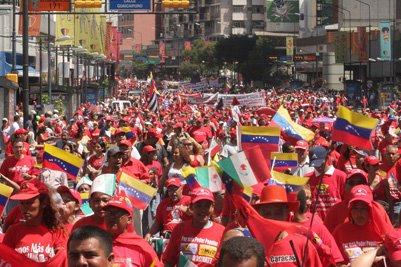 See? Taken from a low angle, nicely set up to make the march look bigger than it really was. This is normal: any self-respecting autocratic regime has a propaganda arm designed to crank out images like this.
But then, how did this other picture make it onto their coverage of Saturday's Chavez-the-Mariachi rally?
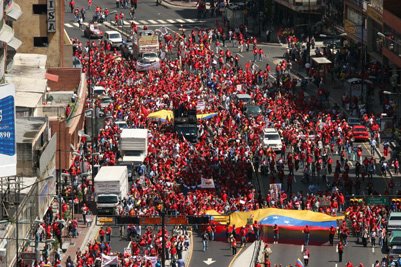 I mean, c'mon! They didn't even crop it off on top and on bottom to make it look like it went farther on either side!
 Don't these ABN types learn anything in those Prensa Latina seminars they send them to in Havana? Frankly, I'm outraged! We send them oil, and they can't even train our journalists to disinform us properly! Shoddy, shoddy propagandizing, I say...
That picture, along with this next one, strike me as totally amazing.
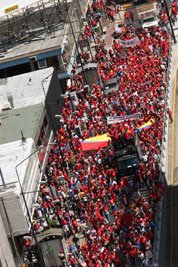 Jesus! Is this really as many people as they can drum up to march along with Chavez? Not so long ago, this is about how many chavistas would turn up outside Miraflores on any given day just to hand in a papelito asking for a personal favor! What the hell happened?
[Thanks to Daniel for the image tip.]
November 19, 2005
CNE to audit self...slowly, very slowly...
CNE's decision to grant itself an amazing five weeks to conduct its "hot" audit, has rekindled my interest in electoral nuts-and-bolts. The CNE Audit "Instructivo" - the official instructions for the audit - starts on page 58 of this large PDF document. The vote-tallying procedure (acto de escrutinio) is set out from page 74 of the same document.
Sumate's big beef with the Escrutinio procedure is that nowhere does it instruct polling workers to physically count all the ballot papers issued. Articles 168-174 of the Framework Law on Suffrage and Political Participation, set out the rules for the vote-tallying process in some detail. According to Article 172, the "Acta de Escrutinio" - the Vote Tally Report that serves as an official record of votes in each polling station - must contain both a count of the total number of ballots that were cast and the automated tally of how many votes each candidate and party got.
The Acta de Escrutinio needs to contain both these counts because Article 220, paragraph 1, says an acta is invalid if the two numbers don't match. The only way to determine whether the two numbers match or not is to actually count the ballot papers.
(Somewhat bizarrely, the law does not say you need a hand-count of how many votes each candidate and each party got, you just need a hand-count of how many ballots were cast in total. This is meant to ensure the automated count does not contain more votes than there are actual ballot papers.)
Under the rules CNE has published, ballot papers will only be counted for a single box in a sample making up about 45% of voting tables. The votes will be audited by a hand-count, but instead of being immediately matched against the automated results, they will be sent to CNE, which will have five weeks to build a data base and conduct a statistical study of discrepancies.
A few things to note about these rules:
Since only CNE will get to see the hand-count data, CNE will effectively audit itself - how many companies get away with that?
The audit procedure contains no mechanism whereby hand-counts trump automated counts in the event of a discrepancy.
By the time the audit is published, 5 weeks after the vote, the election results will long since have been announced and the seats adjudicated - and there's no mechanism for re-adjudicating a seat in the event that the audit demonstrates fraud.
Though not directly related to the audit, the Vote Tallying (escrutinio) procedures AGAIN call for Actas de Escrutinio to be printed after the machine has been connected to CNE headquarters and the data been sent in (article 46, page 75 of the document I linked to above.) This week, Jorge Rodriguez pledged to backtrack on this item. Still, it is hard to figure this sequencing was in there in the first place, given the grave misgivings about bi-directional communications it has always aroused.
Frankly, if this is how they propose to go about it, it's hard to see what good auditing could do. It's silly to think a procedure this opaque, this slow, and this CNE-centric could really convince anyone who currently doubts CNE's probity. Ultimately, if the political will was there, CNE could run a credible hot audit, one that would end once and for all opposition misgivings about its fairness. It could, but it hasn't.
Sumate's big beef with the Escrutinio procedure is that nowhere does it instruct polling workers to physically count all the ballot papers issued. Articles 168-174 of the Framework Law on Suffrage and Political Participation, set out the rules for the vote-tallying process in some detail. According to Article 172, the "Acta de Escrutinio" - the Vote Tally Report that serves as an official record of votes in each polling station - must contain both a count of the total number of ballots that were cast and the automated tally of how many votes each candidate and party got.
The Acta de Escrutinio needs to contain both these counts because Article 220, paragraph 1, says an acta is invalid if the two numbers don't match. The only way to determine whether the two numbers match or not is to actually count the ballot papers.
(Somewhat bizarrely, the law does not say you need a hand-count of how many votes each candidate and each party got, you just need a hand-count of how many ballots were cast in total. This is meant to ensure the automated count does not contain more votes than there are actual ballot papers.)
Under the rules CNE has published, ballot papers will only be counted for a single box in a sample making up about 45% of voting tables. The votes will be audited by a hand-count, but instead of being immediately matched against the automated results, they will be sent to CNE, which will have five weeks to build a data base and conduct a statistical study of discrepancies.
A few things to note about these rules:
Frankly, if this is how they propose to go about it, it's hard to see what good auditing could do. It's silly to think a procedure this opaque, this slow, and this CNE-centric could really convince anyone who currently doubts CNE's probity. Ultimately, if the political will was there, CNE could run a credible hot audit, one that would end once and for all opposition misgivings about its fairness. It could, but it hasn't.
Ana Julia Jatar pulls no punches...
Ana Julia Jatar's speech to the US House of Representatives' Subcommittee on the Western Hemisphere (PDF file) last Thursday was as tough and synthetic a statement of the case against Chavez's assault on democratic institutions as I could think of.
I especially liked the way she closed:
I especially liked the way she closed:
I did not come to speak to this prestigious audience to ask for help, nor did I come to persuade the US Congress of the need to interfere in our destiny. Venezuela has a long history of self determination and we will continue to stand for it. But I did come today to make you reflect about our current challenges and opportunities. Fish don’t know they are in water. They take water for granted. Venezuelans used to take freedom for granted, not knowing what the institutional underpinnings of their freedom were. Today those institutional foundations have been taken away. History is full of lessons about countries where governments are not constrained by laws. Venezuela is becoming one more exhibit in that gruesome old lesson.
...y un rato con la oposicion...
Juan Forero finally tosses us a bone in today's New York Times...
I still wish he'd write something on institutional degradation, but hey, you take what you can get...
SHE'S the Venezuelan government's most detested adversary, a young woman with a quick wit and machine-gun-fast delivery who often appears in Washington or Madrid to denounce what she calls the erosion of democracy under President Hugo Chávez.
In a highly polarized country, María Corina Machado has emerged as perhaps the most divisive figure after Mr. Chávez, a woman who is either beloved or reviled.
I still wish he'd write something on institutional degradation, but hey, you take what you can get...
November 18, 2005
CNE backtracks (a bit)
This afternoon, CNE backtracked on the use of Electronic Voter Rolls, and gave assurances that voting machines will not be connected to phone lines until actas have been printed out, striking out two of the points on my Imaginary Memo to the EU EOM.
CNE also agreed to audit a larger number of voting tables, but the press reports I've seen do not make clear if they will agree to publish the audit results immediately. It's a crucial point. An audit is only "hot" if you publish results as soon as they're available.
If you have info on this, please share.
CNE also agreed to audit a larger number of voting tables, but the press reports I've seen do not make clear if they will agree to publish the audit results immediately. It's a crucial point. An audit is only "hot" if you publish results as soon as they're available.
If you have info on this, please share.
December 5th Chronicles
It's almost certain that the Opposition parties will get taken to the cleaners in the Dec. 4th parliamentary elections. The question is, what are their leaders going to say on Dec. 5th?
They could fall back on their old standby and allege fraud - but imagine how powerless and ridiculous that would sound. For one thing, it's too obvious they don't have the support to win an election right now. For another, they knew full well the kind of CNE they were accepting when they agreed to go to elections - they spent the last year and a half rubbishing it!
So that's not a great option. Alternatively, they could blame the loss on low turnout, pointing the finger the rabble-rousing Art. 350-invoking abstentionist crowd. Tempting, but that would only add fuel to the fire of the near civil-war between Opposition electoralists and abstentionists.
Two bad options so far. So, what's left? Well, Venezuela is the Land of the Possible, so they might just tuck their tail between their legs and congratulate MVR on its win.
How do you think this will go?
Current Results
Free Web Polls
They could fall back on their old standby and allege fraud - but imagine how powerless and ridiculous that would sound. For one thing, it's too obvious they don't have the support to win an election right now. For another, they knew full well the kind of CNE they were accepting when they agreed to go to elections - they spent the last year and a half rubbishing it!
So that's not a great option. Alternatively, they could blame the loss on low turnout, pointing the finger the rabble-rousing Art. 350-invoking abstentionist crowd. Tempting, but that would only add fuel to the fire of the near civil-war between Opposition electoralists and abstentionists.
Two bad options so far. So, what's left? Well, Venezuela is the Land of the Possible, so they might just tuck their tail between their legs and congratulate MVR on its win.
How do you think this will go?
Current Results
Free Web Polls
November 17, 2005
Imaginary Memo to the EU Election Observation Mission
Lets be clear. The basic reason the Opposition will lose the Dec. 4th parliamentary elections is that more people want to vote for the government than for the Opposition. Denying this would be an idle exercise in buck passing - though one so comfortable for Oppo leaders, we can be sure we will hear it. For too long, the Opposition has used CNE's partiality as an excuse to avoid the work of building up its political support. Until it does that, it won't win an election even if a gaggle of angels is put in charge of CNE.
With that proviso firmly in mind, it's also important to understand that CNE is not run by a gaggle of angels. The list of grievances with the Elections Authority has grown longer, not shorter, since last year's referendum. At the moment, the key items are:
Dodgy Voter Roll: The Permanent Electoral Registry grew from 12.310.031 voters to 14.245.614 voters - 16% - in just seven months, from December 2003 to June 2004. Basic safeguards to ensure that all those registered are eligible to vote were not applied. Opposition parties cannot audit the voter roll, because the CNE refuses to publish it.
Unexplained "Migrations": As many as 30% of voters have been "migrated" (switched) from one voting center to another, with no explanation.
Opaque tallying: CNE has consistently ignored its legal obligation to tally votes publicly.
Voter Intimidation: The use of electronic voter lists together with electronic voting machines allows CNE to infer which voter voted for which party, undermining the secrecy of the vote. Given the history of using information about voter preferences to discriminate against opposition supporters, this system results in voter intimidation.
Possibility of electronic tallying fraud: Electronic voting machines will connect with CNE headquarters before each machine produces a print-out of its voting results, opening the possibility of "bi-directional electronic traffic" - meaning that machines may end up producing a tally report beamed back to them from CNE headquarters. In last years referendum, there is evidence that there was back-and-forth electronic communications between voting machines and CNE headquarters throughout the day.
Absence of a credible audit: The all-important "hot audit" - the manual recount of paper ballots in a representative sample of voting centers - will be published five weeks after the election, giving plenty of time for manipulation.
Morochas: Through administrative fiat, CNE will allow the use of the "morochas" - a mechanism that deliberately and unfairly manipulates of the mixed uninominal/list venezuelan voting system. The trick is designed to magnify the number of parliamentary seats allocated to the largest party, in violation of the constitutional principle of Proportional Representation.
Abusive use of state resources: Though not directly under CNE control, the government continues to use state resources to give unfair advantage to pro-Chavez candidates.
It's true that even without these various manipulations, the government would still win the election. That does not make them acceptable. Hopefully, the EU elections observation mission will take note.
Just last week, the OSCE produced a harsh report on the Azerbaijani elections for irregularities roughly comparable to those outlined above, despite the fact that the Azerbaijani government would likely have won those elections even without fraud. We urge the EU EOM to apply European standards consistently.
With that proviso firmly in mind, it's also important to understand that CNE is not run by a gaggle of angels. The list of grievances with the Elections Authority has grown longer, not shorter, since last year's referendum. At the moment, the key items are:
It's true that even without these various manipulations, the government would still win the election. That does not make them acceptable. Hopefully, the EU elections observation mission will take note.
Just last week, the OSCE produced a harsh report on the Azerbaijani elections for irregularities roughly comparable to those outlined above, despite the fact that the Azerbaijani government would likely have won those elections even without fraud. We urge the EU EOM to apply European standards consistently.
November 16, 2005
Clues from Azerbaijan on EU Elections Monitoring
The major innovation in the upcoming Dec. 4th parliamentary elections is the presence of an EU monitoring mission in Venezuela. How tough will the new observers be? Hopefully, at least as tough as the OSCE mission the EU sent to monitor parliamentary elections in Azerbaijan last week.
From Radio Free Europe
So that's a fairly tough assessment. In its preliminary document on the conduct of the elections, published just a day after the voting, the Organization for Security and Cooperation in Europe, in charge of running the EU monitoring mission, noted the following shortcomings:
On the inside pages of the OSCE preliminary report, we find bits like:
Overall, I think if the EU brings this level of scrutiny to the Dec. 4th election, CNE has something to worry about.
From Radio Free Europe
November 7th, 2005
OSCE, EU Question Azerbaijani Vote
Observers from the Organization for Security and Cooperation in Europe (OSCE) said today that parliamentary elections in Azerbaijan that culminated in yesterday's voting failed to meet several international standards, RFE/RL's Azerbaijani Service reported.
The OSCE's election-observation mission noted some improvements in the way the election was run, but it said the shortcomings that were observed led the mission to believe that the election "did not meet a number of OSCE commitments and Council of Europe standards for democratic elections."
The international observers in Baku said the elections' shortcomings included, among other things, a faulty count of the ballots and interference by local authorities.
Citing alleged massive irregularities, opposition representatives have said they it will not recognize the outcome of the vote. The opposition has called on its supporters to hold a peaceful march in Baku tomorrow.
Meanwhile, EU External Relations Commissioner Benita Ferrero-Waldner said earlier today that she regrets reports of electoral violations in Azerbaijan's legislative elections.
"While we are still not knowing all elements in order to draw our conclusions, we understand there are reports of some violations of election procedures and also of the rights of opposition candidates that have been occurring throughout the country, especially in provincial and rural areas," Ferrero-Waldner said.
So that's a fairly tough assessment. In its preliminary document on the conduct of the elections, published just a day after the voting, the Organization for Security and Cooperation in Europe, in charge of running the EU monitoring mission, noted the following shortcomings:
Local executive authorities often interfered in the campaign and failed to act impartially, and were regarded by many as serving only the interests of pro-government candidates; No effective sanctions were imposed on representatives of local executive authorities who, in violation of the law, interfered in the election process, diminishing confidence in the rule of law; The composition of election commissions favored pro-government candidates, at times undermining confidence in the independence and impartiality of the election administration; Restrictive interpretations of campaign provisions and pressure on an independent TV channel limited voters’ access to diverse information; The CEC and constituency election commissions (ConECs) generally failed to address a number of issues in an effective manner, such as the use of voter cards, military voting and the handling of complaints; There was a lack of uniformity in updating voter lists and issuance of voter cards; At least 38 constituencies deviate from legal norms regarding the number of registered voters per constituency.
On the inside pages of the OSCE preliminary report, we find bits like:
There are still shortcomings in the legal framework that have had an adverse effect on the conduct of the elections. The composition of election commissions favors the incumbent authorities and undermines confidence in the independence of the election administration. The provision for voter cards would only be effective if there was strict control and accountability in their distribution.
The OSCE/ODIHR Elections Observation Mission observed cases of abuse of administrative resources such as the use of offices, vehicles and employees for campaign purposes.
In its prime time news and current affairs programs, the AzTV (Azerbaijan's VTV) demonstrated clear bias. Media monitoring results show that in the eight weeks preceding the election, AzTV provided 97 percent of its political and election prime time news coverage to the activities of the President, the presidential administration, the government and the YAP. This coverage was overwhelmingly positive in tone. In contrast, the news programs on AzTV largely ignored activities of opposition candidates. Thus, AzTV failed to meet its legal obligation to create equal conditions for the candidates and political parties. No legal sanctions were imposed on AzTV.
There was a presence of candidate representatives and non-partisan domestic observers in nearly all polling stations visited. However, there were observations of domestic observers and PEC members being expelled or dismissed from polling stations. The international elections observation mission observed local executive officials and observers of YAP candidates interfering in or directing the process, or otherwise attempting to influence voters. The presence of video cameras filming voting and, in some instances, individuals - including exit pollsters in some cases - attempting to influence voter choices or identify voters with their votes, appeared intimidating to voters.
Overall, I think if the EU brings this level of scrutiny to the Dec. 4th election, CNE has something to worry about.
November 15, 2005
Not so hot...
Last year, Venezuela had a big debate over the importance of the "hot audit" (auditoria en caliente) for the credibility of electronic election results.
A hot audit is when the paper-trail produced by the voting machines is audited on election night. It means the paper ballots the machines produce are counted immediately after voting ends in a representative sample of voting centers, and the results of the hand-count are compared against the electronic results right away.
Today, Sumate told the OAS Elections Observers that the National Electoral Council's plan for the Dec. 4th election is to publish the results of their "hot" audit next year!
Cripes, it'll be deep frozen by then.
A hot audit is when the paper-trail produced by the voting machines is audited on election night. It means the paper ballots the machines produce are counted immediately after voting ends in a representative sample of voting centers, and the results of the hand-count are compared against the electronic results right away.
Today, Sumate told the OAS Elections Observers that the National Electoral Council's plan for the Dec. 4th election is to publish the results of their "hot" audit next year!
Cripes, it'll be deep frozen by then.
November 14, 2005
Do you swear to tell the truth, 85% of the truth, and no more than 15% of lies, so help you God?
In the very first post to this blog, all the way back in September 2002, I wrote that, "these days, what I find it hardest to convey to my friends who live outside Venezuela is this strong undercurrent of farce that now permeates public life here." Three years later, I still have the same problem.
Consider, if your patience allows, the Danilo Anderson Case. (Newbies can read a highly simplified summary of it here.)
So far, the official version is that the CIA wanted to have him killed. So, how did they go about this? Apparently, the cleanest, simplest, most low-risk way the CIA could think of having a guy killed was to outsource the job to a sprawling conspiracy including a high profile journalist, a catholic cardinal, an anti-Fidel cuban exile, a pro-government General, an anti-government General...along with others to be named as the prosecutors think them up, I guess. Then the CIA arranged for that motley crew to travel to Miami, Santo Domingo and Panama to plan the hit abroad. (Seriously, this is the government's story!)
Now, you might think "well, if it's not true they'll surely have alibis, and they'll be able to show they weren't in Miami Santo Domingo and Panama on the dates when the alleged conspiracy took place." But not so fast! Sure they have alibis, and sure there are no records of them traveling to those places on those dates, but as the Prosecutor General knows, that's only because the CIA provided these people with "doubles" back home to shore up their alibis, and arranged secret international travel for them so no records of their movements could be found in any subsequent investigation. Clever, those gringos, huh?
Well, maybe not so clever. Apparently, these same hyper-sophisticated CIA agents able to find exact dopplegangers for dozens of suspects and to move them all over the hemisphere without anyone noticing weren't quite sophisticated enough to tell the Generals involved to, erm, remove their uniforms and name-tags as they carried out this conspiracy, since the government's one and only witness claims he could identify them because they were wearing their uniforms, name tags and all, as they conspired!
Right.
This key witness, the guy on whose testimony the Prosecutor General is hanging the entire indictment on, was later found to have a long criminal record in Colombia, mostly for crimes centered on his, erm, difficulties with truth-telling. Among the seven indictments he's faced we find one that led to a conviction for passing himself off for a forensic expert, a physician, and a psychiatrist. This was back in 1999. Yet just a few days ago, our Prosecutor General went in front of the cameras to bolster his witness's credibility because the guy is...you guessed it, a psychiatrist!
Then, this weekend, the whole superwitness farce took an even more improbable turn as the Prosecutor General gave an interview to Caracas daily Ultimas Noticias and said that after careful study of the guy's testimony, the Prosecutor General's Office had collectively determined that "at least 85% of what he says is true." Puzzle this one through...doesn't that imply that a good 15% of what he says is a lie?
But hey, what's a lie here and there between friends? It's not as though he'll be under oath or anything...
Consider, if your patience allows, the Danilo Anderson Case. (Newbies can read a highly simplified summary of it here.)
So far, the official version is that the CIA wanted to have him killed. So, how did they go about this? Apparently, the cleanest, simplest, most low-risk way the CIA could think of having a guy killed was to outsource the job to a sprawling conspiracy including a high profile journalist, a catholic cardinal, an anti-Fidel cuban exile, a pro-government General, an anti-government General...along with others to be named as the prosecutors think them up, I guess. Then the CIA arranged for that motley crew to travel to Miami, Santo Domingo and Panama to plan the hit abroad. (Seriously, this is the government's story!)
Now, you might think "well, if it's not true they'll surely have alibis, and they'll be able to show they weren't in Miami Santo Domingo and Panama on the dates when the alleged conspiracy took place." But not so fast! Sure they have alibis, and sure there are no records of them traveling to those places on those dates, but as the Prosecutor General knows, that's only because the CIA provided these people with "doubles" back home to shore up their alibis, and arranged secret international travel for them so no records of their movements could be found in any subsequent investigation. Clever, those gringos, huh?
Well, maybe not so clever. Apparently, these same hyper-sophisticated CIA agents able to find exact dopplegangers for dozens of suspects and to move them all over the hemisphere without anyone noticing weren't quite sophisticated enough to tell the Generals involved to, erm, remove their uniforms and name-tags as they carried out this conspiracy, since the government's one and only witness claims he could identify them because they were wearing their uniforms, name tags and all, as they conspired!
Right.
This key witness, the guy on whose testimony the Prosecutor General is hanging the entire indictment on, was later found to have a long criminal record in Colombia, mostly for crimes centered on his, erm, difficulties with truth-telling. Among the seven indictments he's faced we find one that led to a conviction for passing himself off for a forensic expert, a physician, and a psychiatrist. This was back in 1999. Yet just a few days ago, our Prosecutor General went in front of the cameras to bolster his witness's credibility because the guy is...you guessed it, a psychiatrist!
Then, this weekend, the whole superwitness farce took an even more improbable turn as the Prosecutor General gave an interview to Caracas daily Ultimas Noticias and said that after careful study of the guy's testimony, the Prosecutor General's Office had collectively determined that "at least 85% of what he says is true." Puzzle this one through...doesn't that imply that a good 15% of what he says is a lie?
But hey, what's a lie here and there between friends? It's not as though he'll be under oath or anything...
Moderating the comments forum
It's with a heavy heart that I've decided to turn on the Moderation option on the Haloscan comments forum. This will unnecessarily slow things down, but the discussion was getting ridiculous. For the moment, I'll moderate the thing myself, but if anyone else would like to volunteer to help me (Torres?) that would be great.
I hate the idea of having to post explicit rules on these things, common sense ought to be enough. Obviously it isn't, so here are the rules.
The Rules
The moderator(s) have the right, but not the obligation, to edit or delete:
The moderator(s) will strive to make decisions on which topics to post on the basis of relevance and civility rather than ideology.
...heavy sigh...
I hate the idea of having to post explicit rules on these things, common sense ought to be enough. Obviously it isn't, so here are the rules.
The Rules
The moderator(s) have the right, but not the obligation, to edit or delete:
- - Posts that are defamatory, libelous, obscene, abusive, harassing, threatening, off-topic, unintelligible, or unnecessarily antagonistic, or in any other way inappropriate, as determined exclusively by the moderator(s).
- - Posts which are submitted repetitively, without bearing on the discussion topic, or otherwise deliberately disrupt the forum.
- - Posts which attack or insult another forum user or the moderator(s), or their families.
The moderator(s) will strive to make decisions on which topics to post on the basis of relevance and civility rather than ideology.
...heavy sigh...
Illiberal Democracy
Ibsen Martínez has a lovely - if typically pedantic - article in yesterday's El Nacional. The gist? Venezuela has become the "most perverse and polimorphous, evanescent and changing example of Illiberal Democracy", as conceived by Fareed Zakaria. Ibsen is too hard to translate, so I'll just point to it for the Spanish readers.
One bit, though, is too lovely to pass up:
"This is a country where, in just one recent day, Chavez can hold a friendly meeting with Felipe González, prince of the modern European social democrats, at the same time as the police raids and closes down the newspaper El Impulso on a flimsy tax pretext. A country whose Public Prosecutors openly intimidate opponents, and whose head of government, at the same time, spends its time designing continental integration strategies based on oil diplomacy; where the prison overcrowding crisis and extrajudicial executions, which today have reached their highest level in decades, coincide with acts revindicating the human rights of afrovenezuelans and indigenous peoples; where the electoral registry has been used to call almost a dozen elections in the last seven years and to institute, in parallel, a political apartheid that violates the right to work...To combat this diabolical complexity we will need a politics that is more realistic and assertive than the sifrino hissyfit of staying home on election day 'because Jorge Rodriguez sold out,' hoping perhaps to see Oswaldo Alvarez Paz and Cardinal Castillo Lara announce, around 7 p.m. on Globovision, the definitive 'endogenous delegitimation' of the regime."
One bit, though, is too lovely to pass up:
"This is a country where, in just one recent day, Chavez can hold a friendly meeting with Felipe González, prince of the modern European social democrats, at the same time as the police raids and closes down the newspaper El Impulso on a flimsy tax pretext. A country whose Public Prosecutors openly intimidate opponents, and whose head of government, at the same time, spends its time designing continental integration strategies based on oil diplomacy; where the prison overcrowding crisis and extrajudicial executions, which today have reached their highest level in decades, coincide with acts revindicating the human rights of afrovenezuelans and indigenous peoples; where the electoral registry has been used to call almost a dozen elections in the last seven years and to institute, in parallel, a political apartheid that violates the right to work...To combat this diabolical complexity we will need a politics that is more realistic and assertive than the sifrino hissyfit of staying home on election day 'because Jorge Rodriguez sold out,' hoping perhaps to see Oswaldo Alvarez Paz and Cardinal Castillo Lara announce, around 7 p.m. on Globovision, the definitive 'endogenous delegitimation' of the regime."
November 13, 2005
CIA ex machina
One thing the Anderson Case has made clear is how the Chavez government intends to put its anti-gringo rhetoric to work. See, from now on, everything bad that happens in Venezuela is the CIA's fault. It's fantastic! Any hole in any official story can be papered over with that old fidelista standby - the vague allusion to the CIA.
Say the Anderson conspirators have alibis. No problem! The CIA instructed them to get dopplegangers to fake them! Say there are no records of them being in Panama or Miami on the dates of the supposed conspiracy? Of course! The CIA obviously helped them to get around undetected!
It's so simple, yet so effective. There's no need to prove anything. Just say the magic word, and all your problems magically disappear!
Too good to be true? It's even better than that. It's not just that you can justify any authoritarian excess with some murky CIA allegation, it's that the International Ñángara Batallion eats it up with mustard! They love it! They'll line up behind you, endorse any unhinged theory you want to throw at them! They'll toast you as a revolutionary! Folks...authoritarianism has never been easier...
Say the Anderson conspirators have alibis. No problem! The CIA instructed them to get dopplegangers to fake them! Say there are no records of them being in Panama or Miami on the dates of the supposed conspiracy? Of course! The CIA obviously helped them to get around undetected!
It's so simple, yet so effective. There's no need to prove anything. Just say the magic word, and all your problems magically disappear!
Too good to be true? It's even better than that. It's not just that you can justify any authoritarian excess with some murky CIA allegation, it's that the International Ñángara Batallion eats it up with mustard! They love it! They'll line up behind you, endorse any unhinged theory you want to throw at them! They'll toast you as a revolutionary! Folks...authoritarianism has never been easier...
November 12, 2005
Danilogate Fails to Crack Gringo Media
Venezuela may be up in arms about the Danilo Anderson case, but the English language media has met the story with a collective yawn. Out of curiousity, I just did a Google News search for "Danilo Anderson". Every story the search yields is from a Venezuela based organization - the DJ, Petroleumworld, (which picked up my highly compressed summary - thanks!) VHeadline, and, of course, Prensa Latina, which more or less counts as Venezuelan by now.
The AP and Reuters wrote a single story each when the first arrests were made and haven't touched it since.
It's strange, the way a story can utterly dominate the Venezuelan press with nary a ripple making it through to English-language readers. In a way it's understandable - Danilogate is too convoluted even for many Venezuelans to understand, so I can well imagine the trouble foreign journos would face in trying to sell it to editors back home. I see the general silence as a function of the tyranny of the 800-word limit - there's no way to explain what happened briefly, so gringo papers just won't run with it.
Still, they're missing a great yarn - L'Affaire Danilo just keeps getting more and more bizarre. Yesterday, El Tiempo, a Bogota Daily, reported that Geovanny Vasquez de Armas, the prosecution's one and only witness, has been in and out of court in Colombia since 1996 on fraud and impersonation charges.
Deliciously, back in 1999 he was convicted to 36 months in jail for impersonating a psychiatrist. Recall that three days ago Isaias tried to puff up the guy's credibility saying "hey, he's a psychiatrist!"
But there's much much more where that came from. Vasquez de Armas got busted in Colombia for faking a medical degree from Johns Hopkins University and for faking claims that he was accredited by the FBI and other US authorities as a forensic scientist. In total, Isaias's supergrass has been accused of fraud and related charges seven times in Colombia. Just for good measure, he told Colombian police he was fluent in German - another howler.
As Teodoro pointed out in Tal Cual yesterday, the truly silly thing is that the Venezuelan Prosecutors apparently failed to conduct any kind of background check on the guy they planned to hang their whole indictment on. Curioser and curioser...
The AP and Reuters wrote a single story each when the first arrests were made and haven't touched it since.
It's strange, the way a story can utterly dominate the Venezuelan press with nary a ripple making it through to English-language readers. In a way it's understandable - Danilogate is too convoluted even for many Venezuelans to understand, so I can well imagine the trouble foreign journos would face in trying to sell it to editors back home. I see the general silence as a function of the tyranny of the 800-word limit - there's no way to explain what happened briefly, so gringo papers just won't run with it.
Still, they're missing a great yarn - L'Affaire Danilo just keeps getting more and more bizarre. Yesterday, El Tiempo, a Bogota Daily, reported that Geovanny Vasquez de Armas, the prosecution's one and only witness, has been in and out of court in Colombia since 1996 on fraud and impersonation charges.
Deliciously, back in 1999 he was convicted to 36 months in jail for impersonating a psychiatrist. Recall that three days ago Isaias tried to puff up the guy's credibility saying "hey, he's a psychiatrist!"
But there's much much more where that came from. Vasquez de Armas got busted in Colombia for faking a medical degree from Johns Hopkins University and for faking claims that he was accredited by the FBI and other US authorities as a forensic scientist. In total, Isaias's supergrass has been accused of fraud and related charges seven times in Colombia. Just for good measure, he told Colombian police he was fluent in German - another howler.
As Teodoro pointed out in Tal Cual yesterday, the truly silly thing is that the Venezuelan Prosecutors apparently failed to conduct any kind of background check on the guy they planned to hang their whole indictment on. Curioser and curioser...
November 11, 2005
Anderson Cover-Up Chronicles
Seldom has the ethical rot at the heart of chavismo found a more pungent manifestation than in the Prosecutor General's bizarre cover-up following Danilo Anderson's murder. Teodoro Petkoff masterfully takes apart Isaias Rodriguez's line in this delightful Tal Cual editorial. Miguel has taken the time to translate to some of the inside coverage from Tal Cual, detailing the case's time-line and Isaias's bizarre shifting declarations over the last few months.
I'm not really a Danilologist (and believe me, there are more than a few out there - the Venezuelan press seems to have gone for an All-Danilo-Anderson-All-The-Time format over the last few days), so I am not qualified to write at length on the case. But you don't need to be an expert to recognize the heavy stench of cover-up hanging over this whole sad affair...the bizarre story from the bizarre single witness, the total, almost comical absence of corroborating evidence, the mind-boggling decision to keep Anderson's co-blackmailers at the helm of the investigation into his murder, the opportunistic use of an assassination to jail political enemies, the whole thing is one big fat bucket of shit.
I've said it before and I'll say it again, there's no better proof of the government's calamitous moral bankruptcy than the fact that Isaias Rodriguez is Prosecutor General.
I'm not really a Danilologist (and believe me, there are more than a few out there - the Venezuelan press seems to have gone for an All-Danilo-Anderson-All-The-Time format over the last few days), so I am not qualified to write at length on the case. But you don't need to be an expert to recognize the heavy stench of cover-up hanging over this whole sad affair...the bizarre story from the bizarre single witness, the total, almost comical absence of corroborating evidence, the mind-boggling decision to keep Anderson's co-blackmailers at the helm of the investigation into his murder, the opportunistic use of an assassination to jail political enemies, the whole thing is one big fat bucket of shit.
I've said it before and I'll say it again, there's no better proof of the government's calamitous moral bankruptcy than the fact that Isaias Rodriguez is Prosecutor General.
November 8, 2005
The Extremely Abridged Version of the Danilo Anderson Saga
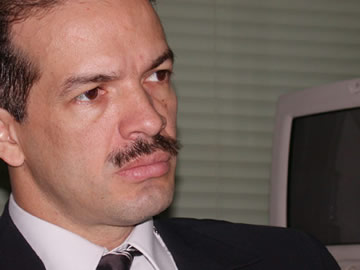 It all started on the evening of November 18th, 2004 when this prosecutor, Danilo Anderson, got blown up. Guy gets into his SUV, the thing explodes, his body is instantly incinerated.
 This was a big shock for everyone. I mean, Venezuela is not Colombia, political assasinations are very rare. So people were really stunned when this happened.
Thing is, Anderson was not just any old prosecutor. The guy had been assigned a series of very high profile, highly politically sensitive cases. For sure he was seen as a chavista, and his investigations were suspiciously consistent in always implicating government critics and always exonerating government supporters.
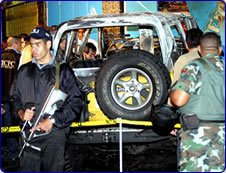
"So the opposition had him killed," you might be thinking.
Well, it sure looked that way at first. Obviously, that was the chavista line. The government made a huge to do about it. The guy was mourned on the floor of the National Assembly. He was decorated post-mortem. Congressmen cried, ministers demanded justice, the prosecutor general vowed to leave no stone unturned in flushing out the evil oppositionists who did it. He became the first bona fide chavista martyr, a rallying cry for the government, definitive proof of how evil and twisted their opponents were.
So far, so good: a nice, neat narrative of opposition evil-doing. But soon, elements started coming out that didn't quite seem to fit in with that story-line.
Two days after the murder, two former cops disappeared off the streets, only to turn up a week later, almost naked and apparently drugged, wandering in the streets of Valencia. The two are brothers, Rolando and Otoniel Guevara, and they claim they were tortured by Disip - Venezuela's secret police. The government blamed them for carrying out the crime. Their cousin Juan Guevara, another former cop, was later implicated in the murder as well. The three were eventually convicted of carrying out the hit and sentenced to long sentences, though the evidence against them was spotty - there was no physical evidence linking them to the crime.
Two other suspects are now dead. Antonio Lopez Castillo, was killed in a strange shoot-out with police on the streets of Caracas. His body had something like 15 bullets in it by the time it got to the morgue. A fourth suspect, Juan Carlos Sanchez, died in mysterious circumstances. The police claim he died in a shootout with them in a Barquisimeto motel nine days after Danilo's murder. The Guevara brothers claim he was with them at the Disip detention center in Caracas, and died under torture.
Then, a series of press leaks showed that a number of eye-witnesses had seen State Security (DISIP) patrols very close to the scene of the explosion less than an hour before it happened. Coincidence?
But it gets even murkier: other highly compromising leaks from the police investigation of the murder started turning up in the opposition press. For one thing, Anderson seemed to have a lot, and I mean a LOT, more money than he could justify from his salary. The guy earned $1100 a month, but he had 3 SUVs, two apartments, two jet-skis, a farm, and stacks of 100 dollar-bills sitting in his apartment. Curious, very curious.
Then a number of bankers started to come forward to say that a group of public prosecutors headed by Anderson had been blackmailing them. 'Cough up $50,000 or face indictment over the 2002 coup.' That sort of thing. Some of the bankers said they were on record making these accusations before Anderson got blown up.
In early 2005, Chavez's own interior minister actually echoed the racketeering allegations. This guy is about as chavista as you can get, he's the guy in charge of the police in Venezuela we're talking about here. Jesse Chacon is his name. Chacon went in front of the cameras and said investigations suggested Anderson had been on the take.
It's at this point that things started to get really screwy. First off, José Cuellar, the police investigator who gathered the evidence on the racketeering angle and the Disip patrol on the scene, was denounced as a "traitor" by the prosecutor general and shifted off the case. Then, all of the evidence Cuellar had collected linking Anderson with blackmail started getting erased from the police record. Worse, it was revealed that the public prosecutors leading the investigation - the ones who had Cuellar bumped off the case - had been accused of taking part in Anderson's extortion racket. "The gang of midgets," they were called, because they were all short.
I know what you're thinking: "Wait, wait, run that by me again!? The other guys who were supposedly blackmailing these bankers were the ones in charge of investigating the murder of their ex-ring leader?"
Bizarre, huh? Well, that's what happened. Thing is, the Prosecutor General has never acknowledged that the extortion allegations even exist, and after a solitary reference to it, Chacon, the Interior Minister never mentioned it again. It's really quite twisted: the gang of midgets is still running the investigation now!
Finally, the government announced they had cracked the case into the "intellectual authors" of the crime - the masterminds. In November 2005, they indicted a weird, mixed group of Opposition and government figures, largely unrelated with one another. The highest-profile indictee was Patricia Poleo, a radical anti-Chavez journalist, who had actually written a book accusing the Guevara brothers of hiding Vladimiro Montesinos in Venezuela. The notion that Poleo could have hired the Guevaras to pull off a hit strains all credulity.
The Prosecutor General innitially proposed to try these masterminds on the basis of the evidence brought forth by a single alleged witness to the conspiracy: a former colombian paramilitary. The guy, Geovanny Vasquez de Armas, became the focus of frenzied media interest. And after just a few phone calls to Colombia, journalists discovered he had an extensive criminal record, had spent time in jail for identity fraud (impersonating a doctor and faking a medical diploma.) Documents they dug up indicate he was in jail in September 2003, on the dates when he claimed to have been planning the murder in Panama. As Vasquez de Armas' credibility started to flounder, the Prosecutor General claimed to have dug up further witnesses.
The reports that DISIP agents were hovering around the scene of the explosion were never followed up. The money in Danilo's apartment, along with all records of its existence, just diappeared. According to some versions, Anderson had a compromising sex video in his safe - obviously, that one vanished as well.
It all seems just too far-fetched to take seriously, I realize. But this is what's out there on the record. Frankly, I have no idea who killed Danilo Anderson. But I'm sure the Prosecutor General is covering something up.
November 7, 2005
Bury FTAA? Easy for Chavez to say!
Chavez was happy like a pig in shit last week, basking in worldwide media attention and lefty adoration for his "principled stand" against one of those gringo proposals everyone loves to hate - the Free Trade Area of the Americas. For all the talk about burying FTAA, one basic fact was mostly ignored in commentary of the summit: it's murderously easy for Chavez to rant at length about this because Venezuela already enjoys most of the benefits of Free Trade.
To explain. Countries engage in trade negotiations in order to improve their access to other countries' markets. If Country A exports mostly shirts, and shirts face high tariffs in Country B's, then Country A has an obvious interest in negotiating better access to Country B's market.
You'll have noticed that Country V's exports are overwhelmingly dominated by oil. Oil already faces low-to-no tariffs all around the world. (It's just too important an input for other countries to tax it at the border.) So oil-exporters like Venezuela are in a peculiar position when it comes to trade negotiations: the basic impetus that drives most countries to negotiate really doesn't apply to them.
It's true that oil products do face high taxes once inside the border, but no country negotiates tax policies in international trade talks, and energy taxes are certainly not on the FTAA agenda. So Venezuela has nothing much to gain from hemispheric trade talks.
This is why it's so easy - but also so fatuous - for Chavez to rant against FTAA. He can talk himself blue in the face, knowing that our access to foreign markets isn't really in doubt.
This also explains why Brazil and Argentina, which are also skeptical of FTAA, were so much more circumspect in criticizing it. Brazil and Argentina's exports are centered on basic manufactures and agriculture, sectors that face serious barriers in the US market. They have much more to gain from negotiating a trade agreements with the US than Venezuela ever will.
In fact, FTAA is an issue taylor-made to Chavez's brand of demagoguery. He can use it to make grand sounding fulminations against imperialism at basically no cost. It's the ultimate risk-free way to position himself as a world leader and get the drooling admirations of ñangaras near and far. Que manguangua!
To explain. Countries engage in trade negotiations in order to improve their access to other countries' markets. If Country A exports mostly shirts, and shirts face high tariffs in Country B's, then Country A has an obvious interest in negotiating better access to Country B's market.
You'll have noticed that Country V's exports are overwhelmingly dominated by oil. Oil already faces low-to-no tariffs all around the world. (It's just too important an input for other countries to tax it at the border.) So oil-exporters like Venezuela are in a peculiar position when it comes to trade negotiations: the basic impetus that drives most countries to negotiate really doesn't apply to them.
It's true that oil products do face high taxes once inside the border, but no country negotiates tax policies in international trade talks, and energy taxes are certainly not on the FTAA agenda. So Venezuela has nothing much to gain from hemispheric trade talks.
This is why it's so easy - but also so fatuous - for Chavez to rant against FTAA. He can talk himself blue in the face, knowing that our access to foreign markets isn't really in doubt.
This also explains why Brazil and Argentina, which are also skeptical of FTAA, were so much more circumspect in criticizing it. Brazil and Argentina's exports are centered on basic manufactures and agriculture, sectors that face serious barriers in the US market. They have much more to gain from negotiating a trade agreements with the US than Venezuela ever will.
In fact, FTAA is an issue taylor-made to Chavez's brand of demagoguery. He can use it to make grand sounding fulminations against imperialism at basically no cost. It's the ultimate risk-free way to position himself as a world leader and get the drooling admirations of ñangaras near and far. Que manguangua!
November 6, 2005
Luis Vicente Leon on Roberto Smith
Closing out his roundup of the four main non-chavista "presidenciables" (the others being Julio Borges, Teodoro Petkoff, and one or the other of the Salases), Luis Vicente Leon evaluates Roberto Smith's chances in today's El Universal.
I'll translate it leaving out Leon's preposterous little Fantastic Four theme...
I'll translate it leaving out Leon's preposterous little Fantastic Four theme...
Many believe that an opposition leader's job is: 1-to give Chavez hell, in order to rouse the peanut gallery, 2-to invoke Article 350 (on civil disobedience) as an expedient to get around the "little detail" of having to put forward an intelligent set of proposals that might rescue the search for an alternative to chavismo.
The results of that strategy are clear: the contender who does best at insulting Chavez (and I don't doubt he deserves it) will be the darling of that 12.6% who define themselves as hardcore oppositionists. Bravo! The problem is that the 46.8% of the population that defines itself as NiNi, plus the 36.7% who define themselves as chavistas, won't even pause to take a look.
Nobody has grasped this better than Roberto "Esmí" Perera. This is the same Roberto Smith from the USB Student Center, the dashing CAP Telecomunications Minister, the former envoy to the European Union and the successful founding CEO of Digitel, it's just that he's spent some time de-gringuifying his background and showing that part of him is as Caroreño as Club Torres. I think it's brilliant.
His biggest strength is that he has a real plan to offer the country, which in the Venezuelan context is almost a miracle. His proposal is intelligent, modern, and geared at bringing people together. He aims to open spaces for all Venezuelans, regardless of ideology or class. He talks about turning Venezuela into a first world country, able to go head to head with the best societies in the world in terms of prosperity, equality, justice and peace. He's put forward the Todos Para Arriba (clunky translation - Everyone for the Better) program: full employment, and zero crime (the central problems people mention in all polls), ending poverty, a house for everyone and a first rate educational system that allows everyone a chance for a high standard of living.
He's been adaptable enough to understand that a head-on confrontation with Chavez would bury him from day one. He explains his strategy with a love metastory: the good girl (the people) who's fallen in love with a low-life (do we really need to spell it out?) If you attack the low-life, you insult her, because she chose him. You need to approach her with subtlety, with tenderness, ask her out, bring her flowers, listen to her problems with absolute respect, and show her what she deserves and doesn't have...but could have.
His proposals and his messages are not improvised. There are many hours of sophisticated study and work behind them, and a first-rate team, which is not usual in national politics.
Some might think his proposal sounds a bit "American". But the facts show it can work. Roberto was a total unknown in Vargas when he decided to run for governor. His biggest link with the state was probably that he used the airport all the time. But during the campaign he deployed his three weapons: his proposal, a fresh team, and his wife, the efficient and well organized engine behind the leader.
This total unknown blew 16 other opposition candidates out of the water, all of them from Vargas. More importantly, chavistas didn't see him as an enemy, but as an option.
But it's not all positive. Unlike the other three (Borges-Petkoff-Salas), few people know him, and I had to spend half this column just introducing him. He sees that as an advantage because his negative ratings are lower that way. I think that's a far-fetched interpretation. Smith needs to improve his name recognition, work his image hard and get some coaching for his media appearances, which are still lackluster. Despite his personal and professional qualities, he can come across as being closed to advise and suggestions, and finally, the political platform supporting him is extremely weak, though the arrival of Cipriano Heredia and Vision Emergente might help.
One way or another, he is a disciplined, smart, organized operative who surprised everyone in Vargas and could do it again nationwide. Today he is in the spotlight more due to his proposal than his leadership. That could be the right way to build a real leader. We'll see.
November 5, 2005
Global Voices Online
Thanks to TrackBack, I discovered Global Voices Online, a unique, very cool roundup of news-oriented blogs from all over the world.
November 4, 2005
Ibéyise Transformed
As longtime readers know, Ibéyise Pacheco is no saint of my devotion. That said, her article in today's El Nacional really struck me as remarkable. A former hyperradical come-candela Oppositionist, Ibéyise decided to run for a National Assembly seat, and it looks like the experience of campaigning has rocked her.
Never in a million years did I imagine I would find myself translating an Ibéyise column, but today she injects a badly needed note of realism to the increasingly vicious Opposition debate about whether to pull out of the Dec. 4th parliamentary elections to protest the chavista-dominated CNE.
I'll translate the gist of it...
The piece is long, and hard to translate, but this gives you a flavor.
What I find remarkable is the effect that going out and actually campaigning has had on Ibéyise. The mother of all comecandelas suddenly realizes that the second you pop your head outside the Eastern Caracas-centered, middle-class dominated debate that stands in for political life in the anti-Chavez press, you find a whole different country out there, one where the debate on whether to participate in elections or not looks worse than meaningless, it looks ridiculous.
If more opposition politicians took the trouble to do what Ibéyise has been doing, if they would take a break from grandstanding and go out to meet the people they aspire to lead, they would realize what Ibéyise has been realizing, and what Roberto Smith has been saying all along. They would grasp how grotesquely out of context the debate on Article 350 really is. And they would realize that the poor are itching for an option, a real option, a credible option, to Chavez's lunacy.
Never in a million years did I imagine I would find myself translating an Ibéyise column, but today she injects a badly needed note of realism to the increasingly vicious Opposition debate about whether to pull out of the Dec. 4th parliamentary elections to protest the chavista-dominated CNE.
I'll translate the gist of it...
Canibalism at home
I know it isn't pleasent, but lets imagine for just a second how satisfied Chavez must be at the spectacle of Opposition canibalism that has been unfolding in the media over the last few weeks.
The latest fashion seems to be to insult my dear and respected colleague and friend Isa Dobles (another hyperoppositionist journalist turned candidate to the AN.) What is it that they have against women?
That's how things stand: we're serving up a ridiculous, puerile show that overshadows the possible, needed and healthy debate between those who propose going to elections and those who favor abstention. It's so petty - and at the same time so destructive - all of this! As though it wasn't legitimate to disagree. As though we hadn't been protesting all along against an attempt to control our thinking, our ideas.
It really pains me. It's disappointing that we can't sit down to debate without insults, without aggressions, without personal attacks. That we aren't able to act differently than Chavez, or Jose Vicente Rangel.
I write this because my experience over the last few weeks, campaigning in the Miranda Highlands where I am running for a seat in the National Assembly, has surrounded me with information and sensations which besides being interesting, have touched me, and which transcend this idiocy, this dire idiocy, which we have been exposing to public opinion.
People are really hurting out there.
I've seen humiliated displaced people, desperate unemployed people, hunger, I say it again, hunger. People eating out of garbage cans, boys and girls turning to prostitution just to survive, drugs, and a crime wave you can feel because the government will let anyone who dons a red shirt do anything at all.
But the poor - many of whom do not support the government but keep quiet because they're scared - just laugh at the middle class debate about whether to vote or not. They just consider it puerile, frivolous. "They got depressed, and now they say they're pissed off and they won't vote," they say with scorn.
These poverty-stricken people, whether chavistas or not, see things from a very different point of view. They see it from an angle that has been forgotten by many of us who have engaged in this valid and courageous struggle, but have ended up talking in front of the mirror, treating the poor once again like alien beings that Chavez takes advantage of through his populism and his lies. Well, he will continue to do so, until we grow up.
The other lament
The middle class has gone through a lot of pain. The question is whether we'll remain stuck in that pain. In a lament that becomes resignation. That's what I always say to people confused by the different points of view in the public arena today. The only way out of this mess is through the ballot box, and that does not deny a place for struggle in the streets.
I can say it with a clear concience because nobody can say (odious though it may be to point it out) that I haven't worked flat out and consistently to battle against the excesses of this regime, against all the attempts to nullify us as citizens, to disappear our dreams, to rip the country away from us, to destroy our freedom. It's just that, alongside all that, the regime also works to demobilize us completely, to paralize us vis-a-vis any electoral option. Might it not be that they are scared of our participation?
The piece is long, and hard to translate, but this gives you a flavor.
What I find remarkable is the effect that going out and actually campaigning has had on Ibéyise. The mother of all comecandelas suddenly realizes that the second you pop your head outside the Eastern Caracas-centered, middle-class dominated debate that stands in for political life in the anti-Chavez press, you find a whole different country out there, one where the debate on whether to participate in elections or not looks worse than meaningless, it looks ridiculous.
If more opposition politicians took the trouble to do what Ibéyise has been doing, if they would take a break from grandstanding and go out to meet the people they aspire to lead, they would realize what Ibéyise has been realizing, and what Roberto Smith has been saying all along. They would grasp how grotesquely out of context the debate on Article 350 really is. And they would realize that the poor are itching for an option, a real option, a credible option, to Chavez's lunacy.
November 3, 2005
Reading guide for beginners
I'm still working to make the Blog more newbie-friendly.
I thought an annotated reading list would be helpful to beginners, so I put together this Reader's Guide to Venezuela in the Chavez Era.
It's a work in progress. I'm eager for suggestions for expanding it.
I thought an annotated reading list would be helpful to beginners, so I put together this Reader's Guide to Venezuela in the Chavez Era.
It's a work in progress. I'm eager for suggestions for expanding it.
November 2, 2005
Chavez for beginners...
I've decided to add a few pages to the site specifically geared at people who don't know much about Venezuela and want a quick explanation of what's happening. First off, I'm writing a Chavez FAQ
Chavez spooked
At first, it seemed like just another of Chavez's folkloric eccentricities. On Sunday, he valiantly faced down the latest imperialist threat from the USA: Halloween. Calling it a "game of terror", Chavez denounced the gringo tradition of dressing kids up like ghosts and witches to extort candy from neighbors.
The Associated Press wrote it up, and the story got picked up by newspapers around the world. I guess editors in South Africa, Pakistan, and Vietnam ran with it because it's the kind of delightfully absurd little "color piece" that can usefully plug a hole in the inside pages of the international section. A bit of magical realism...no more...right?
No, not right. Within hours of the speech, Internal Security Police (DISIP) agents were arresting a group of Primero Justicia activists for putting up anti-government posters with Halloween themes. Three of the activists had to spend the night in jail, while the other four were cited to later court dates to face charges of "inciting hatred."
[You can see some pictures of the entirely benign posters here.]
The message is not hard to grasp: Chavez's eccentric little outbursts are not cute. They long ago stopped being funny. With every state institution under his thumb and public officials competing to suck up to him, they have real consequences. Of course, the foreign papers that jumped on the Wacky-Chavez story notably failed to jump on the Authoritarian-Chavez story. "That zany Chavez guy!" their readers will think...having no clue that, in Venezuela these days, the guy's outbursts, however silly, will land you in jail.
The Associated Press wrote it up, and the story got picked up by newspapers around the world. I guess editors in South Africa, Pakistan, and Vietnam ran with it because it's the kind of delightfully absurd little "color piece" that can usefully plug a hole in the inside pages of the international section. A bit of magical realism...no more...right?
No, not right. Within hours of the speech, Internal Security Police (DISIP) agents were arresting a group of Primero Justicia activists for putting up anti-government posters with Halloween themes. Three of the activists had to spend the night in jail, while the other four were cited to later court dates to face charges of "inciting hatred."
[You can see some pictures of the entirely benign posters here.]
The message is not hard to grasp: Chavez's eccentric little outbursts are not cute. They long ago stopped being funny. With every state institution under his thumb and public officials competing to suck up to him, they have real consequences. Of course, the foreign papers that jumped on the Wacky-Chavez story notably failed to jump on the Authoritarian-Chavez story. "That zany Chavez guy!" their readers will think...having no clue that, in Venezuela these days, the guy's outbursts, however silly, will land you in jail.
November 1, 2005
Venezuela Understood
Thanks to GP (writing in Daniel's Blog) for pointing me to two outstanding pieces by Alma Guillermoprieto published recently in The New York Review of Books. They are here and here
I often dispair at foreign writers' inability to write lucidly and non-propagandistically about Venezuela. The vast majority just pick up one party line or the other and run with it. It takes a rare talent to cut through the layers and layers of BS and get to something genuinely fair, balanced and insightful. Add to this a sleek prose style, an amazing ability to summarize vast amounts of background information and a principled refusal to dumb down the story, and you get...Alma Guillermoprieto.
Really worth a read.
I'll reproduce a key section from her first piece:
I often dispair at foreign writers' inability to write lucidly and non-propagandistically about Venezuela. The vast majority just pick up one party line or the other and run with it. It takes a rare talent to cut through the layers and layers of BS and get to something genuinely fair, balanced and insightful. Add to this a sleek prose style, an amazing ability to summarize vast amounts of background information and a principled refusal to dumb down the story, and you get...Alma Guillermoprieto.
Really worth a read.
I'll reproduce a key section from her first piece:
It is too soon to judge how well the many ambitious social welfare and education programs launched by Chávez —they are known as misiones—have succeeded in redressing Venezuela's deep inequalities, but they suffer already from an essential flaw: as with everything else Chávez creates, their existence depends on him. This would seem to be a reflection of the President's apparent sense that everything that happens, that has happened—in Venezuela, and in this hemisphere as well—in some way relates to him. At a meeting with Uruguayan investors last July he noted that their national independence day was approaching. What a coincidence, he noted: in July also—on July 26, 1953—Fidel led his assault on the Moncada barracks. And on another July 26—in 1952—Evita, Evita Perón, died. "And just two days later," he said, "on July 28th [1954], I was born! Imagine!" There is the melodramatic flair, the flamboyant clothes, the generic love for the poor and the authoritarianism: one could actually think that he is Evita reincarnate, and Perón, too, if it weren't for the fact that Perón died rather late (1975) for a proper transmigration of souls to take place.
Such are the hallucinatory terms in which one can easily find oneself discussing the state of Venezuelan politics. In Caracas today it often seems as if there were no issues, only bilious anger or unconditional devotion—or gasping bafflement—all provoked by the President, who takes up so much oxygen that there is no breathing room left for a discussion of, say, the merits of his neighborhood health policy, his relations with Cuba, or whether the chronically overflowing currency reserves should be used merely to guarantee the rate of exchange or to finance, as Chávez has, the multiplying misiones. How can one reasonably discuss whether the upper management of the oil company was involved in plotting a coup when the President is busy firing seven of those managers on Aló Presidente, saying "You're out!" and giving a blast of an umpire's whistle? And how can an interviewer, in this case Jorge Gestoso of CNN en Español, possibly discuss the merits of such an approach with Chávez when Gestoso must begin by insisting to Chávez that this event actually did take place?[5] The official use of lies, the opposition's terrified rantings, the abandonment of civility by the press and television take place outside the realm of politics, and do away with reason.
The problem is that all of this defies description, one observer has written:
...That is why the critics are so totally at a loss; they don't know what the weak flank of chavista politics is because it is an unheard of combination of little-known things, with a totally new result. The populist element, the good-ole-boy element, the martial spirit, the willfulness, the Bolivarian delirium, the economic pragmatism, and the monarchic arbitrariness are known, along with the authoritarianism of the old [Caudillista] compadre. None of this is new, but the combination of it all (to which must be added his luck, of which he has too much) is what is incomprehensible.
Thus, in a convoluted, sometimes brilliant journal, the columnist Colette Capriles, who writes as if she had spent much of the last few years lying on her sofa in a state of mild depression, watching events unfold on the television screen.
Even after a visit of only a few weeks, one can start to feel claustrophobic in Venezuela, as if the people there were all living inside Chávez's head, with some making small squealing noises as they try to get out. But the President has no visible worries: the various misiones—in favor of ethnic culture, literacy, college equivalency, medical care in the barrios, in defense of street children—are thriving, in no small part because there are tens of thousands of highly skilled Cubans who have been assigned by Fidel to staff them, and also because they are lavishly financed—in ways the health and education ministries could benefit from. Who knows, Chávez says, he might even remain in power through the year 2024, or even 2030.
October 31, 2005
October 30, 2005
Sunday Roundup: Compare and Contrast
The Washington Post runs a tough editorial today (free registration required) on the intimidation of Venezuelan Human Rights Organizations under Chavez. Key paragraph:
Meanwhile, the New York Times runs a particularly sycophantic piece even by Juan Forero's standards (Registration also required.) Check out the creepy mural, though. Key paragraph:
...sigh...
ps: I'm still working on my Venezuela Opinion Duel counter-rebuttal...
One conspicuous victim of this phenomenon is Carlos Ayala, who testified before the commission about the growing threat to journalists and press freedom. One of the most respected human rights lawyers in Latin America, Mr. Ayala is a former president of the Inter-American Commission as well as the Andean Commission of Jurists. When dissident military leaders tried to stage a coup against Mr. Chavez in April 2002, Mr. Ayala not only denounced the plot, which eventually failed, but intervened with police to free a militant pro-Chavez legislator. Yet, last April, after he brought human rights cases against the Chavez government, prosecutors announced that they had opened a criminal investigation against Mr. Ayala for allegedly supporting the coup. Charges are still pending.
Meanwhile, the New York Times runs a particularly sycophantic piece even by Juan Forero's standards (Registration also required.) Check out the creepy mural, though. Key paragraph:
In the tumbledown barrios where Mr. Chávez draws much of his support, it is easy to see why the new system has been warmly welcomed. The hills around Caracas and the farms in the outback are filled with cooperatives and other businesses in which the state plays an important role. Workers produce everything from shoes to corn.
...sigh...
ps: I'm still working on my Venezuela Opinion Duel counter-rebuttal...
October 29, 2005
October 28, 2005
Going head to head with Gustavo Coronel
Gustavo Coronel has been writing about NiNis.
So have I.
I don't agree with a single thing he has to say about them.
So I challenged him to an Opinion Duel.
He accepted.
Click here to read the results...
So have I.
I don't agree with a single thing he has to say about them.
So I challenged him to an Opinion Duel.
He accepted.
Click here to read the results...
October 27, 2005
Roberto Smith in his own words...
I'm translating selected excerpts of Venezuela de Primera leader Roberto Smith's online forum at Noticiero Digital. The questions are posed by Noticiero Digital readers.
Q: What's different in your offer from what we've seen and lived before?
A: We offer something no one has ever offered, not the bolivarian generation, nor the generation of '28, nor that of '58, nor those in power today: to build a first-world country economically, socially, politically and culturally, within one generation. To be the first country in Latin America to be a first-world country, like Singapur, South Korea, Taiwan and Lebannon did, among others.
I'll transcribe the opening of our statement of principles:
"Never in our history has a generation set out to turn Venezuela into one of the best countries in the world. We take on that challenge and we begin here a new era in the history of our people: the era of the construction of a first world Venezuela, a people known as one of the greatest in the world.
Our starting point is clear: all Venezuelans hope for a First World Venezuela, a society like the most successful in the world in all areas of human life, prosperous and poverty-free, with work for everyone without exclusion or marginalization, free, pluralist and republican, free of populism and authoritarianism, with an effective and just government, free of mediocrity and culturally creative. There is no other acceptable destiny, and so a First World Venezuela is the only national project that can truly unity all Venezuelans on a great common enterprise."
There is no country in the world with our potential for prosperity and social justice. We refuse to accept a mediocre destiny. That is VERY DIFFERENT from the offers that the Venezuelan people has heard before.
Q: Are you Rodolfo's son?
A: I am not related to journalist Rodolfo Schmidt, whom I admire. My father is Roberto Smith Camacho, from Churuguara, Falcon State, an engineer and first rate man, and my grandfather Juancho Smith, who was a peasant.
Q: If, right now, unity is the most important thing, what's the point of coming out to compete at this time? Doesn't it just strain the atmosphere and atomize the opposition even more?
A: I agree with you that unity is key, but I mean the unity of ALL Venezuelans around a new project to turn us into a first-world country. That, in my humble opinion, is the only "unity" that's worth anything. The idea that the country is split in two chunks is wrong. There is a huge majority of Venezuelans who don't want what we have now or what we had in the past. Together we should build that more transcendental unity, which will eventually encompass everyone. I don't see what could be bad about setting out to compete by proposing a project for real national unity.
Q: Don't you think the Opposition's possibilities for success would be more realistic if they recognized the lies and errors they've imposed on their followers over the last seven years?
A: I agree with you.
Q: Will you be the leader to recognize once and for all that there was no fraud in the referendum, that April 11th was a planned coup and that the opposition has been in the minority in Venezuela since 1998? Or are you scared of being rejected like all those who have gotten "close" to the government?
A: I don't identify with the Opposition, but rather with a new proposal (in spanish "proposición") to build a first world country. I think the Opposition allowed itself to lose the referendum ("se dejó ganar"), with or without fraud. I have severely criticized the events of April 2002. I marched peacefully along with hundreds of thousands and I was infuriated by the violence that day, but I was much more indignated by what happened afterwards.
I believe most Venezuelans today are not on one side or the other, but that they aspire to a new proposal for a First World Venezuela, without conflict, with national unity. In the past, a large majority systematically backed a project for change that offered much that was positive. But time passes, while the people still suffer and wait...
I want to unite 100% of Venezuelans, not just one part.
Q. The opposition has suffered 10 defeats since 1998. Every defeat has been decisive. Isn't that a sign that in Venezuela today there is an irrefutable rejection against everything that has to do with the political past and a firm determination not to go back?
A: I endorse the idea that THEY SHALL NOT RETURN (NO VOLVERAN) - that includes much from the not-so-recent past, but also lots from the recent past. I share the predominant concern with the excluded and the poor in the current discourse, but I am very worried about the inefficiency and corruption that are a consequence of public mismanagement.
Q: Since you are part of that political past (reference to his stint as communication minister in the early 90s), how do you intend with the stigma?
A: The only thing no one can change is their past. I am proud of my career, marked by efficiency, honesty, social commitment and good management.
Q: Do you think of yourself as right wing or left wing?
A: Part left, part right...I'd rather think of myself as first wing, like all Venezuelans. The right-left axis isn't very meaningful anymore because we live in the century of diversity, of creativity, and that axis is too simplistic.
Q: Do you think the alliance with Cuba is a positive thing?
A: I love Cubans, I hate their dictatorship. It's a historical anomaly, and I dream of helping Cuba find the liberty, the democracy and the prosperity they don't have today.
Q: Do you think CNE is legitimate? If not, why do you participate in the elections put together by an illegitimate CNE?
A: The electoral system, on the whole, is "depressing", not "First World" ("deprimente, no de primera"). We believe in elections, not in abstention, but we're demanding CNE to allow the people to count all the votes, and to get rid of the thumb-print scanners and electronic rolls that undermine the secrecy of the vote, and to clean up the electoral registry. We will keep on demanding those things until they are achieved. If they are not, we will take other steps in due course.
Q: Do you believe in Twentyfirst Century Socialism?
A: I've been studying social and political doctrines since I can remember. I was a democratic socialist (read MAS supporter) when I was at university, but I've left such simplistic views behind. Today my heart is full of solidarity and justice, but my head is focused on efficiency, that's why I believe in a proper balance between market and state, between solidarity and efficiency - I think "isms" work only to justify systems of domination. I believe we should shift from the hegemony of domination to the predominance of cooperation.
Q: Do you really think you have enough support to become president?
A: Our project for a First World Venezuela has the overwhelming support of the population, they want full employment, zero crime, a home for everyone and a First World democracy. Turning that into a vote for president demands, nonetheless, a huge effort. But history is full of election surprises. Fujimori had 0.6% in the polls 8 months before he was elected. Uribe was at 6% just 6 months before his election. Kennedy was on 3% a year before his election. And the current president had 2.5% 10 months before his election. (Note how he NEVER mentions Chavez by name, even when he - exceptionally - talks about him. -ft) Nothing is settled until the people make their choice.
The main tool I use to reach the people is to be there, to live , suffer and share with the poor people of this country. There is no other way to understand the problems of the majority except from inside the poor barries and the most misery-stricken towns. In those barrios and those towns you find the First World people of Venezuela. Those who long for a first-world country, those who want to improve their lives together, those who want to leave the fighting aside and reconnect once again in a world of opportunities for all.
Q: I want to live like they do in the Nordic countries. Will you achieve that? It's impossible: nobody wants Venezuela to be like that. Why did they take down Carlos Andres Perez? He had that goal and they wouldn't let him.
A: We Venezuelans want to live like the richest and most prosperous people on earth...but keeping our culture, identity, originality, beauty. The idea isn't to copy anyone, but to be better than everyone. How? Just two examples:
1. We will become the biggest energy superpower on earth, producing 10 to 12 million barrels of oil and gas per day, processing them to maximize their added value. That will allow us to finance the projects for First World education, First World health care, and others, as well as generating over 1.5 million new productive jobs.
2. We will become a tourism powerhouse, bringing 15 million tourists a year (not the mere 300,000 who come now) on the basis of our biodiversity, our coasts, our mountains, and especially our beautiful and gentle people. That way we would create over 2.5 million jobs with good wages.
Those are just two examples, but I could go into our plans for new export industries, for a knowledge society, for modern agroindustry. Finland is a good example of a country that went from being really backward to being one of the most successful, because they rode the wave of the information society. Why can't we do something similar or better?
Q: What's different in your offer from what we've seen and lived before?
A: We offer something no one has ever offered, not the bolivarian generation, nor the generation of '28, nor that of '58, nor those in power today: to build a first-world country economically, socially, politically and culturally, within one generation. To be the first country in Latin America to be a first-world country, like Singapur, South Korea, Taiwan and Lebannon did, among others.
I'll transcribe the opening of our statement of principles:
"Never in our history has a generation set out to turn Venezuela into one of the best countries in the world. We take on that challenge and we begin here a new era in the history of our people: the era of the construction of a first world Venezuela, a people known as one of the greatest in the world.
Our starting point is clear: all Venezuelans hope for a First World Venezuela, a society like the most successful in the world in all areas of human life, prosperous and poverty-free, with work for everyone without exclusion or marginalization, free, pluralist and republican, free of populism and authoritarianism, with an effective and just government, free of mediocrity and culturally creative. There is no other acceptable destiny, and so a First World Venezuela is the only national project that can truly unity all Venezuelans on a great common enterprise."
There is no country in the world with our potential for prosperity and social justice. We refuse to accept a mediocre destiny. That is VERY DIFFERENT from the offers that the Venezuelan people has heard before.
Q: Are you Rodolfo's son?
A: I am not related to journalist Rodolfo Schmidt, whom I admire. My father is Roberto Smith Camacho, from Churuguara, Falcon State, an engineer and first rate man, and my grandfather Juancho Smith, who was a peasant.
Q: If, right now, unity is the most important thing, what's the point of coming out to compete at this time? Doesn't it just strain the atmosphere and atomize the opposition even more?
A: I agree with you that unity is key, but I mean the unity of ALL Venezuelans around a new project to turn us into a first-world country. That, in my humble opinion, is the only "unity" that's worth anything. The idea that the country is split in two chunks is wrong. There is a huge majority of Venezuelans who don't want what we have now or what we had in the past. Together we should build that more transcendental unity, which will eventually encompass everyone. I don't see what could be bad about setting out to compete by proposing a project for real national unity.
Q: Don't you think the Opposition's possibilities for success would be more realistic if they recognized the lies and errors they've imposed on their followers over the last seven years?
A: I agree with you.
Q: Will you be the leader to recognize once and for all that there was no fraud in the referendum, that April 11th was a planned coup and that the opposition has been in the minority in Venezuela since 1998? Or are you scared of being rejected like all those who have gotten "close" to the government?
A: I don't identify with the Opposition, but rather with a new proposal (in spanish "proposición") to build a first world country. I think the Opposition allowed itself to lose the referendum ("se dejó ganar"), with or without fraud. I have severely criticized the events of April 2002. I marched peacefully along with hundreds of thousands and I was infuriated by the violence that day, but I was much more indignated by what happened afterwards.
I believe most Venezuelans today are not on one side or the other, but that they aspire to a new proposal for a First World Venezuela, without conflict, with national unity. In the past, a large majority systematically backed a project for change that offered much that was positive. But time passes, while the people still suffer and wait...
I want to unite 100% of Venezuelans, not just one part.
Q. The opposition has suffered 10 defeats since 1998. Every defeat has been decisive. Isn't that a sign that in Venezuela today there is an irrefutable rejection against everything that has to do with the political past and a firm determination not to go back?
A: I endorse the idea that THEY SHALL NOT RETURN (NO VOLVERAN) - that includes much from the not-so-recent past, but also lots from the recent past. I share the predominant concern with the excluded and the poor in the current discourse, but I am very worried about the inefficiency and corruption that are a consequence of public mismanagement.
Q: Since you are part of that political past (reference to his stint as communication minister in the early 90s), how do you intend with the stigma?
A: The only thing no one can change is their past. I am proud of my career, marked by efficiency, honesty, social commitment and good management.
Q: Do you think of yourself as right wing or left wing?
A: Part left, part right...I'd rather think of myself as first wing, like all Venezuelans. The right-left axis isn't very meaningful anymore because we live in the century of diversity, of creativity, and that axis is too simplistic.
Q: Do you think the alliance with Cuba is a positive thing?
A: I love Cubans, I hate their dictatorship. It's a historical anomaly, and I dream of helping Cuba find the liberty, the democracy and the prosperity they don't have today.
Q: Do you think CNE is legitimate? If not, why do you participate in the elections put together by an illegitimate CNE?
A: The electoral system, on the whole, is "depressing", not "First World" ("deprimente, no de primera"). We believe in elections, not in abstention, but we're demanding CNE to allow the people to count all the votes, and to get rid of the thumb-print scanners and electronic rolls that undermine the secrecy of the vote, and to clean up the electoral registry. We will keep on demanding those things until they are achieved. If they are not, we will take other steps in due course.
Q: Do you believe in Twentyfirst Century Socialism?
A: I've been studying social and political doctrines since I can remember. I was a democratic socialist (read MAS supporter) when I was at university, but I've left such simplistic views behind. Today my heart is full of solidarity and justice, but my head is focused on efficiency, that's why I believe in a proper balance between market and state, between solidarity and efficiency - I think "isms" work only to justify systems of domination. I believe we should shift from the hegemony of domination to the predominance of cooperation.
Q: Do you really think you have enough support to become president?
A: Our project for a First World Venezuela has the overwhelming support of the population, they want full employment, zero crime, a home for everyone and a First World democracy. Turning that into a vote for president demands, nonetheless, a huge effort. But history is full of election surprises. Fujimori had 0.6% in the polls 8 months before he was elected. Uribe was at 6% just 6 months before his election. Kennedy was on 3% a year before his election. And the current president had 2.5% 10 months before his election. (Note how he NEVER mentions Chavez by name, even when he - exceptionally - talks about him. -ft) Nothing is settled until the people make their choice.
The main tool I use to reach the people is to be there, to live , suffer and share with the poor people of this country. There is no other way to understand the problems of the majority except from inside the poor barries and the most misery-stricken towns. In those barrios and those towns you find the First World people of Venezuela. Those who long for a first-world country, those who want to improve their lives together, those who want to leave the fighting aside and reconnect once again in a world of opportunities for all.
Q: I want to live like they do in the Nordic countries. Will you achieve that? It's impossible: nobody wants Venezuela to be like that. Why did they take down Carlos Andres Perez? He had that goal and they wouldn't let him.
A: We Venezuelans want to live like the richest and most prosperous people on earth...but keeping our culture, identity, originality, beauty. The idea isn't to copy anyone, but to be better than everyone. How? Just two examples:
1. We will become the biggest energy superpower on earth, producing 10 to 12 million barrels of oil and gas per day, processing them to maximize their added value. That will allow us to finance the projects for First World education, First World health care, and others, as well as generating over 1.5 million new productive jobs.
2. We will become a tourism powerhouse, bringing 15 million tourists a year (not the mere 300,000 who come now) on the basis of our biodiversity, our coasts, our mountains, and especially our beautiful and gentle people. That way we would create over 2.5 million jobs with good wages.
Those are just two examples, but I could go into our plans for new export industries, for a knowledge society, for modern agroindustry. Finland is a good example of a country that went from being really backward to being one of the most successful, because they rode the wave of the information society. Why can't we do something similar or better?
Learning the Lessons of the Opposition Debacle
Over the last ten days, I’ve written a series of short posts trying to summarize what has gone wrong with the Traditional Opposition, and pointing to Venezuela de Primera as a group that seems to have learned the right lessons from the Opposition debacle. Looking back, it strikes me that they read more like subsections of one long essay. So, breaking again my pledge to post only shorter pieces, I’ve stitched together those posts into an Epic Post of Opposition Bumbling and Suggestions for Making it Right Again.
1. Understanding NiNis
My starting premise was that the debate on the trustworthiness of CNE is largely misplaced – the basic reason the Opposition can’t beat Chavez at the ballot box is not fraud, it’s that most Venezuelans prefer voting for Chavez than for the Opposition. To have any hope to reverse that trend, we need to understand why.
The startling fact is that seven years into the Chavez era of furious political polarization, about half of the Venezuelan electorate remains politically non-alligned - the so-called NiNis. As a matter of simple arithmetic, it is not possible to construct an antichavista electoral majority without winning over a large chunk of this sector. But Venezuela’s Opposition faces major obstacles in winning over the politically non-alligned; basically because they don’t understand them. So, first, I want to discuss why the Opposition can’t seem to understand the NiNis, as a starting point for a broader discussion of how the Opposition has managed to alienate the broad political center where elections are won.
Obviously, a lot of Opposition supporters are extremely frustrated by the NiNi position. I've come to think the heart of the problem is confusion about the word "opposition."
There are two ways to understand the word in a political context, and the subtle difference between the two has given rise to endless misunderstanding...
Princeton WordNet renders them as:
opposition (n) : a body of people united in opposing something
Opposition (n) : the major political party opposed to the party in office and prepared to replace it if elected (e.g. "Her Majesty's loyal opposition")
The first definition is generic: anyone who disagrees with something is in opposition to it. In English, at least, this generic meaning is conveyed by writing it with a little "o". The second meaning - often capitalized in English - is specific: the Opposition is the particular set of parties and leaders that leads the opposition to the government.
The point about NiNis is that they are in opposition but not in Opposition.
When pollsters ask NiNis "are you part of the opposition?" what NiNis hear is "are you part of the Opposition?" They interpret it specifically, not generically.
Not surprisingly, they say no. The word brings to mind the old Coordinadora Democratica, what I've been calling the Traditional Opposition - and the one thing NiNis are agreed on is that they hate the Traditional Opposition. They reject its radicalism, its Chavez fixation, its obsession with incomprehensible detail, its negativism...they have lots and lots of perfectly good reasons to be upset with the Opposition .
But Opposition supporters usually think of the word generically - and so they can't fathom how anyone who is opposed to Chavez could possibly be a NiNi in good faith.
This is why Opposition supporters get so frustrated with opposition-minded NiNis. "If you oppose the government," they say in exasperation, "then - by definition - you must be part of the opposition! Otherwise you're either a fence-sitter, an opportunist or an idiot!"
"Not at all!" reply the NiNis, "we don't have to be in the Opposition to be opposed to Chavez!"
Thing is: they're talking about subtly different things, but this isn't immediately apparent. So the misunderstanding drags on and on and on...
What the polling data show, though, is that the Opposition has lost the support of large chunks of the opposition. My last few posts just express my anger at the Opposition's inability to grasp this, and its unwillingness take drastic action to reverse the trend.
If the Traditional Opposition doesn't realize it has to change to win back the opposition, then the opposition will have to find a way to form a New Opposition - one embodying the message of optimism and renewal they constantly tell the pollsters they are hungry for.
2. Antichavismo without Chavez
The Opposition, as we've known it, has failed. On this, we're all more or less agreed. It's failed on so many levels it's hard to know where to start. But, to my mind, the most basic failures have been tactical.
Time and again, Opposition leaders have centered political debate on issues that play to Chavez's advantage. Chief among these is the issue of Chavez himself.
It baffles us, angers us, dismays us and infuriates us, but most Venezuelans kinda like Chavez. A good 30% idolize him, another 40% have mixed feelings about him, but only a relatively small minority positively detest him like the Opposition leadership does. In poll after poll, Chavez personally gets much higher marks than "the government", "the cabinet", or anything else associated with Chavez.
How might a tactically savvy Opposition respond to this polling trend? You'd think it would try to refocus debate away from Chavez the man and towards his government's incompetence. But this hasn't happened. Opposition leaders' visceral horror at his caudillismo and autocratic zeal prevents it. With remarkable singleness of purpose, they work to keep debate centered on the one aspect of Chavismo that's most popular with the electorate at large.
Not surprisingly, it hasn't exactly worked. So maybe it's worth trying something different. Maybe the smart way to go about this is to put together an anti-government discourse that scrupulously avoids even mentioning Chavez.
Impossible?
Venezuela de Primera doesn't think so...
3. Discipline, Optimism, Renewal
More than its failures, what exasperates the opposition grassroots is that the Opposition leadership doesn't seem to learn from those failures. Today, I want to go deeper into the Opposition inability to put together a message that people might want to vote for.
The Opposition's main message problem leading up to last year's Recall Referendum was its inability to communicate in a disciplined way. The old Coordinadora Democratica was an absolute gallinero, a loose confederation of politically very diverse groups brought together only by visceral antichavismo. It's not surprising that such a disaggregated coalition could not settle on a limited, deliberately chosen set of key themes and stick to them. The CD members never accepted a single leader, or even a strong central secretariat, with real power to impose some "message discipline."
Not surprisingly, the CD's communications quickly degenerated into an incoherent potpourri of anti-Chavez bile, with spokesmen competing to out-do one another in a game of "quien-es-mas-antichavista". What passed for a "communication strategy" wasn't much more than a string of anti-Chavez rants carried live on Globovision and Union Radio, each stressing different themes in different ways. There was no message discipline at all, largely because there was no organization to impose message discipline.
This combination of message indiscipline and Chavez fixation made it impossible for the CD to put forward an optimistic message. This is important. A pile of social science research shows that voters respond much better to optimistic messages. Even after seven years, Chavez's relentless optimism is a big part of his electoral draw. But an opposition held together only by distaste for Chavez could only talk about how bad things would be if Chavez stayed in power. Their message came over as relentlessly negative: a major turnoff for voters.
A related failure was the CD's inability to put forward a message of renewal. This was also a function of CD heterogeneity. The perceived imperative for "unity" inside such a varied organization meant melding together the fourth republic dinosauriat with sixth republic reformism. The prominence of fourth republic figures in the CD made it an easy target for government attacks. How on earth do you convince the voters that Henry Ramos Allup is really going to go for a forward-looking reformist government? That Antonio Ledezma is the future?! Those are some tough sells!
If the Traditional Opposition had had the guts to accept defeat in last year's referendum, it might have launched a serious internal debate about these problems. Instead, they decided to duck behind a fraud claim on evidence that couldn't convince anyone outside the hardcore base. The claim put a stop to any serious consideration of the CD's message problem. The Traditional Opposition, today, has made exactly zero progress on message discipline, or on forging an optimistic message of renewal.
Again, I can't help but notice that there's only one political group out there that seems to have clearly understood the need to put out an optimistic message of renewal in a disciplined way: Venezuela de Primera. I can see no reason to think that anyone else has quite learned the lessons of the CD failure.
4. Talking to the NiNis
Another area where the Coordinadora Democratica failed disastrously was in thinking through its target audience. By and large, the Traditional Opposition was happy to talk to hardcore antichavistas only. It never really put together a message to attract the political center. It still hasn't.
This is a serious problem. For all the talk about polarization, both hardcore antichavismo and hardcore chavismo have remained minority positions in Venezuela over the last two years. The largest single piece of the political cake has remained the the politically orphaned people who question both Chavez and the opposition – the confusingly dubbed NiNis. According to survey and focus group data gathered by Hinterlaces, 51% of voters were politically non-alligned in March 2005. In the 20 months preceding that study, the NiNis averaged 47% of the electorate.
According to the study, 30% of the Ni Nis identify with some of Chavez's values, but would welcome new political alternatives. They don't consider themselves chavistas, but they voted against revoking Chavez. Half of NiNis broadly question Chavez, but see a few positive aspects in his discourse and his government. 60% of this group voted against Chavez in the referendum. The remaining 20% of NiNis oppose the government radically, but don't identify with the Traditional Opposition. In fact, the one thing that brings NiNis together is that they all reject a Traditional Opposition they see as a holdover from the despised fourth republic.
So the Traditional Opposition has pretty successfully alienated a vast political center. The good news is that 69% of the people Hinterlaces interviewed in March ardently wished for a credible alternative to Chavez. They wanted a fresh face, one that isn't fixated on Chavez, with a positive vision for the future, and free from the stench of puntofijismo.
If the polling data can be believed, the country is ready and waiting for a group like Venezuela de Primera. Run by a frighteningly bright guy, disciplined in its message, free of cuarta republica dinosaurs, armed with an optimistic message of renewal taylor made to the demands of NiNis, fully conscious of where the Traditional Opposition went wrong and determined to learn from those mistakes.
5. Picking Themes that Resonate
The Opposition’s amazing ability to turn off the political center needs to be carefully considered. Part of the problem I’ve gone through already: its negativism, Chavez-fixation, and fourth republic bedfellows have alienated precisely the people they most need to defeat Chavez. But the Opposition’s choice of political themes has also been a major problem. The Traditional Opposition consistently alienates the political center by focusing on particularistic, nitty-gritty matters, often technical in nature, which baffle even many experts and leave the NiNis totally cold. While Chavez leans on themes that resonate with people's aspirations, the Opposition keeps getting bogged down in incomprehensible detail.
There are a million examples of this. In 2001, the Opposition spent months arguing that Chavez should be tried for misallocating FIEM funds. Now, personally, I agree what happened with FIEM was a scandal - the guy more or less admitted to a criminal offense in public. Politically, alas, that's beside the point. The explanation of the crime hinged on a detailed understanding of macroeconomic stabilization legislation, budgeting laws and parliamentary procedure, issues most people neither understand or care about. As a matter of law, the accusation was spot on. As a matter of political communications, it was just silly.
At different times, this Opposition penchant for droning on at great length about incomprehensible details has latched onto topics as varied as data transmission patterns to and from CNE voting machines, the macroeconomics of central bank reserve management, the doctrine of the "Estado Docente," the aplicability of Benford's Law to elections data, juridical doctrines on the relative competence of different chambers within the Supreme Tribunal, the geological dynamics of heavy crude well management, and many, many others. Say what you will about each case on its own merits, but it was always absurd to expect these sorts of topics to "catch fire" politically.
Meanwhile, Chavez limited his political rhetoric to crisp, clear, emotionally resonant themes that anyone at any level of education could understand. Which of these is smarter politics?
What the Traditional Opposition failed to see is that the vast majority of voters care about symbols and they care about their day-to-day lives. You can mobilize them with emotionally resonant, symbolically dense discourses - Chavez's specialty - and with messages about their day-to-day problems - the Opposition’s great wasted opportunity. But you can't mobilize them if they can't understand you.
Tactically, the Traditional Opposition failed calamitously at the basic, emotive trick any politician needs to pull off to get votes: connecting with voters' aspirations. Connecting, in an emotionally meaningful way, with their hopes for the future, their desires, their fantasies even.
At the very least, voters need to be convinced that those who aspire to lead them understand them in some basic way. That they get it, they sympathize, that they feel their pain, to borrow that awful Clintonian formulation. Chavez is a genius at this sort of thing. The Traditional Opposition never even tried to compete, retreating instead into arcane debates that made them seem utterly out of touch. Seen in this light, it's not really a surprise we kept getting our butts kicked at the ballot box.
We need to learn from those mistakes. A renewed Opposition needs to learn to play the game of aspirational politics. Again, I'll point to Venezuela de Primera as a group that seems to have learned this lesson. On their homepage, you read this little blurb from the current Miss Venezuela:
"Today I'm the happiest woman in the world... With the money I get I will help my family: I want to fix up my mom's room, and my brother's, get rid of the leak in the roof... I don't picture myself driving the BMW I won - it's a great car, but it's too risky to drive it around town. They'll think I'm rich and I don't want to risk my life. I have enough for the basics, and I do need a little car to get around. For sure I want to save, to work hard to make sure my kids can get work. I want my own house, so I can give my kids everything I couldn't have."
It's a simple message, really. Modest, optimistic, realistic and forward looking. It speaks to people's aspirations. Speak consistently, optimistically to these themes in a disciplined way, and maybe you can get people to identify with your message. Drone on and on about some technical detail they can't understand, and they certainly won't.
Before closing this essay, I want to stress that I don’t actually know Roberto Smith or anyone else in the Venezuela de Primera team – and I am not actually a VdP zealot. Roberto may well turn out to be an electoral dud. The movement may not catch on at all. What concerns me – as I’ve tried to stress again and again – are opposition tactics. At the level of political communications, of political marketing, I think VdP has a very interesting approach. Ideally, I wish the Traditional Opposition would sit up, take the polling data seriously, think through their past mistakes carefully, and start copying VdP’s approach. What I will say, though, is that VdP is the first group I see that gets serious about the Opposition’s message problem and makes drastic changes to address it. It’s a promising sign…but, for now, it’s nothing more than that.
1. Understanding NiNis
My starting premise was that the debate on the trustworthiness of CNE is largely misplaced – the basic reason the Opposition can’t beat Chavez at the ballot box is not fraud, it’s that most Venezuelans prefer voting for Chavez than for the Opposition. To have any hope to reverse that trend, we need to understand why.
The startling fact is that seven years into the Chavez era of furious political polarization, about half of the Venezuelan electorate remains politically non-alligned - the so-called NiNis. As a matter of simple arithmetic, it is not possible to construct an antichavista electoral majority without winning over a large chunk of this sector. But Venezuela’s Opposition faces major obstacles in winning over the politically non-alligned; basically because they don’t understand them. So, first, I want to discuss why the Opposition can’t seem to understand the NiNis, as a starting point for a broader discussion of how the Opposition has managed to alienate the broad political center where elections are won.
Obviously, a lot of Opposition supporters are extremely frustrated by the NiNi position. I've come to think the heart of the problem is confusion about the word "opposition."
There are two ways to understand the word in a political context, and the subtle difference between the two has given rise to endless misunderstanding...
Princeton WordNet renders them as:
The first definition is generic: anyone who disagrees with something is in opposition to it. In English, at least, this generic meaning is conveyed by writing it with a little "o". The second meaning - often capitalized in English - is specific: the Opposition is the particular set of parties and leaders that leads the opposition to the government.
The point about NiNis is that they are in opposition but not in Opposition.
When pollsters ask NiNis "are you part of the opposition?" what NiNis hear is "are you part of the Opposition?" They interpret it specifically, not generically.
Not surprisingly, they say no. The word brings to mind the old Coordinadora Democratica, what I've been calling the Traditional Opposition - and the one thing NiNis are agreed on is that they hate the Traditional Opposition. They reject its radicalism, its Chavez fixation, its obsession with incomprehensible detail, its negativism...they have lots and lots of perfectly good reasons to be upset with the Opposition .
But Opposition supporters usually think of the word generically - and so they can't fathom how anyone who is opposed to Chavez could possibly be a NiNi in good faith.
This is why Opposition supporters get so frustrated with opposition-minded NiNis. "If you oppose the government," they say in exasperation, "then - by definition - you must be part of the opposition! Otherwise you're either a fence-sitter, an opportunist or an idiot!"
"Not at all!" reply the NiNis, "we don't have to be in the Opposition to be opposed to Chavez!"
Thing is: they're talking about subtly different things, but this isn't immediately apparent. So the misunderstanding drags on and on and on...
What the polling data show, though, is that the Opposition has lost the support of large chunks of the opposition. My last few posts just express my anger at the Opposition's inability to grasp this, and its unwillingness take drastic action to reverse the trend.
If the Traditional Opposition doesn't realize it has to change to win back the opposition, then the opposition will have to find a way to form a New Opposition - one embodying the message of optimism and renewal they constantly tell the pollsters they are hungry for.
2. Antichavismo without Chavez
The Opposition, as we've known it, has failed. On this, we're all more or less agreed. It's failed on so many levels it's hard to know where to start. But, to my mind, the most basic failures have been tactical.
Time and again, Opposition leaders have centered political debate on issues that play to Chavez's advantage. Chief among these is the issue of Chavez himself.
It baffles us, angers us, dismays us and infuriates us, but most Venezuelans kinda like Chavez. A good 30% idolize him, another 40% have mixed feelings about him, but only a relatively small minority positively detest him like the Opposition leadership does. In poll after poll, Chavez personally gets much higher marks than "the government", "the cabinet", or anything else associated with Chavez.
How might a tactically savvy Opposition respond to this polling trend? You'd think it would try to refocus debate away from Chavez the man and towards his government's incompetence. But this hasn't happened. Opposition leaders' visceral horror at his caudillismo and autocratic zeal prevents it. With remarkable singleness of purpose, they work to keep debate centered on the one aspect of Chavismo that's most popular with the electorate at large.
Not surprisingly, it hasn't exactly worked. So maybe it's worth trying something different. Maybe the smart way to go about this is to put together an anti-government discourse that scrupulously avoids even mentioning Chavez.
Impossible?
Venezuela de Primera doesn't think so...
3. Discipline, Optimism, Renewal
More than its failures, what exasperates the opposition grassroots is that the Opposition leadership doesn't seem to learn from those failures. Today, I want to go deeper into the Opposition inability to put together a message that people might want to vote for.
The Opposition's main message problem leading up to last year's Recall Referendum was its inability to communicate in a disciplined way. The old Coordinadora Democratica was an absolute gallinero, a loose confederation of politically very diverse groups brought together only by visceral antichavismo. It's not surprising that such a disaggregated coalition could not settle on a limited, deliberately chosen set of key themes and stick to them. The CD members never accepted a single leader, or even a strong central secretariat, with real power to impose some "message discipline."
Not surprisingly, the CD's communications quickly degenerated into an incoherent potpourri of anti-Chavez bile, with spokesmen competing to out-do one another in a game of "quien-es-mas-antichavista". What passed for a "communication strategy" wasn't much more than a string of anti-Chavez rants carried live on Globovision and Union Radio, each stressing different themes in different ways. There was no message discipline at all, largely because there was no organization to impose message discipline.
This combination of message indiscipline and Chavez fixation made it impossible for the CD to put forward an optimistic message. This is important. A pile of social science research shows that voters respond much better to optimistic messages. Even after seven years, Chavez's relentless optimism is a big part of his electoral draw. But an opposition held together only by distaste for Chavez could only talk about how bad things would be if Chavez stayed in power. Their message came over as relentlessly negative: a major turnoff for voters.
A related failure was the CD's inability to put forward a message of renewal. This was also a function of CD heterogeneity. The perceived imperative for "unity" inside such a varied organization meant melding together the fourth republic dinosauriat with sixth republic reformism. The prominence of fourth republic figures in the CD made it an easy target for government attacks. How on earth do you convince the voters that Henry Ramos Allup is really going to go for a forward-looking reformist government? That Antonio Ledezma is the future?! Those are some tough sells!
If the Traditional Opposition had had the guts to accept defeat in last year's referendum, it might have launched a serious internal debate about these problems. Instead, they decided to duck behind a fraud claim on evidence that couldn't convince anyone outside the hardcore base. The claim put a stop to any serious consideration of the CD's message problem. The Traditional Opposition, today, has made exactly zero progress on message discipline, or on forging an optimistic message of renewal.
Again, I can't help but notice that there's only one political group out there that seems to have clearly understood the need to put out an optimistic message of renewal in a disciplined way: Venezuela de Primera. I can see no reason to think that anyone else has quite learned the lessons of the CD failure.
4. Talking to the NiNis
Another area where the Coordinadora Democratica failed disastrously was in thinking through its target audience. By and large, the Traditional Opposition was happy to talk to hardcore antichavistas only. It never really put together a message to attract the political center. It still hasn't.
This is a serious problem. For all the talk about polarization, both hardcore antichavismo and hardcore chavismo have remained minority positions in Venezuela over the last two years. The largest single piece of the political cake has remained the the politically orphaned people who question both Chavez and the opposition – the confusingly dubbed NiNis. According to survey and focus group data gathered by Hinterlaces, 51% of voters were politically non-alligned in March 2005. In the 20 months preceding that study, the NiNis averaged 47% of the electorate.
According to the study, 30% of the Ni Nis identify with some of Chavez's values, but would welcome new political alternatives. They don't consider themselves chavistas, but they voted against revoking Chavez. Half of NiNis broadly question Chavez, but see a few positive aspects in his discourse and his government. 60% of this group voted against Chavez in the referendum. The remaining 20% of NiNis oppose the government radically, but don't identify with the Traditional Opposition. In fact, the one thing that brings NiNis together is that they all reject a Traditional Opposition they see as a holdover from the despised fourth republic.
So the Traditional Opposition has pretty successfully alienated a vast political center. The good news is that 69% of the people Hinterlaces interviewed in March ardently wished for a credible alternative to Chavez. They wanted a fresh face, one that isn't fixated on Chavez, with a positive vision for the future, and free from the stench of puntofijismo.
If the polling data can be believed, the country is ready and waiting for a group like Venezuela de Primera. Run by a frighteningly bright guy, disciplined in its message, free of cuarta republica dinosaurs, armed with an optimistic message of renewal taylor made to the demands of NiNis, fully conscious of where the Traditional Opposition went wrong and determined to learn from those mistakes.
5. Picking Themes that Resonate
The Opposition’s amazing ability to turn off the political center needs to be carefully considered. Part of the problem I’ve gone through already: its negativism, Chavez-fixation, and fourth republic bedfellows have alienated precisely the people they most need to defeat Chavez. But the Opposition’s choice of political themes has also been a major problem. The Traditional Opposition consistently alienates the political center by focusing on particularistic, nitty-gritty matters, often technical in nature, which baffle even many experts and leave the NiNis totally cold. While Chavez leans on themes that resonate with people's aspirations, the Opposition keeps getting bogged down in incomprehensible detail.
There are a million examples of this. In 2001, the Opposition spent months arguing that Chavez should be tried for misallocating FIEM funds. Now, personally, I agree what happened with FIEM was a scandal - the guy more or less admitted to a criminal offense in public. Politically, alas, that's beside the point. The explanation of the crime hinged on a detailed understanding of macroeconomic stabilization legislation, budgeting laws and parliamentary procedure, issues most people neither understand or care about. As a matter of law, the accusation was spot on. As a matter of political communications, it was just silly.
At different times, this Opposition penchant for droning on at great length about incomprehensible details has latched onto topics as varied as data transmission patterns to and from CNE voting machines, the macroeconomics of central bank reserve management, the doctrine of the "Estado Docente," the aplicability of Benford's Law to elections data, juridical doctrines on the relative competence of different chambers within the Supreme Tribunal, the geological dynamics of heavy crude well management, and many, many others. Say what you will about each case on its own merits, but it was always absurd to expect these sorts of topics to "catch fire" politically.
Meanwhile, Chavez limited his political rhetoric to crisp, clear, emotionally resonant themes that anyone at any level of education could understand. Which of these is smarter politics?
What the Traditional Opposition failed to see is that the vast majority of voters care about symbols and they care about their day-to-day lives. You can mobilize them with emotionally resonant, symbolically dense discourses - Chavez's specialty - and with messages about their day-to-day problems - the Opposition’s great wasted opportunity. But you can't mobilize them if they can't understand you.
Tactically, the Traditional Opposition failed calamitously at the basic, emotive trick any politician needs to pull off to get votes: connecting with voters' aspirations. Connecting, in an emotionally meaningful way, with their hopes for the future, their desires, their fantasies even.
At the very least, voters need to be convinced that those who aspire to lead them understand them in some basic way. That they get it, they sympathize, that they feel their pain, to borrow that awful Clintonian formulation. Chavez is a genius at this sort of thing. The Traditional Opposition never even tried to compete, retreating instead into arcane debates that made them seem utterly out of touch. Seen in this light, it's not really a surprise we kept getting our butts kicked at the ballot box.
We need to learn from those mistakes. A renewed Opposition needs to learn to play the game of aspirational politics. Again, I'll point to Venezuela de Primera as a group that seems to have learned this lesson. On their homepage, you read this little blurb from the current Miss Venezuela:
"Today I'm the happiest woman in the world... With the money I get I will help my family: I want to fix up my mom's room, and my brother's, get rid of the leak in the roof... I don't picture myself driving the BMW I won - it's a great car, but it's too risky to drive it around town. They'll think I'm rich and I don't want to risk my life. I have enough for the basics, and I do need a little car to get around. For sure I want to save, to work hard to make sure my kids can get work. I want my own house, so I can give my kids everything I couldn't have."
It's a simple message, really. Modest, optimistic, realistic and forward looking. It speaks to people's aspirations. Speak consistently, optimistically to these themes in a disciplined way, and maybe you can get people to identify with your message. Drone on and on about some technical detail they can't understand, and they certainly won't.
Before closing this essay, I want to stress that I don’t actually know Roberto Smith or anyone else in the Venezuela de Primera team – and I am not actually a VdP zealot. Roberto may well turn out to be an electoral dud. The movement may not catch on at all. What concerns me – as I’ve tried to stress again and again – are opposition tactics. At the level of political communications, of political marketing, I think VdP has a very interesting approach. Ideally, I wish the Traditional Opposition would sit up, take the polling data seriously, think through their past mistakes carefully, and start copying VdP’s approach. What I will say, though, is that VdP is the first group I see that gets serious about the Opposition’s message problem and makes drastic changes to address it. It’s a promising sign…but, for now, it’s nothing more than that.
Subscribe to:
Posts (Atom)