July 29, 2006

Throwing down the gauntlet...


Alright, Katy - if that is indeed your real name - things have gone far enough. I shall suffer your Guacharophobia in silence no more.

The time has come for an Opinion Duel.

Er Conde en Er Guachinton Pos

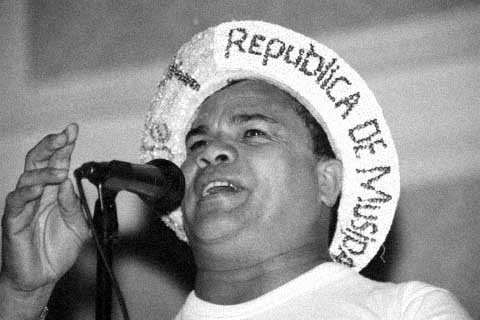
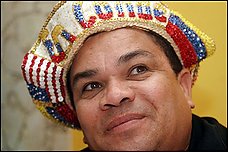
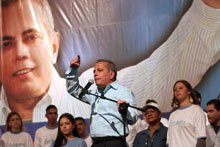
The Guachinton Pos picks up an AP story about Rausseo...
"He's ugly, I'm ugly ... I talk, he talks. But the difference is I live in Venezuela," he quipped, in a gibe at the frequent overseas travels of the Venezuelan leader, who has been on a three- continent tour since last week.

Rausseo, who is also a successful businessman with hotels and other enterprises, grew up poor and left school at 11 to support his family as a shoeshine boy, street vendor and taxi driver.

On Friday he told supporters that even if he cracks jokes on the campaign trail, he's serious about combatting crime, creating jobs, winning the trust of foreign investors and healing a divided nation.
July 27, 2006

The Sancocho Test

Ask yourself this: what drives people's voting in the TV age? Is it experience? "Preparation"? A government program? Ideology?
It's none of these things: in a media-saturated age, voting is driven by primal identification.

A generation ago, before media saturation had reached the extreme levels we see these days, voting was mediated by formal party structures built on long-standing allegiances. An adeco was an adeco hasta que se muera. Party identifications were passed down within the family from one generation to the next.

The rise of ubiquitous media, and the collapse of party affiliations, has dissolved these easy certainties. Today, the mediating structure between candidate and voter is no longer the political party, it's the TV camera. And the sense of intimacy TV creates sets up a whole series of new challenges for candidates, challenges that are more psychosocial than political.

In this reconfigured arena, a candidate needs to stir voters' primal identifications to compete. He needs to give people the sense - on some pre-rational, pre-verbal, entirely emotional, gut level - that he gets it, that he is like them, that they can feel comfortable with him because he understands them, and that he understands them because he has been through the same experiences they have been through.

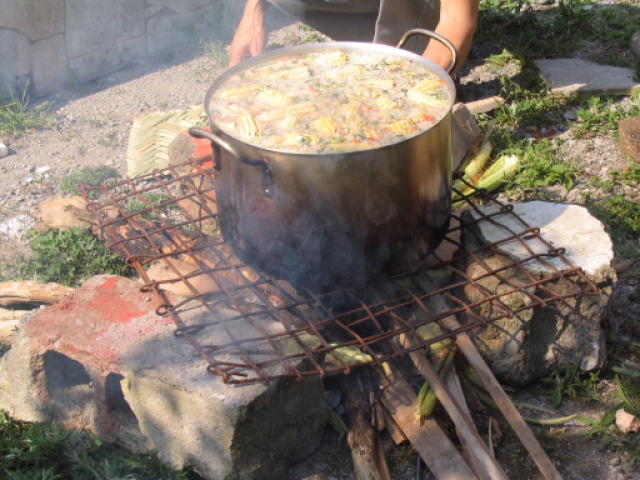
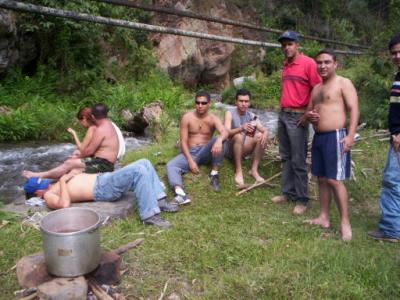
One way to think about this ability to connect on a pre-rational, non-political level is the Sancocho Test. (OK, in the US, it's the Barbeque Test - but lets Venezuelanize it.) Gringo pollsters have taken to asking voters which candidate they would rather invite to a barbeque. Or which candidate they would rather drink a beer with. In one variant, they ask which candidate they would prefer to sit next to on a long flight.

These are powerful questions because they get straight to primal identification issues. They drive at the entirely apolitical sense of emotional comfort with the candidate that drives voting decisions in a media-saturated age. They explain why a barely literate recovering alcoholic and failed oil-man could beat two of the smartest, best prepared democratic pols in a generation: too many gringos couldn't begin to imagine themselves chatting with Al Gore over a burger or hanging out, beer in hand, with John Kerry.

Which, of course, is a roundabout way of explaining why I think El Conde del Guacharo is actually a pretty promising candidate. Because as a candidate you can say all the right things, but you can't BS your way past the Sancocho Test, and if you can't pass it, you're toast. (Hell, just ask Roberto Smith.)

Now, who do you think the average guy trying to sustain a family on one minimum wage and one misión scholarship in Acarigua, or Maturín, or La Vega would rather eat a sancocho with ? Petkoff, Borges, Rosales or Er Conde del Guacharo? It's simply not a contest.


And then, who do you think these guys would rather drink a beer with? Rausseo or Chavez? That's where this whole thing gets interesting...

July 26, 2006

The Schemel-Morris-Musipán Axis

...or: method to the madness.

As Condemania grips the nation, the question looms ever larger: who exactly is behind Benjamín Rausseo?

Frankly, I don't know. I do know who's polling for him: Oscar Schemel, of Hinterlaces, together with the Gringo Prince of Polling Darkness Dick Morris, the legendarily smarmy, ruthlessly effective DC-operative.

If so, Chavez has something to worry about: Morris is not a man to be messed with, and Oscar Schemel is an extremely savvy pollster in his own right. Schemel has spent years building the case that the only way to beat Chavez is to take a sharp turn away from politics as usual.

Just last week, he was telling IPS:
“The only candidate who can confront Chavez successfully with some sort of margin of success, according to this study, is an ‘outsider,’ someone outside of the current political scheme and who still has not emerged.”

In his opinion, an ample spectrum of the population, up to 49%, can be located in a “ni-ni” (neither-nor) space, since they like neither Chavez nor the opposition. Among the other half of the country, 33% is clearly Chavista and 16% is oppositional.

Schemel said that in his research the population transfers to a hypothetical leader strengths that encapsulate their values, such as that he be young, humble, comes from below and has suffered, that he has a concrete governing program and is not part of any political extremes.
Is this ringing any bells yet?

For years Schemel has been arguing that the Chavez era has produced deep changes in Venezuela's political culture and that the opposition got stuck fighting the last war. Schemel has argued to anyone who will listen that perceptions of the Traditional Opposition political class were so overwhelmingly negative, no challenge from the existing cohort could have a chance against Chavez. His polling bears this out clearly:

Click to enlarge.

And so, for years, Oscar Schemel has been out hunting for an outsider able to take the fight to Chavez in a way no traditional pol possibly could.

Last year he argued:
A new culture is emerging, and it's resignifying and deactivating our received ideas about politics, amidst a social and symbolic struggle to redefine democracy, development and social relations.

The current political struggle is chiefly over interpretations and meanings. While the elites and the middle class fight to impose their own notions about democracy and citizenship, the poor majority, chavista and non-chavista, is refuting and resignifying those same ideas.

While chavismo has an important influence on the new interpretation that arises from this unprecedented political experience of the excluded, it is far from imposing its hegemony as a shared vision able to bring together the different interests of Venezuelan society.

The challenge is to build a new hegemony based on the demands of the majority for reconciliation, unity, equality, efficiency and new leaderships.
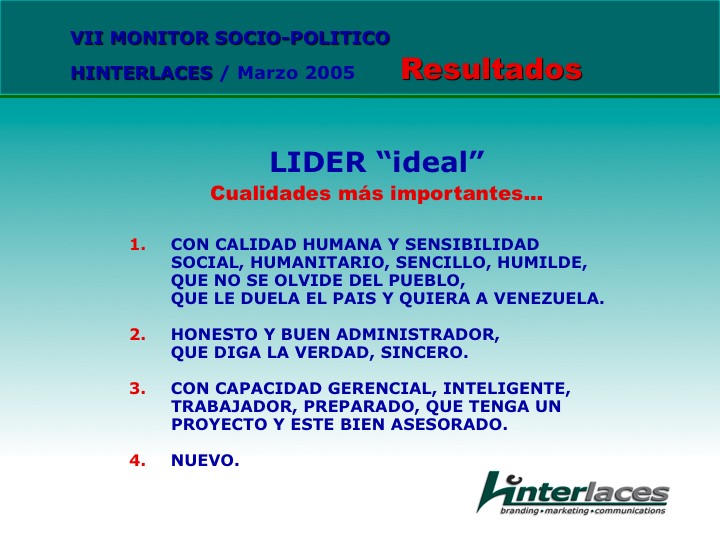
Seen in the context of Schemel's longer-term vision, the Conde del Guacharo experiment makes perfect sense. Benjamín Rausseo incarnates all the characteristic of the Perfect Oppo Candidate Schemel's research shows people are looking for:

Click to enlarge


Rausseo seems to be Schemel's answer to the question of how to launch a radical symbolic contestation of chavismo that has legs in the population at large. How to fight back effectively at Chavez's attempt to impose a new definition of Democracy in Venezuela.

The perfect outsider to unleash the perfect electoral storm.

Can he pull it off?

Amanecerá y veremos...

July 25, 2006

Anti-politics taken to its logical conclusion...

Well, it had to come to this: Benjamín Rausseo, much better known as El Conde del Guacharo, has launched his presidential bid.

It's a bit of a challenge to explain who Mr. Rausseo is to foreign readers. Basically, he's a stand-up comedian who long ago launched a wildly successful, unabashedly ribald act as "El Conde del Guacharo" - a fast talking, obscenity-spewing, tell-it-like-it-is everyman from Oriente. Love his comedy or hate it, Er Conde is just about as far from a traditional politician as it's possible to imagine.

Not surprisingly, the question that dogs Rausseo at this stage is whether he is, you know, actually serious about this. It sure seems like he is: wearing a suit, making a gargantuan effort to contain the stream of utter obscenity that is the cornerstone of his comedy act, and fielding questions (mostly) seriously, he's making every effort to convey that this is not a joke.

Alarmingly, Rausseo seems to be the most talented campaigner the opposition has come up with so far. Making the most of his humble begginings, but also wasting no opportunity to talk about his successful career in business (the guy built and owns a Theme Park in Margarita,) his soon-to-be-earned law degree and his polyglotal abilities, Er Conde is packaging himself as the no-nonsense alternative to Chavez. He's the one opposition guy able to talk to regular Venezuelans in a language they can understand, able to level with them without condescending or patronizing, and able to stake out a dissident position that's solidly grounded in good old, popular common sense. When it comes to connecting with regular people on a gut level, he's just light-years ahead of Borges, Petkoff and Rosales...which is not surprising, since connecting with regular people on a gut level has been his job for 20 years.

Can his candidacy attain the Electoral Tsunami status he aspires to? Only time will tell. For now, I'll just note that his strategic positioning is excellent. Rausseo is selling himself with Roberto Smithesque marketing savvy, but without Smith's hoity-toity East-side-Caracas-via-Harvard baggage. His pitch is solidly centered on Chavez's polling weak points ("se acabó la regaladera de plata! primero los de acá, los demás que se pongan en fila!") and what he lacks in experience he more than makes up in charm, street cred, and chispa.

Other positives? Absolutely everyone knows who El Conde del Guacharo is - and almost everyone seems to like him: he is one candidate with no name-recognition problems, and low negatives. Moreover, he is one guy Chavez just can't run his usual playbook on: Rausseo's outsider aura and popular touch makes him the only candidate with a real chance to out-Chavez-Chavez, to out-feel people's pain, and to out-flank any personal attack. Actually, with his legendary, acerbic wit, trying to attack him would be a distinctly risky proposition for Chavez...who else could bitch-slap the guy the way El Conde could?

Remember how people said Teodoro was a good candidate because Chavez could not credibly dick him around? Well, it turned out that Chavez didn't have to dick him around, because Teodoro is such a hopeless campaigner Chavez can just ignore him. Rausseo, though, is the real thing: a guy who can't be ignored and can't (safely) be attacked.

It's amazing, alarming, depressing, just plain sad that it's come to this, but...I'm sort of excited about it.

[Rausseo's Globovision appearance is here. His campaign website is here.]

Housekeeping Note: New Subscription Software

Those of you who've used the "subscribe" thingy to get Caracas Chronicles delivered to your inbox know that the software I was using, Bloglet, was an unreliable piece of junk.

Today, I switched over to FeedBlitz, which I'm told is substantially better. The formatting on the emailed posts should be much prettier, and the service much more reliable.

Those of you who were already subscribed with the old system don't need to do anything: I already migrated your subscriptions over to the new system. Those of you who weren't subscribed might want to give it a try. Takes two minutes.

Just enter your email, then follow the directions on the screen:


July 24, 2006

Skypecast: Jonathan DiJohn Casts Doubt on the Resource Curse

Click here to listen to the interview.

In the second Skypecast in a series on Venezuela's economic collapse, I interview Jonathan DiJohn. Dr. DiJohn is a lecturer in Political Economy and Development Studies at the University of London, and a former visiting researcher at IESA.

His explanation of Venezuela's economic collapse presents a challenge to the conventional academic wisdom on the subject. Arguing that "resource curse" arguments that highlight the role of oil can't account for Venezuela's growth collapse, Dr. DiJohn focuses instead on the shift to a "Big Push", heavy industry-led development strategy implemented in the 1970s - what we think of as La Gran Venezuela - and argues this type of import-substitution industrialization plan was incompatible with the country's increasingly fragmented and populist political system. Oil, in general, plays a minor role in an explanation that highlights the mismatch between political system and economic strategy starting in 1973.

You can download an early draft of Dr. DiJohn's paper in MS Word format here.

The 40-minute Skypecast is, once again, a non-technical review of his research that I hope will be understandable to non-specialists. I thought the interview was really interesting, but you tell me what you think: Click here to listen to the interview.

If you like what you hear, you're in luck: Dr. DiJohn will publish a book on the history of Venezuela's Development Strategy next year.

Hugo's Axis of Evil 2006 World Tour: Enough Rope to Hang Himself With

Ah, the harvest of incriminating quotes has begun. Here's Huguito on Belarus:

"I have come here to conclude a unity pact. Here we see a model of the social state that we are beginning to create."
"Here, I've got a new friend and together we'll form a team, a go-ahead team," Chavez said before one-on-one talks. "I thank you, Alexander, for solidarity and we've come here to demonstrate our solidarity."

Lukashenko, an open admirer of the Soviet Union, returned the praise, calling the president of the world's fifth-largest oil exporter "a man of extensive knowledge."

"You are versed not only in the economy of Venezuela but in the Belarus economy, as well. You know military science, the military-industrial complex, and this impresses me very much," he said. "We have many directions for cooperation. There are no closed topics for discussions in our cooperation with Venezuela."

During the 24-hour visit, Chavez was slated to tour a military academy and the "Stalin Line" - a network of World War II-era defense installations restored by Lukashenko's government.

Do note, before retorting some variation on the old "Venezuela can seek diplomatic links with anyone it wants" line, that Chavez is specifically praising the state model in Belarus and explicitly noting the similarities between what they have and what he's beginning to create in Venezuela.

First reader to find me a picture of Chavez feeling up Lukashenko good enough to put on the right-hand column wins a lollypop.

July 23, 2006

Comparative Campaign Launches

Here's a study in contrasts:

Julio Borges launching PJ's Progreso Popular plan:


Teodoro Petkoff launching his candidacy


Manuel Rosales launching his campaign (unfortunately, audio only:)

Click here.

July 22, 2006

Making a buck, the North Korean Way

The current New York Times Magazine carries this stunning feature on North Korea's super-sophisticated operation to counterfeit US dollars:
According to defector accounts, Kim Jong Il endorsed counterfeiting not only as a way of paying for covert operations but also as a means of waging economic warfare against the United States, “a way to fight America, and screw up the American economic system,” as the North Korean specialist paraphrased it to me.

In a similar vein, according to Sheena Chestnut, a specialist on North Korea’s illicit activities who has also interviewed several key defectors, counterfeiting was seen as an expression of the guiding idea of the regime: the concept of juche. Often loosely translated as “self-reliance” or “sovereignty,” the idea of juche entails an aggressive repudiation of other nations’ sovereignty — a reaction to the many centuries in which Korea capitulated to its larger, more powerful neighbors. “It appears that counterfeiting actually contributed to the domestic legitimacy of the North Korean regime,” Chestnut told me. “It could be justified under the juche ideology and allowed the regime to advertise its anticapitalist, anti-American credentials.”

By 1984, as North Korea’s planned economy began to fall apart, Kim Jong Il, who by that time was effectively running much of the government, issued another directive, according to the North Korean specialist, who told me he has obtained a copy of the document. It explained that “producing and using counterfeit U.S. dollars” was a means, in part, for “overcoming economic crisis.” The economic crisis was twofold: not only the worsening conditions among the general population but also a growing financial discontent among the regime’s elite, who had come to expect certain perquisites of power. Counterfeiting offered the promise of raising hard currency to buy the elite the luxury items that they had come to expect: foreign-made cars, trips for their children, fine wine and cognac.
...
From all accounts, superb quality is a feature of much North Korean contraband: methamphetamine of extraordinarily high purity; counterfeit Viagra rumored to exceed the bona fide product in its potency; supernotes. It’s an impressive product line for a regime that can barely feed its people. When I discussed this with Asher, he let out a sigh. “I always say that if North Korea only produced conventional goods for export to the degree of quality and precision that they produce counterfeit United States currency, they would be a powerhouse like South Korea, not an industrial basket case.”
Better yet, read the whole thing - it's always good to be up to date on what Chavez's buddies are up to.

Like Caracas Chronicles, only funny...

In his inimitable style, Harry Hutton nails a point I've been trying to make for a long time. It's just that when he does it, you laugh...

July 21, 2006

The Paleopopulist Approach

Zulia Governor Manuel Rosales finally had a proper presidential campaign launch yesterday, giving a good old fashioned, nasal-toned populist speech to a crowd of fawning supporters at the Ateneo de Caracas.

His discourse is pleasingly focused on some Chavez weak points - particularly his wildly unpopular spending spree abroad - and largely ignores the kinds of abstract questions that rile up the Noticiero Digital crowd while leaving most voters cold. That's smart politics. On the other hand, he said nothing at all about Chavez's single most vulnerable issue: crime.

As for his style...well, I'm too much of a hoity-toity intellectual to openly say I like it. Charismatic he ain't, but when he gets going, and in front of an appreciative crowd, he does a passable impression of an old-style, rabble-rousing adeco. At times, the guy sounds like he's channeling Piñerúa. Could this kind of rhetoric do the trick?

Well, judge for yourself: the podcast of the speech is here.

July 20, 2006

Hugo's Axis of Evil 2006 World Tour: Dreamin' of Pyongyang and Propagandizin' of Beirut

Turns out Hugo Chávez still wants to go to North Korea, but Pyongyang seems to be playing hard to get. Could Kim Jong Il bear to sit around a table with an even bigger megalomaniac than him? We can only hope...GOD I want that picture!

Chávez also took the chance to reaffirm his "strategic brotherhood" (?!) with Iran and, obviously, to blame the US for the latest Middle East crisis. Certainly the American refusal to make even a ritual exhortation for peace is pretty appalling. But trying to pin the entire blame for this tragedy on one side or the other is plainly childish. The US is just about as guilty of this as Chávez, with his sophomore-leftie-style rant exonerating Hamas and Hezbollah of any responsibility at all for the war they conciously provoked and his failure to notice that the missiles that have been raining on the north of the Zionist Entit...erm, Israel are made in Tehran.

Faced with a complex diplomatic situation, Chavez's instincts are tiresomely predictable: find out the US position, then argue the diametrical opposite, whatever the facts. His blithe embrace of indefensible overstatements underlines the guy's basic irresponsibility: "it's the Israeli Army," he said, "that is bombing entire cities, a real genocide, how far this madness will go only God knows."

First of all, there's this "entire cities" business. The contrast between Israel's deliberate targetting of relevant military objectives and Hezbollah's perverse pride in the indiscriminate nature of its attacks is all too evident. With the Israeli Air Force dropping leaflets to warn civilians to evacuate areas they are about to strike, Chavez's suggestion that it's the Israeli campaign that is indiscriminate must count as a grotesque reversal.

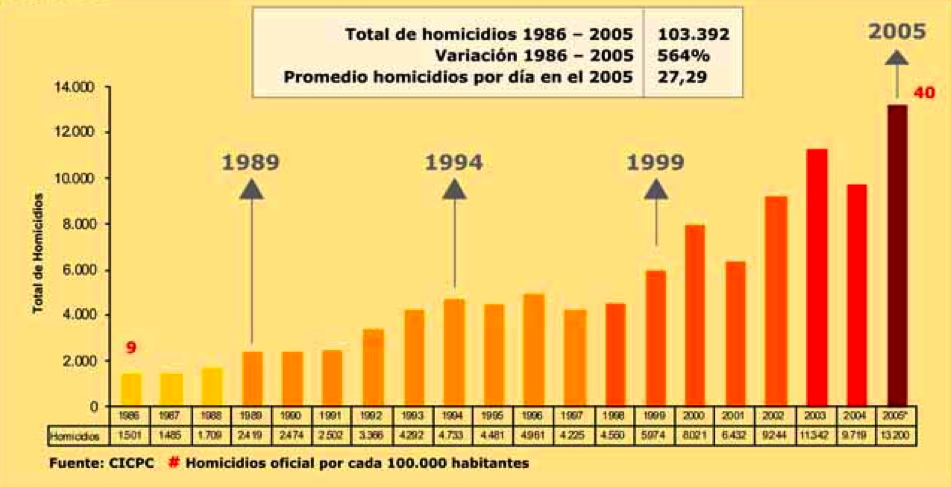
Then there's the sheer indefensibility (not to mention extreme bad taste) of the "real genocide" line. So far, 300 Lebanese civilians have died in a week of air raids. That's 300 too many - but think of it this way: Lebanon has suffered 43 fatalities per day so far, and that's just about the same number of deaths we see in Venezuela on any given day, just from street crime. Venezuelan choros don't even need military weaponry to launch their own little tropical "genocide", but somehow that doesn't get Chavez's juices flowing...

Which brings us back to an old topic: the proof of the anti-semitic pudding is in the eating. Who Chavez thinks killed Christ is a side-show. The smoking gun is Chávez's active, ongoing, diplomatic and material support of a holocaust-denying regime that espouses an ideology laden with extreme, explicit anti-semitism and looks forward with glee to the destruction of the State of Israel, whether through proxies or nukes.

July 18, 2006

The Montonera of the 21st Century

It's a point GP keeps making in my comments section, and it's a good one: for most Chavez supporters abroad, Venezuela didn't exist before 1998. Brought into their consciousness more as a screen where revolutionary aspirations can be projected than as a real place, with a real history and a real people, Venezuela remains an abstraction in PSF minds. For this reason, international philochavismo fails again and again to understand the way developments in the Chavez era fit into the long sweep of Venezuelan history.

This is the reason I like articles like the one I linked to in yesterday's post. They show the much neglected element of continuity in a regime that ceaselessly trumpets its radical novelty.

The fascinating thing about the bolibourgeoisie is how closely its rise re-enacts a socio-political pattern that was already well established 150 years ago. Without an awareness of Venezuela's long history of assimilating new moneyed elites, it's impossible to know what to make of the Wilmer Rupertis and Arné Chacóns of the world.

Venezuela's 19th century was marked precisely by a quite similar dynamic. Central governments in Caracas had access to some tax and customs revenue, but never really consolidated control of the rest of the country. Periodically, regional caudillos would cobble together little private armies - montoneras - and attack Caracas. Once every few years, a montonera would succeed and establish a new "national" government. The sordid little war that brought about such regime change would typically be described as a "revolution" by its leaders.

The financiers and logisticians of the victorious montonera then got to cash in, by trafficking on their access to the new governing elite. They would adapt to the lifestyle and spending patterns of the old moneyed elite, and, if the new government lasted long enough before the next successful montonera, they would insinuate themselves gradually into the pre-existing oligarchy.

Sooner or later a new montonera would bring a new caudillo into power and the whole process would repeat itself.

The process stood in stark contrast with the pattern in countries like Peru and Guatemala, where oligarchies were genuinely closed to new members and new money could not buy access into the upper reaches of polite society. In Venezuela, the difference between a zambo and a catire has always been the size of his bank account.

The discovery of oil merely upped the ante in this little game, but didn't fundamentally change it. The AD trienio of 1945-48 didn't last long enough to establish a new moneyed elite, but the Pérez Jiménez era did, as did - much more profoundly - the Punto Fijo regime. War was replaced by elections as a method of choosing the new governing elite, but the tenor of the relationship between the new governing elites and their financiers and logisticians carried on more or less undisturbed.

These days, amid a discourse that obsessively emphasizes change, we see these old, old patterns re-enacted for the Nth time, as though something in our cultural DNA inexorably pushed our society into playing out the same script again and again.

Revolutionaries are everywhere and always blind to the way they renew the structures of the regimes and social systems they seek to replace.

But don't be fooled: not that much has changed. Just like in the 19th century, the new moneyed elite instinctively mimics the lifestyle of the old. Just like in the 19th century, it builds its fortune out of connections rather than producing anything of real value. Just as in the 19th century, it depends on an atmosphere where back-scratching, influence-peddling, rent-seeking and the mutual dependence of politicians and financiers determines your chances to get rich. And, just like in the 19th century, in time it will grow too fat and comfortable to defend itself, too openly putrefact to enlist anyone's loyalty, and it will fall.

July 17, 2006

Reporting the Bolibourgeoisie

The Miami Herald's Steven Dudley adds one more article to a fast growing subgenre of journalism about the Chavez era: The Bolibourgeoisie Color Piece. I think this one is more snazzily written than most, though:
They drive shiny new Hummers and Audis. They wear Cartier and carry Montblanc bags. They buy up luxury apartments and fly private aircraft to and from Miami. And they almost always pay in cash.

They are the so-called Boliburguesía -- short for Bolivarian bourgeoisie -- a reference to socialist President Hugo Chávez's declared ''Bolivarian'' revolution on behalf of Venezuela's poor.

Chávez has seen world oil prices go from $10 a barrel when he was first elected in 1998 to more than $70 today. He has used these windfall billions to finance dozens of social projects on behalf of the poor at home, and provide assistance to regional neighbors from Cuba to Argentina.

But the rising economic tide has not only lifted the poor's boats, bringing back memories of the 1970s, when another spike in oil prices sparked a free-spending boom. Businessmen agile enough to ally themselves with the government have caught the gravy train. Tops on this Boliburguesía list are men like Wilmer Ruperti, one of the few businessmen who supported the Chávez government during a crippling national strike in late 2002 demanding the president's resignation.
It's easy to see why journos find it easy to sell these pieces to editors back home: they're highly visual - all that talk of Hummers and Cartiers - and appealingly man-bites-doggish - who's ever heard of socialist revolutionaries ponying up for yatchs and things?

Personally, I like them because they highlight perhaps the key theme in the Chavez Era: contradiction. There are so many contradictions running through so many aspects of so much of what the government does it makes your headspin.

Bolibourgeoisie - the weird juxtaposition that makes up the neologism itself neatly captures the taste of the incongruities that run through the Chavez era. To my mind, any reporting that helps foreign readers get a feel for the scale of the gap between the official propaganda line and Venezuela's irreducibly complicated, usually contradictory reality is to be commended.

July 15, 2006

July 14, 2006

How to win with crime...

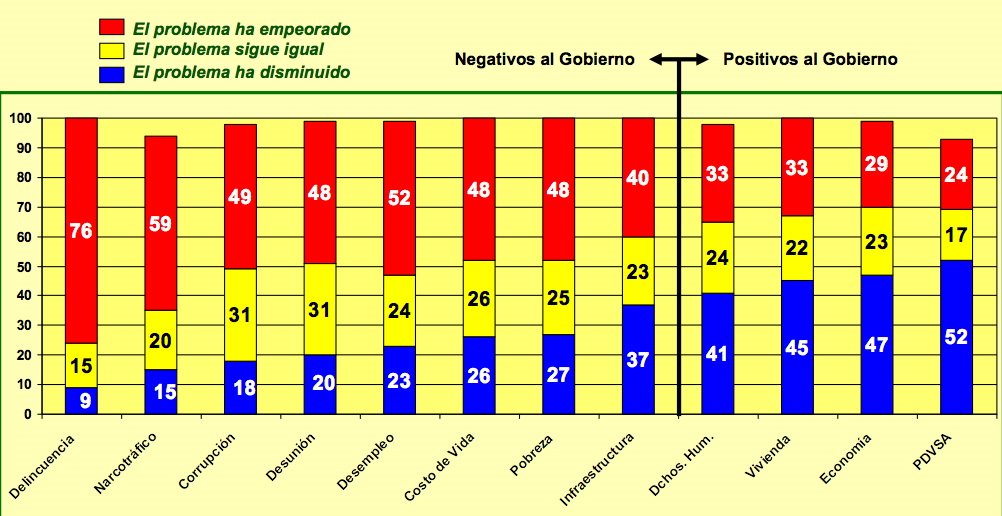
Crime is the issue Venezuelans are most worried about. It's also the issue where they rate Chavez's performance worst. Here's Keller's June 2006 Performance-by-Issue slide:

[Click to expand. Red=Problem is getting worse. Yellow = Problem is the same as ever. Blue = Problem is getting better.]
Somehow, though, the opposition can't get any traction on it. The problem is that, today, crime is just not a politicized issue. That's because Chavez just won't join the fray. The most amazing thing about Chávez's line on the crime epidemic is that he doesn't have one. And when the other side fails to acknowledge the issue, it's impossible to establish a discussion.

How does the opposition change this dynamic? It's tough. But one possible avenue is to talk about crime as a social and economic issue. This is something Tony Blair managed to do with his now famous "tough on crime, tough on the causes of crime" campaign line. By underlining the links between poverty, exclusion and urban violence, the opposition can use the sharp rise in crime to tell a story about the overall social failure of the regime - who's ever heard a country where rapid poverty abatement and social inclusion go hand in hand with an unprecedented crime wave? The story doesn't hang together.

The opposition badly needs to make the December election about its strongest issue. It needs to grab control of the agenda, something it's catastrophically failed to do since 2003. The protests surrounding the deaths of the Fadoul brothers showed that there's an substrate of anger around insecurity, that crime is politicizable. Time to move on this.

Venezuela's Murder Rate: Click here to expand

Addendum: Some of the crimes being reported these days are just jaw-dropping in their audacity. On Wednesday, at 5 a.m. in Guatire, a group of thugs held up fourteen buses in one go in a commando-style operation.

July 13, 2006

Making Crime Pay

From a polling perspective, it's a no-brainer. The issue most people identify as the country's biggest problem is also the one where they rate Chavez's performance the worst.

According to Hinterlaces' May/June 2006 poll, 87% of voters identify crime is the biggest problem in the country. 70% say crime has gotten worse under Chavez, and 24% say it's the same as it's always been.

Keller's June poll also identifies crime as the number one issue - 76% of his respondents think it's gotten worse and 15% say it's the same.

How should a savvy oppo candidate react?

By talking about very little else.

Chavista Assembly Members Demand Dissidents be Jailed

Pro-Chavez National Assembly Members José Albornoz (PPT) and Ismael García (Podemos) are asking the Prosecutor General to jail Sumate's leaders.

Their crimes? Usurping the CNE's prerogative by seeking to organize a primary election outside the state's control and incitement for publicly airing their views on CNE.

Still more proof that chavismo, as an ideology, has no room for the idea that some matters are not the state's business - that there are spaces where citizens can and should come to make decisions without the state's interference. We already saw this in 1999 when chavismo insisted that labor union elections had to be organized by CNE, and in 2003 when they said that signature-gatherings had to be run by CNE.

The notion that citizens can use whichever method they deem best to select their candidate for election is beyond them. The concept of civil society - of a sphere of social life that is both public and outside the state's control - is deeply alien to their understanding of the good society. By this reasoning, voting for Miss Venezuela will end up having to be organized by CNE.

Extremism? What extremism?

July 12, 2006

On the nature of verbal agression


Katy says: The debate that raged in the comments section (see Quico's prior post and the discussion that followed) got me thinking about the power of words. The right words said in the right context, be they Chávez's, Quico's, Alek Boyd's or Materazzi's, can be a powerful tool. They can inspire fear, apprehension, ridicule. They can send people into a tizzy, or send them straight to the nearest airport or locker room. They can provoke a reasonable, inspired response, or they can provoke an act of violence tinged with just the right amount of honor.

But I'm not a good enough writer to talk about these things. Here's what tennis writer/blogger Peter Bodo had to say about Zidane's infamous head-butt. I think there's some truth in there for all of us.

"What Zidane did was undoubtedly stupid. It was silly. It may have cost France a most magically earned World Cup championship, and it cost Zidane himself a fair amount of the glow surrounding his name.

But I also think this: Zidane was driven to butt Italian Marco Materazzi out of a sense of personal honor (you certainly can’t say Zidane acted in the heat of the moment), because Materazzi crossed a line in the sand. And that notion of “honor” is almost entirely gone from our collective life these days.

Theoretically, we should be living in a time of civility and harmony, because we’ve managed to create powerful prohibitions against things like the good old-fashioned punch-in-the-nose. Actually, it appears that we’ve thrown open the floodgates on incivility, reckless accusation (and lying), the vilest kinds of name-calling, bigotry - the whole nine – because nobody is held accountable anymore. Therefore, a guy like Materazzi (I'm basing all this on admittedly unsatisfying press reports) feels he can say anything he wants - Zidane wouldn't dare hold him accountable. Not with millions watching! Not with all that money at stake! Not with the precious World Cup trophy on the line!

But every once in a while, somebody – today, it’s Zidane - violates the taboo. He or she in effect, says, I don’t care what is on the line, how much money or personal advantage or reward. I am not going to have the last laugh, or laugh all the way to the bank. My code of honor simply won’t allow me to let this go unanswered. It takes an individual of great (if not necessarily admirable) character to take that road, and wasn’t Mr. Materazzi surprised to learn, in the most direct manner, that he was being held accountable for his words?

I don't expect many of you to agree with me on this. But I can't deny the way I feel about this. Of course, a part of me feels badly for the French squad, which inadvertently suffered because of what Zidane felt he had to do. But a part of me condones what Zidane did and forgives him because, in addition to striking a blow for accountability, his action also demonstrated something that many people forget and that as a writer I feel strongly about: words are powerful weapons, they can cause more hurt and sorrow than fists or belts or willow switches.

...

The head butt was about the power of words, the notion of accountability, and about honor. It was not an admirable move, nor a clever or practical one; it was something that transcended those mundane considerations."

July 11, 2006

Chavista Extremism: Scarier and scarier...

Extremism is becoming the defining characteristic of the chavista movement. At no point does the ruling ideology draw the line - just the opposite: every part of the new elite seems to operate under the maxim that if a little extremism is good, a lot is better. The result is a kind of tournament within the regime, a dynamic of one-upmanship where each tries to out-extremist the other.

It's a scary thing: the phrase "that's going too far" doesn't seem to be a part of the regime's political lexicon. More and more, the regime has lost its feel for the ridiculous (el sentido del ridículo) - leaving it shorn of any way to judge how much is too much.

Examples? They're a dime a dozen. Here are a few:
The point, I think, is clear: with the government firmly consolidated in power, all restraints on extremism have been lifted. The question then becomes: where does this road lead?

We need to be clear about this: Venezuela is not a totalitarian regime. But we also need to be clear about this: it is moving more and more decisively in that direction. Clearly, spaces for dissent still exist; just as clearly, the regime is working to close them down.

What's terrifying is that there is no logical limit to chavismo's power ambition. Nothing in the structure of the belief system limits its tendency to expand control into new areas of political and - more and more - social life.

There is no room in chavista thinking for the notion that some of spheres of human activity are and ought to remain outside of the political sphere. And there is certainly no space in chavista thinking for the notion that any part of the political sphere ought to remain outside the state's control. It's a way of conceiving politics that never says "enough," that has no notion of "that's not the state's business," that never sees a reason to stop expanding its reach, and that does not recognize any distinctions between the concepts of "nation", "state", "government", "party" and "Chavez." As far as the ruling ideology is concerned, to be for one of those is to be for all of them; to oppose one is to oppose them all.

What's scary is not so much where we are now, but where the internal logic of chavista thinking points us. These days people are happy buying their hummers and plasma TVs and such. But the logic of blanket politization is afoot, and with it the mechanisms first for authoritarian and later for totalitarian control.

We're definitely not there. Chavismo's myriad internal contradictions might yet cause its collapse before we get there. But it's not really possible to deny that we're heading there. Not any more.

July 10, 2006

The 2006 PSF D'Or goes to...

Envelope please...[rustle-rustle, cough]...Ladies and Gentlemen, the 2006 Pendejo sin Fronteras d'Or goes to...Chris Kraul, of the Los Angeles Times!

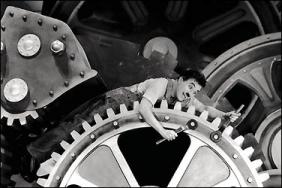
It's no contest, really: his piece in Sunday's LAT about the ways chavistas have been using Charlie Chaplin's 1936 classic, Modern Times, for propaganda purposes will go down as a timeless classic of slack-jawed PSFery. The story misreports, misunderstands, misconstrues and misattributes Venezuelan workers' problems with such gusto, the competition didn't have a chance.

A taste:
Since January, in a bid to expose the evils of "savage capitalism," the Labor Ministry has shown the Chaplin film to thousands of workers in places such as this rundown industrial suburb of Caracas.

Chaplin wanted his Depression-era movie to make a point, that "once inside the factory, workers had no meaningful rights," said Los Angeles-based film historian and Chaplin authority Richard Schickel. "It was very relevant in the moment it was released, a time of social unrest and the emerging U.S. labor movement."

Seventy years later, Chaplin's fable is all too relevant in Venezuela, said several factory workers who saw the film recently.
In a way, the first thing that jumps out at you is not so much Kraul's staggering ignorance as his utter lack of inquisitiveness. The piece details the way chavistas have used Modern Times to make a point about labor exploitation in Venezuela. A minimally curious writer might then ask, "hmmmm, are labor conditions in Venezuela today really comparable to labor conditions in the US during the depression? Do Venezuelan workers really have no meaningful rights? does it really make sense to describe Chaplin's film as 'all too relevant' in Venezuela?"

Well, lets see, what were workers fighting for in the 1930s in the US? First and foremost, they were worried about the right to form unions and bargain collectively...rights that have been guaranteed and widely exercised in Venezuela since 1958.

Bad start. OK, the minimum wage, then? Nope, there has been a minimum wage in Venezuela, for decades. Not only that, figured as a percentage of the average wage, Venezuela's minimum wage is the highest in the America's - fully 90% of the average, meaning that, for all intents and purposes, Venezuelan wages as a whole are decreed by the Central Government.

Not that either, then. Perhaps the eight hour work day is a good parallel? Nope, Venezuelan workers got that reivindicación decades ago. Vacation pay? Got it. Severance pay? Got it. Mandatory employer contributions to pensions? Got those too. Statutory overtime pay premiums? Check.

Hmmm...how about some more lavish perks - the kinds of things European workers protest over these days? Statutory employer-provided childcare and dining facilities, say, or an open-ended ban on layoffs, or subsidized housing, subsidized worker training, subsidized transport, or statutory profit-sharing, or paid maternity leave? Hell, these are demands that would have made US workers blush back in the 30s - but, you guessed it, Venezuelan workers have all of those as well!

In fact, Venezuela has some of the most restrictive, rigid, employment-zapping labor legislation anywhere in the world.

So restrictive is the legal framework that in the paper I wrote about yesterday, Hausmann and Rodriguez set out microeconomic evidence showing how labor market rigidities have hampered Venezuela's attempts to crack non-energy export markets, deepening our dependence on oil exports and contributing to the country's economic collapse since 1977.

In effect, with existing legislation, the legal economy can't begin to generate enough jobs for the size of the workforce we have, leaving about half of Venezuelan workers to scrape together a living somehow in the informal sector. Once there, they have no protections whatsoever. UCAB researchers have found that 90% of informal sector workers earn less than the legal minimum wage. It's hardly surprising that, for informal workers, finding a job in the "savage capitalist" economy Modern Times sends up is a universal aspiration, a wistful dream that's simply out of their reach.

Given the very high costs associated with Venezuela's hypertrophied labor legislation, it's easy to see why the informal sector has swelled. Venezuela has a plainly outsized "fiscal wedge" (cuña fiscal) - the gap between what it costs an employer to create a legal job, and the pay a worker effectively takes home. By some researchers' estimates, every Bs.100 in take-home pay for legal workers costs employers Bs.171 to generate - with the extra Bs.71 going to cover various taxes, mandatory contributions, and statutory workplace perks. These figures dwarf the notorious fiscal wedges in countries like Germany (51%), Belgium (56%) and France (47%).

For all his efforts to "even-handedly" present business viewpoints in his piece, Kraul catastrophically fails to grasp the basic ridiculousness of the way Modern Times is being used to push an extremist ideological agenda. What Kraul tragically fails to process is that Venezuela's legal labor force is a relatively privileged elite within the working class, the better-off half in a vicious insider-outsider dynamic that condemns millions of people to the atrocious poverty and total insecurity of the gray economy...and that the more legal goodies that relatively privileged elite gets, the more expensive it gets to create legal jobs, and the harder outsiders find it to crack into the legal job market.

Maybe, on his way back to the Meliá from that poultry plant, Kraul should've stopped to chat with some of the buhoneras in the Boulevard de Sabaná Grande and asked them what they think about the terrible exploitation of the quince-y-último set. The look of baffled fury he would've gotten from them perfectly mirrors my outrage at his deeply ignorant little piece.

His, dear reader, is one richly deserved PSF D'Or...

July 9, 2006

Skypecast: Francisco Rodríguez on Venezuela's Economic Collapse

Click here to listen to the interview.

This interview features Francisco Rodríguez. Francisco is Assistant Professor of Economics and Latin American Studies at Wesleyan University, and a fast rising academic star. He's currently co-editing a book on Venezuela's economic collapse with Harvard's Ricardo Hausmann. Over the next few weeks I will be publishing Skypecasts with several of the book's contributors.
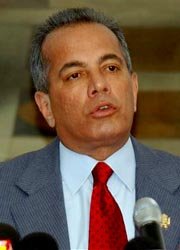
Working drafts of all the book's chapters can be downloaded here.

In this wideranging, 40-minute Skypecast, Francisco describes the overall research project, and then walks us through the draft chapter he co-authored with Ricardo Hausmann. In explaining Venezuela's economic collapse, Hausmann and Rodríguez stress the fact that Venezuela didn't have an alternative export industry to cushion the blow when oil prices fell. They go on to assess five different hypotheses to explain why, unlike Mexico, Indonesia and Malaysia, Venezuela didn't develop alternative export industries.

The Skypecast sets out their research in language that (I hope) will be understandable to non-specialists. Towards the end, Francisco explains some of the policy implications of his analysis.

Click here to listen to the interview.

Talk vCrisis here...

Personally, I've been careful not to say much about the Boyd-Livingston saga. My deep disagreements with Alek are just as public as our friendship is. However, there seems to be a limitless appetite to discuss this, so I'll open this thread for that purpose.

July 8, 2006

Extra! Extra! Sanity breaks out in the comments section!

An event rare enough to merit a post of its own: Yesterday, at about 1:00 p.m., a debate broke out in the comments section that was on topic, fun, sophisticated, enlightening and cordial. Feathers, Katy, Rafael, and Amieres: you don't know how happy you made me!

July 7, 2006

Rosales's Quirky Campaign Launch - And Teo's Obstructionism

After months of sitting on the fence, Zulia's neo-adeco governor Manuel Rosales has finally made it clear that he's running for president - in the weirdest way possible, by announcing he is willing to participate in an oppo primary. What kind of a campaign launch is that?
Though Borges, Rosales and six marginal candidates have signed on, it's still unclear whether there will be a primary on August 13th, because Teodoro Petkoff is still dithering. Teo's made it clear in various ways that he's not for a primary, and would prefer a complicated polling solution to determine the candidate. Not surprising, cuz the guy is far behind in the polls.

Sumate's position, that they will only organize a primary if all main oppo candidates participate, effectively gives any one of them a veto over the whole thing. Is this really sensible?

July 6, 2006

Common Sense Meltdown Chronicles: The Chavez-North Korea Axis

In the wake of worldwide condemnation for North Korea's missile tests, Chávez's timing for a Pyongyang getaway is looking especially ill-judged. North Korea's move, which is being interpreted as a slap in the face even for its only ally, China, has placed the hermit totalitarian prison-state even farther beyond the pale than it already was.

Hell, even Argentina was horrified.

Right on cue, in step the chavistas to stick up for Pyongyang's right to develop missile technology - while, moronically, asserting that the government doesn't have an official position yet. Hm.

With Caracas now serving as the site for meetings of the Board of Directors of the International Institute of the Juche Idea and Venezuela hosting one of the very few North Korean embassies abroad, it's hard to disagree with the US State Department's judgement that Chávez is an outlier on this issue.

Chávez's ongoing flirtations with the Ultimate Rogue State merely underlines a point that should be clear to anyone who's been paying attention: the guy never met a tyranny he didn't like. But does he really understand how very, very far from diplomatically correct it is to cozy up to a state like this?

Of course, my comments section has already served as the site of impassioned defenses of the use of children as mine-clearing equipment in Iran - following Chávez's coddling up to that regime - so how long can it be until someone turns up to explain that no, really, North Korea is really a nice place?

Personally, I can't wait for him to go so I can put the picture on my right-hand column.

Would an AMLO win really favor Chavez?

Say chavistoid populist Andrés Manuel López Obrador somehow gets the Mexican vote count overturned and wins the Mexican presidency...would that really favor Chávez?

Personally, I have doubts. Chávez is happy to have fellow travellers elected in smaller, weaker, poorer countries like Bolivia, Peru and Nicaragua, places where his oil dollars carry enough weight to dictate policies. But would AMLO really play second fiddle to Chávez? Would a larger, richer, stronger country really fall into line behind our little Napoleon's fantasies of hemispheric leadership? I really doubt it.

More likely, AMLO would end up staking a challenge to Chávez's ambitions for leadership of the hemispheric left. And that's the last thing El Comandante wants.

Could the government be lying about illiteracy?

Katy says:
"Just to cite some important examples, our country had the honour in 2005 of having been declared officially by UNESCO as an illiteracy-free territory." Mary Pili Hernández, Venezuela's Vice-Minister for Foreign Affairs

"
UNESCO has not endorsed or made any statement to the effect that Venezuela is free of illiteracy." Sue Williams, UNESCO's Chief of Section of Bureau of Public Information, Paris.

Source: Vcrisis - the encore.

Update: Calderón Pulls Ahead


At 5:07, Ccs time, Calderón takes the lead...

Click here for minute-by-minute updates from the Mexican El Universal.

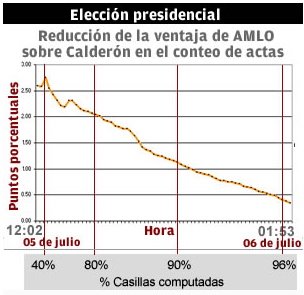
Mexico's Nail-Biter

Nothing to be done in Mexico but nibble at your nails...


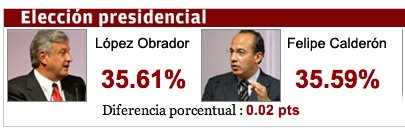
At 4:47 a.m. (Caracas time), with 97.6% of actas recorded, AMLO is ahead by 0.02%...but results are changing all the time and the latest results coming in are from the pro-Calderón north, so keep checking for updates...

July 4, 2006

Chavez's trade policy in historical perspective...

In a Working Paper, presented at a recent conference on Venezuela's disastrous economic performance since the late 70s, Ricardo Hausmann and Francisco Rodríguez put forward a sophisticated explanation for the collapse.

At the center of their interpretation is the argument that the absence of an alternative export industry left Venezuela badly exposed to energy market shocks. Unlike countries like Mexico, Indonesia and Malaysia that managed to diversify their export baskets, Venezuela's nearly complete specialization in energy (and energy-related) exports amplified the impact of sporadic oil price downturns.

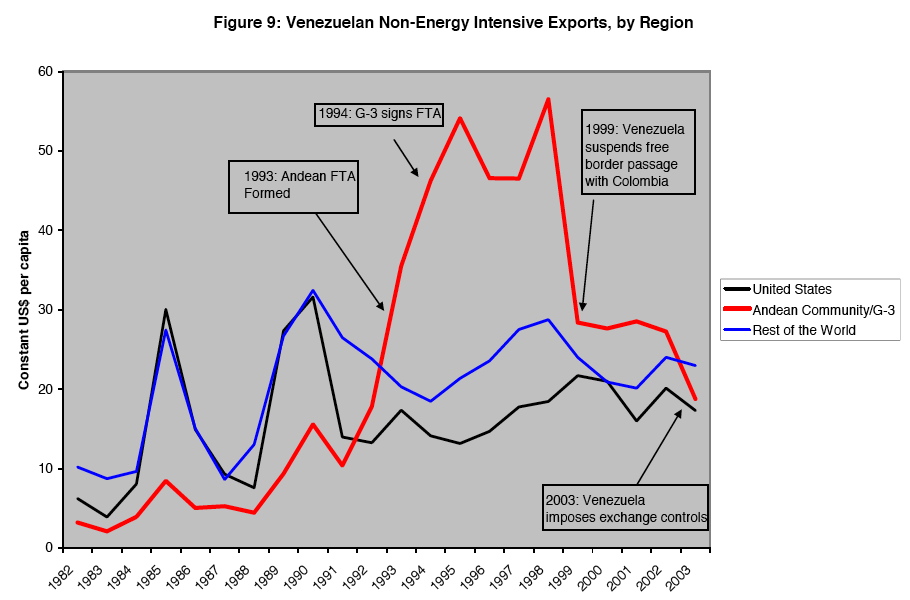
From this point of view, policies that help diversify Venezuela's export basket constitute a safety net against future downturns. And few policies had achieved that goal as well as signing regional free trade agreements like the Andean Community and the G3 deal with Mexico and Colombia. As this chart shows, from the early 1990s Venezuela's non-Energy Intensive producers finally started to gain a foothold, largely thanks to those deals:

Click to enlarge. Taken from Hausmann and Rodríguez, Why did Venezuelan growth collapse?, Page 50.


As the chart also shows, since the very start of the Chavez era, misguided trade policy decisions have seriously undermined the value of those agreements. All of which we should keep in mind as we track the debate over Venezuela's exit from the G3 and the Andean Community, and our entry into the barely-functioning Mercosur.

First off, Venezuela's Andean and G3 trade was largely concentrated on its largest and most "natural" trade partner: Colombia. Tearing down our trade agreements with Colombia to enter a deal with countries whose economic center of gravity is thousands of miles away makes no sense.

Second of all, while it's clearly a bad idea to formally deny Venezuelan exporters their privileged access to the Colombian market, we need to keep the decision in perspective: the real economic damage has already been done, through things like the introduction of transshipment requirements in 1999 and exchange controls in 2003. Formally exiting the deals merely makes it official.

The Chavez Effect: Two for Two

Well, the election in Mexico is achingly close, and the legal challenges will surely mount. One thing we can say for sure, though: Andrés Manuel López Obrador's comfortable lead, which lasted for two years prior to the election, vanished the second Calderón managed to link him to Chávez.

Just like in Perú, even the perception of Chavophilia has proven an electoral poison pill in Mexico.


Imagine how different the hemispheric picture would look without the Chavez Effect. With Ollanta and AMLO in power, all the tooth-gnashing about an authoritarian backslide in the hemisphere would have some real meat on its bones. As it stands, Hugo's club is a problem for Bolivia, Venezuela and Cuba - not for the hemisphere.

July 3, 2006

Last last-ditch effort to save WTO talks fails - attention now shifts to last last last-ditch effort

This weekend's Geneva Mini-Ministerial conference failed yesterday over the same old, same old lingering deadlocks. You know things have really come to a head in the World Trade Organization talks when even the Director General, Pascal Lamy, starts using the C-word to describe the state of negotiations.

The last last last-ditch effort comes in two weeks, when the G8 meets in Saint Petersburg and the whole Doha hot-potato gets tossed up a level, from Trade Ministers to Heads of Government. Some people think that the round was so deadlocked, it was never going to move without Head of Government-level intervention anyway, and that you weren't going to get that level of attention until the Trade Ministers led the round to a near-death experience like the one it's having now.

But can the Bush administration make a dramatic overture just four months before a tough mid-term election? And can Chirac overcome the temptation to poo-poo the whole thing?

Hmmmm...

July 1, 2006

Caracas Chronicles on Restorative Hiatus

Well, you must have noticed that I've moved more or less permanently to the Futbol Blog. I can't help it - ever since España '82 my life has been running on a four-year cycle: 47 months feverishly awaiting the next World Cup followed by one month of total, fanatical immersion in the tournament.

I've gotten an inordinate amount of crap in my inbox about this. Typical emails run something like "while you're off watching grown men chasing a little ball like monkeys, Chavez is doing X, Y and Z under cover of mundial, finally enslaving all Venezuelans." I tend to roll my eyes at this sort of message: as if Chavez was going to slow down if we paid more attention. As if he gave a toss about scrutiny. As if we could actually do something about it.

We can't. And I think it's important for us to come to grips with the fact that we can't. From 1999 to 2004 we fought the good fight, and we lost. At this point, we can act as observers, as scrutinizers, as commenters. But not really as activists. Not meaningfully. Not anymore.

Yes, yes, I know. What is happening in Venezuela is unacceptable. The cruel thing is: we have to accept it. Accept its reality.

To my mind, learning to cohabit with the reality of Chavez in power is not just a sign of maturity, but actually a pre-requisite for staying sane. Getting stuck on the ongoing affront to basic decency represented by his regime does nothing beyond raising our blood pressure. Folks, if our principled anger could change the reality on the ground, Chavez would be long gone.

Faced with a reality we can't accept but have to accept, it becomes imperative to find some way to keep our wits about us. To find some joy all the same. This is why I don't apologize for a second for obsessing over futbol: the World Cup is something that gives me immense pleasure, something to hang on to faced with a reality I can neither accept nor change.

We all need our little coping strategies here. I've found mine. I strongly advice you find yours.

Trust me, I'm not happy that it's come to this. But it has.

So, all together now, y sin complejos: GO BRAZIL! God I hope Parreira sees the light and leaves Adriano on the bench...

June 28, 2006

Vcrisis on hiatus

Katy says: Catching up on the blog posts I may have missed due to an increased workload, I was surprised to see that Vcrisis, Alek Boyd's hard-hitting website, has gone on a temporary hiatus. Alek has never struck me as someone who minces his words, yet his parting editorial, while clearly heartfelt, is strangely vague.

Love him or hate him, Alek always had an opinion, and his website occupied an important role in the opposition blogosphere. Let's hope that whatever funk prompted Alek to shut down is only temporary. Even though I often didn't agree with his views or his language, his no-nonsense, investigative blog was a must-read for me. He will be sorely missed.

June 25, 2006

The colors of the new power - Part 2

The second instalment of my translation of Juan Carlos Zapata's dynamite piece in this week's Descifrado en la Calle:

What is happening with Chavez? He faces down traditional capitalists, he faces down multinational capitalists, and he won't allow new capitalists to emerge freely. The newcomers are scared. They haven't quite emerged yet. There are some new names, but the old names are still bigger players.

Chavez is an autocrat, and the state he's trying to build is not a democratic state. He fears capitalist values, but his collaborators don't. Quite a problem. Quite a problem for Tobías Nóbrega. For Wilmer Ruperti. For Omar Sarría. For Ricardo Fernández. For Pedro Torres Ciliberto. For Carlos Batisttini. For Rafael Satría. For Arturo Sarmiento.

On April 11th, a confluence of business, the church and the armed forces tossed Chavez out of power. And if Chavez returned it;s because the elites that failed in the final years of representative democracy showed their political clumsiness once again. They showed their lack of leadership, of a vision for the country, to the point that they were unable to put together a minimal plan to ensure governability. They betrayed one another, showing themselves incapable of dealing with the imponderables of power. With that mise-en-scene, they confirmed one final time why the old model was exhausted by 1998 and why Chavez won.

However, today, the problem for Chavez is worse than on April 11th. Because:
1-He doesn't have the Church's backing
2-He's still fighting with the business class
3-More than half the country doesn't accept him
4-Emerging capitalists don't trust him for the long haul
5-The most important government leaders are starting to see him as a necessary evil, but still an evil
6-The armed forces will tilt wherever events are leading.

Why do I say the situation is worse? Because Chavez has alienated small and mid-sized businessmen, small and mid-sized agricultural producers, the traditional land-owners, the people who've traditionally struck deals with the government, old and new contractors who have no long-term guarantees that they will be recognized, and old and new capitalists who once helped him make it through the oil strike and the distribution strike in 2002-03.

When the government takes a factory by assault, when the Armed Forces take-over lands, the government's financial allies, or those who simply do business with the government, reach into their pockets, look at their check books, and rule out bringing back any dollars they have abroad. Those businessmen know that cordial relations between business and the government have not been re-established. Everyone negotiates, but everyone understands that it can't be an open and transparent interchange, because they know that within the Chavista government three currents co-exist:

1-Those who want nothing to do with business, not even as a temporary ally. This current knows they are fair-weather friends, but not partners for the future. This is the current that thinks, like Chávez, that capitalism is a virus and the market a disease. It's the most cohesive current, in terms of its plans for power.

2-The capitalist current. The one that understands the necessary alliance between various social forces, including business, as a way to buoy up the economy and guarantee social and economic progress. This force is not as powerful as the first, though it has more people in it.

3-The parasite current. The one that tilts whichever way the wind is blowing, but because of its inefficiency paralizes the state, and in so doing, works in favor of the first current, which for convenience tends to protect it and keep it as an ally.

It's not a comfortable situation for Chávez's power. It's not easy or simple. Nonetheless, he is favored by the dispersion of the capitalists, who have no unity of purpose. And yet, this could happen sooner rather than later, given how aggressive Chávez's for now inhibited plans seem to be.

What will Rafael Sarría do when someone decides to investigate his companies? How will Carlos Kaufman react when they ask him to disclose Venoco's real partners? What will Wilmer Ruperti do when they try to rope him into a congressional hearing again? What will Ricardo Fernández do when Mercal stops dealing with him? What will the Khalil brothers do if they tell them that Eveba's production is only for social purposes? What will Parmigiani and governor Rodriguez do in Vargas? What will all the cooperatives do when they are forced to give away their production because they have received Chavez's money? What will the Chávez brothers do in Barinas? Will they just take it if someone tries to give away what they've accumulated? What will Mercal's private sector intermediaries do when the government tells them they've become too powerful in the distribution chain and so they've become dangerous agents infected with the virus of capitalism? What will Orlando Castro, who has been reborn as a Chavez-era businessman, do? How will Alito Uzcátegui and the Empresarios por Venezuela do when they're told to quit being capitalists? And what will Alberto Cudemus, the pork sector guru, when opportunities start to close for him? What will Luis Felipe Acosta Carles do with Carlos Batisttini and Jorge Motta? What's going to happen with Diosdado Cabello, who says that to develop the country today we need the help of private enterprise and businessmen? What's going to happen with someone who says outright that his model businessman is Oswaldo Cisneros? What will happen to his friend, Omar Camero? What might happen with him and Sarría, who at the right time saved Banesco and Juan Carlos Escotet from Chávez's wrath? And what will happen to José Vielma Mora, who says he is no communist, is a friend of Lorenzo Mendoza, and that Polar is a company that does the country good, while Chávez and the radicals set their sights on Polar? And what about Wilmar Castro Soteldo, the minister who understands the importance of private investment? And what will Acosta Carles's destiny be, given his close link with Carabobo and Caracas businessmen? And what's going to happen with all those who, from the government, help their friends, and their friends' friends, to do business with the government? And what will happen with the friends Luis Velásquez Alvaray left behind? And what's going to happen with the military officers who think only about hoarding money and stashing it away in hard currency, land, and real estate? And what ever happened to José Vicente Rangel, whose family loves the high life? What ever happened with José Vicente Rangel, Pedro Torres Ciliberto's personal friend? And what about Ismael García y the business people clustered around his party, Podemos? And when did we last hear of Alí Rodríguez, who's left the whole Utopian Socialist stage well behind him? And what about the business buddies of Monagas governor José Gregorio Briceño? And how will governor Eduardo Manuitt react, being a businessman and independent farmer by nature? And what will happen with Juan Barreto and his coterie of capitalist friends like Alex del Nogal, Ruperti, Humberto Petricca? And what will happen with former Finance Minister Jesús Bermúdez's many, many friends? And what is going to happen with the crony bankers protected by Finance Minister Nelson Merentes? And what's going to happen when Tobías Nóbregas's network of protected friends is made public? Does Alejandro Dopazo sleep easy at night in New York? And what ever happened to the former Agriculture Minister Albarrán? And what about the Cadivi intermediaries? And what about Nicolás Maduro's friends, and Pedro Carreño's, and Francisco Ameliach's? And how about those involved with Jesse Chacón, the ones incriminated by the evidence Velásquez Alvaray has?

Zapata is a serious researcher, with un-frikkin'-believable contacts in the government. He's putting a lot of names out there - now if someone would just investigate them!

June 24, 2006

The colors of the new power - Part 1

Juan Carlos Zapata has written an excellent but far too long article in this week's Descifrado en la Calle. I'll translate chunks of it, in parts.

(Incidentally, JCZ, buddy, you're a good analyst but BOY do you need an editor! You could knock out at least 20% of the words in this article without losing any content.)

Extracts:
What will Chavez do when the contradictions at the heart of the revolution burst into the open? Because they will burst, as they burst with Luis Miquilena, who Chavez called his father in private but in private, between confidants, linked to the past. The Chavista generals knew that the old man was an obstacle to Chavez's purposes, because Chavez knew that Miquilena didn't understand him, didn't agree or approve of talk of revolution or socialism or taking apart the capitalist system, or his siding with Fidel Castro. And so he was faced down by Chavismo's left wing and, in the end, with Chávez himself.

And as they burst with Luis Alfonso Dávila, a right wing military man who traveled the country with Chávez when he was just starting to build his political project, who would chair Congress and become foreign and interior minister. After Miquilena left he also faced the leftist wing of chavismo: he made a grab for control of MVR, was picked out by the movement's vultures, cornered and defeated.

The winners were Chávez and Diosdado Cabello, and their allies. In just a few years they cleansed the movement of outmoded right-wingers - like Davila and viceadmiral Gruber Odremán, and of groups with roots in the past - like those lead by Luis Miquilena and Tobías Carrero, among others. Having cleaned house, they have become lords and masters of the revolutión. But it's obvious that ideology still separates them. While Chávez fights capitalism, Diosdado Cabello cheers it and protects it.

There is no question: the contradictions will blow into the open again because what's a stake in Venezuela is a conception of the state, of the system. How far will the allies go along with Chávez in deepening an anti-capitalist revolution? How far will they back his constitutional changes to guarantee he can perpetuate himself in the presidency?

The Bolibourgeoisie, born of the Chavez era, might claim the spaces it has won at any time - including the space to make agreements with traditional and multinacional capitalists, because nothing is more pragmatic than capital.

Neither Juan Vicente Gómez nor Pérez Jiménez nor Rómulo Betancourt would hang out at the Caracas Country Club, but they understood their tacit pact with capital. Chávez doesn't go to the Country Club and, at the same time, wants to take apart a system for coexistence that has been in place since the Republic exists, since 1830, where, according to historian Ramón J. Velásquez, the generals rule, the learned make the laws and the rich do business. Since Gómez's time, no head of state had accumulated so much power - in fact, it may not be totally crazy to affirm that Chávez has accumulated more power than Gómez.

In 1998, when the business elite ended up backing Chávez, they thought that the 1830 pact would remain intact, that the partition of powers would continue. But the last few years shows that the regime's goal is not just to break the pact - which it has already done formally - but to go beyond that and to take apart the system that underlies the pact.

"The long term objective, in the economy, is to transcend the capitalist model," said Chávez on November 12, 2004 talking to a meeting of government officials. "The capitalist economic model is inviable, impossible. We, the leaders - especially the leaders - have to be very clear about that."

This is why Chavez lumps the entire business establishment together into just one big fascist, counter-revolutionary oligarchy. And so he has taken on the challenge to dominate it and destroy it if needs be.

And yet, while he says that for now "we are not considering getting rid of private property...at this time (2004) that would be crazy...it's not the right time," and at the same time he says "nobody knows what will happen in the future," a good part of the leadership that surrounds him has very different goals: to become the new big players in the business world, to take the spot of the Polar Group, the Cisneros Group, the bankers, etc. That's the deep divide in chavismo. The major contradiction that sooner or later will burst open within the movement. And Chávez knows it. Chávez suspects it. That's why he keeps talking about Juan Vicente Gómez's treachery against Cipriano Castro and he talks about Gómez's surrender to the Caracas oligarchy.

"We must think through the creation of a new economic system. We can't do that in two or five years, that would be a lie," says Chávez. Many who listen to him think of the utopian nature of the discourse, and rather than utopias they prefer to stuff their pockets.

And so after seven years of bolivarian revolution, power has become military-political domination. The Armed Forces' High Command, the Army Command and the MVR's National Tactical Command all respond to Chávez orders, as both political and military leader, and from their orders are handed on down to the military bureaucracy, which dominates not just the armed forces but also the key structures of the government and the state. The National Assembly, the Supreme Tribunal, the National Electoral Council, the Prosecutors, the Ombudsman and the Comptroller, all see their space for action reduced until they've become mere puppets in a system with a democratic facade.

The minority of the structure is powerful, and within that minority there is the president, who accepts no decentralized political decisions from governors, ministers, parlamentarians or heads of State-owned enterprises. When the finance minister, for instance, announces a decision, he has no problem saying that the decision has been made but the president has the last word, when pro-government candidates are selected for the National Assembly, the leaders have no problem admitting that the president has the last word; when Caracas Mayor Juan Barreto announces a plan, the publicity highlights the president's name; when a little square is opened in any town in Venezuela, the mayor unveils a little plaque saying the public work is due to Hugo Chavez.

These details reflect the domination of that autarkic power, which demands of its followers that they must repeat, again and again, "fatherland or death," "with Chavez unto death," and "Chavez is the people."

The military caudillo cannot accept doubts of any kind, and therefore demands total subservience, and if this stops happening that would be a dangerous signal of a crisis. It also explains why the caudillo prefers to set up a parallel state, to set up the bolivarian schools, the Bolivarian University, the adult education missions, and why he attacks private education and limits autonomous universities: to sow feelings of personal loyalty and loyalty to the revolution. It doesn't matter that the level at the Bolivarian University or Mision Sucre fall far short of quality standards. The problem isn't quality, it's loyalty. Loyalty is proof of love for the caudillo.

But then others say: my loyalty is money.

June 22, 2006

There's more to the shooting

Katy says: This news item from Unión Radio continues the story from my previous post. Laura Toro, the Dean of FACES College where the shooting took place, fears for her life on campus. She claims the shooters began calling for her after the incident.

Prof. Toro says she and a colleague have been recieving death threats for days, and she linked these happenings to the decision by Venezuela's Supreme Tribunal to suspend student body elections at ULA, where chavismo was expected to lose.

If one is to believe Prof. Toro and University Pres. Rodríguez, these shootings are not random, isolated incidents. Something is brewing at ULA, something probably not unrelated to
  • chavismo constantly losing university elections;
  • Pres. Chávez's announcement to eliminate nation-wide University standardized admittance tests;
  • the surge in the amount of weapons on the street;
  • the government's violation of university autonomy; and
  • the impunity in our legal system.

The pretty-well-armed revolution


Katy says: This El Universal note sent shivers down my spine. While PSF chuggers comfortably spin about Venezuela from their First-World ivory towers or their VIO offices with a view of the Potomac, they should spare a thought for university students at one of Venezuela's oldest and most prestigious institutions trying to study while dodging bullets.

With FALs now in the hands of the civilian population, is this a preview of things to come?

"The President of the University of the Andes, Lester Rodríguez, reported that two of its students were wounded today in a gunfight. Nevertheless, he claimed that 'the situation at FACES College is under control ... there is a tense calm, of course, but the situation is under control.'

One of the wounded students was identified as Alfredo Contreras, who was taken to the Integral Medial Center of the Andes University after being hit by a bullet in the leg, presumably by another student who shot him with a 9 mm. weapon.

Several students were eyewitnesses to the incident and are currently giving their accounts at the Prosecutor's Office, the university's President said to Globovisión.

Rodríguez said that he had spoken this afternoon with Lt. Cegarra, general secretary of the Mérida Governor's office, to schedule a meeting tomorrow with Gov. Florencio Porras, so they can work on a disarmament plan.

The university President stated that 'regrettably we have students bearing arms on campus. This situation is no longer sustainable, it is out of control, so it's not only infiltrated individuals anymore, now we also have students aremd with 9 mm. weapons inside the ULA.'

According to the president, there is little the university's authorities can do to control the access and the use of firearms on campus."

June 20, 2006

The Unforgettable Bash


This
is my Tio Pepe's column in today's Universal.
The unforgettable bash
by José Toro Hardy

We Venezuelans are enjoying one of the greatest bashes of our history. Taking advantage of our swollen oil revenues, which are not the outcome of anyone's effort but rather of oil prices higher than we'd ever dreamed, we have gone on a collective consumption binge, forgetting that no society can survive if it doesn't produce.

Far from sowing the oil, as Arturo Uslar Pietri so often recommended, it seems like the governing leadership has coined a marvelous new formula to consume it directly, chugging it from the well. There's no longer any question of taking on great investments or winning markets. There's no need to worry about the feasibility of any project. Who cares? We have more money than we know what to do with.

The old sing-song about the need to be efficient and productive was just the babble of the old PDVSA, that discredited oil meritocracy that wanted to swindle Venezuelans into believing that the hydrocarbon industry is a knowledge-intensive business. None of that seems to make sense anymore. Now PDVSA belongs to everyone and therefore we all have the right to take a swing at that piñata. And not just all Venezuelans. All revolutionaries all around the world as well.

A magical new formula seems to have sprung from the government's labs. It allows us to turn oil into a sort of fascinating elixir that can be consumed directly, causing a feeling of collective happiness.

Nobody can doubt the efficiency of this new formula. Its results are out in the open. For instance, last year, thanks to the effects of this portentous beverage, Venezuela's GDP grew by 9.5%. And yet, that amazing result was achieved creating just 38,000 new jobs. So we have a mechanism that demonstrates the very high productivity of these new economic policies. I'm convinced that those who designed them should be awarded the Nobel Prize in Economics and honorary doctorates from all the best universities.

Chugging our petroleum straight out of the well, as though we're drinking milk from a cow's udder, has considerable advantages. For instance, so far this year, public spending has risen 67% from a year earlier, and in the first quarter imports totaled almost $6 billion. What more could we want?

The instant gratification our society gets is indubitable. For example, so far this year, retail sales have risen 29.8% and wholesaling has grown 51.8%. Other numbers ratify the virtues of the new model. Just in January 2006, car sales grew 112.7% compared to the same month the previous year. And that's nothing. Home appliance sales rose 136%, while textile, clothing, footwear and leather items grew 40.4%. Again, what more could we want?

Venezuelans are swimming in money. Liquidity in the hands of the public exceeds Bs.80 trillion . Who the hell cares that the Central Bank lost Bs.300 billion ($140 million) on the sale of domestic bonds aimed at mopping up excess liquidity to slow down inflation.

This society is finally shaking off all of the economists' pedantries. When it comes down to it, how does it affect us that the government grabbed over $10 billion out of the international reserves and transferred them to Fonden? In fact, to show that you can do that and much more, the government has decided to withdraw another billion dollars out of reserves to send them to a social fund. So what? Haven't the BCV directors told us that Central Banks don't go bankrupt?

The government's detractors insist on scaring us telling us that investment (public and private) is insufficient. Who cares about investing if we're all consuming like never before? Isn't the point of investing to obtain profits so you can consume more later? Well, we're already consuming more, without having to invest. Why worry?

It reminds me of an old story about a fisherman from Margarita:

"Why would I work more?" asks the fisherman.

"So you have money later on and you can retire and rest," said the gringo he was talking to.

"But that's what I'm doing now," replied the fisherman.

And where does all this leave us? Well, tomorrow will take care of itself. For now we're having a hell of a bash; it's an election year. Later on we'll have to pick up the broken glass.