A Castro-loving, Bolivar-worshipping, onetime baseball-player wannabe, Venezuela 's Hugo Chávez is perhaps the world's most openly anti-American head of state. With Latin America in the midst of a leftward swing, how dangerous is he?
by Franklin Foer
Originally published in the May 2006 issue of The Atlantic.
.....
Supporters of the Venezuelan President Hugo Chávez have elevated the political rally to one of the higher forms of recreation. On Saturday mornings, they board scores of government-provided buses in the slums and working-class neighborhoods of Caracas and journey to the urbane Plaza Altamira, the center of one of the country's richest neighborhoods and the site of many anti-Chávez protests. Amid vans blaring folk music from roof-mounted speakers, they then begin a halting four-and-a-half-mile procession through the city's concrete and steel valley toward the presidential palace. Along the way, marchers slip into restaurants, families picnic on street corners, and vendors meander through the crowd selling beer and Chávez dolls, which recite revolutionary slogans with the pull of a cord.
I attended one such march on a warm day last December. Walking behind a rusted hearse carrying a coffin on its roof, which advertised its contents—wishfully—as the corpse of George W. Bush, I followed the crowd to an imposing red stage, which rose twenty feet above the street. A cloth backdrop featured the visages of Latin American revolutionary heroes, including the Mexican Pancho Villa and Venezuela's own Simón Bolívar, who once lived near here in aristocratic splendor.
By five o'clock, the crowd of several thousand had consumed seven hours of speechifying by Chávez supporters and grown hoarse from nearly as much "¡Viva Venezuela!" chanting. It began to grow anxious for the event's promised climax, when el presidente himself would step in front of the microphones. You would wait around this long, too, and just as eagerly, for as everybody in Venezuela knows, Chávez yields incomparable entertainment.
As the sun began to set behind the stage, Chávez finally appeared. A preternatural showman, he knew better than to head straight to the podium. Instead, he walked to the front edge of the stage, one arm extended toward the crowd, the other holding a microphone. His head was topped with a big-brimmed sombrero, with blue, white, and red embellishments. An entourage of guitarists and horn players, dressed in the ruffled mariachi style, took their place beside him. Before he launched into his own hourlong fire-breathing, anti-imperialist disquisition, the Venezuelan president belted a medley of classic rancheras, a romantic genre of Mexican folk music:
I'm not a gold coin to be liked by everyone
that's the way I was born
and that's the way I am
and if they don't like me
… it doesn't matter.
The performance was characteristic. As a young solider, Chávez emceed a beauty pageant, and at certain moments in his presidency, he has resembled nothing so much as one of the hosts of the variety shows that Latin Americans adore. On his weekly television program, Aló Presidente, he spends hours recounting tall tales of his youth, reciting poetry, and conducting Dick Cavett–style interviews of left-wing guests, from Harry Belafonte to Fidel Castro. He once rode an Iranian-built bicycle around the show's set to highlight his country's economic ties to the Islamic Republic.
Chávez's antics have inspired considerable confusion. Among the Venezuelan upper classes and opposition, there has long been a tendency to dismiss him as something of a buffoon, an uneducated provincial lacking in self-control and basic manners. Washington, for a time, adopted a variation of this dismissive line. The U.S. ambassador to Venezuela during the Clinton era, John Maisto, discouraged searching for significance in Chávez's bombastic, sometimes bizarre, public appearances. "Watch what Chávez does, not what he says," Maisto declared.
But Chávez is not just a clown with some oil money in his pocket. He is a deliberate strategic thinker—ham-fisted at times, but also capable of tactical brilliance.
The proximate cause of the rally I attended was a confrontation with Mexican President Vicente Fox. While Fox had joined George W. Bush in championing the Free Trade Area of the Americas, or FTAA, a kind of hemispheric NAFTA, Chávez had proposed an alternative trade agreement that would exclude the United States. Several weeks before the rally, Latin America's leaders had discussed the two plans at a presidential summit in Argentina . Later, on his television show, Chávez showed mysteriously obtained footage of Fox making his argument for the FTAA in private. He then denounced Fox as a "lapdog of the empire," a taunt designed to highlight the Mexican president's ties to the Bush administration. "Don't mess with me, sir, or you will get stung," Chávez blustered. A diplomatic crisis ensued. Fox demanded an apology. Chávez refused to provide one. Ambassadors were recalled.
This isn't the way that heads of state normally conduct business. But Chávez wasn't flying off the handle when he uttered these insults. Nor were his comments (or the airing of the footage that occasioned them) primarily motivated by a desire to advance his trade agenda. By finding an excuse to denounce Fox as an American toady and baiting him into a response, Chávez was hoping to bolster the presidential campaign of Andrés Manuel López Obrador, a Mexican socialist—and potential political ally—running to replace Fox (whom term limits prohibit from seeking another term).
Indeed, by some accounts Chávez's advisers have already been in touch with López Obrador to advise him, and the Venezuelan ambassador was reported to have attended meetings organized ópez Obrador's supporters. Chávez's TV stunt certainly worked in his ally's favor. While Mexicans briefly rallied around Fox in response to the attack, that moment quickly vanished. The attention of the press focused on Fox's support of Bush—one newspaper cartoon in La Jornada, a Mexico City paper, depicted Fox blocking a soccer ball flying toward Bush's head. Politicians of all stripes soon joined to cudgel the Mexican president for his cozy relationship with the United States and his alienation of the rest of Latin America, but López Obrador—who had long been the major candidate most critical of Fox—surely benefited the most. Polls conducted in late February suggest that López Obrador will glide into Fox's old office in July's election.
I asked one of Chávez's oldest friends, Francisco Arias Cárdenas, to explain this melding of buffoonery and strategic acumen. Arias Cárdenas has known Chávez since they were cadets in the army in the 1970s. Together they plotted a failed coup and spent over a year in prison. After the aborted uprising transformed both into national heroes, Arias Cárdenas turned on his old friend and ran against him for president in 2000. Now they are in the midst of a slow reconciliation. Chávez "does have a unique sense of humor," Arias Cárdenas told me, pausing to make sure that he phrased the rest of his answer carefully. "Chávez is a superb strategist. When we were in the army, Chávez took a course in psychological warfare in El Salvador. He became a big proponent of reverse psychology, baiting opponents into underestimating your strength. Chávez does this all the time. On his TV show, he might pick up a carrot and call it a beet. His opponents will begin laughing at him: 'What an idiot! He can't even distinguish a carrot from a beet.' But after the show, I guarantee you Chávez will be the one laughing. He'll think to himself, I can't believe I fooled them into talking about carrots and beets all week."
Bolívarian Dreams
During his run for the presidency in 1998, Chávez would sometimes convene political strategy meetings. The meetings were largely unexceptional, featuring quotidian tactical debates. But there was one notable idiosyncrasy: the conference table around which the meeting's participants sat always had one empty chair pulled up to it. The chair was always near Chávez. No one was permitted to sit on it. According to one of his advisers, Chávez once pointed toward it and proclaimed, "This is the chair of the liberator." He meant Simón Bolívar, who has been dead since 1830.
Hugo Chávez is hardly the first Latin American leader who has attempted to shroud himself in Bolívar's aura. (Bolívar is revered throughout much of the region; through more than ten years of armed struggle and popular exhortation, he secured independence from Spain for Venezuela , Colombia, Peru, Bolivia, and Ecuador.) But few others have done so with the same conviction. As a young boy, Chávez memorized Bolívar's speeches and re-enacted his crossing of the Andes. "Instead of Superman, my hero was Bolívar," Chávez told an interviewer in 1999.
When he first began plotting to overthrow the Venezuelan government, in the early eighties, more than ten years before the actual coup, Chávez and his co-conspirators swore loyalty to one another on a spot beneath a tree where Bolívar had famously enjoyed resting. They would call themselves the Movimiento Bolivariano Revolucionario 200—200 being the number of years separating Bolívar's birth from their cadre's founding. Chávez tends to invest these sorts of personal milestones with mystical significance, noting how fate has placed them on important anniversaries in his hero's life. Alberto Garrido, one of the most respected analysts of Venezuelan politics, told me, "Chávez likes to quote a Pablo Neruda poem about how people return every one hundred years. He's perfectly convinced that he has a historic mission, which is to assume Bolívar's mantle." In 1999, Chávez changed Venezuela's official name to the Bolivarian Republic of Venezuela.
Where Bolívar fought to throw off the yoke of Spanish colonialism, Chávez considers the United States the imperial power from which all of Latin America must now be freed. Traveling the motorways of Caracas , you can't avoid the billboards touting Bolívar's jeremiad, "The United States seems destined by providence to plague Latin America with misery in the name of liberty."
Chávez's hostility to "the empire," along with his more specific goal of purging American influence from the region, has driven his foreign policy. He opposed the war in Afghanistan and has flamboyantly cultivated relationships with members of the "axis of evil." He was the first democratically elected head of state to visit Iraq in its pariah years between the Gulf and Iraq wars. He has invited Iran to open factories in Venezuela.
His theatrics distinguish him as perhaps the world's most anti-American head of state. Chávez has described Condoleezza Rice as an illiterate, and has suggested that she suffers from sexual frustration (though he has declined to offer to help her with this problem, saying, "I don't make that sacrifice for my nation"). Bush he calls "Mr. Danger," or simply "asshole." Last year, Venezuela withdrew all of the assets that it had held in U.S. banks and transferred them to the Bank for International Settlements, in Switzerland .
Just as Bolívar fulfilled his revolutionary destiny with a gun, Chávez speaks incessantly about the coming military confrontation with the gringos, a war that he predicts will last for a hundred years. "It wouldn't bother me at all to end up on a mountain with a rifle defending the dignity of this country," he announced last November. "The leaders of this country have to be ready to make an example, even give our lives if we have to." In part, this is just rhetoric designed to exaggerate the American menace and bolster his domestic popularity. In part, Chávez is slipping into his romantic mode, as you might expect of a president who has disseminated a million free copies of Don Quixote to his compatriots. But Chávez has also closely followed the Iraq insurgency, and has called on his armed forces to learn how to mimic the Sunni resistance in the event of an invasion. That is, he wants to arm the people so they can form a guerrilla resistance.
To this end, he has begun organizing citizen militias, purchased 100,000 new Kalashnikovs, and assigned books on asymmetric warfare to his top brass. Last year, he intoned, "If imperialism ever has the idea of challenging Venezuela, it [will] have to deal with Bolívar's people." When I asked Nicolas Maduro, a fire-breathing, mustachioed Chavista who heads the National Assembly, how his political benefactor views Venezuela's relationship with the United States, he replied, "Conflict, in all likelihood war, is the future."
Bolívar briefly united a northern swath of the continent into a single nation of Gran Colombia, stretching from Ecuador to Panama. Chávez speaks of fulfilling this aborted vision, or some version of it. During the first seven years of his presidency, he has used Venezuela's oil wealth to buy himself a substantial leadership role in the region, signing deals to sell Venezuelan crude at pennies on the dollar to other South American countries. He has talked about creating a Bank of the South that would free the region from the international finance system. Last summer, he launched a new satellite news network called Telesur, which will be beamed across Latin America and is meant to counter CNN en Español. "That network provides a U.S. spin on the news," Telesur's director, Aram Aharonian, told me. In contrast, Telesur bills itself as the "anti-hegemonic network."
This anti-American bent has helped make Hugo Chávez a hero of the international Left—a title that he has aggressively courted. Long before he took over the presidency, Chávez planned Bolivarian congresses bringing together Latin America's indigenous movements and leftist parties. As president, he has built a public-relations machine to woo Americans and Western Europeans of a certain sensibility. His government has placed self-promotional ads in The New Yorker and The New York Times. He has hired staff from Global Exchange, which helped organize the massive protests against the World Trade Organization in Seattle in 1999, to run a Venezuelan Information Office in Washington.
This outreach has turned Caracas into a refugee camp for socialists displaced since the tumultuous events of 1989. Chávez's presidential palace harbors French and American activists. Marta Harnecker, the Chilean Marxist who wrote the seminal defense of the Cuban revolution, has an office there, too. Chávez routinely holds court with star academics and activists—from the anti-war icon Cindy Sheehan to Princeton philosopher Cornel West to the British essayist Tariq Ali—who return from Venezuela announcing the marvels of Chavismo, his amalgamation of anti-Americanism, Bolivarian independence, and Castro-tinged socialism. "We in the United States [hear] so many lies about President Hugo Chávez and the Bolivarian revolution," West declared in January. "This revolution is real."
While this kind of talk from the ideological fringe may sound like mere agitprop, the revolution is indeed real. Chavismo represents a bigger threat to American interests in the region than anything the United States has seen in decades. Not since the Cold War has America faced such a well-financed ideological competitor on its left. And Chávez has played his opening moves so masterfully—and the American government has played its so ineptly—that he may yet realize his neo-Bolivarian dream.
It is strange to find Venezuela run by a revolutionary who bows in the direction of Fidel Castro—and even stranger to find Hugo Chávez leading the revolution. As Chávez came of age in the sixties and seventies, political scientists celebrated Venezuela as an island of social-democratic stability on a volatile continent, a kind of Norway on the Caribbean . It had abandoned dictatorship for democracy in 1958, decades before most of Latin America . Civil liberties, trade unions, and political parties flourished. Oil money—especially after the 1973 price shock—allowed the government to build infrastructure and keep the economy running smoothly.
But the shock also created unsustainable economic expectations. Perhaps more important, it permitted graft to spread unchecked throughout a rapidly expanding government, regardless of which party held power. By the 1980s, lower oil prices had left the country with a corrupt government and a citizenry that was deeply disappointed with its economic fortunes. In short, Venezuela's mood in the late 1980s was in many respects similar to that of much of Latin America today.
Chávez exited adolescence dreaming not of politics but of a baseball career, as a pitcher. To get in front of Major League Baseball scouts in the 1970s, however, you needed to get to Caracas first. He enrolled in the military academy in the capital city, intending to stay for only a year. But he had overestimated the potency of his fastball, and so he stayed in the military, unintentionally landing on one of the great social conveyor belts in Latin America. More than any of its continental counterparts, the Venezuelan army transported fresh recruits from the slums to the middle class.
As a young soldier, Chávez worked to put down a persistent rebellion of armed leftists who had been inspired by Castro and were waging a mostly ineffectual guerrilla war from the hills. By his account, he reached an epiphany as he lay down to sleep in a camp run by an intelligence colonel. He heard the cries of captured guerrillas, beaten with towel-wrapped baseball bats. A moral crisis gripped him. He later told the Colombian novelist Gabriel García Márquez that, as he hung in his hammock, he wondered, Why am I here? The next day he committed himself to joining the rebel cause. Through his older brother, a Marxist university professor, Chávez volunteered his services to the guerrillas.
For ten years, while rising through the ranks of the army, Chávez lived a double life, operating as a revolutionary conspirator under the monikers "José María" and "Che María." "He would drive five hours in a beat-up car to attend an hourlong meeting," his old friend Francisco Arias Cárdenas told me. "He led our group, because he was the hardest-working." Chávez traveled secretly—sometimes bewigged, sometimes smuggled in the trunk of a car—so that his military superiors wouldn't detect his subterfuge. The conspiracy he hatched to overthrow Venezuela's democratically elected government was dubbed Plan Zamora. And when its zero hour finally arrived, on the night of February 3, 1992, Chávez assigned himself the most difficult task: he oversaw the assault against the presidential palace in Caracas, on which the success of the whole operation turned.
Ten percent of the military had enlisted in Chávez's rebel army. On the day of the coup, the rebels seized military bases and other key positions across the country without much difficulty. But Chávez himself had no such luck. Military intelligence caught wind of his intentions, forcing him to alter his plans; then his communications equipment failed. These glitches didn't inspire the confidence of his fellow soldiers. The broad majority of the armed forces declined to follow his lead. With dead comrades already lying by his side and the high command threatening to bombard his position, Chávez pulled the plug. He told the head of the armed forces, "It's OK, my general; I give myself up."
To encourage Chávez's other battalions to surrender, the army allowed him just over a minute to address the nation on television, before taking him off to jail. Wearing his red paratrooper beret and speaking without notes, he went live at 10:30 a.m. on February 4. "Comrades," he said, "unfortunately, for the moment"— por ahora—"the objectives that we had set for ourselves have not been achieved … now is the time for reconsideration; new possibilities will arise again, and the country will be able to move more definitively toward a better future … Comrades, listen to this message of solidarity. I am grateful for your loyalty, for your courage, and for your selfless generosity. Before the country and before you, I alone shoulder responsibility for this Bolivarian military uprising. Thank you." The television networks repeated this address over and over, hoping to dissuade imitators. Instead, they made Hugo Chávez a national icon. Venezuelan politicians of the time never took square responsibility for their failures, and those failures were numerous— Venezuela in the early nineties seemed on the path to economic perdition. And the phrase por ahora" provided a rare cause for optimism.
Red berets quickly emerged as trendy accessories in the Caracas slums. Celia Flores, who is now a militant Chavista and member of the National Assembly, had been a mother without political passions before Chávez's television appearance. "The next day, I began putting up posters to free him," she told me. "I hadn't really considered what I was doing. I was just moved, like I had never been before."
With the aid of new comrades like Flores , pressure mounted on political elites to release Chávez. In 1993, Rafael Caldera, an old lion of Venezuelan politics, won the presidency, in large part by exuding empathy for Chávez. Three months into his presidency, Caldera freed him. Five years later, after campaigning in the same red beret that he wore on television, Chávez won the Venezuelan presidency. He bested his closest rival by 17 percent.
What accounts for Chávez's decision to join—and quickly place himself at the center of—a left-wing insurgency? Sincere ideological belief surely played a part. The groundwork for his conversion had been laid many years before. A friend's father, a Marxist teacher in his town, used to send Chávez home with copies of Marx's writings, as well as biographies of Bolívar and the other nineteenth-century Latin American revolutionaries. "It's very fashionable to consider Chávez an opportunist," says the political analyst Alberto Garrido. "But if you look back at his biography and examine his writings, you can see that ideology is central to understanding him. He has deeply believed in a left-wing form of Bolivarianism for much of his life."
Even so, Chávez's ambition cannot be traced to ideological belief alone. One need not peer too deeply into his personal history to find the abundant and overlapping personal insecurities that drive him.
Despite his strategic acumen, Chávez has at times been susceptible to gurus, some of them charlatans, like Norberto Ceresole, the Argentine Holocaust denier. Chávez's revolutionary beliefs reached full bloom under the tutelage of Douglas Bravo, a legendary guerrilla fighter whose manifestos recast Bolívar as a great hero of the Left. These gurus have succeeded in cracking Chávez's notoriously hermetic inner circle because Chávez likes to create the impression that he is a cosmopolitan intellectual. His speeches and conversations constantly reference the likes of Galbraith, Tolstoy, Negri, and Rousseau. (To be sure, he doesn't always hit the mark, confusing Thomas Mann and Thomas More, or citing the cultural conservative José Ortega y Gasset's Revolt of the Masses as a great leftist work.)
In fact, Chávez is a country boy from the interior plains. He didn't see Caracas or the sea until after his seventeenth birthday. His longtime friend William Lara, who directs the president's political party, comes from the same region as Chávez. Lara told me, "It's like we're from West Virginia or a place like that. We don't have the same codes or cultures. City people know rock-and-roll; we don't know rock-and-roll."
When he was a young boy, Chávez and his older brother were sent to live with their grandmother, Rosa Ines, in a nearby town. (Their parents, primary-school teachers of limited means, continued to raise the brothers' four siblings.) This early separation bred complicated feelings, even resentment, in later life; he once spent two years without speaking to his mother. According to his biographers Cristina Marcano and Alberto Barrera Tyszka, when Chávez's mistress asked him if he loved his mother, he replied, "No, I respect her."
Chávez the child imagined himself as the heroic Bolívar, scaling the Andes to free an oppressed continent. He moved to Caracas hoping to become a baseball star. The need to be seen as a hero—to feel adulation—seems deeply embedded in his character. He must have been disappointed (and perhaps something more) to find himself in an anonymous military career instead. His psychiatrist Edmundo Chirinos told me, "The love of the people is a narcotic to him. He needs it, the same way he needs his coffee." (At one point in his presidency, Chávez drank up to thirty demitasses each day.)
Like Bill Clinton, Chávez calls his friends late at night, with no particular agenda. After Chávez triumphed in the 1998 presidential elections, he telephoned the writer Ibsen Martínez. (In the early nineties, Martínez had written a program that Chávez adored, a popular telenovela celebrated for drawing attention to corruption and social inequities; they later struck up a relationship during Chávez's presidential campaign.) Martínez recounted their conversation to me: "My wife picks up the phone. 'It's Hugo Chávez,' he says. She didn't believe him. But it was him. He said, 'I'm calling from my motorcade.' He was describing the situation like a kid. 'I removed a black screen so that I can see my people. Look, I'll put the cell phone outside and you hear them screaming to me.'"
The Chavista Society
Chávez describes his approach to government as "socialism of the twenty-first century," a phrase borrowed from the German-Mexican theorist Heinz Dieterich, among others. This brand of socialism, its adherents claim, appreciates the failures of past revolutions, in particular the failure to create genuinely "participatory democracies." Chávez, his intellectual supporters argue, has come much closer to hitting the mark, especially since the unveiling of his controversial new constitution in 1999.
Under the auspices of that document, the president can be recalled by a referendum, and the poor can launch privately owned cooperatives, subsidized by the state. Chávez has energetically promoted those aspects of the constitution that grant more power to "the people." Many people on the street carry little blue books that contain the text of the new document. They read it on the subway and can cite its verses from memory. Seemingly every Chavista I met wanted to send me away with a copy. Even taxi drivers and maids have become constitutional boors.
The distribution of the blue books is a part of Chávez's campaign to create what he calls a "protagonist" system—one in which the Venezuelan people have a direct, unmediated relationship with their leader. But there's no mistaking the driving impulse behind the document itself: to concentrate power in the presidency while weakening those branches of government that might, in fact, mediate on the people's behalf.
The constitution trimmed the legislative branch from a potentially obstreperous bicameral body to a more easily managed, one-chamber National Assembly, which can pass legislation into law with a single vote. It eliminated congressional oversight of the military, allowing Chávez to more easily stack the army's top ranks with friendly generals. And it lifted an old provision that prevented the president from serving consecutive terms. Chávez now wants to further amend this rule, so that he can serve a third term. His most powerful political allies openly predict that he will remain in power until 2030.
Chávez's democratic bona fides have always been in question. When he emerged from prison in 1994, he went to live with an old veteran of Venezuelan politics named Luis Miquilena. A leftist, Miquilena had visited Chávez in prison and smuggled a phone into his cell. In Miquilena's small apartment, the two men could hear each other's breathing as they slept in adjoining rooms.
That's not to say they slept much. Miquilena would argue with Chávez late into the night, attempting to persuade his protégé to reject armed struggle. "Eventually, he came to see that he could succeed through democratic processes," Miquilena told me, while smoking a long cigar in a wingback chair. When I asked him about his late-night bull sessions with Chávez, Miquilena (who has since fallen out with the president) replied, "Chávez embraced democracy out of practical considerations, not theoretical ones. He came around to the idea of participating in elections for a simple reason: he believed that he could win."
To visitors, Venezuela hardly resembles an authoritarian state. Unlike Cuba , for instance, private companies abound, and a privately owned press goes about its business. You can sit in a café and listen to people loudly denouncing the president as an ogre. Chavistas will point to these facts whenever their critics begin to denounce the country's anti-democratic turn.
But that's just another example of Chávez's shrewdness: he has led the country in a more authoritarian direction only slowly, carefully calibrating his repressive measures so that they are too incremental to trigger popular outrage. When his opponents describe the prevailing atmosphere, they begin with the "Tascón List." In 2003 and 2004, petitions circulated demanding referenda to recall the president—just the sort of people-empowering action enshrined as a right in the 1999 constitution. Soon thereafter, a list of the petitioners' names and national identification numbers mysteriously appeared on the Web site of a pro-Chávez congressman named Luis Tascón. The government began denying these petitioners passports, government contracts, and public welfare. Two years ago, in a statement that he later recanted, the health minister brashly declared that any ministry employee who signed the list would be fired, "because [the petition] is an act of terrorism."
Media intimidation has begun as well. The Law of Social Responsibility in Radio and Television, passed in 2004, allows the government to suspend stations that "promote, defend, or incite breaches of public order or that are contrary to the security of the nation." The law has cowed the television networks, once devoted to dropping rhetorical napalm on the regime. Venevision, once a particularly notorious anti-Chavista bastion, is now known as the Disney Channel, for its increasing abundance of cartoons and bland newscasts.
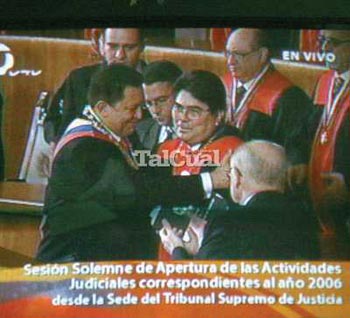
By adding twelve new chairs to the twenty-seat supreme court, and packing them with loyalists, Chávez has begun to domesticate the courts as well. He proudly presented the new jurists like a trophy at the opening of the court's 2006 session. With the president in attendance, the robed justices rose to their feet and began to sing a favored chant of their benefactor: Uh, ah, Chávez no se va" ("Uh, ah, Chávez is not leaving").
Public opinion is far more deeply divided over Chávez than is the judiciary, and protests are relatively common. In 2002, the army high command grew nervous about the president's feints toward a fully nationalized economy, and led a coup against him. The coup temporarily succeeded, and might have endured if Chávez's would-be successor, Pedro Carmona, had not immediately announced the dismissal of the National Assembly, the supreme court, and all of the country's mayors and governors. Carmona (now ignominiously known as Pedro the Brief) succeeded in spooking the public and prompting widespread protests—and the army reinstalled Chávez just two days after removing him (but not before an eager Bush White House had tacitly recognized Carmona's government).
Since 2002, Chávez has purged the military of disloyal officers and stepped up his patronage of those who remain. He has backed off his rhetoric about confiscating private property, which had alienated Venezuela's middle and upper classes. Perhaps most importantly, he has showered Venezuela's large lower class with cash.
Chávez's base resides in the ranchos, the slums that spill down the hills surrounding Caracas. Social scientists refer to the residents of these neighborhoods as the " marginales," and they exist within informal communities, often without police services, municipal buses, stores, or even running water.
While they are not politically monolithic, many marginales have an empathic connection to Chávez, whom they already consider one of their own because of his dark skin color and folksy demeanor. His references to Jesus—"If Christ were here, among us, right now, there's no doubt that Christ … would vote for the revolution"—and his political style bear a striking similarity to those of the evangelical preachers who have acquired massive followings in the slums.
The prime conduits for Chávez's support for the poor are programs that he calls misiones ," another evangelical allusion. Chávez created them on the advice of Castro, and they mimic the Cuban approach to exporting socialism to Latin America . Castro would flood countries with resources intended to quickly heal social ills and demonstrate communist know-how. So if the poor can't get health care in Venezuela, why not invite 17,000 Cuban doctors to live and practice in Caracas ranchos? Illiteracy? Chávez has sent a horde of teachers into the barrios.
All this spending has a tremendous psychological impact on the poor, who have felt neglected and cheated by generations of politicians. Chavista investments in the slums are obvious. For the first time, blighted neighborhoods have government-subsidized grocery stores, access to the Internet, and doctors tending to their children. These improvements have translated into palpable optimism. Some polls show that Venezuelans are more sanguine about their economic future than Canadians or Americans.
Whether this optimism will endure, though, is open to question. Spending has not been designed to produce sustainable results, and there is little evidence of any coherent social policy. Cuban doctors can't compensate for the country's ramshackle public hospitals. According to the government's own official data, infant mortality increased in 2003 and 2004, the last two measured years. Over the course of Chávez's presidency, the percentage of the population earning less than $2 a day has risen from 43 percent to 53 percent.
Today, Chavez's desultory government spending and overall economic approach resembles the populism of the Argentine Juan Perón far more than any authentic socialist model. It is an incoherent mess, dependent on constant infusions of oil money, and is highly unlikely to lead to sustainable development for Venezuela. It is governed primarily by an age-old autocratic goal: the maintenance of personal power.
Chávez has always appeared more interested in "liberating" Latin America 's underclass than in actually fretting over the contours of the society that follows—the legacy he craves is that of a hero, not a technocrat. That may be one reason why so much of his attention now seems focused abroad. Perhaps his neglect of the Venezuelan economy will be his undoing. Perhaps oil prices will fall by half, which might destabilize his regime. But history suggests that oil-rich autocracies can often perpetuate themselves—through showy spending, selective patronage, and control of the military—for a very long time.
The Turning of a Continent
Chávez touts the importance of what he calls "pluri-polarity." Implicit in this notion is that Venezuela will emerge as a new regional power to counter the United States—a promise that appeals to his ultra-patriotic countrymen and helps account for his domestic popularity.
There's one obvious way in which Chávez could truly stagger the United States. Venezuela is an important supplier of oil to America, providing about one-seventh of its petroleum. Chávez appreciates the power this provides him. By touting plans to build a pipeline to the Pacific and cutting deals with Chinese and Indian energy companies, he creates the impression that he might someday cut off the United States—a move that could send American oil prices soaring as the country scrambled to find new suppliers.
But while the United States relies on Venezuelan oil, Venezuela is even more dependent on the American market. More than half of Venezuela's oil exports head north toward the Gulf of Mexico—some 1.5 million barrels a day. Over the course of Chávez's presidency, Venezuela has received billions of dollars from America in oil purchases.
Ultimately, not even a lover of Quixote dares invest too much hope (or cash) in preparing for a break with the American market. Nature has tied Chávez's arms. Venezuelan crude comes from the earth in a particular viscous form that requires specialized refineries, the type that exists in Louisiana and Texas , not China or India. The country's fleet of tankers is geared toward transporting this oil to the Gulf of Mexico , and can't be reversioned for longer hauls. What's more, Venezuela doesn't just export its oil to the United States; it actually sells the stuff there in the 14,000 Citgo stations that the state oil company owns.
None of these obstacles is theoretically insurmountable, but the barriers are so high that neither Venezuela nor its Asian customers have gone much beyond daydreaming of a new relationship. Turning those daydreams into reality would require significant planning, and the United States could simply rearrange its buying patterns—oil is a fungible commodity over anything but the very short term.
But Chávez can still wound the United States by turning his region sharply against it. While Latin America doesn't have the same strategic importance as the Middle East, America depends on it for trade and for its cooperation in stamping out narco-trafficking—both of which could diminish in a political environment where Chávez holds sway. ( Venezuela has allowed members of FARC, the Colombian narco-terrorist group, to cross freely into its territory, and a senior official within the Colombian government has accused Chávez of actively supporting the group.) And at a time when U.S. international leadership appears to many to have lost its legitimacy, coalition-building—for continued trade liberalization, for punitive sanctions against rogue regimes, for military action—has become both more difficult and more important.
Oil money is of course one source of Chávez's regional influence. Last year, he signed an agreement to provide thirteen Caribbean countries cheap financing for oil imports. He recently bought up more than $1 billion in Argentinian debt, allowing Argentina to pay off what it owed to the International Monetary Fund. (Argentina will end up paying Venezuela more than twice the interest rate that it had been paying the IMF, but that seems of little importance to Argentinian President Néstor Kirchner, who said the early repayment will allow "freedom for national decisions." Kirchner recently fired his economy minister in favor of a more leftist choice. His new foreign and defense ministers favor strong ties to Chávez's government.) Chávez has also offered to buy $300 million of Ecuador's debt, and is providing aid and lending to Bolivia. His spending is not altruistic: he is self-consciously trying to assemble a bloc of nations that can be set against the United States on matters of trade and international leadership.
But his regional influence extends well beyond the reach that his oil money provides. He has tapped into a deep vein of frustration and anti-Americanism throughout his continent, and is skillfully exploiting it.
Latin America is in the middle of a leftward swing, a reaction against the economic policies of the past two decades. These early-nineties reforms, known as the Washington Consensus, aimed to counter the continent's runaway inflation and massive debts with free trade, privatization, and balanced budgets. But despite this spurt of neoliberalism, the reformers failed to deliver on their much-hyped promise of prosperity. Not only did they fail to alleviate the terminal problems of poverty and corruption; they also helped inspire the revival of a raw populism that many Latin Americanists had left for dead.
How far left will the region swing in reaction? Teodoro Petkoff, the editor of the Caracas paper Tal Cual and one of Chávez's prime adversaries, has written a book called Dos Izquierdas ("Two Lefts"). Under his taxonomy, Brazilian President Luiz Inácio "Lula" da Silva represents one of these lefts, which pays lip service to Castro but adopts a more pragmatic attitude toward economics and remains committed to liberal democracy. Like European social democracy, it ultimately seeks to humanize capitalism, not destroy it—a political program that could help Latin America correct the excesses of its neoliberal experiment without entirely undermining its core economic contributions.
Chávez, on the other hand, represents a more retrograde form of socialism. His belief in strong leaders over strong institutions, his preference for patronage over careful policy, and his mistrust of some of the basic elements of the capitalist system add up to disaster for government transparency, democracy, and development.
Which of the two lefts will eventually win out is unclear. Most residents of Latin America still believe that market capitalism is the only system that can lead to development, and Lula is more popular than Chávez overall. But there's no doubt that Chavez's approach is winning adherents. Chávez may soon have close friends running Nicaragua, Mexico , and Peru. Argentina's Kirchner seems the junior partner in his relationship with Chávez, despite his country's bigger economy and military. Chávez's protégé Evo Morales has already won the Bolivian presidency, in part by following Chávez's own model of anti-American rhetoric and populist appeals. Morales has promised to decriminalize coca production and redistribute land, and plans to rewrite Bolivia's constitution this summer. Even Alvaro Uribe, the president of Colombia and America 's staunchest ally in South America, has appeared with Chávez in front of Simón Bolívar's home and bashed American "meddling."
Chávez's performance last November at the Summit of the Americas, held in the Argentine resort of Mar del Plata, reveals why his appeals to the leaders and citizens of Latin America have been so successful. He skipped away from the awkward group photos with his fellow heads of state, and addressed a crowd of 25,000 anti-globalization activists gathered for a "counter-summit" in a soccer stadium. He wrapped his arm around Diego Maradona, one of the greatest soccer players of all time, who's probably more admired than any politician at the official proceedings. "I think we came here to bury FTAA [the Free Trade Area of the Americas]," Chávez intoned. "I brought my shovel."
He was playing a clever inside-outside game: at the same time that he huddled with leaders like Lula and Kirchner, he used the media to go over their heads and speak directly to their radical political bases. This tactic works well because most Latin American leaders still depend on support from their own radical parties. Their activist bases still genuflect toward Havana, and constantly lament that their presidents lack Chávez's gumption. "They live in fear of Chávez turning against them, because they worry that their people might not take their side," one U.S. State Department official told me. This dynamic has given Chávez the run of the Southern Hemisphere.
The United States hasn't shown much deftness in tilting this fight between the two lefts toward pragmatists like Lula. Instead of acknowledging the shortcomings of Latin America 's recent neoliberal experiment, it has insisted on pushing forward with the FTAA—an agreement that has little chance in the current political environment. Where Chávez constantly announces new plans to distribute cash around the region, the United States continues to cut back on its aid packages. And while the Bush administration isn't about to confront Chávez seriously, it often gives the impression that such a policy is in the works, allowing Chávez to bait the United States into verbal duels—battles that reinforce Chávez's mythological version of himself.
This hardly makes him the second coming of Simón Bolívar. Nonetheless, there are unavoidable similarities between the two—including some that Chávez might not care to acknowledge. Chávez claims that his favorite book is García Márquez's historical novel about Bolívar's last days, The General in His Labyrinth. If this is true, he must know that Bolívar ended his life distraught and depressed. During his final years, Bolívar devolved from radical democrat to dictator. He both praised democracy as "the most sacred source" of power and proclaimed that "necessity recognizes no laws." When Gran Colombia failed after eleven years of struggle, during which Bolívar himself came to embody many of the oppressive qualities he'd originally campaigned against, he dismissed the continent as ungovernable and descended into a bitter senescence. He died and was buried in Colombia; Venezuela , whose populace had eventually turned on him, had made him an exile in his final years. Chávez, despite his love of poetry, never seems to utter one of Bolívar's most poignant lines: "Those who serve the revolution plow the sea."
Historically, Latin American revolution has proved to be just as futile as Bolívar imagined. Because of its peculiar political temperament, the region has swung back and forth on a dialectical rope between socialism and authoritarianism, occasionally stopping, mid-swing, on governments that combine the worst attributes of both. But in recent decades, the region looked like it might finally transcend this pattern of manic change. Widespread adoption of liberal-democratic governance and an embrace of market capitalism seemed to bring relative prosperity and genuine stability within grasp.
Chávez has the potential to disrupt this progress and revive Latin America's old political habits. According to a recent poll, only about half of the region's citizens—including minorities in Bolivia, Colombia , Ecuador, Peru , and Brazil—now believe that democracy is always the best form of government. Latin America is vulnerable, and Chávez has provided a blueprint not just for harnessing anti- Americanism but for the slow consolidation of power. Along the way, he may succeed in baiting the United States into a rhetorical fight that it can't win, and impeding its international leadership. But ultimately, the United States will not be the biggest loser in the battle Chávez is waging. It will never suffer nearly as much as the people of the continent he dreams of liberating.

February 1, 2006
January 31, 2006
No idea is too discredited to revive...
For years now the government has been yabbering on about something called "endogenous development" and the whole time I've been scratching my head wondering what the hell that actually means. The Chavez propaganda efforts in this regard hardly clear things up: they're a lot clearer on what "endogenous development" is not than on what it is.
At least I took solace from one of the bullet-points: "Endogenous development is not an import-substitution model." Except, then, I read this Bloomberg piece, and realized that when they say "endogenous development is not an import-substitution model" what they really mean - and it takes superior hermeneutic skills to crack this one - is "endogenous development is an import-substitution model."
How screwed up is this idea? Let me count the ways:
Import substitution industrialization (ISI) has been thoroughly discredited as a development strategy for at least 20 years.
Venezuela's experience with ISI was worse than most. The giant ISI projects built in Guayana in the 1970s yielded consistent losses, became hotbeds of corruption, and sucked up huge amounts of money that could've been used far more productively.
Because of the Venezuelan state's deep petrodollar-filled pockets, the absence of a hard budget constraint facing state industries is especially prone to generating to massive waste - the government can always afford to keep bailing out failing state industries rather than face the political costs of letting them fail. There's no particular reason to think that the neopopulist chavistas will be less willing to keep pouring money into wasteful ISI projects than the paleopopulist adecos.
In the zero-oversight atmosphere created by Chavez's practically-embalmed Comptroller General, can anyone doubt that corruption will flourish around these projects?
The financing for these soon-to-be money pits will come out of...you guessed it, "excess foreign reserves." As I've explained elsewhere, the concept of "excess foreign reserves" is economically nonsensical. Leaving that aside for the moment, a plan to use "excess reserves" to fund projects inside Venezuela violates the agreement the government had reached with the Central Bank to only spend "excess reserves" for dollar-denominated imports, not for bolivar-denominated domestic spending. Using "excess reserves" inside the country is tantamount to printing money, so the plan is not only bad industrial policy, it's even worse monetary policy.
Our very own OW does a little bit of a back of the envelop calculation and figures out that if you're planning to spend $3.5 billion to create 5,000 jobs, that works out to a cool $700,000 per job. And that's IF they manage to hit their budget and job creation targets.
Sometimes it seems like Chavez is determined to revive ALL the discredited policies of the past, one by one, one after the other.
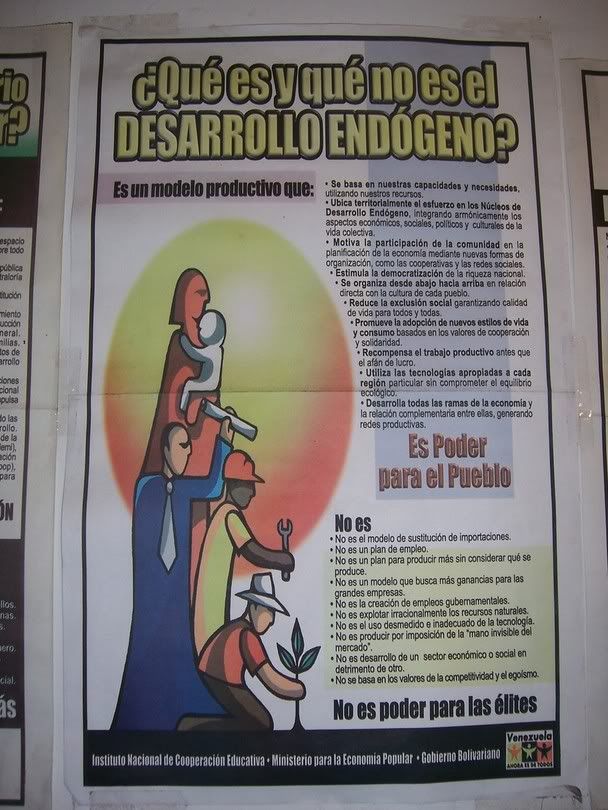
At least I took solace from one of the bullet-points: "Endogenous development is not an import-substitution model." Except, then, I read this Bloomberg piece, and realized that when they say "endogenous development is not an import-substitution model" what they really mean - and it takes superior hermeneutic skills to crack this one - is "endogenous development is an import-substitution model."
Venezuela to Spend $3.25 Bln on 11 State IndustriesGRRREAT!
Jan. 30 (Bloomberg) -- Venezuelan President Hugo Chavez plans to spend $3.25 billion to create 11 state companies that will produce goods ranging from cotton to steel, part of an effort to create jobs and reduce imports.
The businesses will include a new state steel mill, an aluminum-laminating company and ventures in cotton, iron ore, mining, cement and paper pulp, Chavez said in a three-hour televised address in Caracas. Chavez said the companies will create jobs while furthering the South American country's socialist revolution.
``Zero corruption! Zero bureaucracy,'' Chavez said of the new companies. ``They won't have air-conditioned buildings. I'd prefer they be operating out of camps in the country.''
Venezuela, the world's fifth-largest crude exporter, imports about 70 percent of the goods it consumes. Chavez pledged this month to invest oil revenue in ventures that would help develop the nation's industries.
Basic Industries and Mining Minister Victor Alvarez said the new companies will create as many as 5,000 jobs.
``Many of the products will replace imports,'' Alvarez said during remarks before Chavez spoke.
The 11 companies will be part of the country's new heavy industries holding company, Compañía Nacional de Industrias Básicas.
The money for the investments will come from a special spending fund of international reserves created by the government last year, Chavez said. The fund has about $7.9 billion in it now, and $5 billion more could be transferred to it this year, he said.
How screwed up is this idea? Let me count the ways:
Sometimes it seems like Chavez is determined to revive ALL the discredited policies of the past, one by one, one after the other.


January 30, 2006
Pieces of the Puzzle
Translated from Tamoa's piece...
Police Officers
"Still up there"
Two witnesses, a man and a woman, students at the Iupolc Police Academy, were walking towards the metro after class when they heard two police motorcycle agents on the radio saying: "the yellow SUV is still up there." That was the color of the Toyota Anderson was using.
Disip Operation
They let him through
At the start of Las Ciencias avenue in Los Chaguaramos there was a mobile Disip checkpoint on the night of the murder. One witness described how he was not allowed to use that street on the night of the murder, but Anderson's SUV, which was behind him, was let through.
Sócrates Tiniacos
The Money Trail
In the disputed official interview reports, he explained how they took the money from Danilo;s safe on the evening of his death, one hour after the explosion, when the body was still in its SUV. They took it to Coche and he got it back a few days later. He said he had been present when money changed hands. Later he denied everything and was backed by the Prosecutor General, "I haven't seen a single bill." His claims of torture have not been investigated either.
Ángel Farías
Smashed
Danilo's assistant is described in the interview reports as a witness of the money handovers of his boss with the lawyers that were allegedly paying him off. He died in a car accident on July 1st, 2005.
Julio Farías
Disappeared
Danilo's Brother in law and roommate. On the night of the bombing, he carried money, weapons and bullets taken from Danilo's safe, which he knew the combination to. Revealed in the interview reports the money's provenance and why Danilo hid it at home. Isaías Rodríguez has announced that he has "disappeared."
Elianitza Farías
The girlfriend
She had lived for nine years with Danilo Anderson in a Valle Abajo apartment. On the night of the explosion she ran off to Coche and was never heard from again. She had also testified to the Fiscalia about money inside a black suitcase that belonged to her partner.
Oliver Naveda
Assistant prosecutor
Worked with Anderson and shared his last meal on November 18th. According to the leaked interview reports he had received the Bs.10 million that Anderson promised his friends "so they would have a nice christmas. Has not been investigated.
Police Officers
"Still up there"
Two witnesses, a man and a woman, students at the Iupolc Police Academy, were walking towards the metro after class when they heard two police motorcycle agents on the radio saying: "the yellow SUV is still up there." That was the color of the Toyota Anderson was using.
Disip Operation
They let him through
At the start of Las Ciencias avenue in Los Chaguaramos there was a mobile Disip checkpoint on the night of the murder. One witness described how he was not allowed to use that street on the night of the murder, but Anderson's SUV, which was behind him, was let through.
Sócrates Tiniacos
The Money Trail
In the disputed official interview reports, he explained how they took the money from Danilo;s safe on the evening of his death, one hour after the explosion, when the body was still in its SUV. They took it to Coche and he got it back a few days later. He said he had been present when money changed hands. Later he denied everything and was backed by the Prosecutor General, "I haven't seen a single bill." His claims of torture have not been investigated either.
Ángel Farías
Smashed
Danilo's assistant is described in the interview reports as a witness of the money handovers of his boss with the lawyers that were allegedly paying him off. He died in a car accident on July 1st, 2005.
Julio Farías
Disappeared
Danilo's Brother in law and roommate. On the night of the bombing, he carried money, weapons and bullets taken from Danilo's safe, which he knew the combination to. Revealed in the interview reports the money's provenance and why Danilo hid it at home. Isaías Rodríguez has announced that he has "disappeared."
Elianitza Farías
The girlfriend
She had lived for nine years with Danilo Anderson in a Valle Abajo apartment. On the night of the explosion she ran off to Coche and was never heard from again. She had also testified to the Fiscalia about money inside a black suitcase that belonged to her partner.
Oliver Naveda
Assistant prosecutor
Worked with Anderson and shared his last meal on November 18th. According to the leaked interview reports he had received the Bs.10 million that Anderson promised his friends "so they would have a nice christmas. Has not been investigated.
Looking Beyond the Anderson Cover-Up
While much of the private media plays into Isaías Rodríguez's game plan by closely covering the smoke screen, Últimas Noticias' Tamoa Calzadilla keeps up the pressure on a question that seems almost quaint by now: who killed Danilo Anderson?
Also, note that Tamoa was later called to testify at the Prosecutor General's Office in an effort to pressure her into revealing her sources. The charge at the time was of "leaking confidential information." Only later did it morph, in the fiscalia's mysterious ways, into the story that the actas were forged.
*Full disclosure: Tamoa is a friend of mine - and for what it's worth, I think she's one of the gutsiest, fairest reporters in Caracas.
Anderson Mysterybuster II: The Questions Are Still AliveTwo excellent explanatory charts published along with this article can be seen here and here. (In Spanish, I'm afraid...)
"The CIA could want to confuse the investigation," said Prosecutor General Isaías Rodríguez in an interviewed published by Últimas Noticias on February 18th, 2005. It had been just three months since the hit that ended the life of prosecutor Danilo Anderson.
One month earlier, this newspaper had published information on an alleged extortion network that blackmailed some signators of Carmona's decree.
Rodríguez was then consulted about a complaint attributed to banker Arístides Maza and commented, "he didn't press any charges, he only expressed concern and alerted us, because people who were not prosecutors had brought him a notice similar to those brought to the Carmona signators, and he wanted us to investigate."
What did Prosecutor General Rodríguez do faced with such an accusation? "I instructed Danilo Anderson to open an investigation on those people, but unfortunately he was murdered..." Meaning that, among the many cases he was investigating, Anderson was in charge of this "irregularity."
[Note for the uniniciated: Calzadilla is pointing out that Anderson was charged with investigating his own gophers.]
The official interview reports published by Últimas Noticias around that time dealt with people close to the prosecutor: his friends, roommate, and sister. They sketched a story of alleged meetings between prosecutor Anderson and bankers, who negotiated in dollars and bolivars.
The police commission in charge of the investigation was changed three times, and the last to leave it was detective José Cuéllar, responsible for the line of inquiry at the time: "there's no terrorism, the motivation here is economic," he said off the record to one of the investigators then in charge of the case. At the time, some of them whispered "I will not talk to the press, but if I'm called to testify I am going to say that these reports are real, they are not forgeries." They are still waiting for the Prosecutor General's Office to call them to testify.
Tomorrow is the first anniversary of the publication in this newspaper of "Anderson Mysterybuster," containing the first allegations of extortion surrounding Anderson, a story that was built, precisely, around those official interview reports. 18 days later, Rodríguez commented in his interview: "it's among the best reports written on Danilo...I think it's a very beautiful, very useful report, which allows us all to draw conclusions about what happened."
On January 18th, 2006, the Prosecutor General announced that "it has been shown that the reports were forgeries" and although we cannot draw final conclusions at this point, the loose ends are not just the same as they always were, but keep growing.
Could it be due to that maxim by Edmond Locard, the great criminologist, that says "as time passes, the truth escapes"?
Also, note that Tamoa was later called to testify at the Prosecutor General's Office in an effort to pressure her into revealing her sources. The charge at the time was of "leaking confidential information." Only later did it morph, in the fiscalia's mysterious ways, into the story that the actas were forged.
*Full disclosure: Tamoa is a friend of mine - and for what it's worth, I think she's one of the gutsiest, fairest reporters in Caracas.
Uh! Ah!: The video
"We don't want government judges or opposition judges, but rather true constitutional judges."
-Omar Mora Diaz, Chief Magistrate of the Supreme Tribunal.
-Omar Mora Diaz, Chief Magistrate of the Supreme Tribunal.
January 29, 2006
Institutional Debasement in Comparative Perspective
I normally try not to write about US politics in Caracas Chronicles because that's just not what the blog is about. I'll make a bit of an exception today, to air out an old argument with OW. This is a cut-and-paste from the comments section:
Lets say Bush in the United States does something blatantly illegal - like ordering wiretaps with out a court order. Who is going to prosecute him? Not the Attorney General, he works for Bush. Not the Senate that in theory could vote articles of impeachment, that too is controlled by Bush's party. Not the Supreme Court, also controlled by Bush party.
In fact, every institution in the United States government is controlled by the Republican Party - the executive (in the US that includes all prosecutors), the Sentate, the House of Representatives, the federal courts, and on down the line.
Does this mean the United States has ceased to be a democracy? Not really. It just means that party has been winning most of the elections recently.
Same goes for Venezuela. Chavez and his supporters keep winning elections - often by large margins. So it stands to reason they'll wind up controlling pretty much the whole government. After all, God from on high doesn't appoint judges - the A.N. does. And you expect a MVR controlled A.N. to appoint ... whom?
Of course, the opposition could take over control of the government if it were to win some elections. Yet when it was presented with a golden oppertunity to do just that on December 4th it walked away. Which is of course why not too many people take their bitching seriously.
ow | Homepage | 01.28.06 - 11:28 pm | #
I think this argument silly on a number of counts. On the most basic level, using the US as a yardstick of democratic functionality is a weasly move - constitutional liberalism is badly battered in the US, something PSFs should be the first to recognize. Saying "if it happens in the US, it's ok" is a-weirdly out of step with the official chavista line and b-setting the bar way, way too low, because the US itself is badly in need of reform.
But instead of "hey, look how screwed up US democracy is, where the president can wiretap people illegally and nothing happens to him, heaven forbid such a thing should happen in other countries" we get some version of "hey, look how screwed up US democracy is...see, comparatively, Venezuelan democracy isn't so so frayed."
I think that's BS - the NSA Wiretapping scandal is an excellent reason for gringos to raise all kinds of hell about the debasement of their own republic, not AT ALL a reason to excuse the same level of debasement in other countries.
(Incidentally, the NSA Wiretapping story is just exhibit N for my pet theory that the reason Chavez and Bush hate each other so much is that they're so much alike...)
So I reject both leaders, and for the same reasons - neither of them seems to accept the basic principle that the executive branch's power should be limited by law (for Bush the pretext is "hey, there's a war going on here!" for Chavez, "hey, there's a revolution going on here!") Both have a corrosive effect on the institutional system that underpins democracy,
But even if you accept the US-as-yardstick, the argument is still silly...it fails to capture a fundamental difference, the difference between ideological affinity and grovelling sycophancy. My problem with Omar Mora Diaz is not that he's leftish ideologically, it's that he's a yes-man, an appendage of somebody else's will. This is not the case for Justice Roberts or Judge Alito, and glossing over the difference is silly. This, incidentally, is the point of highlighting the grotesque Uh-Ah chanting episode...
OW's argument also misses the basic sociological fact that formal institutional arrangements are only a small part of what gives institutions their vitality, their independence, and their capacity for autonomous action. With or without (the execrable) Alberto Gonzalez as AG, the US Justice Department has the kind of institutional robustness, functional independence, and non-partisan law enforcement ethos that allows its career prosecutors to act against the interests of the party in power, when the evidence merits it. So the House Majority leader can be forced to resign by judicial probes. The biggest fundraising lobbyist in town can be indicted. All because career lawyers at the Republican-controlled Justice Department had the autonomy and the institutional ethos they needed to really investigate, and they really investigated.
And finally, there's a key detail about the US institutional system that serves to contain impunity: multiple fora for criminal prosecution. Tom DeLay was, of course, first investigated by Texas State prosecutors, not the Feds. The existence of State Criminal jurisdiction in the US prevents the situation we have in Venezuela today, where no criminal investigation can go ahead without Isaias' signature.
To sum up - I aspire for democracy in Venezuela to work far better than it does in the US today. But even taking that as the basis of comparison, the argument is unsustainable. You can't spend half your time denouncing US-Republicans' degenerate imperialism and then turn right around and point to their corruption as evidence of democratic normality.
Quico | Homepage | 01.29.06 - 4:46 am | #
The development might be endogenous...
...but the booze is exogenous.
At this rate she'll have to change her name to Lina Güisqui...
Scotch sales in Venezuela grew 55 pct in '05
CARACAS, Venezuela (Reuters) - Venezuela's Scotch whisky market, one of the world's largest, grew by 55 percent during last year and topped the previous sales record set in 2002, a top industry official said.
Juan Valcarcel, Venezuelan brand manager for global drinks maker Diageo, told Reuters the three categories of scotch -- standard, luxury and super luxury -- showed an important expansion in a market that consumes more than 2.6 million boxes of imported and domestic whiskey per year.
"If we compare 2005 to 2004, the Scotch whisky market has grown by around 55 percent," Valcarcel said. "At the close of 2005 we were above 2002 consumption, which was a record year."
In 2002, the annual consumption of whiskey was 1.8 million boxes of scotch, but this declined as the result of a bitter two-and-a-half year political conflict over the rule of President Hugo Chavez.
According to figures from UK-based Diageo, Venezuela is currently the largest consumer of whiskey in Latin America and one of the eight largest in the world.
Valcarcel said the increase is the result of a rise in per capita whiskey consumption, an increase in duty free whiskey sales and a strong advertising campaign by distributors.
At this rate she'll have to change her name to Lina Güisqui...
January 28, 2006
Not-so-P SFs
Just to prove you don't have to bow to chavista authoritarianism to hold left-wing views, here's this fun AP story picked up by The Guardian:
Hundreds of activists are holding an alternative symposium to this week's World Social Forum, accusing the main event of straying from its freethinking leftist roots and serving as a propaganda tool for Venezuelan President Hugo Chavez.
The seven-day Alternative Social Forum shares some of the anti-globalization themes dominating the World Social Forum, an annual event timed to coincide with the market-friendly World Economic Forum in Davos, Switzerland.
But the alternative event is taking up issues that are thorny in Venezuela, like the dangers of authoritarianism under a military strongman. The theme could easily be taken as criticism of Chavez, a former paratroop commander accused by political opponents of running roughshod over democratic institutions. It is off-limits in the main forum, said Nelson Mendez, a Venezuelan engineering professor helping organize the dissident event.
The alternative activists say the ubiquitous red T-shirts of Chavez's party and the rows of promotional booths point to the government's heavy hand in the main event. That is stifling debate and undermining the forum's capacity to act as a catalyst for social change, said Luis Silva, 35, another organizer.
``The World Social Forum was born as an alternative,'' Silva said. ``But little by little it has succumbed to political parties and governments. It's acting as a stage of support for Chavez.''
At the alternative forum, activities in university classrooms include talks on Venezuela's military buildup, the role of transnational corporations in the country, and a march against coal mining in Indian regions of western Venezuela.
Participants - academics, artists and students - are mostly Venezuelans, but speakers have also come from other Latin American countries including Argentina, Brazil and Uruguay. They emphasized they are not aligned with Venezuela's opposition or any other political interest, describing themselves as freethinking leftists, communists and anarchists who feel the World Social Forum no longer represents them.
But they questioned the prevailing idea at the World Social Forum that Chavez is helping create a new economic model at the vanguard of a leftist swing in Latin America.
``The revolution doesn't exist,'' Silva said, suggesting Venezuela needs more radical economic changes. ``It's a government with a nationalist discourse.''
Uh! Ah! Barf!
"Uh! Ah! Chávez no se va!"The chant is a mainstay of pro-Chavez street demonstrations...and now, of Supreme Tribunal opening sessions as well. The moment came, ironically enough, towards the end of a 90 minute speech by Chief Magistrate Omar Mora Diaz
 that repeatedly stressed the newfound "autonomy and independence" of the Tribunal.
 The sight of the 32 magistrates, robed, on their feet, clapping and shouting chavista political slogans neatly illustrates my main problem with the Chavez regime: it has thoroughly hollowed out the institutional system set out in its own constitution. The institutions that are supposed to look over the executive branch, to keep it accountable, honest and law-abiding, are plainly, unabashedly in Chavez's pocket. Hell, they shout his slogans, robes and all, on the floor of the Supreme Tribunal!
Most of you know that, I'm sure, but here's something many of you probably don't know: in Venezuela, the Supreme Tribunal has the power to select, oversee, promote and remove all lower court judges. They do that through the Dirección Ejecutiva de la Magistratura (DEM) - a kind of judicial management agency that is in fact part of the Supreme Tribunal.
Which means that when a lower-court judge has to make a decision in Venezuela these days - perhaps, a
 politically charged decision - s/he does so with full knowledge that his/her career prospects are in the hands of...the Uh! Ah!-chanters. S/he will perhaps remember the fate of Judge Maria Mercedes Prado, fired in November 2005 for ruling against the government's wishes, then prevented from explaining her ruling to the press at the Supreme Tribunal's press room and physically chucked out of the building.
 This is how debased the court system that will hear Geovanny Vasquez de Armas' "evidence" on the Danilo Anderson case has gotten. This is why a free press is the last backstop against the worst excesses of chavista impunity. And this is why efforts to stop the press from publishing everything it finds out about the Anderson case is censorship.
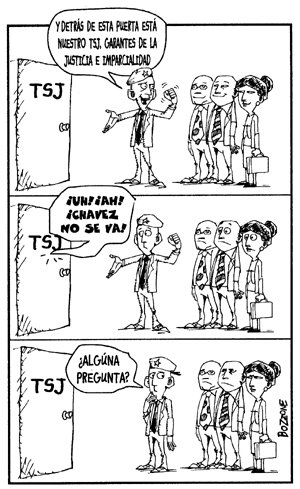
"Behind this door the Supreme Tribunal, guarantor of justice and impartiality!"
"Uh! Ah! Chávez no se va!"
"Any questions?"
Danilology Today
When the Prosecutor General's case on the Danilo Anderson murder investigation began to buckle under the strain of his main witness's credibility problems, he promised to russle up s'more witnesses to vouch for Geovanny. Yesterday, the first of these turned up.
 This man, Fernando Moreno Palmar, is the Maracucho cabbie Isaias Rodriguez said could confirm Geovanny's story. Except, talking to the press yesterday, Moreno Palmar said he had seen Geovanny a grand total of once in his life, when he drove him to an office building in Maracaibo. Moreno Palmar said he couldn't identify anyone else who had gone into the building, hadn't been inside, didn't know Geovanny, didn't know anything about any conspiracy, and pleaded with Geovanny to stop incriminating innocent people on the matter.
(Of course, the Moreno Palmar angle is just a sideshow to a sideshow to a diversion to a smoke screen. The fact that I'm even writing about him just proves that Isaias is playing sick games, and we're falling for them.)
This man, Fernando Moreno Palmar, is the Maracucho cabbie Isaias Rodriguez said could confirm Geovanny's story. Except, talking to the press yesterday, Moreno Palmar said he had seen Geovanny a grand total of once in his life, when he drove him to an office building in Maracaibo. Moreno Palmar said he couldn't identify anyone else who had gone into the building, hadn't been inside, didn't know Geovanny, didn't know anything about any conspiracy, and pleaded with Geovanny to stop incriminating innocent people on the matter.(Of course, the Moreno Palmar angle is just a sideshow to a sideshow to a diversion to a smoke screen. The fact that I'm even writing about him just proves that Isaias is playing sick games, and we're falling for them.)
January 27, 2006
Next Stop for Don Regalón?
This FT story got me thinking.
Hmmmm...lets puzzle this one through. A radical anti-American, pro-Iranian movement, in power and flat broke. If you were in their shoes, who would you turn to for quick cash?
Hey, I'm not saying it'll happen...but if it does...remember where you read it first.
A financial crisis will push the Palestinian territories into chaos in a matter of days if Israel and international donors cut financial ties with the Palestinian Authority following the surprise election win by Hamas, James Wolfensohn, the international community's special envoy to the region, warned on Friday.
"The crunch time is next week," said Mr Wolfensohn, the former head of the World Bank. "The Palestinians are basically bankrupt." He said there was no money to pay salaries of Palestinian security forces or civil servants. "If you do not have the money to pay 135,000 Palestinians you are going to have chaos."
Hmmmm...lets puzzle this one through. A radical anti-American, pro-Iranian movement, in power and flat broke. If you were in their shoes, who would you turn to for quick cash?
Hey, I'm not saying it'll happen...but if it does...remember where you read it first.
Isaias's Sick Games and How We're Falling for It
Danilology is quickly becoming the pastime of choice for Venezuelan media junkies. And it's not hard to see why: the Danilo Anderson murder investigation has gotten weirder than a David Lynch movie - just one layer of absurdity on top of another, a virtual lasagna of unsolved riddles.
Danilogate really does have it all: coup-plotting bankers, racketeering prosecutors, good cops, crooked cops, plastic explosives, police bomb experts, gangs of midgets, purged police files, stacks of hundred-dollar bills, jet-skis, disappearing porn videos, congressional funerals, ordenes del libertador, police abductions, raided jewish schools, helicoide torture, murdered suspects, rigged trials, busloads of suspects, pseudo-paramilitary unpsychiatrists, jungle conspiracies, murder-plotting cardinals, CIA-stunt dubles, fugitive journalists, media gag orders, RSF condemnations and now, now the cherry-on-top: a Fiscalia-sanctioned interview of Geovanny Vasquez de Armas on Colombian TV.
Zowee! It's enough to make your head spin...
Which, I think, is just the problem: our heads are spinning...and that's just the way Isaias likes it. As attention has focused more and more on the shooting-fish-in-a-barrelish sport of punching holes in Isaias' colander of a case, attention has shifted away from what should be the crux of the matter: what actually happened on that evening in November, 2004, who was really behind it, and why.
Seen as an attempt to fool public opinion, Isaias' conspiracy-theory (literally, that's what it is) has failed badly. Seen as a smoke screen to obscure the real story, it's working beautifully.
Think about his decision to allow RCN to interview Vasquez de Armas. At first sight, it makes little sense. On last night's broadcast, Vasquez de Armas merely confirmed the most incriminating stuff the oppo media has been writing about him: he really does have a long history of identity fraud, has lied about his profession, really he just might be the least reliable witness in history.
In a way, allowing foreign reporters to cover a story you've just gagged in Venezuela is a kind of dare: "dare ya to cover the RCN interview," Isaias seems to be saying. And, indeed, most oppo outlets have olympically ignored the judicial gag order and run with the story...what will the consequences be? Maybe Isaias is trying to goad the oppo media into breaking the gag order so he can come down on them like a ton of bricks...but he does that at the cost of further weakening the star-witness's badly battered credibility. So...is Isaias stupid?
Not at all, because this last round of Geovanny Madness keeps the spotlight firmly on Isaias' nutty CIA-in-the-jungle conspiracy theory, and safely away from what actually happened to Danilo.
So lets just consider some of the questions that are not being asked as public opinion swarms on Vasquez de Armas:
These are the questions the press should be focused on. The government has ignored most of them, given very lousy answers for the others. But the media has stopped asking these questions. Instead, they're transfixed with the idiot story about the non-German speaking unpsychiatrist's CIA rumble in the jungle. Sadly, the torrent of bullshit coming out of the fiscalia is working. Nobody talks about this stuff anymore.
Danilogate really does have it all: coup-plotting bankers, racketeering prosecutors, good cops, crooked cops, plastic explosives, police bomb experts, gangs of midgets, purged police files, stacks of hundred-dollar bills, jet-skis, disappearing porn videos, congressional funerals, ordenes del libertador, police abductions, raided jewish schools, helicoide torture, murdered suspects, rigged trials, busloads of suspects, pseudo-paramilitary unpsychiatrists, jungle conspiracies, murder-plotting cardinals, CIA-stunt dubles, fugitive journalists, media gag orders, RSF condemnations and now, now the cherry-on-top: a Fiscalia-sanctioned interview of Geovanny Vasquez de Armas on Colombian TV.
Zowee! It's enough to make your head spin...
Which, I think, is just the problem: our heads are spinning...and that's just the way Isaias likes it. As attention has focused more and more on the shooting-fish-in-a-barrelish sport of punching holes in Isaias' colander of a case, attention has shifted away from what should be the crux of the matter: what actually happened on that evening in November, 2004, who was really behind it, and why.
Seen as an attempt to fool public opinion, Isaias' conspiracy-theory (literally, that's what it is) has failed badly. Seen as a smoke screen to obscure the real story, it's working beautifully.
Think about his decision to allow RCN to interview Vasquez de Armas. At first sight, it makes little sense. On last night's broadcast, Vasquez de Armas merely confirmed the most incriminating stuff the oppo media has been writing about him: he really does have a long history of identity fraud, has lied about his profession, really he just might be the least reliable witness in history.
In a way, allowing foreign reporters to cover a story you've just gagged in Venezuela is a kind of dare: "dare ya to cover the RCN interview," Isaias seems to be saying. And, indeed, most oppo outlets have olympically ignored the judicial gag order and run with the story...what will the consequences be? Maybe Isaias is trying to goad the oppo media into breaking the gag order so he can come down on them like a ton of bricks...but he does that at the cost of further weakening the star-witness's badly battered credibility. So...is Isaias stupid?
Not at all, because this last round of Geovanny Madness keeps the spotlight firmly on Isaias' nutty CIA-in-the-jungle conspiracy theory, and safely away from what actually happened to Danilo.
So lets just consider some of the questions that are not being asked as public opinion swarms on Vasquez de Armas:
Why did multiple witnesses report seeing a DISIP team just meters from the explosion just minutes before it happened? Who were they? What were they doing there? On whose orders? Why was Detective José Cuellar replaced as head of the investigation? Why did so much of the evidence he collected, which leaked to the press, later disappear from the record? Why is the investigation still being led by Prosecutors Gilberto Landaeta and Yoraco Bauza, both of whom are publicly implicated in Anderson's extortion racket? Where did the money Anderson kept at home and in his farm in Sabana de Uriche end up? What else did DISIP find in those locations? Was there really a sex video in Danilo's safe? If so, who was in it, doing what, and where did the video end up? How did Juan Carlos Sanchez die, where, and why? Why were the Guevara brothers' claims that they were tortured never investigated? How could the Guevara brothers be convicted in the absence of any physical evidence linking them to the crime, on the basis of a single anonymous tip-off? Who's behind the cover-up? What exactly is being covered up? Why is Isaias willing to go to such extreme lengths to keep the case murky? And, the big one, who killed Danilo Anderson, and why?
These are the questions the press should be focused on. The government has ignored most of them, given very lousy answers for the others. But the media has stopped asking these questions. Instead, they're transfixed with the idiot story about the non-German speaking unpsychiatrist's CIA rumble in the jungle. Sadly, the torrent of bullshit coming out of the fiscalia is working. Nobody talks about this stuff anymore.
January 26, 2006
Upside-down News Day
Folks, it's Bizarro Day in Venezuela:
 "A high percentage of Venezuelans express discontent with the national government, with regional and local officials. By the same token, there is discontent among MVR [Chavez's party] militants with their national, state, municipal and parrochial leaders."
Says who?
Says Willian Lara, speaking for the MVR's National Committee for Political and Electoral Organization.

 The Supreme Tribunal must block the gag-order on information about Geovanny Vasquez de Armas.
Says who?
Says the National Resistance Committee, Oscar Perez and Antonio Ledezma's Article 350-invoking outfit, which has just petitioned for an injunction to that effect.
 Venezuela is producing 2.6 million barrels of oil per day, not the 3.3 million b/d the government claims.
Says who?
Says OPEC.
 It makes no sense for the Prosecutor General to seek a court order against divulging Anderson case files if he's going to keep talking about the case himself.
Says who?
Says MariPili Hernandez, member of MVR's national leadership and vice-minister of foreign affairs.
 "A high percentage of Venezuelans express discontent with the national government, with regional and local officials. By the same token, there is discontent among MVR [Chavez's party] militants with their national, state, municipal and parrochial leaders."
 Says who?
Says Willian Lara, speaking for the MVR's National Committee for Political and Electoral Organization.
Of course, his line is that while Venezuelans are unhappy with everything about Chavez, they're happy with Chavez himself.
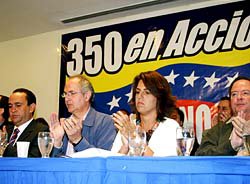 The Supreme Tribunal must block the gag-order on information about Geovanny Vasquez de Armas.
 Says who?
Says the National Resistance Committee, Oscar Perez and Antonio Ledezma's Article 350-invoking outfit, which has just petitioned for an injunction to that effect.
Erm...isn't it a bit fresh to be asking for injunctions from a regime you claim to be resisting? I'd love to hear their oral arguments: "Gentlemen of this illegitimate court we refuse to recognize, we're here today to ask you to..."
Venezuela is producing 2.6 million barrels of oil per day, not the 3.3 million b/d the government claims. Says who?
Says OPEC.
I guess they've joined the CIA-sponsored anti-Chavez disinformation campaign. Et tu, OPEC?
 It makes no sense for the Prosecutor General to seek a court order against divulging Anderson case files if he's going to keep talking about the case himself.
 Says who?
Says MariPili Hernandez, member of MVR's national leadership and vice-minister of foreign affairs.
MariPili is soon to join the ranks of the ideologically suspect if she keeps up this sort of thing. Though, of course, she defends the gag order.
The Big Hegemon that Couldn't
The whole idea that the US is planning to invade Venezuela is so asenine, so aggressively divorced from reality, it hardly seems worth the effort to rebut it. Fact is, though, that this old Fidelista standby has become a cornerstone of chavista propaganda, and I suppose it's not impossible some people stumbling on this blog might buy it.
Probably what irks me the most about it, though, is the way Chavez exploits the ignorance of his supporters to hype up the "threat" of a gringo attack. Anyone with the least sense of the US's strategic stance knows it's hogwash - pretending otherwise can only be seen as rank manipulation.
How far-fetched is the gringo-attack hypothesis? Lets see. It's not just that Venezuela ranks far down on the list of strategic threats facing the US - queuing up a looooong way behind North Korea, Iran, Al Qaeda, Syria, threats that really do keep US strategic planners up at night - it's that the US hardly has the military capability to sustain its current foreign entanglements, much less launch new ones, much, much, much less launch new ones against a third tier nuisance-state. And that's not just me saying it:
Probably what irks me the most about it, though, is the way Chavez exploits the ignorance of his supporters to hype up the "threat" of a gringo attack. Anyone with the least sense of the US's strategic stance knows it's hogwash - pretending otherwise can only be seen as rank manipulation.
How far-fetched is the gringo-attack hypothesis? Lets see. It's not just that Venezuela ranks far down on the list of strategic threats facing the US - queuing up a looooong way behind North Korea, Iran, Al Qaeda, Syria, threats that really do keep US strategic planners up at night - it's that the US hardly has the military capability to sustain its current foreign entanglements, much less launch new ones, much, much, much less launch new ones against a third tier nuisance-state. And that's not just me saying it:
A report commissioned by Democratic members of Congress listed former Defence Secretary William Perry and former Secretary of State Madeleine Albright among its authors, predicted problems recruiting new troops and retaining current ones in the face of repeated overseas tours and shortfalls in vital equipment.
It accused the Bush administration of having failed adequately to assess the size of force and equipment needed in post-invasion Iraq, creating "a real risk of 'breaking the force'."
The report also warned that the lack of a credible strategic reserve "increases the risk that potential adversaries will be tempted to challenge the United States".
A second study, conducted for the Pentagon by military expert Andrew Krepinevich, suggested that the military at its current rate of deployment might not be able to outlast the insurgency in Iraq.
He cited the problems experienced by the army in meeting its recruitment targets last year.
The BBC's Adam Brookes in Washington says the reports echo the view held by some in Congress and even by some within the armed forces.
They fear that if the Iraq commitment lasts a great deal longer, or if the US is drawn into new conflict, the US armed forces could find it difficult to meet their commitments.
January 24, 2006
Somebody is paying attention...

RSF has just released a statement denouncing state censorship of materials relating to the Anderson case. An English version is now available:
Reporters Without Borders today condemned a court order issued yesterday banning Venezuelan news media from revealing any details of the judicial investigation into the November 2004 murder of judge Danilo Anderson or mentioning a key witness in the case.
The organisation also condemned the fact that 10 news media are to be investigated under the Law of Judicial Authority and the November 2004 Law of Social Responsibility in Radio and Television for possible “obstruction of justice” in their reporting on the case until now. The offence is punishable by a prison sentence of six months to two years in prison.
“The Danilo Anderson case is fraught with political and media repercussions as two opposition journalists are accused of being among the instigators of the judge’s murder and certain independent news media have questioned the credibility of Giovanny Vásquez, the prosecution witness against these two journalists,” Reporters Without Borders said.
“We fear this ‘obstruction of justice’ procedure is a judicial device for the government to yet again settle some scores with the privately-owned media and at the same time subject them to state censorship,” the press freedom organisation added.
TalCual doesn't mince its words:

Twentyfirst Century Censorship
Axis of Evo
From the FT's story on Evo's first full day as president:

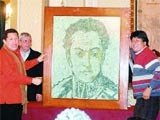
At the end of the ceremony, the Bolivian president proudly presented his guest [Chavez] with a large portrait of Simon Bolívar, the 19th-century liberator of South America, made entirely of coca leaves.
Censor without a cause...
Well, our valiant Prosecutor General, Isaias Rodriguez got what he wanted: a Caracas judge has issued a gag order banning publication of any information about Geovanny Vasquez de Armas, his key witness in the escalatingly weird saga that is the Danilo Anderson murder investigation.
The rationale given was - no se la pierdan - the need to protect his "dignity, honor, reputation, good name and decorum."

While this prior restraint order is despicable for what it says about chavismo's rising "comfort level" with censorship, fact is this particular horse bolted long before the stable door was shut. We already know about Vasquez de Armas' multiple convictions for identity fraud, we already know he isn't a psychiatrist, didn't go to Johns Hopkins medical school, isn't an FBI-accredited forensic expert, wasn't a colombian paramilitary, doesn't speak German and could not have been in Panama in September, 2003 because his ass was in jail.
The only thing we don't know is why Isaias insists on hanging his case on a guy who lies for a living.
The rationale given was - no se la pierdan - the need to protect his "dignity, honor, reputation, good name and decorum."
While this prior restraint order is despicable for what it says about chavismo's rising "comfort level" with censorship, fact is this particular horse bolted long before the stable door was shut. We already know about Vasquez de Armas' multiple convictions for identity fraud, we already know he isn't a psychiatrist, didn't go to Johns Hopkins medical school, isn't an FBI-accredited forensic expert, wasn't a colombian paramilitary, doesn't speak German and could not have been in Panama in September, 2003 because his ass was in jail.
The only thing we don't know is why Isaias insists on hanging his case on a guy who lies for a living.
Noted without comment...
Iran's Ambassador to Cuba Ahmad Edrisian conferred on Monday with Venezuelan Foreign Minister Ali Rodriguez, who is currently visiting Havana, on the expansion of trilateral cooperation among Iran, Cuba and Venezuela.
The Venezuelan foreign minister described current relations between Iran and Venezuela as 'excellent'.
Joint economic cooperation, such as manufacturing of tractors, and construction of cement factory, indicates the depth of such friendly ties, he said.
Welcoming trilateral cooperation among Iran, Venezuela and Cuba, he called for implementation of agreements signed earlier by the three countries.
Supporting Iran's peaceful nuclear activities, Rodriguez said, "Countries which are capable of destroying life many times over are determined to hinder the development of developing countries."
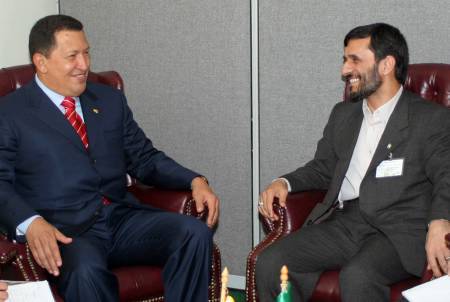
January 23, 2006
"I thought this revolution was supposed to be pretty"
Participants in the World Social Forum in Caracas are already getting a taste of life in Chavez's Venezuela. Soraya Aggege, the correspondent from Brazil's O Globo gets the ball rolling (with my notes to our PSF brethren tacked on after each bit.)
Perhaps paying in anti-imperialist Cuban pesos will get you into town quicker.
You're lucky you don't have to wait two hours to get on a jeep that will bring you down from your cerro to your work, like many poor caraqueños do.
The safety of your wallets has also not been confirmed.
Your metro ticket is brought to you by the Venezuelan taxpayer, the Venezuelan oil company PDVSA, Big-Oil producers that serve as the government's tax base, and SUV-driving Americans who buy gas at Citgo.
If you get lost, just head to Sambil Shopping Mall where there is air conditioning and stores will gladly accept your first-world credit cards.
The official rate is not worth it, it's just a subsidy so that rich Venezuelans can fly overseas more cheaply. Change at the black-market rate and you'll get more bang for your buck. Just ask any chavista operative, they'll be glad to help...
While I genuinely hope you enjoy Venezuelan hospitality, my hope is that you realize that all these "glitches" are not just temporary. They represent a reality, a style of governance-by-chaos , corruption and restriction of civil liberties that extends to all walks of public life. It's an important reason why many of us oppose Chávez. Think about that while the government is busy mischaracterizing the opposition.
WSF participants take up to four hours going from the airport to the city on a hundred-year-old two-lane road. Taxis charge between US$100 and US$130, although WSF buses charge US$50 but there is a long wait to get on them.
Perhaps paying in anti-imperialist Cuban pesos will get you into town quicker.
Participants complain about having to brave long distances to get to the different WSF venues. The city is hot and dry.
You're lucky you don't have to wait two hours to get on a jeep that will bring you down from your cerro to your work, like many poor caraqueños do.
Although a concert has been announced featuring such anti-imperialist artists as Silvio Rodríguez, Joan Baez and Daniel Viglietti, their presence has not yet been confirmed.
The safety of your wallets has also not been confirmed.
Event venues are scattered across the city. Although transportation has been promised, these are still vague, and only include free Metro passes for participants.
Your metro ticket is brought to you by the Venezuelan taxpayer, the Venezuelan oil company PDVSA, Big-Oil producers that serve as the government's tax base, and SUV-driving Americans who buy gas at Citgo.
It's been difficult to withdraw credentials and WSF support material. The final program had not been published as of last Friday. Participants report confusion about the events and venues.
If you get lost, just head to Sambil Shopping Mall where there is air conditioning and stores will gladly accept your first-world credit cards.
Participants have been warned about the exchange problems in the country. The have been told that they can change dollars to bolívars at the official rate, but that they will not be able to change back into dollars at the end of their trip. Most expect long lines at exchange houses since they will have to change money in small amounts.
The official rate is not worth it, it's just a subsidy so that rich Venezuelans can fly overseas more cheaply. Change at the black-market rate and you'll get more bang for your buck. Just ask any chavista operative, they'll be glad to help...
While I genuinely hope you enjoy Venezuelan hospitality, my hope is that you realize that all these "glitches" are not just temporary. They represent a reality, a style of governance-by-chaos , corruption and restriction of civil liberties that extends to all walks of public life. It's an important reason why many of us oppose Chávez. Think about that while the government is busy mischaracterizing the opposition.
January 21, 2006
Out and Out Censorship
Regular readers know I've long resisted calling Chavez's government a dictatorship, and have criticized those who do. For all of the government's evident, growing authoritarianism, three basic elements of a dictatorship seemed to be missing:
Censorship
Systematic (rather than selective) repression of dissidents
Systematic (rather than selective) repression of opposition organizations
Well, you can strike the first one off that list, now that Prosecutor General Isaias Rodriguez has asked the National Telecommunications Council (Conatel) to investigate six TV stations and four newspapers for publishing leaks relating to the Danilo Anderson murder investigation and, much worse, instructed five of his own prosecutors to investigate those news organizations for "obstruction of justice." (In my book, what they're guilty of is more like "obstruction of obstruction of justice"!)

How alarming are these developments? Very. Very, very. Note:
Once again Isaias investigates the leakers, not the leak. On the substance of the latest revelation - documentary evidence that his key witness was in jail in Colombia at the time he claimed to be hatching the Anderson conspiracy in Panama - not a word.
Three of the five prosecutors Isaias has asked to launch this farcical "obstruction of justice" investigation (Yoraco Bauza, Gilberto Landaeta, and Turcy Simancas) are publicly implicated for taking part in Anderson's extortion racket. The same three, lest we forget, who are still heading the Anderson murder investigation.
Conatel - a TELECOMMUNICATIONS regulatory agency - is being asked to investigate four NEWSPAPERS. But newspapers are not telecoms!! They do not use the public airwaves: by definition they are outside Conatel's realm of competence.
The Prosecutor General is seeking an injunction to prevent publication of future leaks of trial materials as well as "any information concerning statements, the identity, or any other information about witness Geovanny Vasquez de Armas." The wording really couldn't be any broader. Isaias is seeking a sweeping prior restraint order - a court action to ban publication of embarrassing information before the fact.
There are no two ways about it, this is the first clear cut instance of out-and-out, no-more-mister-nice-guy censorship in the Chavez era. We're no longer talking about intimidation, harrassment, measures to encourage self-censorship...none of that. These guys are seeking a sweeping prior restraint order. By any definition, that's censorship, pure and simple.
We've seen this coming for a long time. Now it's here...
Well, you can strike the first one off that list, now that Prosecutor General Isaias Rodriguez has asked the National Telecommunications Council (Conatel) to investigate six TV stations and four newspapers for publishing leaks relating to the Danilo Anderson murder investigation and, much worse, instructed five of his own prosecutors to investigate those news organizations for "obstruction of justice." (In my book, what they're guilty of is more like "obstruction of obstruction of justice"!)
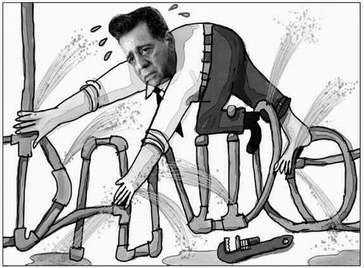
How alarming are these developments? Very. Very, very. Note:


There are no two ways about it, this is the first clear cut instance of out-and-out, no-more-mister-nice-guy censorship in the Chavez era. We're no longer talking about intimidation, harrassment, measures to encourage self-censorship...none of that. These guys are seeking a sweeping prior restraint order. By any definition, that's censorship, pure and simple.
We've seen this coming for a long time. Now it's here...
January 20, 2006
Fun Proposals for the Coat of Arms...
Leave it to Venezuelans to crack jokes about anything...

"Gentlemen of the Assembly: how about this proposal?"

by some guy in Noticiero Digital

"Gentlemen of the Assembly: how about this proposal?"

by some guy in Noticiero Digital
The Antidote to Decency
Talking to Europeans about Venezuela, I find that one of the hardest things to communicate is chavismo's utter lack of common decency. Sure, if you follow the papers every day, it's easy to grasp. But for people coming at it from the outside - say, the idealistic young things heading to the World Social Forum in Caracas - Chavez's passionate, redemptive discourse seems so straightforwardly decent it's hard for them to quite grasp the ethical black hole at the heart of the regime. People, in my experience, actively resist believing it.
Nowhere is the government's ethical turpitude clearer than in the Fiscalía, Chávez's putrid play thing of a public prosecutions service. Run by Former Vice-president Isaias Rodriguez, one of Chavez's most slavishly accomodating yes-men, the Prosecutor General's Office has systematically plumbed the depths of political dirty tricksterism. Serving as both an implicit guarantee of immunity for loyal chavista criminals (who have to get caught on videotape killing people before they face any risk of prosecution) and as a cudgel to intimidate dissidents, Isaias' fiscalía is the biggest culprit in the ongoing collapse of the rule of law in Venezuela today.
And nowhere has the extent of Isaias' sheer mendacity been clearer than in the increasingly bizarre Danilo Anderson murder investigation saga - which over the last three months has become a kind of distillate of chavista dishonesty. Yesterday, we learned that Isaias's "star witness" in his effort to incriminate key opposition figures - a guy we already knew was a compulsive liar with a string of convictions for identity fraud on his record - was actually serving jail time in Colombia at the time he claimed to have been in Panama plotting to kill Anderson.
Undoubtedly, Isaias will tell us that the jailed Vasquez de Armas was only the real Vasquez de Armas's CIA-planted stunt double. (Or maybe Vasquez de Armas' claim to have witnessed such a meeting was part of the 15% of his testimony even Isaias admits is false.)
This latest revelation - which effectively demolishes what was left of Vasquez's credibility together with Isaias' entire case - was backed up with documentary evidence in a Globovision report last night. Is it any coincidence that just days ago, Isaias was threatening a wide-ranging investigation into any news reports casting doubt on his version of the Anderson case?
Folks, the Anderson investigation is like a bucket of shit: you can dig down through it as much as you want, but all you find is still more shit...
Nowhere is the government's ethical turpitude clearer than in the Fiscalía, Chávez's putrid play thing of a public prosecutions service. Run by Former Vice-president Isaias Rodriguez, one of Chavez's most slavishly accomodating yes-men, the Prosecutor General's Office has
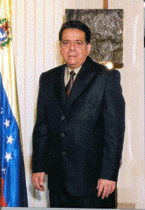 systematically plumbed the depths of political dirty tricksterism. Serving as both an implicit guarantee of immunity for loyal chavista criminals (who have to get caught on videotape killing people before they face any risk of prosecution) and as a cudgel to intimidate dissidents, Isaias' fiscalía is the biggest culprit in the ongoing collapse of the rule of law in Venezuela today.
And nowhere has the extent of Isaias' sheer mendacity been clearer than in the increasingly bizarre Danilo Anderson murder investigation saga - which over the last three months has become a kind of distillate of chavista dishonesty. Yesterday, we learned that Isaias's "star witness" in his effort to incriminate key opposition figures - a guy we already knew was a compulsive liar with a string of convictions for identity fraud on his record - was actually serving jail time in Colombia at the time he claimed to have been in Panama plotting to kill Anderson.
Undoubtedly, Isaias will tell us that the jailed Vasquez de Armas was only the real Vasquez de Armas's CIA-planted stunt double. (Or maybe Vasquez de Armas' claim to have witnessed such a meeting was part of the 15% of his testimony even Isaias admits is false.)
This latest revelation - which effectively demolishes what was left of Vasquez's credibility together with Isaias' entire case - was backed up with documentary evidence in
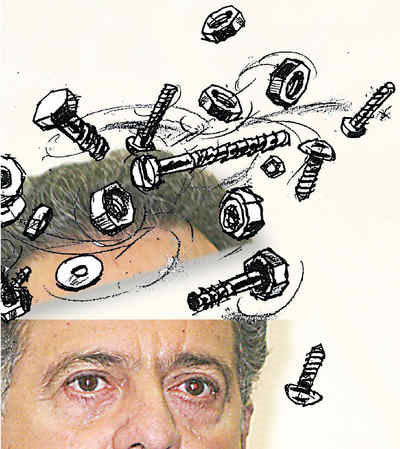 a Globovision report last night. Is it any coincidence that just days ago, Isaias was threatening a wide-ranging investigation into any news reports casting doubt on his version of the Anderson case?
 Folks, the Anderson investigation is like a bucket of shit: you can dig down through it as much as you want, but all you find is still more shit...
January 19, 2006
Utterly Spineless, Fantastically Debased, Prostrated, Grovelling, Bootlicking Sycophancy Chronicles
Yes, I know that by even touching on this subject I'm only taking the bait, playing into a crass ploy to distract attention from much more important issues, etc. etc. etc. I know that, really. But this whole absurdist little play over Venezuela's coat-of-arms is really a provocation too far.
 Just to recap: some weeks ago, Chavez mentioned in passing that his youngest daughter, the adorable 9-year old Rosinés, had asked him why the horse on Venezuela's official coat-of-arms is shown headed to the right with its head turned backwards, and suggested it would be better for it to be pictured galloping to the left. Kids can be so cute! As for dad mentioning it to a national audience, well, we've gotten used to these kinds of folkloric digressions in Chavez's speeches. They're usually mostly harmless, and by now we just tune them out.
The little annecdote was silly enough for satirist Laureano Marquez to write a funny column about it in Tal Cual, gently noting the way it seems only Chavez's kid is allowed to criticize him. The first sign that the story wouldn't just go away came a few weeks later, when the National Council for the Protection of Children and Adolescents opened an investigation against Tal Cual for running Laureano's piece, rapping the paper for dragging a kid into the political arena. It seemed like a fairly sycophantic over-reaction, but to a certain extent, you could see their point.
But Tuesday this idiotic little saga took a totally bizarre turn when the all-chavista National Assembly met for the first time and, in its first decision, actually voted to adopt Rosinés's suggestion, officially changing the coat of arms to conform to her cute little idea. I know, it seems made up, but they really did it!
There's soooooo much that's soooooooo fundamentally fucked up about this whole thing it's hard to know where to start. The episode speaks volumes about the debasement of Venezuela's institutions in the Chavez era, about the increasingly unrestrained cult-of-personality around the guy, and just - God, how to even express it - just the wholesale surrender of common sense in the Chavez movement, the fantastical extent of his followers' determinition to debase themselves to prove their allegiance.
A few things to note:
Apparently even mentioning Rosinés gently in an oppo newspaper is not ok, but having this 9 year old kid dictate policy is peachy.
It's now clear that the all-chavista National Assembly is determined to turn this legislative session into a kind of brown-nosing olympics, a contest between deputies trying to outdo each other in showing just how far they're willing to push the envelope to prove their unswerving adherence to anything Chavez - or, hell, even his kids - say.
The National Symbols - the emblems of National Unity - are again used to divide Venezuelans, to rub dissenters' noses in it, to flout the utter absence of restraints on presidential whims
I just don't understand how episodes like this one can fail to set off alarm bells for first-world lefties, at least those endowed with a modicum of common sense. Granted, we've seen a lot of barely believable lows over the last seven years, but the day the president's 9 year old started making national policy...man, this has to be one of the lowest...
 Just to recap: some weeks ago, Chavez mentioned in passing that his youngest daughter, the adorable 9-year old Rosinés, had asked him why the horse on Venezuela's official coat-of-arms is shown headed to the right with its head turned backwards, and suggested it would be better for it to be pictured galloping to the left. Kids can be so cute! As for dad mentioning it to a national audience, well, we've gotten used to these kinds of folkloric digressions in Chavez's speeches. They're usually mostly harmless, and by now we just tune them out.
The little annecdote was silly enough for satirist Laureano Marquez to write a funny column about it in Tal Cual, gently noting the way it seems only Chavez's kid is allowed to criticize him. The first sign that the story wouldn't just go away came a few weeks later, when the National Council for the Protection of Children and Adolescents opened an investigation against Tal Cual for running Laureano's piece, rapping the paper for dragging a kid into the political arena. It seemed like a fairly sycophantic over-reaction, but to a certain extent, you could see their point.
But Tuesday this idiotic little saga took a totally bizarre turn when the all-chavista National Assembly met for the first time and, in its first decision, actually voted to adopt Rosinés's suggestion, officially changing the coat of arms to conform to her cute little idea. I know, it seems made up, but they really did it!
There's soooooo much that's soooooooo fundamentally fucked up about this whole thing it's hard to know where to start. The episode speaks volumes about the debasement of Venezuela's institutions in the Chavez era, about the increasingly unrestrained cult-of-personality around the guy, and just - God, how to even express it - just the wholesale surrender of common sense in the Chavez movement, the fantastical extent of his followers' determinition to debase themselves to prove their allegiance.
A few things to note:
I just don't understand how episodes like this one can fail to set off alarm bells for first-world lefties, at least those endowed with a modicum of common sense. Granted, we've seen a lot of barely believable lows over the last seven years, but the day the president's 9 year old started making national policy...man, this has to be one of the lowest...
Subscribe to:
Posts (Atom)